Why in News?
The Employees’ Provident Fund Organisation (EPFO) has rolled out a revamped member portal under the Centralised IT Enabled Services (CITES 2.01) project, completing the migration of its member records — previously spread across 120-plus regional office databases — into a single centralised national database. The project builds on EPFO’s earlier centralisation work documented in its official CITES 2.01 project brief. The Ministry of Labour and Employment announced the rollout on July 8, 2026.
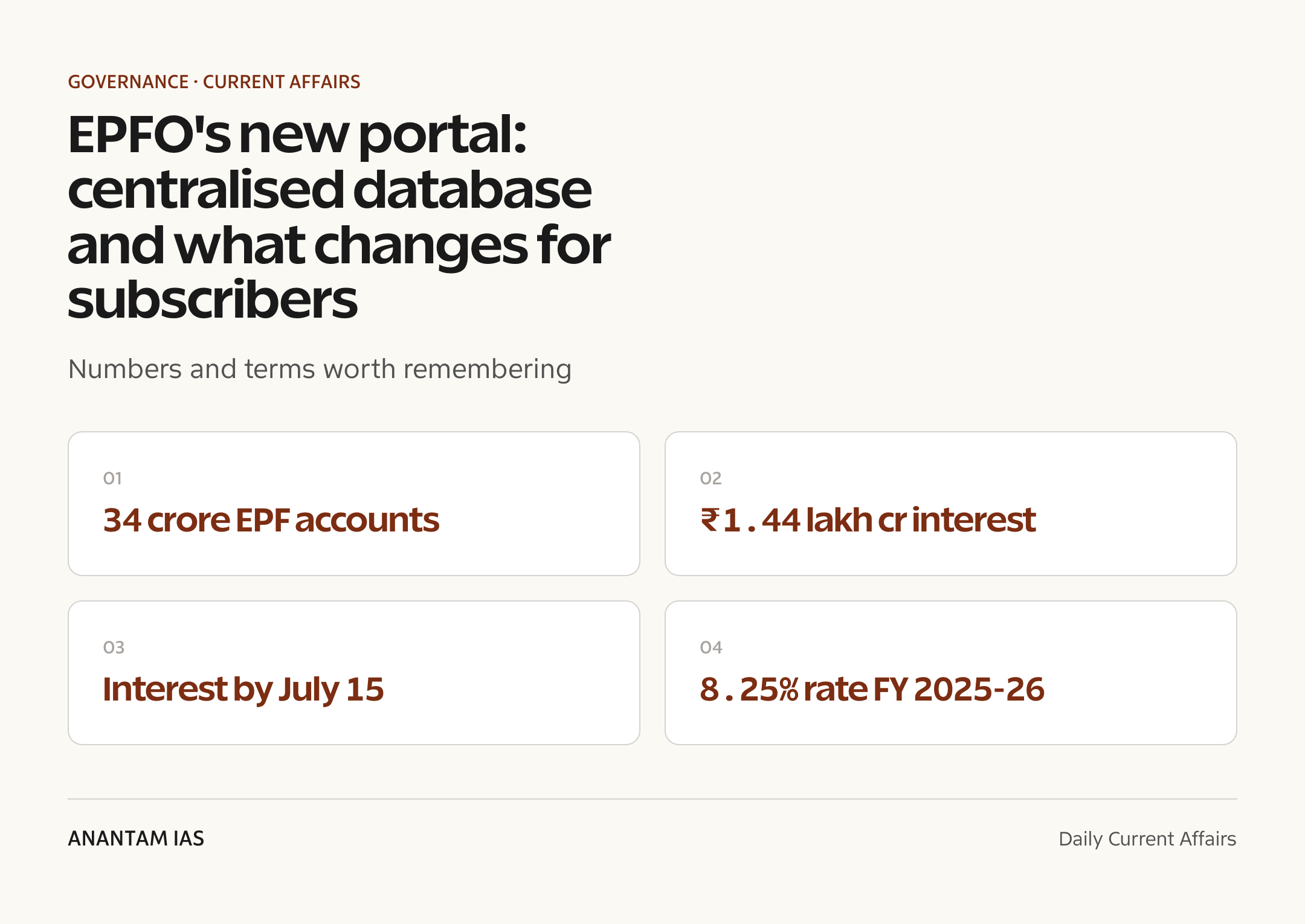
Labour and Employment Minister Mansukh Mandaviya said the annual interest of ₹1.44 lakh crore for FY 2025-26 would be processed on the new portal for about 34 crore EPF accounts. The July 8 announcement targeted July 15, while an EPFO order the next day said computer processing was complete for nearly 34 crore accounts and had moved to field-office verification; the official EPFO portal is the right place to check subsequent notices. Members can also see the amount they are eligible to withdraw under each claim category.
- Full database migration complete: every member record has moved from regional-office silos to one centralised database under CITES 2.01.
- Any-office servicing: a member’s service request can now be processed from any authorised EPFO office in the country, not just the office where PF deductions happened.
- ₹1.44 lakh crore interest for FY 2025-26 (at 8.25%) was processed for about 34 crore accounts; July 15 was the announced target and field-office verification remained part of the workflow.
- Interest till payment date: on final PF settlements, interest is now calculated up to the date of payment authorisation, not just up to the last day of the previous month.
- Auto-settlement of fully KYC-linked, validated advance claims up to ₹5 lakh; automated pre-validation flags deficiencies by SMS and on the portal before processing.
- EPFO has nearly 8 crore contributing members, making this one of the largest social-security database consolidations anywhere.
The development matters in the context of:
- The reform sits at the junction of social security and digital governance — a statutory retirement fund adopting the digital-public-infrastructure playbook of single databases, auto-processing and portability.
- High claim rejection rates have been a persistent grievance against EPFO; visible withdrawal-eligible balances and online query resolution directly target that failure point.
- For India’s migrant formal workforce, de-linking service from the office of employment removes a long-standing friction — records follow the worker, not the city.
- It builds on the October 2025 withdrawal reform that compressed 13 withdrawal categories into 3 and introduced a 25% minimum balance.
UPSC Relevance
Prelims Relevance
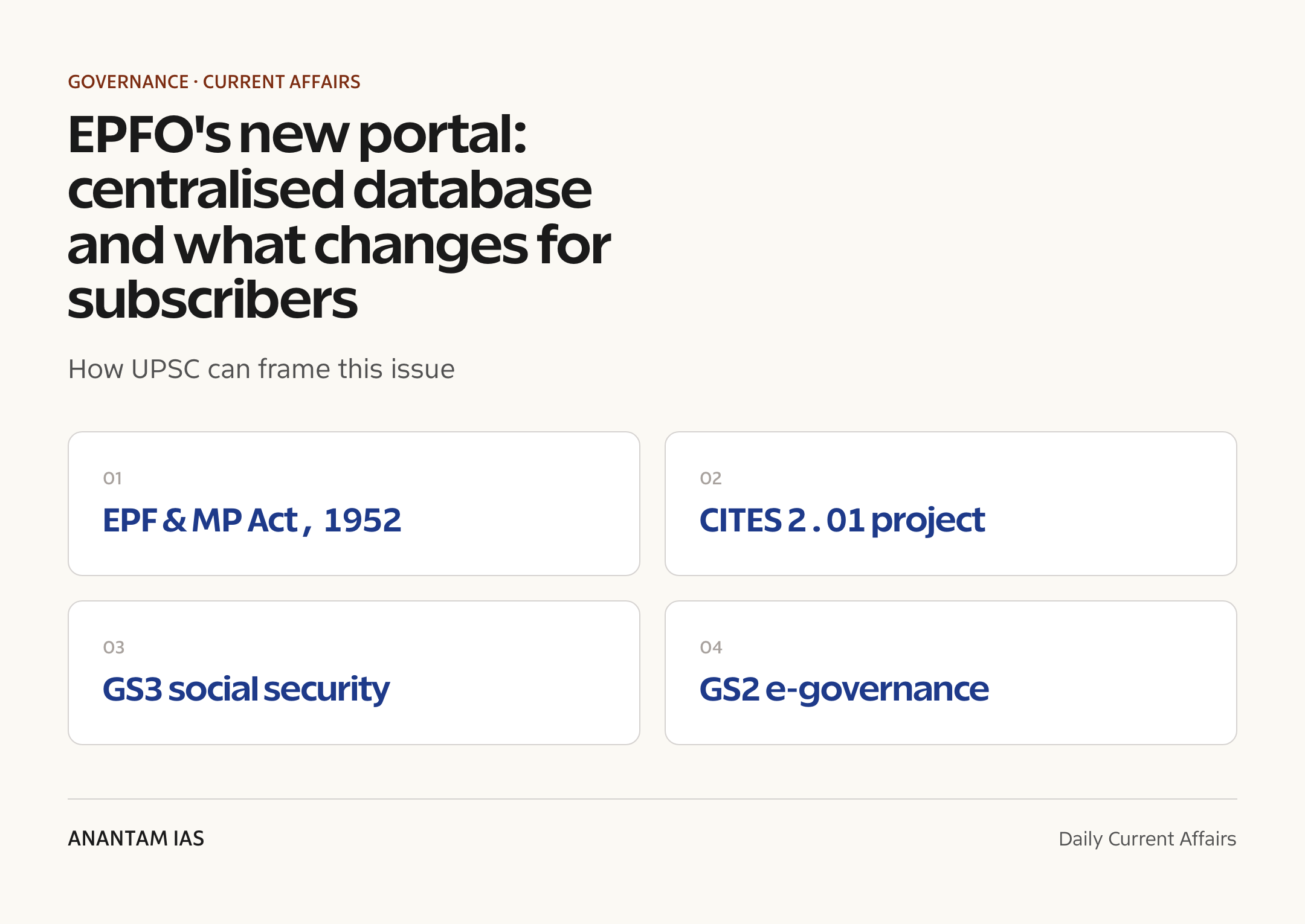
- EPFO — statutory body under the Employees’ Provident Funds and Miscellaneous Provisions Act, 1952; administered by the Ministry of Labour and Employment.
- CITES 2.01 — Centralised IT Enabled Services project; migrated 34 crore EPF accounts from 120-plus decentralised regional databases to one centralised database.
- EPFO runs three schemes: EPF Scheme, 1952; Employees’ Pension Scheme (EPS), 1995; Employees’ Deposit Linked Insurance (EDLI) Scheme, 1976.
- Central Board of Trustees (CBT) — tripartite apex body (government, employers, employees) chaired by the Union Labour Minister; declares the annual EPF interest rate.
- EPF interest rate for FY 2025-26: 8.25%; the July 2026 rollout estimated about ₹1.44 lakh crore across roughly 34 crore accounts.
- Universal Account Number (UAN) — portable lifelong PF account number introduced in 2014; the identity spine the centralised database now completes.
- Auto-settlement limit for KYC-validated advance claims: ₹5 lakh.
- October 2025 norms: withdrawal categories cut from 13 to 3 (essential needs, housing, special circumstances) with a 25% minimum balance rule.
- The Code on Social Security, 2020 subsumes the EPF Act, 1952 (yet to be brought fully into force).
Mains Relevance
GS Paper 3
- Social-security architecture for the formal workforce — how digitisation (centralised database, auto-crediting, auto-settlement) changes the delivery of the EPF entitlement.
- Inclusive growth and labour welfare: portability of benefits for migrant workers and the ease-of-living dividend of any-office servicing.
- E-governance as an efficiency lever in public financial institutions — reducing claim rejections, delays and physical visits.
GS Paper 2
- Government policies for vulnerable sections: transparency (visible withdrawal-eligible balances) as a design principle in welfare delivery.
- Statutory bodies and institutional reform — EPFO’s shift from office-tied processing to a national single-database model.
Essay
- Digital rails as the new welfare state: when a database migration matters more than a new scheme.
- Ease of living for the working class — small administrative frictions, large human costs.
Background and Context
EPFO: the institution behind the news
The Employees’ Provident Fund Organisation is India’s largest retirement-savings institution and one of the world’s biggest social-security bodies.
- Created under the Employees’ Provident Funds and Miscellaneous Provisions Act, 1952; functions under the Ministry of Labour and Employment.
- Administers three statutory schemes — the EPF Scheme, 1952 (retirement corpus), the Employees’ Pension Scheme, 1995 (monthly pension) and the EDLI Scheme, 1976 (life insurance cover).
- Governed by the tripartite Central Board of Trustees — representatives of the Centre, states, employers and employees — chaired by the Union Labour Minister.
- Coverage: establishments with 20 or more employees; both employee and employer contribute 12% of basic wages each, with 8.33% of the employer share diverted to EPS (subject to the ₹15,000 wage ceiling).
- Scale today: about 34 crore EPF accounts and nearly 8 crore contributing members.
- The Universal Account Number (UAN), introduced in 2014, gave each member one portable ID — but the records behind it still sat in separate regional-office databases.
What the CITES 2.01 revamp actually changes
The core of the reform is architectural: one national database replacing more than 120 office-level silos.
- The Ministry of Labour and Employment confirmed EPFO has completed migrating its entire database of member records to the new centralised system under the CITES 2.01 project (part of the EPFO 2.01 modernisation).
- Earlier, services were tied to a particular Regional Office — the one where the employer deposited PF. Now a service request can be processed from any authorised EPFO location in the country.
- Practical effect: an employee who worked in Chennai and returned home to West Bengal can resolve PF issues at the nearest EPFO office instead of chasing the Chennai office.
- A unified digital interface now shows membership details, PF balance, claim status, pensionable service records and benefits availed in one place.
- The portal enables automated processes end to end — interest crediting, online claims verification and visibility of withdrawal-eligible amounts by claim category.
Interest crediting: faster and fuller
Two interest-related changes put real money in members’ hands sooner.
- The FY 2025-26 interest of ₹1.44 lakh crore (rate: 8.25%) will be auto-processed on the new portal, verified by field authorities and credited to 34 crore accounts by July 15.
- Earlier the credit routinely slipped to October–November, months after the CBT declared the rate — members saw stale passbook balances for half the year.
- On final PF settlements, interest is now computed up to the date of payment authorisation; the old rule stopped the clock at the last day of the previous month.
- The ministry said this ensures members get the benefit of additional interest for the intervening period — a small per-member gain, but system-wide it ends a quiet loss borne by every exiting subscriber.
Claims: pre-validation, visible limits, fewer rejections
The portal attacks EPFO’s most criticised metric — claim rejections — before a claim is even filed.
- Claims now undergo automated pre-validation; deficiencies or discrepancies are flagged to the member by SMS and on the portal — a first for EPFO.
- EPFO offices can raise queries online during processing and members can respond online, cutting physical visits and back-and-forth by post.
- Members can now see the eligible withdrawal amount under each claim category. Earlier this was invisible, so claims exceeding permissible limits were routinely rejected.
- Fully KYC-linked and validated advance claims up to ₹5 lakh flow through an auto-settlement mechanism with no human touchpoint.
- The stated goal is a higher first-time acceptance rate — high rejection rates have been a headline grievance against EPFO for several years.
The October 2025 withdrawal reform this builds on
The portal operationalises a simplified withdrawal regime announced in October 2025.
- Withdrawal categories were compressed from 13 to 3 — essential needs (illness, education, marriage), housing needs and special circumstances.
- A mandatory 25% minimum balance was introduced; “100% of eligible balance” in practice means up to 75% of total funds, with the full corpus withdrawable after one year of unemployment.
- Illness (self or family): up to 100% of eligible balance after 12 months of membership.
- Education: allowed after 12 months, capped at 10 withdrawals over the membership; marriage: up to 100% of eligible balance, capped at 5 withdrawals.
- Housing: partial withdrawal for purchase, construction, site acquisition, home-loan repayment or renovation — limited to 75% of total funds after 12 months, not more than five times.
Why it matters: social security meets digital public infrastructure
The reform applies the DPI logic — single source of truth, portability, auto-processing — to a 74-year-old statutory fund.
- It is the same design grammar as India Stack and digital public infrastructure: centralise the record, standardise the rail, automate the transaction.
- Portability directly serves labour mobility — the workforce EPFO serves is increasingly inter-state, while its old architecture assumed a worker stayed put.
- It complements the wider social-security agenda — the Code on Social Security, 2020, gig-worker coverage debates and schemes discussed in our note on social security for gig and informal workers.
- EPFO is also the delivery pipe for employment policy — the Employment Linked Incentive (ELI) scheme routes benefits through EPFO enrolment — so cleaner plumbing raises the ceiling for future programmes.
- For the pension debate mapped in our multi-pillar pension landscape note, a credible, low-friction EPF strengthens Pillar 2 (occupational, contributory) of India’s retirement system.
Caveats and challenges
Centralisation solves the access problem but concentrates new risks that the exam answer should acknowledge.
- Data security and privacy: one national database of 34 crore accounts is a high-value target; breach-resilience, access controls and accountability under the DPDP Act, 2023 framework become critical.
- Transition risk: large migrations can corrupt or orphan legacy records; disputed service histories and missing employer contributions still need human adjudication.
- Digital divide: SMS-and-portal workflows assume smartphone access and digital literacy that low-wage members may lack; assisted physical channels must survive the digitisation.
- Coverage gap remains the bigger story: EPFO protects the formal 8 crore contributors, while roughly 90% of India’s workforce stays informal and outside it — technology upgrades don’t by themselves widen the net.
- Grievance redress capacity at field offices must match the new any-office promise, or the bottleneck simply relocates.
Way Forward
Harden the data layer
- Independent security audits, breach-notification protocols and purpose-limited access consistent with the DPDP Act, 2023.
- A published reconciliation window for members to flag migration errors in service records and balances.
Close the delivery loop
- Publish claim-rejection and first-time acceptance dashboards so the portal’s promise is measurable.
- Retain assisted channels — camps, common service centres, helplines in regional languages — for members outside the smartphone economy.
Widen the net
- Use the clean centralised rail to onboard gig and platform workers under the Code on Social Security, 2020.
- Align EPFO systems with ELI-scheme and formalisation incentives so first-time employees enter with a portable, visible account from day one.
Conclusion
The CITES 2.01 rollout is that rare reform where the headline is a database. By collapsing 120-plus office silos into one national record, EPFO has converted a paper-era, geography-bound entitlement into a portable digital one — interest lands by July 15, balances are visible, and any office can serve any member.
The test now is trust at scale: protecting a 34-crore-account database, fixing migration errors quickly, and keeping non-digital members inside the system. If those hold, the new portal becomes the template for the harder task ahead — extending social security beyond the formal 8 crore to the informal many.
UPSC Practice Questions
Prelims MCQ 1
With reference to the Employees’ Provident Fund Organisation (EPFO) and its recent CITES 2.01 portal, consider the following statements:
- EPFO has migrated its member records from decentralised regional-office databases to a single centralised national database.
- Under the revamped system, a member’s service request can be processed only at the regional office where the PF contributions were deposited.
- Interest on final PF settlements is now calculated up to the date of payment authorisation.
How many of the above statements are correct?
(a) Only one (b) Only two (c) All three (d) None
Answer: (b) Only two
Explanation:
Statements 1 and 3 are correct. Statement 2 is wrong — the centralised database ends the tie to a particular regional office; requests can now be processed from any authorised EPFO location in the country.
Prelims MCQ 2
The Employees’ Provident Fund Organisation (EPFO) functions under which Union Ministry, and under which parent legislation was it established?
(a) Ministry of Finance; Employees’ Provident Funds and Miscellaneous Provisions Act, 1952 (b) Ministry of Labour and Employment; Employees’ Provident Funds and Miscellaneous Provisions Act, 1952 (c) Ministry of Labour and Employment; Code on Wages, 2019 (d) Ministry of Corporate Affairs; Employees’ Pension Scheme, 1995
Answer: (b) Ministry of Labour and Employment; Employees' Provident Funds and Miscellaneous Provisions Act, 1952
Explanation:
EPFO is a statutory body under the EPF & MP Act, 1952, administered by the Ministry of Labour and Employment. Its apex tripartite Central Board of Trustees is chaired by the Union Labour Minister.
UPSC Mains Questions
- EPFO’s migration to a centralised database has been described as applying the digital-public-infrastructure playbook to social security. Examine how the CITES 2.01 reforms improve welfare delivery for formal-sector workers, and identify the risks that centralisation introduces. (250 words)
- High claim rejection rates and geography-tied servicing have long undermined trust in India’s provident fund system. Discuss how transparency-by-design features in EPFO’s new portal address these failures, and suggest measures to extend such social-security architecture to informal workers. (250 words)
Sources: Indian Express Explained and Ministry of Labour and Employment.
Frequently Asked Questions
What is EPFO’s CITES 2.01 project?
CITES 2.01 (Centralised IT Enabled Services) is EPFO’s IT modernisation project under which the entire member database — earlier split across 120-plus regional-office systems — has been migrated to one centralised national database, enabling any-office servicing, auto-crediting of interest and automated claim processing on a revamped portal.
When will EPF interest for FY 2025-26 be credited?
By July 15, 2026. The annual interest of about ₹1.44 lakh crore, at the declared rate of 8.25%, is being auto-processed on the new portal, verified by field authorities and credited to roughly 34 crore EPF accounts — earlier the credit often slipped to October–November.
Can I now get EPF services at any EPFO office?
Yes. Because member records sit in one centralised database, a service request can be processed from any authorised EPFO location in India. You are no longer tied to the regional office of your former employer’s city — a major relief for workers who migrate between states.
What is the ₹5 lakh auto-settlement facility?
Advance claims that are fully KYC-linked and validated, up to ₹5 lakh, are settled through an automated mechanism without manual processing. Combined with automated pre-validation and SMS alerts for deficiencies, this is designed to raise first-time acceptance and cut claim rejections.
How were EPF withdrawal rules changed in October 2025?
EPFO compressed 13 withdrawal categories into 3 — essential needs (illness, education, marriage), housing, and special circumstances — and introduced a 25% mandatory minimum balance. Caps apply: 10 lifetime withdrawals for education, 5 for marriage, and housing withdrawals limited to 75% of funds, up to five times.
Which law and ministry govern EPFO?
EPFO is a statutory body under the Employees’ Provident Funds and Miscellaneous Provisions Act, 1952, administered by the Ministry of Labour and Employment. Its tripartite Central Board of Trustees, chaired by the Labour Minister, oversees the EPF (1952), EPS (1995) and EDLI (1976) schemes.
Tell Google you want more of this.
Add Anantam IAS as a preferred sourceOne tap, and this site shows up more often in your own Top Stories, AI Overviews and AI Mode. Remove it any time.