Why in News?
The Indian Express reported that the Employees’ Provident Fund Organisation is planning an EPFO 3.0 phase built around universal pension access, first-time contributory coverage for gig and platform workers, and a core-banking technology platform. The proposal is still being designed; it should not be confused with an already-notified pension entitlement.
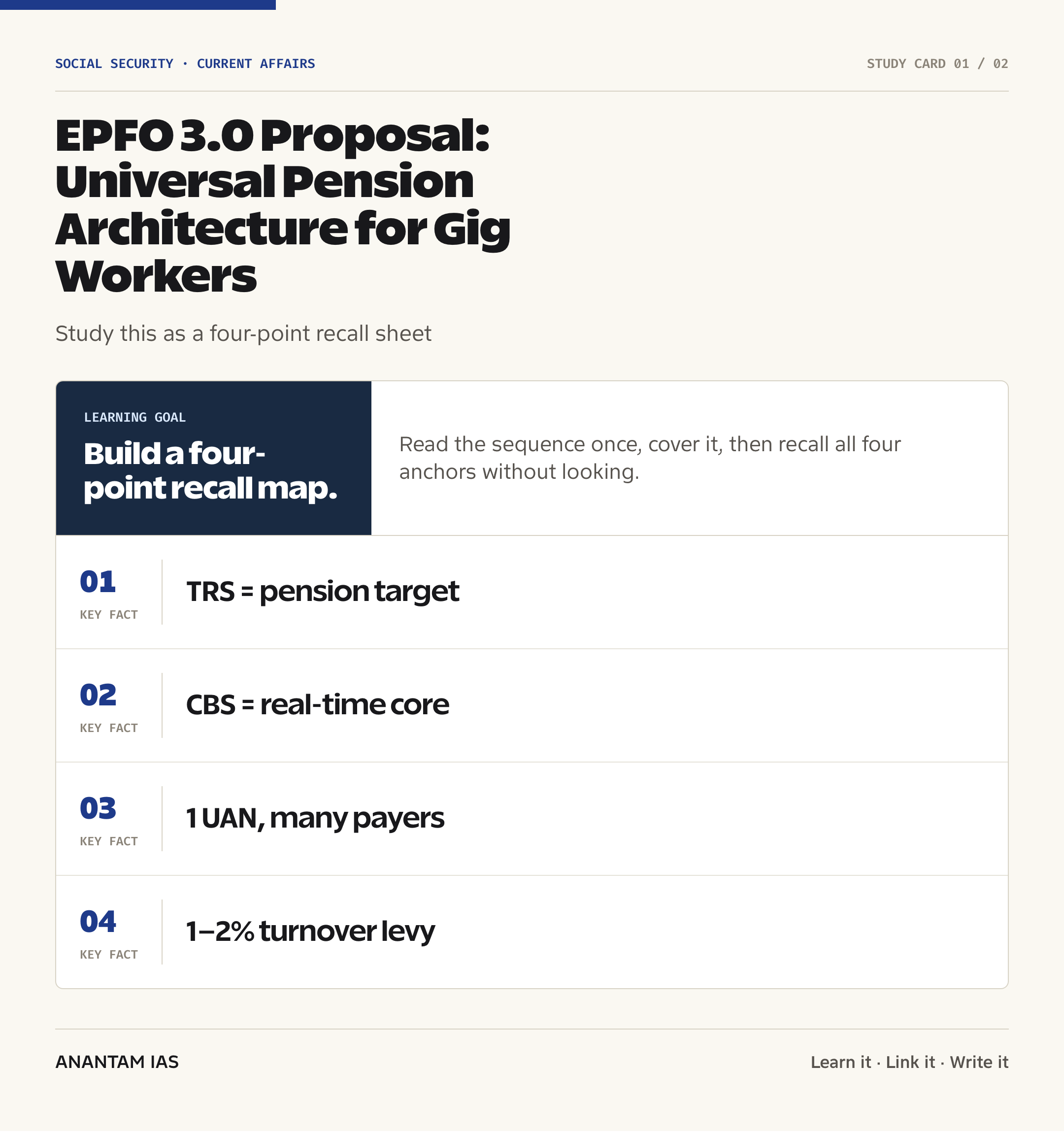
The planned system would let a worker build a Target Retirement Sum through contributions from several sources and choose, at retirement, between an annuity-based pension and a systematic withdrawal plan. EPFO’s official expression of interest separately confirms its search for a core-banking solution capable of administering provident fund, pension and insurance benefits for gig, construction and other unorganised workers.
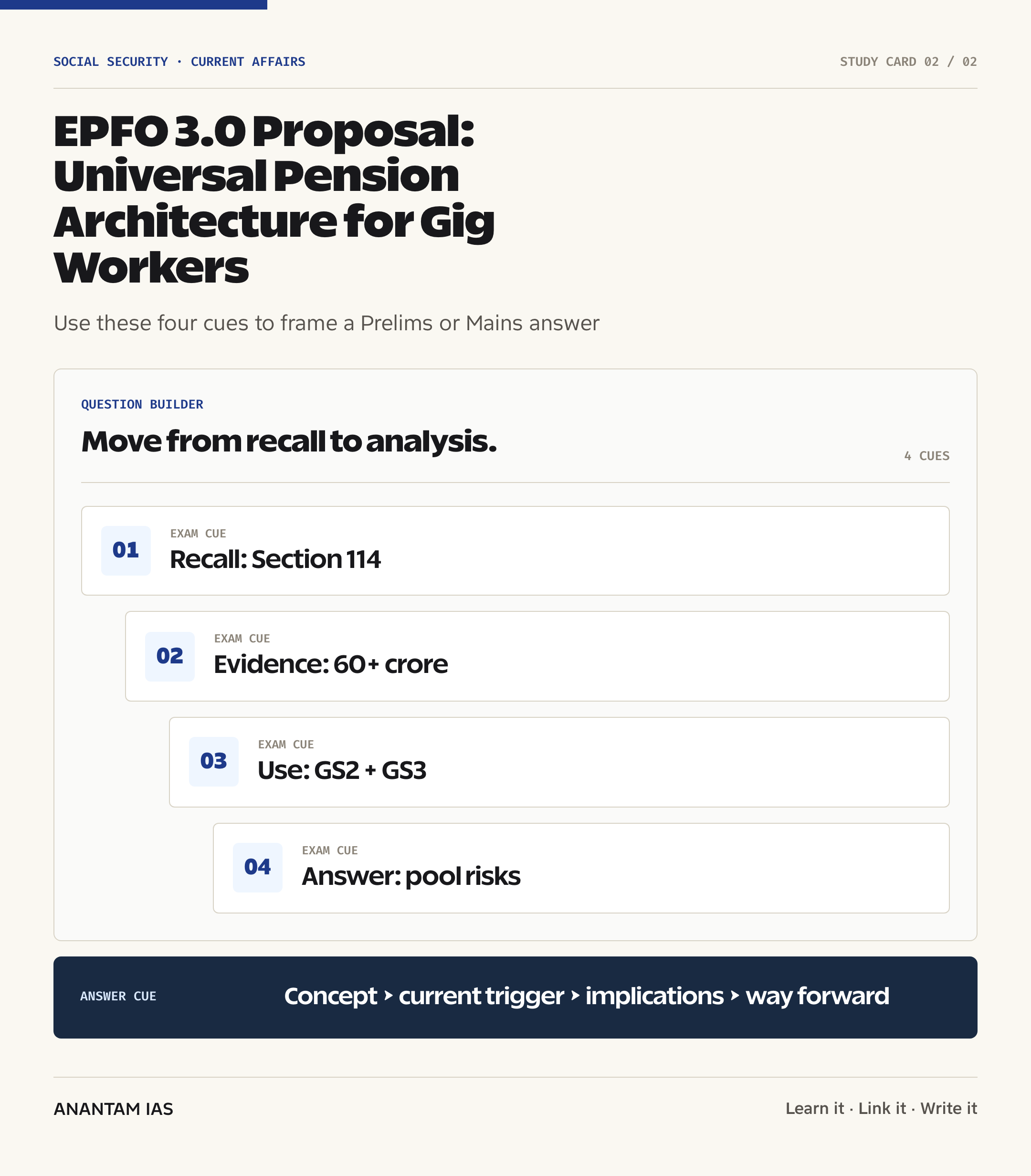
- The proposed coverage universe is India’s workforce of more than 60 crore workers, over three-fourths of whom are reported to be in the unorganised sector with limited pension protection.
- A single Universal Account Number could be mapped to multiple employers and aggregators, while preserving a payer-wise contribution trail.
- The design allows contributions from the worker, employer, government, aggregator, CSR funds and approved third parties rather than depending on one payroll employer.
- EPFO expects the new architecture to serve about 2.5 crore gig and construction workers over five years, subject to scheme design and implementation.
- The proposed retirement choices are an annuity, which converts corpus into periodic income, and a systematic withdrawal plan with adjustable drawdown.
The development matters in the context of:
- This matters in the context of labour-market informality: platform workers can earn from several apps without a stable employer-linked pension account.
- It also matters in the context of social justice: pension adequacy depends not only on enrolment but on regular contributions, pooled risk, low charges and inflation protection.
- The reform links a welfare objective to digital public administration, making identity, transaction capacity, portability and grievance redress part of social-security delivery.
UPSC Relevance
Prelims Relevance
- The EPFO is a statutory social-security organisation under the Ministry of Labour and Employment and administers provident fund, pension and insurance schemes for covered workers.
- A Universal Account Number is a portable identifier intended to connect a member’s employment-linked provident-fund accounts across job changes.
- A gig worker performs work outside a traditional employer-employee relationship; a platform worker accesses work through an online platform.
- Section 114 of the Code on Social Security, 2020 permits schemes for gig and platform workers covering life, disability, accident, health, maternity and old-age protection, among other benefits.
- The Code permits an aggregator contribution of 1–2% of annual turnover when notified, capped at 5% of the amount paid or payable to gig and platform workers.
- A core banking solution is a centralised transaction system that supports real-time account operations across service points instead of keeping isolated regional databases.
- A defined-contribution arrangement links the eventual benefit to accumulated contributions and investment outcomes rather than promising a predetermined benefit solely by formula.
- An annuity converts retirement savings into periodic payments; a systematic withdrawal plan draws periodically from an invested corpus without necessarily locking the full amount into an annuity.
- The Target Retirement Sum in the proposal is a dynamic corpus goal based on a member’s desired pension, retirement age and contribution path.
Mains Relevance
GS Paper 2
- Assess social-security inclusion for workers outside standard employment and the State’s duty to protect income in old age.
- Examine delivery questions involving identification, portability, grievance redress, Centre-State coordination and digital exclusion.
- Distinguish legal recognition under the Code on Social Security from the actual notification, funding and delivery of a benefit scheme.
GS Paper 3
- Connect the proposal with the changing gig economy, multiple-employer work and the limits of payroll-based welfare.
- Evaluate pension adequacy through contribution density, investment safety, inflation and longevity risk.
- Analyse how a core-banking platform could improve transaction scale while creating cyber-security, privacy and operational risks.
Essay
- A welfare state must adapt its institutions when the nature of work changes.
- Portability can turn fragmented livelihoods into continuous social protection.
- Digital capacity expands access only when institutional accountability grows with it.
Background and Context
Why Payroll-Based Protection Misses Gig Work
India’s traditional contributory architecture assumes a recognisable employer, a regular wage and a stable payroll relationship.
- A delivery partner or driver may work for several aggregators, switch platforms frequently and combine platform income with casual or self-employment.
- Irregular earnings create contribution gaps; a monthly fixed contribution that suits salaried work may be unaffordable in a low-income month.
- The absence of a conventional employer can leave unclear who should collect, match and remit a social-security contribution.
- Women often combine paid platform tasks with unpaid care and may enter or leave work repeatedly. A portable design should recognise career breaks and low contribution density without cancelling membership or imposing re-entry costs.
- Workers in smaller towns may alternate between app work, farm work, construction and self-employment. Coverage must follow the person rather than the occupation label, or the same worker will move in and out of protection as livelihoods change.
- This coverage gap is explained in Anantam IAS notes on gig workers and the Social Security Code, which separate legal recognition from effective benefit delivery.
- A universal architecture must support worker mobility without treating every change of platform as a break in pension membership.
How the Proposed Target Retirement Sum Works
The proposed Target Retirement Sum converts a desired retirement income into a visible, adjustable savings goal.
- The system would calculate the Target Retirement Sum from the member’s chosen pension goal and expected retirement age.
- A dashboard would show the accumulated corpus, contribution history and progress toward the target, with scenarios for different contribution frequencies.
- Members could revise the target as income or household needs change; the platform would then recompute the required contribution path.
- At retirement, the corpus could support an annuity or a systematic withdrawal plan, offering a choice between income certainty and drawdown flexibility.
- The dashboard should distinguish a nominal pension from its inflation-adjusted purchasing power. A target that appears large decades before retirement may still finance only a modest real income when prices and longevity are included.
- Default settings matter because most members won’t continuously optimise contributions or drawdown. A prudent lifecycle default, backed by simple comparisons and the right to change course, can protect less financially confident workers without removing choice.
- Choice creates a need for plain-language disclosure: a higher early drawdown can reduce the future corpus, while inflation can erode a pension that looks adequate in nominal terms.
Multi-Source Contributions and One UAN
The proposal treats pension building as a shared contribution problem rather than a single-employer deduction.
- The potential sources include the worker, employer, Union or State government, aggregator, CSR pool and approved third parties.
- A one-to-many mapping would connect one UAN with several platforms or employers while recording the contribution attributable to each source.
- A split-payment feature could divert a small, disclosed share of a platform transaction toward social security, making micro-contributions possible when earnings are irregular.
- The ledger must state when a contribution becomes final, how reversals or refunds are handled and who bears a failed payment. Without common reconciliation standards, millions of tiny transactions could create balances that workers and aggregators cannot independently verify.
- Portability also needs a clear rule for duplicate or dormant accounts. UAN-based consolidation should preserve the worker’s complete contribution history while correcting identity errors through due process rather than automatic account blocking.
- The design could also accept voluntary additions, but a voluntary-only model risks low balances for workers with thin and volatile incomes.
- The wider policy context is covered in Anantam IAS notes on social security for gig and informal workers.
Code on Social Security as the Legal Base
The Code creates the legal vocabulary and funding possibilities, but an operational pension still needs notified rules and administrative machinery.
- Section 114 authorises schemes for gig and platform workers covering old-age protection along with life, disability, accident, health and maternity benefits.
- A scheme may be funded by governments, aggregators, beneficiaries, CSR funds or a combination specified in the notified design.
- The aggregator levy, when notified, may range from 1% to 2% of annual turnover, subject to the statutory cap linked to payments made to workers.
- Registration makes an eligible worker capable of receiving the concerned scheme benefit, but registration alone does not create an adequate pension corpus.
- The Code assigns a role to the National Social Security Board, including worker and aggregator representation when it deals with gig-worker welfare. Scheme rules should use this forum for review rather than treating platform design as a purely technical exercise.
- Rules must identify the authority that collects and spends contributions, the consequences of delayed payment and the route for appeals. These institutional details determine whether a statutory funding power becomes an enforceable worker benefit.
- For answer writing, separate four stages: recognition, registration, contribution and benefit delivery. Confusing them produces an incomplete policy assessment.
Why Core Banking Is Central to EPFO 3.0
The technology shift is meant to support a much larger and more transaction-intensive membership base.
- EPFO’s official expression of interest seeks a mix of core-banking and custom applications for provident-fund, pension and insurance administration.
- The proposed platform supports Aadhaar-based authentication, mobile-first access, real-time fund management and multilingual interfaces in at least 12 Scheduled languages.
- Centralised processing can reduce dependence on isolated regional databases and improve balance visibility, reconciliation and timely crediting.
- Migration should be phased through parallel runs, sampled balance checks and worker-visible statements. A technically successful transfer that changes a pension balance without explanation would create a serious trust and accountability failure.
- Interoperability with e-Shram, State welfare boards and aggregator systems should use only the fields needed for the stated purpose. More data linkage isn’t automatically better; data minimisation lowers breach risk and reduces exclusion from inconsistent records.
- The preceding portal reform and its centralised database are explained in EPFO’s new portal.
- But a pension system is not only a payment engine: it also requires actuarial governance, investment controls, audit trails and accessible dispute resolution.
Construction Workers and Dormant Welfare Funds
The proposal also tries to connect portable pensions with construction-worker welfare resources that are now managed through State boards.
- The report cited more than 3.5 crore registered building and other construction workers and net cess collections above ₹70,000 crore across State welfare boards.
- A pension route could convert part of available welfare financing into long-term income security, subject to legal authority, consent and transparent fund accounting.
- Construction work is often seasonal and inter-State, so benefits need portability across contractors and States rather than residence- or employer-locked access.
- State boards differ in registration quality, benefits and unspent balances. A common pension channel should retain State-level accountability and publish transfer records instead of pooling resources in a way that obscures their origin and intended beneficiaries.
- Workers need continuity when they cross State borders, but portability doesn’t require identical benefits everywhere. The Union can set minimum data and service standards while allowing States to finance additional welfare according to local needs.
- Any transfer of cess-supported resources must not crowd out health, accident, education or immediate welfare benefits already financed by the boards.
- Centre-State data standards will be needed to avoid duplicate identities while preventing exclusion caused by mismatched records.
Pension Adequacy, Risk and Worker Protection
Universal enrolment is only the first test; the harder test is whether the final pension is adequate, predictable and fairly financed.
- A defined-contribution corpus depends on the amount and regularity of contributions; low contribution density can produce a very small pension despite long membership.
- Government co-contributions for low-income workers could improve adequacy, but they require a clear fiscal rule and eligibility test that don’t penalise fluctuating income.
- Annuities pool longevity risk, while systematic withdrawals offer flexibility but can exhaust the corpus if drawdown is excessive or life expectancy is underestimated.
- A family or survivor pension must specify eligibility, contribution cost and treatment of nominees after death. A pooled Family Benefit Fund needs regular actuarial valuation so benefits aren’t promised without adequate reserves.
- Investment governance should state permissible assets, benchmarks, custody, conflict rules and public reporting. Government-backed securities can reduce credit risk, but interest-rate and inflation risks still affect the real value of a long-term pension.
- Inflation-adjusted projections should disclose assumptions on returns, charges, inflation and retirement age instead of presenting one forecast as a guarantee.
- Data safeguards must apply to UAN-linked work histories, earnings and identity records through purpose limitation, consent, encryption and breach response.
- A comparative answer may mention Atal Pension Yojana, but it should distinguish a guaranteed-pension scheme from EPFO 3.0’s proposed corpus-and-drawdown design.
Way Forward
Notify a Clear Rights-and-Funding Framework
- Specify the benefit formula, vesting, withdrawal conditions and treatment of interrupted contributions before large-scale enrolment.
- Make aggregator, government and worker contributions predictable, with a transparent rule for low-income co-contributions.
- Clarify that platform participation in social-security financing doesn’t settle the separate legal question of employment classification and labour rights.
Design for Irregular Earnings
- Allow low-value, high-frequency contributions and pause-resume flexibility without punitive charges for seasonal or volatile income.
- Use automatic contribution prompts with informed opt-in, easy reversal and a visible payer-wise ledger.
- Provide a minimum-protection layer for workers whose earnings cannot generate an adequate retirement corpus even with regular saving.
Build Trust into the Digital Platform
- Subject the CBS platform to independent security audits, load tests and disaster-recovery drills before migration.
- Offer assisted offline service, multilingual help and time-bound grievance escalation so digital exclusion doesn’t become benefit exclusion.
- Publish scheme-level dashboards on enrolment, contribution density, claims, grievances, investment performance and pension adequacy, with privacy-preserving aggregation.
Protect Retirement Outcomes
- Use default investment and drawdown options based on prudent fiduciary and actuarial standards, while preserving informed choice.
- Display inflation-adjusted pension ranges and downside scenarios rather than a single optimistic projection of future income.
- Create survivor benefits and nomination rules that work for diverse households, backed by transparent pricing of the proposed Family Benefit Fund.
Conclusion
EPFO 3.0 could shift social security from a job-linked account to a worker-linked, portable retirement architecture. Its strongest idea is continuity: one identity, many payers and a pension corpus that follows the worker across platforms, employers and States.
But universal pension cannot mean universal registration alone. The durable measure of success will be adequate retirement income, fair contribution sharing, safe investment, accessible grievance redress and credible protection of workers’ data.
UPSC Practice Questions
Prelims MCQ 1
With reference to the Code on Social Security, 2020, consider the following statements:
- The Central Government may frame schemes for old-age protection of gig and platform workers.
- The Code fixes the aggregator contribution at exactly 5% of annual turnover.
- A gig-worker scheme may receive funding from corporate social responsibility funds.
How many of the above statements are correct?
(a) Only one (b) Only two (c) All three (d) None
Answer: (b) Only two
Explanation:
Statements 1 and 3 are correct. Section 114 permits old-age protection and CSR funding. The aggregator contribution, when notified, is 1–2% of annual turnover, subject to a separate cap of 5% of the amount paid or payable to gig and platform workers.
Prelims MCQ 2
In the EPFO 3.0 proposal, what is the primary purpose of a core banking solution?
(a) To replace every pension with a fixed government grant (b) To process centralised, real-time account transactions across service points (c) To limit each UAN to one employer for its entire lifetime (d) To invest the entire pension corpus only in equities
Answer: (b) To process centralised, real-time account transactions across service points
Explanation:
A core banking solution provides a central transaction backbone. For EPFO, it is intended to support high-volume, portable and multi-source contributions while improving account visibility and reconciliation.
UPSC Mains Questions
- The proposed EPFO 3.0 architecture seeks to move social security from an employer-linked model to a worker-linked model. Examine how multi-source contributions and a portable UAN can improve gig-worker protection, and identify the safeguards needed for pension adequacy.
- Core-banking technology can expand the scale and portability of social-security delivery, but technology cannot substitute for sound welfare design. Discuss with reference to contribution equity, digital exclusion, data protection, grievance redress and actuarial governance.
Sources: EPFO and The Indian Express Explained and The Indian Express Explained.
Frequently Asked Questions
What is EPFO 3.0?
EPFO 3.0 is the proposed next reform phase of the Employees’ Provident Fund Organisation. It combines a core-banking technology platform with new contribution and retirement features intended to support organised, unorganised, gig and construction workers. The reported universal-pension design is under development and is not yet the same as a notified entitlement.
What is a Target Retirement Sum?
The Target Retirement Sum is a proposed personalised corpus goal. It would be calculated from a worker’s desired pension, expected retirement age and contribution pattern. A dashboard would track progress and recalculate the required amount when the worker changes the pension goal, contribution frequency or retirement assumptions.
How could gig workers contribute?
The design allows contributions from workers, aggregators, employers where relevant, governments, CSR pools and approved third parties. One UAN could receive contributions from several platforms while preserving a source-wise ledger. Small split-payment contributions could suit irregular earnings, but adequate pensions may still require mandatory or publicly supported contributions.
What does the Social Security Code provide?
Section 114 of the Code on Social Security, 2020 permits schemes for gig and platform workers covering old age, accident, health, maternity, life and disability. It also permits mixed funding and an aggregator contribution of 1–2% of annual turnover when notified, subject to the statutory worker-payment cap.
Why does EPFO need core banking?
A core banking solution can process account transactions centrally and in real time across service points. EPFO expects a much larger, mobile membership with multiple contribution sources. The platform can improve portability and reconciliation, but it also needs cyber-security, privacy, audit, disaster-recovery and assisted-service safeguards.
Is universal enrolment enough for pension security?
No. Enrolment creates access, but pension adequacy depends on contribution size and continuity, investment returns, charges, inflation, longevity and drawdown choices. Low-income workers with volatile earnings may need government co-contributions or a minimum-protection layer, alongside simple disclosures and strong grievance redress.
Tell Google you want more of this.
Add Anantam IAS as a preferred sourceOne tap, and this site shows up more often in your own Top Stories, AI Overviews and AI Mode. Remove it any time.