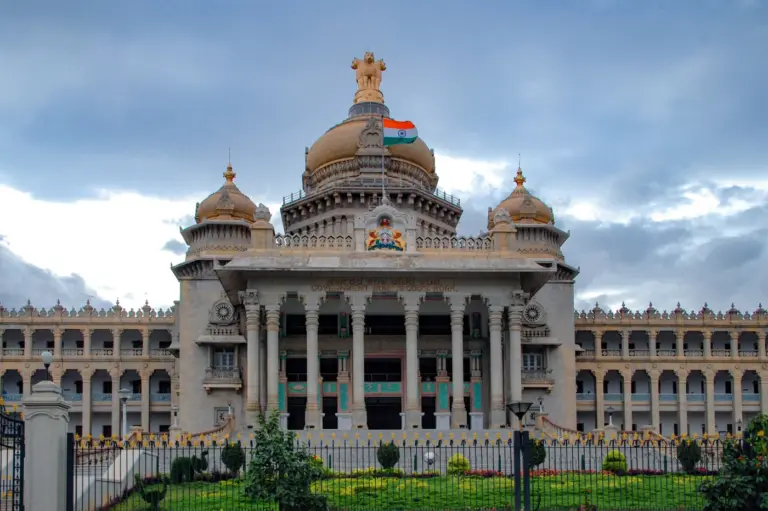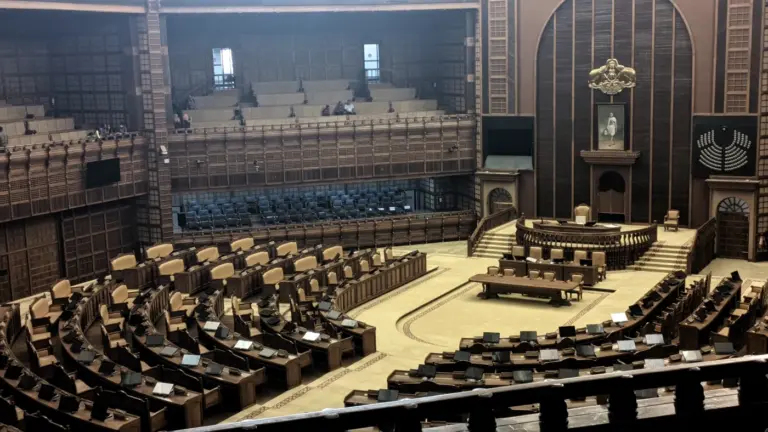
The parliamentary system is the foundation on which Indian democracy is built. Adopted from the British Westminster model, it fuses the legislative and executive branches — the government is drawn from and accountable to Parliament. For UPSC Polity, the parliamentary system is essential reading for GS-II questions on separation of powers, executive accountability, and the ongoing presidential vs parliamentary debate.
What Is a Parliamentary System?
A key feature of any political system is the relationship between the assembly and the government — between the legislative and executive authorities. In a parliamentary system:
- The executive is drawn from the legislature.
- The executive is accountable to the legislature.
- There is a fusion of legislative and executive power.
- The head of state (President in India) is distinct from the head of government (Prime Minister).
- The government stays in office only as long as it retains the confidence of the lower house.
Most liberal democracies — the UK, India, Canada, Australia, Germany, Japan — have adopted some form of parliamentary government.
Merits of the Parliamentary System
Effective Government
- The government rests on the confidence of the legislature and can usually ensure that its legislative programme is passed.
- A parliamentary executive with a majority can get things done.
- This delivers policy consistency and legislative throughput.
Responsible Government
- The executive can govern only as long as it retains the confidence of the assembly.
- Question Hour, no-confidence motions, and adjournment motions create continuous accountability.
- The collective responsibility of the Cabinet (Art. 75(3)) ensures unified executive conduct.
More Representative Executive
- A parliamentary cabinet can reflect diverse regions, communities, and social backgrounds.
- The Council of Ministers typically includes representation from multiple states and sections.
- This is especially valuable in a diverse country like India.
Flexibility
- A government can be changed mid-term through a no-confidence motion, without waiting for a fixed term.
- Prime ministers can be replaced by their own party (Cameron to May to Johnson in the UK).
- This contrasts with the rigidity of a fixed presidential term.
Demerits of the Parliamentary System
Elected Dictatorship
- If the ruling party commands a large majority, it can push through any legislation.
- Parliament effectively becomes a "talking shop" rather than a meaningful check.
- The executive dominates the legislature.
Policy Paralysis
- Conversely, if the ruling party is weak or the coalition is not cohesive, government decisions can stall.
- Minority governments struggle to pass significant legislation.
- Coalition partners can exercise disproportionate influence.
Ministerial Musical Chairs
- Cabinet reshuffles can destabilise long-term policymaking.
- Ministers may not have the expertise required for specialised portfolios.
- Continuity of leadership is undermined.
Familiar but Not Federal
- India adopted the parliamentary system because the framers were familiar with it at the provincial level.
- At the Centre, a genuine federal balance (with strong states) did not fully materialise.
Reasons for Adopting the Parliamentary System
Familiarity
K.M. Munshi noted during the Constituent Assembly Debates that responsible government had already been introduced in British India. The conventions of the parliamentary system were already understood.
Avoiding Legislative-Executive Conflict
B.R. Ambedkar argued that a newly independent developing country must be able to deliver on its government's agenda. What would happen if the budget got stalled in an adversarial presidential system? Parliamentary fusion solves this coordination problem.
Diversity and Representation
In a diverse country like India, a parliamentary system results in an executive that closely resembles the population. The Cabinet collectively represents the social fabric of the country in a way a single elected president cannot.
Basic Structure Status
In Kihoto Hollohan (1992) and subsequent cases, the Supreme Court treated the parliamentary form of government as part of the basic structure of the Constitution. This means Parliament cannot switch to a presidential system through ordinary amendment.
The Presidential System Debate: Arguments "For"
Periodically, voices call for India to adopt a presidential system.
- No genuine separation of powers in the parliamentary system.
- The legislature cannot work distinctly to apply a collective mind to national law.
- Coalition era brought "more politics, less policy and performance."
- Changing to a presidential system would ensure democracy works better.
- India's system has challenges of drift and indecision.
- Leaders need to focus on governance rather than staying in power.
- Fixed tenure for the executive would improve individual and collective performance.
- Fear that an elected President would become a Caesar is ill-founded — power would be balanced by chief executives of states.
- The Emergency (1975-77) showed that even a parliamentary system can be turned autocratic.
- For budget and special bills, the President depends on the legislature — consensus-building would be a must.
- Direct accountability to the people through direct election.
The Presidential System Debate: Arguments "Against"
- Surrender to one individual is dangerous for democracy.
- The parliamentary system has been designated part of the basic structure.
- A presidential system works best with a majority at both places — otherwise stalemate.
- India is a diverse country that cannot live without consensus.
- "Outside talent" can be brought in through the parliamentary system — C.D. Deshmukh, Manmohan Singh are examples of non-politicians becoming effective ministers.
- Switching to a presidential system at the Centre would force a similar switch in states.
The Debate in Historical Context
The presidential-system debate resurfaces whenever:
- Super-majority governments emerge (e.g., in the US, triggering comparisons).
- Coalition instability creates policy drift (India, late 1990s).
- Electoral reforms are discussed — simultaneous elections, expenditure ceilings.
Feasibility and Desirability
Feasibility
Unless the Supreme Court changes its mind on basic structure, a formal switch to a presidential system is constitutionally foreclosed.
Desirability
There are many presidential models — US, France (semi-presidential), South Africa. Key parameters include:
- Term length and re-election rules
- Who can amend the Constitution
- Veto powers (the US President's veto over Congress is substantial)
- Impeachment mechanism (complex in the US)
The US presidential office is highly powerful — India must ask whether it is ready to concentrate that much power in a single person.
The Viable Path: Reform Within
Rather than switching systems, the more pragmatic path is reforming the parliamentary system:
- Simultaneous elections — One Nation One Election committee report under Ram Nath Kovind, 2024.
- Expenditure and campaign finance reform.
- Anti-defection law reform — to balance party discipline with MP independence.
- Strengthening committees — Departmentally-Related Standing Committees.
- Parliamentary productivity — longer sittings, better debates, fewer disruptions.
Latest Developments (2024-26)
- One Nation One Election — the Kovind Committee report (March 2024) recommended simultaneous elections; bill tabled in Parliament (December 2024); continues to be debated.
- Parliamentary disruptions — 17th Lok Sabha lost 48% of scheduled time (PRS data).
- 18th Lok Sabha (2024) began in June 2024 with NDA forming government — a return to coalition politics after a decade of majority rule.
- Anti-defection law — debates on transferring disqualification decisions from the Speaker to an independent body.
- Parliamentary committees — their role is being reassessed after several bills were passed without committee scrutiny.
UPSC Relevance
GS-II mapping: Parliament and State legislatures — structure, functioning, conduct of business, powers, privileges and issues; separation of powers; comparative study of constitutions.
Prelims bullets:
- Parliamentary system — Westminster model.
- Head of state (President) ≠ Head of government (Prime Minister).
- Article 75(3) — Council of Ministers collectively responsible to Lok Sabha.
- Parliamentary form is part of basic structure.
- Ambedkar, K.M. Munshi on adoption rationale.
Mains angles:
- Discuss the merits and demerits of India's parliamentary system.
- Should India shift to a presidential system? Examine in light of recent coalition politics and the basic-structure doctrine.
- "India's parliamentary system is facing a crisis of productivity." Discuss reforms needed.
- Compare the Indian parliamentary system with the American presidential system.
Tell Google you want more of this.
Add Anantam IAS as a preferred sourceOne tap, and this site shows up more often in your own Top Stories, AI Overviews and AI Mode. Remove it any time.