Daily Digest
UPSC · Civil Services Examination
Current Affairs · Tuesday, 28 July 2026
Current affairs curated and edited by Anantam IAS faculty — pulled from The Hindu, PIB, IDSA, Foreign Affairs and the ministries. Read, annotate, revise.
Old Rajinder Nagar · Delhi 110005 · anantamias.com
Urban Cooperative Bank Licensing: Inclusion Versus Depositor Safety
Why in News?
The Ministry of Cooperation has urged the Reserve Bank of India to frame a policy for licensing new urban cooperative banks. The Indian Express reported on 28 July 2026 that Secretary Ashish Kumar Bhutani described wider UCB coverage as a ministry focus, citing the need for cooperative banks in more towns.
This is a policy push, not an RBI decision to grant new licences. RBI issued a discussion paper on 13 January 2026, invited feedback until 13 February and said it would consider detailed draft guidelines after reviewing comments. The licensing window that has remained paused since 2004 has not automatically reopened.
- A speaker at the July event estimated about 1,450 UCBs, with nearly 1,100 located in Maharashtra, Gujarat and Karnataka.
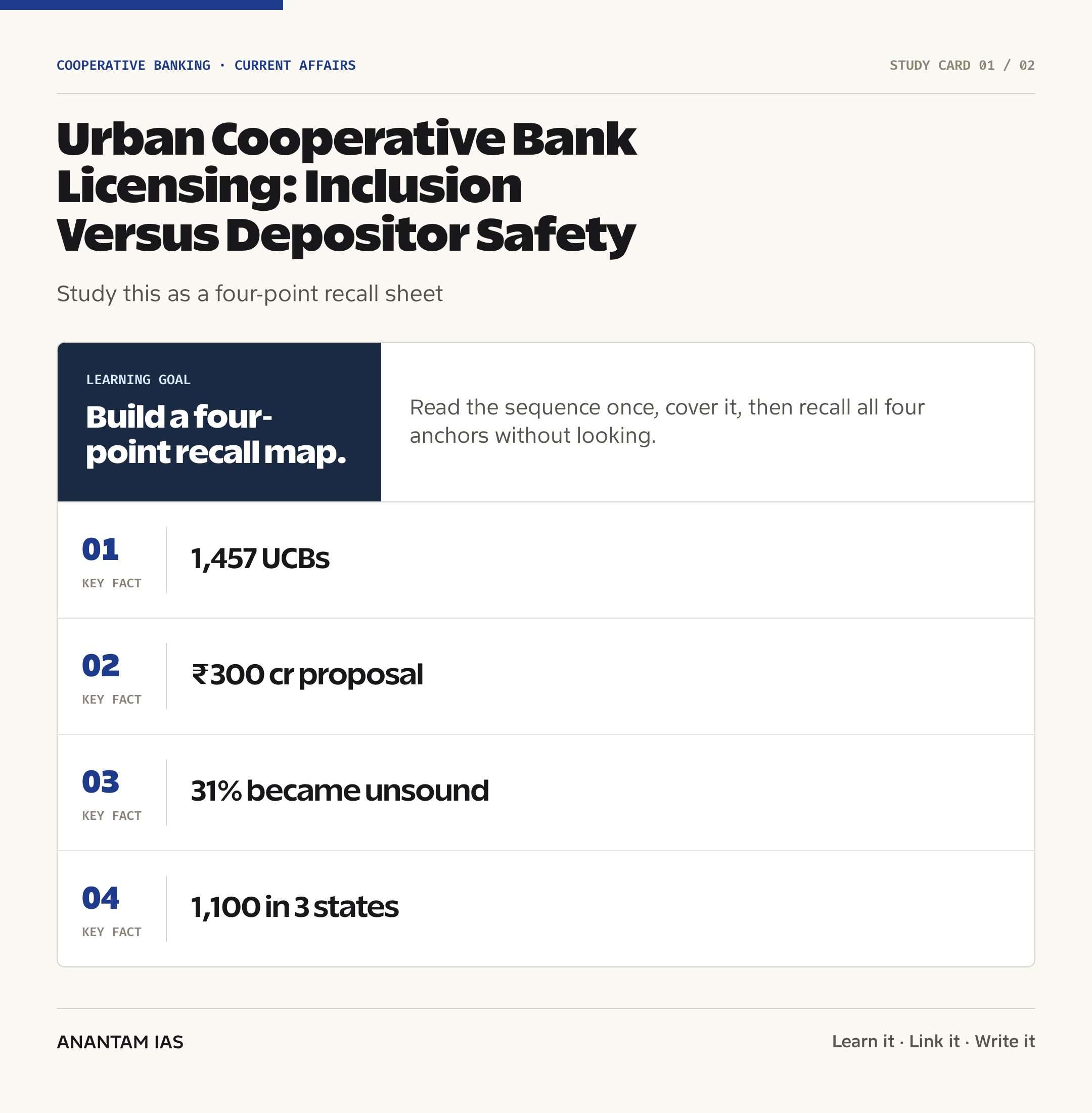
- RBI’s verified statistical baseline counted 1,457 UCBs as of 31 March 2025: 838 in Tier 1, 535 in Tier 2, 78 in Tier 3 and six in Tier 4.
- RBI’s discussion paper tentatively suggested considering large cooperative credit societies with at least ₹300 crore capital, subject to governance, track-record and prudential tests.
- RBI, not the Cooperation Ministry, grants a banking licence under Section 22 read with Section 56 of the Banking Regulation Act, 1949.
- The central tradeoff is between financial inclusion through local member-owned institutions and depositor safety in a sector with a history of small-bank governance failures.
The development matters in the context of:
- This matters in the context of India’s federal division between cooperative-society law and Union control over banking.
- It also tests whether stronger RBI powers after the Banking Regulation (Amendment) Act, 2020 are enough to support cautious new entry.
- The debate isn’t simply more banks versus fewer banks; it is about choosing between new licences, expansion of sound existing UCBs and other financial-inclusion channels.
UPSC Relevance
Prelims Relevance
- An urban cooperative bank is a cooperative society licensed by RBI as a primary cooperative bank to conduct banking business.
- A UCB may be registered under a State Cooperative Societies Act or the Multi-State Cooperative Societies Act, 2002.
- The RBI regulates and supervises UCB banking functions under the Banking Regulation Act, 1949 as applicable to cooperative societies.
- The relevant Registrar of Cooperative Societies or Central Registrar deals with the cooperative entity under State or multi-state law.
- Banking laws were extended to cooperative societies in 1966 through Section 56 of the Banking Regulation Act.
- The Banking Regulation (Amendment) Act, 2020 strengthened RBI powers over governance, audit, capital and resolution of cooperative banks.
- RBI’s four-tier framework classifies UCBs mainly by deposit size: below ₹100 crore; ₹100-1,000 crore; ₹1,000-10,000 crore; and ₹10,000 crore or above.
- Urban cooperative banks are supervised by RBI; State Cooperative Banks and District Central Cooperative Banks are regulated by RBI but supervised by NABARD.
- The DICGC deposit-insurance scheme is mandatory for RBI-licensed commercial and cooperative banks, with cover up to ₹5 lakh per depositor per bank.
Mains Relevance
GS Paper 3
- Role of UCBs in local credit, MSME finance, financial inclusion and competition with small finance banks and NBFCs.
- Bank regulation, capital adequacy, non-performing assets, cyber resilience and depositor protection.
- Balancing proportional regulation for small member-owned banks with common standards for any institution accepting public deposits.
GS Paper 2
- Federal division of powers: State List Entry 32 for cooperative societies and Union List Entry 45 for banking.
- Institutional coordination between RBI, State Registrars, the Central Registrar and the Ministry of Cooperation.
- Cooperative governance, democratic member control and professional banking management.
Essay
- Local ownership can deepen inclusion only when institutions protect public trust.
- In banking, growth without governance transfers private weakness to depositors.
- Cooperation and regulation are complements, not opposites.
Background and Context
What an Urban Cooperative Bank Is
A UCB combines a cooperative legal identity with the privileges and obligations of a licensed bank.
- The institution begins as a cooperative society registered under a State law or the Multi-State Cooperative Societies Act, 2002.
- It becomes a bank only after RBI grants a licence under Section 22 read with Section 56 of the Banking Regulation Act, 1949.
- A cooperative credit society ordinarily mobilises and lends funds within its membership. It cannot present itself as a bank or accept public deposits as banking business without the required RBI licence.
- The cooperative principle of one member, one vote differs from the shareholding-based control common in companies and commercial banks.
- UCBs traditionally serve urban and semi-urban members, local traders, salaried groups, small enterprises and communities that value proximity and relationship-based banking.
- They sit within the wider structure explained in Anantam IAS’s guide to the banking system in India, but they aren’t the same as rural cooperative banks or Primary Agricultural Credit Societies.
Dual Regulation: The Federal Design
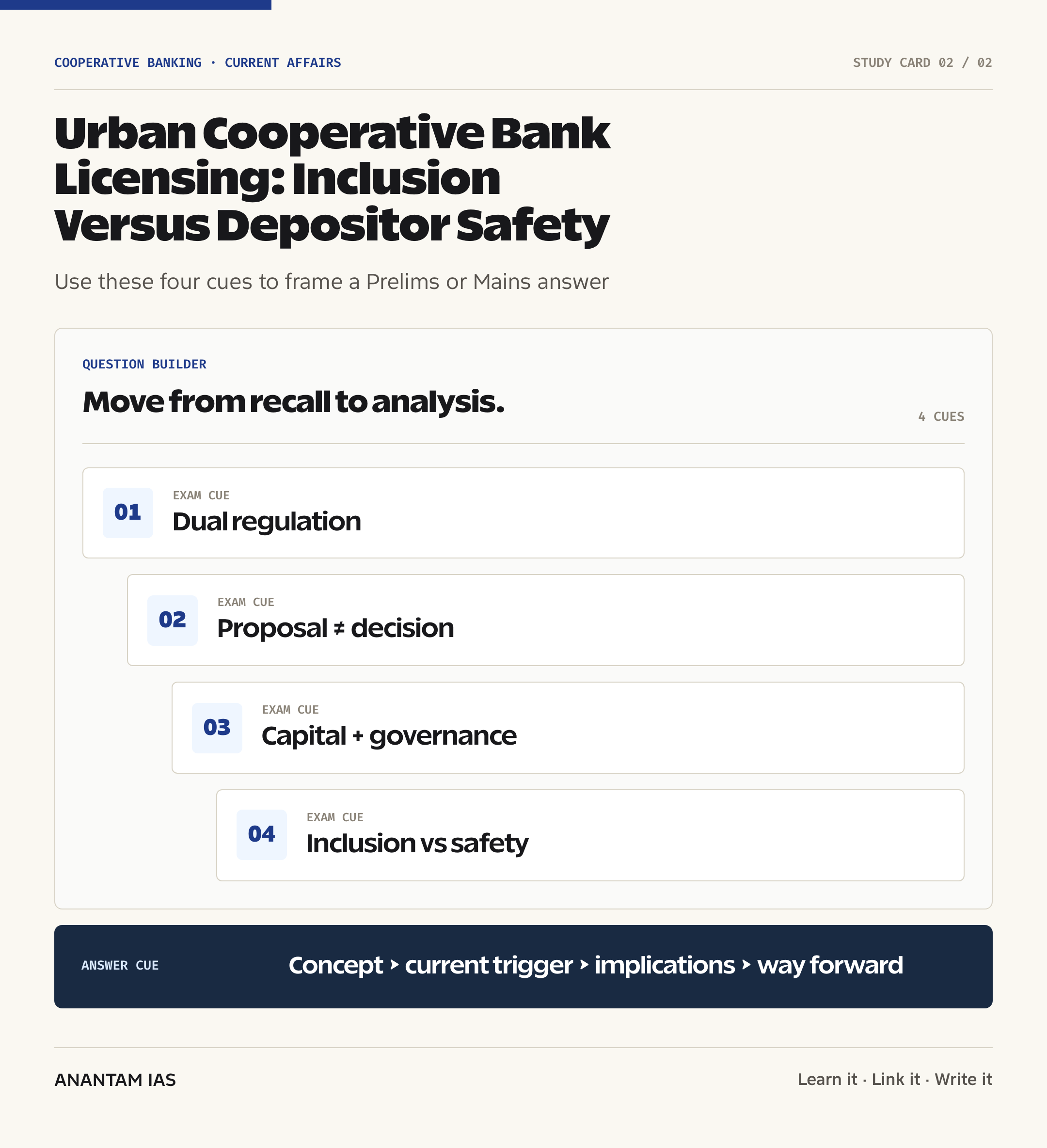
Dual regulation arises because a UCB is simultaneously a cooperative society and a banking institution.
- State List Entry 32 covers incorporation, regulation and winding up of cooperative societies within a State, while Union List Entry 45 covers banking.
- The State Registrar or Central Registrar handles the society’s registration, bye-laws, elections and other cooperative-law matters, depending on whether the entity is single-state or multi-state.
- RBI controls the banking function: licensing, prudential regulation, inspection, capital standards, restrictions, corrective action and cancellation of a bank licence.
- Banking laws first became applicable to cooperative societies in March 1966, creating the long-standing duality of jurisdiction.
- The 2020 amendment brought RBI’s regulatory and supervisory powers over UCBs closer to those used for commercial banks, especially for governance, audit and resolution.
- But the amendment didn’t erase the cooperative society’s legal identity or every role of the registrar. Coordination problems can still arise when banking directions require action under a separate cooperative law.
- The federal seam is also visible in the Banking Laws Amendment Act, which adjusted cooperative-bank governance without converting UCBs into commercial companies.
Why RBI Paused New Licences
The licensing pause followed evidence that rapid entry had produced too many weak institutions.
- After licensing norms were liberalised in May 1993, RBI issued 823 UCB licences up to June 2001.
- RBI later found that 31% of these newly licensed UCBs became financially unsound within a short period.
- In June 2004, RBI decided to consider fresh licences only after a comprehensive policy and a stronger legal and regulatory framework were in place.
- The screening approach increasingly favoured graduation from an established cooperative credit society with a demonstrated, verifiable track record rather than a newly created entity.
- A comprehensive policy in 2005 focused on financial health, coordination with governments and consolidation through mergers or closure of non-viable UCBs.
- The total number of UCBs fell from 2,104 on 31 December 2003 to 1,457 on 31 March 2025, reflecting consolidation as well as licence cancellation.
- The pause was a prudential response to experience, not a statutory ban imposed by Parliament. RBI can revisit entry policy, but it must still preserve the conditions in Section 22 governing a sound banking licence.
What RBI's 2026 Discussion Paper Actually Says
The paper opens a consultation and sketches safeguards; it doesn’t itself authorise a new bank.
- RBI released the paper on 13 January 2026 and sought public comments by 13 February on whether licensing should resume and what eligibility rules should apply.
- It tentatively favours starting with large cooperative credit societies, because established societies offer a longer record of governance and operating performance.
- A society would need at least ₹300 crore capital as on 31 March of the previous financial year merely to be eligible to apply under the proposed approach.
- The paper suggests at least 10 years of active operations and a good financial track record for at least five years.
- At the licensing stage, the proposed financial tests include assessed CRAR of at least 12% and net NPA not exceeding 3%.
- A wider geographic footprint is preferred for diversification and viability; multi-state societies may be favoured, though a compliant single-state society with sufficient spread could be considered.
- RBI says that after examining comments it may issue detailed draft guidelines for another round of public feedback. That sequencing confirms the July ministry request remains part of a live policy process.
The Sector Is Stronger but Still Uneven
Aggregate improvement supports reconsideration, while the distribution of weakness argues for strict entry norms.
- RBI counted 1,457 UCBs on 31 March 2025: 838 Tier 1, 535 Tier 2, 78 Tier 3 and six Tier 4 banks.
- The sector held ₹7.38 lakh crore in assets and ₹5.84 lakh crore in deposits at that date.
- Average CRAR was 18%, and 92% of UCBs had capital ratios above 12%, compared with 83% in 2015.
- Gross NPA stood at 6.2%, net NPA at 0.7% and provision coverage at 90.1%. These figures show stronger provisioning but don’t remove the burden of stressed assets.
- RBI reported 82 weak UCBs under various supervisory restrictions: 28 under All-Inclusive Directions, 32 under Prompt Corrective Action and 22 under the earlier Supervisory Action Framework.
- All 57 insolvent UCBs whose licences were cancelled in the disaggregated 2020-21 onward data were in Tiers 1-3, supporting RBI’s caution about small-bank failure.
- The latest aggregate health can be compared with Anantam IAS’s review of the RBI banking stability report, but UCBs require a separate risk lens from scheduled commercial banks.
Why the Ministry Wants Wider Coverage
The ministry’s case rests on geographic imbalance and the cooperative model’s potential to serve local borrowers.
- At the July event, RBI Central Board member Satish K. Marathe estimated that nearly 1,100 of about 1,450 UCBs were concentrated in Maharashtra, Gujarat and Karnataka.
- Those event figures are approximate and date-specific, while RBI’s formal March 2025 count is 1,457. Both indicate strong regional concentration rather than uniform national reach.
- A well-run UCB can use local information to assess small traders and enterprises that lack long credit histories or standard collateral.
- Member ownership can support relationship banking, local accountability and the recycling of community savings into community credit.
- New entrants in underserved towns could add competition, but a bank without scale, technology or diversified deposits may simply relocate risk rather than solve exclusion.
- Existing UCB branch expansion, small finance banks, business correspondents and digital public infrastructure are alternative ways to extend service. New licences should be compared against these channels, not treated as the only path.
- The wider cooperative-development context is covered in Anantam IAS’s note on India’s cooperative-sector reform push.
The Policy Tradeoffs
Licensing must reconcile cooperative participation with the non-negotiable duties of a deposit-taking institution.
- Inclusion versus viability: a small local bank may reach neglected borrowers, but a narrow customer and geographic base can create concentration risk.
- Democracy versus expertise: one-member-one-vote protects cooperative character, but elected boards may lack banking, risk, technology or treasury expertise.
- Local capital versus loss absorption: refundable member shares and entry or exit at face value make cooperative capital less permanent and less attractive to outside investors.
- Development versus connected lending: community knowledge can improve underwriting, while political capture or loans to directors and related interests can destroy credit discipline.
- Proportionality versus parity: smaller banks need rules suited to their scale, but depositors deserve common floors for capital, audit, cyber security and fit-and-proper management.
- Expansion versus consolidation: licensing a new institution may fill a map gap, while allowing a sound UCB to expand could achieve the same reach with an existing systems and compliance record.
- Innovation versus operational risk: digital channels lower delivery costs, but weak cyber security, vendor dependence and fraud controls can expose thousands of small depositors.
Four-Tier Regulation and Safety Nets
RBI now uses differentiated regulation, but tiering does not dilute the core duty to protect depositors.
- Tier 1 covers unit and salary-earner UCBs and other UCBs with deposits below ₹100 crore; Tier 2 covers ₹100 crore to below ₹1,000 crore.
- Tier 3 covers ₹1,000 crore to below ₹10,000 crore; Tier 4 covers ₹10,000 crore or more.
- The current prudential framework prescribes a minimum CRAR of 9% for Tier 1 and 12% for Tiers 2-4, with transition arrangements for existing banks.
- RBI’s Prompt Corrective Action framework for Tiers 2-4 permits early supervisory intervention when capital, asset quality or profitability weakens; Tier 1 remains under enhanced monitoring.
- The National Urban Co-operative Finance and Development Corporation became functional as an umbrella organisation in February 2024, intended to support technology, liquidity and shared services.
- DICGC cover of up to ₹5 lakh per depositor per bank limits household loss in an insured bank failure, but insurance cannot replace sound governance or prevent service disruption.
- A new licensing policy should be judged by its entry filters, continuing supervision and credible exit tools together. A high starting capital number alone cannot prevent fraud or mismanagement.
Way Forward
Complete the consultation transparently
- RBI should publish a reasoned response to stakeholder feedback and issue draft licensing guidelines before reopening applications.
- The final policy should state clearly that meeting eligibility conditions creates a right to apply, not an automatic entitlement to a bank licence.
Prefer proven institutions and underserved markets
- Require a verifiable operating record, professional management, clean related-party conduct and strong capital and asset quality.
- Use objective service-gap data so new licences address genuine exclusion rather than duplicating banks in already concentrated markets.
Align cooperative and banking governance
- Create common fit-and-proper, board-skill and audit standards through coordination among RBI, RCS and CRCS.
- Where State or multi-state laws block professional governance, pursue targeted legal amendments before licensing expansion.
Make technology a licensing condition
- Test core banking, cyber security, fraud monitoring, business continuity and vendor governance before a society begins public banking.
- Use the umbrella organisation for shared services without outsourcing the board’s responsibility for operational risk.
Review alternatives before creating a bank
- Compare a new licence with branch expansion by sound UCBs, small finance bank coverage and digital or business-correspondent delivery.
- Apply a staged approach with a small number of licences, close supervision and a public evaluation before wider rollout.
Conclusion
The Cooperation Ministry has identified a real map problem: UCBs remain heavily concentrated in a few States. But geographic scarcity doesn’t by itself prove that a new bank is the safest or cheapest solution. The relevant benchmark is durable access to trustworthy credit, not the count of licences.
RBI’s cautious sequence is sound: discussion paper, stakeholder feedback, draft guidelines and only then a possible licensing framework. If entry resumes, the model should combine cooperative ownership with bank-grade capital, professional governance, cyber resilience and early supervisory action. Inclusion that leaves depositors carrying governance risk isn’t inclusion.
UPSC Practice Questions
Prelims MCQ 1
With reference to Urban Cooperative Banks in India, consider the following statements:
- They require a licence from RBI under the Banking Regulation Act, 1949.
- They may be registered under a State Cooperative Societies Act or the Multi-State Cooperative Societies Act, 2002.
- Their banking functions are supervised by NABARD.
How many of the above statements are correct?
(a) Only one (b) Only two (c) All three (d) None
Answer: (b) Only two
Explanation:
Statements 1 and 2 are correct. RBI regulates and supervises UCB banking functions. NABARD supervises State Cooperative Banks and District Central Cooperative Banks, not UCBs.
Prelims MCQ 2
Which one of the following best describes RBI’s January 2026 paper on new UCB licensing?
(a) It immediately reopened licensing for every registered cooperative society (b) It transferred UCB licensing authority to the Ministry of Cooperation (c) It began consultation and tentatively proposed stringent eligibility for large cooperative credit societies (d) It abolished the four-tier regulatory framework for existing UCBs
Answer: (c) It began consultation and tentatively proposed stringent eligibility for large cooperative credit societies
Explanation:
The paper sought feedback and said RBI may later issue detailed draft guidelines. Its tentative safeguards included ₹300 crore capital, operating and financial track records, prudential tests and a wider footprint.
UPSC Mains Questions
- The case for new urban cooperative banks rests on local financial inclusion, while the case for restraint rests on depositor safety. Examine this tradeoff in light of RBI’s 2026 licensing discussion paper and the sector’s governance history. (250 words)
- Dual regulation is both a constitutional feature and an operational challenge for urban cooperative banks. Explain the division of authority between RBI and cooperative registrars, and suggest safeguards for any future reopening of the licensing window. (250 words)
Sources: Reserve Bank of India Discussion Paper and The Indian Express.
Frequently Asked Questions
What is an urban cooperative bank?
An urban cooperative bank is a cooperative society that has obtained an RBI licence to conduct banking business as a primary cooperative bank. It combines member-based ownership with banking functions such as accepting deposits and making loans. Its cooperative identity is governed by State or multi-state law, while RBI regulates its banking activities.
Has RBI reopened UCB licensing?
No final reopening follows merely from the January 2026 discussion paper or the Cooperation Ministry’s July request. RBI invited feedback on whether and how licensing should resume and said it may issue detailed draft guidelines afterward. A final framework and individual RBI approvals would still be required before a new UCB could operate.
Why were new licences paused?
RBI paused fresh licensing in 2004 after rapid entry produced weak banks. Of 823 UCB licences issued between May 1993 and June 2001, RBI found that 31% became financially unsound within a short period. The subsequent policy prioritised consolidation, stronger regulation and established credit societies with verifiable records.
What does dual regulation mean?
A UCB is regulated under two legal tracks. The State Registrar or Central Registrar oversees the cooperative society under the applicable cooperative law. RBI licenses and supervises its banking business under the Banking Regulation Act. The 2020 amendment strengthened RBI’s powers, but it didn’t eliminate the cooperative-law role of registrars.
What safeguards did RBI propose?
The discussion paper tentatively suggested large cooperative credit societies with at least ₹300 crore capital, 10 years of active operations, five years of good financial performance, CRAR of at least 12%, net NPA not above 3% and a wider geographical footprint. These are consultation proposals, not final licensing conditions.
Why are UCBs geographically concentrated?
The July policy discussion cited an estimate that nearly 1,100 of roughly 1,450 UCBs were in Maharashtra, Gujarat and Karnataka. The cooperative movement developed unevenly across States, producing strong regional clusters. Any response must compare new licences with expansion by sound existing banks and other inclusion channels.
Source: https://anantamias.com/current-affairs/urban-cooperative-bank-licensing-policy/
Processed Foods: ICMR-NIN Proposes a Two-Axis Test
Why in News?
Scientists at the ICMR-National Institute of Nutrition have proposed a dual-axis framework for food policy: one axis assesses the degree of processing, while the other assesses nutrients of concern such as fat, sugar and sodium.
The proposal builds on the Dietary Guidelines for Indians 2024 and could inform future front-of-pack labels, health-claim controls, marketing restrictions and school-food policy. It is a research-based regulatory recommendation, not a new rule, statutory definition or immediate ban.
- The Hindu reported that researchers see a gap because India lacks a formal regulatory definition that comprehensively captures ultra-processed foods.
- A food may be heavily industrially processed without crossing every nutrient threshold, while a freshly prepared food may be high in fat, sugar or salt without being ultra-processed.
- The proposed framework tries to prevent either axis from hiding the other and to reflect Indian foods and culinary practices.
- ICMR-NIN Director Dr. Bharati Kulkarni linked evidence-based food policy to India’s simultaneous burdens of undernutrition, obesity and diet-related non-communicable diseases.
- Lead scientist SubbaRao M. Gavaravarapu presented the approach as a basis for future labelling, consumer awareness and policy decisions, not as an already-notified FSSAI regulation.
The development matters in the context of:
- The issue matters because food regulation must distinguish necessary processing, which can improve safety and shelf life, from formulations designed around additives, refined ingredients and high palatability.
- It also matters for the design of front-of-pack nutrition labelling: a simple score can conceal a serious nutrient excess or create a health halo after limited reformulation.
- For UPSC answers, separate scientific classification, dietary guidance and enforceable food law. They influence one another but have different legal effects.
UPSC Relevance
Prelims Relevance
- ICMR-NIN is a nutrition research institute under the Indian Council of Medical Research, Department of Health Research, Ministry of Health and Family Welfare.
- FSSAI is the statutory food regulator established under the Food Safety and Standards Act, 2006.
- Ultra-processed food focuses on extensive industrial alteration, refined ingredients and additives not commonly used in domestic cooking; it is not simply another name for high-calorie food.
- HFSS refers to foods high in fat, sugar or salt; a product can be HFSS without being ultra-processed.
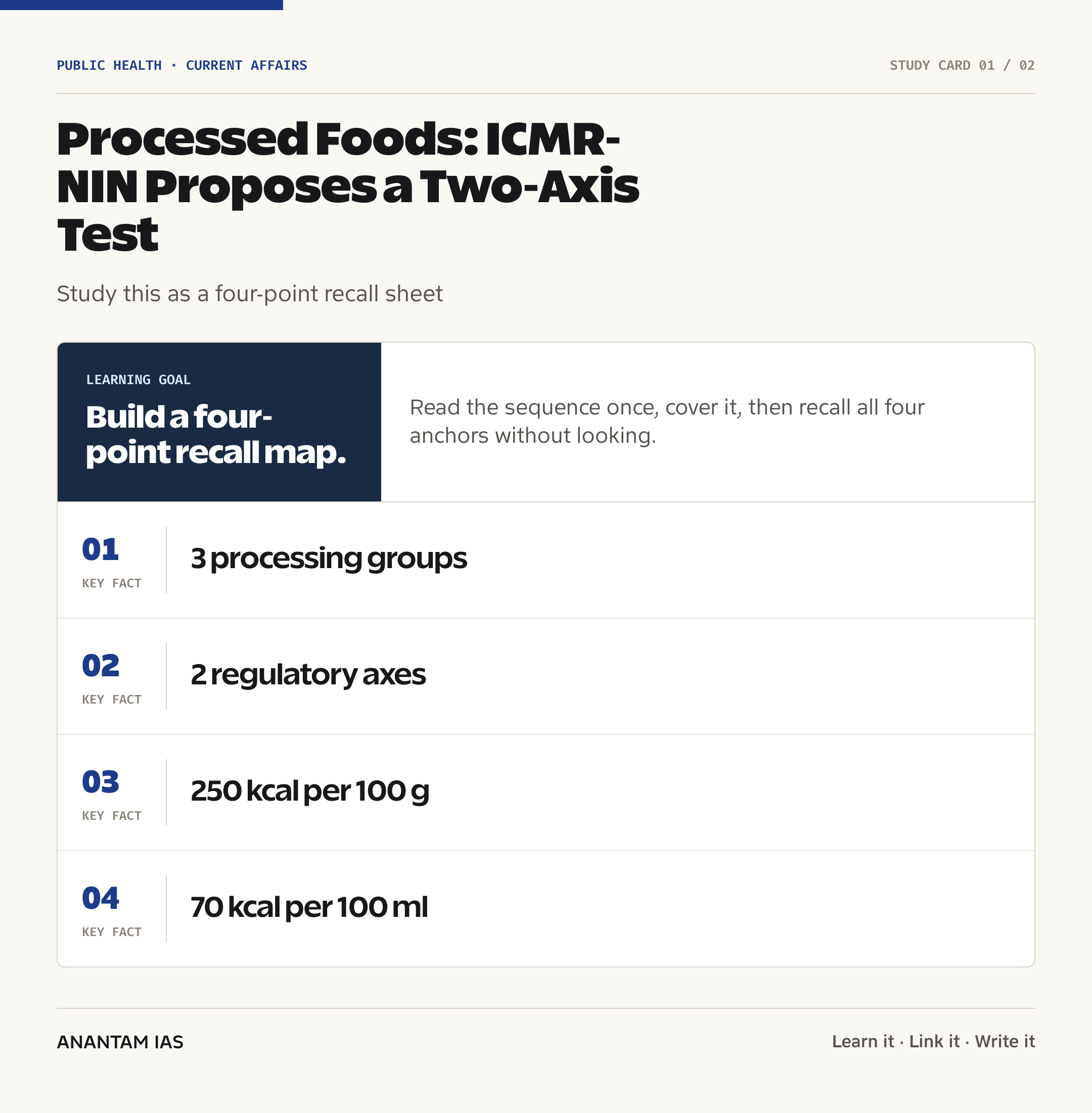
- The ICMR-NIN guidance uses processing groups A, B and C for minimal, moderate and extensive processing, then overlays nutrient-risk categories.
- The guidance threshold for 100 g of solid food is 250 kcal, 4.2 g added fat, 3 g added sugar and 625 mg salt; these are reference criteria, not current statutory limits for every food.
- For 100 ml of a liquid, the corresponding guidance values are 70 kcal, 1.5 g added fat, 2 g added sugar and 175 mg salt.
- WHO’s adult recommendation is less than 2,000 mg sodium per day, equivalent to less than 5 g salt; a daily dietary goal is not the same as a per-product threshold.
- The Food Safety and Standards (Safe Food and Balanced Diets for Children in School) Regulations, 2020 restrict specified HFSS foods in school premises and within 50 metres of school gates.
- The wider regulator-and-enforcement context is explained in the Anantam IAS State Food Safety Index note.
Mains Relevance
GS Paper 2
- Examine food labelling and marketing controls as instruments of the right to health, consumer information and preventive public health.
- Analyse why protecting children requires coordinated action across health, education, food regulation, schools and local enforcement.
- Assess the challenge of regulating commercial food environments while India still faces a double burden of malnutrition.
GS Paper 3
- Connect food reformulation and processing standards with food-industry innovation, testing capacity, compliance costs and responsible consumption.
- Discuss how clear classification can reduce information asymmetry without treating every form of preservation, fortification or food processing as harmful.
Essay
- A label informs only when it reveals the risk that marketing tries to hide.
- Public health must address both scarcity and excess because malnutrition can take opposite forms in the same household.
- Good regulation turns complex science into simple choices without turning simplicity into distortion.
Background and Context
What the Proposed Two-Axis Framework Measures
The proposal treats processing and nutrient composition as related but independent dimensions of food quality.
- The processing axis asks how far the edible portion has been altered, whether native fibre and micronutrients are lost, and whether industrial additives or techniques substantially reshape the product.
- ICMR-NIN’s Group A broadly covers unaltered or minimally altered foods prepared with familiar ingredients and without cosmetic or preservative additives.
- Group B covers moderate alteration or preservation, such as drying, freezing, fermenting, baking or canning, while retaining a recognisable food base and avoiding the additive profile associated with extensive processing.
- Group C covers extensively processed formulations whose original food structure is substantially altered, often with additives used for shelf life, texture, colour, flavour or high palatability.
- The nutrient axis asks whether energy, added fat, added sugar and salt remain within guidance thresholds. Foods above the reference levels can enter higher HFSS categories within any processing group.
- This creates a matrix rather than a single ladder. A food can be minimally processed but HFSS, extensively processed but below selected nutrient cut-offs, or high-risk on both axes.
Why UPF and HFSS Are Not Synonyms
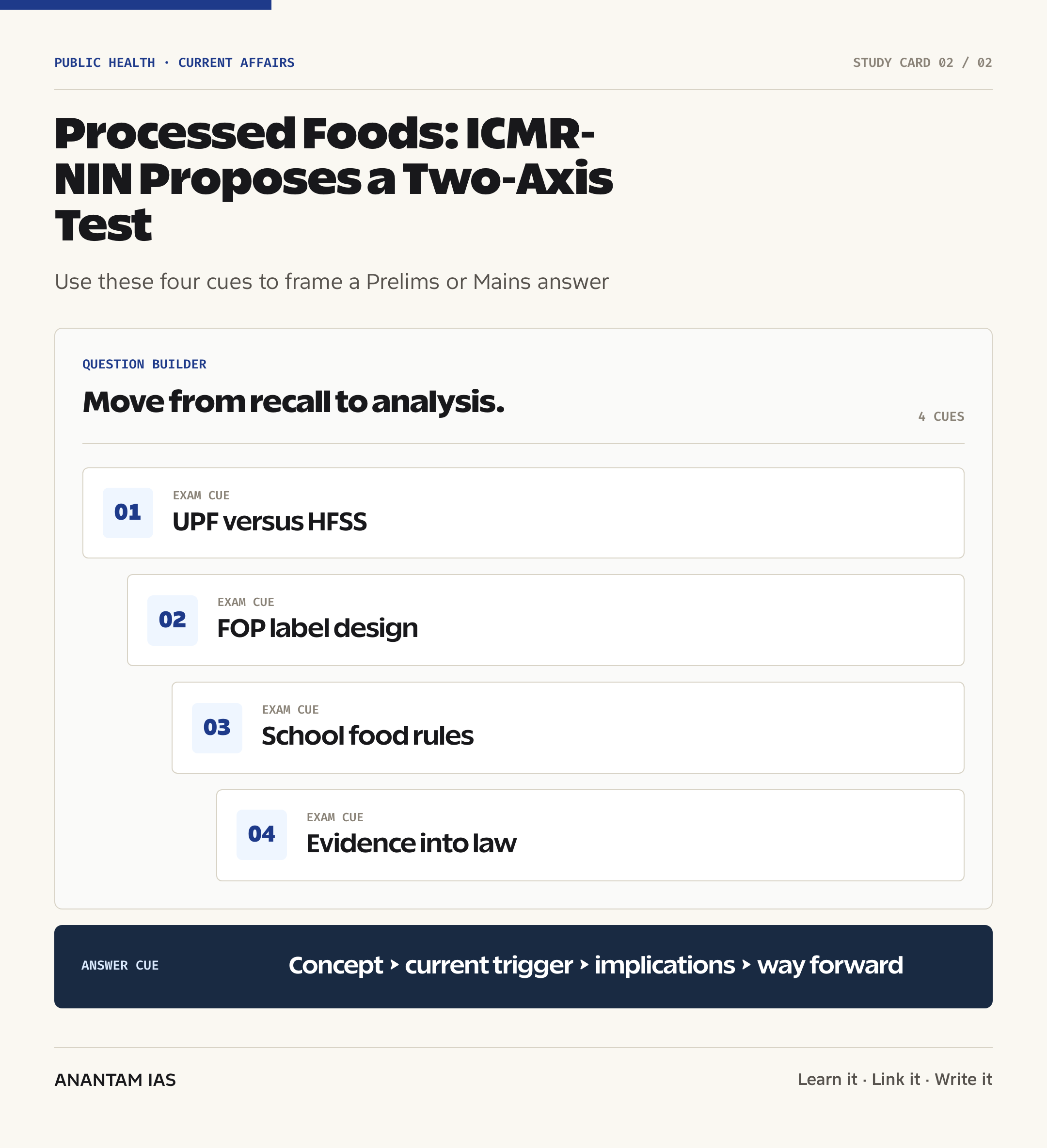
The distinction prevents policy from equating the manufacturing process with the final nutrient profile.
- UPF classification focuses on industrial formulation, food-matrix alteration, refined fractions, additives and distance from ordinary culinary preparation.
- HFSS classification focuses on specified nutrients of concern. A home-made sweet or deep-fried snack may be HFSS even if it has no industrial additive.
- A pasteurised food, frozen vegetable or fermented food has undergone processing for safety, preservation or access; processing by itself does not establish poor nutritional quality.
- A product can be reformulated to reduce one nutrient and still remain extensively processed, fibre-depleted or dependent on cosmetic additives. The processing axis limits this reformulation health halo.
- The reverse warning also matters: calling a product minimally processed should not excuse excessive salt, sugar or fat. The nutrient axis keeps traditional and freshly prepared HFSS foods visible.
- A sound rule should classify risk without moralising food or blaming consumers. Price, availability, advertising, time poverty and school environments shape what people eat.
Verified ICMR-NIN Thresholds
The numerical values come from the 2024 dietary guidelines and must be presented as guidance criteria rather than notified legal limits.
- For solid food per 100 g, ICMR-NIN Table 15.1 lists 250 kcal, 4.2 g added fat, 3 g added sugar and 625 mg salt as the reference criteria.
- For liquids per 100 ml, it lists 70 kcal, 1.5 g added fat, 2 g added sugar and 175 mg salt.
- The guidelines explain that the solid-food sugar threshold approximates 5% of energy from added sugar, with total sugar not exceeding 10% of energy.
- The solid-food added-fat threshold approximates 15% of energy from added fat, with total fat not exceeding 30% of energy.
- For beverages, the guidance uses about 10% of energy from added sugar, with total sugar not exceeding 30% of energy, and about 15% of energy from added fat.
- These product-level reference values should not be confused with WHO population intake goals: free sugars below 10% of daily energy, saturated fat no more than 10%, trans fat no more than 1%, and sodium below 2,000 mg daily for adults.
- Differences in denominator matter. A per-100 g threshold helps compare products, while a daily-intake recommendation considers the whole diet and quantity consumed.
Public-Health Rationale and Burden
The proposal responds to a food environment in which nutrient excess and intensive processing can reinforce obesity and diet-related disease.
- WHO identifies unhealthy diet as a major risk factor for cardiovascular disease, diabetes, stroke and some cancers, while stressing adequacy, balance, moderation and diversity.
- WHO estimates that excess sodium was associated with 1.7 million deaths globally in 2023; it recommends product reformulation, front-of-pack labels, healthier public procurement and behaviour-change communication.
- The official ICMR-INDIAB estimate placed diabetes at about 101 million people and prediabetes at about 136 million in India. These figures show metabolic-disease scale, but they do not prove that any single processed food caused an individual’s disease.
- WHO’s country profile estimated age-standardised adult obesity in India at 7.3% in 2022 using the BMI threshold of at least 30 kg/m². Different studies may use different age groups and Asian-Indian cut-offs, so figures shouldn’t be mixed casually.
- India also retains undernutrition and micronutrient deficiencies. The dual burden is explained in Anantam IAS’s malnutrition guide.
- The two-axis model can support prevention, but it should be one part of a wider response that includes affordable healthy foods, physical activity, primary care, screening and action on commercial determinants.
What Current Indian Law Already Does
India already regulates food safety, nutrition declarations, school food and claims, but the proposed matrix has not automatically become part of those rules.
- The Food Safety and Standards Act, 2006 empowers FSSAI to set science-based standards and regulate manufacture, storage, distribution, sale and import.
- The Labelling and Display Regulations, 2020 require nutrition information on packaged foods, including relevant declarations for energy, sugars, fat and sodium.
- The Advertising and Claims Regulations, 2018 require claims to be truthful, meaningful and not misleading; adding a positive nutrient cannot justify an unsupported disease-prevention claim.
- The school-food regulations of 2020 restrict sale and marketing of specified HFSS products to children on school premises and within 50 metres of the school gate.
- FSSAI’s 2022 proposal for an Indian Nutrition Rating and a formal front-of-pack HFSS system is still identified as a draft on the regulator’s notification archive. A draft invites comments; it does not create the same duty as a final gazette notification.
- The new ICMR-NIN proposal may inform future amendments, definitions or guidance, but research recommendations do not amend regulations by themselves.
- For broader preventive-health framing, see this Anantam IAS current-affairs note.
Possible Regulatory Uses
If validated and adopted through due process, the matrix could give different policy tools a common food-classification base.
- A front-of-pack system could display a clear nutrient warning while separately signalling extensive processing, rather than compressing both into one favourable average score.
- Marketing rules could use the matrix to restrict promotion of products that are HFSS, extensively processed or both, especially when advertisements target children.
- School procurement standards could favour minimally processed, nutrient-appropriate foods and apply consistent exclusion criteria to canteens, vending and nearby sales.
- Health-claim review could prevent a manufacturer from adding fibre, protein or vitamins and presenting an otherwise high-risk product as fully healthy.
- Fiscal policy could distinguish product classes for taxes or incentives, but any levy needs evidence on substitution, affordability and distributional effects.
- Reformulation targets could be food-category specific. The technically feasible sodium reduction in bread may differ from that in pickles, sauces or regional preparations.
- Public procurement and nutrition education can translate the framework into food environments, while enforcement must remain led by government and protected from conflicts of interest.
Design and Implementation Challenges
A scientifically appealing matrix still needs clear definitions, validation and administratively workable rules.
- Regulators must define which additives or industrial processes move a product into the highest processing group and ensure that independent assessors reach consistent classifications.
- Manufacturers need rules for composite foods, restaurant meals, artisanal products, fortified staples and products sold after preparation from a commercial premix.
- The framework needs an accurate nutrient database, standard laboratory methods and a rule for whether values are measured as sold, as prepared or per serving.
- Per-100 g comparisons improve consistency but can mislead when normal portion sizes differ sharply. Per-serving information also risks manipulation through unrealistically small declared servings.
- A label must be readable across literacy levels and languages. Consumer testing should compare warnings, traffic lights and summary ratings before choosing a national design.
- Small businesses may need phased compliance and technical support, but high-risk products should not gain open-ended exemptions that weaken public-health protection.
- Government should publish the evidence, conflict-of-interest safeguards, consultation record and final rationale before notifying any binding classification.
- Post-implementation evaluation should track product reformulation, purchases, dietary intake and equity, not merely the number of labels printed.
Way Forward
Validate the Matrix
- Test inter-rater reliability, nutrient thresholds and classification outcomes across Indian packaged, restaurant and traditional foods.
- Publish a searchable examples database and a transparent method for resolving borderline products.
Use Formal Rulemaking
- FSSAI should move from evidence to a draft, public consultation, scientific review and final gazette notification before imposing duties.
- The final instrument should specify coverage, exemptions, transition periods, testing and penalties.
Protect Children First
- Align school-food enforcement, digital marketing rules and procurement standards around a consistent, evidence-based definition.
- Strengthen monitoring within the existing 50-metre school zone and across online advertising.
Pair Labels with Food-System Action
- Combine simple labels with reformulation, healthy public procurement, nutrition literacy and affordable access to minimally processed foods.
- Measure whether the policy changes diets and disease risks across income groups, not only whether consumers recall the logo.
Conclusion
ICMR-NIN’s proposed dual-axis framework improves the policy question. It asks not only what nutrients a food contains, but also what industrial processing has done to its structure, ingredients and role in the diet.
Its strongest contribution is preventing false equivalence: UPF and HFSS overlap but aren’t identical. That distinction can sharpen labels, claims, school rules and marketing controls.
The next step is lawful, transparent conversion from evidence to regulation. India needs validated definitions, tested labels, public consultation and enforceable standards, while retaining healthy forms of preservation and processing.
UPSC Practice Questions
Prelims MCQ 1
With reference to the proposed ICMR-NIN dual-axis framework, consider the following statements:
- It assesses the degree of food processing separately from nutrients such as fat, sugar and sodium.
- Every food that is high in fat, sugar or salt must also be ultra-processed.
- The proposal itself has the force of a final FSSAI regulation.
How many of the above statements are correct?
(a) Only one (b) Only two (c) All three (d) None
Answer: (a) Only one
Explanation:
Only Statement 1 is correct. HFSS and UPF are distinct axes, so either can occur without the other. The ICMR-NIN framework is a policy proposal based on dietary guidance; it does not acquire legal force without adoption through the applicable FSSAI rulemaking process.
Prelims MCQ 2
Which one of the following correctly distinguishes a WHO intake recommendation from an ICMR-NIN product threshold?
(a) Both always use the same denominator and legal status (b) WHO’s adult sodium goal concerns total daily intake, while ICMR-NIN reference values can compare a fixed quantity of food (c) WHO recommendations apply only to packaged food manufacturers (d) ICMR-NIN thresholds are criminal prohibitions under the Food Safety and Standards Act
Answer: (b) WHO's adult sodium goal concerns total daily intake, while ICMR-NIN reference values can compare a fixed quantity of food
Explanation:
WHO’s sodium recommendation is a population dietary goal of less than 2,000 mg per adult per day. ICMR-NIN’s table supplies per-100 g or per-100 ml reference criteria. Their denominators and present legal roles differ.
UPSC Mains Questions
- India’s processed-food debate cannot be resolved by nutrient profiling or processing classification alone. Explain the logic of ICMR-NIN’s proposed dual-axis framework and assess how it could improve front-of-pack labels, school-food policy and health claims without treating all food processing as harmful. (250 words)
- Scientific recommendations become legitimate public-health regulation only through clear definitions, validation, consultation and enforceable standards. Discuss this proposition with reference to FSSAI’s existing labelling, advertising and school-food architecture and the proposed classification of ultra-processed and HFSS foods. (250 words)
Sources: ICMR-NIN Dietary Guidelines for Indians 2024 and The Hindu.
Frequently Asked Questions
What are the framework’s two axes?
The first axis measures the extent and purpose of processing, including alteration of the food matrix, nutrient loss and industrial additives. The second measures nutrients of concern, especially fat, sugar and sodium. Reading both axes prevents a favourable result on one dimension from concealing risk on the other.
Are UPF and HFSS identical?
No. Ultra-processed food is classified mainly by industrial formulation and processing characteristics. HFSS classification focuses on high fat, sugar or salt. A freshly prepared sweet can be HFSS without being ultra-processed, while a heavily formulated product may remain extensively processed after reducing one nutrient.
Is the proposal current law?
No. It is an ICMR-NIN research and policy recommendation building on the Dietary Guidelines for Indians 2024. FSSAI would need to adopt any binding definition or label through the relevant statutory process. Existing nutrition labels, advertising controls and school-food rules continue to operate independently.
What thresholds does ICMR-NIN use?
For 100 g of solid food, the guidance lists 250 kcal, 4.2 g added fat, 3 g added sugar and 625 mg salt. For 100 ml of liquid, it lists 70 kcal, 1.5 g added fat, 2 g added sugar and 175 mg salt. They are guidance criteria, not universal statutory limits.
Why not regulate nutrients alone?
Nutrient-only rules can encourage limited reformulation that earns a favourable score while leaving extensive processing, fibre depletion or additive dependence unexamined. The processing axis makes those characteristics visible. Nutrient thresholds remain necessary because minimally processed and freshly prepared foods can still contain excessive fat, sugar or salt.
How could the framework protect children?
A validated classification could align school procurement, canteen restrictions, front-of-pack labels and marketing controls. India already restricts specified HFSS foods in and around schools. A clearer common definition could improve enforcement, but it should be adopted transparently and paired with affordable healthy choices and nutrition education.
Source: https://anantamias.com/current-affairs/icmr-nin-processed-food-dual-axis-framework/
Ganga Water Treaty: A Broader Renewal Test
Why in News?
An Indian Express opinion column published on 28 July argued that India and Bangladesh should use the approaching end of the 1996 Ganga Water Treaty‘s 30-year term to look beyond dry-season allocation at Farakka. It proposed a wider agenda covering climate risk, flood forecasting, ecology, navigation, federal consultation and stronger institutions.
Those recommendations are the author’s analysis, not adopted policy or agreed treaty language. The official baseline remains the treaty signed on 12 December 1996, while a June 2024 India-Bangladesh announcement recorded a decision to begin technical-level discussions for renewal.
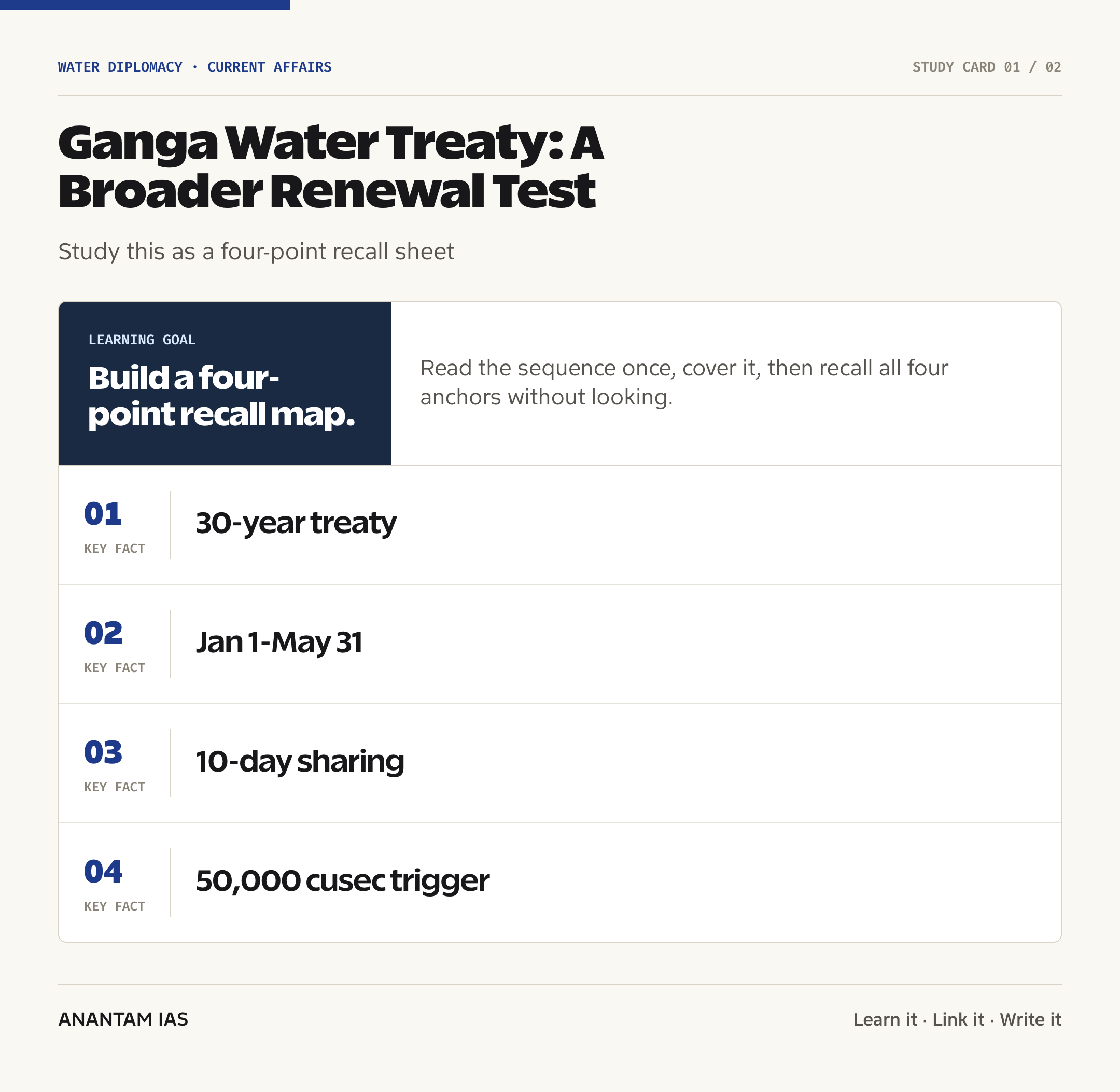
- Treaty period: the agreement remains in force for 30 years and is renewable by mutual consent.
- Sharing window: Ganga flows at Farakka are shared from 1 January to 31 May in 10-day periods.
- Monitoring: joint teams observe flows at Farakka and Hardinge Bridge under a bilateral Joint Committee.
- Official continuity: India’s 2024 statement announced technical-level renewal discussions; it did not endorse every expansion proposed in the opinion column.
- Renewal question: whether to preserve a focused allocation treaty or add risk-management functions requires negotiation by both governments.
The development matters in the context of:
- The issue matters in the context of India-Bangladesh relations, where shared rivers combine foreign policy with state-level politics and livelihood concerns.
- It tests whether a fixed sharing formula can remain credible when river flow varies across seasons and years.
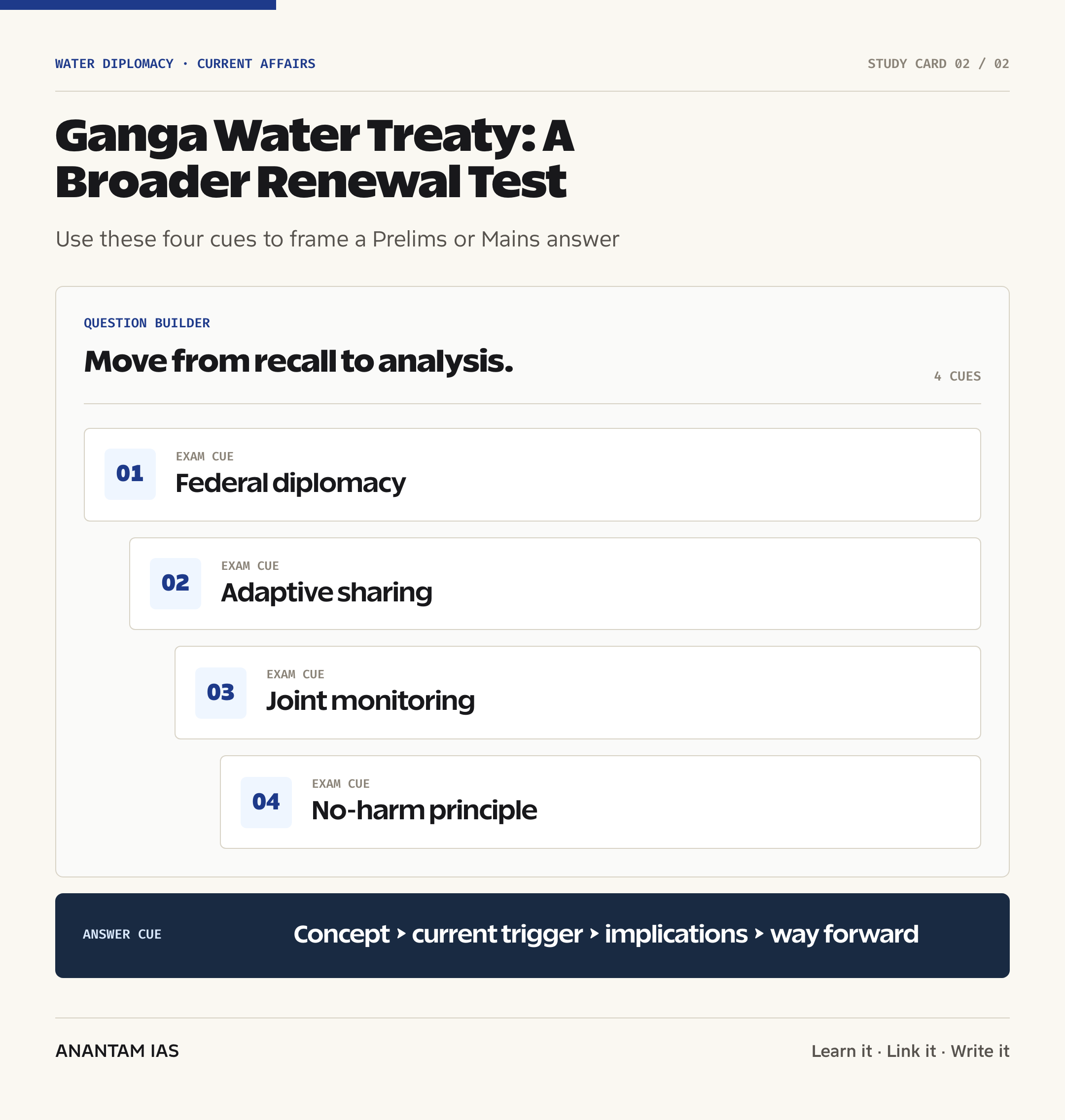
- It also raises a design choice between a narrow allocation agreement and broader adaptive river governance based on data, consultation and joint risk reduction.
UPSC Relevance
Prelims Relevance
- The treaty concerns sharing of the Ganga/Ganges waters at Farakka, not all common rivers between India and Bangladesh.
- Its annual sharing period is 1 January to 31 May, divided into 10-day blocks.
- At flows of 70,000 cusecs or less, India and Bangladesh receive equal shares.
- Between 70,000 and 75,000 cusecs, Bangladesh receives 35,000 cusecs and India receives the balance.
- At 75,000 cusecs or more, India receives 40,000 cusecs and Bangladesh receives the balance.
- If flow falls below 50,000 cusecs in a 10-day period, the governments must enter immediate emergency consultations.
- A bilateral Joint Committee implements the treaty and collects data; unresolved issues move to the Indo-Bangladesh Joint Rivers Commission.
- The Joint Rivers Commission has functioned since 1972 and is broader than the treaty-specific Joint Committee.
- Hardinge Bridge is a treaty observation location in Bangladesh; Farakka is the release and primary sharing point in India.
- The treaty is renewable by mutual consent; renewal is not automatic.
Mains Relevance
GS Paper 2
- Transboundary-water diplomacy as a test of neighbourhood policy, trust and reciprocal restraint.
- The role of West Bengal, Bihar and other domestic stakeholders in international river negotiations.
- Institutional design, dispute management and data credibility in India-Bangladesh relations.
GS Paper 3
- Dry-season allocation, flood risk, sediment, river morphology, ecology and inland navigation.
- Climate adaptation through flexible rules, shared observations and pre-agreed drought or flood responses.
- River-basin management that connects water quantity with water quality, fisheries and ecosystem functions.
Essay
- A shared river turns sovereignty into interdependence.
- Durable treaties allocate not only water but also uncertainty and trust.
- Federal diplomacy strengthens external agreements when affected regions have a voice.
Background and Context
What the 1996 treaty actually covers
The agreement is a focused dry-season sharing arrangement at one control point, not a complete Ganga-basin treaty.
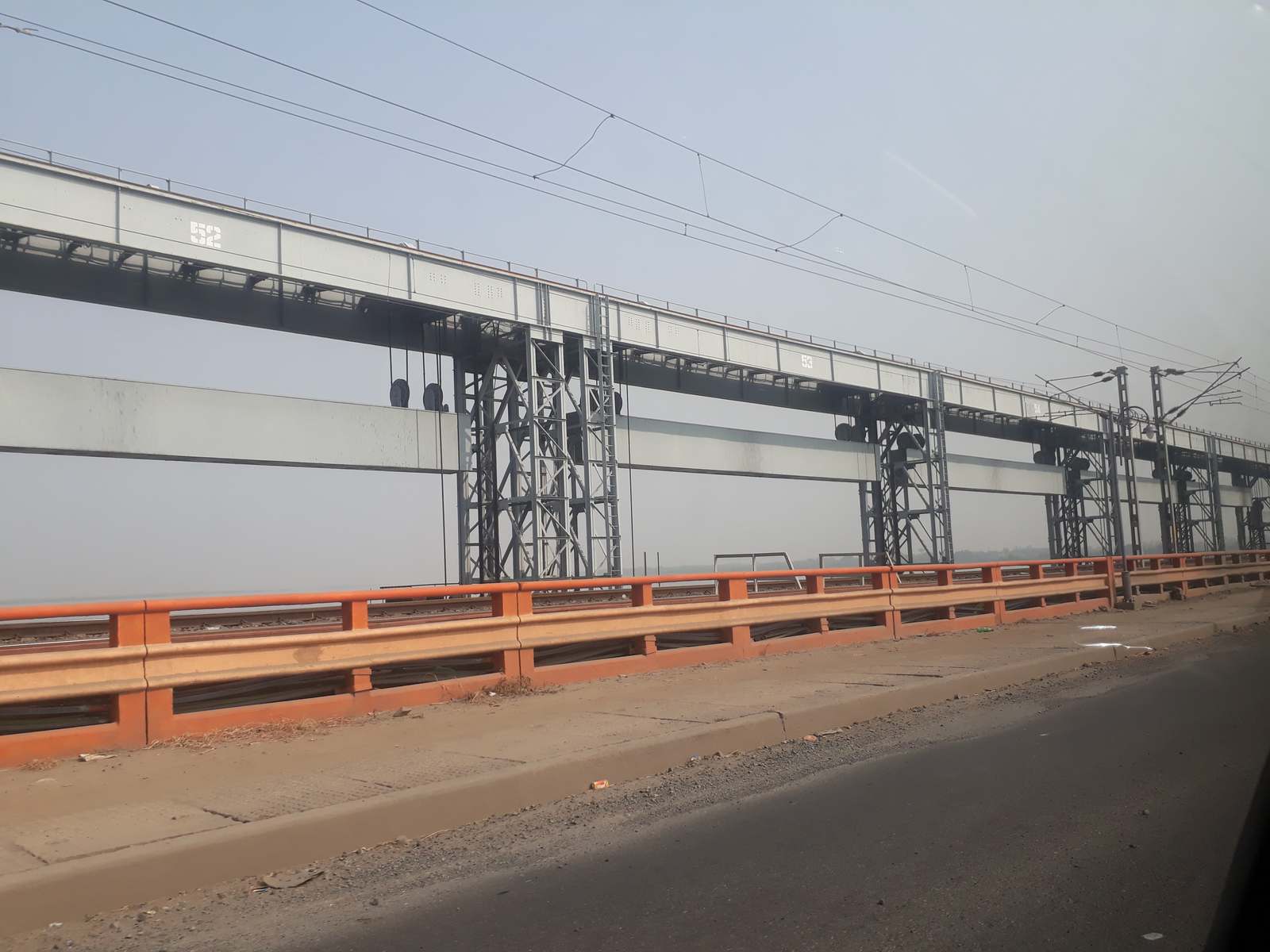
- Article I fixes Farakka as the point at which India releases the agreed quantum of water to Bangladesh.
- Article II applies the Annexure I formula in 10-day periods from 1 January to 31 May each year.
- The indicative schedule uses the 1949-1988 10-day average availability at Farakka as its historical reference.
- The upper riparian is to make every effort to protect flows at Farakka in line with that 40-year average availability.
- Article III limits Indian withdrawals below Farakka and before both banks lie in Bangladesh to reasonable uses not exceeding 200 cusecs.
- The agreement does not allocate monsoon flows, establish a whole-basin environmental-flow regime or settle sharing of the Teesta and other common rivers.
- Students can use the Farakka Barrage explainer for the structure’s role in the Bhagirathi-Hooghly system and Kolkata Port.
How the flow-sharing formula works
The formula changes with measured availability rather than promising both countries a fixed volume in every condition.
- When availability is 70,000 cusecs or less, the flow is divided equally between India and Bangladesh.
- When flow is between 70,000 and 75,000 cusecs, Bangladesh gets 35,000 cusecs and India receives the balance.
- When availability is 75,000 cusecs or more, India gets 40,000 cusecs and Bangladesh receives the balance.
- Each country is guaranteed 35,000 cusecs in alternate sets of three 10-day periods between 11 March and 10 May, subject to the Annexure condition.
- If availability falls below 50,000 cusecs in any 10-day period, both governments must consult immediately for an emergency adjustment based on equity, fair play and no harm.
- A cusec means one cubic foot per second. It measures discharge, not the total seasonal volume received by a country.
- The formula’s bands make measurement quality decisive: a dispute over discharge data can become a dispute over the share itself.
Institutions, measurement and disputes
The treaty creates a monitoring chain before a disagreement reaches the two governments.
- Article IV creates a Joint Committee with equal representation from India and Bangladesh.
- Its teams record daily flows below Farakka Barrage, in the Feeder Canal, at the Navigation Lock and at Hardinge Bridge.
- The Committee supplies collected data and a yearly report to both governments and examines implementation difficulties.
- An unresolved difference first goes to the Indo-Bangladesh Joint Rivers Commission; if it remains unresolved, the two governments meet urgently for mutual discussion.
- The Joint Rivers Commission was established in 1972 for wider cooperation on shared rivers, flood management and water-resource questions.
- India’s 2024-25 official reporting says the 86th Joint Committee meeting was held at Kolkata and Farakka on 4-6 March 2025 and noted joint measurements under the approved procedure.
- That official record supports continued implementation at that meeting; it does not settle every political, ecological or distributional criticism of the treaty.
Review, protection and renewal clauses
The treaty contains review mechanisms, but long-term continuation still depends on political consent.
- Article X allows review every five years or earlier when either party requests it, with adjustments guided by equity, fairness and no harm.
- Either party could seek the first review after two years to assess the working and impact of the arrangement.
- During the treaty period, if reviews produce no mutual agreement, Article XI protects a floor of 90% of Bangladesh’s formula share until agreed flows are decided.
- Article XII sets a 30-year term and says renewal is possible on the basis of mutual consent.
- The text does not prescribe automatic rollover, a compulsory arbitral tribunal or a ready-made replacement formula after the term.
- The official June 2024 announcement to start technical-level discussions is evidence of a renewal process, not proof that a final renewed text has been agreed.
- A renewal can retain the existing core, amend selected provisions or create linked instruments, but each route requires bilateral agreement.
Hydrology behind the diplomatic problem
Farakka discharge reflects a changing river system, so allocation cannot be understood from treaty percentages alone.
- Dry-season flow depends on antecedent monsoon rainfall, groundwater contribution, tributary inflows, upstream uses and channel conditions.
- Sediment transport and changing river morphology can alter conveyance, bank erosion, navigation and the performance of control structures.
- Climate change can shift the timing and intensity of rainfall and increase the probability of hydrological extremes, but it doesn’t produce one uniform flow trend in every season.
- Glacier and snow processes influence parts of the wider Ganga system, while monsoon rainfall remains a major driver; a renewal should use verified basin-specific evidence rather than a single climate slogan.
- Bangladesh’s downstream concerns include dry-season availability, salinity, agriculture, fisheries and ecosystem health; Indian concerns include Hooghly flows, navigation, local water needs and flood or sediment management.
- Claims that one structure alone caused a particular flood, siltation pattern or ecological change require site-specific hydrological analysis, not political assertion.
- A modern agreement could mandate transparent methods for updating reference flows, but that is a policy option and not part of the current treaty text.
Federal diplomacy inside India
An international agreement is negotiated by the Union, but its costs and benefits are experienced by states and river communities.
- Water is primarily in the State List, while Parliament can regulate and develop inter-State rivers in the public interest under Union List Entry 56.
- Foreign affairs and treaty-making lie with the Union, creating a need for structured consultation with affected states before an external commitment is finalised.
- West Bengal has direct interests in Farakka operation, the Bhagirathi-Hooghly system, navigation, water supply and local livelihoods.
- Bihar’s concerns about upstream sediment and flooding, cited in the opinion column, are stakeholder claims that should be tested through shared technical evidence.
- Federal consultation can identify minimum needs, acceptable flexibility and compensation or adaptation measures before positions harden publicly.
- State participation should inform the national negotiating mandate without turning a bilateral treaty into a veto contest among domestic actors.
- A standing Centre-state technical forum could review data and draft options, but today’s column presents this as a governance direction, not an announced mechanism.
What a broader renewal could add
The Indian Express column proposes moving from allocation alone toward shared-risk management, but none of these additions is yet agreed policy.
- A renewed framework could link allocation with flood forecasting, drought triggers, water-quality alerts and emergency communication.
- Joint ecological work could cover fisheries, wetlands, bank erosion and sediment, with indicators defined before compliance is assessed.
- Inland navigation and trade can create visible mutual gains, making cooperation valuable beyond a debate over who receives each cusec.
- Updated hydrological baselines could be reviewed at fixed intervals, while preserving predictability through transparent adjustment rules.
- A strengthened secretariat could support continuous data analysis, public summaries and technical mediation between formal Joint Rivers Commission meetings.
- Track 2 dialogue among researchers and former officials may widen options and build trust, but it cannot replace decisions by authorised governments.
- The Teesta River guide shows why other shared-river questions may influence political trust even though they remain legally outside the Ganga treaty.
Principles for transboundary river cooperation
A durable renewal needs predictable allocation and a method for dealing with conditions the original schedule did not anticipate.
- Equity is not the same as an equal split in every circumstance; it requires consideration of relevant needs, effects and basin conditions.
- The treaty itself invokes fairness and no harm, but does not create a general precedent beyond the rights and entitlements it expressly covers.
- Data sharing works only when both sides agree on observation sites, instruments, calibration, timing and treatment of missing measurements.
- Adaptive rules should be bounded: too little flexibility makes a treaty brittle, while unchecked discretion weakens predictability and trust.
- Dispute prevention through joint facts is usually cheaper than dispute settlement after national narratives have diverged.
- Public communication should distinguish measured flow, allocated share, delivered share and ecological outcome; these are related but not identical.
- For the wider relationship, see the India-Bangladesh relations overview covering connectivity, security and neighbourhood diplomacy.
Way Forward
Protect continuity first
- Both sides should prevent a legal vacuum through timely technical and political decisions based on mutual consent.
- Existing measurement and data-sharing work should continue while renewal terms are negotiated.
- Any interim arrangement should state its duration, formula and dispute path clearly.
Update the evidence base
- Jointly audit discharge series, instruments, reference periods and climate-risk assumptions.
- Publish agreed summaries that separate observed flow from allocation and delivery.
- Commission shared studies on sediment, ecology and extreme events rather than relying on competing national claims.
Create bounded adaptability
- Retain clear allocation bands while adding pre-agreed drought and flood triggers.
- Schedule periodic scientific reviews without making every seasonal variation a reopening of the treaty.
- Define how revised data can change future rules and how existing entitlements are protected during review.
Deepen institutional capacity
- Give the Joint Committee stronger technical support for modelling, ecological indicators and public reporting.
- Use the Joint Rivers Commission for cross-river coordination while keeping treaty-specific accountability visible.
- Add mediation or expert review stages if both governments agree they would resolve technical disputes faster.
Practise federal and public diplomacy
- Consult West Bengal, Bihar and affected communities through a structured evidence-led process.
- Engage Bangladeshi stakeholders without treating domestic criticism as hostility to bilateral cooperation.
- Label proposals, negotiating positions and adopted commitments accurately to protect public trust.
Conclusion
The 1996 Ganga Water Treaty has value because it converted a long dispute into a measurable sharing arrangement with joint monitoring. Its renewal should preserve that predictability rather than discard it for an undefined vision of basin cooperation.
But continuity need not mean institutional stasis. India and Bangladesh can pair a clear Farakka formula with updated data, bounded adaptation, federal consultation and joint management of floods, droughts and ecological risks. The opinion column opens that debate; only bilateral negotiation can turn any proposal into policy.
UPSC Practice Questions
Prelims MCQ 1
With reference to the 1996 Ganga Water Treaty, consider the following statements:
- It applies to 10-day sharing periods from 1 January to 31 May.
- It provides equal sharing whenever availability at Farakka is 70,000 cusecs or less.
- It renews automatically for another 30 years unless either party objects.
How many of the above statements are correct?
(a) Only one (b) Only two (c) All three (d) None
Answer: (b) Only two
Explanation:
Statements 1 and 2 are correct under Article II and Annexure I. Statement 3 is incorrect because Article XII makes renewal dependent on mutual consent.
Prelims MCQ 2
Which institution first examines an implementation difficulty under the Ganga Water Treaty?
(a) SAARC Secretariat (b) International Court of Justice (c) Treaty Joint Committee (d) Central Water Commission alone
Answer: (c) Treaty Joint Committee
Explanation:
The bilateral Joint Committee implements the arrangement and examines difficulties. An unresolved issue moves to the Indo-Bangladesh Joint Rivers Commission and later to the two governments for urgent mutual discussion.
UPSC Mains Questions
- The approaching renewal of the Ganga Water Treaty is both a foreign-policy negotiation and an exercise in federal diplomacy. Examine how India can reconcile a predictable Farakka allocation with state interests, updated hydrology and the principles of equity and no harm.
- Transboundary river treaties must manage uncertainty as well as divide water. Using the Ganga treaty as a case, discuss institutional reforms for joint data, flood forecasting, drought response, ecological monitoring and dispute prevention without weakening clear legal entitlements.
Sources: 1996 Ganga Water Treaty, Bangladesh Ministry of Water Resources and The Indian Express.
Frequently Asked Questions
When was the Ganga treaty signed?
India and Bangladesh signed the treaty in New Delhi on 12 December 1996. It entered into force on signature, remains in force for 30 years and can be renewed by mutual consent. The agreement focuses on sharing Ganga flows at Farakka during the annual dry-season window.
How is water shared at Farakka?
The treaty uses three flow bands. At or below 70,000 cusecs, flow is shared equally. Between 70,000 and 75,000, Bangladesh gets 35,000 and India the balance. At or above 75,000, India gets 40,000 and Bangladesh the balance, subject to the alternating guarantee condition.
What happens below 50,000 cusecs?
If flow falls below 50,000 cusecs in any 10-day period, the two governments must consult immediately and make emergency adjustments according to equity, fair play and no harm to either party. The treaty doesn’t provide a separate automatic low-flow percentage for that situation.
Are the renewal proposals official policy?
No. The broader ideas on climate risk, navigation, ecology, federal diplomacy and redesigned institutions come from an Indian Express opinion column. Officially, India and Bangladesh announced technical-level renewal discussions in 2024. A proposal becomes policy only if authorised governments agree and adopt it.
What does the Joint Committee do?
The treaty-specific Joint Committee has equal representation, observes flows at Farakka and Hardinge Bridge, supplies data and annual reports, implements the sharing arrangement and examines difficulties. It is distinct from the wider Indo-Bangladesh Joint Rivers Commission, to which unresolved treaty issues may be referred.
Is Teesta covered by this treaty?
No. The Teesta is a separate shared-river question. The 1996 agreement covers Ganga/Ganges waters at Farakka. Teesta politics may affect bilateral trust and the negotiating climate, but renewal of the Ganga treaty does not by itself create a Teesta allocation.
Source: https://anantamias.com/current-affairs/india-bangladesh-ganga-water-treaty/
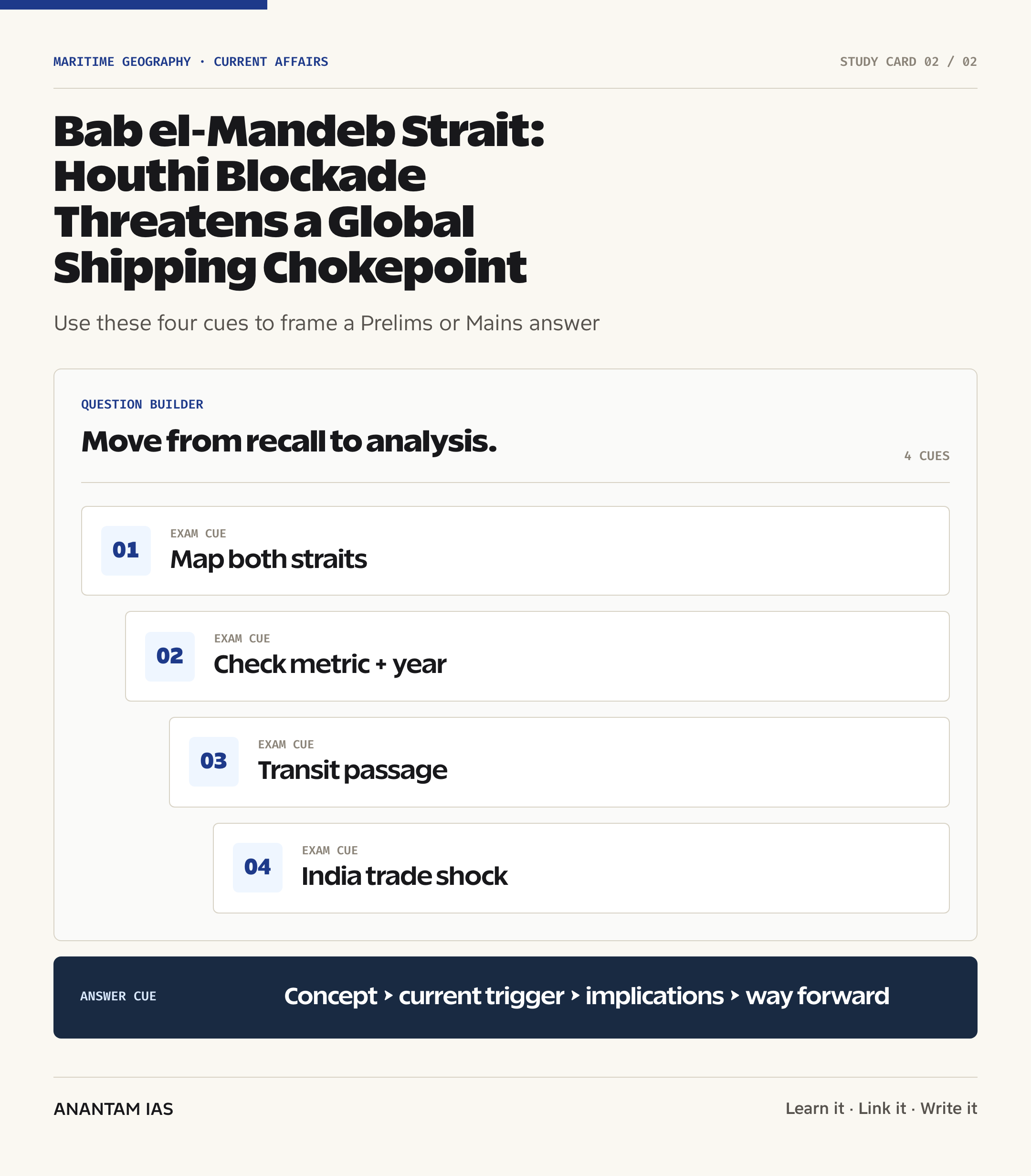
Bab el-Mandeb Strait: Houthi Blockade Threatens a Global Shipping Chokepoint
Why in News?
Yemen’s Houthi movement announced on 20 July 2026 that it would impose a maritime embargo on Saudi-linked shipping through the Bab el-Mandeb Strait. The Hindu and The Indian Express reported the declaration as a renewed threat to the southern gateway of the Red Sea, while Saudi Arabia rejected the blockade claim and said it would protect commercial vessels.
The declaration isn’t the same as a verified closure of all traffic. It was framed as a targeted measure against Saudi-linked vessels, its enforcement method was initially unclear, and claims that ships had been forced to reroute lacked independent confirmation. The exam issue is the risk created by a credible threat near a narrow sea lane, even before a complete physical closure occurs.
- The threatened route connects the Gulf of Aden and the Red Sea, forming the southern approach to the Suez Canal.
- The Houthis said the embargo was retaliation for what they described as a Saudi blockade of Yemen and a recent strike on Sanaa airport.
- Saudi Arabia’s official response described the blockade narrative as false and invoked UNCLOS and protection of commercial navigation.
- The threat comes after repeated Houthi attacks on merchant shipping since November 2023, which had already pushed carriers toward the Cape of Good Hope.
- A selective threat can still raise war-risk insurance, freight rates and voyage times because shipowners price uncertainty, not only confirmed closures.
The development matters in the context of:
- This matters in the context of simultaneous pressure on two different chokepoints: Bab el-Mandeb on the Red Sea route and the Strait of Hormuz at the exit of the Persian Gulf.
- It also tests the rules governing transit passage, the protection of civilian shipping and the limits of coercion by non-state armed groups.
- For India, the exposure runs through energy prices, Asia-Europe trade, marine insurance, delivery schedules and the safety of Indian seafarers.
UPSC Relevance
Prelims Relevance
- Bab el-Mandeb connects the Red Sea with the Gulf of Aden and, beyond it, the Arabian Sea and Indian Ocean.
- The strait lies between Yemen on the Arabian Peninsula and Djibouti and Eritrea in the Horn of Africa.
- Perim Island, also called Mayyun, divides the strait into eastern and western channels.
- The Suez Canal connects the Red Sea with the Mediterranean Sea; a normal Asia-Europe voyage using Suez must also pass Bab el-Mandeb.
- The alternative around southern Africa passes the Cape of Good Hope and avoids both Bab el-Mandeb and Suez.
- The Strait of Hormuz is a separate waterway connecting the Persian Gulf with the Gulf of Oman; it does not connect the Red Sea and Gulf of Aden.
- Under Part III of UNCLOS, straits used for international navigation are generally governed by the regime of transit passage.
- The SUMED pipeline in Egypt links Red Sea and Mediterranean terminals and has an EIA-listed capacity of 2.5 million barrels per day.
- Saudi Arabia’s East-West Pipeline, or Petroline, moves crude from the east to the Red Sea coast and can bypass Hormuz, but Asia-bound cargo from Yanbu may still face Bab el-Mandeb.
Mains Relevance
GS Paper 2
- West Asian geopolitics, Yemen’s conflict and the use of maritime coercion by a non-state armed group.
- Freedom of navigation, UNCLOS transit passage and multilateral responsibility for civilian shipping.
- India’s strategic autonomy while engaging Gulf partners, regional states and maritime security coalitions.
GS Paper 3
- Transmission of a shipping-risk shock into freight costs, imported inflation, trade competitiveness and the current account.
- Energy security through supplier, route and transport-mode diversification, supported by strategic petroleum reserves.
- Sea-lane security, maritime domain awareness and the role of the Information Fusion Centre-Indian Ocean Region.
GS Paper 1
- Map-based geography of the Red Sea, Gulf of Aden, Horn of Africa, Suez Canal, Hormuz and Cape of Good Hope.
Essay
- A narrow passage can cast a long economic shadow.
- Energy security is inseparable from maritime security.
- Rules-based navigation in an age of asymmetric warfare.
Background and Context
Geography: The Southern Gate of the Red Sea
Bab el-Mandeb is valuable because it compresses a major intercontinental route into a narrow passage.
- Its name is commonly translated as the Gate of Tears, and the strait separates Yemen from the Horn of Africa.
- To its north lies the Red Sea; to its southeast lies the Gulf of Aden, which opens into the Arabian Sea and Indian Ocean.
- Ships travelling between the Indian Ocean and Europe normally follow the chain: Gulf of Aden → Bab el-Mandeb → Red Sea → Suez Canal → Mediterranean Sea.
- Perim Island splits the passage into two channels. This physical concentration makes surveillance and attack easier than on an open-ocean route.
- A disruption doesn’t make trade impossible. It makes the principal substitute, the route around the Cape of Good Hope, longer and more expensive.
Bab el-Mandeb Is Not the Strait of Hormuz
The two straits affect overlapping energy networks but occupy different geographic and commercial positions.
- Bab el-Mandeb links the Gulf of Aden with the Red Sea and is essential to the Suez-based Asia-Europe route.
- Hormuz links the Persian Gulf with the Gulf of Oman and is the sea outlet for most exports from Gulf producers located inside the Persian Gulf.
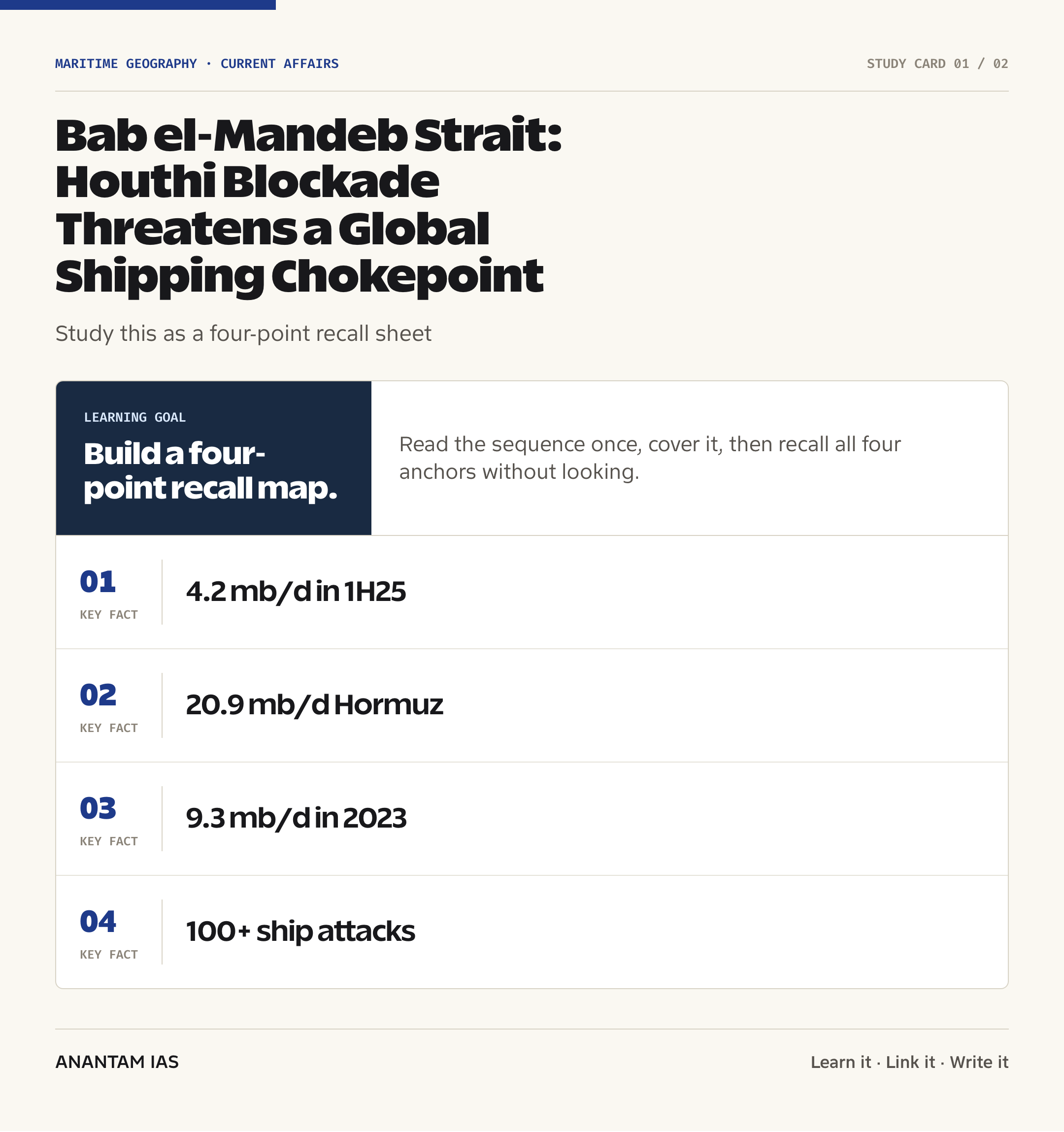
- The U.S. Energy Information Administration estimated 4.2 million barrels per day of oil flows through Bab el-Mandeb in the first half of 2025, against 20.9 million barrels per day through Hormuz.
- Bab el-Mandeb’s 2025 flow was about half its 9.3 million barrels per day level in 2023 because security threats had already diverted vessels.
- Saudi Arabia’s East-West Pipeline can move crude to the Red Sea without using Hormuz. But an Asia-bound tanker leaving the Red Sea port of Yanbu must sail south through Bab el-Mandeb.
- For a visual and legal comparison, see the Anantam IAS note on the Strait of Hormuz transit-route dispute.
Reading Shipping-Share Claims Carefully
Different percentages measure different years, commodities and route segments, so they shouldn’t be treated as interchangeable.
- The often-cited 12% of global trade figure describes the broader Red Sea-Suez artery under normal conditions; it isn’t a live measure of traffic physically crossing Bab el-Mandeb during disruption.
- UN Trade and Development’s 2024 review placed the Suez route at about 11.1% of global seaborne trade volume in 2023, again a route measure rather than a current Bab el-Mandeb count.
- The EIA’s older 12% of seaborne oil trade and 8% of LNG trade estimates refer specifically to the first half of 2023, before widespread rerouting.
- The newer EIA series shows 4.2 million barrels per day of oil at Bab el-Mandeb in the first half of 2025 and near-zero LNG flows there in 2024 and 1H25.
- A good answer should name the metric and period: total trade, container trade, seaborne oil, LNG or barrels per day. A bare percentage hides more than it explains.
Blockade Claim, Capability and Maritime Risk
A declared blockade and an effective closure are separate legal, military and commercial questions.
- The July announcement targeted Saudi-linked shipping; it wasn’t presented as an indiscriminate closure of every vessel using the strait.
- The Houthis don’t control the Yemeni coastline directly at the narrowest part of Bab el-Mandeb, but they operate from territory close enough to threaten vessels using missiles, drones and explosive boats.
- The U.S. Maritime Administration recorded more than 100 Houthi attacks on commercial vessels affecting over 60 nations between November 2023 and October 2025.
- Commercial disruption can arise without continuous territorial control. One successful attack, a credible warning or uncertain vessel-identification rules can alter insurer and carrier behaviour.
- Claims that several ships had been forced to reroute were initially not independently verified. UPSC answers should distinguish an actor’s claim from confirmed operational effect.
- Saudi Arabia briefly suspended oil shipments through the strait in July 2018 after attacks on two tankers, showing how limited incidents can trigger precautionary closures.
International Law and Security Architecture
The legal baseline protects continuous navigation, but enforcement in a conflict zone depends on capable states and risk-conscious shipowners.
- Under UNCLOS Articles 37-44, ships and aircraft enjoy transit passage through straits used for international navigation, subject to continuous and expeditious transit and lawful safety rules.
- States bordering such straits must not hamper transit passage and must publicise known dangers; transit passage cannot be suspended.
- A non-state armed group’s coercive claim doesn’t acquire legality merely because it can impose practical risk. Attacks must also be assessed under international humanitarian law where an armed conflict exists.
- Naval patrols, escorts and information-sharing can reduce risk, but they don’t erase long-range missile, drone or mine threats. Security planning needs layered defence and accurate vessel identification.
- India’s Gulf of Aden anti-piracy deployments show the value of mission-based presence, while the IFC-IOR helps fuse commercial shipping information across the Indian Ocean.
Economic and Strategic Stakes for India
India’s exposure extends beyond imported crude because the route carries exports, containers, inputs and Indian seafarers.
- A Cape diversion raises fuel use and voyage time. The EIA compared a Persian Gulf-to-northwest Europe petroleum voyage of about 19 days through Suez with nearly 35 days around the Cape.
- Longer voyages tie up ships for more days, reducing effective fleet capacity and pushing up freight and insurance costs even when cargo remains available.
- Indian petroleum-product exports to Europe and India’s wider trade with Europe use the Red Sea-Suez route, so disruption can weaken export margins and delay inputs.
- If oil prices and shipping costs rise together, India faces pressure through the import bill, rupee, current-account deficit and transport-linked inflation.
- The safety of Indian crews requires timely advisories, company-level risk assessment and coordination among the Indian Navy, Directorate General of Shipping and maritime information centres.
- The strategic lesson is redundancy: supplier diversification alone is insufficient when several suppliers and buyers depend on the same sea lane of communication.
How a Chokepoint Shock Travels Through the Economy
The first impact appears in voyage planning, but the cost moves through several linked markets before reaching households and firms.
- A carrier that avoids the Red Sea must buy more bunker fuel, pay crews for longer and keep the same vessel occupied for additional days. The immediate result is a higher cost per voyage.
- When many vessels take longer routes, available ship capacity tightens even if the physical fleet is unchanged. This capacity effect can raise freight rates across routes that never enter the Red Sea.
- War-risk underwriters reassess the probability and potential loss from missile, drone, mine and boarding attacks. A higher insurance premium becomes part of the landed cost of oil, machinery, chemicals and consumer goods.
- Importers respond by holding larger inventories or ordering earlier, which raises working-capital needs. Smaller firms bear this burden more heavily because they have less bargaining power and fewer routing options.
- Energy markets react to expected disruption as well as lost barrels. A threat to Saudi-linked flows can add a risk premium to crude prices before measurable supply disappears from the market.
- For India, dearer crude widens the merchandise trade deficit; demand for dollars can pressure the rupee, and currency depreciation makes other imports costlier in domestic terms.
- The inflation effect isn’t automatic or uniform. It depends on global demand, the duration of disruption, refinery inventories, tax policy and whether firms absorb or pass on transport costs.
- A balanced Mains answer should trace this chain while noting the buffers: alternative suppliers, Cape routing, inventories, pipelines and diplomatic de-escalation. None is a cost-free substitute for a stable Red Sea corridor.
Way Forward
Separate verified traffic data from wartime claims
- Track AIS patterns, port calls and insurer advisories before describing the strait as closed.
- Publish dated metrics with clear denominators so policy isn’t built on an outdated headline percentage.
Protect civilian navigation through coordination
- Strengthen information exchange among UKMTO, regional navies, IFC-IOR and shipping companies.
- Use escorts and defensive measures based on vessel-specific risk while keeping de-escalation and seafarer safety central.
Build trade and energy redundancy
- Diversify crude suppliers, ports, shipping contracts and delivery windows; maintain adequate strategic petroleum reserves.
- Stress-test Cape routing, Suez-SUMED options and inventory buffers instead of assuming any one bypass can replace the full corridor.
Defend the legal norm without widening conflict
- Reaffirm UNCLOS transit passage and condemn attacks on civilian shipping through broad diplomatic coalitions.
- Pair deterrence with Yemen-focused diplomacy because maritime security won’t hold if the underlying conflict keeps regenerating threats.
Prepare India's economy for freight shocks
- Monitor pass-through from freight and crude into inflation, fertilizer, logistics and export competitiveness.
- Create contingency protocols for seafarers, insurers, refiners and exporters before a warning becomes an operational crisis.
Conclusion
Bab el-Mandeb demonstrates why a maritime chokepoint can be economically disrupted without being physically sealed. A targeted Houthi threat can change insurance, routing and inventory decisions across continents, while loose reporting can exaggerate a declared embargo into a confirmed universal closure.
For India, the durable answer is to combine accurate maritime awareness, rules-based diplomacy, naval readiness and economic redundancy. The most useful exam comparison is with Hormuz: different geography and traffic scale, but the same warning that concentrated sea lanes turn regional conflict into global economic risk.
UPSC Practice Questions
Prelims MCQ 1
With reference to the Bab el-Mandeb Strait, consider the following statements:
- It connects the Red Sea with the Gulf of Aden.
- It lies between Yemen and the Horn of Africa.
- Perim Island divides the strait into two channels.
How many of the above statements are correct?
(a) Only one (b) Only two (c) All three (d) None
Answer: (c) All three
Explanation:
All three statements are correct. Bab el-Mandeb is the southern gateway of the Red Sea, bordered by Yemen and the African side represented by Djibouti and Eritrea, and Perim Island divides its navigable passage.
Prelims MCQ 2
Which one of the following correctly distinguishes Bab el-Mandeb from the Strait of Hormuz?
(a) Bab el-Mandeb links the Persian Gulf to the Gulf of Oman, while Hormuz links the Red Sea to the Gulf of Aden (b) Bab el-Mandeb links the Red Sea to the Gulf of Aden, while Hormuz links the Persian Gulf to the Gulf of Oman (c) Both connect the Mediterranean Sea directly to the Indian Ocean (d) Both lie between Yemen and Djibouti
Answer: (b) Bab el-Mandeb links the Red Sea to the Gulf of Aden, while Hormuz links the Persian Gulf to the Gulf of Oman
Explanation:
Bab el-Mandeb is the southern Red Sea chokepoint. Hormuz is the outlet of the Persian Gulf toward the Gulf of Oman and Arabian Sea.
UPSC Mains Questions
- A maritime chokepoint need not be fully closed to disrupt global commerce. Analyse this statement with reference to the Houthi threat at Bab el-Mandeb, distinguishing declared blockade, operational capability and commercial risk. (250 words)
- Compare the geographic and economic significance of Bab el-Mandeb and the Strait of Hormuz. Discuss how simultaneous stress at both passages could affect India’s energy security, external trade and maritime strategy. (250 words)
Sources: U.S. Energy Information Administration and The Hindu Explained and The Indian Express Explained.
Frequently Asked Questions
Where is Bab el-Mandeb?
Bab el-Mandeb lies between Yemen on the Arabian Peninsula and Djibouti and Eritrea in the Horn of Africa. It connects the Red Sea with the Gulf of Aden, which opens into the Arabian Sea and Indian Ocean. It is the southern gateway for ships using the Red Sea-Suez route.
Is Bab el-Mandeb fully closed?
The July 2026 announcement was a Houthi declaration aimed at Saudi-linked shipping, not verified proof that all traffic had stopped. Enforcement details were initially unclear, and some rerouting claims lacked independent confirmation. Traffic can still be disrupted through threat perception, insurance costs and voluntary carrier avoidance without a universal physical closure.
How is Bab el-Mandeb different from Hormuz?
Bab el-Mandeb connects the Gulf of Aden and Red Sea, supporting the Suez route between Asia and Europe. Hormuz connects the Persian Gulf and Gulf of Oman, carrying much larger oil flows from Gulf producers. EIA estimated 4.2 million barrels per day at Bab el-Mandeb and 20.9 million at Hormuz in 1H25.
How much oil uses Bab el-Mandeb?
The U.S. Energy Information Administration estimated about 4.2 million barrels per day of crude oil, condensate and petroleum products through Bab el-Mandeb in the first half of 2025. The comparable 2023 flow was 9.3 million barrels per day, before security-driven diversions sharply reduced traffic.
Why does the strait matter to India?
The route carries India-Europe trade and Indian petroleum-product exports, and instability can raise crude prices, freight, insurance and delivery times. Those costs can feed into the import bill, rupee, current-account deficit and inflation. Indian seafarers and merchant vessels also face direct safety and operational risks.
What is the Cape alternative?
Ships can avoid Bab el-Mandeb and Suez by sailing around the Cape of Good Hope at Africa’s southern end. The route is safer from Red Sea threats but longer. EIA compared roughly 19 days through Suez with nearly 35 days around the Cape for a Persian Gulf-to-northwest Europe petroleum voyage.
Source: https://anantamias.com/current-affairs/bab-el-mandeb-houthi-blockade/
India-U.S. Cooperation: From Defence Interoperability to Trusted AI
Why in News?
U.S. Assistant Secretary of State S. Paul Kapur said at a Hoover Institution roundtable that India and the United States were expanding defence and civil nuclear cooperation, including the adoption of trusted artificial intelligence and other emerging technologies.
The statement is a diplomatic description of an expanding agenda, not the announcement of a fresh treaty or completed commercial project. It draws together three existing tracks: the signed 2025 ten-year defence framework, efforts to operationalise civil nuclear commerce, and technology cooperation under the U.S.-India TRUST initiative.
- The official spoke of cooperation that creates jobs and strengthens critical supply chains in both countries and the wider region.
- India and the U.S. signed the Framework for the U.S.-India Major Defense Partnership in October 2025; it is an operative policy framework, not a collective-defence treaty.
- The U.S.-India 123 Agreement has enabled peaceful nuclear commerce since 2008, but proposed U.S.-designed reactor projects still require commercial, regulatory, liability and financing closure.
- The TRUST initiative, launched in February 2025, covers AI, semiconductors, quantum, biotechnology, energy, space and defence while stressing verified vendors and protection of sensitive technologies.
- A May 2026 PIB release recorded discussions with a U.S. nuclear-industry delegation, including private investment, small modular reactors and the proposed Westinghouse AP1000 project at Kovvada; discussions are not the same as a final investment decision.
The development matters in the context of:
- The development matters in the context of India’s effort to combine strategic autonomy with deeper access to advanced military, nuclear and digital technologies.
- It also tests whether broad political commitments can become co-production, localisation and resilient supply chains without compromising security, regulatory accountability or domestic capability.
- For UPSC answers, the central distinction is between a signed enabling framework, a negotiated commercial arrangement and an announced intention that still awaits implementation.
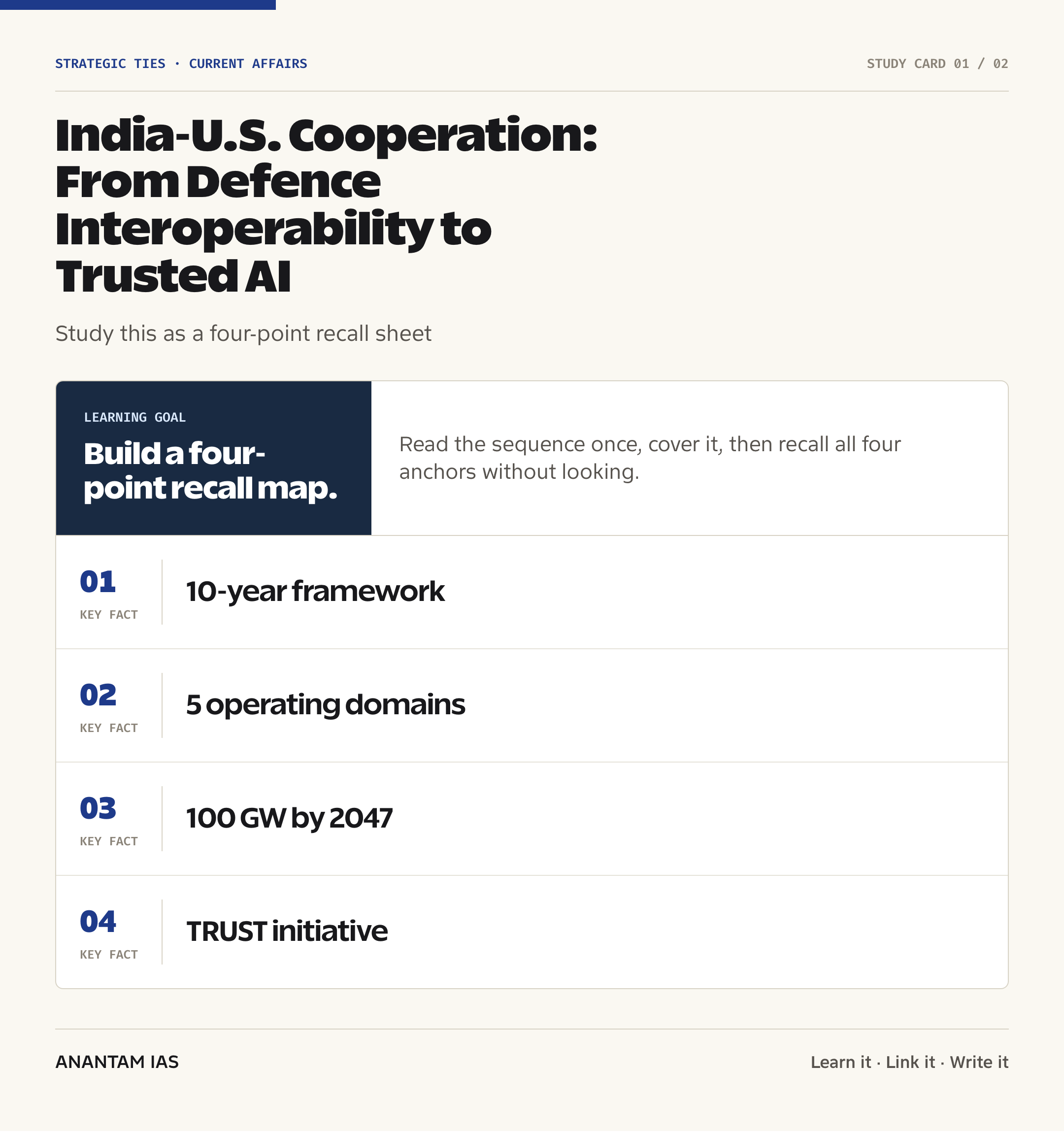
UPSC Relevance
Prelims Relevance
- Major Defense Partner is a U.S. designation for India; it does not make India a treaty ally.
- Interoperability means the ability of forces, platforms, communications and procedures to operate together; it does not require identical equipment.
- The 2025 defence framework covers land, maritime, air, space and cyberspace and is intended to guide cooperation for ten years.
- The 123 Agreement takes its name from Section 123 of the U.S. Atomic Energy Act and governs peaceful nuclear cooperation.
- India’s civilian nuclear facilities placed under safeguards are inspected under an India-specific IAEA safeguards agreement.
- The TRUST acronym expands to Transforming the Relationship Utilizing Strategic Technology; the initiative spans government, academia and industry.
- INDUS-X links defence startups, investors, universities and officials in the two countries; it is an innovation ecosystem, not a military exercise.
- Small Modular Reactors are advanced reactors designed with lower unit capacity and modular construction; their commercial deployment still depends on licensing and project economics.
- The Civil Liability for Nuclear Damage framework determines compensation and the allocation of liability after a nuclear incident; liability design can affect supplier participation.
- Read the durable liability concepts in Anantam IAS’s CLNDA explainer rather than treating the current diplomatic statement as a substitute for the law.
Mains Relevance
GS Paper 2
- Use the case to assess how India-U.S. strategic convergence is widening from defence procurement to operational coordination, industrial collaboration, energy security and emerging technology.
- Examine the balance between deeper partnership and strategic autonomy, especially when technology access, export controls, Russia ties and Indo-Pacific expectations pull policy in different directions.
- Distinguish political declarations from institutional delivery: defence frameworks need projects and exercises, nuclear commitments need bankable reactor arrangements, and technology initiatives need measurable research or infrastructure outcomes.
GS Paper 3
- Connect civil nuclear cooperation with energy security, low-carbon firm power, domestic manufacturing and nuclear-safety regulation.
- Analyse trusted AI through compute access, semiconductor supply chains, cybersecurity, data governance and dependence on a narrow group of technology vendors.
- Evaluate whether co-development and localisation can create domestic technological capability instead of reproducing a buyer-seller relationship.
Essay
- Trust in international relations is built not by declarations alone but by institutions, safeguards and repeated delivery.
- Technology partnerships can widen national capability, but dependence hidden inside supply chains can narrow strategic choice.
- Strategic autonomy is not isolation; it is the capacity to cooperate without surrendering independent judgement.
Background and Context
What the Latest Statement Does and Does Not Mean
The current remark should be read as a policy signal that groups several bilateral workstreams under one strategic narrative.
- S. Paul Kapur’s statement confirms the U.S. administration’s political emphasis on India, jobs, supply-chain security and technology adoption; it does not itself create legal obligations.
- No new defence acquisition, reactor contract or AI governance agreement was announced at the Hoover Institution roundtable.
- The phrase trusted AI is a policy concept. In this setting, it points to verified technology vendors, protection of sensitive systems, resilient compute and chip supply chains, and safeguards around high-end technology.
- The safest UPSC formulation is that the statement reaffirmed and connected existing initiatives. Writing that all three sectors have reached completed agreements would overstate the evidence.
- This distinction improves answer quality: an announcement shows intent, a signed framework fixes direction, an implementing arrangement specifies rules, and a commercial contract allocates cost, risk and delivery.
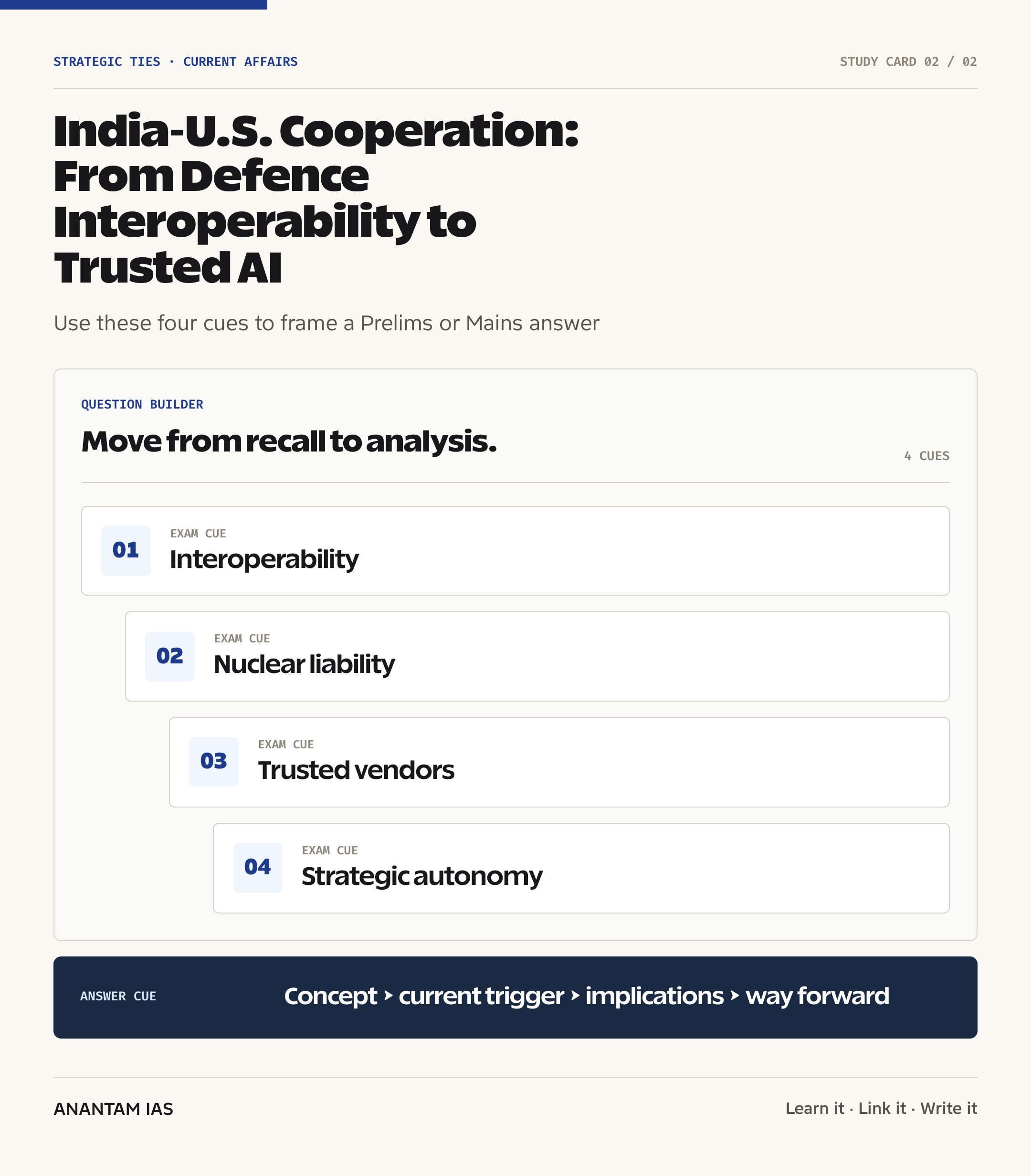
The Signed Defence Framework
Defence is the most institutionally developed of the three tracks because a new ten-year framework was signed in October 2025.
- The official U.S. fact sheet describes the 2025 Framework for the U.S.-India Major Defense Partnership as the defining bilateral defence document and says it supersedes the 2023 defence-industrial roadmap.
- Its priorities include interoperability across five domains, maritime security, information-sharing, military education, exercises, logistics, defence-industrial resilience, advanced technology and counterterrorism.
- Operational interoperability can grow through common procedures, secure communications, logistics access, exercises and experience with shared platforms. It does not erase India’s independent command or sovereign decisions.
- Industrial cooperation seeks to move beyond direct purchases toward co-production, maintenance, repair, supply chains and innovation. Export controls, intellectual-property terms, cost and assured orders still shape what is transferred.
- INDUS-X supports startup and innovation connections, while larger platform or engine projects require separate negotiations and approvals. An ecosystem cannot be counted as a delivered weapon system.
- India’s aim is to turn access into capability while retaining diversified partnerships. The broader defence context is covered in this Anantam IAS defence note.
Civil Nuclear Cooperation: Enabling Law Versus Built Reactors
Civil nuclear relations have a durable legal base, but the gap between diplomatic commitment and an operating U.S.-designed reactor project remains central.
- The 2008 U.S.-India civil nuclear arrangement ended India’s isolation from global peaceful nuclear commerce even though India is outside the Nuclear Non-Proliferation Treaty as a nuclear-weapon state.
- The bilateral 123 Agreement, the India-specific IAEA safeguards arrangement and the Nuclear Suppliers Group waiver form separate but connected parts of this opening.
- A February 2025 leaders’ statement committed both sides to work toward U.S.-designed reactors in India, including localisation and possible technology transfer. The words work toward matter because they describe a path, not a completed build.
- Supplier concern over nuclear liability, alongside financing, tariffs, localisation, regulatory approval and project economics, has slowed conversion of the political deal into reactor construction.
- PIB reported in May 2026 that implementation rules under the SHANTI Act, 2025 were still being finalised. It also listed the proposed Westinghouse AP1000 project at Kovvada among matters reviewed with U.S. industry.
- The same PIB release stated India’s target of expanding nuclear capacity from 8.8 GW to 100 GW by 2047 and referred to nearly ₹20,000 crore for small modular-reactor development. These are Indian policy ambitions, not proof that a U.S. reactor order has closed.
- Candidates can pair this update with Anantam IAS’s SHANTI framework note and test the reform against safety, liability and public accountability.
TRUST and the Meaning of Trusted AI
The technology track aims to create a protected ecosystem for strategic technologies rather than a stand-alone bilateral AI treaty.
- The February 2025 joint leaders’ statement launched TRUST across defence, AI, semiconductors, quantum, biotechnology, energy and space.
- Its design joins government-to-government coordination, academic research and private investment, while encouraging verified vendors and protection of sensitive technologies.
- The leaders also committed to develop a roadmap for accelerating AI infrastructure in India, including data centres, compute, processors, models, applications, financing, power and connectivity.
- Trusted systems need more than a friendly supplier label. They require cybersecurity assurance, auditable model behaviour, secure hardware, data protection, procurement standards and continuity of supply.
- The label can create a geopolitical technology club if vendor verification or export controls exclude other suppliers. India must weigh security gains against vendor lock-in, cost and reduced policy space.
- Absent a published completion record for every promised roadmap or project, candidates should write that the initiative provides an enabling platform, then identify which outputs still need public evidence.
Strategic and Economic Significance for India
The three tracks converge around capability, supply-chain resilience and India’s role in the Indo-Pacific.
- Defence cooperation can strengthen maritime domain awareness, logistics, disaster response and deterrence, especially in the Indian Ocean, while giving India access to advanced platforms and practices.
- Civil nuclear investment can add firm low-carbon electricity and domestic manufacturing demand, but only if safety regulation, liability and waste management retain public credibility.
- AI and semiconductor cooperation can improve compute availability, research links and data-centre capacity, all of which increasingly affect economic and national-security power.
- A combined partnership can reduce single-source dependence, but excessive reliance on one foreign ecosystem can create a new concentration risk. Diversification and domestic absorption must proceed together.
- For India, success is not the volume of announcements. It is the share of technology learned, components made, intellectual property developed, personnel trained and systems maintained within India.
- For the U.S., India offers a large market, skilled talent, a strategic geography and an alternative manufacturing base. The partnership is driven by converging interests, not identical positions on every global issue.
How to Judge Delivery Across the Three Tracks
Each sector has a different implementation chain, so a single claim that the partnership is expanding cannot serve as proof of equal progress everywhere.
- In defence, the first layer is the signed ten-year policy framework. Delivery should then be judged through exercises, secure information-sharing, logistics, maintenance arrangements, industrial orders and equipment that can actually operate together.
- In civil nuclear energy, the legal opening created by the 123 Agreement is only the base. A reactor project also needs a site, technology choice, safety review, liability allocation, financing, tariff viability, fuel arrangements, construction contracts and long-term waste plans.
- In AI, a strategic initiative becomes material when it produces compute capacity, research programmes, secure procurement rules, skilled personnel and deployable applications. A roadmap or vendor principle is useful, but it is not the same as commissioned infrastructure.
- The three tracks also move at different speeds. Military exercises can be scheduled within months, while a nuclear plant takes years of licensing and construction. AI infrastructure can scale faster, but chips, power, cooling and export permissions can become binding constraints.
- Cross-sector links are important. Trusted chips and software can support defence systems; reliable nuclear power can serve energy-intensive data centres; resilient supply chains can reduce disruption across all three. These links also enlarge the cybersecurity and critical-infrastructure attack surface.
- A balanced assessment needs both outputs and safeguards: equipment availability, domestic value added, research results and energy capacity on one side; safety, auditability, competition and sovereign control on the other.
- This framework prevents two common answer-writing errors: treating every diplomatic statement as a completed deal, and dismissing an enabling agreement merely because its final commercial outputs are still under negotiation.
Risks, Constraints and the Strategic-Autonomy Test
A durable partnership must manage differences instead of hiding them behind broad strategic language.
- Technology-transfer controls and intellectual-property restrictions can limit genuine co-development even when political statements promise industrial cooperation.
- Defence interoperability must not be confused with alliance dependence. India retains independent decisions on deployment, procurement and foreign policy.
- Civil nuclear projects face long construction periods, high capital costs, safety scrutiny, liability allocation and questions of spent-fuel and waste management.
- Trusted AI can embed opaque standards set by powerful states or firms. India needs transparent criteria for vendor trust, model assurance, data access and security review.
- The countries can differ over trade, sanctions, third-country relations and market access. Institutional dialogues help prevent one dispute from freezing the entire relationship.
- Parliamentary scrutiny, regulatory independence and public disclosure matter because strategic technology arrangements can distribute commercial risk and public liability for decades.
Way Forward
Publish Trackable Deliverables
- Both governments should issue sector-wise milestones that identify what is signed, under negotiation, financed, contracted and operational.
- Annual public reviews should report exercises, co-production outputs, research awards, manufacturing content and completed regulatory steps without exposing sensitive information.
Build Capability, Not Permanent Dependence
- Defence and nuclear projects should include realistic localisation, maintenance, skills and supplier-development plans tied to measurable outcomes.
- India should preserve diversified partnerships and invest in domestic research so foreign access produces absorptive capacity rather than vendor lock-in.
Define Trusted Technology Transparently
- India needs risk-based standards for secure chips, cloud infrastructure, AI models, critical data and procurement, with independent testing and audit.
- Vendor verification should be based on published security criteria and enforceable safeguards, not only the vendor’s country of origin.
Protect Safety and Accountability
- Civil nuclear expansion must retain strong safety regulation, emergency preparedness, compensation and environmental review while improving investment certainty.
- Commercial confidentiality should not block disclosure of who bears construction, accident, fuel, decommissioning and waste-management risks.
Conclusion
The latest U.S. statement captures a real widening of the India-U.S. strategic partnership, but it should not be read as evidence that every defence, nuclear or AI objective has already been delivered.
The defence framework is signed, the civil nuclear legal relationship is established, and TRUST provides a technology platform. The next test is conversion: interoperable capability, bankable reactor projects, secure AI infrastructure and domestic learning.
India’s best outcome is deeper cooperation with independent judgement. That requires clear milestones, accountable regulation, technology absorption and diversified strategic options.
UPSC Practice Questions
Prelims MCQ 1
With reference to India-U.S. strategic cooperation, consider the following statements:
- India’s designation as a Major Defense Partner makes it a treaty ally of the United States.
- The U.S.-India TRUST initiative includes artificial intelligence, semiconductors, quantum technology, biotechnology, energy and space.
- Interoperability can include common procedures, communications and logistics without placing forces under a common sovereign command.
How many of the above statements are correct?
(a) Only one (b) Only two (c) All three (d) None
Answer: (b) Only two
Explanation:
Statements 2 and 3 are correct. TRUST covers several critical and emerging technologies, and interoperability does not require a common sovereign command. Major Defense Partner is a special U.S. designation, not a mutual-defence treaty.
Prelims MCQ 2
Which one of the following best describes the U.S.-India 123 Agreement?
(a) A collective-defence pact requiring automatic military assistance (b) A bilateral framework for peaceful civil nuclear cooperation (c) An agreement creating a common regulator for artificial intelligence (d) A Quad arrangement for sharing nuclear-powered submarines
Answer: (b) A bilateral framework for peaceful civil nuclear cooperation
Explanation:
The 123 Agreement governs peaceful nuclear cooperation under the relevant U.S. legal framework. It is distinct from India’s IAEA safeguards arrangement and the Nuclear Suppliers Group waiver, although all three helped enable civil nuclear commerce.
UPSC Mains Questions
- The expansion of India-U.S. relations from defence purchases to interoperability, civil nuclear commerce and trusted artificial intelligence creates both capability gains and new dependencies. Examine how India can convert these arrangements into domestic technological capacity while preserving strategic autonomy and regulatory accountability. (250 words)
- Diplomatic announcements, signed frameworks and implemented projects represent different stages of international cooperation. Using recent India-U.S. defence, nuclear and emerging-technology initiatives, explain why this distinction matters for evaluating the depth and durability of a strategic partnership. (250 words)
Sources: PIB, Ministry of Science and Technology and The Hindu.
Frequently Asked Questions
What did the U.S. official announce?
The official described expanding cooperation in defence, civil nuclear energy and trusted AI. The remark did not announce a new treaty, reactor contract or AI agreement. It connected existing workstreams, including the signed 2025 defence framework, civil nuclear implementation efforts and the TRUST technology initiative.
Is India a U.S. treaty ally?
No. India is designated a Major Defense Partner by the United States, but there is no mutual-defence treaty requiring automatic military assistance. The relationship supports exercises, logistics, information-sharing, procurement and technology cooperation while India retains sovereign control over deployment and foreign-policy decisions.
What is trusted AI here?
Trusted AI refers to an ecosystem of verified vendors, protected sensitive technology, secure compute and chips, resilient supply chains, and safeguards for data and model behaviour. TRUST is an enabling strategic initiative, not a single technical standard or a bilateral AI law.
Has a U.S. reactor project begun?
Official statements support U.S.-designed reactors and record discussions on the proposed Westinghouse AP1000 project at Kovvada. But the available documents describe plans and industry engagement, not a completed reactor contract or operating project. Commercial, regulatory, liability, financing and localisation arrangements still determine delivery.
Why does interoperability matter?
Interoperability lets two forces coordinate through compatible procedures, communications, logistics, training and shared understanding of equipment. It can improve exercises, maritime awareness and disaster response. It does not by itself create an alliance, merge command structures or remove India’s freedom to decide when and where its forces operate.
What should UPSC answers emphasise?
Separate announced intent from signed and operational outcomes. Link defence cooperation to strategic autonomy and industrial capacity, nuclear cooperation to energy security and liability, and trusted AI to compute, cybersecurity and vendor dependence. End with measurable implementation, regulatory accountability, domestic absorption and diversified partnerships.
Source: https://anantamias.com/current-affairs/india-us-defence-civil-nuclear-trusted-ai/
Black Sea Shipping: Protecting Indian Seafarers in Conflict Zones
Why in News?
The Ministry of External Affairs summoned Ukrainian Ambassador Dr. Oleksandr Polishchuk after an attack on the commercial vessel MV OMORFI killed an Indian national. The official statement, carried by Akashvani on 27 July, recorded India’s serious concern and its condemnation of attacks on commercial shipping.
India asked the envoy to convey its concerns to the Ukrainian authorities and stressed that attacks endangering civilian seafarers damage maritime safety, freedom of navigation and international commerce. The statement confirmed the death and diplomatic action, but did not publish the weapon used, precise coordinates, vessel status or a detailed legal finding on responsibility.
- Confirmed officially: one Indian national died in the attack on MV OMORFI.
- Diplomatic step: India summoned Ukraine’s Ambassador and asked him to convey New Delhi’s concerns.
- Policy language: the MEA called the targeting of commercial vessels and risks to innocent civilian crews unacceptable.
- Reported detail: The Hindu described the incident as an attack linked to Ukraine; that attribution is a news-source claim, not a substitute for a completed investigation.
- Exam focus: separate the protection of civilian shipping from claims about the belligerent responsible for a particular strike.
The development matters in the context of:
- The incident matters in the context of India’s large overseas seafaring workforce, whose safety depends on flag States, shipowners, coastal States and Indian consular authorities acting together.
- It tests whether navigation rights, humanitarian safeguards and commercial risk controls can operate when a regional war spills into merchant-shipping lanes.
- It also shows how India can use diplomatic protection, consular coordination and maritime advisories without prejudging disputed operational facts.
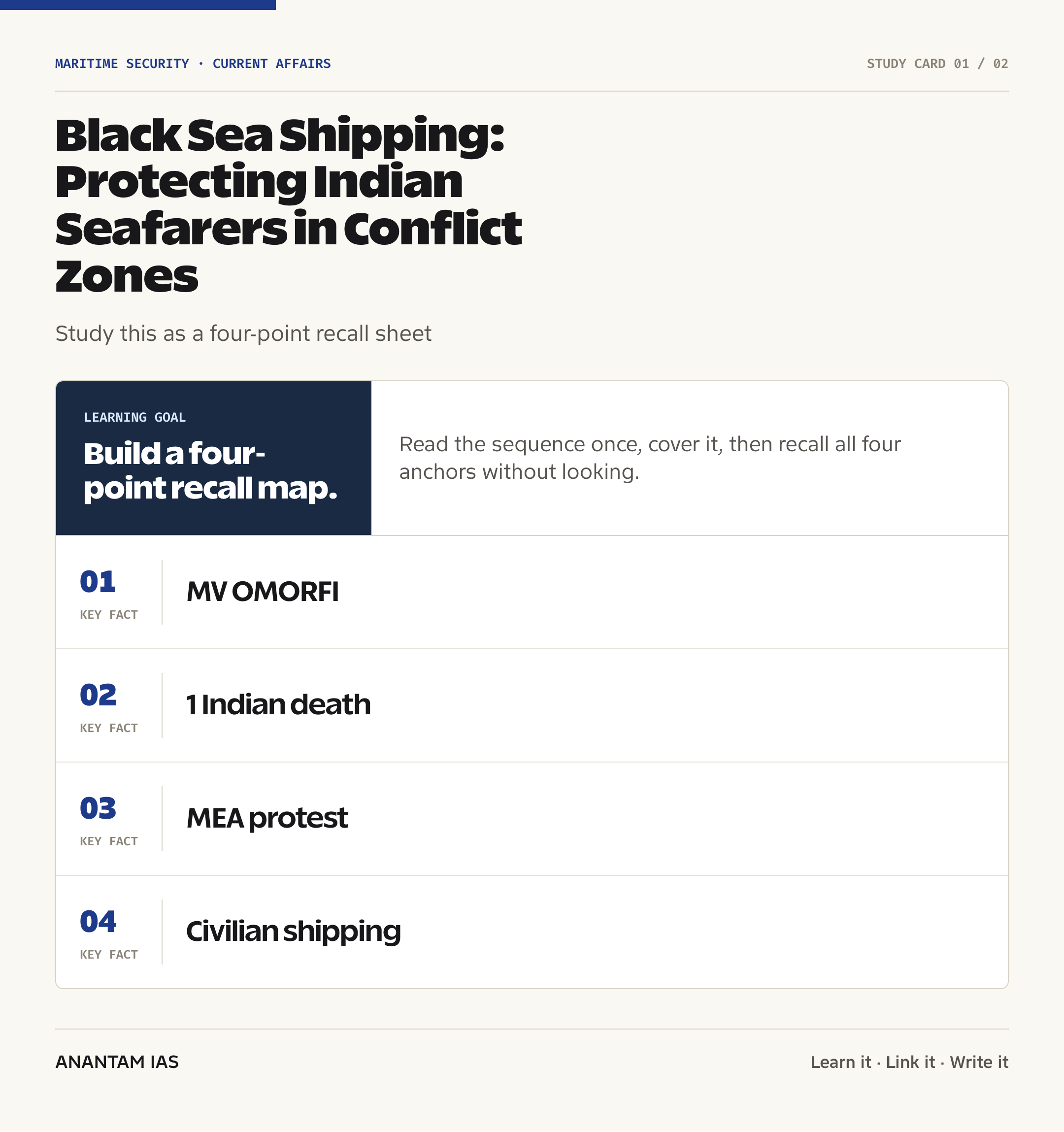
UPSC Relevance
Prelims Relevance
- International Maritime Organization is a specialised agency of the United Nations responsible for the global regulatory framework for shipping.
- UNCLOS Article 87 includes freedom of navigation among the freedoms of the high seas.
- UNCLOS Article 17 recognises innocent passage through the territorial sea, subject to the conditions in the Convention.
- UNCLOS Article 94 requires a flag State to exercise jurisdiction and control over ships flying its flag in administrative, technical and social matters.
- SOLAS, 1974 is the principal treaty concerned with the safety of merchant ships; its security architecture includes the ISPS Code.
- The ISM Code requires a safety-management system and structured management of shipboard operational risks.
- The Maritime Labour Convention, 2006 sets minimum working and living standards for seafarers and provides a framework for health, welfare and repatriation duties.
- International humanitarian law, rather than UNCLOS alone, supplies the core distinction, proportionality and precaution rules for attacks connected with an armed conflict.
- A merchant ship is normally a civilian object; its legal protection turns on the facts and is not decided merely by its flag, cargo label or location.
- The Montreux Convention, 1936 regulates passage of warships through the Turkish Straits; it should not be confused with the ordinary commercial-navigation regime.
Mains Relevance
GS Paper 2
- India’s use of a diplomatic summons, formal protest and consular engagement to protect nationals abroad.
- The interaction among UNCLOS, the law of armed conflict, flag-State duties and international institutions.
- Balancing relations with belligerents while maintaining a consistent civilian-protection principle.
GS Paper 3
- Maritime-security threats to merchant shipping, global supply chains, ports and crew welfare.
- Risk assessment, voyage planning, insurance, distress response and search-and-rescue coordination in conflict-affected waters.
- Protection of Indian human capital in a globally distributed shipping industry.
Essay
- Global commerce is only as resilient as the safety of the civilian workers who keep it moving.
- Freedom of navigation requires legal rules, credible restraint and practical protection at sea.
- Strategic autonomy is tested by the consistency with which a State defends civilian life.
Background and Context
What the official record establishes
A sound UPSC answer should begin with confirmed facts and keep source claims in separate boxes.
- The official Akashvani account attributes the statement to the External Affairs Ministry and confirms the summons of Ambassador Polishchuk.
- It names the affected commercial vessel as MV OMORFI and confirms the death of one Indian national.
- It records three Indian concerns: safety of maritime navigation, freedom of navigation and international commerce.
- It says the envoy was asked to convey India’s concern about the targeting of commercial vessels to the Ukrainian authorities.
- It does not provide a public forensic account of the munition, launch platform, ship’s cargo, exact position or sequence of events.
- A diplomatic summons is a formal way to demand an explanation or register protest. It signals seriousness, but it is neither a criminal judgment nor conclusive proof of every operational claim surrounding the incident.
- The Hindu reported a Ukrainian connection to the attack. That can be cited as a reported attribution, while responsibility and the incident’s legal character require verified evidence.
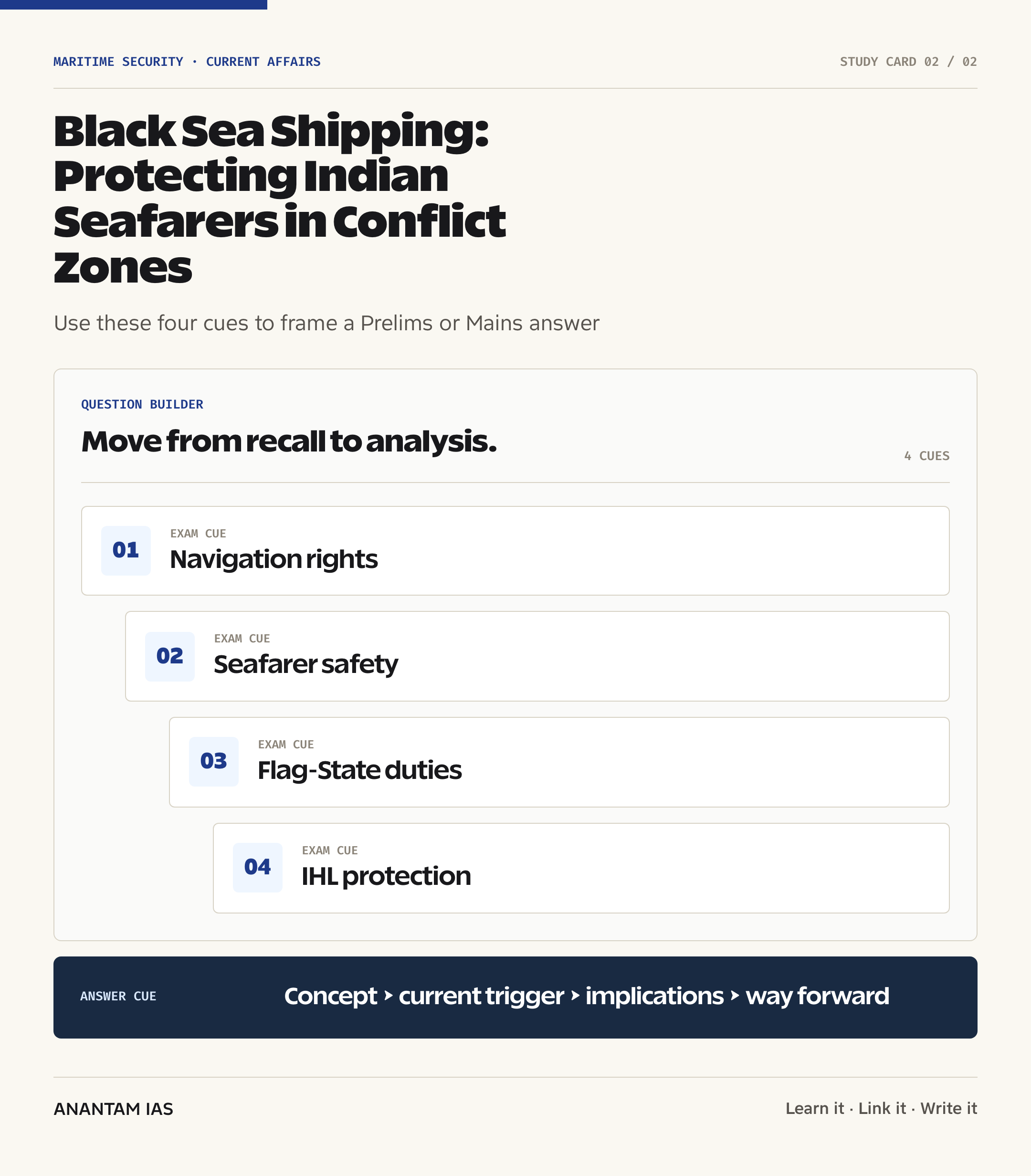
Freedom of navigation is a layered legal idea
Navigation rights vary with the maritime zone, and they do not remove the separate rules applicable during armed conflict.
- On the high seas, UNCLOS Article 87 recognises freedom of navigation for all States, exercised with due regard for the interests of others.
- In a territorial sea, foreign ships enjoy innocent passage under Articles 17 to 19, provided passage is continuous, expeditious and not prejudicial to the coastal State’s peace, good order or security.
- Straits used for international navigation may carry a transit-passage regime under UNCLOS Part III, while treaty-specific arrangements can also matter.
- The Turkish Straits connect the Black Sea with the Mediterranean system; the Montreux Convention is especially important for warships and belligerent naval access.
- UNCLOS defines maritime entitlements and navigation regimes, but it does not by itself answer whether a particular vessel was lawfully targeted during an armed conflict.
- The phrase freedom of navigation should not be used as though every ship has an identical right in every maritime zone. High-seas freedom, innocent passage and transit passage have different legal conditions.
- For a related foundation, the UNCLOS and High Seas Treaty explainer distinguishes maritime zones, jurisdiction and high-seas governance.
Civilian merchant ships under armed-conflict law
The central rule is distinction: parties must distinguish military objectives from civilian objects.
- A merchant vessel is presumptively civilian; being commercially active in a belligerent’s economy does not automatically settle its target status.
- A civilian object may lose protection from attack only when, on the facts, its nature, location, purpose or use makes an effective contribution to military action and its destruction offers a definite military advantage.
- Even when an object qualifies as a military objective, attackers remain bound by proportionality and feasible precautions to reduce expected civilian harm.
- Crew members do not become combatants merely because their ship trades in a conflict-affected area. Their conduct and the vessel’s verified function matter.
- Warnings, identification, route information and the reliability of intelligence can be important to the precaution assessment, but the available public record here is too limited for a legal verdict.
- The proportionality rule asks whether expected incidental civilian harm would be excessive compared with the concrete and direct military advantage anticipated. It does not permit a simple exchange of civilian lives for economic pressure.
- A post-strike inquiry should preserve voyage data, bridge records, communications, cargo papers and damage evidence. Without that material, confident claims about target status, intent or weapon origin can outrun the facts.
- An exam answer should reject two shortcuts: calling every merchant ship immune regardless of use, or treating every ship trading with a belligerent as a lawful target.
Who protects a seafarer at sea?
Protection is distributed across several actors rather than resting with the seafarer’s home State alone.
- The flag State must exercise jurisdiction and control over the ship and enforce applicable safety, labour and security standards.
- The shipowner and company must run a functioning safety-management system, assess route risks, brief crews and support emergency response.
- The master has operational responsibility for the vessel and needs timely threat information, reliable communications and authority to prioritise safety.
- A coastal or port State may provide navigation warnings, port controls, medical aid, casualty response and search-and-rescue coordination within its competence.
- The seafarer’s State of nationality can provide consular assistance, seek information, liaise with families, support repatriation and make diplomatic representations.
- The IMO does not command navies or investigate every strike as a criminal court. It develops shipping rules, convenes States, circulates safety information and supports coordinated action for navigation and crew protection.
- Insurers and protection and indemnity clubs support liabilities, claims and incident coordination, but insurance pricing cannot replace a decision about whether a voyage is acceptably safe.
Safety, security and labour instruments
Different treaties address different parts of the risk, so they should not be collapsed into one rule.
- SOLAS establishes core ship-safety standards, including navigation, communications, life-saving appliances and emergency arrangements.
- The ISPS Code, linked to SOLAS, provides a ship-and-port security framework based on security assessments, plans and designated officers.
- The ISM Code focuses on safe management and pollution prevention through documented company systems, reporting and continuous improvement.
- The STCW Convention sets international standards for seafarer training, certification and watchkeeping, including competence needed for emergencies.
- The Maritime Labour Convention covers conditions of employment, medical care, welfare and repatriation standards; applicable contracts and collective agreements may add war-risk rights.
- Some international labour instruments recognise repatriation when a ship is bound for a war zone without a seafarer’s consent. The exact entitlement depends on ratification, flag law, contract and collective agreement, so it should not be stated as a universal automatic right.
Why Indian seafarers need a protection chain
Indian workers may serve on foreign-flagged ships operated through multinational ownership and crewing arrangements.
- A ship’s flag, beneficial owner, operator, manager and crewing agency may be connected to different jurisdictions, complicating accountability after an incident.
- Before deployment, workers need a clear seafarer employment agreement, verified employer details, insurance information and emergency contacts.
- Recruitment channels should communicate designated high-risk or warlike-area terms, additional compensation and refusal or repatriation clauses where applicable.
- The Directorate General of Shipping can issue safety advice, regulate Indian recruitment-and-placement channels within its remit and coordinate with other authorities.
- Indian missions need an up-to-date crew manifest and direct links to the shipowner, flag State and local authorities; missing or delayed crew data weakens consular response.
- A workable crew-protection protocol needs contact details for the vessel, company security officer, flag administration, nearest rescue coordination centre and Indian mission before the ship enters a high-risk route.
- After a casualty, families need a single verified information channel. Unchecked names, casualty figures and location claims can compound harm and complicate next-of-kin notification.
- Students can connect this issue with the maritime distress-signals guide, which explains Mayday, urgency messages and rescue communication.
Strategic and economic significance
Attacks on merchant shipping convert a military confrontation into a wider human-security and trade problem.
- Higher war-risk premiums, crew costs and security expenses raise freight rates even for ships that are not attacked.
- Route cancellations and port avoidance can disrupt grain, energy and bulk-cargo flows, affecting prices beyond the immediate region.
- Repeated incidents may reduce the supply of willing crews and create unequal pressure on workers with fewer employment alternatives.
- Threats to Global Navigation Satellite Systems, communications and port infrastructure can multiply accident risk alongside direct attack risk.
- India’s interest is not limited to one bilateral relationship; it includes safe commerce, worker protection and a consistent rule against endangering civilian crews.
- A recurring attack pattern can create a risk-transfer problem: cargo owners retain the commercial benefit while crews, often recruited across borders, bear the most immediate physical danger.
- The Hormuz shipping-security note offers a comparative case on convoy proposals, navigation rights and the limits of militarised protection.
Way Forward
Build a verified maritime-threat picture
- India should combine embassy reporting, DG Shipping advisories, flag-State notices and IMO information into timely, route-specific guidance.
- Incident reports should separate confirmed facts, party claims and unresolved questions to prevent misattribution during a fast-moving conflict.
- Operators should update voyage risk assessments before entering affected waters and after any material change in the threat.
Put informed crew consent at the centre
- Crewing agencies and shipowners should disclose the route, threat level, insurance cover and applicable war-risk clauses before assignment.
- Contracts should state refusal, substitution, additional-pay and repatriation rules in language the seafarer can understand.
- No commercial schedule should override the master’s safety judgment or a worker’s rights under applicable law and agreement.
Strengthen consular readiness
- Indian missions should maintain 24-hour maritime contacts and pre-agreed channels with local rescue services, hospitals and port authorities.
- A verified crew database should help authorities locate Indian nationals quickly without exposing personal data publicly.
- Family liaison, medical evacuation, compensation support and repatriation should be treated as one continuous response.
Use multilateral maritime institutions
- India can support IMO-led deconfliction, navigation warnings, incident reporting and practical safe-passage arrangements acceptable to relevant parties.
- Flag States should investigate casualties promptly and share safety findings without waiting for political disputes to end.
- Belligerents should protect civilian shipping, respect international law and keep humanitarian rescue channels insulated from escalation.
Keep India's diplomacy principle-based
- New Delhi should apply the same test to every party: commercial vessels and innocent crews must not be endangered.
- Formal protests should seek facts, accountability, compensation where legally due and guarantees against recurrence.
- Cautious attribution protects credibility; restraint in language does not weaken a clear demand for seafarer safety.
Conclusion
The MV OMORFI incident is not only a bilateral diplomatic episode. It exposes the gap between the global dependence on merchant shipping and the fragmented protection available to civilian crews when war reaches commercial sea lanes.
India’s strongest response combines verified attribution, consistent diplomacy, enforceable employment safeguards and multilateral maritime coordination. The durable principle is simple: navigation rights and international commerce cannot be defended while treating seafarers as expendable risk.
UPSC Practice Questions
Prelims MCQ 1
With reference to international maritime law, consider the following statements:
- UNCLOS recognises freedom of navigation on the high seas.
- The flag State must exercise jurisdiction and control over ships flying its flag in administrative, technical and social matters.
- UNCLOS alone contains the complete legal rules for deciding whether a merchant vessel may be attacked during an armed conflict.
How many of the above statements are correct?
(a) Only one (b) Only two (c) All three (d) None
Answer: (b) Only two
Explanation:
Statements 1 and 2 reflect UNCLOS Articles 87 and 94. Statement 3 is incorrect because international humanitarian law supplies key targeting rules in armed conflict; UNCLOS does not by itself decide the legality of an attack.
Prelims MCQ 2
Which one of the following best describes the International Safety Management Code?
(a) A tariff code for cargo moving through international straits (b) A framework for safe ship operation and pollution-prevention management (c) A treaty that fixes maritime boundaries between coastal States (d) A convention governing only the passage of warships through Turkish Straits
Answer: (b) A framework for safe ship operation and pollution-prevention management
Explanation:
The ISM Code requires companies to establish safety-management systems for the safe operation of ships and prevention of pollution. It operates through the SOLAS framework.
UPSC Mains Questions
- Attacks on merchant vessels in conflict-affected waters expose the limits of treating freedom of navigation as a purely legal entitlement. Examine the responsibilities of belligerents, flag States, shipowners and States of nationality in protecting civilian seafarers.
- India’s protection of nationals at sea requires more than diplomatic protests after casualties. Discuss how consular preparedness, DG Shipping oversight, contractual safeguards, threat intelligence and multilateral maritime coordination can form an effective seafarer-protection architecture.
Sources: Ministry of External Affairs statement carried by Akashvani and The Hindu.
Frequently Asked Questions
What did India officially confirm?
The External Affairs Ministry confirmed that MV OMORFI was attacked, an Indian national died, and Ukraine’s Ambassador was summoned. It condemned attacks on commercial shipping and highlighted risks to navigation and commerce. The public statement did not provide a full forensic account or a detailed legal determination of responsibility.
Is every merchant ship immune from attack?
A merchant ship is normally a civilian object, but protection is assessed under international humanitarian law. A vessel may become a military objective only if strict factual tests are met. Even then, proportionality and feasible precautions remain mandatory. A ship’s flag or commercial label alone does not settle the question.
What does freedom of navigation mean?
Freedom of navigation is a set of navigation rights whose form depends on the maritime zone. UNCLOS protects high-seas navigation, innocent passage in territorial seas and transit passage in qualifying straits. During armed conflict, these rules operate alongside international humanitarian law and relevant security restrictions.
Who is responsible for seafarer safety?
Responsibility is shared. The flag State regulates the ship, the company manages operational risk, the master controls voyage safety, coastal States support warnings and rescue, and the seafarer’s country provides consular help. Labour contracts, insurers and recruitment agencies also shape protection and compensation.
Can a seafarer refuse a war-zone voyage?
The answer depends on the applicable flag law, employment agreement, collective bargaining terms and international instruments in force. Some labour standards recognise war-zone refusal or repatriation situations, but the entitlement is not identical for every worker. The route and contractual rights should be disclosed before assignment.
Why is the Black Sea important for UPSC?
The region links international relations, maritime law, food and energy trade, human security and India’s diaspora protection. It also tests a candidate’s ability to separate UNCLOS navigation rights from armed-conflict targeting rules and to propose practical protection for civilian shipping without speculative attribution.
Source: https://anantamias.com/current-affairs/black-sea-shipping-indian-seafarers/
Peaceful Protest and Pellet Guns: Rights, Force and Accountability
Why in News?
On July 27, 2026, a three-judge Supreme Court Bench led by Chief Justice Surya Kant orally stressed that peaceful and lawful protest is constitutionally protected. The Bench was considering the listing of connected petitions alleging disproportionate police action during protests over examination paper leaks and said the competing claims of injured protesters and police personnel required a balanced, independent examination.
A separate Article 32 petition by retired Intelligence Bureau officer Yashovardhan Azad and two persons who say they suffered pellet injuries seeks the decommissioning or prohibition of metallic kinetic projectiles for dispersing civilian assemblies, compensation, treatment and rehabilitation. This is a live prayer, not a ruling: the Court had not declared a nationwide ban on pellet guns or finally decided that their use in the July 20 operation was unlawful.
- The Hindu reported that a general diary entry recorded the Rapid Action Force firing two anti-riot rounds containing plastic pellets on the direction of a Delhi Police officer during the July 20 march.
- The reported diary entry also listed 55 non-electrical shells, 15 electrical shells and five tear-smoke grenades; these are details from a media-reviewed document, not findings recorded in a final judicial order.
- Delhi Police had earlier denied using pellet guns, while the CRPF said it was verifying media reports. The apparent conflict makes preservation and independent examination of operational records central to accountability.
- The July 27 Bench indicated that connected matters would be heard together on July 28 and discussed the possible need for a uniform protocol, but its remarks were oral observations during a pending proceeding.
- The legal issue is wider than whether an assembly had permission: it asks whether any force used was authorised, necessary, graduated, proportionate and followed by medical care, reporting and review.
The development matters in the context of:
- This matters in the context of the constitutional balance between Article 19 freedoms and the State’s duty to protect public order, commuters and police personnel.
- The label less-lethal describes a design objective, not a guarantee of safety; kinetic projectiles can penetrate tissue, damage eyes and cause permanent disability.
- A clear chain of command matters because lawful crowd management depends on who ordered dispersal, what warning was given, why a weapon was selected and how each discharge was recorded.
- The case can shape future standards for protest policing, but allegations, operational records, medical evidence and settled judicial holdings must not be collapsed into one narrative.
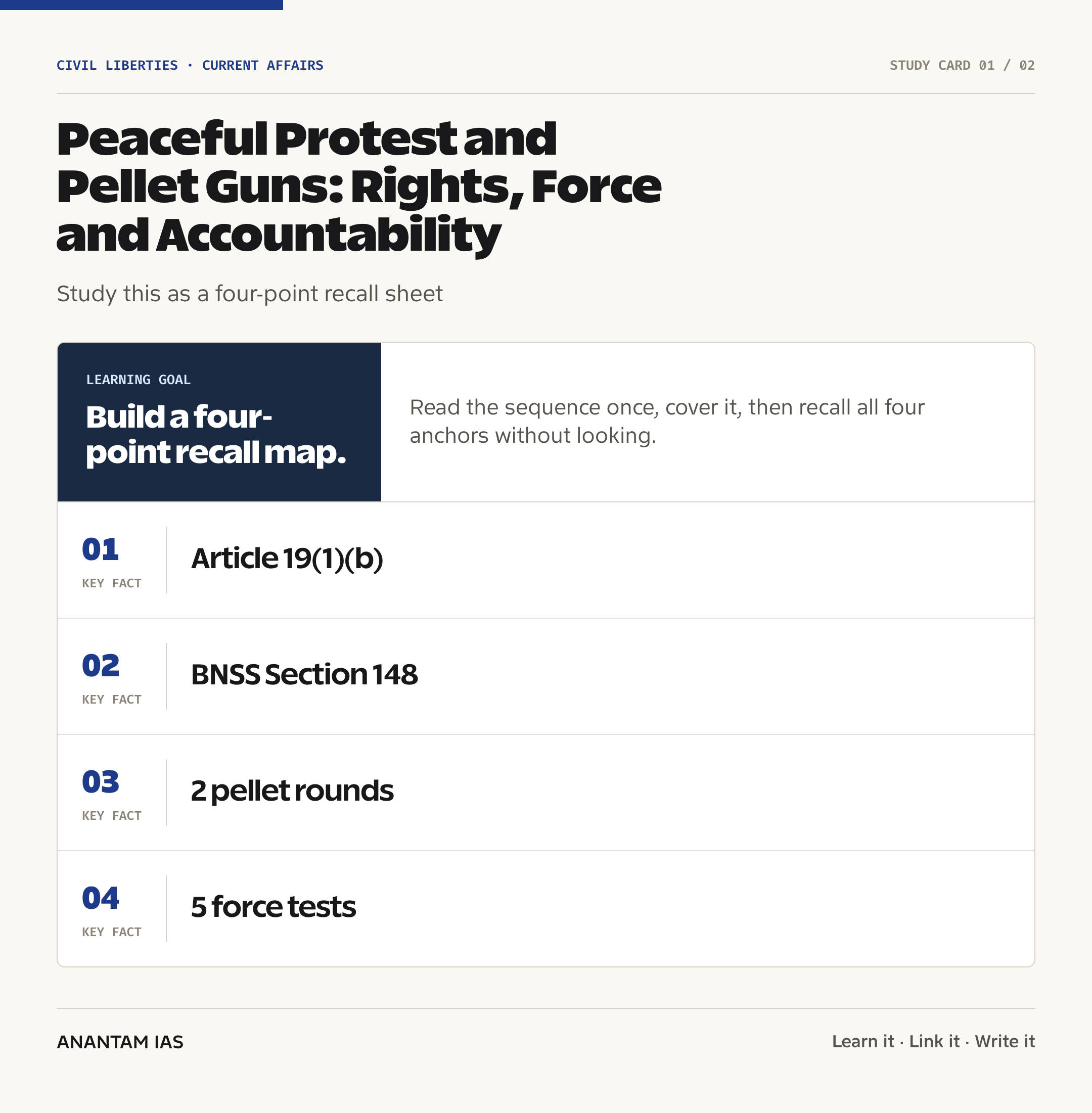
UPSC Relevance
Prelims Relevance
- Article 19(1)(a) protects freedom of speech and expression, while Article 19(1)(b) protects the right of citizens to assemble peaceably and without arms.
- Article 19(3) permits reasonable restrictions on peaceful assembly in the interests of the sovereignty and integrity of India or public order.
- Article 21 protects life and personal liberty and supplies the constitutional basis for dignity, bodily integrity and fair procedure in police action.
- Article 32 enables a person to approach the Supreme Court for enforcement of Fundamental Rights; filing a petition does not establish the truth of its allegations.
- BNSS Section 148 permits specified magistrates or police officers to command certain assemblies to disperse and, if the statutory conditions arise, to disperse them by civil force.
- BNSS Section 149 concerns use of the armed forces when an assembly cannot otherwise be dispersed and public security requires it; it expressly requires as little force and injury as consistent with dispersal.
- Ramlila Maidan Incident, Anita Thakur, Mazdoor Kisan Shakti Sangathan and Amit Sahni are important Supreme Court authorities on protest, regulation and police force.
- The Rapid Action Force is a specialised riot-control component of the Central Reserve Police Force, not a unit of Delhi Police.
- A kinetic impact projectile transfers energy by striking the body; calling it less-lethal does not make it non-injurious.
- The UN Basic Principles on the Use of Force and Firearms are international standards; they are persuasive benchmarks and should not be described as an Indian statute.
Mains Relevance
GS Paper 2
- Scope of Articles 19(1)(a), 19(1)(b), 19(3) and 21, and the difference between reasonable regulation of assemblies and arbitrary suppression of dissent.
- Judicial review of police action through the tests of legality, necessity, proportionality, precaution and accountability.
- Institutional design of a pan-India crowd-control protocol without converting judicial guidance into day-to-day operational command.
GS Paper 4
- Ethical duties of public officials: restraint, impartiality, empathy, truthfulness in official records and responsibility for foreseeable harm.
- Resolving the moral tension between protecting peaceful citizens and police personnel while isolating individuals who commit violence.
Essay
- Dissent tests a democracy most sharply when public order is under strain.
- Legitimate authority is strengthened, not weakened, by restraint and transparent accountability.
- Technology described as less-lethal still demands ethical limits because risk is borne by human bodies.
Background and Context
Constitutional Architecture of Peaceful Protest
The Constitution protects protest as a combined exercise of expression and assembly, while allowing carefully bounded regulation.
- Article 19 protects speech under clause (1)(a) and peaceful, unarmed assembly under clause (1)(b); the word peaceful is part of the guarantee itself.
- Restrictions on assembly must fit Article 19(3): they need legal authority, a connection with sovereignty and integrity or public order, and substantive reasonableness.
- Public order is not a free-standing licence to punish dissent. The State must connect the restriction or force to a real risk and cannot treat every inconvenience, slogan or criticism as violence.
- Article 21 adds protection for life, dignity and bodily integrity. Serious injury during a police operation raises questions under Articles 14, 19 and 21 together.
- Protesters also carry duties: an assembly must remain peaceful and unarmed, comply with lawful and reasonable regulation, avoid attacks and allow the rights of others to be protected.
- The correct constitutional frame is a balance of rights, not a choice between absolute protest freedom and unlimited police power.
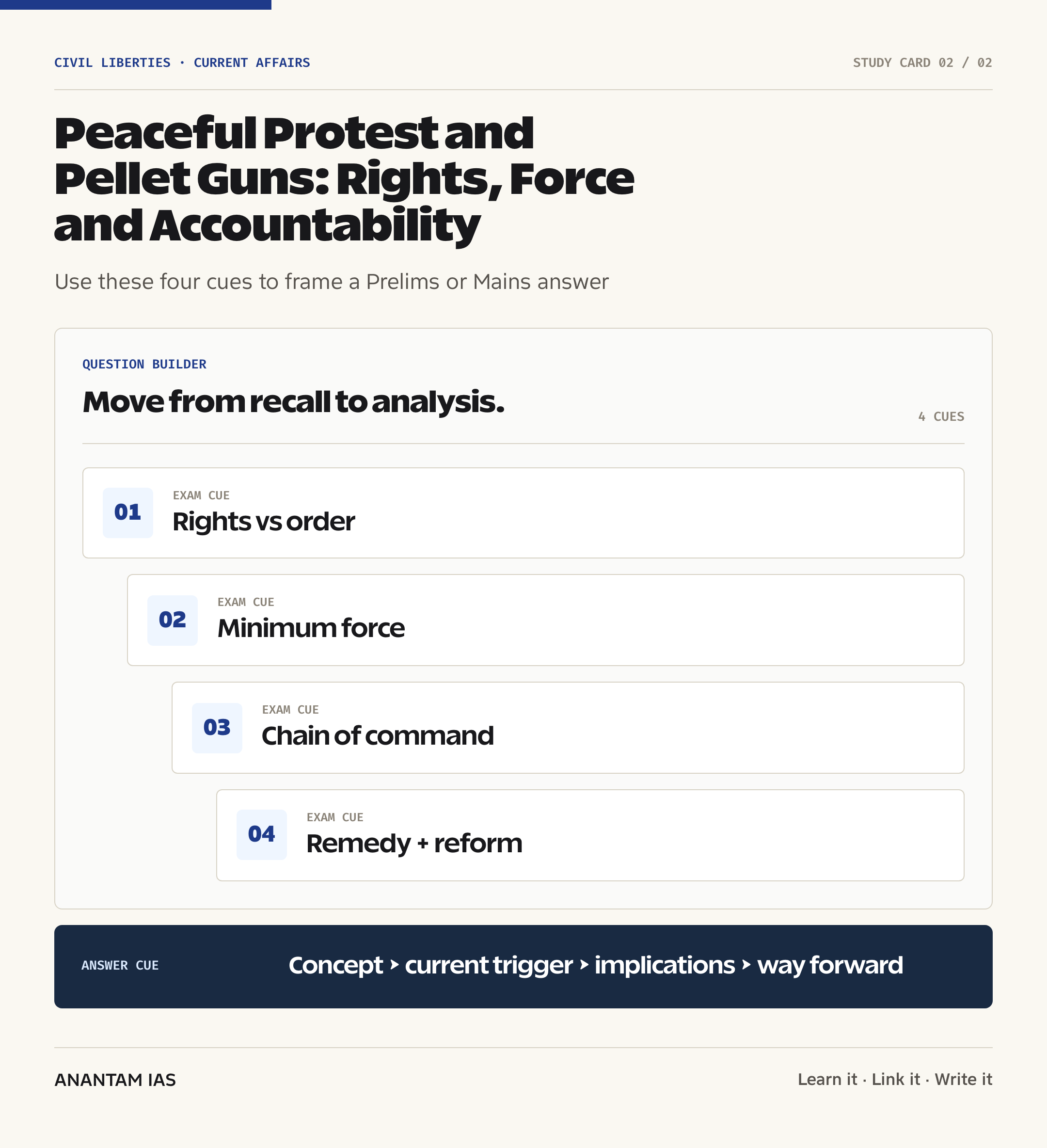
What the Supreme Court Has Already Settled
Earlier judgments supply durable principles, but none should be misreported as a final decision on the new pellet-gun petition.
- In Ramlila Maidan Incident v. Home Secretary, Union of India (2012), the Court examined the forcible midnight dispersal of a gathering and treated speech, peaceful assembly, sleep, dignity and police restraint as constitutional concerns.
- In Anita Thakur v. Government of J&K (2016), the Court accepted that reasonable force may become necessary when an assembly turns violent, but held that excessive force violates human rights and human dignity; it awarded compensation to persons found to have suffered such excess.
- The judgment discussed minimum and progressive force: warnings and less harmful measures should precede more injurious options, subject to the actual threat and operational feasibility.
- In Mazdoor Kisan Shakti Sangathan v. Union of India (2018), the Court recognised protest under Articles 19(1)(a) and 19(1)(b), rejected an approach amounting to a blanket ban in central Delhi and required workable regulation that also protected residents.
- In Amit Sahni v. Commissioner of Police (2020), the Court reiterated the right to dissent but held that public ways cannot be occupied indefinitely; time, place and manner regulation may protect commuters and other rights.
- These holdings establish neither a categorical right to occupy any site nor a categorical power to use any weapon. They require contextual justification and review of the least harmful effective response.
Domestic Statutory Route for Dispersal
The Bharatiya Nagarik Suraksha Sanhita provides authority to disperse certain assemblies, but statutory power remains subject to Fundamental Rights.
- Under BNSS Section 148, an Executive Magistrate, station house officer or qualifying police officer may command an unlawful assembly, or an assembly of five or more likely to disturb public peace, to disperse.
- If the assembly does not disperse after the command, or manifests a determination not to disperse, the authorised official may use civil force for dispersal and may arrest and confine participants as legally necessary.
- Section 149 sets a higher institutional route for armed-forces assistance: the assembly cannot otherwise be dispersed, public security must require dispersal and an authorised Executive Magistrate must act.
- Section 149(3) states that the armed-forces officer should use as little force and cause as little injury as is consistent with dispersal and arrest. This text captures restraint but doesn’t answer every weapon-specific question.
- A power to disperse doesn’t automatically validate a particular projectile, target area, firing distance or number of rounds. Those choices must still satisfy the operational order, training, weapon protocol and constitutional standard.
- For examination answers, separate authority to disperse from manner of dispersal. A lawful objective can still be pursued through an excessive or poorly controlled means.
Pellet Guns and the Unsettled Regulatory Question
India has operational rules for riot-control weapons, but no simple nationwide statutory sentence declaring pellet guns either universally lawful or universally banned.
- A pellet shotgun or projectile-action system releases multiple small projectiles over an area. Its spread makes individualised targeting difficult, especially in a moving crowd.
- The Union Home Ministry told the Lok Sabha in March 2018 that an Expert Committee had been constituted on July 26, 2016 to explore alternatives and that a three-day special training programme covered less-lethal weapons in Jammu and Kashmir.
- That parliamentary answer said the Jammu and Kashmir SOP followed an established use-of-force hierarchy, including rubber and plastic bullets. It was an account of a particular operational framework, not a permanent nationwide judicial endorsement.
- Past Jammu and Kashmir litigation did not result in a nationwide Supreme Court ban. The earlier High Court’s refusal to impose a blanket prohibition in its factual setting doesn’t foreclose a fresh challenge based on a different assembly, record or injury pattern.
- The new petition reportedly asks for decommissioning or banning wholly or partly metallic kinetic projectiles for civilian crowd dispersal. The Court may accept, narrow or reject that prayer after hearing all sides.
- The legal gap worth analysing is weapon-specific transparency: publicly intelligible standards on authorisation, ammunition type, safe use, medical response, reporting and independent review.
Less-Lethal Does Not Mean Harmless
The relevant test is the foreseeable risk created by the weapon and manner of use, not the marketing label attached to it.
- Kinetic projectiles may cause blunt trauma, penetration, fractures and organ injury; strikes to the eye or head can cause permanent visual loss or death.
- The UN Human Rights Guidance on Less-Lethal Weapons says kinetic impact projectiles should generally be aimed directly at the lower abdomen or legs of a violent individual to address an imminent threat of injury.
- The same guidance warns that firing toward the face or head may cause brain injury, blindness or death and that elevated firing can increase the risk of head strikes.
- International guidance is not itself the holding in the pending Indian case. It offers a persuasive benchmark for necessity, proportionality, precaution and weapon design.
- Indiscriminate spread creates an attribution problem: peaceful participants, bystanders, journalists and violent individuals may be physically close, but their legal status and conduct differ.
- A rights-compliant protocol should match the response to individual conduct and imminent threat wherever feasible rather than treating the crowd as one undifferentiated target.
Evidence, Command Responsibility and Remedies
Accountability depends on reconstructing the decision chain rather than drawing conclusions from a single video, denial or newspaper report.
- Investigators should preserve the general diary, deployment plan, ammunition issue-and-return register, wireless logs, body-camera or CCTV footage, medical records and names of commanding officers.
- A diary entry may be important contemporaneous evidence, but a court must test its authorship, context, accuracy and relationship with other records before treating disputed facts as proved.
- Independent medical documentation should record the number, location and depth of projectiles without making unsupported conclusions about which unit fired them.
- A valid review asks who authorised dispersal, whether a warning was audible, whether exit routes remained open, what immediate threat existed, which alternatives failed and why each escalation was chosen.
- Possible remedies include medical care, rehabilitation, compensation, departmental action, criminal investigation, protocol revision and disclosure, depending on findings and legal responsibility.
- Protection of police personnel is part of the same design: suitable helmets, shields, spacing, training and extraction plans reduce injuries and lower the claimed need for high-risk force.
- Institutional learning requires after-action review even when force is found lawful. The aim is to reduce future harm, improve command decisions and preserve public confidence.
Way Forward
Publish a Rights-Based Use-of-Force Framework
- Create a clear national minimum standard built around legality, necessity, proportionality, precaution and accountability, while allowing local operational plans for venue and threat conditions.
- Define each weapon category, authorised officer, permissible threat threshold, prohibited target areas, warning requirements and mandatory post-use reporting.
Prefer De-escalation and Graduated Response
- Use liaison officers, intelligible directions, time to comply, open exit routes, barriers and targeted arrest before area-effect weapons wherever practicable.
- Separate peaceful participants from persons committing violence; isolated misconduct shouldn’t automatically extinguish protection for an otherwise peaceful assembly.
Make the Evidence Chain Auditable
- Digitally log each weapon issue, discharge, operator, commander, ammunition type and stated reason, with safeguards against later alteration.
- Require prompt independent review whenever a projectile causes serious injury, along with preservation of video and medical evidence.
Build Safety for Both Sides
- Equip police with protective gear and recurrent human-rights training so operational safety doesn’t depend on early escalation.
- Guarantee immediate medical access, family information and a time-bound complaint route for injured protesters, bystanders and police personnel.
Let the Court Decide on a Complete Record
- The pending petitions should be resolved after responses from the Union, police and force authorities, verified operational records, medical evidence and expert assessment of weapon risks.
- Any final guideline should distinguish peaceful assemblies, unlawful but non-violent assemblies and violent conduct instead of applying one force threshold to all three.
Conclusion
The immediate controversy is not proof that the Supreme Court has banned pellet guns. It is a live constitutional inquiry into alleged force, disputed official accounts, a reported command record and injuries that may reveal whether existing safeguards worked.
The durable UPSC lesson is that democratic policing is judged by both its objective and its method. Public order is legitimate, but force gains constitutional legitimacy only when it is lawful, necessary, proportionate, carefully directed and answerable to independent review.
A credible protocol must protect peaceful dissent, isolate actual violence, reduce risk to police personnel and produce records strong enough for courts and the public to test every serious use of force.
UPSC Practice Questions
Prelims MCQ 1
With reference to the constitutional right to protest in India, consider the following statements:
- Article 19(1)(b) protects the right of citizens to assemble peaceably and without arms.
- Reasonable restrictions on this right may be imposed in the interests of public order.
- The right permits indefinite occupation of any public road chosen by an assembly.
How many of the above statements are correct?
(a) Only one (b) Only two (c) All three (d) None
Answer: (b) Only two
Explanation:
Statements 1 and 2 are correct under Articles 19(1)(b) and 19(3). Statement 3 is incorrect: Amit Sahni affirmed peaceful dissent but rejected indefinite occupation of public ways and recognised reasonable time-place-manner regulation.
Prelims MCQ 2
Which one of the following correctly describes BNSS Section 148?
(a) It creates an absolute ban on all assemblies of five persons. (b) It authorises specified officials to command certain assemblies to disperse and permits civil force when statutory conditions are met. (c) It gives only the Supreme Court power to order crowd dispersal. (d) It specifically prohibits every kinetic impact projectile.
Answer: (b) It authorises specified officials to command certain assemblies to disperse and permits civil force when statutory conditions are met.
Explanation:
BNSS Section 148 concerns dispersal by civil force. It neither bans every five-person assembly nor creates a weapon-specific nationwide prohibition.
UPSC Mains Questions
- The right to peaceful protest and the duty to maintain public order are complementary constitutional responsibilities, not mutually exclusive claims. Examine this proposition with reference to Articles 19 and 21, Supreme Court jurisprudence and the principles governing police use of force.
- A label such as less-lethal cannot substitute for legality, necessity and accountability. Discuss the regulatory and institutional reforms needed for the use of kinetic impact projectiles in crowd control, including command responsibility, medical response and independent review.
Sources: The Hindu, Supreme Court of India, Ministry of Home Affairs and India Code and The Hindu.
Frequently Asked Questions
Has the Supreme Court banned pellet guns?
No. A fresh Article 32 petition reportedly seeks decommissioning or prohibition of certain kinetic projectiles for civilian crowd dispersal, but a prayer in a petition isn’t a judicial holding. The Court’s July 27 comments protected peaceful protest and discussed police excesses and protocols; they were oral observations in pending matters, not a final nationwide pellet-gun ban.
Is every protest protected by Article 19?
Article 19(1)(b) protects citizens assembling peaceably and without arms. The State may impose reasonable restrictions under Article 19(3) for sovereignty and integrity or public order. Violence, weapons or indefinite blockage can justify proportionate regulation, but isolated misconduct shouldn’t automatically erase the rights of every peaceful participant.
What does BNSS Section 148 permit?
BNSS Section 148 allows an Executive Magistrate or specified police officer to command an unlawful assembly, or an assembly of five or more likely to disturb public peace, to disperse. If statutory conditions continue, civil force may be used. The provision supplies authority; it doesn’t remove constitutional scrutiny of necessity, proportionality or method.
Why are pellet weapons called less-lethal?
They are intended to reduce the probability of death compared with conventional firearms, but less-lethal doesn’t mean harmless. Multiple projectiles can penetrate tissue and strikes to the head or eyes can cause blindness or death. Their legal assessment depends on design, ammunition, distance, targeting, threat level, warnings and medical response.
Which judgment governs excessive police force?
Anita Thakur v. Government of J&K (2016) is a key authority. It recognised that reasonable force may be justified when an assembly becomes violent, but held that excessive force violates human rights and dignity and may require compensation. Ramlila Maidan Incident also anchors police restraint and the protection of peaceful assembly.
What evidence should an independent inquiry examine?
It should examine the general diary, command and deployment orders, ammunition records, wireless logs, CCTV or body-camera footage, medical imaging, witness accounts and the sequence of warnings and exits. Each item needs authentication and comparison with the rest; neither an official denial nor a media report alone should be treated as conclusive.
Source: https://anantamias.com/current-affairs/peaceful-protest-pellet-guns-supreme-court/
Crypto-Asset Reporting: India Aligns with the OECD CARF
Why in News?
The Central Board of Direct Taxes released a 198-page guidance note in late July 2026 to help Reporting Crypto-Asset Service Providers comply with India’s new crypto-transaction reporting framework.
The note explains Section 509 of the Income-tax Act, 2025, Rules 241 to 244 and Form 167, aligning domestic reporting with the OECD’s Crypto-Asset Reporting Framework, or CARF.
- The guidance places the primary collection and reporting duty on RCASPs, such as covered exchanges and intermediaries, rather than creating a fresh direct filing form for every investor.
- Reporting applies for each relevant calendar year beginning on or after 1 January 2026; the statement is due by 31 May of the following calendar year.
- Information for the 2026 reporting period can support India’s planned automatic exchange of information with eligible partner jurisdictions from 2027, subject to the required international arrangements.
- The note is guidance, not a new tax or a decision on whether crypto transactions are legally permissible; the Act and Rules prevail if the guidance conflicts with them.
- The official Form 167 captures provider, user, tax-residence and transaction information in a standardised structure.
The development matters in the context of:
- This matters in the context of a visibility gap: crypto-assets can move through exchanges, self-hosted wallets and borders without remaining inside the conventional banking-account chain covered by the Common Reporting Standard.
- It also matters for cooperative federal and global tax administration, because useful cross-border data depends on common definitions, compatible technology and trusted confidentiality safeguards.
- For users, exchange-reported records can be compared with income-tax disclosures, making accurate transaction histories and wallet-transfer records more important.
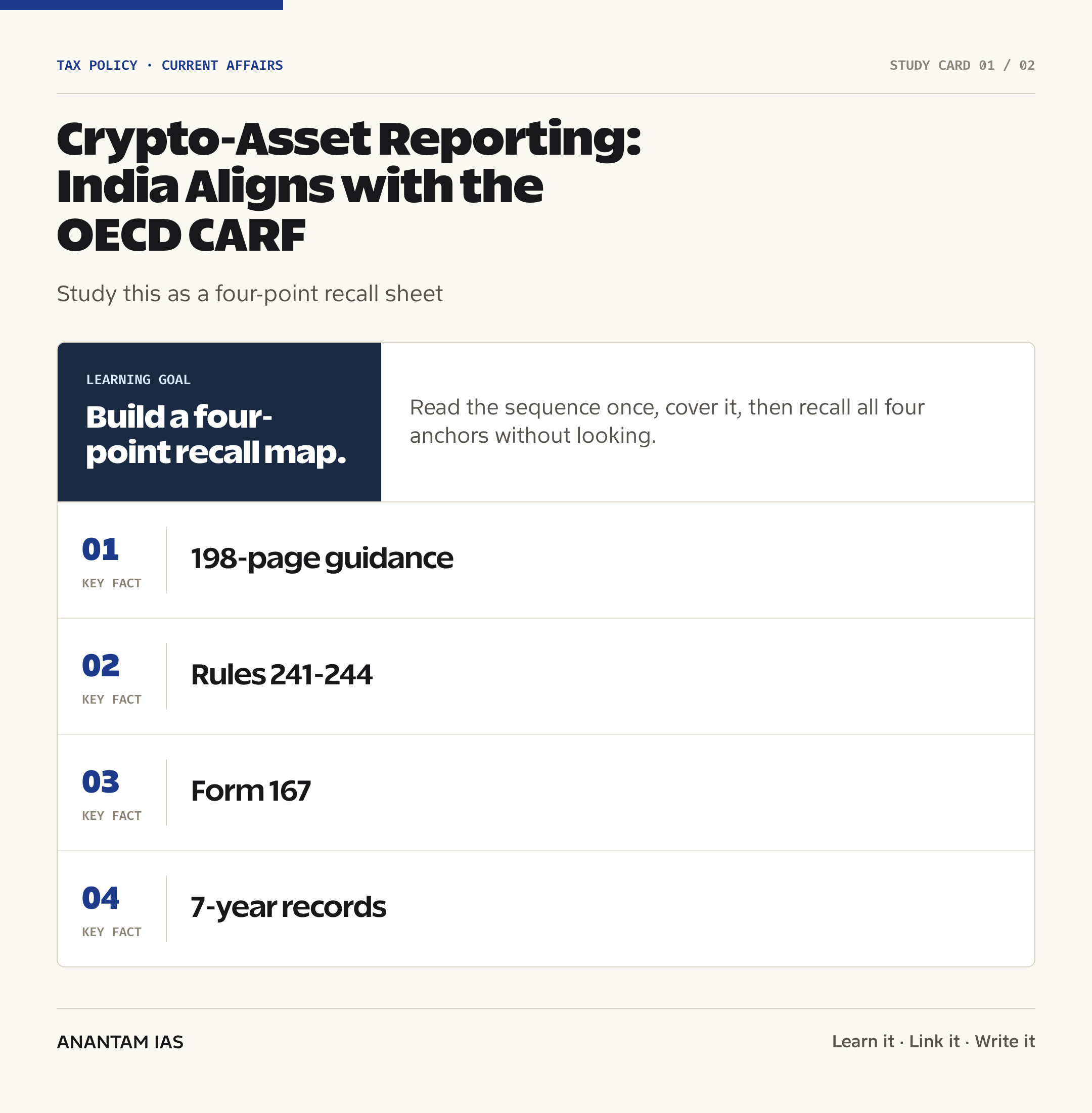
UPSC Relevance
Prelims Relevance
- CARF was developed by the OECD to collect and automatically exchange tax-relevant information on transactions in relevant crypto-assets.
- The Indian legal base is Section 509 of the Income-tax Act, 2025, supported by Rules 241 to 244 of the Income-tax Rules, 2026.
- Form 167 is the prescribed statement for relevant crypto-asset transactions reported by an RCASP.
- The framework covers exchanges between crypto-assets and fiat currency, crypto-to-crypto exchanges and transfers, including specified retail-payment transactions.
- Relevant crypto-assets generally exclude central bank digital currencies, specified electronic money products and assets reliably found incapable of use for payment or investment.
- An RCASP is functionally identified by providing, as a business, services that effect exchange transactions for or on behalf of customers.
- Due diligence uses self-certification of tax residence, checked for reasonableness against information such as AML and KYC records.
- Rules require reporting by 31 May of the year following the relevant calendar year; a nil statement is required where due diligence finds no reportable user or controlling person.
- The CARF MCAA is a multilateral competent-authority arrangement that can provide an administrative route for exchanges based on an international legal foundation.
- CARF complements the CRS; it does not replace the CRS reporting of conventional financial accounts.
Mains Relevance
GS Paper 3
- Tax transparency, the digital economy and the challenge of tracing value transferred through distributed-ledger networks.
- Regulatory technology, data quality and the compliance burden on crypto exchanges, brokers and other covered service providers.
- Balancing revenue protection with innovation, privacy, cybersecurity and proportionate regulation.
GS Paper 2
- International tax cooperation through common reporting standards, competent-authority agreements and reciprocal information exchange.
- Institutional roles of the CBDT, OECD Global Forum and domestic reporting entities in implementing transnational standards.
Essay
- Digital borders are porous, but public authority still depends on verifiable information.
- Technology can decentralise transactions while increasing the need for coordinated institutions and shared rules.
Background and Context
Why CARF Was Needed
The framework addresses tax-information gaps created when crypto activity sits outside conventional financial accounts.
- The CRS works mainly through financial institutions reporting offshore accounts, while many crypto-assets can be held directly in self-hosted wallets or moved through providers not historically covered as reporting financial institutions.
- A user can transfer a token across borders without the correspondent-bank trail normally associated with a cross-border fiat payment.
- The OECD designed CARF around transaction visibility, not around an assumption that every crypto holding is illegal or evasive.
- The G20 supported the work, and the New Delhi Leaders’ Declaration of 2023 called for swift implementation and noted the aspiration to begin exchanges by 2027.
- CARF adds a dedicated reporting layer while India’s wider crypto-regulation debate continues across taxation, financial stability, consumer protection and illicit-finance concerns.
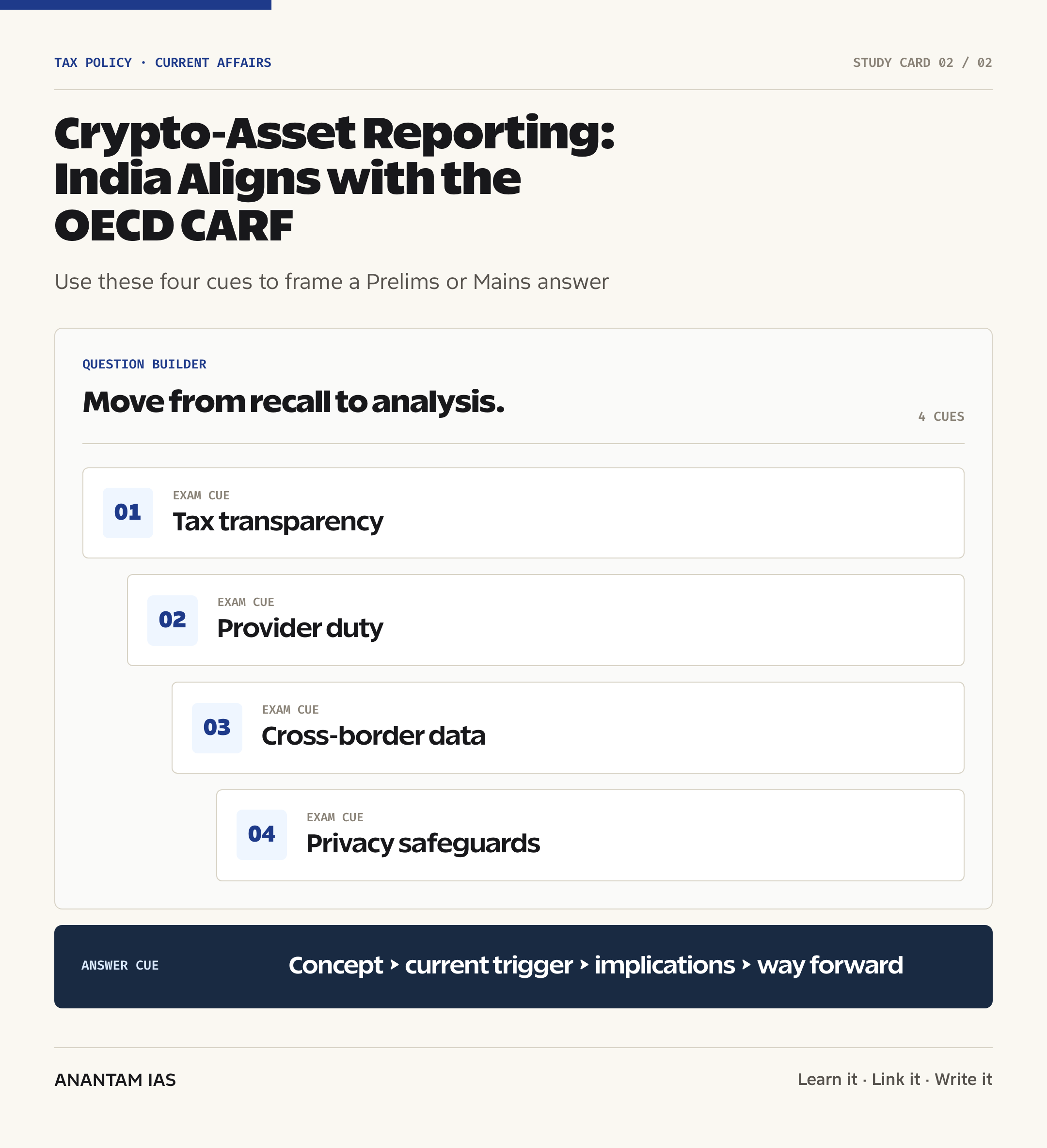
The Indian Legal Architecture
CBDT’s guidance translates a statutory scheme into operational instructions for reporting providers.
- Section 509 provides for furnishing statements about prescribed crypto-asset transactions by reporting entities.
- Rule 241 supplies the core definitions; Rule 242 determines when an RCASP has a sufficient Indian reporting nexus; Rule 243 specifies the information and filing rule; and Rule 244 sets due-diligence procedures.
- The official Form 167 records RCASP identity, the reporting period, reportable users or controlling persons, and asset-wise transaction aggregates.
- For each relevant calendar year starting on or after 1 January 2026, covered providers maintain and report the prescribed information.
- The statement is due by 31 May of the following calendar year. This makes 31 May 2027 the filing date for the 2026 reporting period, based on the rule as published.
- CBDT’s note states that its examples and FAQs facilitate compliance; they don’t override the Income-tax Act or Rules and don’t settle the regulatory legitimacy of crypto transactions.
Who Must Report
CARF follows the function performed and the provider’s jurisdictional nexus, not only its business label.
- An RCASP broadly includes an entity or individual that, as a business, effects relevant exchange transactions for or on behalf of customers, including as counterparty, intermediary or trading-platform operator.
- The OECD framework can cover exchanges, brokers, dealers, crypto-asset ATM operators and some decentralised arrangements where a person or entity exercises sufficient control or influence.
- India’s Rule 242 connects reporting duties to factors such as tax residence, incorporation or organisation, management, a regular place of business and relevant transactions through an Indian branch.
- Hierarchy and partner-jurisdiction rules seek to reduce duplicative reporting when a provider has more than one jurisdictional connection.
- Providers must still determine their own status carefully; describing a platform as decentralised doesn’t by itself answer whether a reporting intermediary exists.
Assets and Transactions in Scope
The scope is broad enough to follow economically meaningful crypto transactions while carving out low-risk categories.
- A crypto-asset is a digital representation of value relying on a cryptographically secured distributed ledger or similar technology to validate and secure transactions.
- Relevant assets can include cryptocurrencies, stablecoins, derivatives issued in crypto form and certain NFTs when they can be used for payment or investment.
- CARF excludes CBDCs, specified electronic money products and assets that the RCASP has adequately determined cannot be used for payment or investment purposes; corresponding account-based reporting may fall under the CRS.
- Reportable categories include crypto-to-fiat acquisitions and disposals, crypto-to-crypto exchanges, inbound and outbound transfers and specified retail-payment transactions.
- Crypto-to-crypto activity is not invisible merely because no rupees enter the trade: the exchanged assets are valued and classified under the reporting rules.
- For a clear technology foundation, revise blockchain technology and distributed ledgers, then separate the ledger mechanism from the tax-reporting obligation imposed on service providers.
What Form 167 Captures
The return links user identity and tax residence with standardised, asset-wise aggregates.
- For reportable individual users, data include name, address, tax residence, TIN and, where required, date and place of birth.
- For relevant entities, providers identify the entity and any controlling persons who are reportable persons, together with their roles.
- For each type of relevant crypto-asset, the provider reports aggregate amounts, units and transaction counts across prescribed acquisition, disposal and transfer categories.
- Amounts are reported in Indian rupees under the domestic rule, with conversion or fair-value methods applied at the transaction time and alternative valuation methods identified where used.
- Where the provider maintains a crypto-asset-to-rupee trading pair, that pair is the primary valuation reference. If it doesn’t, the rule provides an ordered fallback using book value, reliable third-party value, recent provider valuation and a reasonable estimate as a last resort.
- Form 167 distinguishes crypto-to-fiat from crypto-to-crypto activity and separates inbound from outbound movements, supporting risk-based reconciliation.
- Transfers to an external wallet not known to belong to a virtual-asset service provider or financial institution are aggregated; the RCASP retains the external wallet identifier but doesn’t routinely report that address in Form 167.
Due Diligence and Record Keeping
Reliable exchange begins with identifying the user and the jurisdictions entitled to receive the information.
- For a new individual user, the provider obtains a valid self-certification of tax residence during onboarding and checks its reasonableness against available information, including KYC material.
- For users existing on 31 December 2025, the Indian rule provides a 12-month period from 1 January 2026 to complete the prescribed due diligence.
- A material change of circumstances requires the RCASP to stop relying on an unreliable certification and obtain a valid replacement or supporting explanation.
- For entities, the process can require classification of the entity and identification of controlling persons, especially where passive structures could conceal the beneficial taxpayer.
- Tax residence is the key exchange link, so a provider must retain all identified residence jurisdictions and associated TINs when a reportable user is resident in more than one country or territory.
- The RCASP may rely on a third party in allowed circumstances, but the ultimate due-diligence responsibility remains with the provider.
- Relevant documents and data must be kept for at least seven tax years after the reporting period ends, supporting later verification and correction.
Automatic Exchange and Safeguards
Domestic collection and international exchange are separate legal and technical steps.
- The RCASP reports to its domestic tax administration; the administration can exchange information with a user’s jurisdiction of tax residence under an applicable international agreement.
- The CARF MCAA, bilateral tax arrangements or other lawful competent-authority agreements can provide the exchange mechanism.
- The OECD’s design uses a common XML schema so participating administrations can transmit and validate similarly structured records.
- India’s 2026 collection schedule is designed to support exchanges from 2027, but actual exchange relationships also require an international legal basis, compatible systems and approved partners.
- Confidentiality and data safeguards are not optional extras: exchange partners must protect sensitive identity, tax-residence and transaction information.
- The international layer is reciprocal and partner-specific rather than a public global database. A jurisdiction receives information under an activated relationship and uses it for the authorised tax-administration purpose.
- Rule 244 limits exchanged information to the administration of taxes by the relevant jurisdiction, making purpose limitation central to legitimate use.
Implications and Limitations
CARF improves visibility, but it isn’t a complete crypto regulator or a substitute for good tax administration.
- For taxpayers, there is no new investor filing created by the guidance note, but returns should remain consistent with exchange statements, purchase records, sales, token swaps and wallet movements.
- For providers, the difficult work lies in data lineage: mapping identities, tax residences, token identifiers, transaction types and valuations across changing systems.
- Self-hosted wallets can still sit outside a reporting provider, although transfers to unknown external wallets create an audit signal and the provider retains related identifiers.
- Different tax characterisations across countries may complicate exchange, so CARF standardises the information flow without making every jurisdiction’s substantive tax law identical.
- Large datasets can produce false matches or duplicate reports; correction processes, unique identifiers, quality controls and taxpayer grievance channels are needed.
- The reporting framework can identify inconsistencies, but an inconsistency may arise from timing, valuation or data-quality differences. Assessment still requires due process and fact-specific verification, not automatic presumption of concealed income.
- Tax reporting doesn’t settle consumer protection, monetary sovereignty or market-conduct questions explored in the regulation of stablecoins.
Way Forward
Build Verifiable Reporting Systems
- RCASPs should map every Form 167 field to a controlled source system, maintain audit trails and test valuation logic before the first filing.
- CBDT should publish machine-readable validation rules, correction procedures and consistent technical guidance for unusual token and transfer types.
- Providers need clear controls for changes in tax residence, duplicate users, missing TINs and entity controlling-person data.
Protect Taxpayer Rights
- Give users accessible transaction statements and a practical route to correct identity, residence or valuation errors before data are exchanged.
- Apply purpose limitation, access controls, encryption and retention discipline to the sensitive tax and wallet-related records.
- Use risk-based verification instead of treating every mismatch as proof of evasion; provide reasons and review channels when automated analytics trigger action.
Coordinate Without Regulatory Confusion
- Keep the distinction clear between tax reporting, anti-money-laundering supervision and decisions about the legal or regulatory status of crypto products.
- Coordinate CBDT, FIU-IND and other competent bodies so overlapping KYC and reporting duties don’t produce contradictory formats or needless duplication.
- Activate exchange relationships only with partners meeting confidentiality and data-safeguard standards, and monitor data quality after exchanges begin.
Conclusion
India’s CARF-aligned rules shift crypto tax transparency from scattered disclosures toward standardised third-party reporting. The key change is better visibility through providers that already sit at important exchange and transfer points.
Success will depend less on the length of the guidance note than on accurate classification, fair valuation, secure data exchange and workable correction rights. Transparency and privacy must be designed together if cross-border reporting is to remain credible.
UPSC Practice Questions
Prelims MCQ 1
With reference to India’s Crypto-Asset Reporting Framework implementation, consider the following statements:
- Form 167 is furnished by a Reporting Crypto-Asset Service Provider.
- The prescribed reporting can include crypto-to-crypto exchanges and transfers.
- Central bank digital currencies are treated as relevant crypto-assets under CARF.
How many of the above statements are correct?
(a) Only one (b) Only two (c) All three (d) None
Answer: (b) Only two
Explanation:
Statements 1 and 2 are correct. CBDCs are excluded from relevant crypto-assets under CARF; account-based reporting for them is addressed through the CRS framework.
Prelims MCQ 2
What is the primary purpose of the OECD Crypto-Asset Reporting Framework?
(a) To make all cryptocurrencies legal tender (b) To create a global central bank digital currency (c) To collect and automatically exchange tax-relevant crypto transaction information (d) To fix uniform crypto tax rates across countries
Answer: (c) To collect and automatically exchange tax-relevant crypto transaction information
Explanation:
CARF creates common due-diligence and reporting standards for tax information. It neither grants legal-tender status nor harmonises substantive tax rates.
UPSC Mains Questions
- The Crypto-Asset Reporting Framework seeks to restore tax visibility in a financial ecosystem built for borderless transfer. Explain its reporting architecture and assess how India can balance effective enforcement, data protection and taxpayer rights during implementation.
- India’s CARF-aligned rules place service providers at the centre of crypto tax transparency. Discuss the advantages and limits of third-party reporting for offshore transactions, self-hosted wallets and rapidly evolving decentralised platforms.
Sources: Income Tax Department, Ministry of Finance: Form 167 and Rules 241-244 and The Indian Express Explained.
Frequently Asked Questions
What is CARF?
The Crypto-Asset Reporting Framework is an OECD standard for collecting tax-relevant information from covered crypto service providers and exchanging it with eligible jurisdictions where users are tax-resident. It complements the Common Reporting Standard by addressing crypto activity that can fall outside conventional financial accounts.
Who files Form 167?
A covered Reporting Crypto-Asset Service Provider files Form 167 under Section 509 and Rule 243. The form reports provider details, reportable users or controlling persons, tax-residence information and prescribed asset-wise transaction aggregates. The CBDT guidance doesn’t create a new Form 167 filing duty for each individual investor.
When is the first statement due?
Rule 243 applies to relevant calendar years beginning on or after 1 January 2026 and requires filing by 31 May of the following year. On the published rule, information for calendar year 2026 is due by 31 May 2027.
Does CARF regulate crypto legality?
No. CBDT’s guidance explains tax-information reporting and says it shouldn’t be read as deciding the permissibility, legitimacy or wider regulation of crypto transactions. If an explanation conflicts with the Income-tax Act, 2025 or the Income-tax Rules, 2026, the statutory text prevails.
Which transactions are reported?
The framework covers prescribed exchanges between relevant crypto-assets and fiat currency, exchanges between crypto-assets, and transfers, including specified retail-payment transactions. Domestic Rule 243 requires asset-wise aggregates of amounts, units and transaction counts across defined categories rather than a single undifferentiated total.
Are external wallets invisible?
Not completely. Where an RCASP facilitates a transfer to a wallet not known to belong to a virtual-asset service provider or financial institution, it reports prescribed aggregate value and units. The provider must retain the relevant external wallet identifier for the required period, even though the address isn’t routinely reported in Form 167.
Source: https://anantamias.com/current-affairs/india-crypto-reporting-oecd-carf-guidance/