On 29 December 2025, the Reserve Bank of India released its yearly health certificate for the country’s banks — the Report on Trend and Progress of Banking in India 2024-25 — and the headline number was the kind a banker waits a decade to see. The gross bad-loan ratio of India’s scheduled commercial banks had fallen to 2.1 per cent of all loans by the end of September 2025, the lowest level in several decades. A little over seven years earlier, that same number had been close to 11.2 per cent, a mountain of soured loans that had nearly choked off lending across the economy. The RBI’s verdict on the system in 2025 was blunt and confident: resilient, well-capitalised and profitable.
The report is not a press release the central bank chooses to write when the mood is good. It is a statutory document the RBI must publish every year under Section 36(2) of the Banking Regulation Act, 1949, covering commercial banks, co-operative banks and non-banking financial companies. So when it says the banking system is in its best shape in a generation, that is a formal, on-the-record assessment. But the same report does something a cheerleader never would — it spends its later pages warning where the next crack could appear: in unsecured personal loans, in microfinance, and in the tightening web of links between banks and shadow lenders. For a UPSC aspirant, this single document is the cleanest source there is on the state of Indian banking, and it rewards anyone who can pair its bright numbers with its quiet warnings.
Why It’s in the News
The report landed in the last week of December 2025 and was picked up everywhere because the asset-quality figure crossed a psychological line. A gross non-performing asset, or GNPA, ratio of 2.1 per cent means that for every 100 rupees banks have lent, only about 2 rupees are loans where the borrower has stopped paying — the technical threshold being interest or principal overdue for more than 90 days. Falling below 2.6 per cent put the number at a level last seen well over a decade ago, and the RBI itself described it as a “multi-decadal low.” After the trauma of the 2018 NPA crisis, when one rupee in nine sat in the bad-loan bucket, that is a genuinely big turn.
What gives the story weight beyond the single number is the company it keeps. The same report shows banks holding far more capital than the rules demand, earning their best profits in years, and still growing their loan books in double digits. So this is not a fragile recovery propped up by accounting. And yet the RBI chose to release its most upbeat banking report in years alongside an unusually careful list of risks. That combination — strength on the surface, specific stress underneath — is exactly why it became a talking point for economists, exam-setters and editorial writers alike.
What This Report Is and the Long Climb Out of the NPA Crisis
The Report on Trend and Progress of Banking is the RBI’s flagship annual review of the entire banking and non-banking financial landscape. Because it is mandated by the Banking Regulation Act, it carries the authority of law, and it works as a companion to two other RBI publications aspirants should keep straight: the RBI Annual Report (the bank’s own accounts and operations) and the Financial Stability Report (a twice-yearly, forward-looking risk scan). The Trend and Progress report is the backward-looking, comprehensive one — it tells you how banks actually did over the year just gone.
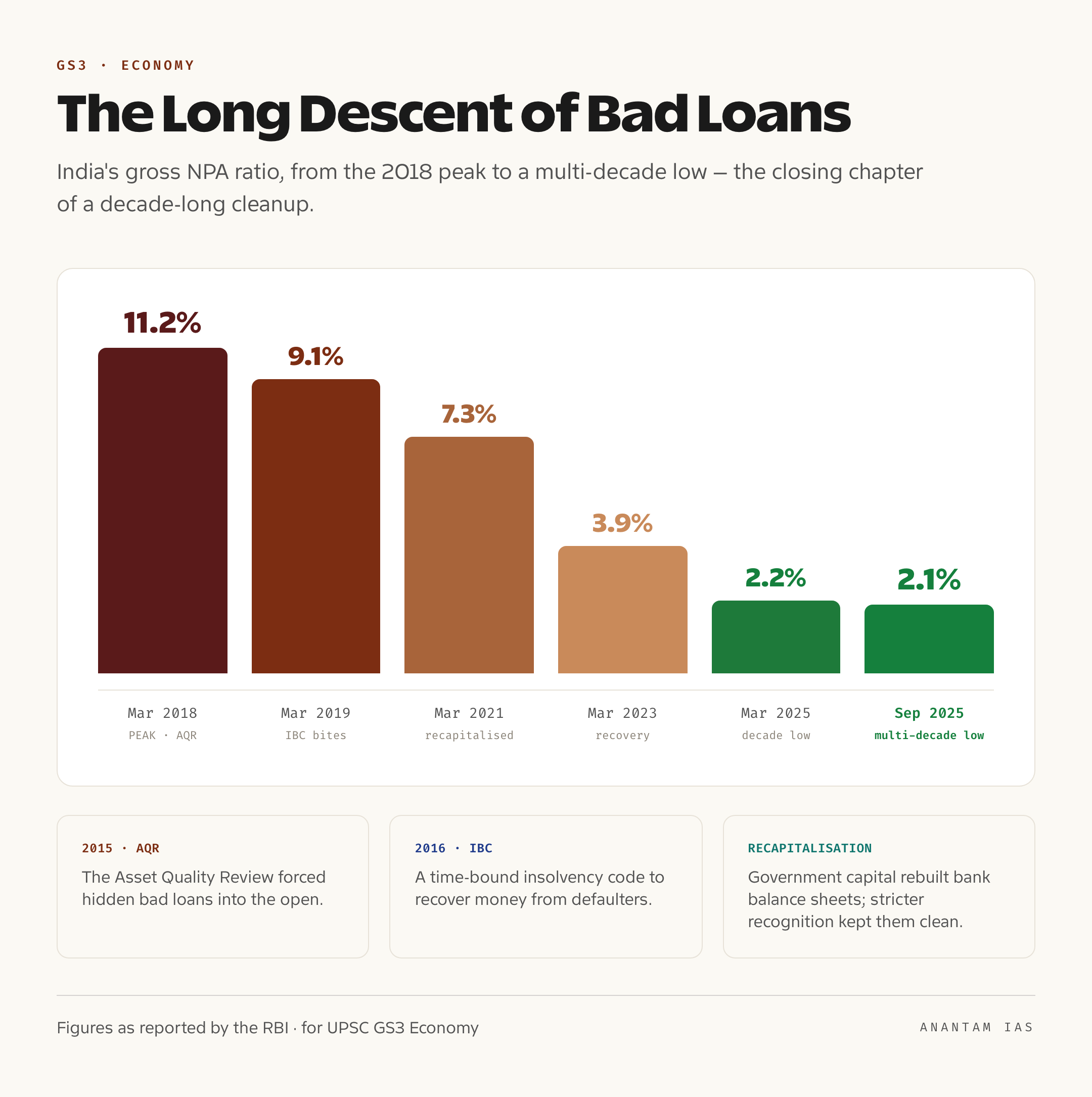
To understand why a 2.1 per cent bad-loan ratio is so striking, you have to remember where the system started. Through the early 2010s, banks — especially public-sector banks — had lent heavily to infrastructure, steel and power projects during a boom. When growth slowed, many of those projects could not repay, but banks dressed up the bad loans as “restructured” to avoid recognising losses. The RBI’s Asset Quality Review of 2015 forced the truth into the open, and bad loans that had been hidden suddenly appeared on the books. By March 2018 the GNPA ratio peaked near 11.2 per cent — among the worst in any major economy. What followed was a hard, multi-year clean-up: the Insolvency and Bankruptcy Code of 2016 gave banks a real tool to drag defaulters to a time-bound resolution, the government pumped in capital to rebuild bank balance sheets, and tighter rules on recognising stress stopped the rot from being papered over again. The 2024-25 report is, in effect, the closing chapter of that decade-long cleanup — proof the medicine worked.
The Key Numbers: Asset Quality, Capital, Profit and Credit
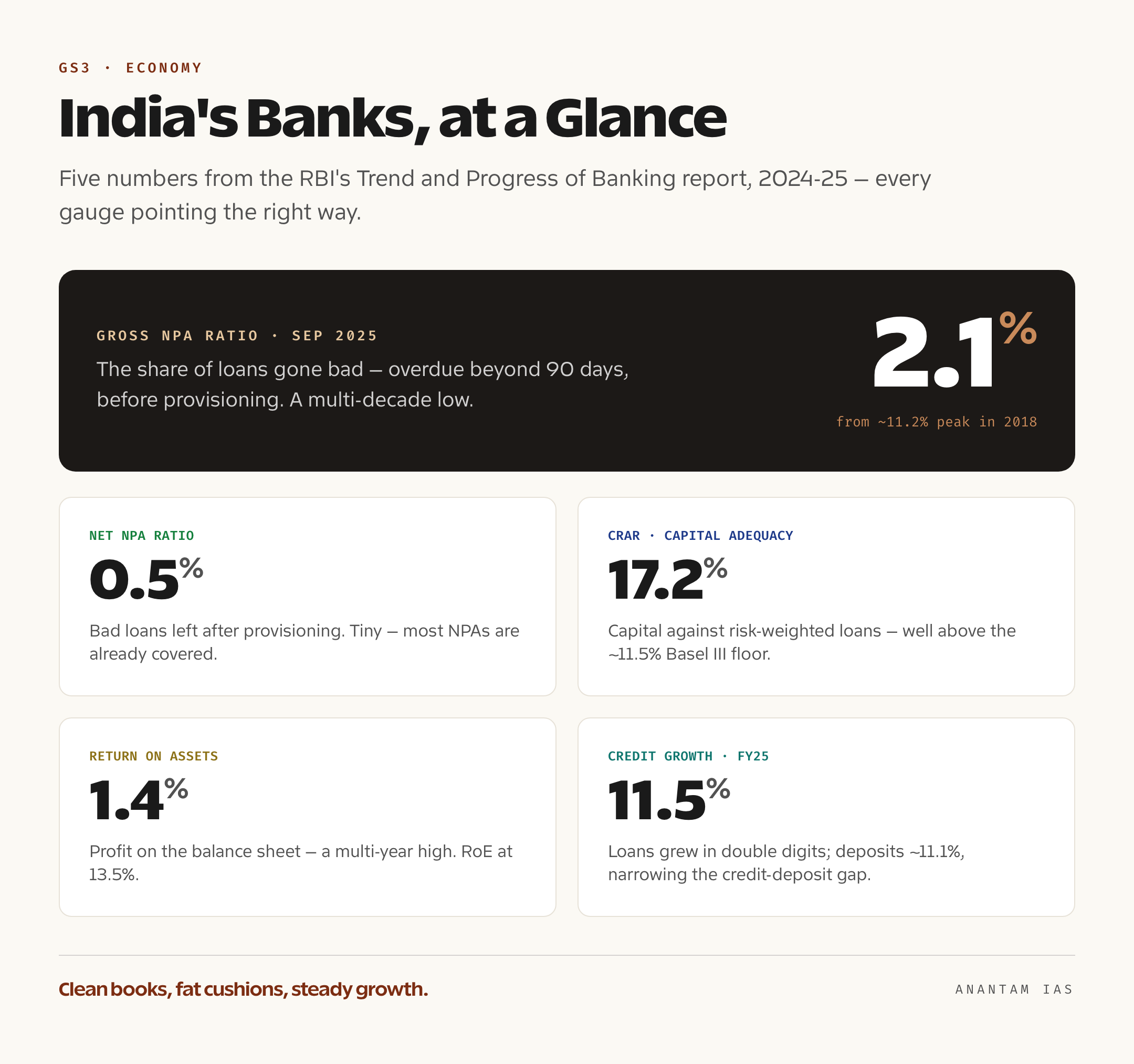
Start with asset quality, because that is the spine of the report. The GNPA ratio fell to 2.2 per cent by the end of March 2025 and slipped further to 2.1 per cent by the end of September 2025. The net NPA ratio — what’s left of the bad loans after banks set aside money to cover expected losses — dropped to just 0.5 per cent. That gap between gross and net matters: it tells you banks have already provisioned for most of their bad loans, so the unabsorbed hit to their capital is tiny. The cushion behind that is the Provisioning Coverage Ratio, or PCR — the share of bad loans for which banks have already kept money aside — which stood at roughly 77 per cent, a comfortable buffer.
Now capital, the shock-absorber of any bank. The key gauge is the Capital to Risk-Weighted Assets Ratio, or CRAR — the ratio of a bank’s own capital to its loans, weighted by how risky those loans are. It answers a simple question: if loans go bad, how much of the bank’s own money stands between depositors and disaster? For Indian banks the CRAR was 17.4 per cent at the end of March 2025 and 17.2 per cent by September 2025. Set that against the regulatory floor — the Basel III global standard requires about 11.5 per cent including buffers — and you can see banks are carrying capital well above the minimum. They are, in plain terms, heavily over-insured against losses.
On profitability, the report records the strongest run in years. Return on Assets, or RoA — net profit measured against the bank’s total assets, the cleanest test of how efficiently a bank turns its balance sheet into earnings — came in at 1.4 per cent for 2024-25, with Return on Equity, or RoE, at 13.5 per cent. Both figures eased only slightly in the first half of 2025-26, to around 1.3 and 12.5 per cent, staying near multi-year highs. An RoA above 1 per cent is generally considered healthy, so 1.4 per cent is a strong, broad-based number. Credit grew about 11.5 per cent over the year while deposits rose roughly 11.1 per cent — both in double digits, though slower than the breakneck pace of the previous year. That near-alignment narrowed the credit-deposit gap that had worried the RBI earlier, when loans were racing ahead of the deposits that fund them. So the picture is consistent on every front: clean books, fat capital cushions, healthy profit and steady, balanced growth.
What’s Healthy and Why It Matters
The significance of these numbers runs well beyond the banking sector. A banking system this clean and this well-capitalised is the precondition for everything else the economy wants to do. When banks are buried in bad loans, as they were after 2018, they hoard capital, lend cautiously and starve good businesses of credit — the so-called “twin-balance-sheet problem,” where stressed companies and stressed banks drag each other down. With the GNPA ratio at 2.1 per cent and capital at 17.2 per cent, that brake is off. Banks have both the room and the appetite to fund the investment a growing economy needs, from factories to housing to small enterprise.
It also buys India resilience against shocks. The RBI runs stress tests — simulations of severe but plausible crises — and the report’s verdict is that even under harsh scenarios, the system’s capital would stay above the regulatory minimum. That is the practical meaning of a 17.2 per cent CRAR and a 77 per cent provisioning cover: there is real money standing behind the loans, so a downturn would bruise banks rather than break them. Strong profits feed the same loop, because retained earnings rebuild capital from within, without the government having to inject taxpayer money as it did during the crisis years. And the report’s reach beyond commercial banks matters too. Non-banking financial companies — NBFCs, the lenders that don’t take regular deposits but now account for about a quarter of all bank-style credit — grew their loan books a brisk 19.4 per cent while holding a very high CRAR of 25.9 per cent. So the engines of credit outside the traditional banks were firing as well. The system, in short, isn’t just safe — it’s safe and still expanding, which is the combination policymakers dream of.
The Risks the Report Flags and the Way Forward
But the RBI did not write a victory lap, and the most examinable part of the report is its warning section. The first flag is unsecured retail credit — personal loans, credit cards and small-ticket consumer loans handed out without collateral. These had exploded at well over 30 per cent a year before the RBI stepped in late in 2023, raising the “risk weights” on such lending (which forces banks to hold more capital against it) to cool the frenzy. Growth has since moderated sharply, but the report cautions that pockets of stress are showing up among over-leveraged borrowers who took on more debt than their incomes can carry. So the very segment that drove easy retail growth is the one to watch.
The second and louder flag is microfinance — tiny collateral-free loans to low-income borrowers, often through NBFC-MFIs. Here the strain is already visible in the numbers: the bad-loan ratio in the NBFC-microfinance segment roughly doubled, climbing from about 2 per cent to over 4 per cent within a single half-year, as borrowers in some regions buckled under repayments from multiple lenders at once. The third flag is interconnectedness — the dense web of borrowing and lending between banks and NBFCs. Because NBFCs raise much of their money from banks, trouble in a large shadow lender can travel straight back into the banking system, the way a problem at one firm can ripple through a chain. The report also notes a sharp rise in high-value banking frauds, with the amount involved jumping to about Rs 34,771 crore in 2024-25, and points to newer worries from climate risk and rapid digitisation.
So what’s the way forward the report implies? Vigilance, not complacency. Keep the strong capital and provisioning buffers in place rather than running them down in good times. Watch unsecured retail and microfinance lending closely, and act early — as the RBI did with risk weights — before stress in a segment becomes a system-wide problem. Strengthen oversight of NBFCs and the bank-NBFC linkages so the shadow-banking sector grows safely rather than recklessly. And invest in fraud detection, cyber-resilience and climate-risk assessment, the risks of the next decade rather than the last. The deeper message is one every aspirant should carry into an answer: the best time to fix a banking system is when it looks strongest, because that is exactly when the seeds of the next crisis get planted.
For Your Mains Answer
This is a high-value topic for GS Paper 3, which covers the Indian economy, mobilisation of resources, banking, financial intermediation and inclusive growth. Questions on banking-sector health, NPAs, the role of the RBI as regulator, the IBC and bad-loan resolution, NBFC regulation and financial stability can all draw on this report. It also gives the Essay paper a data-rich case study on reform, resilience and the discipline of fixing problems before they explode. The skill examiners reward is the one this article uses — pair a few exact figures with a clear cause-and-effect chain, and always balance the good news against the risks.
How to Build the Answer
Open with what the report is and the single headline — the GNPA ratio at a multi-decade low of 2.1 per cent. Then move in a logical chain: define the key terms (GNPA, CRAR, PCR), give the supporting numbers (net NPA 0.5 per cent, CRAR 17.2 per cent, RoA 1.4 per cent, credit growth ~11.5 per cent), explain why the system got here (the 2018 peak, the IBC, recapitalisation, tighter recognition), state why it matters (credit flow, shock resilience, no twin-balance-sheet drag), then pivot to the risks (unsecured retail, microfinance, NBFC interconnectedness), and close with the way forward. That arc — what, how clean, why it matters, what could break it — fits almost any banking-stability question.
Common Mistakes to Avoid
Don’t confuse GNPA with net NPA — gross is before provisioning (2.1 per cent), net is after (0.5 per cent), and the gap is the whole point about provisioning strength. Don’t say capital adequacy is “just above” the minimum; at 17.2 per cent against an 11.5 per cent floor, banks are well above it, and that margin is the answer. Don’t present the report as pure good news — leaving out the microfinance and unsecured-retail warnings is the most common way to lose marks. And don’t credit the cleanup to a single reform; it was the IBC plus recapitalisation plus stricter recognition working together.
A Compact Answer Spine
RBI Trend & Progress report (statutory, Banking Regulation Act 1949) → GNPA at multi-decade low of 2.1% (Sep 2025), down from ~11.2% peak in 2018 → net NPA 0.5%, PCR ~77% → CRAR 17.2% vs Basel III ~11.5% floor → RoA 1.4%, RoE 13.5% → credit ~11.5% and deposit ~11.1% growth, narrowing C-D gap → drivers: IBC 2016 + recapitalisation + stricter recognition → significance: credit flow restored, system shock-resilient, no twin-balance-sheet drag → risks flagged: unsecured retail stress, NBFC-MFI GNPA doubling to ~4%, bank-NBFC interconnectedness, rising frauds → way forward: vigilance, keep buffers, early action, stronger NBFC oversight.
Diagram or Flowchart Idea
Draw a simple downward step-line of the GNPA ratio from ~11.2% (2018) to ~2.1% (2025), annotated with the cleanup tools at each step (AQR, IBC, recapitalisation). Beside it, a small two-box panel — “What’s Healthy” (CRAR 17.2%, RoA 1.4%, PCR 77%) versus “What to Watch” (unsecured retail, microfinance, NBFC links). That contrast captures the report’s whole message at a glance.
A Balanced-Conclusion Line
A line that lands the marks: “India’s banks have never looked healthier — bad loans at a multi-decade low, capital well above the rules and profits at multi-year highs — but the RBI’s own warnings on unsecured retail, microfinance and shadow-banking linkages are a reminder that the discipline which cleaned up the system must now be used to keep it clean.”
How to Use Data Without Cramming
You need only five anchors, not the full report: 2.1 per cent (GNPA, the multi-decade low), 0.5 per cent (net NPA), 17.2 per cent (CRAR against an ~11.5 per cent floor), 1.4 per cent (RoA), and ~11.5 per cent (credit growth). Add one number for the risks — the NBFC-microfinance GNPA roughly doubling to over 4 per cent — and one for history, the ~11.2 per cent peak of 2018. Attribute them plainly to “the RBI’s Trend and Progress of Banking report” rather than scattering figures without a source.
FAQ
What is the RBI’s Report on Trend and Progress of Banking? It is the Reserve Bank of India’s flagship annual review of the banking and non-banking financial sector, published every year as a statutory requirement under Section 36(2) of the Banking Regulation Act, 1949. It covers commercial banks, co-operative banks and NBFCs, and is the most comprehensive backward-looking assessment of how Indian banks performed over the year. The 2024-25 edition was released on 29 December 2025.
What does GNPA, CRAR and PCR mean? GNPA — the Gross Non-Performing Asset ratio — is the share of a bank’s total loans where the borrower has stopped repaying for more than 90 days; it fell to a multi-decade low of 2.1 per cent in September 2025. CRAR — the Capital to Risk-Weighted Assets Ratio — measures a bank’s own capital against its risk-weighted loans, showing how much loss it can absorb; it stood at 17.2 per cent, well above the roughly 11.5 per cent regulatory minimum. PCR — the Provisioning Coverage Ratio — is the share of bad loans for which a bank has already set money aside, at roughly 77 per cent.
Why are India’s bank NPAs at a multi-decade low now? Because of a decade-long cleanup. After the GNPA ratio peaked near 11.2 per cent in 2018, the Insolvency and Bankruptcy Code of 2016 gave banks a time-bound way to recover money from defaulters, the government recapitalised public-sector banks, and the RBI tightened the rules on recognising bad loans so they could no longer be hidden. Together these brought the ratio down to 2.1 per cent and rebuilt bank profitability and capital.
What risks did the RBI flag despite the strong numbers? Three main ones. Stress is emerging in unsecured retail credit — personal loans and credit cards lent without collateral. Microfinance is straining, with the bad-loan ratio in the NBFC-microfinance segment roughly doubling to over 4 per cent in half a year. And the deepening interconnectedness between banks and NBFCs means trouble in a large shadow lender could spread back into the banking system. The report also noted rising high-value frauds and called for continued vigilance.
Practice Questions
Prelims MCQs
- The RBI’s “Report on Trend and Progress of Banking in India” is published as a statutory requirement under which law?
(a) The Reserve Bank of India Act, 1934
(b) The Banking Regulation Act, 1949
(c) The Insolvency and Bankruptcy Code, 2016
(d) The Companies Act, 2013
Answer: (b) The report is mandated under Section 36(2) of the Banking Regulation Act, 1949, and covers commercial banks, co-operative banks and NBFCs. - With reference to the Gross NPA (GNPA) ratio, which statement is correct?
(a) It measures a bank’s profit against its total assets
(b) It is the share of total loans where repayment is overdue beyond 90 days, before provisioning
(c) It measures a bank’s capital against its risk-weighted assets
(d) It is the share of deposits lent out as loans
Answer: (b) GNPA is the gross bad-loan ratio before provisioning; it fell to a multi-decade low of 2.1 per cent by September 2025. - The Capital to Risk-Weighted Assets Ratio (CRAR) of Indian scheduled commercial banks in 2024-25, at around 17.2-17.4 per cent, was:
(a) Below the Basel III regulatory minimum
(b) Exactly equal to the regulatory minimum
(c) Well above the roughly 11.5 per cent regulatory minimum
(d) Not measured for Indian banks
Answer: (c) At about 17 per cent against a Basel III floor of roughly 11.5 per cent including buffers, banks held capital well above the minimum. - The Provisioning Coverage Ratio (PCR) of a bank indicates:
(a) The proportion of loans given to priority sectors
(b) The share of bad loans for which the bank has already set aside money
(c) The ratio of credit growth to deposit growth
(d) The interest margin earned on loans
Answer: (b) PCR is the cushion a bank keeps against bad loans; at roughly 77 per cent it shows most NPAs are already provided for, which is why the net NPA ratio was only 0.5 per cent. - Which of the following were flagged as emerging risks in the RBI’s banking report despite strong headline numbers? 1. Stress in unsecured retail and personal loans 2. Rising bad loans in the NBFC-microfinance segment 3. Interconnectedness between banks and NBFCs. Select the correct answer:
(a) 1 and 2 only
(b) 2 and 3 only
(c) 1 and 3 only
(d) 1, 2 and 3
Answer: (d) The report flagged all three — unsecured retail stress, an NBFC-MFI bad-loan ratio roughly doubling to over 4 per cent, and bank-NBFC interconnectedness.
Mains Practice Questions
- “India’s banking system has emerged from its worst asset-quality crisis to its cleanest balance sheet in a generation.” Examine the factors behind the fall in the gross NPA ratio from its 2018 peak to a multi-decade low, and assess the role of the Insolvency and Bankruptcy Code in this turnaround. (15 marks, 250 words)
- Explain the concepts of GNPA, CRAR and the Provisioning Coverage Ratio. Using recent data, discuss how these indicators together establish the resilience of India’s scheduled commercial banks. (15 marks, 250 words)
- A strong banking system is described as the precondition for credit-led growth. In light of the latest data on asset quality, capital adequacy and profitability, evaluate how far Indian banks are positioned to finance the investment needs of a growing economy. (15 marks, 250 words)
- Discuss the risks emerging in unsecured retail credit and microfinance, and explain why the interconnectedness between banks and NBFCs poses a systemic concern for financial stability. (10 marks, 150 words)
- “The best time to strengthen a banking system is when it looks strongest.” Critically analyse this proposition with reference to the regulatory measures and the way forward suggested by the RBI for India’s banking sector. (15 marks, 250 words)
Tell Google you want more of this.
Add Anantam IAS as a preferred sourceOne tap, and this site shows up more often in your own Top Stories, AI Overviews and AI Mode. Remove it any time.