
Why in News?
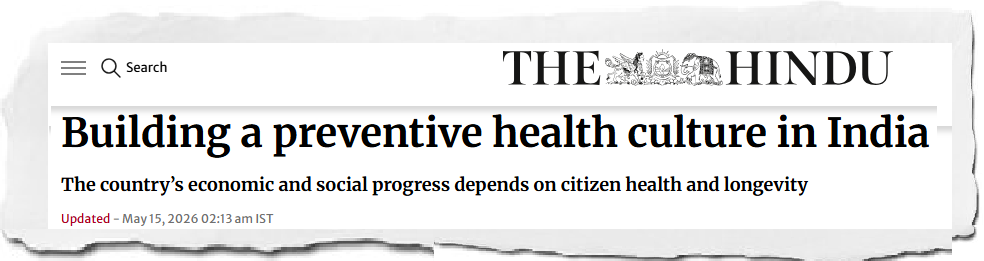
India is witnessing a rapid rise in non-communicable diseases (NCDs) such as diabetes, cardiovascular diseases, cancer and strokes, which are now the leading causes of mortality. Recent discussions around preventive health care, including findings from large-scale health assessments such as the Apollo Hospitals Health of the Nation Report 2026, have highlighted the urgent need to shift India’s health-care model from disease treatment to disease prevention. The issue has gained policy relevance in the context of rising health-care costs, demographic transition and India’s long-term developmental goals.
UPSC Relevance
Prelims: Non-communicable diseases, National Health Policy 2017, Ayushman Bharat, SDG-3, preventive health care, public health indicators
Mains:
GS II: – Health sector, public health infrastructure, human development, government policies and interventions, social sector development
GS III: – demographic dividend, economic productivity and human capital;
Essay: – preventive health, public health governance, development and human well-being
Background/Context:
Over the past four decades, India has made notable advancements in healthcare, establishing institutions of global repute, expanding tertiary care, and improving access to advanced treatments.
However, the health system remains predominantly curative, focused on treating illness after it manifests rather than preventing its onset. With a large youthful population, India is at a critical juncture where rising NCDs threaten to undermine the demographic dividend.
According to various health assessments, approximately 270 million Indians live with chronic conditions, many undiagnosed until complications arise. This situation necessitates a paradigm shift from illness response to health preservation.
Burden of Non-Communicable Diseases
NCDs such as cardiovascular diseases, diabetes, cancer, chronic respiratory diseases, and strokes have surpassed infectious diseases as the leading causes of death and disability in India. These conditions are largely lifestyle-related and preventable through early intervention. The economic cost is substantial, including direct medical expenses, productivity losses, and increased out-of-pocket expenditure that pushes families into poverty.
Critical Window of Intervention
The period between 30 and 40 years of age emerges as a decisive phase. During these years, metabolic and cardiovascular risks accelerate due to sedentary lifestyles, unhealthy diets, stress, and lack of routine screening. Most individuals remain asymptomatic, delaying care until irreversible damage occurs. Timely lifestyle modifications and regular health checks can significantly delay or reverse many conditions, highlighting the importance of early action.
Preventive Health as Self-Stewardship
Prevention requires a cultural transformation where health is viewed as an active daily commitment rather than the mere absence of disease. This involves personal responsibility, family-level awareness, and community participation. It calls for integrating wellness into everyday life through balanced nutrition, physical activity, mental well-being, and periodic screenings.
Constitutional, Economic, Social and Governance Dimensions
- Constitutional Provisions: Article 21 (Right to Life) has been interpreted by the Supreme Court to include the right to health and a clean environment. Directive Principles of State Policy (Articles 39, 41, 47, and 48A) direct the State to improve public health, nutrition, and living standards.
- Economic Dimension: High out-of-pocket health expenditure (around 45-50% of total health spending) exacerbates inequality. NCDs impose a heavy burden on GDP; the World Economic Forum estimates that India could lose trillions due to NCDs by 2030 if unchecked.
- Social Dimension: Preventive care can reduce gender disparities in health outcomes and empower marginalised sections. It also addresses the urban-rural divide in awareness and access.
- Governance: Health is a State subject (List II), but the Centre plays a key role through concurrent powers and centrally sponsored schemes. Effective prevention demands cooperative federalism and convergence between health, education, and nutrition ministries.
Relevant Schemes, Reports and Initiatives
- Ayushman Bharat (2018): Comprises Health and Wellness Centres (HWCs) for primary preventive care and Pradhan Mantri Jan Arogya Yojana (PMJAY) for secondary and tertiary care. Over 1.5 lakh HWCs aim to deliver comprehensive primary healthcare including NCD screening.
- National Health Policy 2017: Emphasises preventive and promotive health, targeting reduction in NCD burden.
- National Programme for Prevention and Control of Cancer, Diabetes, Cardiovascular Diseases and Stroke (NPCDCS).
- Apollo Hospitals Health of the Nation Report 2026 and other surveys like the National Family Health Survey (NFHS-5) and Global Burden of Disease Study.
- International linkages: Sustainable Development Goal 3 (Good Health and Well-being) and WHO Framework on NCD prevention.
Challenges and Concerns
- Low health-seeking behaviour in asymptomatic populations and inadequate health literacy.
- Resource constraints, shortage of trained personnel for preventive services, and weak primary healthcare infrastructure in several regions.
- Rising risk factors such as obesity, tobacco use, alcohol consumption, air pollution, and unhealthy processed food consumption.
- Fragmented data systems and poor integration of digital health tools.
- Over-commercialisation of curative care may disincentivise investment in prevention.
- Socio-cultural barriers, including fatalistic attitudes towards health in some communities.
Way Forward
- Strengthen primary healthcare through full operationalisation of Ayushman Bharat HWCs with focus on NCD screening, lifestyle counselling, and community health workers (ASHAs and ANMs).
- Launch a national mission for preventive health literacy, integrating it into school and college curricula and using digital platforms for mass awareness.
- Incentivise regular health check-ups through tax benefits, workplace wellness programmes, and insurance premium discounts.
- Promote inter-sectoral coordination involving education, urban planning, agriculture (for nutrition), and environment ministries to address social determinants of health.
- Leverage technology through digital health IDs (ABHA), AI-driven risk prediction, and telemedicine for follow-ups.
- Encourage public-private partnerships and civil society participation to scale community-based prevention models.
- Adopt outcome-based monitoring with clear targets for reduction in NCD incidence and improvement in healthy life expectancy.
- Foster a whole-of-society approach where individuals, families, communities, and governments share responsibility for health creation.
Conclusion
India’s journey from a curative to a preventive health paradigm is essential for realising its aspiration of becoming a developed nation by 2047. By building a robust culture of prevention rooted in awareness, early action, and self-stewardship, India can not only reduce disease burden but also enhance the quality of life of its citizens. This shift will safeguard the demographic dividend, promote inclusive growth, and strengthen the foundation of Viksit Bharat. The time for this civilisational reckoning is now.
Practice Questions Prelims MCQs
Which of the following is/are the objectives of Ayushman Bharat Scheme?
- Establishment of Health and Wellness Centres for primary care.
- Providing health insurance coverage for secondary and tertiary care.
- Focus exclusively on curative treatment of communicable diseases.
Select the correct answer using the code given below:
(a) 1 only
(b) 1 and 2 only
(c) 2 and 3 only
(d) 1, 2 and 3
Answer: (b)
Explanation: Ayushman Bharat strengthens primary healthcare through HWCs and provides insurance via PMJAY. It covers both preventive and curative aspects, with emphasis on NCDs as well.
Consider the following statements:
- Non-Communicable Diseases are now the leading cause of death in India.
- Article 47 of the Indian Constitution directs the State to improve public health as a primary duty.
Which of the statements given above is/are correct?
(a) 1 only
(b) 2 only
(c) Both 1 and 2
(d) Neither 1 nor 2
Answer: (c)
Explanation: Both statements are factually correct and reflect current health trends and constitutional provisions.
Mains Questions
Examine the economic and social implications of the rising burden of non-communicable diseases in India. How can government schemes like Ayushman Bharat be reoriented to address this challenge more effectively?
“India’s healthcare system has excelled in curative care but lags in preventive health.” Discuss the statement and suggest a multi-pronged strategy to build a preventive health culture in the country.
Tell Google you want more of this.
Add Anantam IAS as a preferred sourceOne tap, and this site shows up more often in your own Top Stories, AI Overviews and AI Mode. Remove it any time.