Introduction
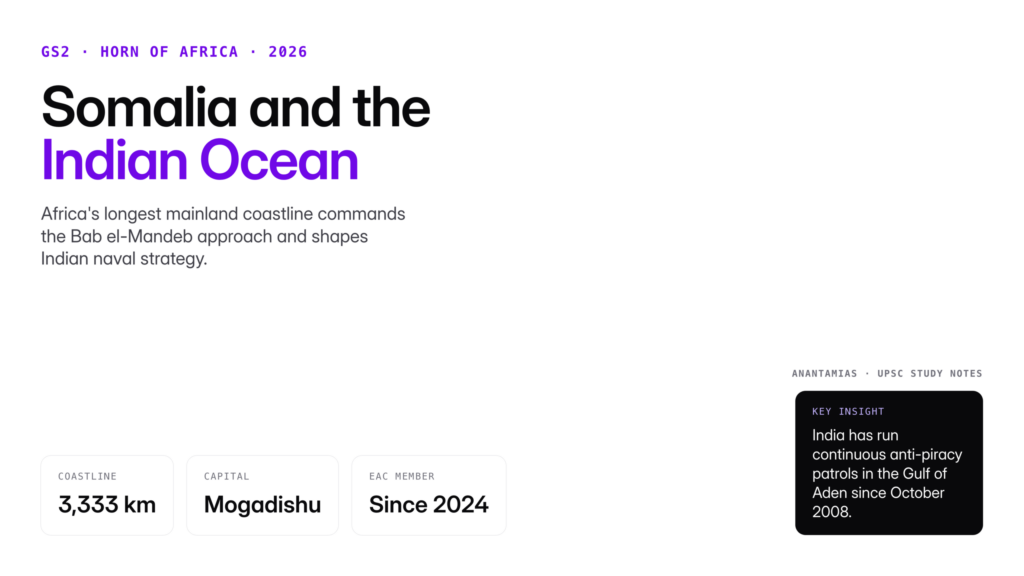
Somalia occupies the eastern tip of the African continent, a long coastal wedge along the Indian Ocean and the Gulf of Aden that gives it the longest coastline of any mainland African state. For UPSC aspirants, the country is not a peripheral entry on the map. It sits astride one of the world’s most strategic maritime corridors, the approaches to the Bab el-Mandeb strait, through which a significant share of global oil and container trade moves. Understanding Somalia is therefore essential to understanding Red Sea security, Indian Ocean geopolitics, and India’s Africa outreach.
The country has also become a shorthand in international relations textbooks for the problems of state collapse, piracy, counter-terrorism, and fragile reconstruction. After the fall of Siad Barre’s regime in 1991, Somalia spent two decades without a functional central government. The contemporary Federal Government of Somalia, the persistent insurgency of Al-Shabaab, the de facto independent Somaliland, and the evolving African Union stabilisation mission all map onto recurring themes in GS2 and GS3 syllabi. This guide unpacks the geography, political structure, security challenges and India-Somalia relationship in exam-ready detail.
Quick Facts at a Glance
| Parameter | Detail |
|---|---|
| Official name | Federal Republic of Somalia |
| Capital | Mogadishu |
| Area | Approximately 637,657 sq km |
| Population (UN 2024 estimate) | Approximately 18 million |
| Coastline | About 3,333 km, longest on mainland Africa |
| Location | Horn of Africa, eastern Africa |
| Borders | Djibouti, Ethiopia, Kenya |
| Official languages | Somali, Arabic |
| Currency | Somali shilling (SOS) |
| Government | Federal parliamentary republic |
| Current President (2026) | Hassan Sheikh Mohamud |
| Membership | UN (1960), African Union, Arab League, OIC, EAC (2024), IORA |
Background and Historical Context
Somalia’s modern political map was drawn by colonial partition in the late 19th century. The northern coast became British Somaliland in 1884, while Italy consolidated the south as Italian Somaliland by 1889. A smaller French Somali Coast became today’s Djibouti. British Somaliland gained independence on 26 June 1960 and united five days later with the independent trust territory of Italian Somaliland on 1 July 1960 to form the Somali Republic. This unification is the origin of contemporary Somalia’s two distinct legal and administrative traditions.
The post-independence civilian government gave way to the military coup of Siad Barre in 1969. Barre’s regime pursued scientific socialism, aligned initially with the Soviet Union, and in 1977 invaded Ethiopia’s Ogaden region in pursuit of a Greater Somalia. Defeat in that war, followed by drought, debt, and clan-based repression, eroded state authority. When Barre fell in 1991, the state itself collapsed. The north-west declared independence as the Republic of Somaliland, a state that remains unrecognised internationally but has held regular elections and maintains its own currency and passport.
The 1990s and 2000s brought UN interventions, the failed UNOSOM and UNITAF missions, the rise of the Islamic Courts Union, and Ethiopia’s 2006 military intervention. Out of this disorder emerged Al-Shabaab, an Al-Qaeda-affiliated insurgent group that still controls parts of southern and central Somalia. The 2012 adoption of a provisional federal constitution and the installation of the Federal Government marked a turning point, though state-building remains incomplete in 2026.
Key Features of Somalia
Geography and Climate
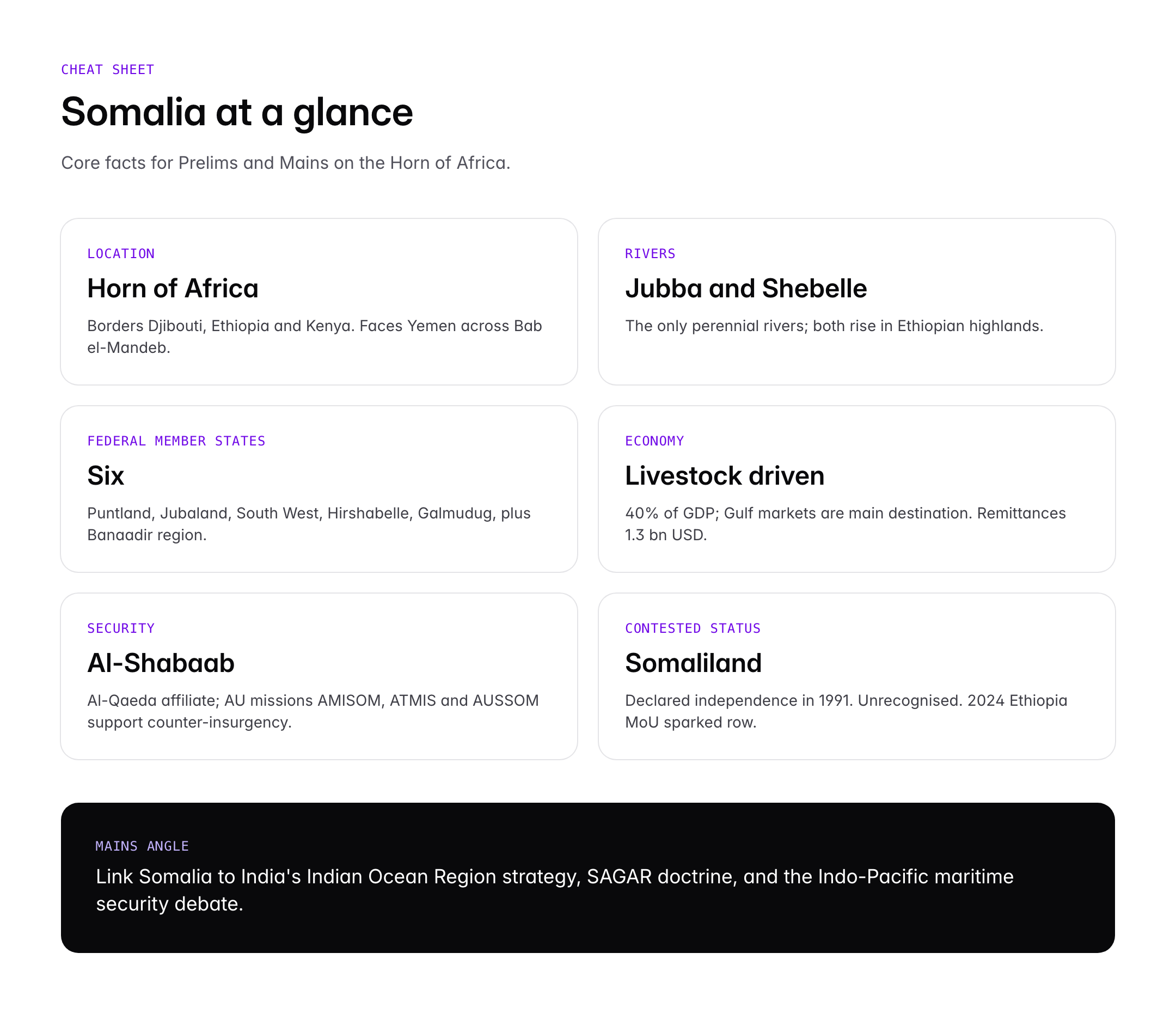
Somalia is dominated by arid and semi-arid plateaus with narrow coastal plains. The Guban coastal zone faces the Gulf of Aden in the north, while the south features deegaan grasslands watered by the Jubba and Shebelle rivers, the country’s only perennial streams. Mount Shimbiris in the Cal Madow range is the highest point at about 2,460 m. The climate is hot, with two rainy seasons, Gu (April to June) and Deyr (October to December), punctuated by recurring droughts.
Federal Structure
The 2012 Provisional Constitution establishes a federal republic with a bicameral Federal Parliament, a President elected by Parliament, and a Prime Minister as head of government. The six federal member states are Puntland, Jubaland, South West State, Hirshabelle, Galmudug, and the special status of Banaadir region around Mogadishu. Somaliland’s status is disputed and it is not part of the federal system.
Economy and Livelihoods
Somalia’s economy is dominated by livestock rearing, which contributes roughly 40 percent of GDP and is the single largest export to Gulf markets. Remittances from the diaspora, estimated by the World Bank at more than 1.3 billion US dollars annually, form a critical safety net. Fisheries, telecommunications, and mobile money platforms, notably EVC Plus and eDahab, are fast-growing sectors. The country formally joined the East African Community in 2024.
Security Landscape
Counter-insurgency against Al-Shabaab dominates the security agenda. The African Union Transition Mission in Somalia, ATMIS, succeeded AMISOM in 2022 and is handing over to the new AUSSOM mission in 2025-2026 with phased reduction of foreign troops.
Piracy and Maritime Security
Somali piracy peaked around 2011 and has since declined due to coordinated international naval operations, including the EU NAVFOR Operation Atalanta, the Combined Task Force 151, and India’s own anti-piracy patrols in the Gulf of Aden since 2008.
Diaspora and Culture
Somalia has one of Africa’s largest proportional diasporas, with significant communities in Kenya, Ethiopia, the Gulf states, the United Kingdom, the United States, Canada and Sweden. Somali is a Cushitic language of the Afro-Asiatic family and is written in Latin script since 1972.
Significance for UPSC and General Knowledge
- Somalia controls the western flank of the Bab el-Mandeb chokepoint, essential for GS2 questions on maritime trade and GS3 questions on energy security.
- It is a classic case study of state failure and reconstruction, frequently cited in essay and IR optional questions.
- The piracy surge and its suppression illustrates multilateral naval cooperation, directly relevant to India’s Indian Ocean Region strategy.
- Al-Shabaab remains a key reference point for questions on Africa-linked transnational terrorism.
- Somalia’s recent EAC membership and its role in IORA connect it to India’s regional economic diplomacy.
- India’s evacuation of citizens during Somali crises and its naval escort missions illustrate capability-based diplomacy.
Detailed Analysis: India-Somalia Relations
India’s engagement with Somalia predates its independence. Indian traders were present in Mogadishu and other Somali ports under the dhow trade network across the Arabian Sea. Diplomatic relations were established in 1960 and India supported Somalia’s early development through the Indian Technical and Economic Cooperation programme. Indian doctors, teachers and engineers served across the Somali peninsula during the 1970s and 1980s.
The civil war ruptured this engagement. India closed its Mogadishu embassy in 1991 and operated through its mission in Nairobi for nearly three decades. A working-level embassy was reopened only in recent years as the security environment improved. In the interim, the most visible form of Indian presence has been naval. The Indian Navy has deployed warships to the Gulf of Aden on a continuous anti-piracy patrol since October 2008, escorting more than 3,400 merchant vessels across several years and rescuing crews from hijacked ships. The operations include the 2011 rescue of the Iranian dhow Al Qambar and, more recently, the 2024 rescue of the hijacked MV Ruen off the Somali coast.
India has also offered humanitarian assistance. During the 2011 Horn of Africa famine and subsequent droughts, India contributed food, medicines and financial aid through the World Food Programme and direct bilateral grants. New Delhi has trained Somali diplomats and civil servants through ITEC and IAFS scholarships. Somalia participates in the India-Africa Forum Summit process, and Indian companies have shown interest in Somalia’s nascent oil and gas sector, telecoms and construction, though security constraints have slowed actual investment.
Strategically, India views Somalia through three lenses. First, as a Western Indian Ocean partner whose coast borders sea lanes vital to Indian trade. Second, as part of the broader Africa outreach emphasised under the India-Africa Forum Summit framework. Third, as a node in counter-terrorism cooperation, given Al-Shabaab’s links to wider Al-Qaeda networks. The recent opening of Somalia to the East African Community further aligns it with the India-backed Asia-Africa Growth Corridor vision.
Comparative Perspective
| Feature | Somalia | Ethiopia | Djibouti |
|---|---|---|---|
| Coastline | About 3,333 km | Landlocked since 1993 | About 314 km |
| Regime type | Federal parliamentary | Federal parliamentary | Presidential republic |
| Key port | Mogadishu, Berbera (Somaliland) | None (uses Djibouti) | Port of Djibouti |
| India ties | Anti-piracy, ITEC, humanitarian | Defence, capacity-building, trade | Djibouti Code of Conduct, shipping |
| Chokepoint role | Bab el-Mandeb approach | Inland supplier via corridor | Bab el-Mandeb, hosts foreign bases |
| Key security concern | Al-Shabaab, piracy | Tigray aftermath, ethnic federalism | Host to US, French, Chinese bases |
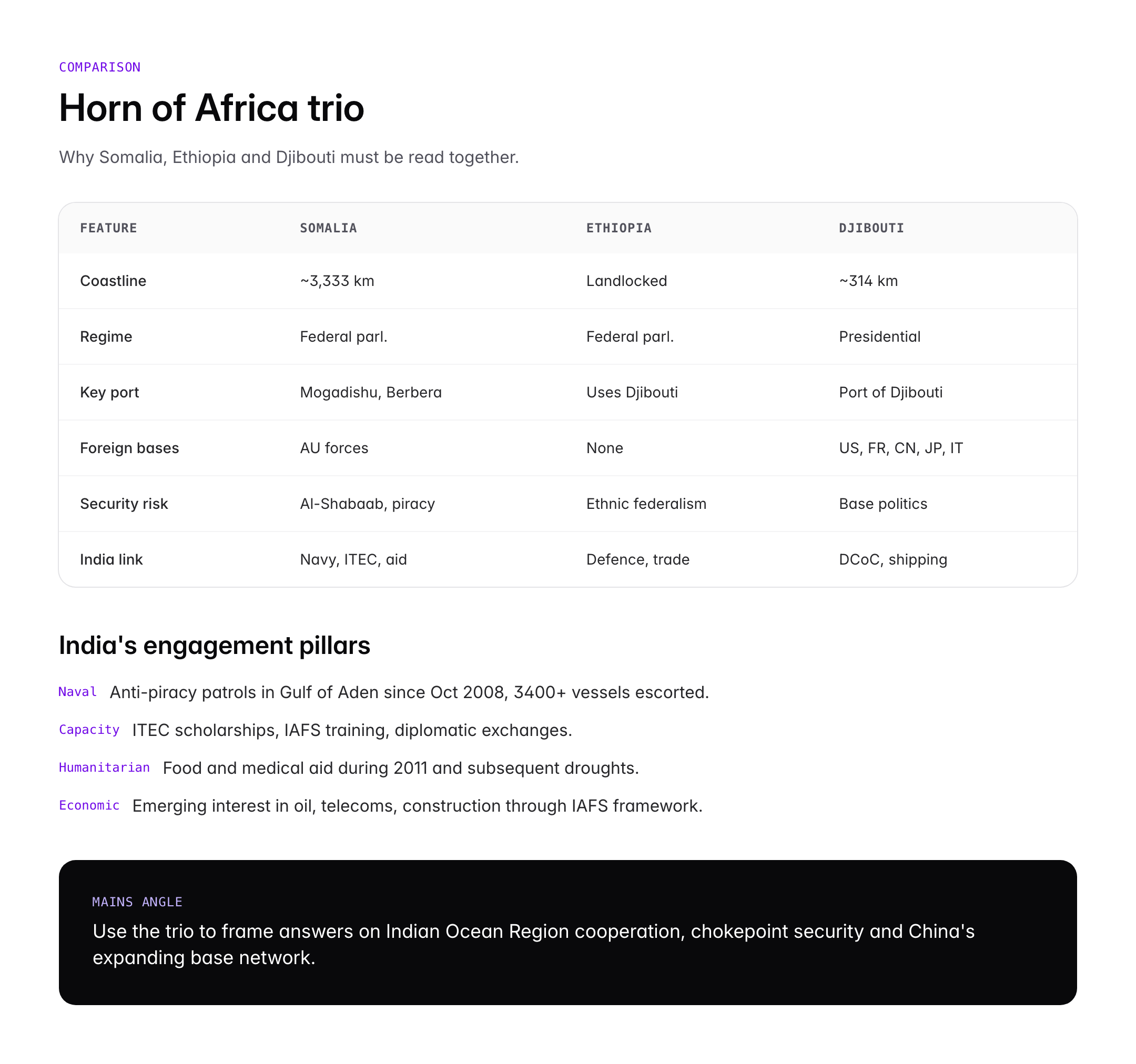
The table makes explicit why a rounded Horn of Africa answer must treat the three states together. Ethiopia is the populous inland anchor, Djibouti the dense base-and-logistics hub, and Somalia the long coastal state that knits these roles to the open Indian Ocean.
Challenges and Criticisms
Somalia’s federal project remains contested. Puntland suspended cooperation with the federal government on several occasions, and tensions between Mogadishu and member states over resource sharing, natural gas exploration, and security command slow the constitution-making process. The unresolved status of Somaliland, which in 2024 signed a controversial Memorandum of Understanding with Ethiopia regarding sea access and possible recognition, is a fresh diplomatic flashpoint.
Counter-terrorism critics point to the high civilian cost of kinetic operations and the dependence on external forces. Human rights organisations have documented collateral damage from airstrikes and ground operations, while aid agencies warn that food insecurity driven by recurrent droughts and climate change compounds the crisis. The UN OCHA has repeatedly classified Somalia among the worst humanitarian emergencies globally.
For India, engagement is constrained by security risk to personnel, limited commercial opportunity and the need to balance relations with Ethiopia and the Gulf states simultaneously. A measured, long-term approach built on naval presence, training and humanitarian support appears to be the current policy choice.
Prelims Pointers
- Somalia’s capital is Mogadishu, located on the Indian Ocean coast.
- It has the longest coastline on mainland Africa, about 3,333 km.
- Somalia borders Djibouti, Ethiopia and Kenya.
- The country joined the East African Community in 2024.
- It gained independence in 1960 from the unification of British and Italian Somalilands.
- Siad Barre ruled Somalia from 1969 until 1991.
- Al-Shabaab is an Al-Qaeda-affiliated insurgent group active in southern and central Somalia.
- Somaliland declared independence in 1991 but is not internationally recognised.
- The Jubba and Shebelle are Somalia’s only perennial rivers.
- Somalia is a member of the UN, AU, Arab League, OIC and IORA.
- The Indian Navy has run anti-piracy patrols in the Gulf of Aden since October 2008.
- The African Union Transition Mission in Somalia, ATMIS, is being succeeded by AUSSOM in 2025-2026.
Mains Practice Questions
- Somalia occupies a pivotal position in the Horn of Africa. Examine its strategic significance for India’s Indian Ocean policy. (250 words)
- Locate Somalia in relation to the Bab el-Mandeb chokepoint and Red Sea sea lanes.
- Discuss India’s anti-piracy operations, humanitarian assistance and ITEC engagement.
- Evaluate constraints such as Al-Shabaab insurgency, Somaliland dispute and regional rivalries.
- Discuss the challenges of state-building in post-1991 Somalia and the lessons for international state-reconstruction efforts. (150 words)
- Trace collapse after Siad Barre and failed UN interventions.
- Analyse the 2012 federal constitution, AMISOM, ATMIS and AUSSOM.
- Draw lessons on clan dynamics, external stabilisation and humanitarian coordination.
Conclusion
Somalia is a country whose very geography makes it strategically unavoidable. Its long Indian Ocean coast and Gulf of Aden frontage place it on the same maritime chessboard as Yemen, Djibouti and Egypt, and therefore on India’s. Its internal politics, from the aftermath of Siad Barre to the 2012 federal constitution and the unresolved status of Somaliland, offer one of the most instructive contemporary case studies in state failure and slow reconstruction.
For the UPSC aspirant, Somalia is best read as a stress test of Indian Ocean Region cooperation. India’s approach, long-duration naval patrols, humanitarian assistance, capacity-building and cautious commercial engagement, demonstrates how a middle power can convert strategic geography into durable partnership without overextending itself. As the Horn of Africa becomes more crowded with external powers, Somalia’s trajectory will matter well beyond its borders.
Frequently Asked Questions
What is Somalia?
Somalia is a federal republic at the eastern tip of Africa, occupying the Horn of Africa. With a coastline of about 3,333 km along the Indian Ocean and Gulf of Aden, it is the longest coastal state on mainland Africa. Its capital is Mogadishu and its population is around 18 million. It is a member of the United Nations, African Union, Arab League, OIC, IORA and, since 2024, the East African Community.
Why is Somalia strategically important for UPSC?
Somalia controls the western approaches to the Bab el-Mandeb strait and sits on sea lanes through which a significant share of global oil and container trade passes. It is central to Indian Ocean security, features prominently in counter-piracy and counter-terrorism debates, and is a key node in India’s Africa outreach. These overlaps make it highly relevant for GS2 international relations and GS3 internal security answers.
Where is Somalia located?
Somalia lies in the Horn of Africa, bordering Djibouti to the north-west, Ethiopia to the west and Kenya to the south-west. To its east and south lies the Indian Ocean, and to its north the Gulf of Aden. The country sits directly opposite Yemen across the narrow Bab el-Mandeb strait. This position makes it a key state in both Indian Ocean and Red Sea geopolitics.
How is Somalia related to the Bab el-Mandeb chokepoint?
The Bab el-Mandeb strait separates the Horn of Africa from the Arabian Peninsula and connects the Red Sea to the Gulf of Aden. Somalia’s northern coastline faces this corridor directly. Maritime insecurity in Somali waters, from piracy in the 2000s to recent Houthi spillover effects, immediately impacts shipping through Bab el-Mandeb, giving Somalia a central role in global sea-lane security.
What is the role of Al-Shabaab in Somalia?
Al-Shabaab is an Al-Qaeda-affiliated insurgent group that emerged from the Islamic Courts Union in the mid-2000s. It controls parts of southern and central Somalia and conducts attacks in Mogadishu, Kenya and Uganda. The African Union missions AMISOM, ATMIS and the new AUSSOM, along with the Somali National Army and US drone strikes, have sought to contain it, but the group remains active.
What are India-Somalia relations?
India established diplomatic relations with Somalia in 1960. Ties weathered the 1991 civil war, after which India’s mission operated from Nairobi. Since October 2008, the Indian Navy has conducted continuous anti-piracy patrols in the Gulf of Aden, escorting thousands of merchant vessels. India also offers ITEC training, humanitarian aid during droughts and scholarships through the India-Africa Forum Summit framework, and is re-engaging commercially as security improves.
What is the status of Somaliland?
Somaliland is the north-western region of Somalia that declared independence in 1991 as the Republic of Somaliland. It has held regular elections, has its own currency, passports and armed forces, but no UN member state recognises it. In 2024 Ethiopia signed a controversial Memorandum of Understanding with Somaliland on sea access and possible recognition, triggering strong objections from the Somali federal government.
What are the main challenges facing Somalia today?
The central challenges are the Al-Shabaab insurgency, contested federal-state relations, the unresolved status of Somaliland, recurrent droughts and food insecurity aggravated by climate change, and dependence on external security forces. Economic challenges include weak state revenue, reliance on livestock exports and diaspora remittances, and limited foreign investment. International coordination, climate adaptation finance and inclusive federalism are seen as the main pathways forward.
Tell Google you want more of this.
Add Anantam IAS as a preferred sourceOne tap, and this site shows up more often in your own Top Stories, AI Overviews and AI Mode. Remove it any time.