Daily Digest
UPSC · Civil Services Examination
Current Affairs · Saturday, 18 July 2026
Current affairs curated and edited by Anantam IAS faculty — pulled from The Hindu, PIB, IDSA, Foreign Affairs and the ministries. Read, annotate, revise.
Old Rajinder Nagar · Delhi 110005 · anantamias.com
Mumbai–Ahmedabad High-Speed Rail: Domestic Trains Before Japan’s E10
Why in News?
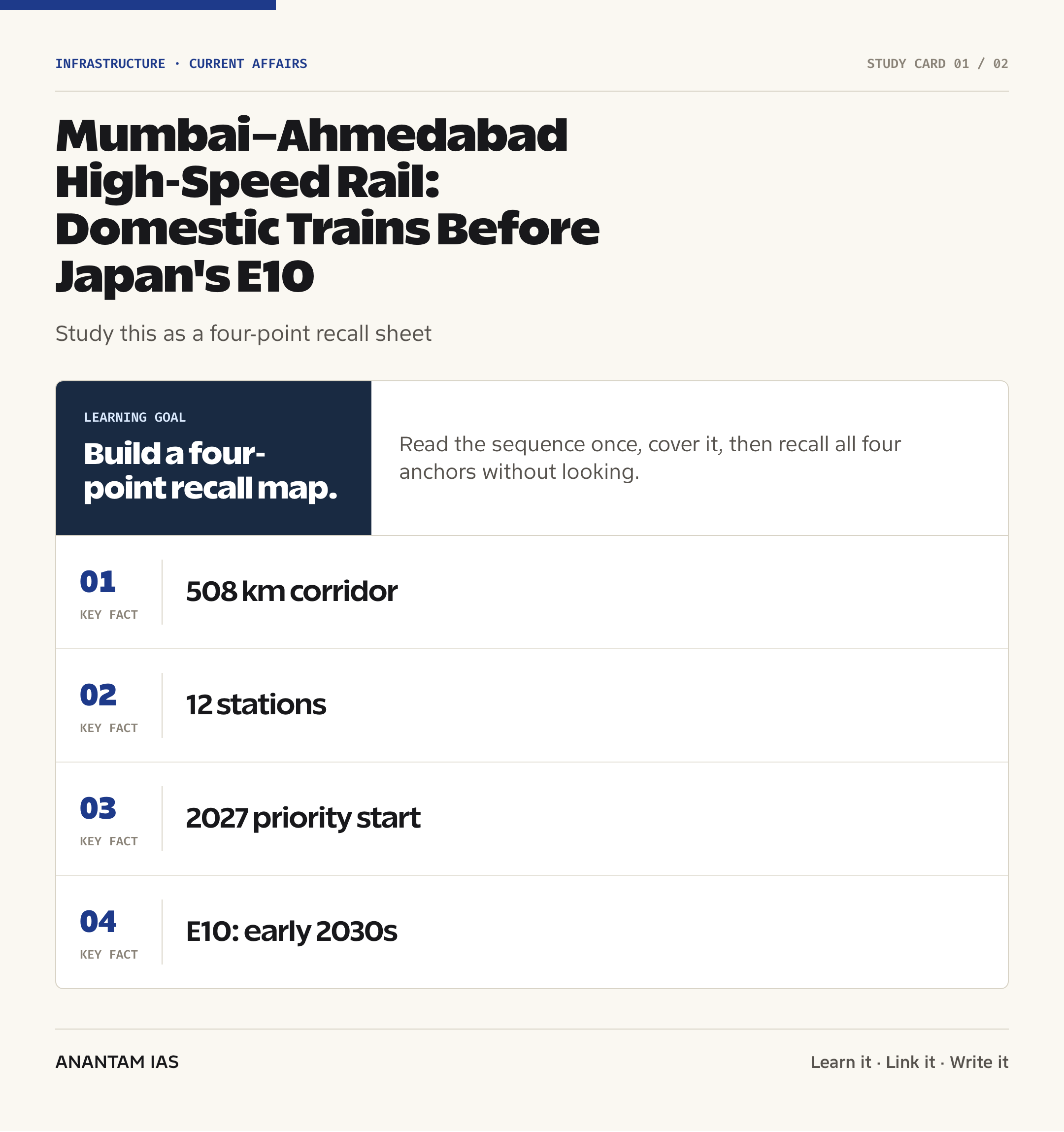
The Ministries of External Affairs and Railways clarified on 17 July 2026 that operations on a priority section of the Mumbai–Ahmedabad High-Speed Rail corridor are planned to begin with an Indian high-speed train, while Japan’s next-generation E10 Shinkansen is expected only in the early 2030s.
The clarification, reported by The Hindu and The Indian Express, answered claims that India–Japan cooperation had stalled. The durable issue isn’t a replacement of Japanese technology by Indian technology; it is a phased rolling-stock and systems strategy within a bilateral infrastructure project.
- Near-term sequence: India is developing a domestic high-speed trainset through Integral Coach Factory and BEML for initial service on a priority section.
- Later sequence: The bilateral commitment is to introduce the still-developing E10 Shinkansen in the early 2030s, not necessarily in calendar year 2030.
- Priority opening: A current PIB factsheet expects the first high-speed service in August 2027 on the Surat–Vapi section; this isn’t a full-corridor completion date.
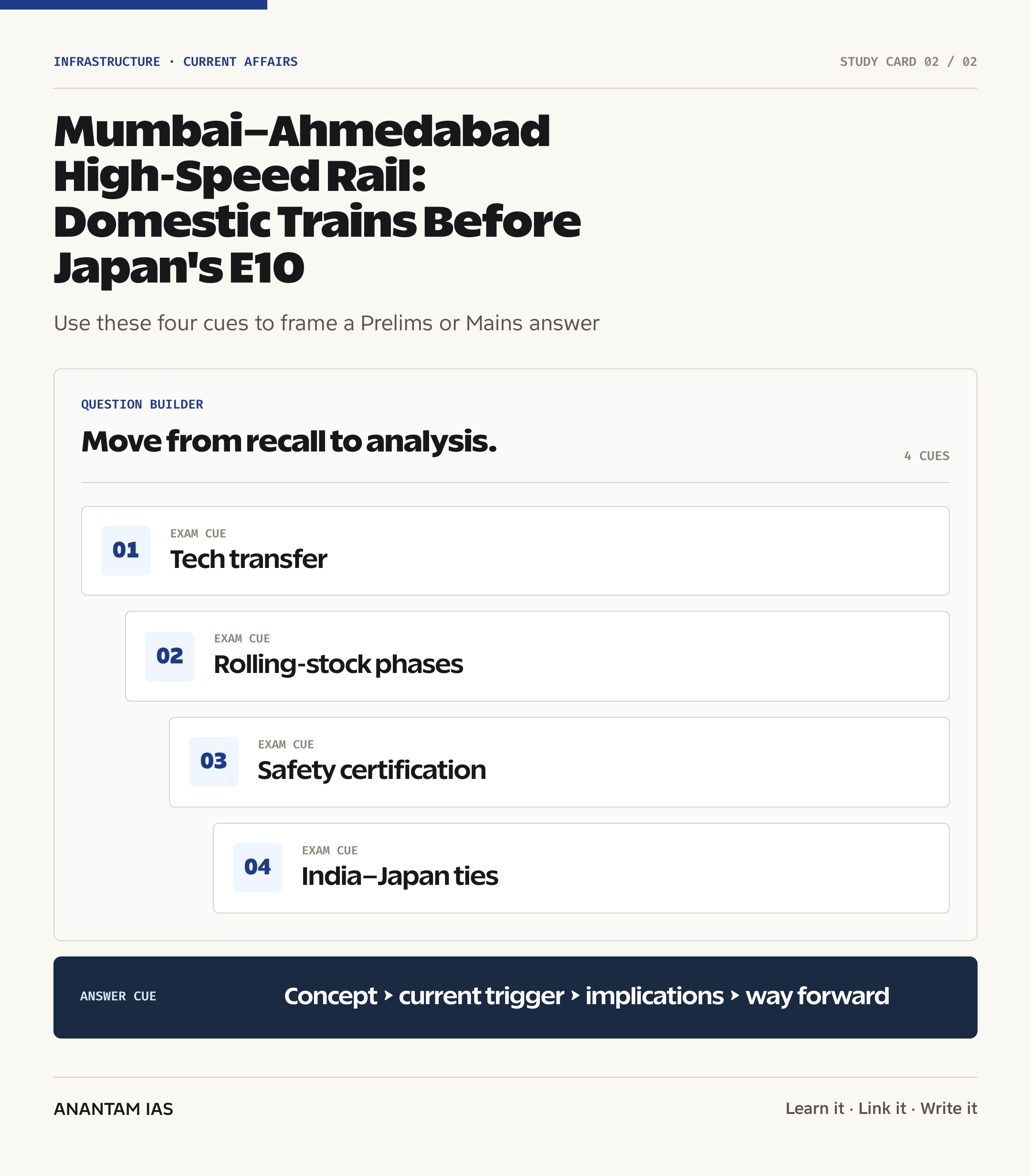
- System question: Signalling, train control and rolling stock must be certified as one safety system, so sequencing can’t be reduced to the nationality of the train.
- Bilateral continuity: The July 2026 India–Japan summit acknowledged both India’s 2027 priority-section target and the goal of introducing the E10.
The development matters in the context of:
- Technology transfer: The project combines Japanese high-speed-rail practices with domestic construction, manufacturing, training and systems capability.
- Project governance: Phased commissioning can produce learning earlier, but only if every interim configuration meets independent safety and interoperability requirements.
- Industrial policy: Domestic trainset development creates tooling, testing and supplier capacity that may support India’s proposed future high-speed corridors.
- Strategic partnership: MAHSR is a flagship of the India–Japan Special Strategic and Global Partnership, linking finance, engineering and long-term industrial cooperation.
UPSC Relevance
Prelims Relevance
- MAHSR stands for the Mumbai–Ahmedabad High-Speed Rail corridor, India’s first dedicated high-speed rail corridor.
- The implementing company is the National High Speed Rail Corporation Limited, incorporated in 2016.
- The approximately 508 km corridor crosses Maharashtra, Gujarat and the Union Territory of Dadra and Nagar Haveli.
- The corridor has 12 planned stations, from Mumbai BKC to Sabarmati.
- The official corridor specification gives a 350 kmph design speed and a 320 kmph operating speed for the mature system.
- The J-slab ballastless track is based on Japanese Shinkansen track technology.
- ICF, in collaboration with BEML, is developing indigenous high-speed trainsets described by PIB as 280 kmph trainsets.
- The E10 is Japan’s next-generation Shinkansen series and remains under development.
- The 2025 India–Japan joint statement placed E10 introduction in the early 2030s and referred to the Japanese signalling system.
- High-speed rail uses dedicated infrastructure, advanced rolling stock, continuous train control and stringent system-level safety assurance.
Mains Relevance
GS Paper 3
- Infrastructure: Benefits and risks of phased commissioning in a capital-intensive, safety-critical transport corridor.
- Industrial capability: Localisation of rolling stock, slab track, construction equipment, testing facilities and maintenance skills.
- Technology governance: Interoperability among trainsets, signalling, electrification, track and operating procedures.
- Regional development: Station-area planning, multimodal integration and productivity gains along an economic corridor.
GS Paper 2
- International relations: Infrastructure finance and technology cooperation as pillars of the India–Japan partnership.
- Institutional coordination: Managing standards, procurement and public communication across two governments and multiple implementing agencies.
- Strategic trust: Separating political controversy from agreed summit outcomes and verifiable project milestones.
Essay
- Self-reliance works best as capability building, not technological isolation.
- Infrastructure partnerships endure when finance, standards, skills and accountability move together.
Background and Context
What the New Sequencing Actually Means
The domestic trainset and the E10 belong to different stages of the same corridor plan, so they shouldn’t be treated as identical or mutually exclusive choices.
- Stage one: India plans to use an indigenously developed trainset when a priority section is ready for service.
- Stage two: Japan is expected to supply the E10 after that train family is developed and the corridor is prepared for its introduction.
- Timing discipline: The official bilateral phrase is early 2030s; converting it into a guaranteed 2030 delivery date would overstate the commitment.
- Scope discipline: A 2027 start on a priority section doesn’t mean the entire Mumbai–Ahmedabad corridor will be commercially open that year.
- Not a simple substitution: Rolling stock, signalling, train control, track, power, depots and operating rules have to function as an integrated safety system.
- Policy reading: The sequence tries to balance early operations, domestic capability and continued access to advanced Japanese technology.
The Corridor at a Glance
MAHSR is a dedicated standard-gauge passenger corridor built for speeds and safety requirements far beyond conventional Indian Railways operations.
- Alignment: The corridor runs for about 508 km through Maharashtra, Dadra and Nagar Haveli, and Gujarat.
- Stations: Its 12 planned stops are Mumbai, Thane, Virar, Boisar, Vapi, Bilimora, Surat, Bharuch, Vadodara, Anand, Ahmedabad and Sabarmati.
- Performance: NHSRCL specifies a mature-system operating speed of 320 kmph and limited-stop travel of about two hours.
- Structures: Most of the route is elevated, while the Maharashtra section includes a long tunnel with an undersea portion beneath Thane Creek.
- Track: The project introduces J-slab ballastless track, which fixes rails to concrete slabs instead of conventional ballast.
- Planning connection: Read the corridor alongside India’s broader infrastructure constraints and investment pipeline.
Domestic Trainset: Capability, Not Yet a Finished Service
Building a trainset is only one milestone; safe commercial service needs design validation, dynamic trials, certification and operating readiness.
- Industrial actors: ICF awarded BEML the work to design, manufacture and commission two eight-car high-speed trainsets.
- Official description: PIB calls these indigenous 280 kmph high-speed trainsets, while BEML’s technical material distinguishes test speed from commercial operating speed.
- Exam caution: A test or design speed isn’t automatically the speed at which passengers will initially travel.
- Testing chain: Braking distance, ride dynamics, wheel–rail interaction, electromagnetic compatibility and emergency procedures need verification.
- Production ecosystem: The programme creates specialised tooling, jigs, test facilities, suppliers and skilled teams for future trainsets.
- Operational learning: Initial service can build experience in dispatch, maintenance, passenger handling and incident response before later rolling stock arrives.
E10 and the India–Japan Technology Compact
The E10 is part of a wider bilateral package that includes finance, engineering, safety culture, inspection systems and human-resource development.
- Summit mandate: The 2025 joint statement recorded Japan’s offer to introduce the E10 in the early 2030s.
- Development status: Japan’s Ministry of Foreign Affairs describes the E10 as still under development, which explains why it can’t anchor the first operational stage.
- Inspection support: The same bilateral framework referred to a General Inspection Train and one E5 set for inspection, testing and preparatory work.
- Human capital: Japanese methods are being transmitted through training of Indian engineers, technicians, operators and maintenance personnel.
- Finance: Japan’s concessional official-development assistance lowers financing pressure while binding the project to agreed procurement and technical frameworks.
- Strategic meaning: The corridor shows how a bilateral partnership can move from buying a finished asset toward co-developing domestic capabilities.
Why Signalling and Interoperability Matter
High-speed signalling is a continuous safety architecture, not a roadside signal upgraded for faster trains.
- Cab signalling: At high speed, drivers need movement authority and speed information inside the cab because trackside signals may be unreadable in time.
- Automatic protection: The system must enforce speed limits and braking curves if human action is late or unsafe.
- Interoperability: Train-borne equipment must communicate reliably with trackside equipment, control centres and radio networks.
- Interface risk: A train proven on one signalling architecture can’t be assumed safe on another without engineering integration and certification.
- Migration planning: If the domestic trainset and E10 use different onboard configurations, the infrastructure and operating rules need an explicit transition path.
- Governance test: Procurement speed should never weaken independent safety assurance, transparent interface management or incident accountability.
Economic and Regional Significance
The strongest case for high-speed rail rests on network effects and regional productivity, not speed as a spectacle.
- Time geography: Faster reliable travel can bring major business centres within a practical same-day travel market.
- Intermediate cities: Vapi, Surat, Bharuch, Vadodara and Anand can gain access to larger labour, services and investment networks.
- Station-area development: Dense mixed-use planning and public-transport interchange are needed to turn a station into an economic node.
- Modal integration: Last-mile metro, bus and conventional-rail links determine whether door-to-door time savings reach ordinary passengers.
- Industrial spillovers: Demand for steel, electrical systems, precision components and civil engineering can deepen local supply chains.
- Evidence need: Appraisal should track ridership, affordability, land-value change, emissions and regional distribution, themes also central to transport-economics research.
Risks and Public-Policy Questions
A phased launch reduces waiting time but can add interface, cost and accountability risks if the transition is poorly governed.
- Schedule risk: Civil works, stations, power, signalling, depots, rolling stock and certification must converge on the same usable section.
- Configuration risk: An interim system can become costly if later E10 introduction requires extensive retrofitting.
- Safety risk: Political deadlines may pressure testing, making regulator independence and public disclosure of readiness criteria essential.
- Financial risk: Delays and scope changes can raise lifetime costs even when headline loan terms are concessional.
- Equity risk: High fares or weak feeder links can limit benefits to a narrow passenger segment.
- Communication risk: Governments should distinguish target dates, expected dates and certified readiness so public debate isn’t built on false precision.
Way Forward
Publish a Phased Commissioning Baseline
- Define each stage: State the section, trainset, signalling configuration, trial window and safety approvals required before passenger service.
- Separate milestones: Report civil completion, trial readiness and commercial opening as different events.
- Use evidence: Publish periodic progress against interfaces, not only kilometres of viaduct or piers.
Protect System-Level Safety
- Independent assurance: Subject rolling stock, signalling and operating rules to third-party review and statutory certification.
- Transition case: Prepare and disclose a safety case for moving from domestic trainsets to the E10 configuration.
- Emergency readiness: Test evacuation, tunnel response, power failure, degraded-mode operations and multi-agency command.
Turn Localisation into Learning
- Supplier development: Use quality audits and long-term orders to deepen precision manufacturing instead of chasing a headline local-content ratio.
- Skills: Build permanent training, simulation, maintenance and research capacity around NHSRCL, ICF, BEML and technical institutes.
- Open standards: Document interfaces carefully so future corridors can reuse verified designs without creating vendor lock-in.
Maximise Public Value
- Integrate stations: Coordinate metro, bus, conventional rail, walking and land use before operations begin.
- Track outcomes: Measure door-to-door time, ridership, affordability, safety, emissions and regional investment.
- Maintain bilateral trust: Resolve technical disputes through formal India–Japan mechanisms and communicate agreed facts jointly.
Conclusion
The July clarification doesn’t mark a retreat from the India–Japan high-speed-rail partnership. It describes a sequence: use a domestic trainset for an earlier priority-section launch, then introduce the E10 when the Japanese train and corridor systems are ready.
For UPSC answers, the real issue is the governance of technological transition. India gains only if early commissioning, localisation, interoperability and safety certification reinforce one another while public timelines remain precise about what is opening and when.
UPSC Practice Questions
Prelims MCQ 1
With reference to the Mumbai–Ahmedabad High-Speed Rail corridor, consider the following statements:
- It passes through Maharashtra, Gujarat and the Union Territory of Dadra and Nagar Haveli.
- It has 12 planned stations between Mumbai and Sabarmati.
- The entire corridor is officially scheduled to begin commercial operations in August 2027.
How many of the above statements are correct?
(a) Only one (b) Only two (c) All three (d) None
Answer: (b) Only two
Explanation:
Statements 1 and 2 are correct. The August 2027 expectation concerns the first priority section, identified by PIB as Surat–Vapi, not guaranteed commercial opening of the entire 508 km corridor.
Prelims MCQ 2
Which statement best describes the current rolling-stock sequence for MAHSR?
(a) The E10 is already operating on the completed corridor (b) India has cancelled Japanese technology and converted MAHSR to conventional rail (c) A domestic trainset is planned for initial operations before the later introduction of Japan’s E10 (d) The domestic trainset and E10 are the same train under different names
Answer: (c) A domestic trainset is planned for initial operations before the later introduction of Japan's E10
Explanation:
The domestic ICF–BEML trainset is intended for the initial priority-section sequence. The E10 is a separate next-generation Japanese Shinkansen train under development and planned for the early 2030s.
UPSC Mains Questions
- The Mumbai–Ahmedabad High-Speed Rail project is as much a technology-governance challenge as a transport-infrastructure project. Examine how phased commissioning, domestic manufacturing, interoperability and independent safety assurance should be balanced.
- Infrastructure cooperation has become a durable pillar of the India–Japan Special Strategic and Global Partnership. Discuss with reference to financing, technology transfer, human-resource development and the evolving rolling-stock plan for MAHSR.
Sources: PIB Research and Ministry of Railways and Prime Minister's Office, Government of India.
Frequently Asked Questions
What is the MAHSR corridor?
The Mumbai–Ahmedabad High-Speed Rail corridor is India’s first dedicated high-speed passenger railway. It runs for about 508 km through Maharashtra, Dadra and Nagar Haveli, and Gujarat, with 12 planned stations between Mumbai BKC and Sabarmati. NHSRCL is the implementing company.
Will Indian trains operate before the E10?
Yes. The July 2026 clarification says both sides agreed to begin operations on a priority section with an Indian high-speed trainset because the E10 is still under development. This is a phased rolling-stock plan, not proof that Japan has left the project.
When will the E10 reach India?
The official India–Japan joint statement uses the phrase early 2030s for E10 introduction. It doesn’t guarantee a calendar-year 2030 delivery. The train is still under development, and deployment also depends on corridor systems, testing, signalling integration and certification.
Will the full corridor open in 2027?
No official source cited here promises full-corridor commercial opening in 2027. PIB expects the first high-speed service in August 2027 on the Surat–Vapi priority section. Other sections have separate civil, systems, tunnel, station and certification dependencies.
Why is signalling central to this issue?
At high speed, signalling continuously controls movement authority, speed and braking. Train-borne and trackside equipment must work together reliably. Any domestic trainset, inspection train or later E10 needs system-level integration, trials and independent safety certification before passenger operations.
How does MAHSR support Make in India?
The project builds domestic capability in trainsets, slab track, precision components, construction methods, testing facilities, maintenance and workforce training. The stronger objective is reusable engineering capacity for future corridors, while retaining access to Japanese safety practices and advanced Shinkansen technology.
Source: https://anantamias.com/current-affairs/india-japan-bullet-train-e10-2030/
Platform Work in India: Gig Internet Workforce May Reach 21 Million by 2030
Why in News?
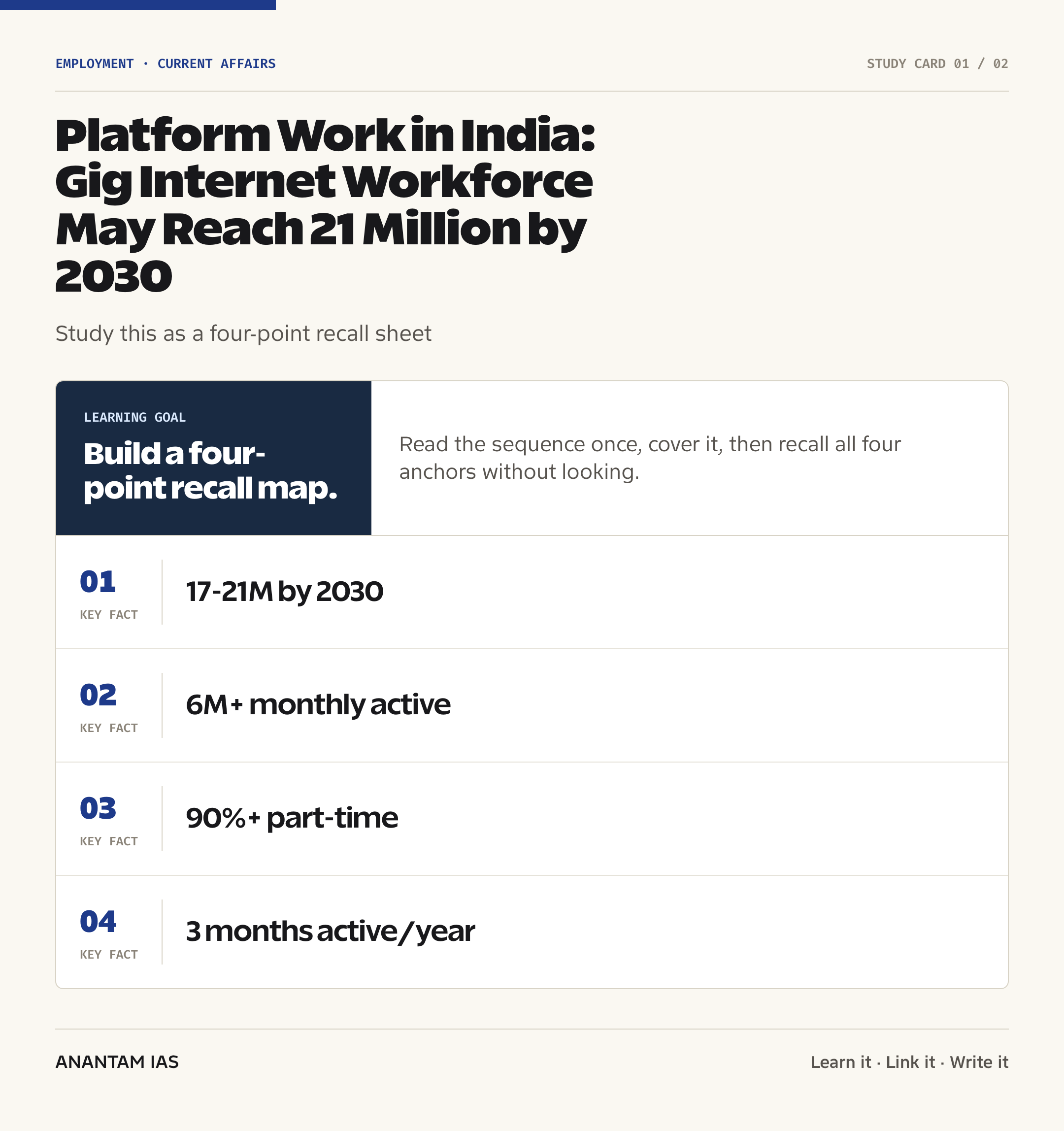
The Hindu reported on 18 July 2026 that a new study by Redseer Strategy Consultants, a private Bengaluru-based consulting firm, projects India’s monthly active gig internet workforce to grow from more than 6 million workers to 17-21 million by 2030.
The number is a private estimate, not a Government of India employment statistic. It measures monthly active workers in selected consumer-internet segments such as delivery, ride-hailing and home services, so it must not be treated as interchangeable with the broader gig-worker projection published by NITI Aayog.
- Redseer says the covered monthly active workforce currently exceeds 6 million and could nearly triple by the end of the decade.
- Its report says over 90% of surveyed workers engage part-time, defined by the firm as less than 40 hours a week, while an average worker is active on a platform for about three months a year.
- The private survey found that about 54% of respondents had no paid work before joining a platform, suggesting that low entry barriers can draw new participants into paid work.
- Redseer also reports that full-time workers in the covered segments can earn up to 2.5 times the monthly net income of workers in selected comparable occupations; this is the firm’s comparative finding and not an official wage benchmark.
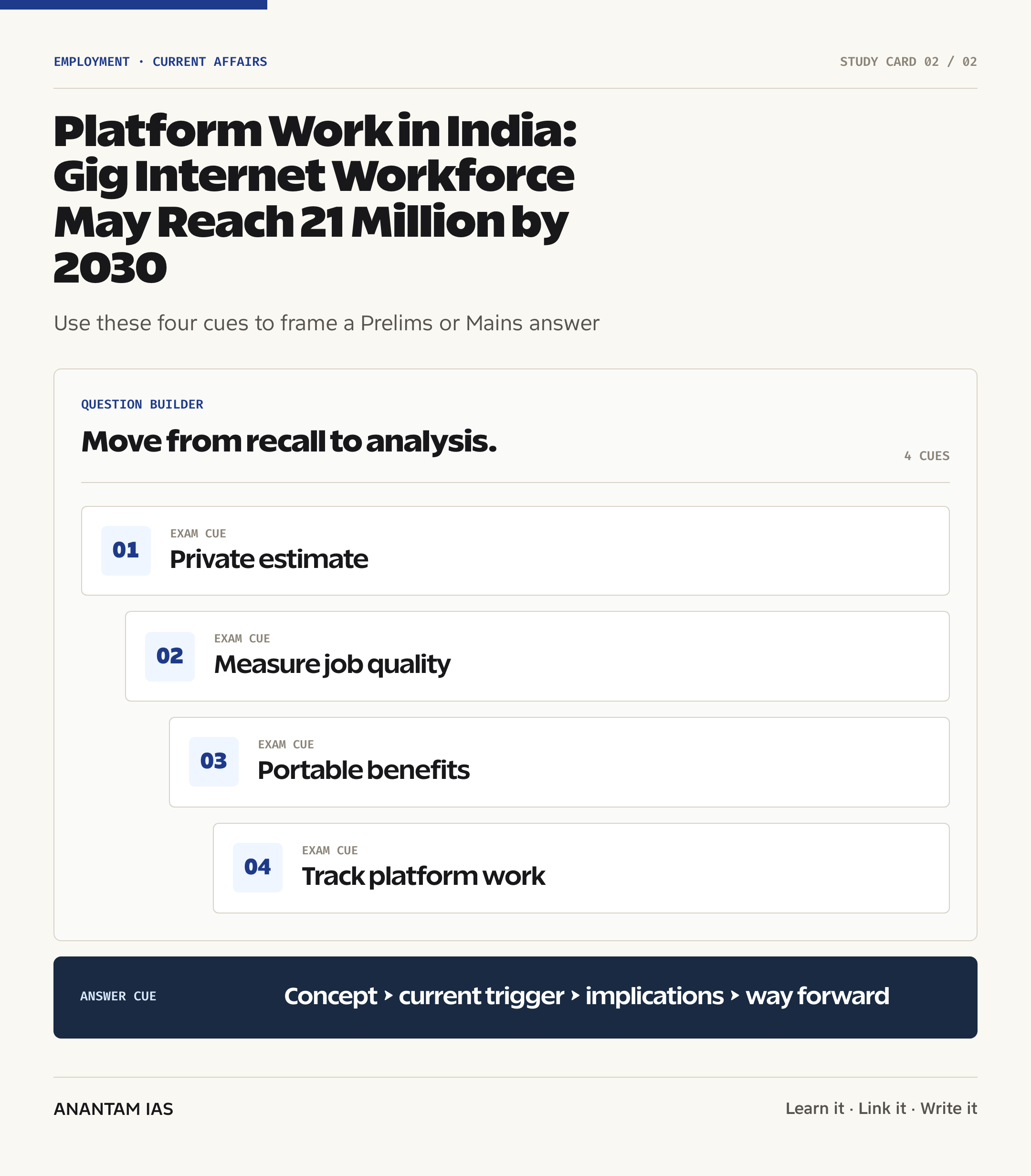
- The policy question is bigger than headcount: India must measure net earnings, working time, occupational risk and benefit access alongside the number of people receiving tasks through apps.
The development matters in the context of:
- The projection matters in the context of India’s search for non-farm livelihoods, especially for young people entering urban and semi-urban labour markets.
- It also tests whether legal recognition under the Code on Social Security, 2020 can become portable, funded protection for workers who frequently move across platforms and occupations.
- Different estimates use different units, including persons who did any gig work during a year and workers active in a particular month. Sound policy needs comparable labour statistics, not a single headline forecast.
UPSC Relevance
Prelims Relevance
- A gig worker performs work and earns outside a traditional employer-employee relationship, while a platform worker accesses organisations or individuals through an online platform to provide services.
- Platform work is a subset of gig work; offline task-based and short-duration work may also fall within the wider gig economy.
- The Code on Social Security, 2020 legally defines gig worker, platform worker and aggregator, and came into force on 21 November 2025.
- The Code permits schemes covering life and disability, accident insurance, health and maternity benefits, and old-age protection for gig and platform workers.
- The Code provides for a Social Security Fund and a role for the National Social Security Board in welfare schemes for these workers.
- The statutory aggregator-contribution framework links a notified contribution to annual turnover, subject to a cap tied to payments made or payable to gig and platform workers.
- e-Shram is the national database for unorganised workers; registration is based on self-declaration and provides a Universal Account Number.
- The Ministry launched an Aggregator Module on e-Shram on 12 December 2024 to onboard platforms and workers engaged through them.
- The Union Budget 2025-26 announced e-Shram registration, identity cards and AB-PMJAY health coverage for eligible online platform workers.
- NITI Aayog’s 2022 report estimated 7.7 million gig workers in 2020-21 and projected 23.5 million by 2029-30, but this broader estimate is not the same series as Redseer’s monthly active internet-workforce measure.
Mains Relevance
GS Paper 3
- Employment and inclusive growth: assess whether platform work is creating durable productive employment, supplementing incomes, or mainly absorbing gaps in the formal labour market.
- Digital economy: examine how algorithmic task allocation, ratings and dynamic pricing shape earnings, competition and worker bargaining power.
- Data and measurement: distinguish gross earning opportunities from net income after fuel, maintenance, insurance, device and waiting-time costs.
GS Paper 2
- Welfare governance: evaluate whether portable social protection can follow a worker across platforms, cities and periods of intermittent participation.
- Vulnerable sections: discuss gender barriers, accident exposure, grievance redress and the recognition-versus-benefit-delivery gap.
Essay
- Flexibility without security can widen opportunity while shifting economic risk from firms to individuals.
- The future of work should be judged not only by how many tasks technology creates, but by the dignity, voice and resilience attached to those tasks.
- Good labour statistics are public infrastructure because invisible workers rarely receive well-designed protection.
Background and Context
What the Redseer projection measures
The headline figure describes a narrow, commercially observed segment rather than the whole Indian workforce.
- Redseer’s Gig Internet Workforce Report 2026 covers monthly active workers connected to consumer-internet services, especially delivery, ride-hailing and home services.
- The estimate rises from more than 6 million currently to a range of 17-21 million by 2030; a range signals model uncertainty and should not be converted into a precise forecast.
- The report characterises most participation as part-time and transient, with over 90% working fewer than 40 hours weekly and the average person active for roughly three months in a year.
- Its claim that 54% had no prior paid employment comes from surveyed workers. It indicates a possible entry effect, but cannot by itself establish how many jobs are additional at national level.
- The reported earnings multiple of up to 2.5 times applies to full-time workers and selected comparable occupations. A careful answer should ask about the sample, city mix, expenses, hours and survivorship before generalising.
- Read the estimate as evidence about a fast-growing market, then test it against official labour surveys and administrative data. The Anantam IAS note on gig workers in labour data explains why measurement design changes the apparent size of the sector.
Why estimates cannot be casually compared
Gig-work counts vary because datasets ask different questions over different reference periods.
- NITI Aayog estimated 7.7 million gig workers in 2020-21 and projected 23.5 million by 2029-30 in its official 2022 report, India’s Booming Gig and Platform Economy.
- NITI’s projection covers the broader gig and platform economy, while Redseer focuses on monthly active participants in selected internet-mediated services. The scope, base year and activity threshold differ.
- A person who drives for an app briefly, freelances offline and holds another job may appear differently in a household survey, platform record and annual estimate.
- Multiple accounts can inflate account counts, while workers using several apps can be duplicated unless records are deduplicated. Inactive accounts can also exaggerate the effective workforce.
- The correct policy dashboard should separate unique persons, active months, hours worked, primary versus secondary livelihood, gross receipts and net earnings.
- For the wider employment picture, link platform data with unemployment and labour-force measures, especially PLFS concepts such as usual status and current weekly status.
Opportunity offered by platform work
Digital platforms can reduce matching costs and open a quick route to income, particularly when formal vacancies are scarce.
- Digital onboarding, app-based discovery and flexible scheduling lower the transaction cost of connecting workers with dispersed consumer demand.
- Part-time participation can support students, migrants, caregivers, small entrepreneurs and workers between jobs through supplementary income.
- Expansion beyond major metros can connect services to smaller cities, but demand density, road infrastructure, digital access and local purchasing power will shape viability.
- The finding that many surveyed workers lacked prior paid employment suggests an entry pathway; the stronger test is whether workers gain skills, stable income and mobility to better opportunities.
- Platform records can improve visibility of work that traditional establishment surveys miss, provided privacy, consent and purpose limitation govern data sharing.
- India’s demographic dividend needs both quantity and quality of employment. Platform work can be one bridge, but it cannot substitute for manufacturing, care, construction and high-productivity services.
Job-quality and power asymmetries
Flexibility is valuable, but workers often carry costs and risks that would sit with an employer in a standard job.
- Headline earnings can overstate welfare when workers pay for fuel, vehicle depreciation, repairs, insurance, mobile data and unpaid waiting time.
- Algorithmic management can influence task allocation, incentives, route expectations, ratings and deactivation without giving workers a clear explanation or effective appeal.
- Variable demand and incentive changes create income volatility; a worker may remain logged in for long periods even when paid time counts only completed tasks.
- Classification outside a traditional employer-employee relationship can leave uncertainty over minimum wages, paid leave, collective voice and occupational safety.
- Accident exposure is especially important in ride-hailing and delivery. Insurance must specify coverage hours, exclusions, claims support and continuity when a worker switches apps.
- Women can value flexible schedules but face safety, mobility, care-work and asset-ownership barriers. Inclusion requires safe task design, grievance channels and access to vehicles, credit and skills, not recruitment targets alone.
India's social-security architecture
Legal recognition has advanced, but coverage becomes meaningful only when workers can register, qualify and actually receive benefits.
- The Code on Social Security, 2020 came into force on 21 November 2025 and recognises gig and platform workers within a statutory welfare framework.
- It enables schemes for life and disability cover, accident insurance, health and maternity benefits, and old-age protection, supported through a Social Security Fund.
- The Code provides an aggregator-contribution mechanism. The Ministry’s March 2026 labour-code FAQ states that the Central Government will notify the contribution payable under Section 114(4).
- The e-Shram portal supplies an Aadhaar-linked Universal Account Number on self-declaration. A dedicated Aggregator Module is meant to reduce friction in onboarding platform workers.
- A January 2026 Ministry of Labour and Employment reply listed 12 major aggregators onboarded and reiterated Budget measures for identity cards and AB-PMJAY access.
- Registration is an enabling step, not proof of benefit delivery. The policy chain must track eligible workers, funded entitlements, claims, rejections, portability and grievance outcomes.
- For the legal framework and recurring exam themes, revise the Anantam IAS explainer on gig workers and their rights.
The policy test for 2030
India should treat the forecast as a prompt to build institutions before the workforce expands, not as a target to maximise platform headcount.
- The first test is additionality: whether platform work draws people into productive paid activity or mainly redistributes existing informal services through an app.
- The second is earnings adequacy: net hourly income after work-related costs, unpaid time and income volatility, compared with credible local alternatives.
- The third is worker agency: clear contracts, explainable automated decisions, human review of deactivation and the ability to contest incorrect data.
- The fourth is social protection: benefits that remain available when workers use multiple platforms, change location, stop temporarily or combine gig work with another occupation.
- The fifth is mobility: whether workers can gain certified skills, credit histories and pathways into higher-productivity employment or enterprise.
- A high-quality policy outcome is not 21 million app-based workers by itself. It is a labour market in which digital intermediation expands choice without normalising unpriced risk and weak bargaining power.
Way Forward
Build a common evidence base
- Add stable questions on platform-mediated work, secondary jobs, hours and expenses to PLFS modules, while publishing methods and confidence intervals.
- Create privacy-preserving standards for aggregators to report unique active workers, task hours, gross payments, deductions and accident claims without exposing personal data.
- Publish official and private estimates side by side with scope notes so users do not merge monthly active and annual workforce series.
Make protection portable
- Use the e-Shram UAN as an interoperable worker identifier and allow benefits and contribution records to follow workers across platforms.
- Notify transparent contribution rules, credit funds on time and disclose scheme-level receipts, enrolment, claims and grievance disposal.
- Design accident, health, maternity and old-age protection for intermittent multi-platform work, with simple assisted registration and appeal routes.
Set fair-work safeguards
- Require plain-language contracts and advance notice of major changes to pay formulas, incentives, deductions and deactivation rules.
- Mandate human review for serious automated decisions and give workers access to the evidence used against them.
- Track net hourly earnings and occupational safety, including unpaid waiting time and worker-borne capital costs, instead of relying only on gross payouts.
Convert entry into mobility
- Link platform experience with Recognition of Prior Learning, modular skilling and digital credentials that workers can carry to other jobs.
- Expand safe mobility, childcare, credit and anti-harassment measures to improve women’s participation without weakening safety standards.
- Support worker collectives and accessible dispute-resolution channels so flexibility is matched by voice and bargaining capacity.
Conclusion
The 17-21 million figure is useful as a private market signal, not as an official forecast. Its real value lies in forcing an early policy conversation about who counts as a worker, how earnings are measured and whether protection reaches a person across changing apps and working patterns.
India’s goal should be productive flexibility with portable security. If official data, transparent platform rules and funded welfare mature together, digital labour markets can widen opportunity without making insecurity the default price of entry.
UPSC Practice Questions
Prelims MCQ 1
With reference to gig and platform workers in India, consider the following statements:
- Platform work is a subset of gig work mediated through an online platform.
- The Code on Social Security, 2020 provides for social-security schemes for gig and platform workers.
- Every person holding an account on a delivery platform is counted as a monthly active worker.
How many of the above statements are correct?
(a) Only one (b) Only two (c) All three (d) None
Answer: (b) Only two
Explanation:
Statements 1 and 2 are correct. Statement 3 is incorrect because an account may be inactive, duplicated across platforms or used intermittently; monthly active status requires a defined activity threshold.
Prelims MCQ 2
Which institution operates e-Shram, the national database that includes gig and platform workers?
(a) Ministry of Labour and Employment (b) NITI Aayog (c) Reserve Bank of India (d) National Statistical Office
Answer: (a) Ministry of Labour and Employment
Explanation:
The Ministry of Labour and Employment launched e-Shram in 2021. It registers unorganised workers, including gig and platform workers, and provides a Universal Account Number.
UPSC Mains Questions
- A rising platform-work headcount does not by itself establish employment quality. Examine the opportunities created by India’s gig economy and the indicators needed to assess net earnings, worker agency, occupational risk and upward mobility.
- Legal recognition of gig and platform workers is only the first step towards social protection. Discuss how India can design funded, portable and accountable benefits for workers whose participation is intermittent and spread across multiple digital platforms.
Sources: Ministry of Labour and Employment, PIB and The Hindu; Redseer Strategy Consultants (private estimate).
Frequently Asked Questions
What is Redseer’s 2030 gig workforce estimate?
Redseer Strategy Consultants projects that India’s monthly active gig internet workforce in selected segments could rise from more than 6 million to 17-21 million by 2030. It is a private consulting estimate, not an official Government of India statistic, and its scope is narrower than the entire gig economy.
Is the 17-21 million figure official?
No. The range comes from a private Redseer report. NITI Aayog’s separate 2022 official study projected the broader gig workforce at 23.5 million by 2029-30. The two numbers use different scopes, base years and activity concepts, so they should not be merged or compared as one time series.
How is platform work different from gig work?
Gig work is task-based work outside a traditional employer-employee relationship. Platform work is the part of gig work arranged through an online platform that connects workers with customers or organisations. All platform workers are gig workers in this framework, but not all gig work has to be mediated by an app.
What protection does the Social Security Code provide?
The Code on Social Security, 2020 enables schemes for life and disability cover, accident insurance, health and maternity benefits, and old-age protection for gig and platform workers. It also provides a Social Security Fund and an aggregator-contribution framework, with operational details to be notified and implemented.
Why does e-Shram matter for platform workers?
e-Shram creates a national record and gives registered unorganised workers a Universal Account Number. For platform workers, it can support identification and portability across apps and locations. Registration alone is not a benefit, so policy must also track eligibility, funding, enrolment, claims and grievance resolution.
How should India measure gig job quality?
India should measure unique active workers, months and hours worked, gross receipts, worker-borne expenses, net hourly earnings, accidents, income volatility and access to benefits. Data should also distinguish primary from supplementary work and record gender, location and occupation while protecting privacy.
Source: https://anantamias.com/current-affairs/india-gig-internet-workforce-2030-projection/
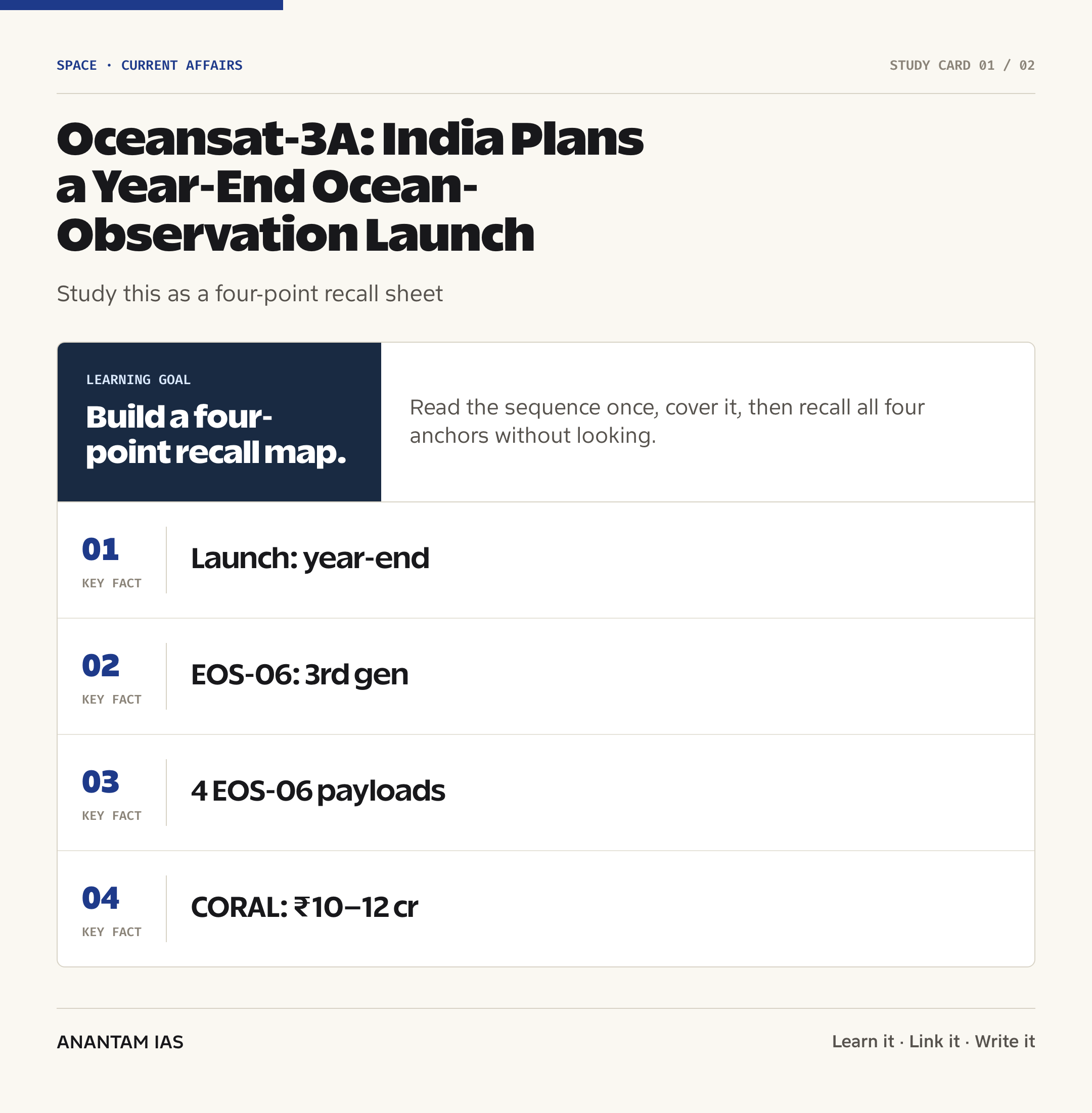
Oceansat-3A: India Plans a Year-End Ocean-Observation Launch
Why in News?
National Remote Sensing Centre (NRSC) Director Prakash Chauhan said in Visakhapatnam on July 17 that the Oceansat-3A satellite was likely to be launched before the end of the year. The Hindu reported the announcement after the inauguration of a coastal observation laboratory at Andhra University.
The update matters because the Oceansat programme supplies observations of ocean colour, surface winds and sea-surface conditions. These measurements support marine science, weather and climate services, coastal management and parts of India’s blue economy.
- Launch window: The NRSC Director described a likely year-end launch, but the sources reviewed don’t yet provide a firm date, launch vehicle or final Oceansat-3A payload list.
- New laboratory: The NICES-Coastal Observation Research Laboratory (CORAL) was inaugurated at Andhra University’s Centre for Studies on Bay of Bengal in Visakhapatnam.
- Ground observations: The laboratory is designed to collect in-situ measurements that can help interpret and validate space-based ocean observations.
- Project support: Andhra University said NRSC had sanctioned about ₹10 crore–₹12 crore in phased funding for equipment procurement, installation and maintenance.
- Research field: Planned cruises along selected Bay of Bengal transects will examine ocean-atmosphere and land-sea interactions and their effects on marine ecosystems.
The development matters in the context of:
- Data continuity is central to Earth observation: long, consistently calibrated records are more useful for detecting change than isolated satellite snapshots.
- Calibration and validation connect a sensor’s signal with measurements taken in the water, reducing uncertainty in products such as chlorophyll concentration.
- Public value emerges when satellite observations are converted into usable products for fishers, forecasters, researchers, coastal administrators and disaster managers.
UPSC Relevance
Prelims Relevance
- Oceansat-3 is also designated EOS-06; ISRO describes it as the third-generation satellite in the Oceansat series.
- EOS-06 was launched by PSLV-C54 from Satish Dhawan Space Centre on November 26, 2022.
- The four EOS-06 payloads are the Ocean Color Monitor-3 (OCM-3), Sea Surface Temperature Monitor, Ku-band Scatterometer-3 and ARGOS.
- Ocean colour is inferred from sunlight leaving the ocean in different spectral bands and can indicate chlorophyll-bearing phytoplankton and suspended matter.
- A scatterometer measures microwave backscatter from the sea surface to derive near-surface wind speed and direction.
- Sea-surface temperature is an important input for understanding air-sea heat exchange, ocean fronts and weather-climate processes.
- NRSC, an ISRO centre, acquires, processes, archives and enables applications of Earth-observation data.
- NICES stands for the National Information System for Climate and Environment Studies and operates as a multi-institutional programme led through NRSC.
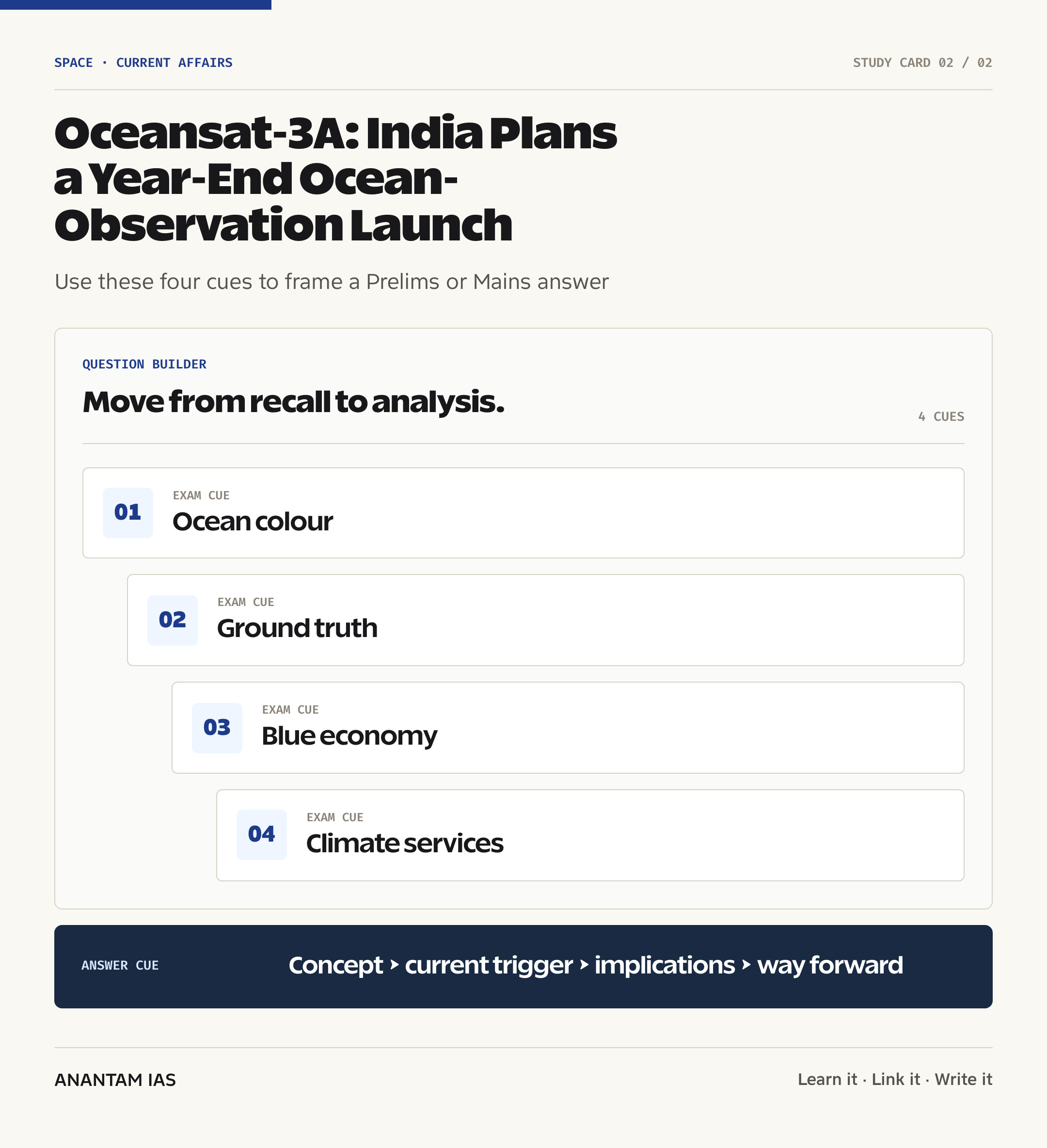
- Ground truth means observations collected at or near the Earth’s surface to calibrate or validate satellite-derived measurements and algorithms.
- Ocean colour isn’t the physical colour of seawater alone; it is a remote-sensing signal shaped by water, phytoplankton, sediments and dissolved material.
Mains Relevance
GS Paper 3
- Indigenisation and public applications of space technology, including Earth-observation missions and downstream data products.
- The role of ocean remote sensing in fisheries, disaster management, climate services, marine ecosystem assessment and the blue economy.
- Why calibration-validation infrastructure, open data, institutional coordination and user-oriented products determine the social return from a satellite.
GS Paper 1
- Physical geography of ocean-atmosphere interaction, sea-surface winds, upwelling, coastal processes and the Bay of Bengal.
- Spatial observation of phytoplankton, suspended sediments and other ocean-colour features as indicators of marine conditions.
GS Paper 2
- Centre-university collaboration through NRSC, NICES and Andhra University as a model for building scientific capacity and sharing public research infrastructure.
Essay
- Seeing from space, measuring at sea: credible public science combines broad satellite coverage with patient local observation.
- Blue economy with ecological limits: better information can support livelihoods only when marine productivity and ecosystem health are monitored together.
Background and Context
What an Ocean-Observation Satellite Measures
An ocean-observation satellite repeatedly measures electromagnetic signals from the sea surface and atmosphere, turning them into geophysical products.
- Ocean-colour sensors measure reflected sunlight across selected wavelengths; algorithms estimate properties such as chlorophyll concentration, suspended sediments and water clarity.
- Microwave scatterometers can derive ocean-surface wind vectors by measuring how radar energy is scattered by wind-roughened waves.
- Thermal observations help estimate sea-surface temperature, a variable linked with air-sea heat exchange, fronts, convection and cyclone-supporting ocean conditions.
- ARGOS is a data-collection and location system that relays measurements from compatible platforms, complementing imaging and geophysical sensors.
- Remote sensing offers repeat coverage across large areas, but it doesn’t remove the need for ships, buoys, coastal stations and laboratory analysis.
Oceansat Lineage and the Continuity Principle
The value of the Oceansat series lies in maintaining observations over time while improving sensor capability and applications.
- ISRO identifies EOS-06/Oceansat-3 as the third generation of the series and says its purpose includes continuity of ocean-colour and wind-vector services.
- PSLV-C54 placed EOS-06 and eight nano-satellites into their intended sun-synchronous polar orbits on November 26, 2022.
- EOS-06 carries OCM-3, SSTM, SCAT-3 and ARGOS; these instruments shouldn’t be automatically treated as the confirmed Oceansat-3A payload because an official final payload list wasn’t found in the sources reviewed.
- Mission continuity allows researchers to compare seasons and years, identify anomalies and separate short-lived variability from longer changes.
- Continuity also requires cross-calibration: an apparent change in a record must reflect the ocean, not a difference between sensors or processing methods.
- Like the radar-based NISAR mission, Oceansat shows that the usefulness of Earth observation depends on matching sensor design with a clearly defined measurement problem.
Why Ground Truth Is Indispensable
Ground-truth observations test whether satellite-derived values correspond to conditions measured directly at sea or on the coast.
- Calibration establishes or corrects the relationship between a sensor’s response and a known reference; validation independently checks the accuracy of the derived product.
- Coastal waters are optically complex because sediments, coloured dissolved matter, plankton and shallow bottoms can influence the signal together.
- The official NICES programme calls for in-situ data to support calibration and validation of data products, science products and algorithms.
- The new NICES-CORAL facility is expected to analyse dissolved inorganic carbon, nutrients, plankton and dissolved oxygen, among other variables reported by Andhra University.
- Reported equipment includes a high-performance liquid chromatograph, FTIR spectrophotometer, flow cytometer and sensors for carbon dioxide, sunlight and ozone.
- Research cruises across selected Bay of Bengal transects can connect point measurements with simultaneous satellite scenes and ocean-atmosphere conditions.
From Raw Signal to Public Service
A satellite creates public value only after its measurements are processed, validated, interpreted and delivered in a form that supports decisions.
- Ocean-colour products can help monitor chlorophyll patterns, algal blooms, sediment plumes and changes in coastal water quality.
- Surface-wind products support marine weather analysis, ocean-state modelling and the study of circulation driven partly by wind stress.
- Sea-surface temperature contributes to the assessment of fronts, upwelling zones, ocean heat patterns and air-sea interactions.
- Potential fishing-zone advisories combine relevant ocean indicators to identify areas likely to be productive; satellites guide search effort but don’t directly count fish.
- For a broader view of livelihood policy, connect these observations with India’s fisheries and Blue Revolution, where data must support both productivity and resource sustainability.
- Disaster management can use space-based data across preparedness, monitoring and damage assessment, as the NRSC Director noted in his lecture at Andhra University.
Climate, Coasts and the Bay of Bengal
The Bay of Bengal is a useful natural laboratory because monsoon rainfall, river discharge, cyclones and dense coastal populations connect land, ocean and atmosphere.
- River-borne sediments and freshwater alter salinity, turbidity and biological conditions, making coastal algorithms harder to design than open-ocean algorithms.
- Ocean-atmosphere exchanges redistribute heat, moisture and carbon, affecting weather variability and the climate system.
- Marine ecosystems respond to changes in temperature, nutrients, oxygen, circulation and acidity; no single satellite variable captures the whole system.
- Long records can reveal changes, while ship and laboratory measurements help explain the processes behind observed patterns.
- The relationship between warming, deoxygenation, acidification and ecosystems is covered in climate change and the oceans.
- Coastal observation also supports planning around erosion, pollution, ports, aquaculture and ecosystem restoration when combined with administrative and field data.
Institutional Architecture
Ocean observation is a chain of institutions rather than a single satellite or laboratory.
- ISRO develops and operates space missions, while NRSC serves as a major centre for Earth-observation data reception, processing, dissemination and applications.
- NICES brings ISRO centres, government departments and national institutions into a programme for climate and environment data, products and research.
- Andhra University’s Centre for Studies on Bay of Bengal adds coastal access, laboratories, researchers and student training to the partnership.
- Universities can widen the validation network, test region-specific algorithms and train people who understand both instruments and local marine systems.
- Operational agencies and users must translate scientific products into advisories, planning tools and warnings that are timely, comprehensible and accountable.
- Ocean observation complements, but doesn’t duplicate, the Deep Ocean Mission, which covers deep-sea technology, resources, biodiversity and exploration.
Limits and Governance Questions
The Oceansat-3A announcement should be read as a mission plan, not as proof that every downstream challenge has been solved.
- Launch uncertainty remains until ISRO publishes a firm mission schedule, launch vehicle, payload configuration and successful orbital commissioning.
- Cloud cover and aerosols can constrain optical ocean-colour retrieval, while microwave sensors answer different questions and have their own resolution and calibration trade-offs.
- Coastal complexity makes algorithms developed for clear open water unreliable in some estuaries, turbid plumes and shallow zones unless locally validated.
- Data gaps can arise from launch delays, sensor degradation, orbital constraints, processing changes or inadequate field sampling.
- Last-mile delivery matters: a technically sound product has limited value if fishers or district agencies receive it too late or can’t act on it.
- Open standards, metadata and uncertainty labels are needed so researchers can reproduce results and administrators don’t treat modelled products as error-free observations.
Way Forward
Publish a Transparent Mission Baseline
- ISRO should release the confirmed Oceansat-3A payloads, orbit, launch vehicle, product plan and commissioning milestones once finalised.
- A public continuity and cross-calibration plan should explain how the new mission will connect with EOS-06 and other ocean datasets.
Build a Dense Validation Network
- Link NICES-CORAL with buoys, research vessels, coastal laboratories and university partners across different Indian marine environments.
- Synchronise field sampling and satellite overpasses, archive quality-control information and publish representative validation results.
Design Products Around Users
- Co-design services with fishers, disaster managers, coastal regulators and researchers so that delivery time, scale and uncertainty fit actual decisions.
- Provide regional-language interfaces, simple risk explanations and feedback channels without overselling the precision of satellite estimates.
Join Blue Growth with Ecosystem Safeguards
- Use observations to track marine productivity, harmful blooms, sediment, heat stress and pollution alongside economic indicators.
- Treat long-term data stewardship, interoperable formats and open scientific access as core infrastructure, not post-launch extras.
Conclusion
Oceansat-3A can strengthen India’s ability to observe a changing ocean, but a launch is only the beginning of the public-service chain. Stable sensors, validated algorithms, reliable archives and timely products determine whether orbital data becomes usable knowledge.
The new NICES-CORAL laboratory captures the larger lesson: wide satellite coverage and detailed field measurements are complements. India’s blue-economy ambitions will be more credible when growth decisions rest on measurements that also reveal ecological stress and uncertainty.
UPSC Practice Questions
Prelims MCQ 1
With reference to EOS-06/Oceansat-3, consider the following statements:
- It is described by ISRO as the third-generation satellite in the Oceansat series.
- It carries an Ocean Color Monitor and a Ku-band scatterometer.
- It was launched by the Geosynchronous Satellite Launch Vehicle.
How many of the above statements are correct?
(a) Only one (b) Only two (c) All three (d) None
Answer: (b) Only two
Explanation:
Statements 1 and 2 are correct. EOS-06 carries OCM-3, SSTM, SCAT-3 and ARGOS. It was launched by PSLV-C54, not GSLV.
Prelims MCQ 2
In ocean remote sensing, the term ground truth most directly refers to:
(a) A political boundary map used to georeference satellite images (b) Direct observations used to calibrate or validate satellite products (c) A backup command transmitted from a terrestrial control station (d) The ocean-floor elevation derived only from satellite gravity
Answer: (b) Direct observations used to calibrate or validate satellite products
Explanation:
Ground-truth or in-situ measurements provide reference observations against which satellite signals, retrieval algorithms and derived products can be checked.
UPSC Mains Questions
- Earth-observation missions create value through a chain that extends far beyond launch. Explain how Oceansat-series observations, ground-truth infrastructure, calibration-validation and last-mile services can jointly strengthen India’s fisheries, coastal governance and climate resilience.
- The blue economy requires both productive use of marine resources and credible measurement of ecological limits. Discuss the contribution and limitations of satellite ocean observation, with special reference to ocean colour, surface winds, sea-surface temperature and field validation.
Sources: ISRO and National Remote Sensing Centre and The Hindu.
Frequently Asked Questions
What is Oceansat-3A?
Oceansat-3A is a planned Indian ocean-observation satellite in the Oceansat programme. The NRSC Director said it was likely to launch before year-end. A firm date, launch vehicle and final payload list weren’t stated in the sources reviewed, so those details should await an official ISRO mission announcement.
Is Oceansat-3 the same as EOS-06?
Yes. EOS-06 is commonly identified as Oceansat-3, the third-generation satellite in the Oceansat series. ISRO says it was launched by PSLV-C54 in November 2022 to continue ocean-colour and wind-vector services while adding enhanced observations, including sea-surface temperature.
What does an ocean-colour monitor measure?
An ocean-colour monitor records sunlight emerging from the ocean in multiple spectral bands. Algorithms use that signal to estimate variables such as chlorophyll concentration, suspended sediments and water clarity. Coastal waters need careful validation because several substances and shallow bottoms can influence the same signal.
Why is ground truth needed?
Ground truth supplies direct measurements from ships, buoys, coastal sites or laboratories. These observations calibrate sensors and validate satellite-derived products. Without them, a broad satellite image may show a pattern, but researchers have less confidence about its accuracy, cause and suitability for local decisions.
What is NICES-CORAL?
NICES-CORAL is the coastal observation research laboratory inaugurated at Andhra University’s Centre for Studies on Bay of Bengal. The reported project will analyse coastal-water and atmosphere-related variables and support field cruises, helping connect in-situ evidence with ISRO’s ocean-observation programme.
How can Oceansat data help fishers?
Ocean-colour, temperature and surface-wind products can help identify marine conditions associated with productive zones and support ocean advisories. Satellites don’t directly detect or count fish. Their observations must be combined with models, validation data, local knowledge and timely communication to reduce search effort responsibly.
Source: https://anantamias.com/current-affairs/oceansat-3a-year-end-launch-plan/
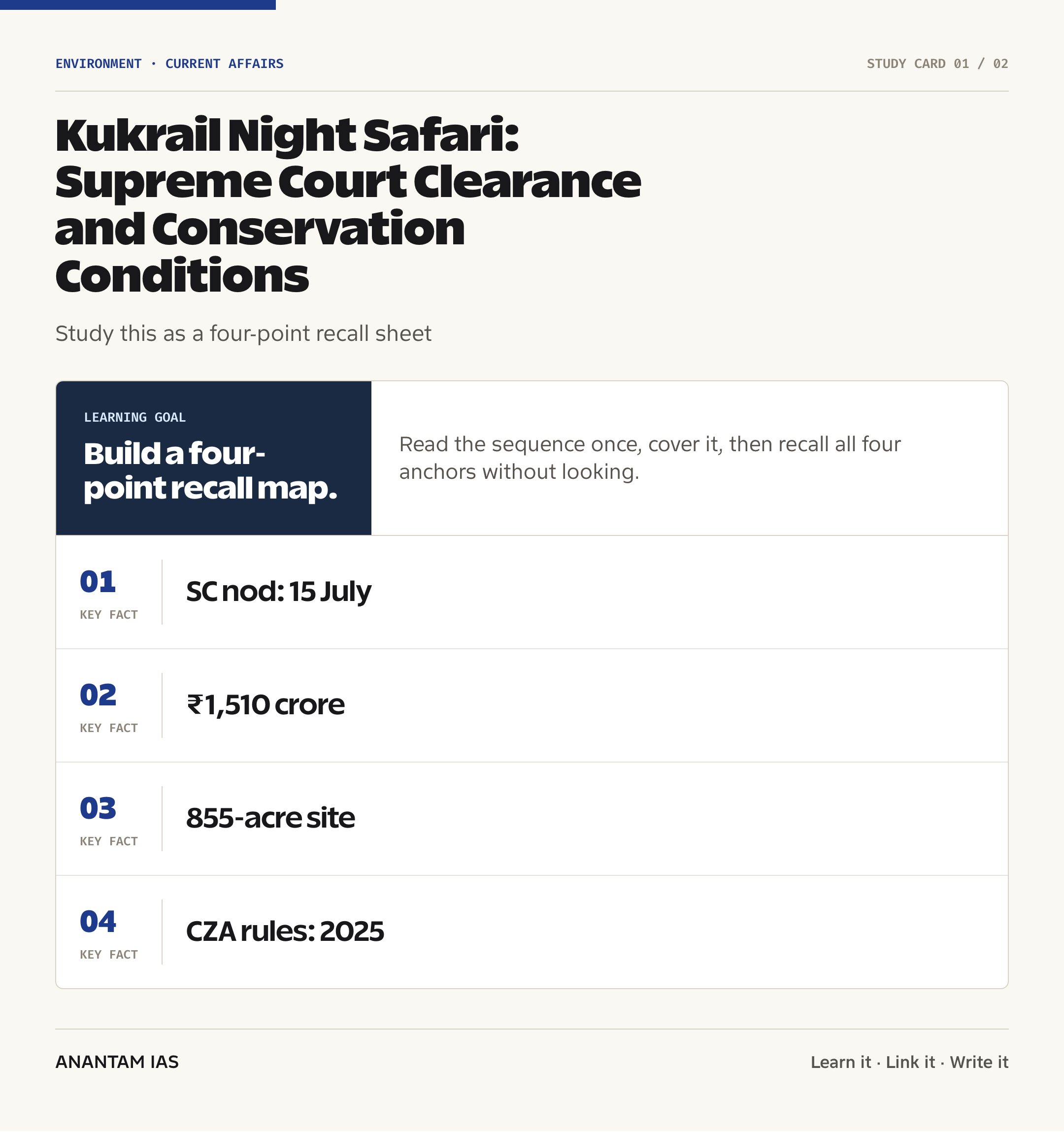
Kukrail Night Safari: Supreme Court Clearance and Conservation Conditions
Why in News?
On 15 July 2026, the Supreme Court permitted Uttar Pradesh to proceed with the Kukrail Night Safari and zoological park project in Lucknow’s Kukrail Reserve Forest. The order came in Ashok Kumar Sharma, IFS (Retd.) & Others v. Union of India, W.P. (C) No. 1164 of 2023, while considering the state’s application for permission.
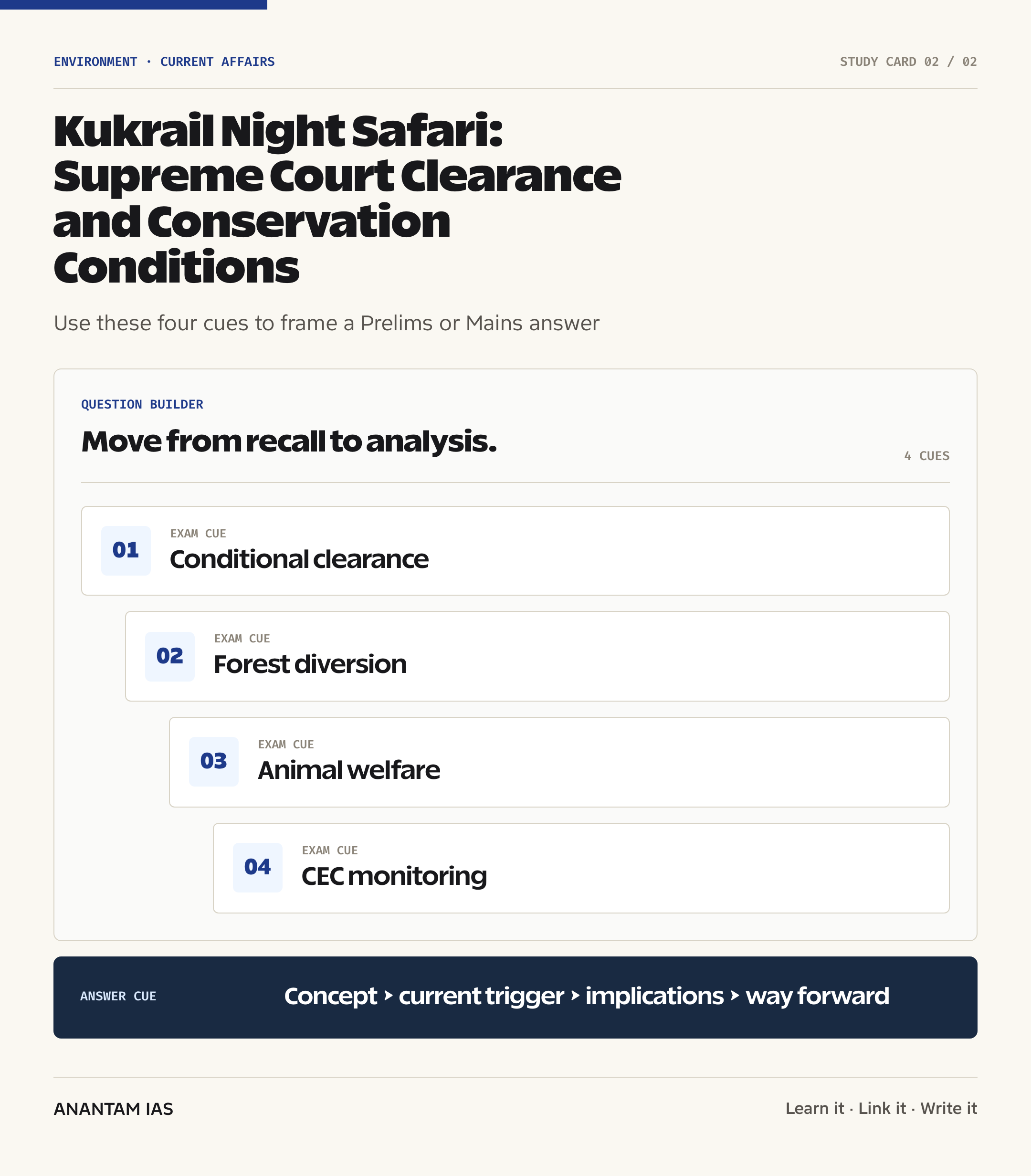
The clearance is conditional. The Court said the state must comply with the requirements imposed or recommended by the Central Empowered Committee, the Central Zoo Authority and the Ministry of Environment, Forest and Climate Change, obtain any other legally required prior permission, and face periodic compliance visits.
- Indian Express reported that a Bench led by Chief Justice Surya Kant, with Justices Joymalya Bagchi and V. Mohana, granted the permission.
- The Court relied on the expert and regulatory scrutiny already undertaken by the CEC, CZA and MoEFCC; it did not treat judicial permission as a substitute for statutory compliance.
- A CEC member must periodically visit the project and submit compliance reports to the Court.
- The project is proposed as India’s first operational night safari, but that description concerns the plan; the facility has not yet begun operations.
- The Indian Express described a proposed outlay of ₹1,510 crore and a project footprint of about 855 acres within the wider 2,027-hectare reserve forest.
The development matters in the context of:
- The case matters in the context of balancing urban ecological security with tourism, education and ex-situ conservation infrastructure.
- It tests the difference between a headline approval and a condition-bound environmental permission that remains subject to monitoring.
- It also connects zoo governance under the Wild Life (Protection) Act, 1972 with forest-land regulation and the Supreme Court’s continuing oversight of forest matters.

UPSC Relevance
Prelims Relevance
- Kukrail Reserve Forest is located in Lucknow, Uttar Pradesh, and is named after the Kukrail stream, a tributary of the Gomti.
- A reserve forest is a legal forest category; it is not the same as a national park, wildlife sanctuary or biosphere reserve.
- The Central Zoo Authority is constituted under Section 38A of the Wild Life (Protection) Act, 1972.
- Recognition of zoos and prescribed standards fall within the CZA’s statutory mandate; the relevant legal framework is explained in Anantam IAS notes on the Wildlife Protection law.
- The Central Empowered Committee assists the Supreme Court in forest and wildlife matters and can inspect projects and monitor compliance.
- The Court’s interim order of 19 February 2024 required prior judicial approval before final approval of new zoos or safaris covered by the order.
- The CZA’s 2025 night-safari guidelines address site inspection, animal welfare, lighting, visitor movement, staffing and emergency protocols.
- CZA guidance prefers low-intensity, species-specific lighting, avoidance of disruptive blue light, and protection of natural circadian rhythms.
- Kukrail hosts a gharial rehabilitation centre, making reptile conservation and habitat disturbance relevant to project appraisal.
- The governing forest-diversion framework and Section 2 approval logic are covered in Forest Conservation Act notes.
Mains Relevance
GS Paper 3
- Conservation-development trade-offs in an urban reserve forest, including fragmentation, tree loss, artificial light, noise and visitor pressure.
- Designing tourism infrastructure around animal welfare, ecological carrying capacity, native vegetation and measurable compliance.
- The role of ex-situ conservation facilities alongside the protection of natural habitats and ecological processes.
GS Paper 2
- Institutional coordination among the Supreme Court, CEC, CZA, MoEFCC and the Uttar Pradesh government.
- Conditional approvals, expert monitoring and public accountability as tools of environmental governance.
Essay
- Development gains legitimacy when environmental safeguards are treated as design constraints, not post-project formalities.
- A city needs both access to nature and the ecological restraint required to keep that nature alive.
Background and Context
What the Supreme Court actually permitted
The order removes a judicial hurdle but keeps the project inside a continuing compliance framework.
- The permission arose from I.A. No. 89434 of 2025 in the broader forest matter Ashok Kumar Sharma, IFS (Retd.) & Others v. Union of India.
- The state’s proposal had already passed through the CZA, MoEFCC and the Court-linked CEC process before the Bench considered it.
- The Court allowed the state to proceed only within the scope cleared by the expert bodies and subject to their conditions.
- Any further approval required under another law must still be obtained from the competent authority; the order isn’t a blanket waiver.
- Periodic site visits and reports by a CEC member convert compliance from a one-time paperwork exercise into ongoing supervision.
- For answer writing, describe the ruling as conditional judicial clearance, not final ecological certification or permission to begin every component immediately.
Project design and the Kukrail setting
The proposed facility combines a night safari, a later day-zoo component, conservation facilities and visitor infrastructure inside a major urban forest landscape.
- The Indian Express reported a proposed cost of ₹1,510 crore and an approximately 855-acre footprint within the 2,027-hectare Kukrail Reserve Forest.
- The plan is divided into Phase I, covering the night safari and eco-tourism zone, and Phase II, covering a day zoo.
- Proposed visitor movement uses battery-operated vehicles, while the experience is built around night trails, forest trails and naturalistic habitats.
- The proposal includes habitats for species such as Asiatic lions, Bengal tigers, leopards, hyenas, flying squirrels and gharials; actual collection plans remain subject to CZA scrutiny.
- The forest developed as a plantation landscape in the 1950s and functions as an important green space in the Lucknow urban region.
- The Kukrail Gharial Rehabilitation Centre, established in 1975, adds a sensitive conservation function that must be insulated from construction and visitor disturbance.
The layered clearance architecture
Different institutions examine different legal and technical questions, so one approval cannot automatically replace all the others.
- The Supreme Court supplied the prior judicial permission required by its 19 February 2024 interim direction concerning new zoos and safaris.
- The CEC examines forest and wildlife implications for the Court, undertakes site-based scrutiny and recommends conditions.
- The CZA regulates zoo planning, recognition, animal collections, enclosure standards, veterinary care and visitor management.
- The MoEFCC and Union government remain relevant where central forest, wildlife or environmental permission is legally triggered.
- The Uttar Pradesh government and project authority remain responsible for implementation, record-keeping, local approvals and compliance on the ground.
- This layered system reflects a key governance rule: permission follows jurisdiction. A judicial nod, technical approval and forest-land approval answer related but distinct questions.
Forest law and the Godavarman context
The litigation sits within India’s long-running judicial effort to prevent forest land from being reclassified or diverted through narrow administrative labels.
- The T.N. Godavarman line of cases gave the term forest a functional reach beyond only land formally notified under one statute.
- The present writ petition challenged aspects of the Forest (Conservation) Amendment Act, 2023, now reflected in the renamed Van (Sanrakshan Evam Samvardhan) Adhiniyam, 1980.
- Section 2 of the forest-conservation law restricts state action that dereserves forest or permits its use for a non-forest purpose without prior central approval where the law applies.
- A reserve forest and a protected area under wildlife law aren’t interchangeable categories; compare them through National Park vs Wildlife Sanctuary notes.
- The precautionary principle supports advance assessment where ecological harm may be serious or difficult to reverse, even when every impact cannot be quantified beforehand.
- The public trust doctrine frames forests and ecological commons as resources the state must protect for the public, not merely assets available for commercial conversion.
CZA rules turn animal welfare into design
The Central Zoo Authority’s 2025 guidance treats a night safari as a specialised zoological operation, not simply a zoo kept open after sunset.
- A CZA expert team must inspect the site, and a post-commissioning audit must check enclosures, lighting, visitor management and animal-welfare measures before operations begin.
- Where day and night operations coexist, the guidance calls for physical and operational separation, including a planted buffer of at least 50 metres in relevant configurations.
- Animals displayed at night shouldn’t also be displayed during the day; rest periods must support their natural activity cycles.
- Lighting should protect stable circadian rhythms. The guidance recommends low intensity, ideally below five lux, with 0.5 lux preferred for sensitive species unless research supports another level.
- Blue light should be avoided because it can suppress melatonin; controlled red, amber or moonlight-mimicking systems are less disruptive when matched to species needs.
- Animals must never be lured or baited for viewing. Stress monitoring, retreat areas, rotation between display and off-display spaces, veterinary care and species-specific husbandry are core obligations.
- For a wider comparison between captive management and species conservation, see CZA deer conservation notes.
Visitor management is an ecological safeguard
A night safari’s ecological footprint depends not only on buildings but also on how people, vehicles, light and noise move through the site every evening.
- The CZA guidance requires distinct or fully segregated entry routes, pathways and service areas so day and night operations don’t overlap.
- It calls for trained night staff, veterinarians, guides, security personnel, CCTV coverage, emergency exits, first-aid stations and rehearsed emergency plans.
- Battery-operated-vehicle tours should be limited to a maximum of one hour, while foot-trail visits should be limited to two hours.
- Foot trails should be guided, generally limited to one kilometre, and designed to prevent crowding near animal enclosures.
- Visitors shouldn’t carry personal torches or high-beam lights, provoke animals, use flash photography or create avoidable noise.
- For Kukrail, carrying capacity must also include impacts beyond enclosures: traffic, peripheral development, waste, stream health, tree loss and disturbance to the gharial centre.
Potential gains and ecological risks
The project can support conservation education and research only if its measurable ecological performance matches its stated objectives.
- Potential gains include conservation education, research on non-diurnal behaviour, improved veterinary capacity and public awareness of threatened species.
- A well-designed facility can replace passive animal display with habitat interpretation and stronger links between visitor experience and species recovery.
- But artificial light at night can disrupt feeding, breeding, navigation and hormonal cycles in captive animals and wildlife around the site.
- Road widening, construction, fencing and utilities can produce fragmentation even when the directly built area appears limited.
- High visitor volumes can intensify noise, waste, traffic and edge effects; projected footfall must be tested against an ecological carrying capacity, not treated only as revenue.
- The real policy test is whether monitoring data can trigger corrective action, operational limits or redesign when animal stress or habitat degradation becomes visible.
Way Forward
Publish the enforceable project boundary
- Place the final CEC, CZA and MoEFCC conditions, approved site plan and component-wise permissions in the public domain.
- Distinguish approved safari, conservation, research and visitor facilities from rejected, deferred or redesigned components.
- Maintain a searchable compliance matrix linking each condition to the responsible agency, deadline and documentary evidence.
Measure ecology before construction
- Create a scientifically credible baseline for flora, fauna, tree cover, nocturnal species, light levels, noise and Kukrail stream health.
- Use seasonally representative data and publish methods so later monitoring can identify real change.
- Protect no-construction buffers around the gharial centre, sensitive habitats, drainage lines and mature vegetation.
Make animal welfare auditable
- Commission species-specific lighting and enclosure trials before opening the full facility.
- Track stress behaviour, veterinary indicators, reproductive health, off-display time and circadian stability through independent review.
- Give animal-welfare findings priority over visitor visibility or attendance targets.
Tie operations to carrying capacity
- Set booking caps, route-wise vehicle limits, quiet periods and adaptive seasonal restrictions.
- Use low-spill lighting, waste controls, clean mobility and traffic management across the wider Kukrail landscape.
- Allow the CEC and CZA monitoring process to recommend pauses, redesign or reduced footfall when thresholds are breached.
Create credible public oversight
- Publish periodic CEC visit reports and the project authority’s responses in accessible formats.
- Provide a grievance channel for researchers, local residents and conservation groups to submit site-specific evidence.
- Commission independent ecological and financial audits so conservation claims can be tested against outcomes.
Conclusion
The Kukrail order doesn’t settle the conservation-development debate by choosing tourism over forests. It permits a project within an enforceable web of expert conditions, statutory permissions and judicial monitoring.
For UPSC answers, the strongest inference is that approval quality depends on implementation quality. A night safari can claim conservation value only when animal welfare, habitat integrity and public accountability govern its design and daily operation.
Kukrail will become a useful governance case study if periodic monitoring produces transparent correction. If conditions remain paperwork, the same project may deepen the pressures it says it will help people understand.
UPSC Practice Questions
Prelims MCQ 1
With reference to the Kukrail Night Safari clearance, consider the following statements:
- Kukrail Reserve Forest is located in Lucknow, Uttar Pradesh.
- The Central Zoo Authority is constituted under the Wild Life (Protection) Act, 1972.
- The Supreme Court’s permission exempted the project from all other statutory approvals.
How many of the above statements are correct?
(a) Only one (b) Only two (c) All three (d) None
Answer: (b) Only two
Explanation:
Statements 1 and 2 are correct. Statement 3 is incorrect because the Court made its permission conditional on CEC, CZA and MoEFCC requirements and any other prior permission required by law.
Prelims MCQ 2
Which institution is specifically responsible for zoo recognition and prescribed zoological standards in India?
(a) Central Pollution Control Board (b) National Biodiversity Authority (c) Central Zoo Authority (d) Wildlife Crime Control Bureau
Answer: (c) Central Zoo Authority
Explanation:
The Central Zoo Authority, created under the Wild Life (Protection) Act, 1972, regulates zoo recognition, standards, animal collection planning and related management requirements.
UPSC Mains Questions
- The Supreme Court’s clearance for the Kukrail Night Safari is better understood as a framework of conditional environmental governance than as a simple approval. Examine the roles of judicial oversight, expert bodies and statutory regulators in balancing conservation with public infrastructure.
- Artificial light, visitor pressure and habitat fragmentation can turn a conservation-themed tourism project into an ecological stressor. Suggest design, monitoring and accountability measures that should govern a night safari proposed inside an urban reserve forest.
Sources: Central Zoo Authority, Ministry of Environment, Forest and Climate Change and Indian Express Explained and Indian Express Legal News.
Frequently Asked Questions
Where is the Kukrail Night Safari proposed?
It is proposed within the Kukrail Reserve Forest in Lucknow, Uttar Pradesh. The wider forest covers about 2,027 hectares, while the project footprint reported by the Indian Express is about 855 acres. Kukrail is also associated with a long-running gharial rehabilitation centre.
Did the Supreme Court give unconditional approval?
No. The Court allowed Uttar Pradesh to proceed subject to conditions imposed or recommended by the Central Empowered Committee, Central Zoo Authority and MoEFCC. The state must also obtain other prior permissions required under applicable law, while a CEC member will periodically inspect compliance.
What is the Central Empowered Committee?
The Central Empowered Committee is an expert body that assists the Supreme Court in forest and wildlife matters. In the Kukrail process, it examined the proposal, undertook scrutiny and recommended conditions. The Court also assigned periodic site monitoring and reporting to a CEC member.
Why does a night safari need special rules?
Night operations can disrupt animal circadian rhythms through light, noise and visitor activity. CZA guidance requires species-specific lighting, rest periods, trained staff, controlled visitor movement, emergency systems and welfare monitoring. A night safari is a specialised zoological operation, not merely a daytime zoo with longer hours.
What is the main UPSC takeaway?
The case illustrates layered environmental governance. Courts, expert committees, statutory regulators and state agencies have distinct roles. Approval doesn’t end scrutiny; conditions, baseline data, carrying-capacity limits, transparent monitoring and corrective action determine whether conservation and development can coexist in practice.
Why is Kukrail ecologically sensitive?
Kukrail is a large urban reserve forest linked to the Kukrail stream and the Gomti river system. It provides green-space and habitat functions and houses a gharial rehabilitation centre. Construction, artificial light, traffic, noise and visitor pressure can affect both captive-animal welfare and the surrounding forest landscape.
Source: https://anantamias.com/current-affairs/kukrail-night-safari-supreme-court-clearance/
Census 2027: Tamil Nadu Opens Digital Self-Enumeration
Why in News?
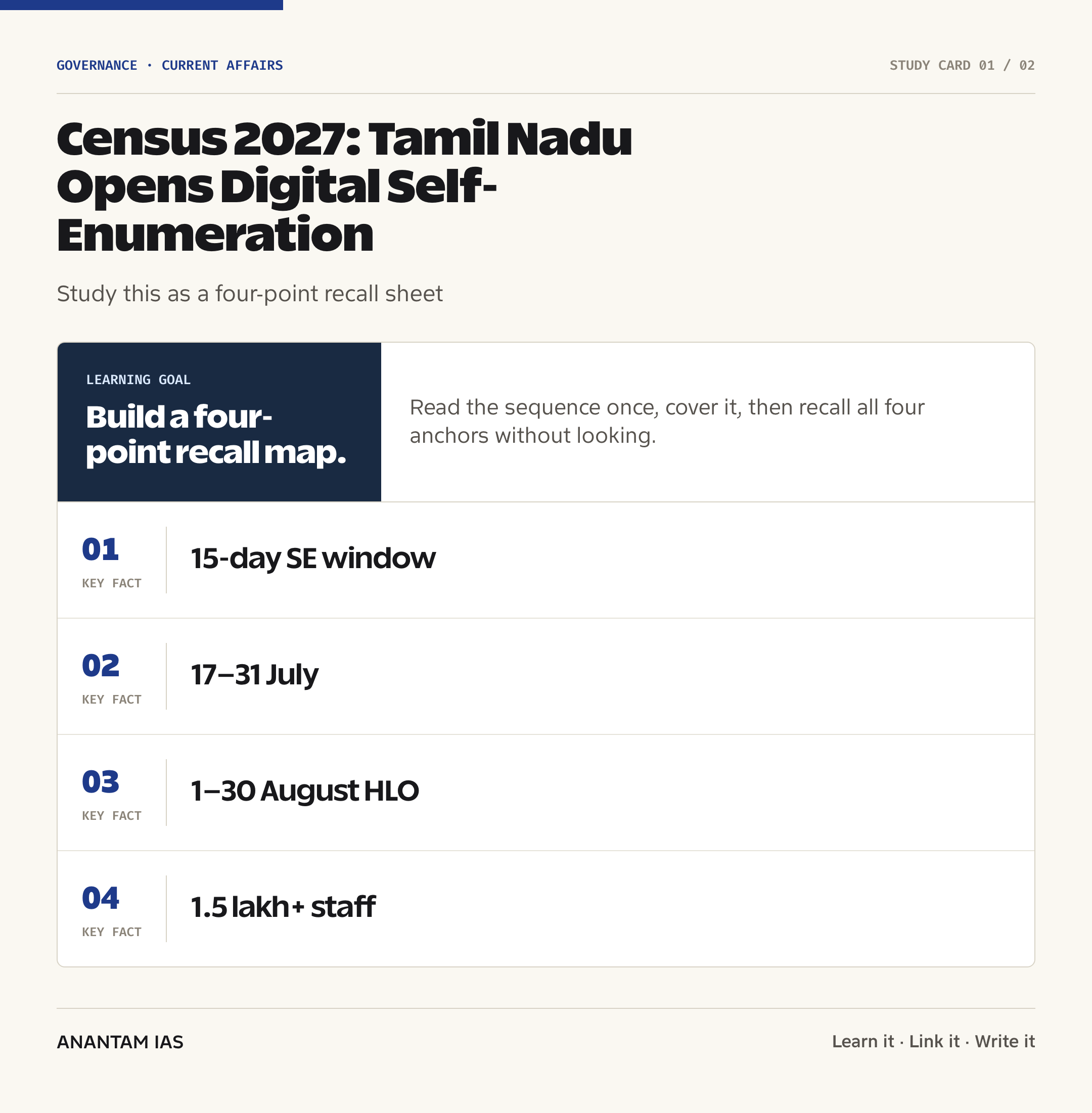
Tamil Nadu opened the optional online self-enumeration window for the first phase of Census 2027 on 17 July 2026. PIB Chennai confirmed that households across the State can submit their houselisting and housing details through the official self-enumeration portal until 31 July.
The digital window precedes door-to-door Houselisting and Housing Census operations from 1 to 30 August 2026. A completed household receives a unique Self-Enumeration ID for verification by the enumerator; households that don’t use the online option will still be covered during the regular field visit.
- Window: Self-enumeration in Tamil Nadu is available for 15 days, from 17 to 31 July 2026.
- Coverage: The official announcement applies across Tamil Nadu, while The Hindu separately reported the start of the process within Greater Chennai Corporation limits.
- Next step: More than 1,50,000 personnel are expected to support the State’s field operations from 1 to 30 August.
- Verification: Online submission generates an SE ID that the household must share when the enumerator visits.
- Optional route: Self-enumeration isn’t a substitute for universal coverage; non-users remain part of door-to-door enumeration.
- Safety advice: The Directorate asked residents to use only the official Census portal and enter details accurately because submissions feed the national database.
The development matters in the context of:
- Digital transition: Census 2027 is India’s first census designed around digital data capture, with an online citizen route and mobile applications for enumerators.
- Inclusion test: A digital option can reduce respondent burden, but weak connectivity, low digital literacy, disability and language barriers can create uneven participation.
- Trust test: Accuracy depends on residents understanding what is being asked and believing that identifiable household information will remain confidential.
- Policy value: Housing and amenities data create the local evidence base for water, sanitation, electricity, internet, housing and transport planning.
UPSC Relevance
Prelims Relevance
- Census is a Union subject under Entry 69 of the Union List in the Seventh Schedule.
- The post-Independence legal framework consists of the Census Act, 1948 and the Census Rules, 1990.
- The Office of the Registrar General and Census Commissioner, India functions under the Union Ministry of Home Affairs.
- Census 2027 is the 16th census in the Indian series and the eighth after Independence.
- Phase I is the Houselisting and Housing Census; Phase II is Population Enumeration.
- A 15-day optional self-enumeration period precedes the 30-day house-to-house Phase I operation in each State or Union Territory.
- Tamil Nadu’s self-enumeration period is 17–31 July 2026, followed by houselisting from 1–30 August 2026.
- The self-enumeration portal supports 16 languages and generates a unique SE ID after successful submission.
- Section 15 of the Census Act protects census records from public inspection and restricts their admissibility as evidence.
- The usual Census Moment is 00:00 hours on 1 March 2027; specified snow-bound areas have 1 October 2026 as their reference date.
Mains Relevance
GS Paper 2
- Digital governance: Citizen-facing self-service combined with field verification, multilingual access and near real-time administrative monitoring.
- Data governance: Purpose limitation, confidentiality, cyber security, accountability and public trust in a population-scale state database.
- Last-mile delivery: Designing assisted and offline channels so a digital option improves convenience without weakening universal coverage.
GS Paper 1
- Indian society: Census data as the baseline for studying population, migration, urbanisation, household amenities and social change.
- Data gaps: Consequences of the delayed 2021 cycle for demographic baselines and evidence-based planning.
Essay
- Technology can widen state capacity only when access and trust grow with it.
- Good public policy begins with people who are counted accurately and seen in their local context.
Background and Context
The Tamil Nadu Rollout: Sequence and Citizen Journey
Self-enumeration adds a citizen-facing digital route before the same household enters the field-verification workflow.
- Access period: An eligible household respondent can enter Phase I details online between 17 and 31 July.
- Submission: The respondent should use the dedicated government portal, follow its validation prompts and check entries before final submission.
- Receipt: A successful submission produces a unique SE ID, which connects the online record with the later field visit.
- Enumerator visit: The visiting official uses the ID to confirm the information rather than treating online submission as an unverified final record.
- Fallback: If a household doesn’t self-enumerate, the enumerator collects its information during the 1–30 August field operation.
- Key distinction: Optional self-enumeration changes the method of initial entry; it doesn’t remove the State’s duty to seek complete territorial coverage.
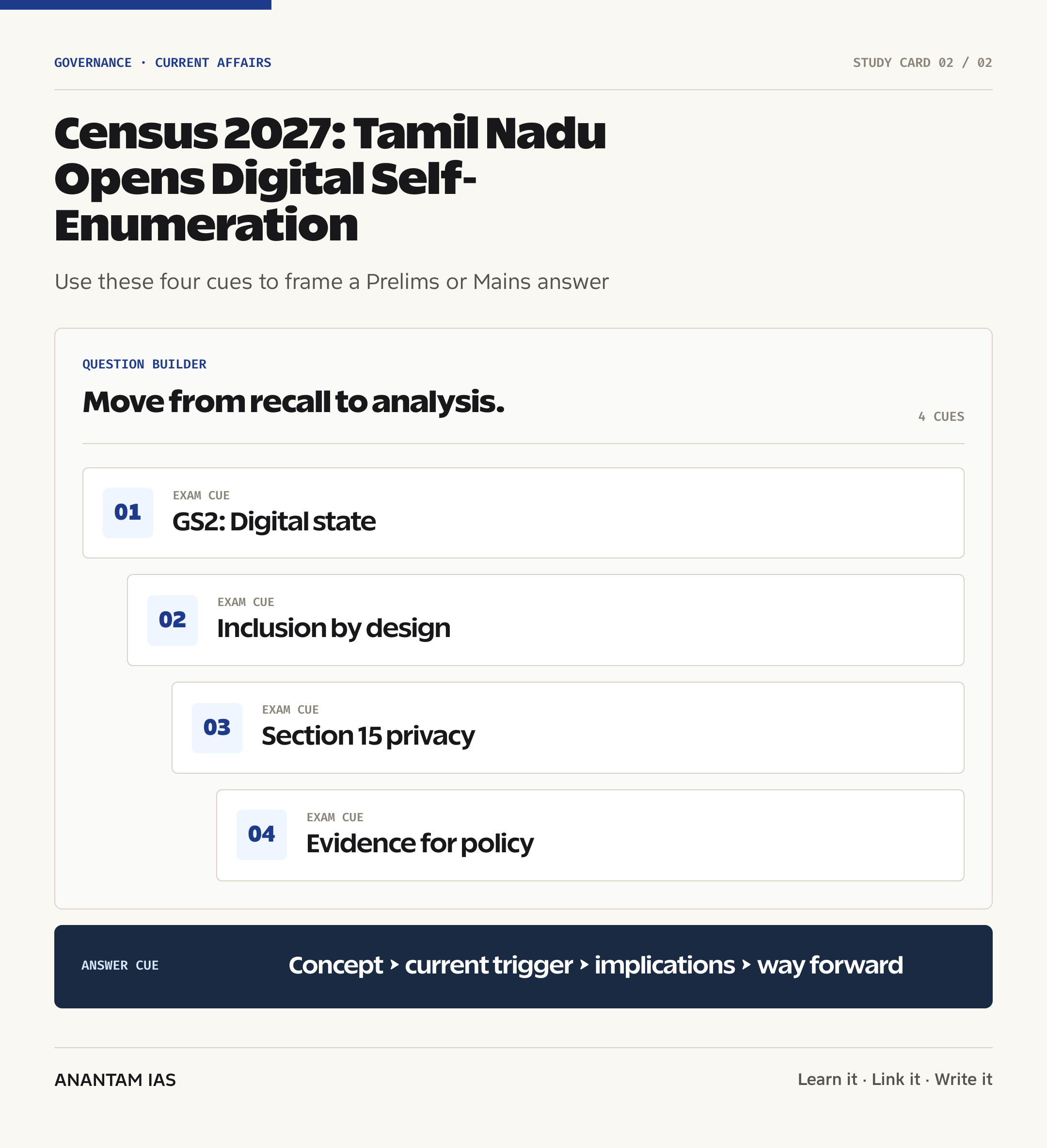
Constitutional, Legal and Administrative Architecture
A census is centrally authorised but depends on a large Union-State-local administrative chain for execution.
- Constitutional location: Entry 69 places census work in the Union List, supporting uniform national concepts, schedules and outputs.
- Statutory basis: The Census Act, 1948 empowers the Central Government to declare a census and provides for census officers, questions, duties and confidentiality.
- Operational rules: The Census Rules, 1990 govern administrative procedures, while notified schedules specify what census officers may ask.
- National authority: The Registrar General and Census Commissioner coordinates the exercise through Directors of Census Operations in States and Union Territories.
- State machinery: State officers, district and charge officials, supervisors, enumerators and local bodies convert the national design into household coverage.
- Answer connection: Read the broader Census in India framework alongside the chronology in Indian Census history.
What Phase I Counts and Why It Comes First
Houselisting creates the physical and household frame needed before people are counted in the Population Enumeration phase.
- Housing conditions: Phase I records characteristics of the census house and the material used for floors, walls and roofs.
- Basic amenities: It captures access to drinking water, sanitation, electricity, cooking fuel and related household facilities.
- Connectivity and assets: The notified exercise includes information such as internet connectivity and vehicle ownership.
- Enumeration frame: Listing buildings, census houses and households helps assign field workloads and reduce omissions or duplication in Phase II.
- Not the same exercise: Detailed individual demographic, migration, fertility and caste questions belong to Population Enumeration, not the current Tamil Nadu houselisting window.
- Policy use: Aggregated results can expose neighbourhood-level deficits that State averages hide, improving the targeting of infrastructure and services.
How the First Digital Census Changes Operations
Digital collection changes the speed and auditability of the workflow, but it doesn’t automatically guarantee accurate data.
- Two capture routes: Households may use the secure web portal, while authorised enumerators use dedicated mobile applications during fieldwork.
- CMMS: The Census Management and Monitoring System allows officers at different levels to track progress and operational readiness on a near real-time basis.
- Geo-referenced work: Digital houselisting blocks can help define field boundaries and detect geographic gaps or overlap.
- Built-in checks: Validation rules can flag missing or inconsistent entries before submission, reducing some manual transcription errors.
- Faster processing: Direct digital transfer can shorten the path from collection to cleaning and release compared with paper schedules.
- Human verification remains central: Identity resolution, unusual household arrangements, language interpretation and local geography still need trained field judgement.
- Related reading: The earlier note on building a credible digital Census explains why technical capacity and institutional trust must develop together.
Inclusion Risks Behind a Digital Option
Self-enumeration can increase convenience for some households while excluding others unless assisted routes remain visible and reliable.
- Connectivity divide: Poor networks, unavailable devices or high data costs may block rural, remote and low-income households from using the portal.
- Capability divide: Older persons, first-time internet users and people with limited digital literacy may need in-person or community assistance.
- Accessibility: The portal and guidance should work with screen readers, keyboard navigation, clear error messages and low-bandwidth devices.
- Language access: Sixteen language options are important, but translations, examples and help systems must remain understandable in practice.
- Household power: One respondent may not know or may misstate the circumstances of every member, especially migrants, tenants, persons with disabilities or absent workers.
- Coverage principle: Door-to-door enumeration, public help channels and supervisor checks should function as inclusion safeguards, not as secondary services.
Privacy, Confidentiality and Cyber Security
Census participation depends on a clear separation between identifiable returns used for counting and aggregate statistics released for public use.
- Statutory shield: Section 15 bars a right to inspect census records and limits their use as evidence, protecting the confidentiality of individual returns.
- Operational promise: PIB says Census 2027 uses end-to-end encryption for collection, transmission and storage, along with secure transmission protocols.
- Protected infrastructure: Official data centres are designated as Critical Information Infrastructure and are reported to follow ISO/IEC 27001:2022 controls.
- Fraud risk: Residents should use only the official census.gov.in portal and should distrust unofficial links seeking household details or an SE ID.
- Least privilege: Access to identifiable records should be role-based, logged and limited to the minimum period and purpose needed for census operations.
- Public accountability: Security audits, incident response, correction channels and plain-language notices are needed to make privacy claims verifiable.
- Legal comparison: The Digital Personal Data Protection Act framework provides a wider data-governance lens, while Census confidentiality rests on its specific statutory regime.
Data Quality, Policy Value and Answer-Building
The strongest assessment links technology to measurable coverage and error control rather than treating digitisation as success by itself.
- Coverage error: The main risk is missing or duplicating houses, households or people; geo-referenced blocks and field reconciliation should reduce it.
- Content error: Respondents may misunderstand a definition or enter an inaccurate value, so examples, validations and enumerator confirmation matter.
- Non-response bias: If online users differ systematically from non-users, self-enumeration statistics alone cannot represent the population.
- Timeliness: Faster processing has value only if cleaning, quality assurance and release calendars remain transparent.
- Planning dividend: Reliable local data can guide housing, water, sanitation, digital connectivity, transport and welfare delivery.
- Representation impact: Updated population evidence can shape debates on fiscal transfers, constituency delimitation and the implementation of women’s legislative reservation, even though these involve separate constitutional and statutory processes.
- Answer structure: Start with the Tamil Nadu sequence, explain the legal and digital architecture, evaluate inclusion and privacy, and end with assisted access plus independent quality assurance.
Way Forward
Make Assisted Access Universal
- Provide staffed help at local-body offices and authorised public facilities, with clear safeguards against intermediaries retaining personal data.
- Keep door-to-door enumeration fully resourced so no household is disadvantaged for choosing not to self-enumerate.
Design for Accessibility and Low Bandwidth
- Test the portal in all supported languages on inexpensive phones, slow networks, screen readers and keyboard-only navigation.
- Offer plain-language guides, visible helplines and error recovery that doesn’t force a household to restart the full schedule.
Reconcile Digital and Field Records
- Use the SE ID for controlled matching, enumerator confirmation and duplicate detection without exposing household details.
- Require supervisors to review unresolved buildings, unusually high non-response and boundary gaps before closing a houselisting block.
Turn Privacy Claims into Controls
- Apply role-based access, strong authentication, encryption, audit logs, time-bound retention and tested incident-response procedures.
- Publish non-sensitive security and privacy information so residents understand who can access their return and what aggregate data will be released.
Publish a Quality Account
- Release metadata on coverage checks, corrections, non-response and processing methods without revealing any identifiable return.
- Separate administrative progress metrics from statistical quality, and explain revisions so researchers and governments can use the results responsibly.
Conclusion
Tamil Nadu’s self-enumeration window is a practical test of digital state capacity: a household can submit information directly, but the system still relies on trained enumerators, universal field coverage and careful reconciliation. Convenience is useful only when it strengthens completeness and accuracy.
The durable governance lesson is that a credible census needs access, confidentiality and quality assurance in equal measure. If assisted channels protect inclusion and security controls earn public trust, faster digital collection can produce a stronger evidence base for local and national policy.
UPSC Practice Questions
Prelims MCQ 1
With reference to Census 2027, consider the following statements:
- Census is listed in the Union List of the Seventh Schedule.
- Self-enumeration replaces the enumerator’s field visit for every participating household.
- The Houselisting and Housing Census precedes Population Enumeration.
How many of the above statements are correct?
(a) Only one (b) Only two (c) All three (d) None
Answer: (b) Only two
Explanation:
Statements 1 and 3 are correct. Census is a Union subject, and houselisting is Phase I. Statement 2 is incorrect: an SE ID is presented during the enumerator’s visit so the submitted information can be confirmed.
Prelims MCQ 2
Which one of the following correctly matches Tamil Nadu’s first-phase Census 2027 schedule?
(a) Self-enumeration: 17–31 July; houselisting: 1–30 August (b) Self-enumeration: 1–15 August; Population Enumeration: 16–31 August (c) Houselisting: 17–31 July; self-enumeration: 1–30 August (d) Population Enumeration and caste enumeration: 17 July–30 August
Answer: (a) Self-enumeration: 17–31 July; houselisting: 1–30 August
Explanation:
Tamil Nadu’s optional 15-day self-enumeration window runs from 17 to 31 July 2026. The 30-day door-to-door Houselisting and Housing Census follows from 1 to 30 August.
UPSC Mains Questions
- Digital self-enumeration can make a census faster without making it automatically more inclusive or accurate. Examine this statement using Tamil Nadu’s Census 2027 rollout, and suggest institutional safeguards that can reconcile citizen convenience with universal coverage, data quality and confidentiality.
- Reliable census data are public infrastructure for welfare, urban planning and democratic representation. Discuss the legal and administrative architecture of India’s Census, and assess how digital collection should address the risks of exclusion, cyber insecurity, non-response bias and weak public trust.
Sources: PIB Chennai and Directorate of Census Operations, Tamil Nadu and The Hindu.
Frequently Asked Questions
When is Tamil Nadu self-enumeration open?
Tamil Nadu’s optional Census 2027 self-enumeration window runs from 17 to 31 July 2026. It is followed by the Houselisting and Housing Census from 1 to 30 August. The online window concerns the first phase, not the later Population Enumeration exercise that counts individual demographic characteristics.
Is online self-enumeration compulsory?
No. It is an optional method for entering household information before the field operation. A household that doesn’t use the portal will still be covered by an enumerator during the regular door-to-door exercise. Keeping the offline route fully functional is essential for universal coverage and digital inclusion.
What happens after online submission?
A successful submission generates a unique Self-Enumeration ID. The household should keep this ID and share it when the census enumerator visits. The enumerator can then confirm the online information and connect it with the correct houselisting record, helping prevent omission or duplication.
What does the housing census collect?
The Houselisting and Housing Census records the housing stock, household frame, building characteristics, amenities and selected assets. Official examples include drinking water, sanitation, electricity, internet connectivity, cooking fuel and vehicle ownership. Detailed individual demographic and caste information belongs to the later Population Enumeration phase.
How are individual census returns protected?
Section 15 of the Census Act, 1948 protects census records from public inspection and sharply limits their admissibility as evidence. The government also reports encryption, secure transmission and protected data centres for Census 2027. Good implementation still requires restricted access, audit logs, incident response and clear public communication.
Why does self-enumeration need field verification?
Field confirmation helps connect an online return to the correct household and houselisting block. It can also catch incomplete records, misunderstandings, duplicates and geographic gaps. The combination of digital entry, local verification and supervisor review is stronger than assuming either technology or a household visit is error-free.
Source: https://anantamias.com/current-affairs/census-2027-self-enumeration-tamil-nadu/
China’s AI Governance Pitch: A Standards Contest for the Global South
Why in News?
At the 2026 World AI Conference in Shanghai on July 17, Chinese President Xi Jinping announced the formation of the World Artificial Intelligence Cooperation Organization, or WAICO, as a platform aimed mainly at developing countries.
China’s Foreign Ministry said Beijing would offer developing countries 5,000 AI training and seminar opportunities over five years, build application cooperation centres with six regional groupings, and extend its MAZU meteorological warning system to 30 countries.
- WAICO has been established in Shanghai as a new international AI development and governance platform.
- The Hindu reported that China and 29 other countries, mainly from Asia, Africa and Latin America, formed the organisation.
- China proposed cooperation centres with ASEAN, the League of Arab States, the African Union, CELAC, the Shanghai Cooperation Organisation and BRICS.
- The official speech paired open-source AI and wider access with laws, technical monitoring, early warning and human control.
- India attended the Shanghai meeting through a Joint Secretary-level delegation but was not among WAICO’s initial participants, according to The Hindu.
The development matters in the context of:
- The initiative matters in the context of a widening AI divide in access to compute, data, skilled workers, safety tools and standards-setting forums.
- Training and application centres can create useful capacity, but they can also generate long-term technology dependence through models, cloud services, datasets and technical specifications.
- The development turns AI governance into an arena of strategic competition between UN-centred, rights-based, market-led and state-sovereignty-oriented approaches.
- For India, the issue joins BRICS and SCO diplomacy with its own claim to represent an inclusive, safe and development-focused Global South model.
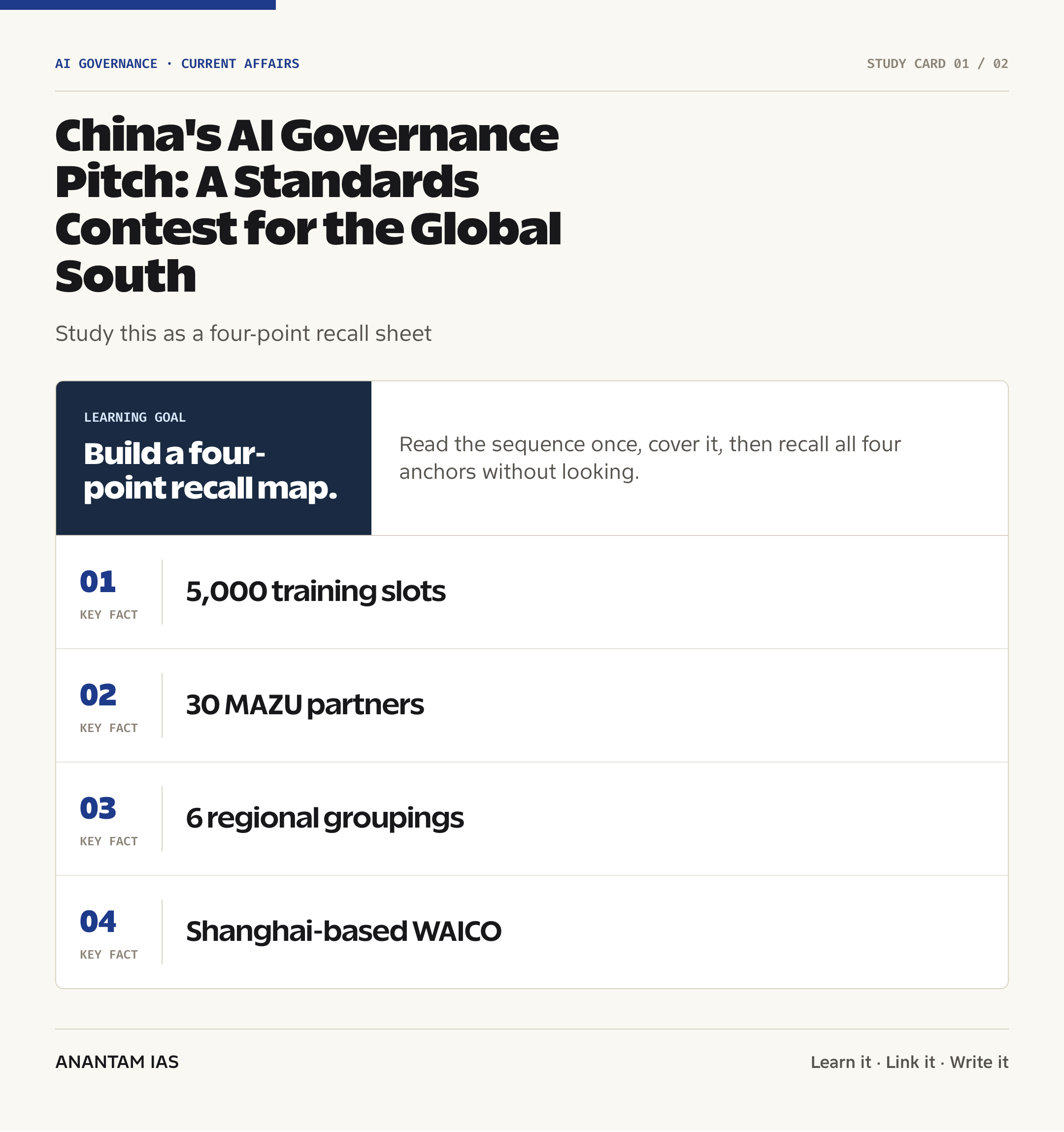
UPSC Relevance
Prelims Relevance
- WAICO stands for World Artificial Intelligence Cooperation Organization and is based in Shanghai.
- ASEAN, the African Union, the League of Arab States, CELAC, SCO and BRICS were named for application cooperation centres.
- CELAC is the Community of Latin American and Caribbean States.
- MAZU is described by China as an AI-powered meteorological warning system.
- The Global Digital Compact was adopted as an annex to the UN Pact for the Future in 2024.
- UN General Assembly Resolution A/RES/78/311 concerns international cooperation on AI capacity-building and was adopted without a vote in 2024.
- The UN Global Dialogue on AI Governance is designed to give all governments and relevant stakeholders a forum for international AI cooperation.
- India’s AI Governance Guidelines use a principle-based, techno-legal and sector-sensitive approach rather than a single omnibus AI law.
Mains Relevance
GS Paper 2
- Changing institutions of global governance, China’s engagement with developing countries, and India’s choices inside BRICS and SCO.
- The tension between strategic autonomy, South-South cooperation and dependence on foreign digital infrastructure.
- The case for an inclusive UN-centred framework with meaningful participation by smaller states, technical experts and civil society.
GS Paper 3
- AI safety, algorithmic accountability, open-source models, data governance and technical standards.
- Public capacity in compute, datasets, multilingual models, testing, auditing and incident reporting.
- The role of interoperable standards in balancing innovation, national security, human rights and digital sovereignty.
Essay
- Technology and power: those who build standards shape markets, institutions and public values.
- Inclusion without dependence: capacity-building becomes durable only when recipients gain agency over skills, data and infrastructure.
- One technology, many societies: global rules must protect common human interests while respecting linguistic and cultural diversity.
Background and Context
What China has proposed
The Shanghai package combines an institution, training, deployment partnerships and a normative governance pitch.
- WAICO is presented as an international platform for AI development and governance, with its institutional base in Shanghai.
- The 5,000 opportunities cover training and seminar programmes for developing countries over the next five years; the announcement doesn’t specify country quotas, selection rules or funding terms.
- Application cooperation centres are intended to connect China with six regional groupings, widening the initiative beyond bilateral technology projects.
- The MAZU offer links governance diplomacy with a practical public-interest use case: AI-assisted early warning for weather hazards.
- The official address calls for alignment on development strategies, governance rules and technical standards, making standard-setting an explicit part of the initiative.
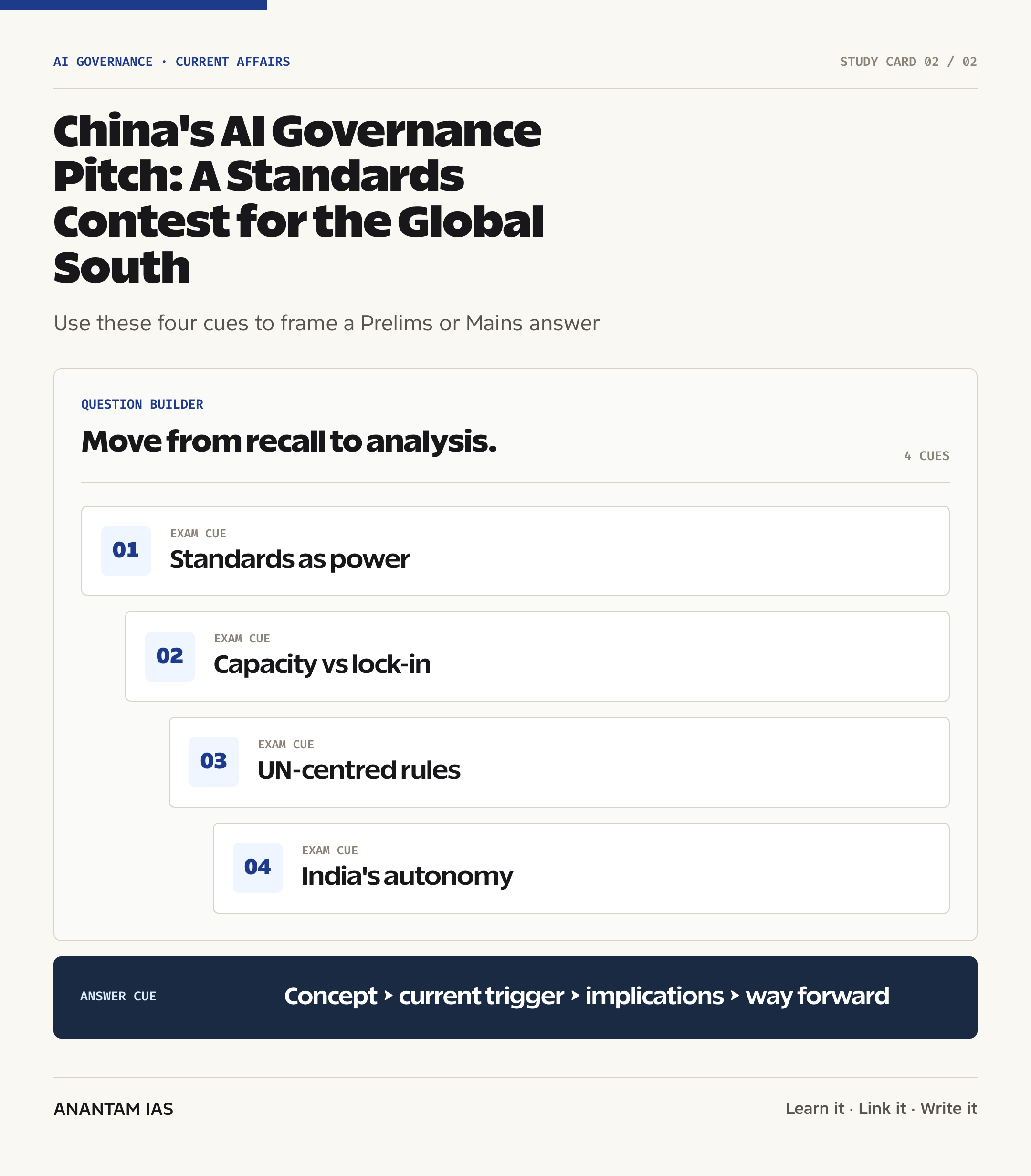
The four principles in China's pitch
Xi’s address organised the proposed approach around development, control, cultural plurality and international cooperation.
- Openness and win-win cooperation: encourage open source, collaboration, sharing, industrial innovation and application across economic sectors.
- Security and controllability: combine laws, technical monitoring, early warning and emergency response while keeping AI under human control.
- Civilisational diversity: prevent AI systems from eroding the distinct cultures and values of different societies.
- Solidarity and multilateralism: recognise a central UN role and help Global South countries bridge AI and digital divides.
- China also opposes what it calls the overstretching of national security, a position tied to its criticism of technology restrictions and exclusive supply chains.
Why capacity-building is also standards power
Technical assistance is never only about skills; it can influence the systems and rules adopted by recipient states.
- Training officials and engineers shapes their familiarity with particular models, audit methods, cloud stacks and policy vocabulary.
- Application centres may encourage common procurement requirements, data formats and safety tests, creating path dependence even without a binding treaty.
- Open-source availability can reduce entry costs and support local adaptation, but usable AI still requires compute, maintenance, cybersecurity and high-quality data.
- The provider can gain insight into local sectors, languages and demand while building diplomatic influence through digital public goods.
- Recipient countries need transparent terms on data access, model updates, vendor switching, security audits and intellectual property to retain policy autonomy.
The wider global governance landscape
WAICO enters a crowded field where universal institutions and smaller coalitions already produce overlapping principles.
- The UN’s Global Digital Compact calls for inclusive, risk-based AI governance, capacity-building, human oversight and interoperable standards.
- The UN Global Dialogue on AI Governance provides a universal discussion forum, while an independent scientific panel is meant to strengthen evidence-based assessment.
- The UNESCO Recommendation on the Ethics of AI anchors governance in human dignity, rights, fairness, transparency, sustainability and oversight.
- The OECD AI Principles support trustworthy, human-centred AI and international interoperability, while the G7 Hiroshima process focuses strongly on advanced systems.
- The central policy problem is forum fragmentation: different institutions may duplicate work or produce incompatible definitions, tests and reporting duties.
Global South opportunities and risks
Developing countries need both a voice in rule-making and material access to the foundations of AI.
- Capacity programmes can improve public services in health, agriculture, education, disaster warning and language technology when designed around local needs.
- Participation can move states from rule-takers to contributors in standards bodies, model evaluation and cross-border incident coordination.
- But low-cost models may still lock governments into foreign cloud infrastructure, chips, cybersecurity services and update cycles.
- Weak privacy law or procurement capacity can expose citizens to surveillance, discriminatory outputs and opaque automated decisions.
- A credible partnership should measure local ownership through skills retained, datasets governed locally, independent audits enabled and vendors made replaceable.
India's position and policy assets
India has its own governance model and must assess new platforms through strategic autonomy, interoperability and public value.
- The India AI Governance Guidelines favour a balanced, agile and pro-innovation framework grounded in seven guiding principles.
- India’s architecture includes an AI Governance Group, a Technology and Policy Expert Committee, the IndiaAI Safety Institute and sectoral regulators.
- The approach is techno-legal: existing laws, sector rules and technical safeguards are combined instead of regulating every AI system through one method.
- The IndiaAI Impact Summit positioned digital public infrastructure, multilingual systems and safe AI as contributions to the Global South.
- India can work through the UN, GPAI, G20, BRICS and SCO while avoiding automatic alignment with any single country’s institutional project.
How to evaluate competing AI governance models
The label of inclusion matters less than the rules, resources and accountability built into a platform.
- Representation: do smaller states, researchers, businesses, labour groups and civil society influence decisions or merely endorse them?
- Rights and remedies: are privacy, non-discrimination, explanation, human review and grievance mechanisms operational rather than aspirational?
- Technical credibility: are common benchmarks, red-teaming, incident reporting and independent audits available across languages and sectors?
- Development value: does assistance expand local compute, datasets, institutions and research capacity instead of only distributing finished models?
- Interoperability: can national frameworks connect with UN norms and other standards without forcing countries into closed geopolitical blocs?
Way Forward
Keep universal rules at the centre
- Use the United Nations as the legitimising forum for baseline principles, scientific assessment and participation by all states.
- Require regional or plurilateral initiatives to map their standards against the Global Digital Compact and human-rights obligations.
- Avoid duplicate institutions by assigning clear functions to scientific assessment, policy dialogue, technical standards and capacity finance.
Make capacity-building recipient-led
- Let partner countries define priority sectors, local-language needs and public-interest outcomes before technology is selected.
- Publish programme terms, beneficiary selection, costs, data arrangements and evaluation metrics.
- Build local trainers, regulators, auditors and research teams so knowledge remains after a project ends.
Protect strategic and data autonomy
- Use open standards, portable data formats and contractual exit clauses to prevent vendor lock-in.
- Mandate security testing, model documentation, data minimisation and independent algorithmic audits for public deployments.
- Keep sensitive government and citizen data under enforceable jurisdictional, cybersecurity and access-control safeguards.
Build an Indian interoperability offer
- Connect the IndiaAI Safety Institute, sector regulators and standards bodies to partners across the Global South.
- Offer multilingual datasets, evaluation tools and digital public infrastructure with privacy, openness and modular architecture built in.
- Draw on the findings of the UN scientific panel to keep Indian diplomacy evidence-led.
Judge initiatives by measurable outcomes
- Track local jobs, institutions strengthened, languages covered, safety incidents reported and independent audits completed.
- Measure whether recipient states contribute to standards rather than only adopt rules written elsewhere.
- Review environmental costs, including electricity, water and hardware use, alongside claimed development benefits.
Conclusion
China’s WAICO launch turns AI capacity-building into a visible instrument of Global South diplomacy. Its training, open-model and application-centre offers may close real capability gaps, but their long-term value depends on transparency, local ownership and compatibility with universal safeguards.
India needn’t choose between disengagement and institutional alignment. A stronger response is to build an interoperable Indian offer, work through universal forums, and test every partnership against rights, resilience, strategic autonomy and measurable development gains.
UPSC Practice Questions
Prelims MCQ 1
With reference to institutions and initiatives in global AI governance, consider the following statements:
- WAICO is based in Shanghai.
- The Global Digital Compact calls for an Independent International Scientific Panel on AI and a Global Dialogue on AI Governance.
- CELAC is a regional grouping of African states.
How many of the above statements are correct?
(a) Only one (b) Only two (c) All three (d) None
Answer: (b) Only two
Explanation:
Statements 1 and 2 are correct. CELAC is the Community of Latin American and Caribbean States, not an African grouping.
Prelims MCQ 2
Which one of the following best describes a techno-legal approach to AI governance?
(a) Replacing all laws with voluntary technical standards (b) Banning high-compute models across every sector (c) Combining legal duties, institutional oversight and technical safeguards across the AI lifecycle (d) Allowing model developers to regulate themselves without public oversight
Answer: (c) Combining legal duties, institutional oversight and technical safeguards across the AI lifecycle
Explanation:
A techno-legal approach connects law and regulation with tools such as audits, testing, documentation and monitoring; it doesn’t treat either law or technology as sufficient alone.
UPSC Mains Questions
- China’s new AI cooperation architecture shows that capacity-building and technical standards are emerging as instruments of geopolitical influence. Analyse the opportunities and strategic risks this creates for Global South countries, with special reference to institutional autonomy and development needs.
- India should respond to competing global AI governance models by building interoperable public goods rather than joining rigid technology blocs. Discuss with reference to India’s AI Governance Guidelines, multilateral forums and the requirements of safe, inclusive AI.
Sources: Ministry of Foreign Affairs of the People's Republic of China and The Hindu.
Frequently Asked Questions
What is WAICO?
The World Artificial Intelligence Cooperation Organization, or WAICO, is a Shanghai-based platform announced for international cooperation on AI development and governance. China presents it as a response to Global South demands for capacity, applications and a voice in rule-making. Its practical significance will depend on membership rules, decision-making, transparency and links with existing UN processes.
What did China offer developing countries?
China announced 5,000 AI training and seminar opportunities over five years, application cooperation centres with six regional groupings, and access for 30 countries to the MAZU AI-powered meteorological warning system. The offer combines skills, institutional links and practical deployment, but detailed financing, selection, data and accountability terms remain important.
Why are AI standards geopolitically important?
Standards define accepted terminology, testing, safety thresholds, documentation and interoperability. Countries or firms that shape them can influence market access, procurement and regulation. When training and infrastructure accompany standards, recipients may gain useful capacity but also develop dependence on a provider’s models, cloud stack, evaluation tools and policy assumptions.
How does the UN govern AI?
The Global Digital Compact supplies a universal political framework focused on inclusion, human rights, capacity-building and interoperable governance. It supports an Independent International Scientific Panel on AI and a Global Dialogue on AI Governance. UNESCO’s ethics recommendation and UN resolutions on safe AI and capacity-building add normative and development-focused layers.
What is India’s AI governance approach?
India favours a principle-based, agile and techno-legal approach. It combines existing laws, sector regulators, technical safety tools and institutions such as the AI Governance Group, Technology and Policy Expert Committee and IndiaAI Safety Institute. The aim is to protect people and build trust without blocking beneficial innovation or context-specific regulation.
Should India join China-led AI platforms?
India should assess each platform by its governance, transparency, rights safeguards, data rules, interoperability and development value rather than by geopolitical labels alone. Selective cooperation can be useful, but India should preserve strategic autonomy, strengthen UN-centred processes and expand its own multilingual, safe and modular AI public-goods offer.
Source: https://anantamias.com/current-affairs/china-ai-governance-global-south/
Access to Life-Saving Drugs: Supreme Court Flags Judicial Delay
Why in News?
The Supreme Court took suo motu cognizance of delays in cases concerning access to life-saving medicines after examining a long-pending Kerala High Court matter about the patented breast-cancer drug Ribociclib. Suo motu means that a court starts proceedings on its own motion rather than waiting for a conventional petition.
The Indian Express reported that the case, titled In Re: Access to Life Saving Medicines and Judicial Expediency in Article 21 Matters, was heard by a three-judge Bench led by the Chief Justice of India. The intervention treats time as part of an effective remedy when delay can permanently defeat a patient’s right to health.
- The underlying Kerala proceedings concerning Ribociclib had reportedly been listed 57 times without a final conclusion.
- The original petitioner, a patient with breast cancer, died while the proceedings were pending; the High Court then converted the matter into a suo motu public interest litigation on expensive patented medicines.
- The Supreme Court said it would issue notice and asked the Kerala High Court to take up the pending proceedings at the earliest.
- The High Court separately sought expert views on whether the cheaper medicine Palbociclib could serve as an alternative to Ribociclib and Abemaciclib.
- A representation cited a monthly Ribociclib cost of about Rs 78,468 and sought government intervention under the Patents Act, 1970.
The development matters in the context of:
- This matters in the context of Article 21: a remedy delivered after the therapeutic window closes may be formally available but practically meaningless.
- It also tests how India balances patent protection, incentives for pharmaceutical innovation and the public interest in reasonably affordable medicines.
- The dispute highlights the need to connect courts, expert medical bodies, drug regulators and public-health purchasing systems without substituting judicial opinion for clinical evidence.
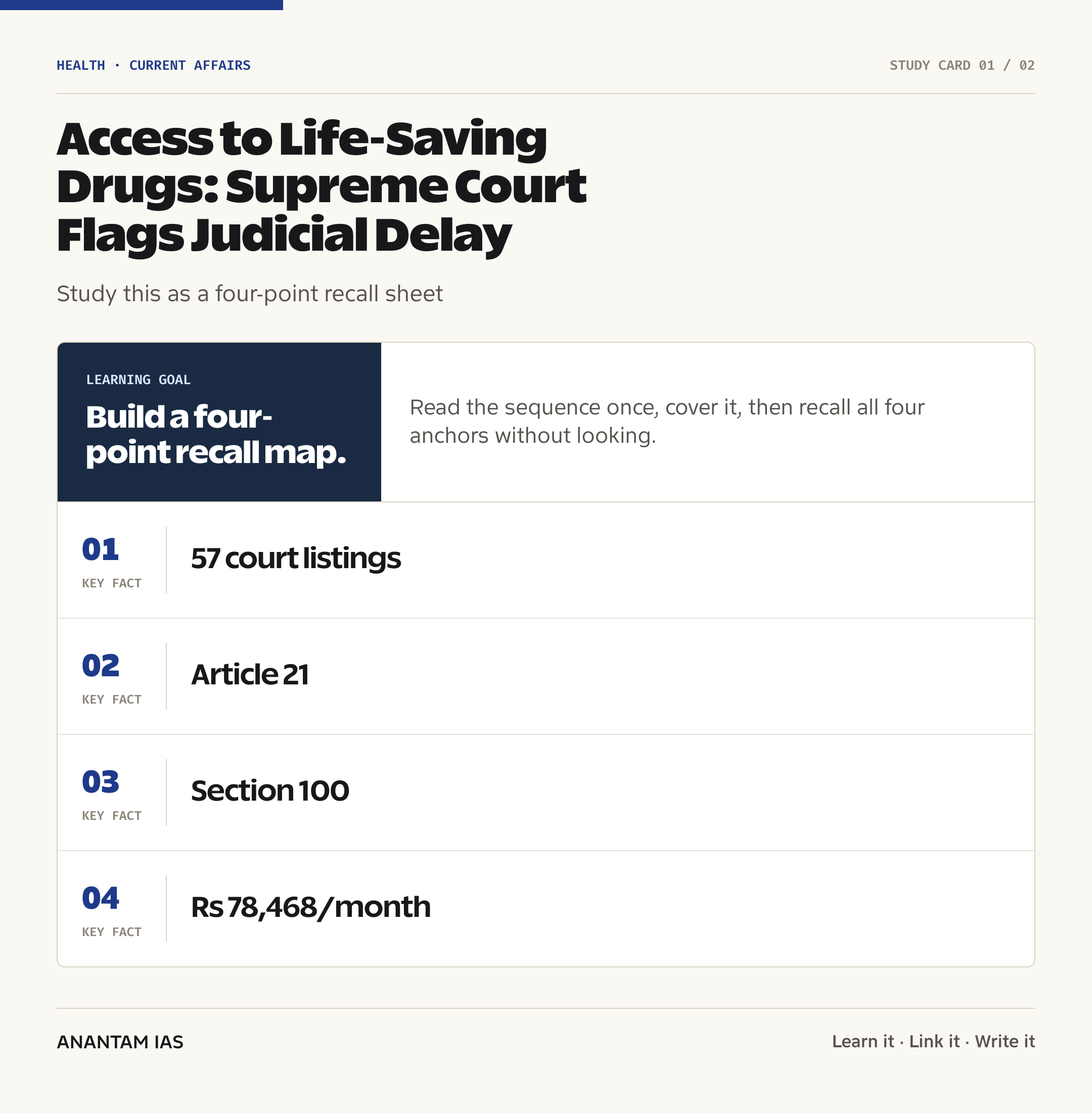
UPSC Relevance
Prelims Relevance
- Article 21 protects life and personal liberty; Supreme Court jurisprudence has read the right to health and timely medical care into its protection of life with dignity.
- Article 47, a Directive Principle, makes improvement of public health a primary duty of the State.
- Article 226 empowers High Courts to issue writs for fundamental rights and for other purposes; Article 32 guarantees access to the Supreme Court for enforcement of fundamental rights.
- Section 84 of the Patents Act permits an interested person, subject to statutory conditions, to seek a compulsory licence after three years from grant of a patent.
- Section 92 provides a special route for compulsory licences after a Central Government notification involving national emergency, extreme urgency or public non-commercial use.
- Section 100 allows the Central Government, or a person authorised by it, to use an invention for government purposes after a patent application is filed or a patent is granted.
- Section 47(4) permits government import of a patented medicine for its own use or distribution through specified public medical institutions.
- Ribociclib, Palbociclib and Abemaciclib are medicines used in defined clinical settings for hormone-receptor-positive, HER2-negative breast cancer; interchangeability requires expert assessment.
- The Drugs Controller General of India functions within the Central Drugs Standard Control Organisation and regulates matters such as approval of new drugs.
Mains Relevance
GS Paper 2
- Fundamental rights: relationship between Article 21, dignity, timely health care and an effective constitutional remedy.
- Judiciary: case management, prioritisation of time-sensitive matters and the human consequences of repeated listings without final adjudication.
- Social justice: unequal access to high-cost cancer therapy and the State’s obligations toward vulnerable patients.
- Governance: coordination among courts, health ministries, regulators, expert institutions and public procurement agencies.
GS Paper 3
- Intellectual property: public-health flexibilities under the Patents Act and the balance between innovation incentives and affordability.
- Science and technology: evidence-based assessment of therapeutic alternatives, generic entry and domestic pharmaceutical capacity.
Essay
- Justice delayed is justice denied acquires a literal public-health meaning when the subject is a time-sensitive treatment.
- A humane State must make innovation sustainable without allowing ability to pay to become the sole gatekeeper of survival.
Background and Context
From an individual petition to a systemic case
The litigation shows how one patient’s affordability claim grew into a wider inquiry about access to patented medicines.
- A patient approached the Kerala High Court in 2022 seeking help to obtain Ribociclib, an expensive prescribed treatment.
- After the petitioner’s death, the High Court kept the public issue alive by renaming the proceedings In Re Exorbitant Pricing of Life Saving Patented Medicines and appointing an amicus curiae.
- An amicus curiae, or friend of the court, assists with law and evidence but does not replace the parties or the judge.
- The later concern was not confined to one reimbursement request; it covered pricing, accessibility, government powers and potential therapeutic alternatives.
- On 15 July 2026, the High Court sought opinions from national and regional cancer institutions and the Drugs Controller General of India on alternative medicines.
- The Supreme Court’s new proceeding adds a second institutional question: how rapidly courts must act when delay itself can extinguish the value of a remedy.
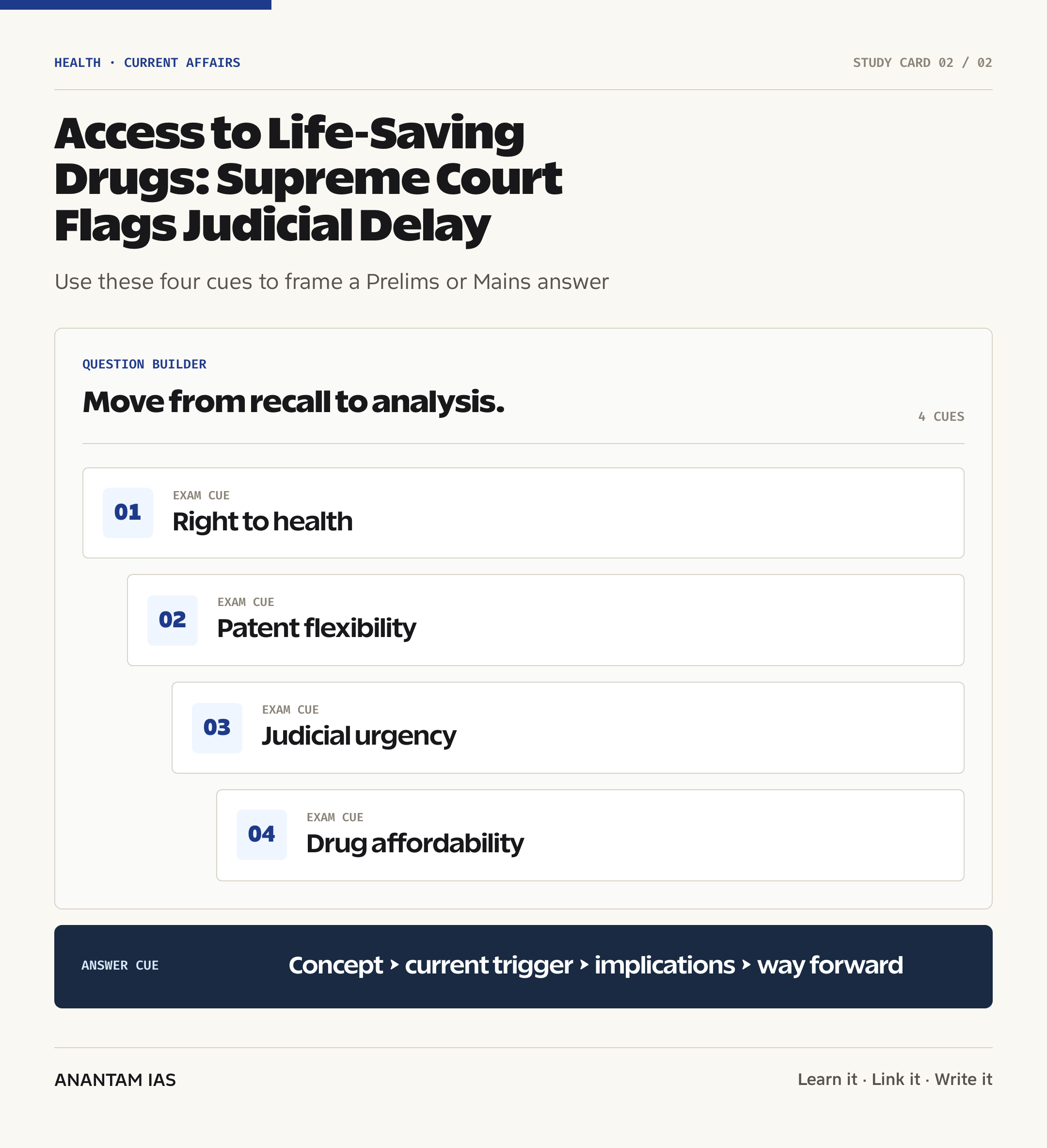
Article 21 and the right to health
The Constitution does not use the phrase right to health in Part III, but courts have derived it from life, dignity and the State’s welfare obligations.
- Article 21 bars deprivation of life or personal liberty except according to procedure established by law; its judicial interpretation covers more than mere animal existence.
- In Paschim Banga Khet Mazdoor Samity v State of West Bengal (1996), the Supreme Court held that failure of a government hospital to provide timely treatment can violate Article 21.
- In State of Punjab v Mohinder Singh Chawla (1997), the Court recognised health as integral to the right to life and placed a constitutional obligation on government.
- Article 47 directs the State to improve nutrition, living standards and public health, while Articles 38 and 41 reinforce social welfare and public assistance.
- Directive Principles are not individually enforceable like Fundamental Rights, but they guide interpretation, legislation, budgeting and the design of health systems.
- The current case sharpens the idea of effective relief: a decision must arrive while treatment remains medically useful, not only after pleadings are complete.
Why repeated listing can defeat substantive justice
Listing a case means placing it on a cause list; it does not guarantee that the court will reach, hear and decide it that day.
- Time-sensitive health cases face a different risk from ordinary commercial delay because disease can progress during each adjournment or ineffective listing.
- A court may need expert reports and party responses, but procedural completeness cannot become an indefinite substitute for a reasoned interim or final order.
- Urgency can be managed through priority listing, fixed timelines, focused issues, early appointment of experts and carefully framed interim relief.
- An interim order can preserve access while the court examines liability, but it should identify the patient group, treatment period, funding route and review date. This prevents temporary relief from becoming an open-ended policy made without evidence.
- Judicial expedition does not mean a predetermined outcome; it means preserving fairness while preventing delay from deciding the dispute by default.
- The principle also protects the other side: clear schedules and limited adjournments reduce uncertainty for governments, hospitals and patent holders.
- A transparent urgency protocol would support judicial accountability without inviting executive control over judicial outcomes.
Patent protection and public-health flexibilities
A pharmaceutical patent grants a time-bound exclusive right, but Indian law builds public-interest limits into that exclusivity.
- Section 83 states general principles: patents should promote innovation, be worked in India and should not impede protection of public health and nutrition.
- Under Section 84, an applicant may seek a compulsory licence if statutory grounds are met, including unmet public requirements, lack of reasonable affordability or failure to work the invention in India.
- Section 92 allows the Central Government to notify a national emergency, extreme urgency or public non-commercial use, enabling an accelerated compulsory-licensing route.
- Section 100 is a distinct government-use power. India Code states that the Central Government or its authorised person may use an invention for government purposes, subject to the Act’s terms and adequate remuneration where applicable.
- Section 47(4) separately preserves government import and distribution options for medicines through qualifying public institutions.
- These mechanisms differ in trigger, decision-maker and procedure, so government use should not be casually treated as identical to an ordinary compulsory licence.
- For the wider statutory map, see compulsory licensing in India and Section 3(d)’s anti-evergreening safeguard.
Affordability is more than the sticker price
Access depends on the medicine’s price, clinical suitability, duration of therapy, household finances and availability through public programmes.
- The representation reported a Ribociclib cost of about Rs 78,468 per month; this is a case-specific reported figure, not a universal retail price for every dose or patient.
- Cancer treatment can add diagnostics, consultations, travel, supportive medicines and lost income, creating catastrophic health expenditure even when one component is subsidised.
- Price reduction alone does not establish access if a medicine is unavailable in public hospitals or excluded from insurance and procurement lists.
- Financial protection also depends on whether Ayushman Bharat PM-JAY, State insurance programmes or hospital assistance packages cover the diagnosis and treatment pathway. Coverage on paper must be tested against package rates, eligibility and actual hospital availability.
- Generic competition can lower prices after patent expiry or lawful licensing, but manufacturing quality, regulatory approval and reliable supply remain essential.
- Public procurement can negotiate volume-based prices and pool demand, while schemes such as Pradhan Mantri Bhartiya Janaushadhi Pariyojana improve access to many quality generic medicines.
- Patented oncology medicines may require additional tools such as negotiated pricing, risk-sharing, patient-assistance safeguards, insurance coverage or a statutory patent flexibility.
Clinical alternatives require evidence, not price comparison
The High Court’s request for expert opinions recognises that affordability and therapeutic equivalence are separate questions.
- Ribociclib, Palbociclib and Abemaciclib belong to the CDK4/6-inhibitor class, but class membership does not automatically make medicines interchangeable for every patient.
- Choice of therapy can depend on disease stage, biomarker profile, prior treatment, contraindications, adverse effects and the applicable clinical guideline.
- An expert comparison should examine efficacy, safety, dosing, monitoring, quality of life and total treatment cost, not only the purchase price.
- Courts can require a transparent assessment and test the legality of a decision, while qualified health authorities should make the core clinical evaluation.
- The Drugs Controller General of India can contribute regulatory evidence; specialist cancer institutes can assess clinical practice and patient-level consequences.
- This separation of roles reduces two risks: judges making medical choices without evidence, and administrators invoking an alternative without showing that it is genuinely suitable.
Innovation, equity and the patent bargain
The policy problem is not a simple choice between patents and patients; it is how to make the innovation system serve public welfare.
- Patents can reward research by granting limited exclusivity, but that exclusivity is a statutory instrument rather than an unlimited natural right.
- The public side of the bargain includes disclosure of the invention, eventual generic entry and safeguards against abuse or unaffordable access.
- Predictable use of statutory flexibilities is better than ad hoc pressure because it gives governments, manufacturers and patients clear legal expectations.
- Publicly funded research and procurement should include access conditions, transparent licensing and affordable-pricing commitments where legally feasible.
- India’s pharmaceutical capacity makes domestic manufacture relevant, but a licence still needs technology, regulatory compliance, raw materials and procurement demand.
- The durable objective is patient-centred access: the right medicine, for the right patient, at the right time, with fair payment for legitimate innovation.
Way Forward
Create a health-urgency listing protocol
- High Courts should identify cases involving imminent death, irreversible disability or a closing therapeutic window at the filing and listing stages.
- Use fixed hearing dates, written issue lists, limits on adjournments and reasoned priority orders while preserving notice and hearing rights.
- Allow a rapid request to modify priority when medical circumstances change, supported by a clinician’s concise certificate.
Build a standing medical and economic evidence channel
- Create neutral panels that can quickly provide courts with evidence on clinical need, alternatives, prices, patents, supply and public-programme coverage.
- Require experts to disclose conflicts of interest and distinguish established evidence from professional judgment.
- Publish non-confidential reports so that similarly placed patients and authorities can rely on a common evidence base.
Use the full access-to-medicines toolkit
- Start with pooled procurement, negotiated prices, insurance coverage and public-hospital supply where they can deliver timely access.
- If those tools fail, evaluate Sections 84, 92, 100 and 47 against their own legal thresholds instead of treating patent flexibilities as politically unusable.
- Record reasons, compensation principles, expected savings, supply plans and patient eligibility to make government action reviewable and credible.
Measure access by patient outcomes
- Track waiting time from prescription to therapy, abandonment due to cost, public-facility availability and out-of-pocket expenditure.
- Pair price interventions with pharmacovigilance, quality assurance and uninterrupted supply.
- Include patient groups in policy design while protecting personal health information and avoiding industry capture.
Conclusion
The Supreme Court’s intervention converts a tragic delay into a constitutional governance question. Article 21 is not served by a remedy that arrives after illness has made relief useless, but urgency must still operate through fair procedure and sound medical evidence.
India already has legal tools to balance pharmaceutical innovation with public health. The harder task is institutional: courts must decide time-sensitive cases promptly, governments must explain whether and how they will use patent flexibilities, and health systems must turn legal authority into actual treatment access.
For UPSC analysis, the central link is clear: timely justice, affordable medicines and evidence-based health governance are mutually reinforcing parts of the right to live with dignity.
UPSC Practice Questions
Prelims MCQ 1
With reference to the Patents Act, 1970, consider the following statements:
- Section 84 allows an application for a compulsory licence only after three years from the grant of a patent.
- Section 92 concerns national emergency, extreme urgency or public non-commercial use.
- Section 100 empowers only State Governments, and not the Central Government, to authorise use of a patented invention.
How many of the above statements are correct?
(a) Only one (b) Only two (c) All three (d) None
Answer: (b) Only two
Explanation:
Statements 1 and 2 are correct. Section 100 gives the relevant authorising power to the Central Government, which may permit a person to use an invention for government purposes.
Prelims MCQ 2
Which constitutional provision specifically directs the State to improve public health?
(a) Article 32 (b) Article 39A (c) Article 47 (d) Article 51A
Answer: (c) Article 47
Explanation:
Article 47 is a Directive Principle that makes improvement of nutrition, living standards and public health a primary duty of the State.
UPSC Mains Questions
- A constitutional remedy in a health emergency can lose all practical value through delay. Examine how Indian courts can secure judicial expedition in life-saving treatment cases without compromising procedural fairness, expert medical assessment or institutional boundaries.
- India’s Patents Act contains multiple public-health flexibilities, but legal authority alone does not guarantee affordable access to medicines. Distinguish compulsory licensing from government use and suggest an integrated policy for access to high-cost patented therapies.
Sources: India Code, Patents Act 1970 and The Indian Express.
Frequently Asked Questions
Why did the Supreme Court intervene?
The Supreme Court was concerned that the Kerala medicine-access case had reportedly been listed 57 times without a final conclusion. Because delay in a life-saving-treatment dispute can make later relief useless, the Court began a suo motu Article 21 proceeding and asked the Kerala High Court to decide its pending matter expeditiously.
What is Ribociclib?
Ribociclib is a CDK4/6 inhibitor used in defined treatment settings for hormone-receptor-positive, HER2-negative breast cancer. It is a patented medicine at the centre of the Kerala litigation. Whether another CDK4/6 inhibitor is a suitable alternative depends on clinical evidence and the patient’s condition, not price alone.
Is right to health a Fundamental Right?
The Constitution does not separately name a Fundamental Right to health, but the Supreme Court has interpreted Article 21’s right to life with dignity to include health and timely medical care. Directive Principles, especially Article 47, reinforce the State’s duty to improve public health.
What does Section 100 permit?
Section 100 of the Patents Act allows the Central Government, or a person authorised by it, to use an invention for government purposes after a patent application is filed or a patent is granted. Statutory rules on notice, terms and adequate remuneration apply according to the circumstances.
Is government use compulsory licensing?
They are related patent flexibilities but follow different routes. A Section 84 compulsory licence is sought before the Controller on specified grounds, while Section 92 follows a government notification in special circumstances. Section 100 directly concerns government use and has its own terms and compensation framework.
Can courts choose a cheaper substitute?
Courts can demand a lawful, transparent and timely evaluation, but the clinical choice should rest on expert evidence. Medicines in the same drug class aren’t automatically interchangeable. Regulators and cancer specialists must compare efficacy, safety, biomarker fit, dosing, monitoring and total treatment consequences for the relevant patient group.
Source: https://anantamias.com/current-affairs/supreme-court-life-saving-drug-access-delays/
Online Content Blocking: NITI Aayog Seeks Industry Views on Reform
Why in News?
Government policy think tank NITI Aayog has sought technology-industry views on whether India’s online content-blocking, grievance-redressal and transparency timelines are operationally feasible. The Indian Express reported that a stakeholder meeting was held in New Delhi on June 25, 2026 as part of a wider exercise on simplifying regulation.
The consultation covers laws affecting social-media intermediaries, cybersecurity, data protection and online gaming. It matters because faster removal can limit online harm, but poorly designed blocking can also burden smaller platforms, encourage over-removal and affect the freedom of speech protected by Article 19(1)(a).
- NITI Aayog asked whether existing takedown, grievance and transparency timelines work across different categories and sizes of intermediaries.
- It also asked which intermediary due-diligence duties create the highest recurring compliance burden and what operational simplifications would help.
- Industry bodies reported at the meeting included Nasscom, CII, IAMAI and the Broadband India Forum.
- The exercise is linked to NITI Aayog’s reported Jan Vishwas Siddhant initiative for trust-based regulation and rationalisation of existing laws.
- NITI Aayog is expected to study the responses and send recommendations to the Ministry of Electronics and Information Technology; the consultation itself does not amend any law.
The development matters in the context of:
- The debate sits at the intersection of online safety, state capacity, platform accountability and constitutional liberty.
- A short deadline may be justified for urgent and clearly unlawful material, but the same deadline can be unsuitable for complex speech, satire, journalism or context-dependent claims.
- Reform must distinguish Section 69A blocking orders from the separate due-diligence and grievance obligations imposed on intermediaries under the IT Rules.

UPSC Relevance
Prelims Relevance
- NITI Aayog is the Union government’s apex policy think tank; its recommendations are advisory and do not themselves create binding takedown powers.
- Section 69A of the Information Technology Act, 2000 empowers the Central Government or a specially authorised officer to direct blocking of public access to online information.
- The statutory grounds include sovereignty and integrity of India, defence, security of the State, friendly relations with foreign States, public order and prevention of incitement to related cognisable offences.
- A Section 69A direction requires reasons to be recorded in writing and operates subject to the procedure and safeguards prescribed by rules.
- The Information Technology (Procedure and Safeguards for Blocking for Access of Information by Public) Rules, 2009 provide the institutional procedure for blocking.
- Section 79 grants conditional safe-harbour protection to intermediaries when they satisfy statutory and rule-based due diligence.
- Under the updated IT Rules, 2021, an intermediary must act within three hours after legally defined actual knowledge of specified unlawful information.
- The rules separately require action within two hours on certain complaints involving nudity, sexual content, impersonation or artificially morphed images of an individual.
- The Shreya Singhal judgment upheld Section 69A while stressing its limited grounds and procedural safeguards; it also linked intermediary takedown duties to a court order or valid government notification.
- Reasonable restrictions on speech must fall within Article 19(2); administrative convenience is not an independent constitutional ground for restricting expression.
Mains Relevance
GS Paper 2
- Balance between Article 19(1)(a) and the reasonable-restriction grounds under Article 19(2).
- Institutional design of executive blocking, procedural fairness, transparency, review and access to an effective remedy.
- Role of NITI Aayog as an advisory reform body and of MeitY as the rule-making ministry for intermediary governance.
GS Paper 3
- Cybersecurity, coordinated online harm, platform-scale risk and the operational capacity needed for rapid response.
- Effect of uniform compliance burdens on start-ups, smaller intermediaries and India’s digital innovation ecosystem.
Essay
- A trustworthy digital state needs both the capacity to act quickly and the discipline to explain, review and correct its actions.
- Regulation by deadline alone can reward speed while weakening judgment, proportionality and public accountability.
Background and Context
What NITI Aayog Is Examining
The present exercise is a regulatory consultation, not a new blocking order or a notified amendment.
- The reported questions examine whether takedown, grievance and transparency deadlines are workable for intermediaries with different functions, risk profiles and user bases.
- The consultation also asks industry to identify the most burdensome recurring due-diligence obligations and suggest specific simplifications.
- Its scope extends beyond social media to cybersecurity, data protection and online gaming, indicating a wider review of technology regulation.
- NITI Aayog can collect evidence and recommend changes, but any amendment to the IT Rules must follow the lawful process led by MeitY under the parent statute.
- Industry input is useful for estimating compliance costs, but reform must also hear users, civil-society groups, journalists, independent experts and affected communities.
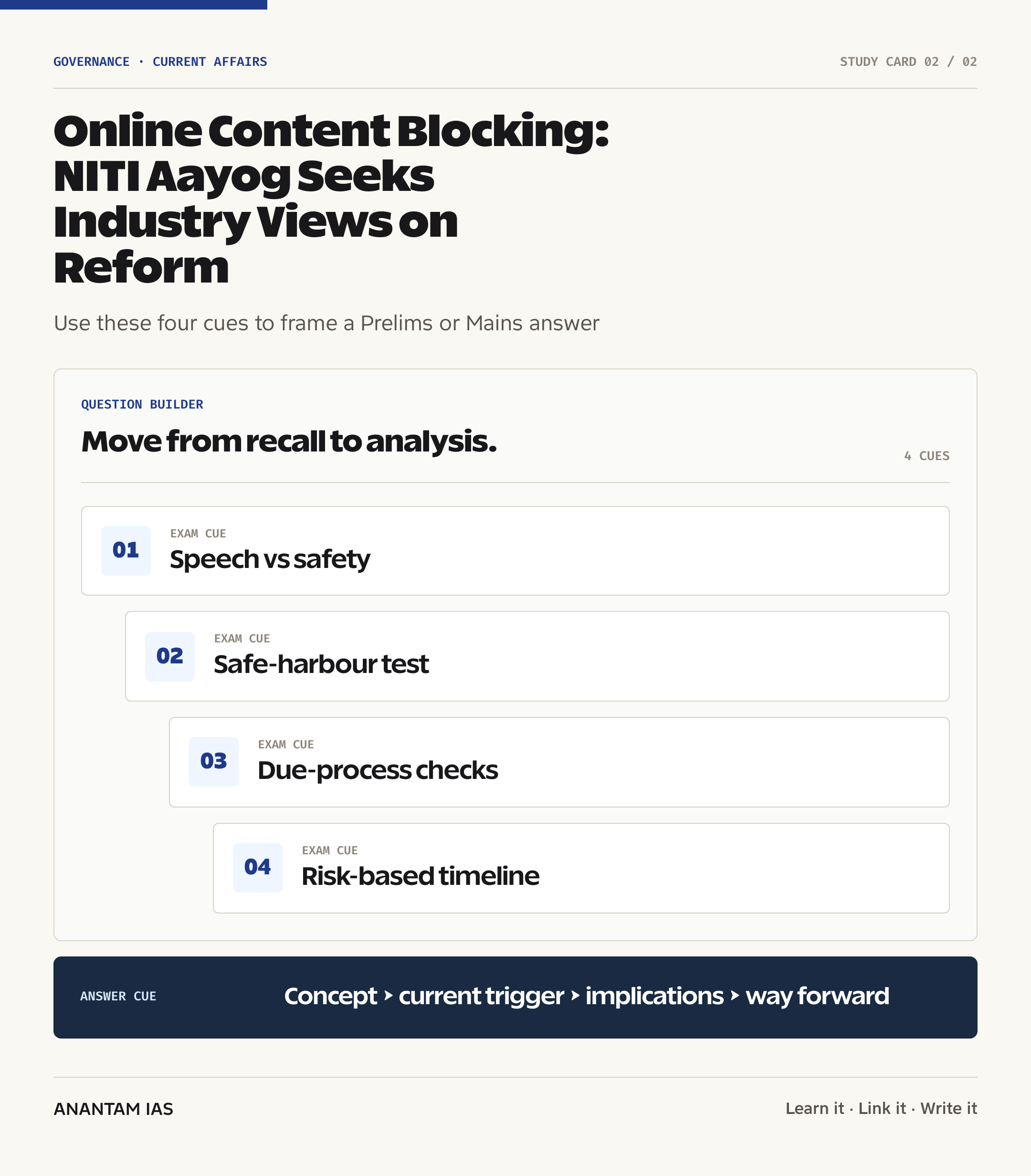
Section 69A Blocking Architecture
Section 69A is a specific statutory power to block public access to information through a computer resource.
- The power is limited to enumerated grounds such as national security, public order and sovereignty and integrity; it is not a general power to suppress inconvenient speech.
- The government must record reasons in writing, and the 2009 Blocking Rules prescribe examination through a Designated Officer and a committee of government representatives.
- The ordinary process allows the originator or intermediary an opportunity to submit a representation; an emergency route permits interim blocking before committee consideration.
- A Review Committee examines whether directions comply with Section 69A, while Rule 14 of the 2009 Rules requires confidentiality regarding requests, complaints and actions.
- Failure by an intermediary to comply with a valid Section 69A direction can attract imprisonment of up to seven years and a fine.
- For connected background, see Telegram and Section 69A, which explains the durable statutory framework.
Intermediary Due Diligence and Safe Harbour
Platform liability is also shaped by Section 79 and the IT Rules, which are related to but legally distinct from Section 69A blocking.
- An intermediary receives, stores or transmits third-party information or provides related services; examples include social networks, messaging services, marketplaces and internet-service providers.
- Section 79 safe harbour protects an intermediary from liability for third-party information when it remains within its limited role and observes prescribed due diligence.
- The updated IT Rules define actual knowledge for specified unlawful information through a court order or a reasoned written intimation from an authorised government officer.
- Following the February 2026 amendment, Rule 3(1)(d) requires removal or disabling of access within three hours after such actual knowledge, replacing the earlier 36-hour limit.
- The rules also contain different clocks for grievance acknowledgement, resolution and urgent complaints, so every content action cannot be reduced to a single universal deadline.
- The note on messaging apps and intermediary accountability shows how due diligence can vary with platform design.
Why Short Timelines Are Contested
Speed can reduce exposure to serious harm, but it can also compress the time available for legal and contextual assessment.
- Urgent removal may be necessary for non-consensual intimate imagery, impersonation, incitement or rapidly spreading operational threats.
- Complex posts may require language expertise, contextual review, verification of the issuing authority and assessment of whether the order matches a lawful ground.
- Large platforms can maintain round-the-clock legal and moderation teams, while start-ups and specialised services may face disproportionate fixed compliance costs.
- Very short deadlines can encourage risk-averse over-compliance: a platform may remove lawful speech rather than risk criminal exposure or loss of safe harbour.
- The Indian Express reported industry concern that a three-hour window may be insufficient to investigate and validate some government notices.
- A sound framework should classify requests by urgency, type of harm, evidentiary clarity and reversibility instead of treating every case alike.
Constitutional and Judicial Guardrails
Online speech receives constitutional protection even though the medium makes scale, velocity and anonymity important regulatory concerns.
- Article 19(1)(a) protects freedom of speech and expression, including communication through digital platforms.
- Restrictions must be authorised by law, pursue a ground listed in Article 19(2) and satisfy standards of reasonableness and proportionality.
- In Shreya Singhal v. Union of India, the Supreme Court struck down Section 66A but upheld Section 69A because the latter had specific grounds and procedural safeguards.
- The Court read intermediary actual knowledge narrowly, reducing the risk that private complaints alone would force platforms to decide the legality of speech.
- The discussion in Article 32 and social-media regulation underlines the need to use the proper legal route and implead affected parties.
- A right-compatible system needs notice, recorded reasons, meaningful review and a remedy, subject to narrowly tailored exceptions where prior disclosure would defeat a legitimate purpose.
Transparency and Democratic Accountability
Blocking affects not only a platform and the state but also speakers, readers and the wider information environment.
- Aggregate disclosure should show the number of orders, legal grounds, issuing authorities, compliance rates and outcomes of review without exposing operationally sensitive details.
- Affected speakers should ordinarily receive a notice or a usable statement of reasons so that they can contest mistaken identity, context or legal classification.
- Confidentiality can protect investigations and national security, but blanket secrecy weakens the ability of courts, Parliament and citizens to detect arbitrary or inconsistent blocking.
- Platforms should publish clear transparency reports, while government reporting should be sufficiently standardised to permit year-to-year comparison.
- The Indian Express reported more than 24,000 blocking orders in 2025, compared with over 12,000 in 2024; the sharp reported increase strengthens the case for auditable public data.
- Independent scrutiny is especially important because automated enforcement can reproduce errors at scale and obscure who made the decisive legal judgment.
A Better Regulatory Design
The policy choice is not between an unregulated internet and unchecked executive removal; it is about designing a capable and reviewable system.
- Create differentiated timelines for emergency harm, ordinary illegality and context-heavy disputes, with written criteria for invoking the fastest route.
- Use secure and standardised digital notices containing the legal provision, exact URL or account, reasons, urgency classification and authorised officer details.
- Offer smaller intermediaries common compliance interfaces, verified officer directories and model procedures without diluting their duty to act on lawful orders.
- Separate the functions of requesting, approving and reviewing a restriction so that institutional checks do not collapse into one executive decision.
- Build correction mechanisms for wrongful removal, including prompt restoration, user notification and preservation of records for appeal.
- Periodically review whether a block remains necessary; a lawful order at one moment should not automatically become a permanent and invisible restriction.
Way Forward
Consult Beyond Industry
- Publish a structured consultation paper and invite submissions from platforms, start-ups, users, journalists, researchers and rights organisations.
- Release a reasoned summary showing which proposals were accepted, modified or rejected and why.
Use Risk-Based Timelines
- Reserve the shortest clock for clearly defined and imminent harm, while allowing proportionate time for contextual legal review in other cases.
- Measure both speed and accuracy through restoration rates, successful appeals and repeat errors, not takedown volume alone.
Strengthen Due Process
- Require authenticated, reasoned and machine-readable orders with precise content identifiers and a traceable chain of authority.
- Provide notice, an accessible appeal and periodic review, with narrow exceptions supported by recorded reasons.
Improve Transparency
- Publish standardised aggregate statistics on Section 69A orders, legal grounds, emergency use, review outcomes and restoration.
- Enable parliamentary and independent oversight without disclosing information whose release would create a demonstrable security risk.
Conclusion
NITI Aayog’s consultation creates an opportunity to test whether India’s online-content rules are fast, clear and workable. But ease of compliance cannot be the only measure of good regulation; the framework must also protect lawful speech, allow correction and make coercive power reviewable.
The durable reform principle is calibrated accountability: urgent action for urgent harm, documented authority for every restriction, proportionate duties for different intermediaries and meaningful remedies when the state or a platform gets the decision wrong.
UPSC Practice Questions
Prelims MCQ 1
With reference to Section 69A of the Information Technology Act, 2000, consider the following statements:
- It permits blocking on grounds that include public order and security of the State.
- Reasons for a blocking direction must be recorded in writing.
- NITI Aayog is the statutory authority that issues all blocking directions under the provision.
How many of the above statements are correct?
(a) Only one (b) Only two (c) All three (d) None
Answer: (b) Only two
Explanation:
Statements 1 and 2 are correct. Section 69A lists specified grounds and requires written reasons. NITI Aayog is an advisory policy think tank, not the authority that issues every blocking direction.
Prelims MCQ 2
Which one of the following best describes intermediary safe harbour under Section 79 of the IT Act?
(a) Absolute immunity from all content-related liability (b) Immunity available only to government-owned platforms (c) Conditional protection linked to the intermediary’s role and due diligence (d) A power to issue blocking directions without written reasons
Answer: (c) Conditional protection linked to the intermediary's role and due diligence
Explanation:
Section 79 provides conditional protection for third-party information. An intermediary must remain within the statutory role and comply with due-diligence and lawful-order requirements.
UPSC Mains Questions
- India’s online content-removal framework must respond quickly to genuine harm without converting short compliance deadlines into a substitute for legal judgment. Examine this statement with reference to Section 69A, intermediary safe harbour and freedom of speech.
- What institutional and procedural safeguards should guide reform of India’s content-blocking regime? Discuss differentiated timelines, reasoned orders, transparency, independent review and remedies for wrongful removal.
Sources: MeitY and India Code and The Indian Express.
Frequently Asked Questions
What did NITI Aayog ask technology firms?
NITI Aayog reportedly asked whether current content-takedown, grievance and transparency timelines are feasible across different kinds and sizes of intermediaries. It also sought views on recurring compliance burdens and possible simplification. The exercise is consultative; it does not itself change the IT Act or the IT Rules.
What is Section 69A of the IT Act?
Section 69A empowers the Central Government or a specially authorised officer to direct blocking of public access to online information on specified grounds. These include sovereignty, national security and public order. Reasons must be recorded in writing, and the action must follow the procedure and safeguards prescribed under the 2009 Rules.
Are all takedown timelines under Section 69A?
No. Section 69A concerns statutory blocking directions, while the IT Rules also prescribe intermediary due diligence, grievance handling and action after legally defined actual knowledge. These mechanisms can interact, but they have different legal bases, triggers and procedures. UPSC answers should avoid treating every platform removal as a Section 69A block.
What is intermediary safe harbour?
Safe harbour under Section 79 is conditional protection from liability for third-party information hosted or transmitted by an intermediary. It depends on the intermediary remaining within its limited role and observing due diligence, including compliance with valid court orders and authorised government notices under the governing legal framework.
Why are very short removal deadlines controversial?
Short deadlines can reduce exposure to urgent harm, but they may leave too little time to verify authority, understand context or assess legality. Large firms may absorb the cost more easily than start-ups. Fear of penalties or lost safe harbour can also cause platforms to remove lawful speech defensively.
What reforms can balance safety and free speech?
India can use harm-based timelines, authenticated reasoned notices, clear emergency criteria, user notice, accessible appeals and periodic review. Standardised public reporting can reveal patterns without exposing genuine security details. Reform should measure the accuracy and reversibility of decisions alongside the speed of platform compliance.
Source: https://anantamias.com/current-affairs/niti-aayog-content-blocking-regime-consultation/
SIR Deletions: Supreme Court Separates Voter Rolls from Citizenship and Welfare
Why in News?
On 17 July 2026, a three-judge Supreme Court Bench led by Chief Justice Surya Kant issued notice to the Election Commission of India, the West Bengal government and the State Chief Electoral Officer on a plea concerning the wider consequences of deletions during the Special Intensive Revision (SIR) of electoral rolls.
The Court’s oral observations stressed a critical institutional boundary: the Election Commission of India (ECI) may examine citizenship only to decide electoral-roll eligibility, but its deletion decision isn’t a conclusive determination of citizenship for every legal purpose. The Hindu and Indian Express reported that the Court would examine allegations that exclusion from the roll was also being used to withdraw welfare benefits and re-verify caste certificates.
- The petitioner alleged that West Bengal orders linked SIR deletion to the Annapurna Yojana, the Public Distribution System (PDS) and re-verification of caste certificates.
- Counsel told the Court that only about 38,000 of 34 lakh appeals had been decided by 19 appellate tribunals, leaving roughly 33.5 lakh pending.
- The petitioner also stated that about 70% of decided appeals resulted in restoration to the electoral roll; this was a submission before the Court, not a judicial finding on the figures.
- The Bench linked its observations to the 27 May 2026 Bihar SIR judgment, which distinguished the ECI’s limited electoral inquiry from formal citizenship adjudication.
- The Court issued notice and agreed to hear the matter with other West Bengal SIR cases; it did not finally decide the legality of the State’s contested welfare-related actions at this hearing.
The development matters in the context of:
- This matters in the context of institutional competence: electoral administration, citizenship adjudication and welfare eligibility arise under different constitutional and statutory frameworks.
- It also tests procedural fairness because a slow or inaccessible appeal process can turn a provisional electoral exclusion into prolonged loss of voting opportunity and essential services.
- The dispute connects electoral integrity with inclusion: accurate rolls are necessary, but error correction must not create disproportionate burdens for poor, rural, elderly or less literate residents.
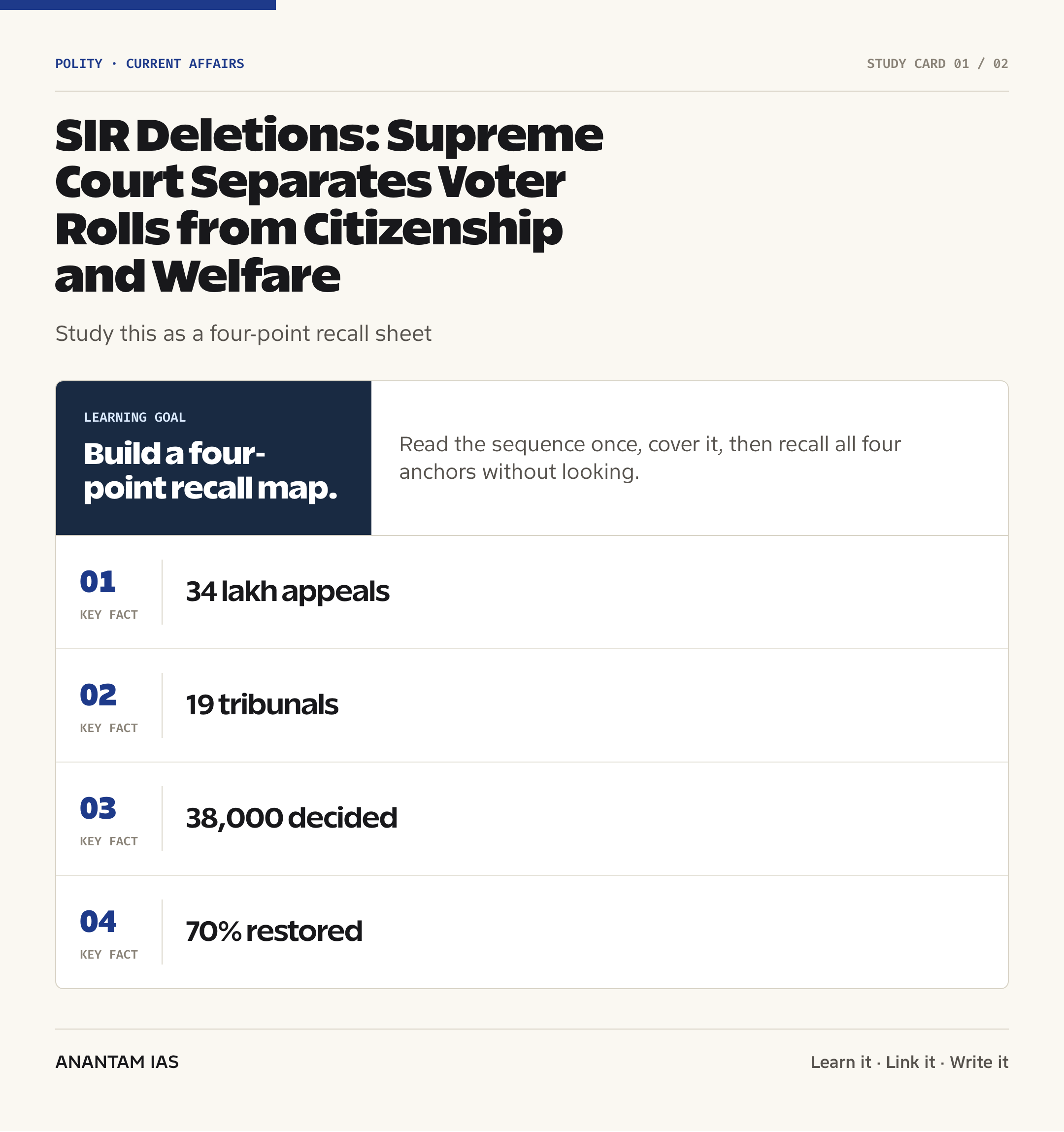
UPSC Relevance
Prelims Relevance
- Article 324 vests the superintendence, direction and control of elections and electoral rolls in the ECI.
- Article 326 provides for elections to the Lok Sabha and State Assemblies on the basis of adult suffrage, subject to constitutional and statutory disqualifications.
- Part II of the Constitution, covering Articles 5-11, deals with citizenship at the commencement of the Constitution and Parliament’s power to regulate citizenship.
- Section 16 of the Representation of the People Act, 1950 disqualifies a person from electoral-roll registration if the person isn’t an Indian citizen, among other specified grounds.
- Sections 19 and 20 of the 1950 Act connect registration to age and ordinary residence in a constituency.
- Section 21 governs preparation and revision of electoral rolls, while Sections 22 and 23 concern correction and inclusion.
- Section 24 of the 1950 Act provides an appeal against specified electoral-registration orders, subject to the prescribed procedure.
- Under the Citizenship Act, 1955, renunciation, termination and deprivation of citizenship follow separate legal routes; an electoral-roll deletion isn’t listed as a mode of citizenship loss.
- Aadhaar may establish identity for electoral purposes under the statutory framework, but it isn’t proof of citizenship.
Mains Relevance
GS Paper 2
- Separation of functions among the ECI, the Central Government’s competent citizenship authority, courts and welfare departments.
- Constitutional limits on administrative spillover from an electoral eligibility decision to citizenship status and civil entitlements.
- Need for transparent, accessible and time-bound electoral-roll appeals as part of free and fair elections.
GS Paper 2
- Welfare exclusion, Article 14, procedural fairness and protection of vulnerable groups.
- Design of interoperable public databases without allowing one database’s error or limited-purpose decision to become a universal exclusion trigger.
- Balancing roll accuracy with the democratic principle of universal adult suffrage.
Essay
- A database can improve governance only when its purpose, evidentiary value and correction process are clearly limited.
- Democracy is tested not only by the integrity of the ballot but also by how institutions correct wrongful exclusion.
Background and Context
What SIR Does and Does Not Decide
A Special Intensive Revision is an electoral-roll exercise, not a general census of citizenship or a universal eligibility audit.
- The ECI conducts revision to identify eligible electors, remove dead, shifted, duplicate or otherwise ineligible entries, and add persons who satisfy the law.
- The Supreme Court’s Bihar SIR judgment upheld the Commission’s power under Article 324 read with Section 21(3) of the 1950 Act to undertake a special revision when roll conditions justify it.
- The judgment recognised that citizenship is a condition for enrolment, so the ECI can undertake a limited inquiry into whether that condition is met.
- But the inquiry is purpose-limited: it determines whether a name should remain on the electoral roll and does not replace formal adjudication under the Citizenship Act.
- A person deleted as dead, shifted, duplicated or not ordinarily resident may face an electoral consequence even when citizenship itself is not in dispute.
Electoral Eligibility and Citizenship Are Different Legal Questions
Citizenship may be necessary for enrolment, but enrolment isn’t the source of citizenship.
- Article 326 and Section 16 of the 1950 Act make citizenship relevant to voter registration, while the Citizenship Act, 1955 governs acquisition and loss of citizenship.
- The Act recognises renunciation under Section 8, termination on voluntary acquisition of foreign citizenship under Section 9, and deprivation by a Central Government order in specified cases under Section 10.
- None of these statutory routes says that deletion by an Electoral Registration Officer automatically ends citizenship.
- The Supreme Court’s May judgment required the ECI to refer cases involving its adverse citizenship assessment to the competent Central Government authority for lawful adjudication.
- If that authority later holds that the person is a citizen, the judgment directs electoral inclusion, subject to the legal requirements.
Why Welfare Linkage Raises Constitutional Concerns
A limited-purpose electoral record shouldn’t become a shortcut for deciding unrelated entitlements without an independent legal basis.
- The petition alleged that orders dated 14 May, 19 May and 4 June connected SIR exclusion with caste-certificate re-verification, the Annapurna Yojana and PDS benefits respectively.
- These allegations are still under judicial examination, so the exact scope and legality of the State orders must be distinguished from the Court’s settled statement about the ECI’s limited role.
- Many welfare schemes turn on criteria such as residence, income, age, gender, disability or food-security status; electoral enrolment may not be a statutory condition at all.
- Automatic cross-use can violate Article 14 if persons in unlike legal situations are treated as a single excluded class without rational classification or fair procedure.
- Where food support or subsistence benefits are involved, abrupt exclusion can also implicate Article 21 concerns and the State’s obligations under welfare legislation.
- A welfare department must identify its own statutory authority, issue notice where required, examine relevant evidence and provide a remedy before stopping a benefit.
Due Process in Electoral-Roll Deletion
Accuracy and inclusion can coexist only when the process offers notice, reasons, assistance and an effective remedy.
- The 1950 Act and the Registration of Electors Rules, 1960 structure claims, objections, corrections and appeals; administrative convenience cannot displace the prescribed safeguards.
- A person facing adverse action should know the ground of proposed deletion, the documents relied on, the response deadline and the authority deciding the case.
- A reasoned order matters because it enables a meaningful statutory appeal and, where necessary, judicial review.
- The petitioner asked for public standard operating procedures, disclosure of data, local-language guidance, legal help and time-bound disposal by the 19 tribunals.
- A high restoration rate among decided appeals, if the submitted figure is verified, would be a strong signal to improve first-instance decision quality and simplify correction.
- Read this issue with Anantam IAS notes on Special Intensive Revision and electoral-roll integrity and inclusion.
Institutional Roles in the Dispute
The constitutional answer depends on keeping each authority within its assigned function.
- The ECI supervises electoral rolls and may decide enrolment eligibility through the statutory machinery.
- The Electoral Registration Officer deals with entries at the constituency level, while appellate authorities examine challenges under the applicable framework.
- The Central Government’s competent authority formally adjudicates citizenship questions under the Citizenship Act and rules where such adjudication is required.
- A State welfare department administers benefits under the scheme’s own law, guidelines and eligibility criteria; it cannot simply inherit another authority’s conclusion beyond its legal purpose.
- The Supreme Court reviews legality, institutional competence, proportionality and procedural safeguards without itself becoming the primary roll-revision authority.
- For the wider constitutional framework, revise Article 324 and the Election Commission and citizenship in India.
Database Federalism and Function Creep
The case illustrates function creep: data collected or assessed for one purpose begins controlling decisions in another domain.
- Electoral rolls, ration databases, caste-certificate records and scheme beneficiary lists have different legal purposes, evidence standards and correction pathways.
- Interoperability can reduce duplication, but a negative flag should not become an irrebuttable presumption across systems.
- A wrong deletion can cascade when databases are linked, multiplying one error into loss of vote, food support, cash assistance and documentary recognition.
- Good data governance requires purpose limitation, data minimisation, audit trails, human review and clear responsibility for correcting downstream effects.
- Departments should record whether a data point is verified, provisional, disputed or under appeal instead of treating every status as final.
- The governance lesson is wider than SIR: digital public infrastructure needs a right to correction that works across connected databases.
Way Forward
Protect Rights During Pending Appeals
- Treat SIR deletion as an electoral-status decision unless a competent authority independently decides citizenship or scheme eligibility under the relevant law.
- Avoid automatic welfare suspension while a timely appeal or citizenship reference is pending, especially for food and subsistence benefits.
- Where immediate action is legally unavoidable, provide notice, a speaking order and a fast restoration process with arrears.
Make Appeals Usable
- Publish tribunal jurisdiction, filing steps, acceptable documents, hearing dates, anonymised orders and disposal data on a common portal.
- Provide forms and guidance in Bengali and other locally used languages, along with offline filing and receipt facilities.
- Deploy legal-services institutions, trained facilitation desks and mobile camps for poor, elderly, rural and digitally excluded appellants.
- Set case-management timelines while preserving a real opportunity to present evidence.
Build Safer Data-Linkage Rules
- Require each department to document the legal basis and necessity before importing electoral-roll status into a welfare decision.
- Use warning flags rather than automatic deletion, with mandatory human verification for adverse cross-database action.
- Create a correction protocol that propagates a successful appeal to every department that received the earlier exclusion signal.
- Commission independent audits for exclusion errors, social-group impact and grievance-resolution time.
Improve Roll Accuracy at Source
- Give clear pre-deletion notice, disclose reasons and accept a practical range of reliable documents.
- Track errors by ground such as death, migration, duplication, ordinary residence and citizenship doubt so systemic weaknesses become visible.
- Use Booth Level Officers and recognised political-party agents for outreach without shifting the legal burden entirely onto vulnerable electors.
Conclusion
The constitutional distinction is straightforward but consequential: the ECI can decide whether a person qualifies for an electoral roll, yet it doesn’t possess a free-standing power to terminate citizenship. A roll deletion must remain tied to its electoral purpose unless another competent authority acts under the governing law.
The pending West Bengal case will test whether that boundary is being respected in practice. The durable policy response is not to weaken roll verification, but to pair accurate rolls with fair notice, accessible appeals, purpose-limited data use and protection against cascading exclusion.
UPSC Practice Questions
Prelims MCQ 1
With reference to electoral rolls and citizenship in India, consider the following statements:
- Article 324 vests the superintendence, direction and control of electoral rolls in the Election Commission of India.
- Deletion from an electoral roll is itself a mode of termination of citizenship under the Citizenship Act, 1955.
- Section 24 of the Representation of the People Act, 1950 provides for appeals against specified electoral-registration orders.
How many of the above statements are correct?
(a) Only one (b) Only two (c) All three (d) None
Answer: (b) Only two
Explanation:
Statements 1 and 3 are correct. Electoral-roll deletion isn’t a statutory mode of citizenship loss; the Citizenship Act separately regulates renunciation, termination and deprivation.
Prelims MCQ 2
Which one of the following best describes the Election Commission’s citizenship inquiry during electoral-roll revision?
(a) A final adjudication binding on every government department (b) A limited inquiry into eligibility for electoral enrolment (c) A criminal trial for unlawful migration (d) A process that automatically cancels all residence-based benefits
Answer: (b) A limited inquiry into eligibility for electoral enrolment
Explanation:
The Supreme Court distinguishes the ECI’s limited electoral inquiry from formal citizenship adjudication by the competent authority under the Citizenship Act.
UPSC Mains Questions
- The integrity of electoral rolls and protection against wrongful exclusion are complementary democratic duties, not competing goals. Examine this statement with reference to the Election Commission’s powers, procedural safeguards and the need for effective appellate remedies.
- Automatic use of electoral-roll deletion to withdraw welfare benefits risks turning a limited-purpose administrative decision into a system-wide civil disability. Discuss the constitutional concerns and propose safeguards for responsible inter-departmental data sharing.
Sources: Supreme Court of India and The Hindu and Indian Express.
Frequently Asked Questions
What is Special Intensive Revision?
Special Intensive Revision is a detailed exercise to prepare or revise electoral rolls by checking whether entries meet statutory requirements. It may involve house-to-house verification, documents, claims and objections. Its purpose is electoral-roll accuracy. It is not, by itself, a nationwide citizenship adjudication or a universal audit of welfare eligibility.
Does voter deletion cancel citizenship?
No. Electoral-roll deletion can remove a person’s eligibility to vote from that roll, but citizenship loss follows the Constitution, the Citizenship Act, 1955 and prescribed adjudication. The Supreme Court has said the ECI’s citizenship inquiry is limited to electoral purposes and does not become a final citizenship ruling for every other purpose.
Can ECI examine citizenship?
Yes, in a limited sense. Citizenship is a condition for electoral registration, so the ECI may examine whether an applicant or elector satisfies that requirement. But formal citizenship adjudication lies with the competent authority under the Citizenship Act. The ECI must refer an adverse citizenship case rather than treat its electoral assessment as universally conclusive.
Why are welfare benefits involved?
The West Bengal petitioner alleged that State orders used SIR exclusion to affect Annapurna Yojana payments, PDS benefits and caste-certificate verification. The Court has issued notice and will examine the matter. The key issue is whether an electoral decision can lawfully control benefits governed by separate eligibility rules without independent notice and adjudication.
What safeguards should deletion include?
A fair process should disclose the proposed ground, give reasonable notice, accept relevant evidence, provide a reasoned order and offer an accessible appeal. Local-language guidance, offline filing, legal assistance, published procedures and time-bound hearings are especially important because wrongful exclusion often burdens poor, rural, elderly and less literate electors.
What did the Court finally decide?
At the 17 July hearing, the Supreme Court issued notice and made oral observations; it did not finally decide the challenge to the West Bengal actions. Its May 2026 Bihar SIR judgment had already established the durable distinction between the ECI’s limited electoral inquiry and formal citizenship adjudication by the competent authority.
Source: https://anantamias.com/current-affairs/sir-deletion-citizenship-welfare-entitlements/