Why in News?
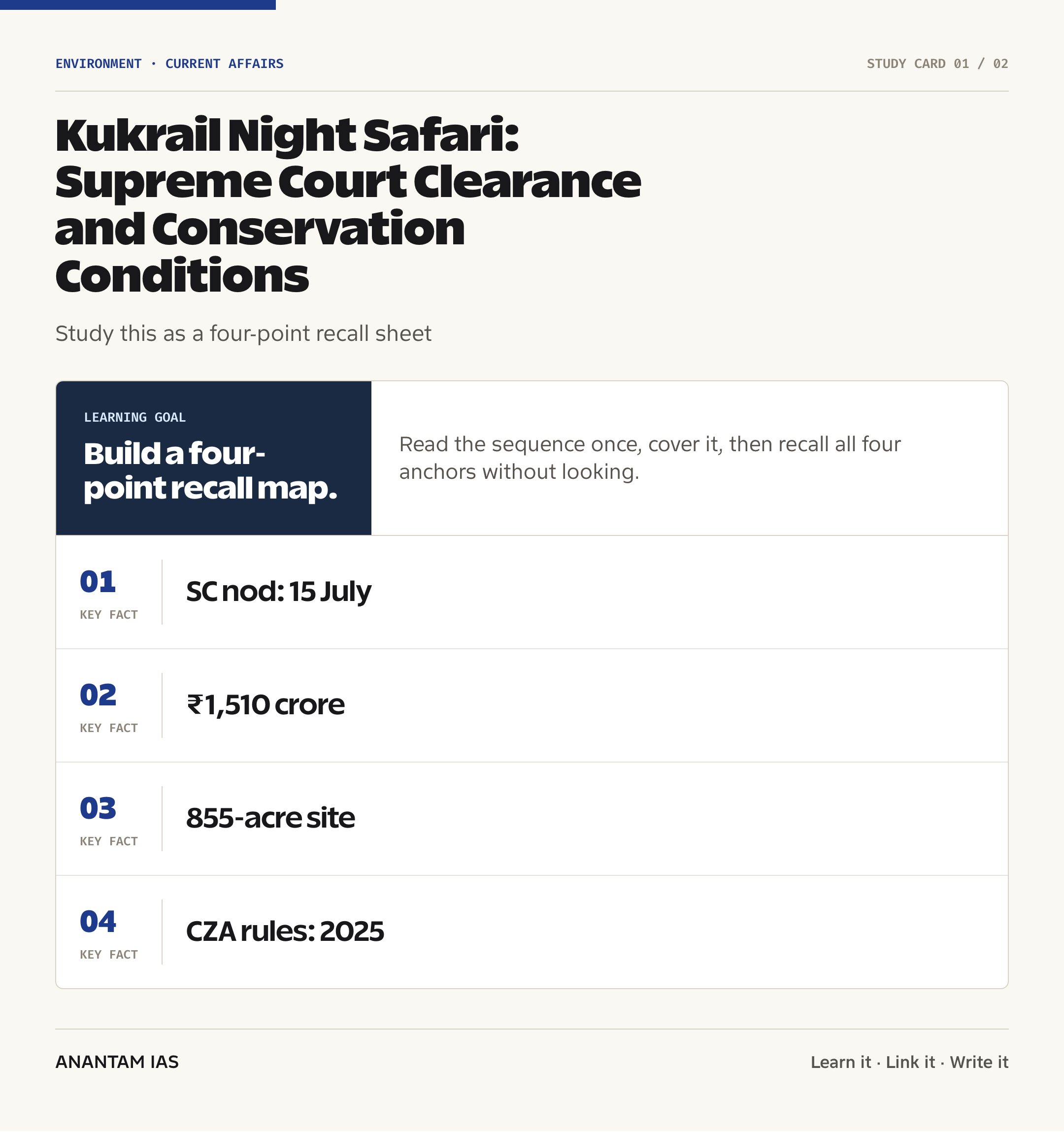
On 15 July 2026, the Supreme Court permitted Uttar Pradesh to proceed with the Kukrail Night Safari and zoological park project in Lucknow’s Kukrail Reserve Forest. The order came in Ashok Kumar Sharma, IFS (Retd.) & Others v. Union of India, W.P. (C) No. 1164 of 2023, while considering the state’s application for permission.
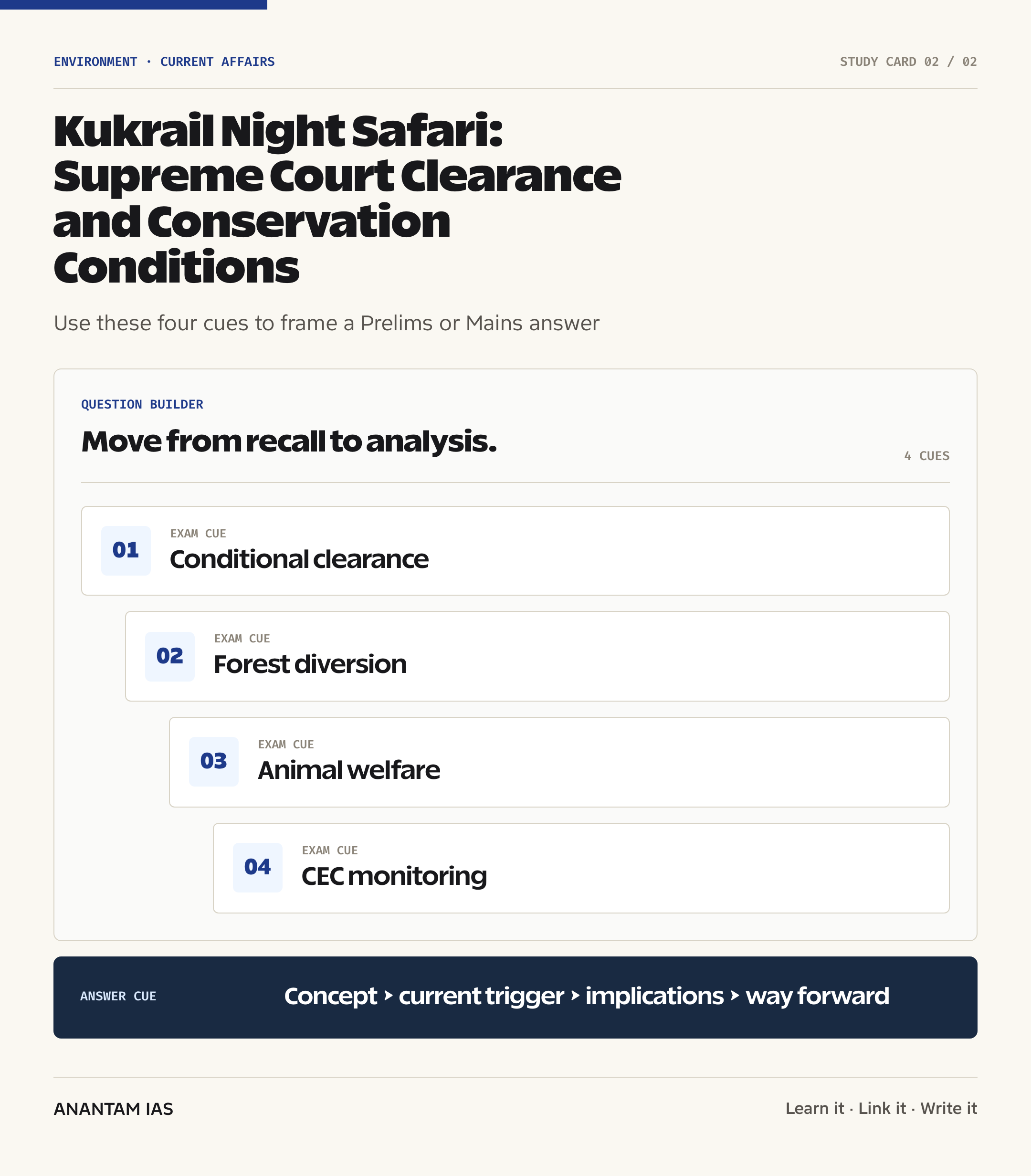
The clearance is conditional. The Court said the state must comply with the requirements imposed or recommended by the Central Empowered Committee, the Central Zoo Authority and the Ministry of Environment, Forest and Climate Change, obtain any other legally required prior permission, and face periodic compliance visits.
- Indian Express reported that a Bench led by Chief Justice Surya Kant, with Justices Joymalya Bagchi and V. Mohana, granted the permission.
- The Court relied on the expert and regulatory scrutiny already undertaken by the CEC, CZA and MoEFCC; it did not treat judicial permission as a substitute for statutory compliance.
- A CEC member must periodically visit the project and submit compliance reports to the Court.
- The project is proposed as India’s first operational night safari, but that description concerns the plan; the facility has not yet begun operations.
- The Indian Express described a proposed outlay of ₹1,510 crore and a project footprint of about 855 acres within the wider 2,027-hectare reserve forest.
The development matters in the context of:
- The case matters in the context of balancing urban ecological security with tourism, education and ex-situ conservation infrastructure.
- It tests the difference between a headline approval and a condition-bound environmental permission that remains subject to monitoring.
- It also connects zoo governance under the Wild Life (Protection) Act, 1972 with forest-land regulation and the Supreme Court’s continuing oversight of forest matters.
UPSC Relevance
Prelims Relevance
- Kukrail Reserve Forest is located in Lucknow, Uttar Pradesh, and is named after the Kukrail stream, a tributary of the Gomti.
- A reserve forest is a legal forest category; it is not the same as a national park, wildlife sanctuary or biosphere reserve.
- The Central Zoo Authority is constituted under Section 38A of the Wild Life (Protection) Act, 1972.
- Recognition of zoos and prescribed standards fall within the CZA’s statutory mandate; the relevant legal framework is explained in Anantam IAS notes on the Wildlife Protection law.
- The Central Empowered Committee assists the Supreme Court in forest and wildlife matters and can inspect projects and monitor compliance.
- The Court’s interim order of 19 February 2024 required prior judicial approval before final approval of new zoos or safaris covered by the order.
- The CZA’s 2025 night-safari guidelines address site inspection, animal welfare, lighting, visitor movement, staffing and emergency protocols.
- CZA guidance prefers low-intensity, species-specific lighting, avoidance of disruptive blue light, and protection of natural circadian rhythms.
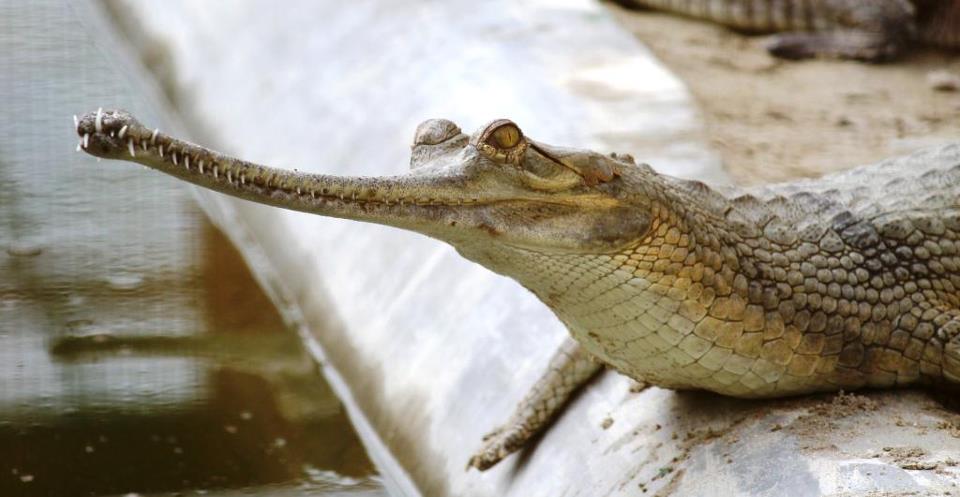
- Kukrail hosts a gharial rehabilitation centre, making reptile conservation and habitat disturbance relevant to project appraisal.
- The governing forest-diversion framework and Section 2 approval logic are covered in Forest Conservation Act notes.
Mains Relevance
GS Paper 3
- Conservation-development trade-offs in an urban reserve forest, including fragmentation, tree loss, artificial light, noise and visitor pressure.
- Designing tourism infrastructure around animal welfare, ecological carrying capacity, native vegetation and measurable compliance.
- The role of ex-situ conservation facilities alongside the protection of natural habitats and ecological processes.
GS Paper 2
- Institutional coordination among the Supreme Court, CEC, CZA, MoEFCC and the Uttar Pradesh government.
- Conditional approvals, expert monitoring and public accountability as tools of environmental governance.
Essay
- Development gains legitimacy when environmental safeguards are treated as design constraints, not post-project formalities.
- A city needs both access to nature and the ecological restraint required to keep that nature alive.
Background and Context
What the Supreme Court actually permitted
The order removes a judicial hurdle but keeps the project inside a continuing compliance framework.
- The permission arose from I.A. No. 89434 of 2025 in the broader forest matter Ashok Kumar Sharma, IFS (Retd.) & Others v. Union of India.
- The state’s proposal had already passed through the CZA, MoEFCC and the Court-linked CEC process before the Bench considered it.
- The Court allowed the state to proceed only within the scope cleared by the expert bodies and subject to their conditions.
- Any further approval required under another law must still be obtained from the competent authority; the order isn’t a blanket waiver.
- Periodic site visits and reports by a CEC member convert compliance from a one-time paperwork exercise into ongoing supervision.
- For answer writing, describe the ruling as conditional judicial clearance, not final ecological certification or permission to begin every component immediately.
Project design and the Kukrail setting
The proposed facility combines a night safari, a later day-zoo component, conservation facilities and visitor infrastructure inside a major urban forest landscape.
- The Indian Express reported a proposed cost of ₹1,510 crore and an approximately 855-acre footprint within the 2,027-hectare Kukrail Reserve Forest.
- The plan is divided into Phase I, covering the night safari and eco-tourism zone, and Phase II, covering a day zoo.
- Proposed visitor movement uses battery-operated vehicles, while the experience is built around night trails, forest trails and naturalistic habitats.
- The proposal includes habitats for species such as Asiatic lions, Bengal tigers, leopards, hyenas, flying squirrels and gharials; actual collection plans remain subject to CZA scrutiny.
- The forest developed as a plantation landscape in the 1950s and functions as an important green space in the Lucknow urban region.
- The Kukrail Gharial Rehabilitation Centre, established in 1975, adds a sensitive conservation function that must be insulated from construction and visitor disturbance.
The layered clearance architecture
Different institutions examine different legal and technical questions, so one approval cannot automatically replace all the others.
- The Supreme Court supplied the prior judicial permission required by its 19 February 2024 interim direction concerning new zoos and safaris.
- The CEC examines forest and wildlife implications for the Court, undertakes site-based scrutiny and recommends conditions.
- The CZA regulates zoo planning, recognition, animal collections, enclosure standards, veterinary care and visitor management.
- The MoEFCC and Union government remain relevant where central forest, wildlife or environmental permission is legally triggered.
- The Uttar Pradesh government and project authority remain responsible for implementation, record-keeping, local approvals and compliance on the ground.
- This layered system reflects a key governance rule: permission follows jurisdiction. A judicial nod, technical approval and forest-land approval answer related but distinct questions.
Forest law and the Godavarman context
The litigation sits within India’s long-running judicial effort to prevent forest land from being reclassified or diverted through narrow administrative labels.
- The T.N. Godavarman line of cases gave the term forest a functional reach beyond only land formally notified under one statute.
- The present writ petition challenged aspects of the Forest (Conservation) Amendment Act, 2023, now reflected in the renamed Van (Sanrakshan Evam Samvardhan) Adhiniyam, 1980.
- Section 2 of the forest-conservation law restricts state action that dereserves forest or permits its use for a non-forest purpose without prior central approval where the law applies.
- A reserve forest and a protected area under wildlife law aren’t interchangeable categories; compare them through National Park vs Wildlife Sanctuary notes.
- The precautionary principle supports advance assessment where ecological harm may be serious or difficult to reverse, even when every impact cannot be quantified beforehand.
- The public trust doctrine frames forests and ecological commons as resources the state must protect for the public, not merely assets available for commercial conversion.
CZA rules turn animal welfare into design
The Central Zoo Authority’s 2025 guidance treats a night safari as a specialised zoological operation, not simply a zoo kept open after sunset.
- A CZA expert team must inspect the site, and a post-commissioning audit must check enclosures, lighting, visitor management and animal-welfare measures before operations begin.
- Where day and night operations coexist, the guidance calls for physical and operational separation, including a planted buffer of at least 50 metres in relevant configurations.
- Animals displayed at night shouldn’t also be displayed during the day; rest periods must support their natural activity cycles.
- Lighting should protect stable circadian rhythms. The guidance recommends low intensity, ideally below five lux, with 0.5 lux preferred for sensitive species unless research supports another level.
- Blue light should be avoided because it can suppress melatonin; controlled red, amber or moonlight-mimicking systems are less disruptive when matched to species needs.
- Animals must never be lured or baited for viewing. Stress monitoring, retreat areas, rotation between display and off-display spaces, veterinary care and species-specific husbandry are core obligations.
- For a wider comparison between captive management and species conservation, see CZA deer conservation notes.
Visitor management is an ecological safeguard
A night safari’s ecological footprint depends not only on buildings but also on how people, vehicles, light and noise move through the site every evening.
- The CZA guidance requires distinct or fully segregated entry routes, pathways and service areas so day and night operations don’t overlap.
- It calls for trained night staff, veterinarians, guides, security personnel, CCTV coverage, emergency exits, first-aid stations and rehearsed emergency plans.
- Battery-operated-vehicle tours should be limited to a maximum of one hour, while foot-trail visits should be limited to two hours.
- Foot trails should be guided, generally limited to one kilometre, and designed to prevent crowding near animal enclosures.
- Visitors shouldn’t carry personal torches or high-beam lights, provoke animals, use flash photography or create avoidable noise.
- For Kukrail, carrying capacity must also include impacts beyond enclosures: traffic, peripheral development, waste, stream health, tree loss and disturbance to the gharial centre.
Potential gains and ecological risks
The project can support conservation education and research only if its measurable ecological performance matches its stated objectives.
- Potential gains include conservation education, research on non-diurnal behaviour, improved veterinary capacity and public awareness of threatened species.
- A well-designed facility can replace passive animal display with habitat interpretation and stronger links between visitor experience and species recovery.
- But artificial light at night can disrupt feeding, breeding, navigation and hormonal cycles in captive animals and wildlife around the site.
- Road widening, construction, fencing and utilities can produce fragmentation even when the directly built area appears limited.
- High visitor volumes can intensify noise, waste, traffic and edge effects; projected footfall must be tested against an ecological carrying capacity, not treated only as revenue.
- The real policy test is whether monitoring data can trigger corrective action, operational limits or redesign when animal stress or habitat degradation becomes visible.
Way Forward
Publish the enforceable project boundary
- Place the final CEC, CZA and MoEFCC conditions, approved site plan and component-wise permissions in the public domain.
- Distinguish approved safari, conservation, research and visitor facilities from rejected, deferred or redesigned components.
- Maintain a searchable compliance matrix linking each condition to the responsible agency, deadline and documentary evidence.
Measure ecology before construction
- Create a scientifically credible baseline for flora, fauna, tree cover, nocturnal species, light levels, noise and Kukrail stream health.
- Use seasonally representative data and publish methods so later monitoring can identify real change.
- Protect no-construction buffers around the gharial centre, sensitive habitats, drainage lines and mature vegetation.
Make animal welfare auditable
- Commission species-specific lighting and enclosure trials before opening the full facility.
- Track stress behaviour, veterinary indicators, reproductive health, off-display time and circadian stability through independent review.
- Give animal-welfare findings priority over visitor visibility or attendance targets.
Tie operations to carrying capacity
- Set booking caps, route-wise vehicle limits, quiet periods and adaptive seasonal restrictions.
- Use low-spill lighting, waste controls, clean mobility and traffic management across the wider Kukrail landscape.
- Allow the CEC and CZA monitoring process to recommend pauses, redesign or reduced footfall when thresholds are breached.
Create credible public oversight
- Publish periodic CEC visit reports and the project authority’s responses in accessible formats.
- Provide a grievance channel for researchers, local residents and conservation groups to submit site-specific evidence.
- Commission independent ecological and financial audits so conservation claims can be tested against outcomes.
Conclusion
The Kukrail order doesn’t settle the conservation-development debate by choosing tourism over forests. It permits a project within an enforceable web of expert conditions, statutory permissions and judicial monitoring.
For UPSC answers, the strongest inference is that approval quality depends on implementation quality. A night safari can claim conservation value only when animal welfare, habitat integrity and public accountability govern its design and daily operation.
Kukrail will become a useful governance case study if periodic monitoring produces transparent correction. If conditions remain paperwork, the same project may deepen the pressures it says it will help people understand.
UPSC Practice Questions
Prelims MCQ 1
With reference to the Kukrail Night Safari clearance, consider the following statements:
- Kukrail Reserve Forest is located in Lucknow, Uttar Pradesh.
- The Central Zoo Authority is constituted under the Wild Life (Protection) Act, 1972.
- The Supreme Court’s permission exempted the project from all other statutory approvals.
How many of the above statements are correct?
(a) Only one (b) Only two (c) All three (d) None
Answer: (b) Only two
Explanation:
Statements 1 and 2 are correct. Statement 3 is incorrect because the Court made its permission conditional on CEC, CZA and MoEFCC requirements and any other prior permission required by law.
Prelims MCQ 2
Which institution is specifically responsible for zoo recognition and prescribed zoological standards in India?
(a) Central Pollution Control Board (b) National Biodiversity Authority (c) Central Zoo Authority (d) Wildlife Crime Control Bureau
Answer: (c) Central Zoo Authority
Explanation:
The Central Zoo Authority, created under the Wild Life (Protection) Act, 1972, regulates zoo recognition, standards, animal collection planning and related management requirements.
UPSC Mains Questions
- The Supreme Court’s clearance for the Kukrail Night Safari is better understood as a framework of conditional environmental governance than as a simple approval. Examine the roles of judicial oversight, expert bodies and statutory regulators in balancing conservation with public infrastructure.
- Artificial light, visitor pressure and habitat fragmentation can turn a conservation-themed tourism project into an ecological stressor. Suggest design, monitoring and accountability measures that should govern a night safari proposed inside an urban reserve forest.
Sources: Central Zoo Authority, Ministry of Environment, Forest and Climate Change and Indian Express Explained and Indian Express Legal News.
Frequently Asked Questions
Where is the Kukrail Night Safari proposed?
It is proposed within the Kukrail Reserve Forest in Lucknow, Uttar Pradesh. The wider forest covers about 2,027 hectares, while the project footprint reported by the Indian Express is about 855 acres. Kukrail is also associated with a long-running gharial rehabilitation centre.
Did the Supreme Court give unconditional approval?
No. The Court allowed Uttar Pradesh to proceed subject to conditions imposed or recommended by the Central Empowered Committee, Central Zoo Authority and MoEFCC. The state must also obtain other prior permissions required under applicable law, while a CEC member will periodically inspect compliance.
What is the Central Empowered Committee?
The Central Empowered Committee is an expert body that assists the Supreme Court in forest and wildlife matters. In the Kukrail process, it examined the proposal, undertook scrutiny and recommended conditions. The Court also assigned periodic site monitoring and reporting to a CEC member.
Why does a night safari need special rules?
Night operations can disrupt animal circadian rhythms through light, noise and visitor activity. CZA guidance requires species-specific lighting, rest periods, trained staff, controlled visitor movement, emergency systems and welfare monitoring. A night safari is a specialised zoological operation, not merely a daytime zoo with longer hours.
What is the main UPSC takeaway?
The case illustrates layered environmental governance. Courts, expert committees, statutory regulators and state agencies have distinct roles. Approval doesn’t end scrutiny; conditions, baseline data, carrying-capacity limits, transparent monitoring and corrective action determine whether conservation and development can coexist in practice.
Why is Kukrail ecologically sensitive?
Kukrail is a large urban reserve forest linked to the Kukrail stream and the Gomti river system. It provides green-space and habitat functions and houses a gharial rehabilitation centre. Construction, artificial light, traffic, noise and visitor pressure can affect both captive-animal welfare and the surrounding forest landscape.
Tell Google you want more of this.
Add Anantam IAS as a preferred sourceOne tap, and this site shows up more often in your own Top Stories, AI Overviews and AI Mode. Remove it any time.