Why in News?
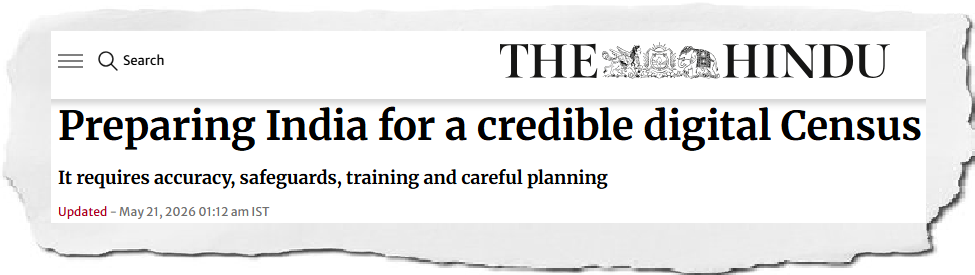
India has begun preparatory work for the 2027 Census, with the house-listing phase progressing in several States. The Census will be the first fully digital Census in India and is expected to include caste enumeration for the first time after Independence. The exercise assumes greater significance as its population figures will form the basis for future delimitation of Lok Sabha and State Assembly constituencies.
UPSC Relevance
Prelims:
Census in India, 73rd and 74th Constitutional Amendments, Delimitation, demographic concepts;
Mains:
GS I: Population and related issues,
GS II: Governance, electoral reforms, federalism,
GS III: Digital governance and technology in administration.
Background/Context
The Census is one of the largest administrative and statistical exercises undertaken by the Government of India. Conducted under the provisions of the Census Act, 1948, it provides critical information on demographic, social and economic characteristics of the population.
India has conducted a Census every ten years since 1881. The 2021 Census was postponed due to the COVID-19 pandemic, making the 2027 Census particularly significant.
The upcoming Census is unique because:
- It is expected to include caste data after Independence.
- It will rely primarily on digital data collection through smartphones and electronic devices.
- It may allow self-enumeration by citizens.
- Census data will influence future political representation through delimitation.
Census Methodology in India
India traditionally follows an extended de facto approach to enumeration.
Under this method:
- Individuals present at their normal residence during enumeration are counted.
- Persons temporarily absent but residing there during the enumeration period are included.
- Visitors staying for the entire Census period may also be counted.
- Household members are identified based on sharing a common kitchen.
This differs from a de jure Census, where individuals are counted strictly at their place of usual residence.
Significance of Census Methodology
The method adopted has important implications:
Political Representation
Population figures determine parliamentary and legislative constituency boundaries through delimitation.
Welfare Planning
Government schemes rely on population data for resource allocation.
Economic Planning
Accurate demographic information influences infrastructure, education, health and employment policies.
Social Inclusion
Enumeration helps identify vulnerable and marginalised groups.
Key Issues in Conducting the 2027 Digital Census
Inclusion of Caste Enumeration
The inclusion of caste data introduces several administrative and social challenges.
Different communities may dispute their numerical representation and categorisation. Experiences from caste surveys conducted in Bihar and Karnataka suggest that caste enumeration can become contentious and politically sensitive.
Differences in self-identification and variations in local terminology may also affect accuracy.
Challenges of Digital Enumeration
The entire Census exercise is expected to use electronic devices for data collection.
Potential issues include:
Digital literacy among enumerators
Many enumerators may not possess adequate familiarity with smartphones or tablets.
Technical difficulties
Hardware failures, software glitches or connectivity issues may affect field operations.
Data confidentiality concerns
If data entry assistance is taken from family members or others, accountability and privacy may be compromised.
Data-entry errors
Incorrect entries during digital transfer can affect overall quality.
Challenges of Self-Enumeration
Self-enumeration may improve convenience but also creates new risks.
Complex questions
Questions regarding occupation, disability or work participation often require detailed interpretation.
Misreporting
Respondents may intentionally or unintentionally provide inaccurate information.
Fraudulent entries
There is a possibility of manipulation through false or duplicate submissions.
Respondent Fatigue
Long questionnaires increase the burden on respondents.
Consequences include:
- Incomplete responses
- Incorrect responses
- Deliberate skipping of questions
- Reduced overall quality of information
Risk of Omission Errors
Past post-enumeration surveys indicated that certain categories are more likely to be missed:
- Domestic workers
- Distant relatives
- Paying guests
- Temporary migrants
- Persons living in hostels
Digital systems may increase such omissions if questions are not carefully structured.
Challenges Related to Non-Resident Indians (NRIs)
India has a large overseas population.
According to estimates, about 1.58 crore Indians live abroad. States such as Kerala, Gujarat, Punjab, Telangana and Tamil Nadu have substantial migrant populations.
Exclusion of overseas residents from population counts may influence: Population figures, Future delimitation, Political representation
Constitutional and Governance Dimensions
Article 82
Provides for readjustment of parliamentary constituencies after each Census.
Article 170
Provides for readjustment of State Legislative Assembly constituencies.
Census Act, 1948
Provides the legal framework for Census operations in India.
Delimitation Commission
Uses Census data to redraw electoral constituencies.
Importance of a Credible Digital Census
Better Governance
Reliable data enables evidence-based policy making and efficient implementation of welfare programmes.
Strengthening Democracy
Accurate population estimates are necessary for fair representation.
Targeted Welfare Delivery
Socio-economic data allows better targeting of subsidies and public services.
Economic Planning
Reliable demographic data helps assess labour force trends, urbanisation and migration.
Improved Administrative Efficiency
Digital systems can significantly reduce processing time and improve accessibility of data.
Challenges in Broader Perspective
Balancing Technology and Accuracy: Technological efficiency should not come at the cost of data reliability.
Data Privacy and Security: Digital collection increases risks of data breaches and misuse.
Political Sensitivities: Caste data and delimitation implications may generate political contestation.
Administrative Capacity Constraints: Training more than three million enumerators poses a major challenge.
Trust Deficit: Public confidence in data collection processes is critical for obtaining accurate information.
Way Forward
Simplify Questionnaire Design
Questions should be framed in simple and clear language. Embedded explanations and user-friendly interfaces can reduce confusion.
Strengthen Enumerator Training
Comprehensive training on digital devices, concepts and field practices should be provided.
Conduct Extensive Field Testing
Pilot studies and pre-testing should be expanded to identify weaknesses before full implementation.
Strengthen Data Security Framework
Robust encryption and privacy safeguards should be introduced to protect personal information.
Introduce Verification Mechanisms
Cross-checking systems and post-enumeration surveys should be strengthened to detect omissions and inaccuracies.
Consider Limited NRI Enumeration
Appropriate mechanisms may be developed to capture information on overseas populations for better demographic assessment.
Promote Public Awareness
Mass awareness campaigns can improve participation and reduce misinformation.
Conclusion
The 2027 Census is not merely a statistical exercise but a foundational pillar of governance and democracy. Its significance extends beyond counting people to shaping political representation, resource allocation and development planning. A credible digital Census requires balancing technological innovation with accuracy, transparency and inclusiveness so that demographic data remains a reliable guide for India’s future development trajectory.
Practice Questions
Prelims Question 1
With reference to Census methodology in India, consider the following statements:
- India follows a purely de jure method of Census enumeration.
- Individuals temporarily absent during the Census period may still be counted.
- Household members are generally identified on the basis of sharing a common kitchen.
Which of the statements given above is/are correct?
(a) 1 only
(b) 2 and 3 only
(c) 1 and 2 only
(d) 1, 2 and 3
Correct Answer: (b)
Explanation: India follows an extended de facto method, not a purely de jure method. Persons temporarily absent and members sharing a common kitchen are counted.
Prelims Question 2
Consider the following Articles of the Constitution:
- Article 82
- Article 170
- Article 324
Which of the above are directly related to delimitation based on Census data?
(a) 1 and 2 only
(b) 2 and 3 only
(c) 1 and 3 only
(d) 1, 2 and 3
Correct Answer: (a)
Explanation: Articles 82 and 170 deal with readjustment of parliamentary and assembly constituencies. Article 324 concerns powers of the Election Commission.
Mains Question
- The transition to a digital Census presents both opportunities and challenges for India. Examine.
- Discuss the significance of Census data for democratic representation and governance in India. Examine the challenges associated with conducting a credible Census exercise.
Tell Google you want more of this.
Add Anantam IAS as a preferred sourceOne tap, and this site shows up more often in your own Top Stories, AI Overviews and AI Mode. Remove it any time.