
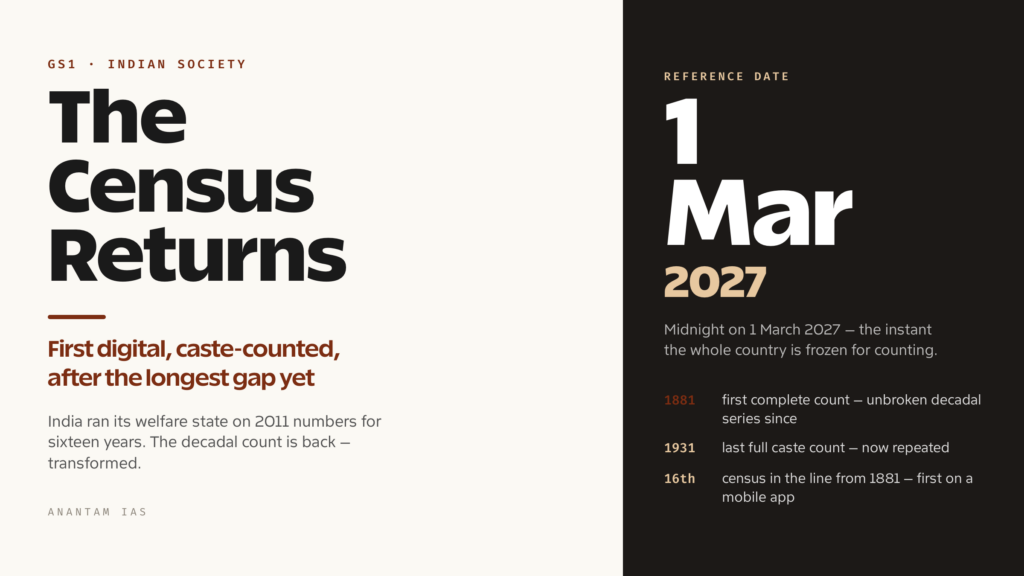
For the first time in its 150-year history, India missed a census. The decennial count due in 2021 was pushed back again and again — first by the pandemic, then by reasons no one fully explained — until the country was running its largest welfare state on numbers gathered back in 2011. By the time the government finally moved, the gap had stretched past sixteen years, the longest break in an exercise that had run like clockwork since 1881.
That long silence is now ending. The Census of India is back, and it returns transformed: counted on a mobile app instead of paper, pegged to a reference moment of midnight on 1 March 2027, and — for the first time since 1931 — recording the caste of every Indian. So this is no longer a routine head-count being resumed. It’s a different instrument, switched on after the country spent half a decade flying with an outdated map.
What the Census Actually Is
A census is a total enumeration — every person, every household, counted at the same reference moment so the snapshot is comparable across the whole country. It’s not a sample survey like the National Family Health Survey or the Periodic Labour Force Survey, which extrapolate from a slice of households. The census tries to find everyone, which is why it costs thousands of crores and takes years to process.
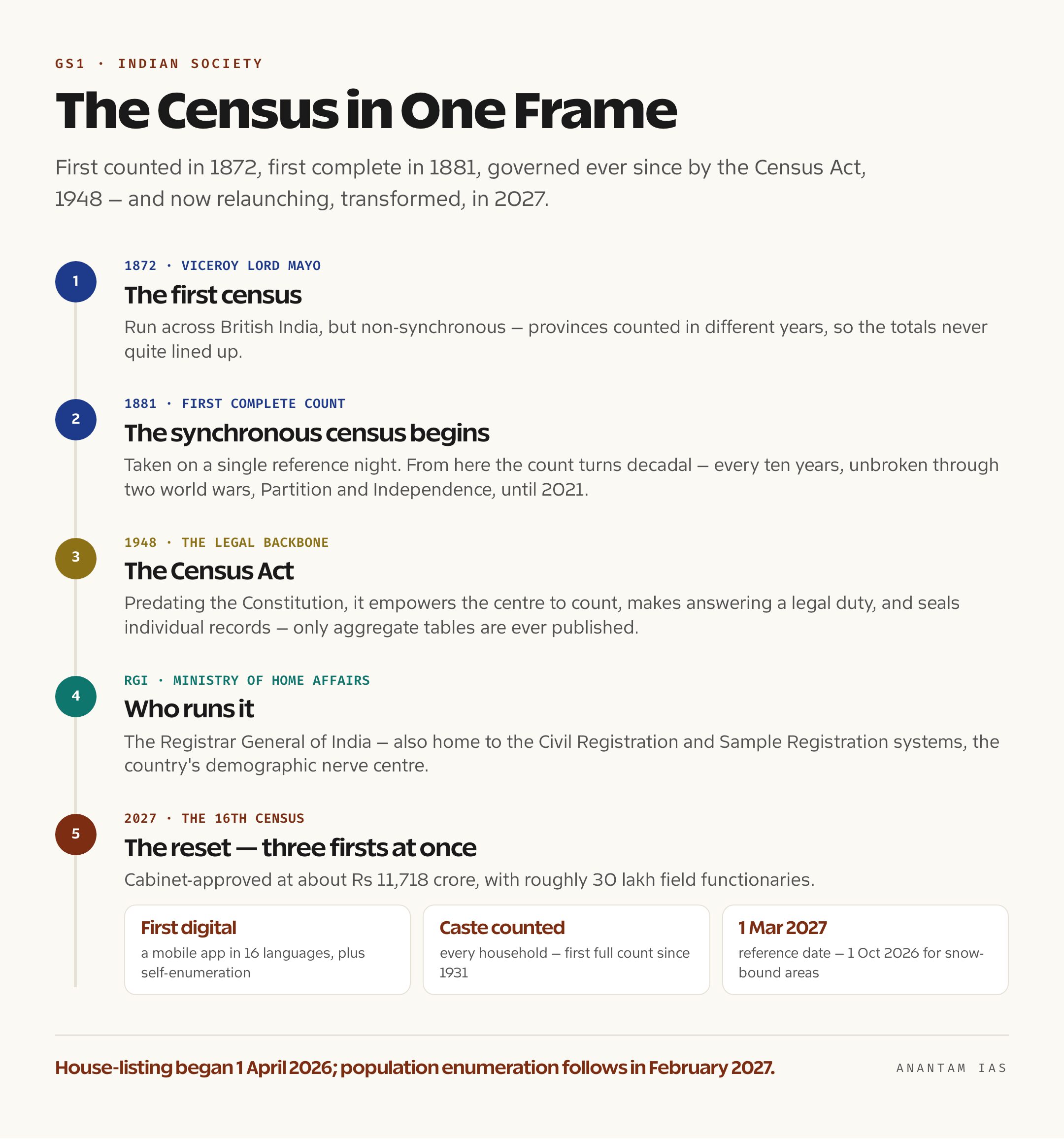
India’s counting habit is old. The British ran the first census in 1872 under Viceroy Lord Mayo, but it was non-synchronous — different provinces counted in different years, so the totals never quite lined up. The first complete, synchronous census, taken on a single reference night across British India, came in 1881. From then on the count became decadal, every ten years, and that rhythm survived the Revolt’s aftermath, two world wars, Partition and Independence unbroken — until 2021.
The legal backbone is the Census Act, 1948, which actually predates the Constitution. It empowers the central government to conduct the census, makes answering the enumerator’s questions a legal obligation, and — crucially — guarantees confidentiality: individual records are sealed and only aggregate tables are ever published. The exercise is run by the Office of the Registrar General and Census Commissioner of India, usually shortened to the Registrar General of India or RGI, which sits under the Ministry of Home Affairs. The same office also runs the Civil Registration System for births and deaths and the Sample Registration System, so it is effectively the country’s demographic nerve centre.
The 2027 Census: First Digital, First Caste-Counted
What’s coming is the sixteenth census in the unbroken line from 1881, and it breaks new ground on almost every front. The government notified its intent in the Gazette of India on 16 June 2025, and the Union Cabinet approved the scheme at a cost of about Rs 11,718 crore, deploying roughly 30 lakh field functionaries — enumerators, supervisors and the schoolteachers who do most of the legwork.
The reference date — the instant the whole country is “frozen” for counting — is midnight on 1 March 2027. There’s one important exception: for the Union Territory of Ladakh and the snow-bound, non-synchronous pockets of Jammu and Kashmir, Himachal Pradesh and Uttarakhand, the reference date is brought forward to 1 October 2026, because counting those high valleys in March is impossible once the passes close. The work runs in two phases, as it always has. Phase one, the House Listing and Housing Census, began on 1 April 2026 and maps every dwelling and its amenities; phase two, the Population Enumeration that records each person, follows in February 2027 (and in September 2026 for the snow-bound areas).
The bigger break is the technology. This is India’s first digital census. Enumerators will key responses straight into a mobile app in sixteen languages, and for the first time citizens can fill their own forms through a self-enumeration web portal before a field worker verifies them. The promise is speed — results in a fraction of the years it once took — plus GPS-tagged accuracy and less manual transcription error. The risk is the obvious one: data security, network gaps in remote blocks, and a digital divide that could leave the least-connected households dependent on the old paper fallback.
And then the most politically charged change of all. On 30 April 2025 the Cabinet Committee on Political Affairs decided that the 2027 census will enumerate caste for every household — not just the Scheduled Castes and Scheduled Tribes that every census since Independence has counted, but the full caste identity of all Indians. That hasn’t happened in a regular census since 1931, almost a century ago. India has been making reservation and welfare policy on a caste structure last measured under British rule.
Why the Census Carries So Much Weight
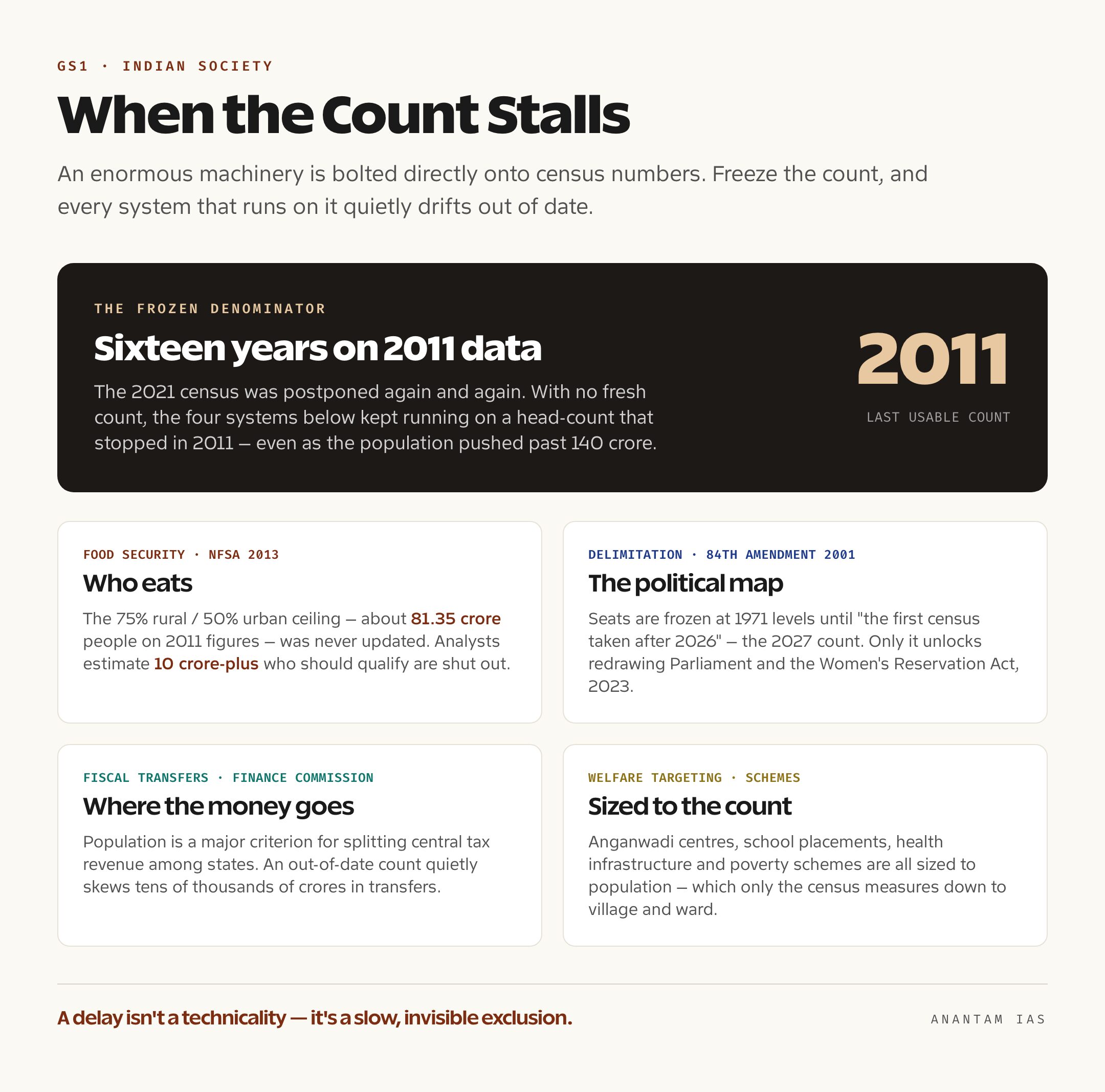
The reason a delayed count became a national problem is that an enormous machinery is bolted directly onto census numbers. Strip the exercise back and it does four jobs that nothing else can.
It draws the political map. The number of Lok Sabha and Assembly seats, and the boundaries of every constituency, are fixed by delimitation — and delimitation runs on census population. The 84th Constitutional Amendment of 2001 froze the total number of seats at 1971 levels until “the first census taken after 2026,” a deliberate move to stop fast-growing states from gaining seats at the expense of states that controlled their population. The 2027 census is precisely that first census after 2026. So this count, and no other, unlocks the long-postponed redrawing of Parliament — and, with it, the operation of the Women’s Reservation Act of 2023, which the law itself ties to the first delimitation after the next census.
It decides who eats. The National Food Security Act of 2013 guarantees subsidised grain to up to 75 percent of rural and 50 percent of urban Indians — about 81.35 crore people when the 2011 figures were applied. But that ceiling was locked to the 2011 count and never updated. With the population now past 140 crore, analysts estimate more than 10 crore people who should qualify are shut out of the public distribution system, simply because the denominator is fifteen years stale.
It moves money. The Finance Commission uses population as a major criterion when it splits central tax revenue among the states, so an out-of-date count quietly skews tens of thousands of crores in transfers. And it targets welfare — Anganwadi centres, school placements, health infrastructure, the rural and urban poverty schemes — all sized to population that the census alone measures down to the village and ward. No other dataset reaches that granular level for the whole country.
Where the System Falls Short
A count this consequential is only as good as its timing and its trust, and on both the recent record is uneven.
The delay itself is the headline failure. Running the world’s largest democracy on a sixteen-year-old population estimate isn’t a technicality — it’s a slow, invisible exclusion that falls hardest on the people least able to absorb it, the new urban migrant who isn’t on any ward roll, the family that grew after 2011 and never made it into the food-security ceiling. Sample surveys and projections papered over the gap, but a projection is an educated guess; only the census produces the authoritative local number.
There’s also the chronic lag in releasing results. Historically, detailed tables — migration, occupation, language — have trickled out five to seven years after the count, by which point they’re already ageing. The digital model is meant to fix that, but it has to prove it can.
Accuracy under pressure is a real worry too. Fear of losing a benefit, or anxieties stirred by citizenship debates, can push people to misreport. Caste enumeration multiplies the challenge: India has thousands of caste and sub-caste names, spellings vary, and the experience of state-level surveys has shown how messy classification gets. Get the categories wrong and the headline numbers — the share of OBCs, the basis for reservation arguments — become contestable. And concentrating sensitive details on caste, religion and occupation in one digital system raises the stakes on data protection, which now has to square with the Digital Personal Data Protection Act of 2023.
The Way Forward
- Hold the timeline and never let it slip again. The strongest reform is the simplest: publish the schedule, fund it fully, and treat the decadal census as a non-negotiable constitutional rhythm rather than a discretionary exercise. The 2027 dates are now public — they should be met to the month.
- Release data fast and openly. The whole point of going digital is speed. Provisional totals within months, detailed tables within a year or two, and machine-readable open data for researchers and states would turn the count from a historical record into a live planning tool.
- Get the caste enumeration methodology right. A clear, pre-published list of categories, trained enumerators, and transparent rules for handling sub-castes would protect the credibility of the most scrutinised numbers India has collected in a century.
- Re-base welfare on the new count immediately. The moment population totals are out, the NFSA ceiling, Finance Commission inputs and scheme targets should be recalibrated, so the 10-crore exclusion gap closes instead of carrying into another decade.
- Lock down data governance. Self-enumeration and a central digital database demand DPDP-compliant safeguards, independent audits and a bridging plan for households without devices or connectivity — so the digital leap doesn’t quietly leave the poorest uncounted.
For Your Mains Answer
The census sits squarely in GS Paper 1 (population, society, social empowerment, the issues of caste), runs strongly through GS Paper 2 (welfare schemes, federal fiscal transfers, delimitation and representation, women’s reservation), and supports GS Paper 3 (evidence-based policy and inclusive growth). It’s also a ready-made example for the Essay paper on themes of data, governance and equity.
How to Build the Answer
Don’t write a history essay. Lead with the consequence — that a postponed count quietly excluded crores from food security and froze India’s political map — and only then explain the machinery behind it. Move from what the census is, to what it unlocks (delimitation, NFSA, fiscal transfers), to what the delay broke, to what the 2027 reset changes (digital, caste, the 1 March 2027 reference date), and close on reform. The examiner is rewarding the link between the dataset and the lives it governs.
Common Mistakes to Avoid
Don’t confuse the census with a survey — NFHS and PLFS are sample-based, the census is total. Don’t say the 2021 census “was conducted”; it was postponed, and the next one is the 2027 count. Don’t mix up the 1872 first census with the 1881 first complete one. And don’t treat the caste census as obviously good or bad — show both the equity argument and the risks of entrenching caste and contesting numbers.
A Compact Answer Spine
Total enumeration under the Census Act 1948, run by the RGI → unbroken decadal series from 1881, snapped after 2011 → the delay froze NFSA coverage (10-crore-plus exclusion), delimitation and fiscal transfers on stale numbers → the 2027 reset: first digital census, 1 March 2027 reference date, caste counted for the first time since 1931 → reforms: hold the timeline, release data fast, sound caste methodology, re-base welfare, secure the data.
Diagram or Flowchart Idea
Draw a hub-and-spoke: “Census Data” in the centre, with arrows out to Delimitation, NFSA / Food Security, Finance Commission transfers, and Welfare Targeting. A second small arrow loop labelled “stale by 2011” shows why a delay distorts every spoke at once. It’s fast to sketch and instantly shows the stakes.
A Balanced-Conclusion Line
A modern state cannot govern equitably on numbers it stopped collecting — the 2027 census is less a routine count than India’s attempt to see itself clearly again, and its credibility now rests on doing it on time, in the open, and with care.
How to Use Data Without Cramming
Carry four anchors, not forty: first complete census 1881; Census Act 1948; the 84th Amendment freeze until “the first census after 2026”; and the NFSA exclusion of 10-crore-plus on 2011 numbers. Add the 1 March 2027 reference date and “first caste count since 1931,” and you have every figure an examiner expects.
FAQ
When is the next Census of India, and why was it delayed? The decennial census due in 2021 was postponed for years, first because of the pandemic and then for administrative reasons, creating the longest gap since 1881. The next census now has a reference date of midnight on 1 March 2027 (1 October 2026 for snow-bound Himalayan areas), with the house-listing phase having begun in April 2026.
Why is the 2027 Census called India’s first digital census? Enumerators will record answers on a mobile app in sixteen languages instead of paper schedules, and for the first time citizens can fill their own forms through a self-enumeration web portal that a field worker later verifies. The aim is faster results and GPS-tagged accuracy, balanced against data-security and digital-divide risks.
Will the 2027 Census count caste? Yes. On 30 April 2025 the Cabinet Committee on Political Affairs decided to enumerate the caste of every household in the 2027 census — the first full caste count in a regular census since 1931. Earlier censuses recorded only Scheduled Castes and Scheduled Tribes.
How does the census connect to delimitation and the Women’s Reservation Act? The 84th Constitutional Amendment froze the number of Lok Sabha and Assembly seats until “the first census taken after 2026.” The 2027 census is that census, so it unlocks the long-postponed redrawing of constituencies — and with it the Women’s Reservation Act of 2023, which the law ties to the first delimitation after the next census.
Practice Questions
Prelims MCQs
- With reference to the census in India, consider its early history. When was the first complete, synchronous census of British India conducted?
(a) 1872
(b) 1881
(c) 1891
(d) 1901
Answer: (b) — The first census was run in 1872 under Lord Mayo but was non-synchronous; the first complete, single-reference-night census came in 1881, after which the count became decadal. - Which of the following statements about the legal and administrative framework of the Census of India is/are correct? 1. The Census Act, 1948, predates the Constitution of India.
2. The census is conducted by the Office of the Registrar General and Census Commissioner under the Ministry of Home Affairs.
3. Individual census records are published only in aggregate, never individually.
(a) 1 and 2 only
(b) 2 and 3 only
(c) 1 and 3 only
(d) 1, 2 and 3
Answer: (d) — All three are correct: the Act of 1948 predates the 1950 Constitution, the RGI sits under the MHA, and the Act guarantees confidentiality with only aggregate tables published. - The 2027 Census of India is described as a landmark on several counts.
Which of the following is correct regarding it?
(a) It is the first census to count Scheduled Castes and Scheduled Tribes
(b) It will be the first digital census and the first to enumerate full caste since 1931
(c) Its reference date is uniform across the entire country at 1 March 2027
(d) It abandons the two-phase structure used in earlier censuses
Answer: (b) — It is India’s first digital census and the first regular census to record full caste identity since 1931; SC/ST have been counted since Independence, the reference date differs for snow-bound areas, and the two-phase structure is retained. - The 84th Constitutional Amendment, 2001, is significant for delimitation because it froze the total number of Lok Sabha and Assembly seats until which event?
(a) The census of 2021
(b) The first census taken after 2026
(c) The year 2031
(d) A constitutional amendment by Parliament
Answer: (b) — The 84th Amendment froze seats at 1971 levels until “the first census taken after 2026,” which is precisely the 2027 census, linking it to delimitation and the Women’s Reservation Act of 2023. - Why did the postponement of the decennial census create a national problem for welfare delivery?
(a) Sample surveys cannot estimate population at all
(b) The National Food Security Act ceiling stayed locked to the 2011 count, excluding an estimated 10-crore-plus people
(c) The Finance Commission stopped using population as a criterion
(d) Anganwadi centres were closed during the delay
Answer: (b) — The NFSA’s coverage ceiling of about 81.35 crore was fixed to 2011 numbers and never updated, so with the population past 140 crore, analysts estimate more than 10 crore eligible people are shut out of the PDS.
Mains Practice Questions
- “A modern welfare state cannot govern equitably on numbers it stopped collecting.” Examine how the delay in conducting India’s decennial census distorted food security, delimitation and fiscal transfers. (15 marks, 250 words)
- The 2027 Census represents a structural reset rather than a routine resumption. Discuss its three defining shifts — digital enumeration, the 1 March 2027 reference date, and caste counting — and the risks each carries. (15 marks, 250 words)
- Discuss the constitutional and statutory framework governing the Census of India, and explain why the census remains the single irreplaceable dataset for governance and representation. (15 marks, 250 words)
- The decision to enumerate caste in the 2027 Census after nearly a century is both an equity measure and a methodological challenge. Critically analyse. (15 marks, 250 words)
- “Going digital must mean both speed and safety.” In the context of the 2027 census, evaluate the opportunities and the data-governance challenges of self-enumeration and a centralised digital database. (15 marks, 250 words)
Tell Google you want more of this.
Add Anantam IAS as a preferred sourceOne tap, and this site shows up more often in your own Top Stories, AI Overviews and AI Mode. Remove it any time.





