Why in News?
The Independent International Scientific Panel on Artificial Intelligence — the first global scientific body on AI, created under the United Nations — released its Preliminary Report on 1 July 2026. The report is the first global, independent scientific assessment of the opportunities, risks and impacts of AI, and its findings will be tabled before governments at the inaugural Global Dialogue on AI Governance in Geneva on 6–7 July 2026.
The panel’s central warning is stark: current safeguards can’t keep pace with the growth of AI capabilities. Co-chair Yoshua Bengio said “AI capabilities are outpacing both scientific understanding and governments’ ability to adapt” — and that science can’t guarantee ever-more-capable AI won’t cause catastrophic harm. The Hindu, in its editorial ‘A hold on AI’, read the report as a caution against treating AI purely as a geostrategic asset while its potential for broad damage goes unaddressed.
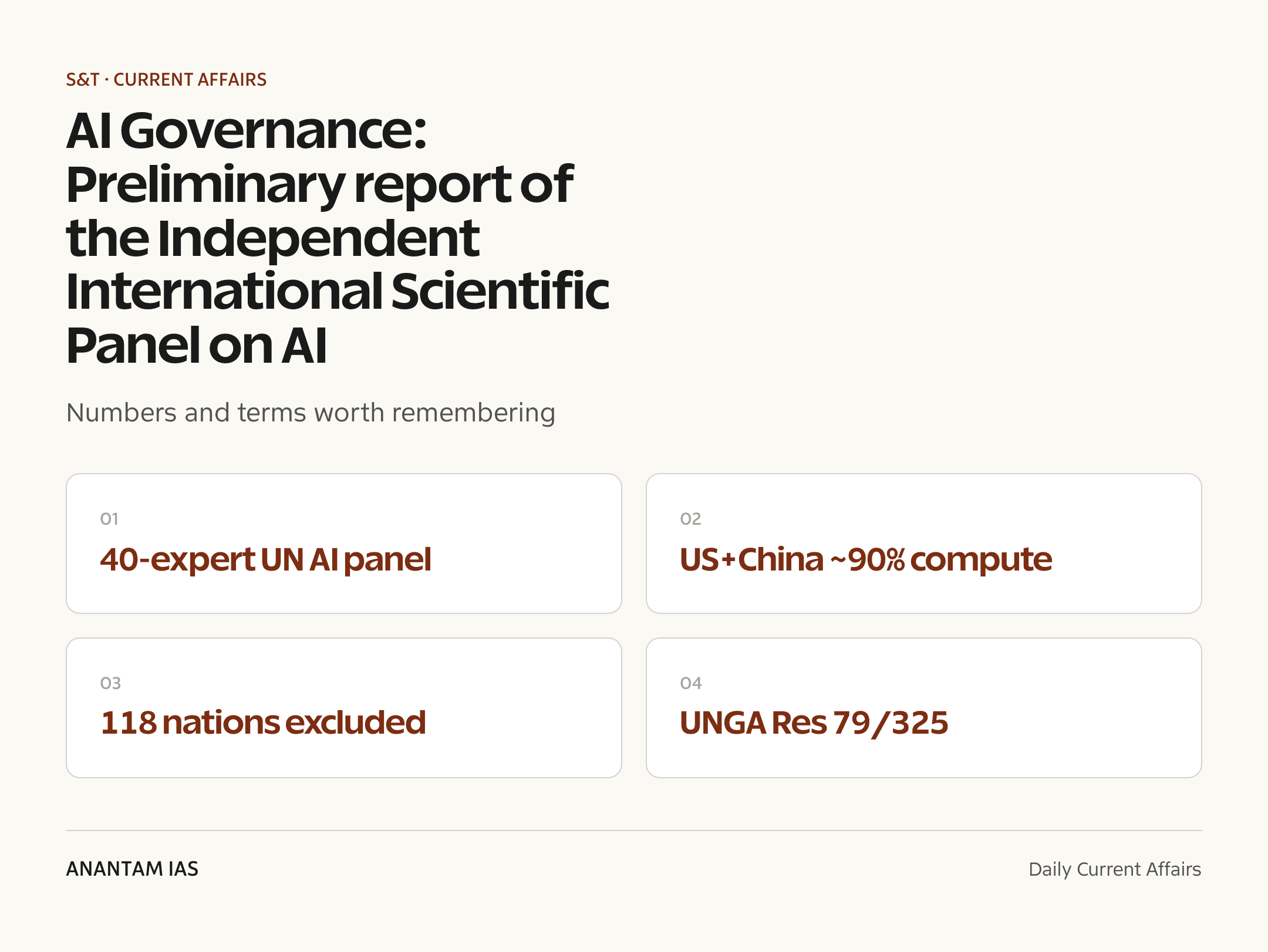
- Report released on 1 July 2026 by a panel of 40 experts drawn from all five UN regions, serving in their personal capacity.
- Panel is co-chaired by Yoshua Bengio (Turing Award-winning AI pioneer) and Maria Ressa (2021 Nobel Peace Prize laureate).
- The body was established by UN General Assembly resolution A/RES/79/325 (26 August 2025), a follow-through on the Global Digital Compact of September 2024.
- The report finds the US (~75%) and China (~15%) together control roughly 90% of the computing power behind leading AI supercomputers.
- 118 countries, mostly in the Global South, aren’t part of major AI governance discussions — a core equity finding.
- Findings feed directly into the first Global Dialogue on AI Governance, Geneva, 6–7 July 2026.
The development matters in the context of:
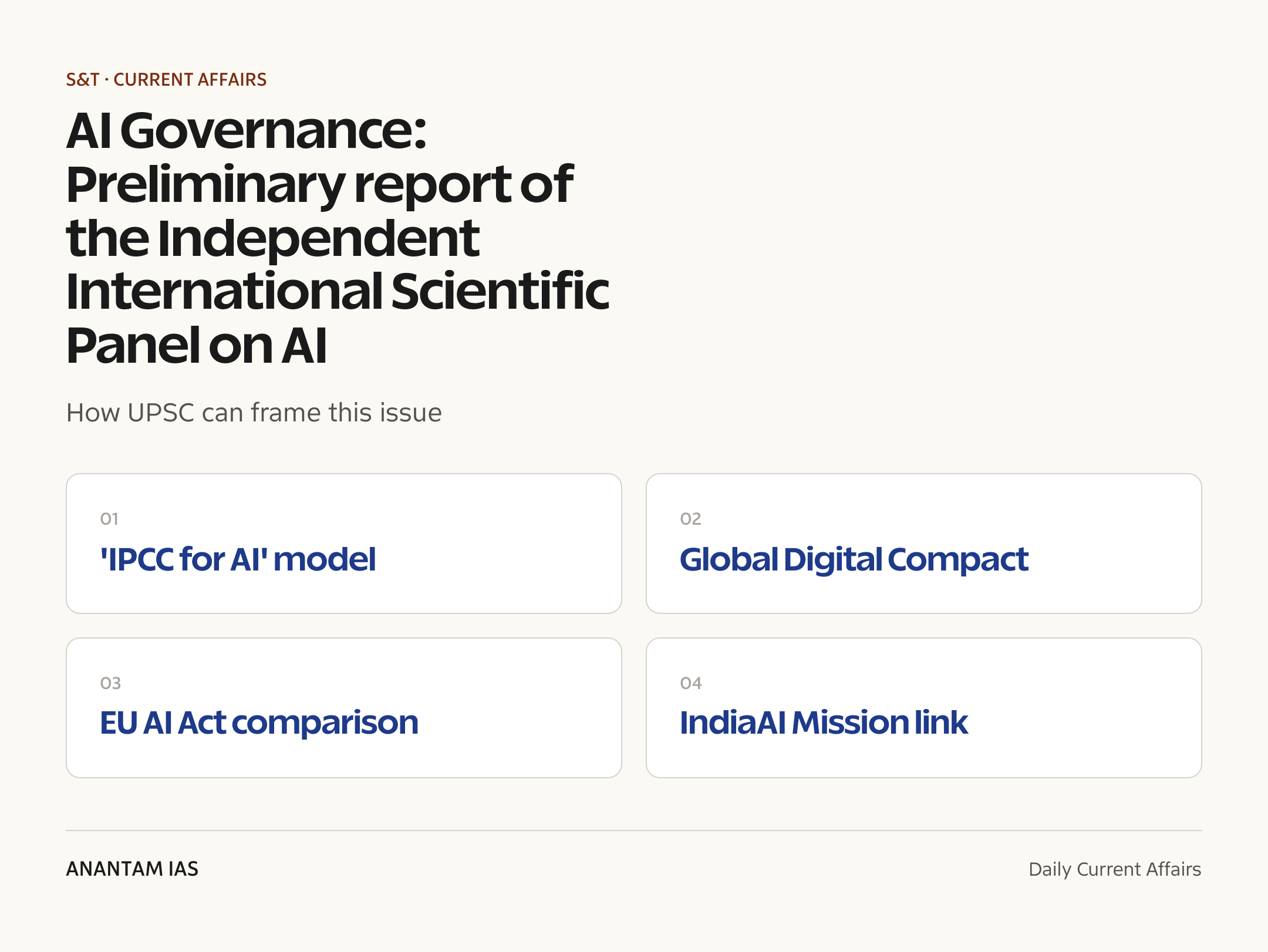
- This is widely described as the ‘IPCC for AI’ moment — an independent scientific panel assessing AI risk for governments, the way the IPCC does for climate change.
- It matters for the durable GS3 theme of regulating emerging technologies: evidence-based, multilateral assessment as the first step toward global rules.
- For India — which runs the IndiaAI Mission and champions Global South voice in AI — the report’s equity findings strengthen its long-standing negotiating position.
UPSC Relevance
Prelims Relevance
- Independent International Scientific Panel on AI — first global scientific body on AI; 40 experts from all 5 UN regions, serving in personal capacity; produces annual policy-relevant but non-prescriptive assessments.
- Created by UNGA resolution A/RES/79/325 (26 August 2025), which also set up the Global Dialogue on AI Governance.
- Both mechanisms flow from the Global Digital Compact, adopted at the UN Summit of the Future (September 2024) as part of the Pact for the Future.
- Co-chairs: Yoshua Bengio and Maria Ressa.
- First Global Dialogue on AI Governance: Geneva, 6–7 July 2026.
- Compute concentration: US ~75% + China ~15% ≈ 90% of leading AI supercomputing power; 118 countries outside major AI governance forums.
- EU AI Act — world’s first comprehensive, risk-based AI law; entered into force August 2024.
- IndiaAI Mission — approved March 2024 with a ₹10,371.92 crore outlay; includes an AI Safety Institute under MeitY.
- Earlier UN step: consensus UNGA resolution of March 2024 on safe, secure and trustworthy AI for sustainable development, co-sponsored by India.
Mains Relevance
GS Paper 3
- Regulating emerging technologies: why AI governance is a collective-action problem — capabilities move faster than evidence, and evidence arrives after the window to act closes.
- Science-policy interface: the ‘IPCC for AI’ model — independent assessment first, binding rules later — and its strengths and limits.
- Compute concentration as a strategic-technology dependency; implications for India’s semiconductor, data-centre and sovereign-compute push under the IndiaAI Mission.
GS Paper 2
- Global governance architecture: Global Digital Compact → scientific panel + Global Dialogue as new UN machinery; comparison with IPCC/UNFCCC layering.
- India’s advocacy for the Global South in digital governance — 118 excluded countries validates New Delhi’s inclusion agenda (GPAI leadership, AI summit diplomacy).
Essay
- Technology travels faster than wisdom: governing what we don’t yet fully understand.
- The window is closing: precaution versus innovation in the age of intelligent machines.
- A digital divide is becoming an intelligence divide — equity in the AI century.
Background and Context
From Global Digital Compact to a scientific panel
The panel is the product of a deliberate, step-by-step construction of UN machinery for AI over three years.
- March 2024: the UN General Assembly adopted by consensus its first AI resolution, on safe, secure and trustworthy AI for sustainable development — co-sponsored by India and over 120 countries.
- September 2024: the Global Digital Compact, adopted at the Summit of the Future, committed member states to two new mechanisms — an independent scientific panel on AI and a global dialogue on AI governance.
- 26 August 2025: UNGA resolution A/RES/79/325 operationalised both, fixing the panel’s terms of reference and the dialogue’s modalities.
- The panel has 40 members selected from all five UN regional groups across disciplines — computer science, law, economics, human rights — serving in their personal capacity, independent of any government or company.
- Its mandate is to issue an annual policy-relevant but non-prescriptive scientific assessment — it informs governments; it doesn’t write rules.
- Co-chairs Yoshua Bengio and Maria Ressa embody the design: one built modern AI systems, the other documented technology’s harms to democracy.
What the preliminary report finds: capability and opportunity
The report is not a doom document — it catalogues genuine, measurable benefits across seven domains, from science and health to education and agriculture.
- AI systems have predicted the structures of over 200 million proteins, compressing years of laboratory work and accelerating drug discovery.
- Diagnostic AI enables earlier disease detection — the report cites breast cancer screening as a proven use case.
- AI-driven early-warning systems for food insecurity help humanitarian agencies act before famines take hold.
- Assistive AI expands accessibility for persons with disabilities — speech, vision and mobility support at near-zero marginal cost.
- Its seven assessment domains: AI science and trajectories; societal applications; economic implications; security and environment; human rights, information and democracy; individual flourishing, autonomy and child safety; and governance and reliability.
The risk ledger: what the panel is worried about
The core finding is an evidence trap: policymakers need scientific proof to regulate, but by the time proof is conclusive, it may be too late to act.
- Co-chair Yoshua Bengio: science currently can’t guarantee that increasingly capable AI won’t cause catastrophic harm.
- Documented present-day harms: AI-generated child sexual abuse material and non-consensual deepfakes spreading online.
- Disinformation at industrial scale — synthetic media convincing enough to corrode trust in elections and institutions.
- AI-enabled cybercrime: automated attacks, fraud and social-engineering at scale.
- Emerging psychological harms — chatbots implicated in mental-health crises and reinforcement of suicidal ideation.
- A frontier-safety concern: as systems become more autonomous, human ability to monitor and correct them declines.
- Environmental cost: energy-hungry data centres add materially to greenhouse-gas emissions — an AI-climate linkage examiners like.
Compute concentration and the Global South divide
The report’s most quotable numbers describe who owns the infrastructure of intelligence — and who is locked out of the room.
- The United States hosts about 75% and China about 15% of the computing power behind leading AI supercomputers — roughly 90% between two states.
- 118 countries, overwhelmingly in the Global South, aren’t engaged in the major AI governance discussions shaping the rules they’ll live under.
- The Global South is disproportionately exposed to AI misuse because it has the least capacity to detect and mitigate harms.
- More than 40 AI governance frameworks already exist worldwide — but they’re fragmented, voluntary and inconsistent, which is precisely the gap a UN-level process is meant to close.
- The equity finding converts AI from a purely technological question into a development and justice question — the report’s sharpest break from a race-to-the-frontier framing.
The comparative governance landscape
The panel lands in a crowded but uneven field of national and plurilateral AI rulemaking.
- The EU AI Act — in force since August 2024 — is the first comprehensive, legally binding AI law, using a risk-based classification (unacceptable, high, limited, minimal risk).
- The US relies on sectoral regulators plus executive action; China licenses generative-AI services and mandates content labelling — three incompatible templates.
- Summit diplomacy built momentum: the Bletchley Declaration (November 2023, 28 countries + EU, India a signatory), the Seoul summit (2024), and the Paris AI Action Summit (February 2025), which India co-chaired.
- A network of national AI Safety Institutes (UK, US, Japan, India and others) now tests frontier models — the technical counterpart to the UN’s assessment layer.
- The Global Partnership on Artificial Intelligence (GPAI) — where India was lead chair in 2024 — pioneered the multistakeholder approach; the UN panel’s value addition is universality, since every member state receives the same evidence base.
Where India stands
India enters this debate with an operating mission at home and a bridge-builder identity abroad.
- The IndiaAI Mission (approved March 2024, ₹10,371.92 crore over five years) spans seven pillars — compute capacity, foundation models, datasets, application development, FutureSkills, startup financing and safe and trusted AI. Details at the official IndiaAI portal.
- MeitY has set up an AI Safety Institute under the mission’s safe-and-trusted pillar to evaluate models and build indigenous safety tooling.
- India hosted the AI Impact Summit in New Delhi in February 2026 — the first leaders-level AI summit held in the Global South, centring inclusion and development.
- India consistently argues that AI governance must reflect Global South realities — the report’s 118-countries finding is, in effect, empirical support for that position.
- India’s approach is pro-innovation regulation: no omnibus AI law yet; it relies on the DPDP Act 2023, IT rules and sectoral advisories while capability is built.
- Track India’s evolving tech-policy positions through the daily current affairs digests and the monthly current affairs compilations.
Way Forward
For the multilateral process
- Convert the panel’s evidence into minimum global baselines — incident reporting, pre-deployment testing of frontier models, and watermarking of synthetic media — through the Global Dialogue.
- Guarantee Global South participation: funded seats at the table, compute-access windows, and capacity-building so the 118 excluded countries become rule-shapers, not rule-takers.
- Protect the panel’s independence — its credibility, like the IPCC’s, depends on scientists writing conclusions governments can’t edit.
For India
- Operationalise the AI Safety Institute quickly and plug it into the international safety-institute network so Indian evaluations shape global benchmarks.
- Reduce compute dependency through the IndiaAI compute pillar and the semiconductor mission — the report’s 90% concentration figure is a strategic-autonomy warning.
- Codify a graded domestic framework — high-risk-use obligations, deepfake and provenance rules — so India negotiates in Geneva from the strength of a working model.
Conclusion
The preliminary report’s contribution is not any single number but a method: get the world’s scientists to agree on what AI can do, before asking the world’s governments to agree on what it may do. That IPCC-style sequencing turned climate change from contested science into negotiated treaty — the bet is that it can do the same for artificial intelligence, faster.
For India, the report validates both halves of its strategy — build capability at home, demand inclusion abroad. The test now moves to Geneva: whether the first Global Dialogue on AI Governance converts a shared evidence base into even minimal shared rules, while the window the panel describes is still open.
UPSC Practice Questions
Prelims MCQ 1
With reference to the Independent International Scientific Panel on Artificial Intelligence, consider the following statements:
- It was established through a UN General Assembly resolution that followed from the Global Digital Compact.
- Its members serve in their personal capacity, independent of governments and companies.
- It is a treaty body empowered to enforce binding AI regulations on member states.
How many of the above statements are correct?
(a) Only one (b) Only two (c) All three (d) None
Answer: (b) Only two
Explanation:
Statements 1 and 2 are correct: UNGA resolution A/RES/79/325 (August 2025) created the panel as a follow-through on the Global Digital Compact, and its 40 experts serve in personal capacity. Statement 3 is wrong — the panel’s assessments are policy-relevant but non-prescriptive; it has no enforcement power.
Prelims MCQ 2
The first Global Dialogue on AI Governance, where the preliminary report of the UN’s scientific panel on AI is being presented to member states, is convening in which city?
(a) New York (b) Geneva (c) Nairobi (d) New Delhi
Answer: (b) Geneva
Explanation:
The inaugural Global Dialogue on AI Governance meets in Geneva on 6–7 July 2026. Like the panel, it was created by UNGA resolution A/RES/79/325 in fulfilment of the Global Digital Compact.
UPSC Mains Questions
- The preliminary report of the Independent International Scientific Panel on AI warns that AI capabilities are outpacing both scientific understanding and governments’ ability to respond. Examine the challenges of governing frontier technologies under such uncertainty, and evaluate the ‘IPCC model’ as a response. (250 words)
- About 90% of the computing power behind leading AI systems is concentrated in two countries, while 118 countries remain outside major AI governance discussions. Discuss the implications of this twin concentration for the Global South, and outline how India’s AI strategy addresses it. (250 words)
- Fragmented national AI regulations cannot manage a borderless technology. In light of the EU AI Act, national AI safety institutes and the new UN machinery on AI, critically examine the prospects of a coherent global AI governance regime. (250 words)
Sources: United Nations, Independent International Scientific Panel on AI and The Hindu Editorial.
Frequently Asked Questions
What is the Independent International Scientific Panel on AI?
It is the first global scientific body on artificial intelligence, created under UN General Assembly resolution A/RES/79/325 (August 2025). Forty experts from all five UN regions, serving in personal capacity, produce annual independent, policy-relevant but non-prescriptive assessments of AI’s opportunities, risks and impacts for governments.
Why is it called the ‘IPCC for AI’?
Like the Intergovernmental Panel on Climate Change, it separates science from politics: independent experts assess the evidence, and governments then negotiate responses. The panel informs the Global Dialogue on AI Governance the way IPCC assessments inform climate negotiations, without itself writing binding rules.
What did the preliminary report say?
Released on 1 July 2026, it found AI capabilities are outpacing scientific understanding and government responses. It documented benefits (protein prediction, disease detection, famine early warning) alongside risks — deepfakes, disinformation, cybercrime, autonomy loss — and flagged extreme compute concentration and Global South exclusion.
Who chairs the panel?
It is co-chaired by Yoshua Bengio, the Turing Award-winning deep-learning pioneer, and Maria Ressa, the 2021 Nobel Peace Prize-winning journalist — pairing a builder of AI systems with a chronicler of technology’s harms to democracy.
What is the Global Digital Compact?
Adopted at the UN Summit of the Future in September 2024, it is the first comprehensive global framework for digital cooperation. Among its commitments were two new AI mechanisms — the Independent International Scientific Panel on AI and the Global Dialogue on AI Governance — operationalised in August 2025.
Where does India fit into global AI governance?
India runs the ₹10,371.92 crore IndiaAI Mission with an AI Safety Institute, co-chaired the 2025 Paris AI Action Summit, led GPAI in 2024, and hosted the 2026 AI Impact Summit in New Delhi. It consistently pushes for Global South inclusion — a position the report’s findings support.
Tell Google you want more of this.
Add Anantam IAS as a preferred sourceOne tap, and this site shows up more often in your own Top Stories, AI Overviews and AI Mode. Remove it any time.