Why in News?
Tamil Nadu opened the optional online self-enumeration window for the first phase of Census 2027 on 17 July 2026. PIB Chennai confirmed that households across the State can submit their houselisting and housing details through the official self-enumeration portal until 31 July.
The digital window precedes door-to-door Houselisting and Housing Census operations from 1 to 30 August 2026. A completed household receives a unique Self-Enumeration ID for verification by the enumerator; households that don’t use the online option will still be covered during the regular field visit.
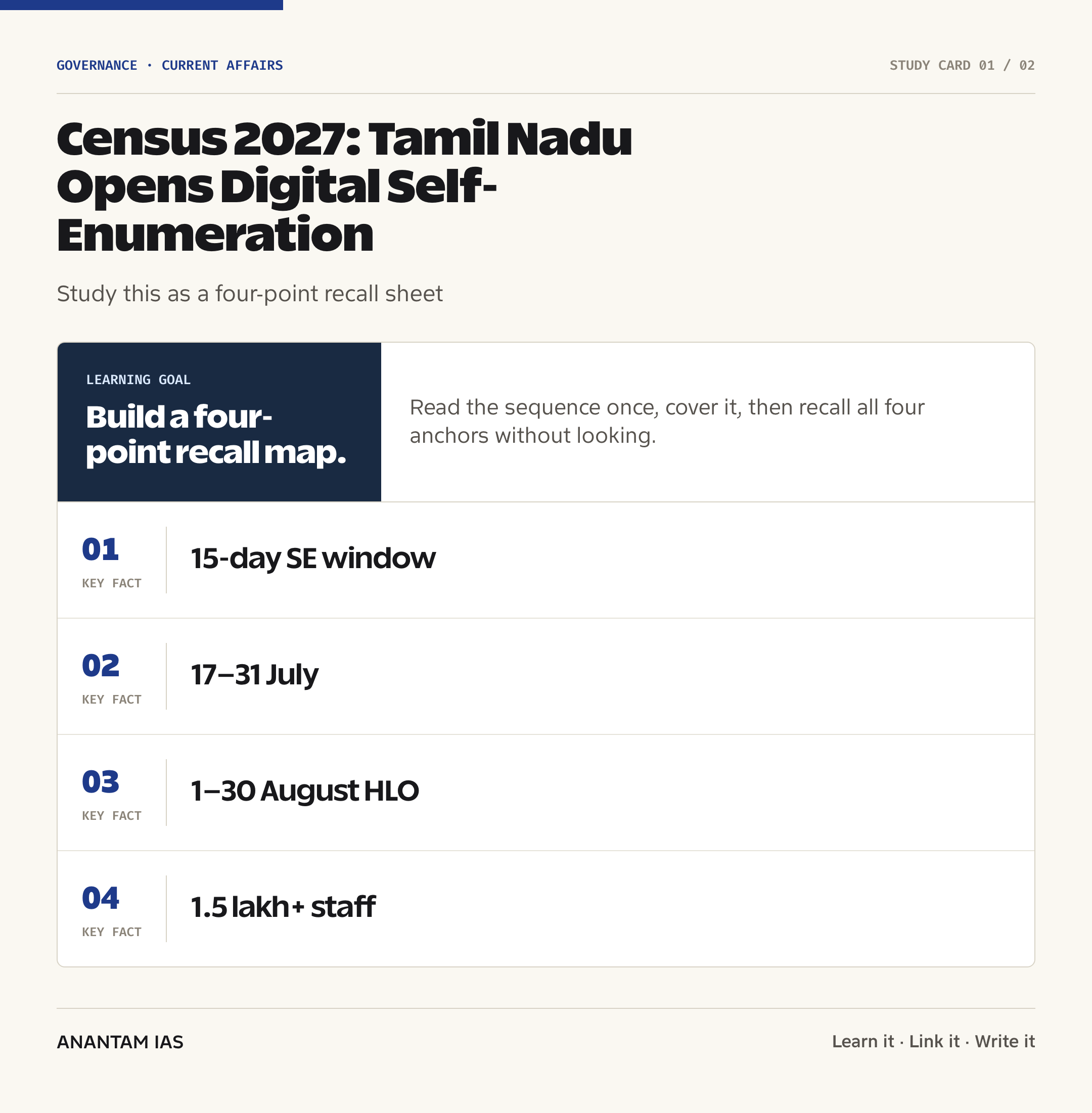
- Window: Self-enumeration in Tamil Nadu is available for 15 days, from 17 to 31 July 2026.
- Coverage: The official announcement applies across Tamil Nadu, while The Hindu separately reported the start of the process within Greater Chennai Corporation limits.
- Next step: More than 1,50,000 personnel are expected to support the State’s field operations from 1 to 30 August.
- Verification: Online submission generates an SE ID that the household must share when the enumerator visits.
- Optional route: Self-enumeration isn’t a substitute for universal coverage; non-users remain part of door-to-door enumeration.
- Safety advice: The Directorate asked residents to use only the official Census portal and enter details accurately because submissions feed the national database.
The development matters in the context of:
- Digital transition: Census 2027 is India’s first census designed around digital data capture, with an online citizen route and mobile applications for enumerators.
- Inclusion test: A digital option can reduce respondent burden, but weak connectivity, low digital literacy, disability and language barriers can create uneven participation.
- Trust test: Accuracy depends on residents understanding what is being asked and believing that identifiable household information will remain confidential.
- Policy value: Housing and amenities data create the local evidence base for water, sanitation, electricity, internet, housing and transport planning.
UPSC Relevance
Prelims Relevance
- Census is a Union subject under Entry 69 of the Union List in the Seventh Schedule.
- The post-Independence legal framework consists of the Census Act, 1948 and the Census Rules, 1990.
- The Office of the Registrar General and Census Commissioner, India functions under the Union Ministry of Home Affairs.
- Census 2027 is the 16th census in the Indian series and the eighth after Independence.
- Phase I is the Houselisting and Housing Census; Phase II is Population Enumeration.
- A 15-day optional self-enumeration period precedes the 30-day house-to-house Phase I operation in each State or Union Territory.
- Tamil Nadu’s self-enumeration period is 17–31 July 2026, followed by houselisting from 1–30 August 2026.
- The self-enumeration portal supports 16 languages and generates a unique SE ID after successful submission.
- Section 15 of the Census Act protects census records from public inspection and restricts their admissibility as evidence.
- The usual Census Moment is 00:00 hours on 1 March 2027; specified snow-bound areas have 1 October 2026 as their reference date.
Mains Relevance
GS Paper 2
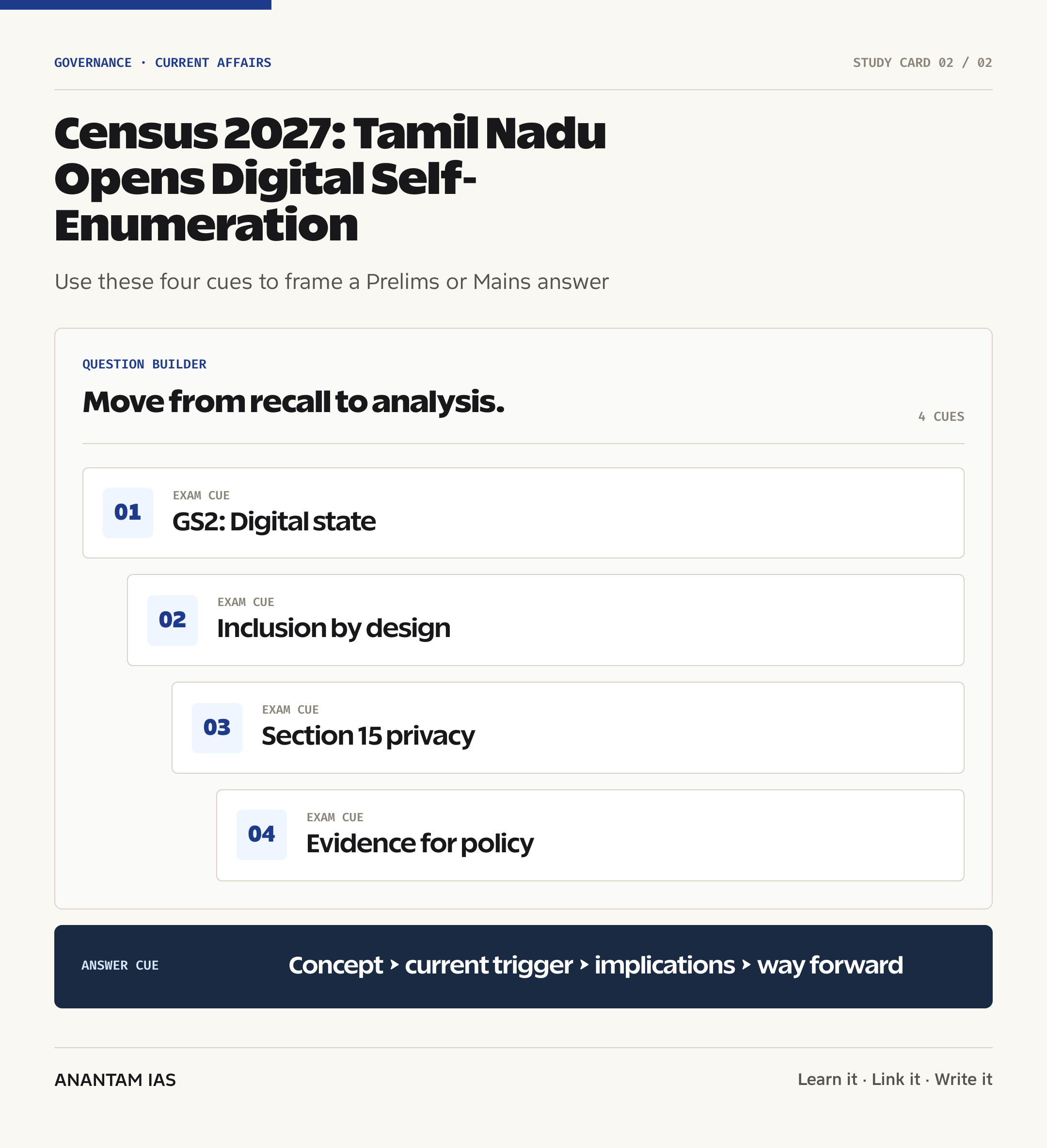
- Digital governance: Citizen-facing self-service combined with field verification, multilingual access and near real-time administrative monitoring.
- Data governance: Purpose limitation, confidentiality, cyber security, accountability and public trust in a population-scale state database.
- Last-mile delivery: Designing assisted and offline channels so a digital option improves convenience without weakening universal coverage.
GS Paper 1
- Indian society: Census data as the baseline for studying population, migration, urbanisation, household amenities and social change.
- Data gaps: Consequences of the delayed 2021 cycle for demographic baselines and evidence-based planning.
Essay
- Technology can widen state capacity only when access and trust grow with it.
- Good public policy begins with people who are counted accurately and seen in their local context.
Background and Context
The Tamil Nadu Rollout: Sequence and Citizen Journey
Self-enumeration adds a citizen-facing digital route before the same household enters the field-verification workflow.
- Access period: An eligible household respondent can enter Phase I details online between 17 and 31 July.
- Submission: The respondent should use the dedicated government portal, follow its validation prompts and check entries before final submission.
- Receipt: A successful submission produces a unique SE ID, which connects the online record with the later field visit.
- Enumerator visit: The visiting official uses the ID to confirm the information rather than treating online submission as an unverified final record.
- Fallback: If a household doesn’t self-enumerate, the enumerator collects its information during the 1–30 August field operation.
- Key distinction: Optional self-enumeration changes the method of initial entry; it doesn’t remove the State’s duty to seek complete territorial coverage.
Constitutional, Legal and Administrative Architecture
A census is centrally authorised but depends on a large Union-State-local administrative chain for execution.
- Constitutional location: Entry 69 places census work in the Union List, supporting uniform national concepts, schedules and outputs.
- Statutory basis: The Census Act, 1948 empowers the Central Government to declare a census and provides for census officers, questions, duties and confidentiality.
- Operational rules: The Census Rules, 1990 govern administrative procedures, while notified schedules specify what census officers may ask.
- National authority: The Registrar General and Census Commissioner coordinates the exercise through Directors of Census Operations in States and Union Territories.
- State machinery: State officers, district and charge officials, supervisors, enumerators and local bodies convert the national design into household coverage.
- Answer connection: Read the broader Census in India framework alongside the chronology in Indian Census history.
What Phase I Counts and Why It Comes First
Houselisting creates the physical and household frame needed before people are counted in the Population Enumeration phase.
- Housing conditions: Phase I records characteristics of the census house and the material used for floors, walls and roofs.
- Basic amenities: It captures access to drinking water, sanitation, electricity, cooking fuel and related household facilities.
- Connectivity and assets: The notified exercise includes information such as internet connectivity and vehicle ownership.
- Enumeration frame: Listing buildings, census houses and households helps assign field workloads and reduce omissions or duplication in Phase II.
- Not the same exercise: Detailed individual demographic, migration, fertility and caste questions belong to Population Enumeration, not the current Tamil Nadu houselisting window.
- Policy use: Aggregated results can expose neighbourhood-level deficits that State averages hide, improving the targeting of infrastructure and services.
How the First Digital Census Changes Operations
Digital collection changes the speed and auditability of the workflow, but it doesn’t automatically guarantee accurate data.
- Two capture routes: Households may use the secure web portal, while authorised enumerators use dedicated mobile applications during fieldwork.
- CMMS: The Census Management and Monitoring System allows officers at different levels to track progress and operational readiness on a near real-time basis.
- Geo-referenced work: Digital houselisting blocks can help define field boundaries and detect geographic gaps or overlap.
- Built-in checks: Validation rules can flag missing or inconsistent entries before submission, reducing some manual transcription errors.
- Faster processing: Direct digital transfer can shorten the path from collection to cleaning and release compared with paper schedules.
- Human verification remains central: Identity resolution, unusual household arrangements, language interpretation and local geography still need trained field judgement.
- Related reading: The earlier note on building a credible digital Census explains why technical capacity and institutional trust must develop together.
Inclusion Risks Behind a Digital Option
Self-enumeration can increase convenience for some households while excluding others unless assisted routes remain visible and reliable.
- Connectivity divide: Poor networks, unavailable devices or high data costs may block rural, remote and low-income households from using the portal.
- Capability divide: Older persons, first-time internet users and people with limited digital literacy may need in-person or community assistance.
- Accessibility: The portal and guidance should work with screen readers, keyboard navigation, clear error messages and low-bandwidth devices.
- Language access: Sixteen language options are important, but translations, examples and help systems must remain understandable in practice.
- Household power: One respondent may not know or may misstate the circumstances of every member, especially migrants, tenants, persons with disabilities or absent workers.
- Coverage principle: Door-to-door enumeration, public help channels and supervisor checks should function as inclusion safeguards, not as secondary services.
Privacy, Confidentiality and Cyber Security
Census participation depends on a clear separation between identifiable returns used for counting and aggregate statistics released for public use.
- Statutory shield: Section 15 bars a right to inspect census records and limits their use as evidence, protecting the confidentiality of individual returns.
- Operational promise: PIB says Census 2027 uses end-to-end encryption for collection, transmission and storage, along with secure transmission protocols.
- Protected infrastructure: Official data centres are designated as Critical Information Infrastructure and are reported to follow ISO/IEC 27001:2022 controls.
- Fraud risk: Residents should use only the official census.gov.in portal and should distrust unofficial links seeking household details or an SE ID.
- Least privilege: Access to identifiable records should be role-based, logged and limited to the minimum period and purpose needed for census operations.
- Public accountability: Security audits, incident response, correction channels and plain-language notices are needed to make privacy claims verifiable.
- Legal comparison: The Digital Personal Data Protection Act framework provides a wider data-governance lens, while Census confidentiality rests on its specific statutory regime.
Data Quality, Policy Value and Answer-Building
The strongest assessment links technology to measurable coverage and error control rather than treating digitisation as success by itself.
- Coverage error: The main risk is missing or duplicating houses, households or people; geo-referenced blocks and field reconciliation should reduce it.
- Content error: Respondents may misunderstand a definition or enter an inaccurate value, so examples, validations and enumerator confirmation matter.
- Non-response bias: If online users differ systematically from non-users, self-enumeration statistics alone cannot represent the population.
- Timeliness: Faster processing has value only if cleaning, quality assurance and release calendars remain transparent.
- Planning dividend: Reliable local data can guide housing, water, sanitation, digital connectivity, transport and welfare delivery.
- Representation impact: Updated population evidence can shape debates on fiscal transfers, constituency delimitation and the implementation of women’s legislative reservation, even though these involve separate constitutional and statutory processes.
- Answer structure: Start with the Tamil Nadu sequence, explain the legal and digital architecture, evaluate inclusion and privacy, and end with assisted access plus independent quality assurance.
Way Forward
Make Assisted Access Universal
- Provide staffed help at local-body offices and authorised public facilities, with clear safeguards against intermediaries retaining personal data.
- Keep door-to-door enumeration fully resourced so no household is disadvantaged for choosing not to self-enumerate.
Design for Accessibility and Low Bandwidth
- Test the portal in all supported languages on inexpensive phones, slow networks, screen readers and keyboard-only navigation.
- Offer plain-language guides, visible helplines and error recovery that doesn’t force a household to restart the full schedule.
Reconcile Digital and Field Records
- Use the SE ID for controlled matching, enumerator confirmation and duplicate detection without exposing household details.
- Require supervisors to review unresolved buildings, unusually high non-response and boundary gaps before closing a houselisting block.
Turn Privacy Claims into Controls
- Apply role-based access, strong authentication, encryption, audit logs, time-bound retention and tested incident-response procedures.
- Publish non-sensitive security and privacy information so residents understand who can access their return and what aggregate data will be released.
Publish a Quality Account
- Release metadata on coverage checks, corrections, non-response and processing methods without revealing any identifiable return.
- Separate administrative progress metrics from statistical quality, and explain revisions so researchers and governments can use the results responsibly.
Conclusion
Tamil Nadu’s self-enumeration window is a practical test of digital state capacity: a household can submit information directly, but the system still relies on trained enumerators, universal field coverage and careful reconciliation. Convenience is useful only when it strengthens completeness and accuracy.
The durable governance lesson is that a credible census needs access, confidentiality and quality assurance in equal measure. If assisted channels protect inclusion and security controls earn public trust, faster digital collection can produce a stronger evidence base for local and national policy.
UPSC Practice Questions
Prelims MCQ 1
With reference to Census 2027, consider the following statements:
- Census is listed in the Union List of the Seventh Schedule.
- Self-enumeration replaces the enumerator’s field visit for every participating household.
- The Houselisting and Housing Census precedes Population Enumeration.
How many of the above statements are correct?
(a) Only one (b) Only two (c) All three (d) None
Answer: (b) Only two
Explanation:
Statements 1 and 3 are correct. Census is a Union subject, and houselisting is Phase I. Statement 2 is incorrect: an SE ID is presented during the enumerator’s visit so the submitted information can be confirmed.
Prelims MCQ 2
Which one of the following correctly matches Tamil Nadu’s first-phase Census 2027 schedule?
(a) Self-enumeration: 17–31 July; houselisting: 1–30 August (b) Self-enumeration: 1–15 August; Population Enumeration: 16–31 August (c) Houselisting: 17–31 July; self-enumeration: 1–30 August (d) Population Enumeration and caste enumeration: 17 July–30 August
Answer: (a) Self-enumeration: 17–31 July; houselisting: 1–30 August
Explanation:
Tamil Nadu’s optional 15-day self-enumeration window runs from 17 to 31 July 2026. The 30-day door-to-door Houselisting and Housing Census follows from 1 to 30 August.
UPSC Mains Questions
- Digital self-enumeration can make a census faster without making it automatically more inclusive or accurate. Examine this statement using Tamil Nadu’s Census 2027 rollout, and suggest institutional safeguards that can reconcile citizen convenience with universal coverage, data quality and confidentiality.
- Reliable census data are public infrastructure for welfare, urban planning and democratic representation. Discuss the legal and administrative architecture of India’s Census, and assess how digital collection should address the risks of exclusion, cyber insecurity, non-response bias and weak public trust.
Sources: PIB Chennai and Directorate of Census Operations, Tamil Nadu and The Hindu.
Frequently Asked Questions
When is Tamil Nadu self-enumeration open?
Tamil Nadu’s optional Census 2027 self-enumeration window runs from 17 to 31 July 2026. It is followed by the Houselisting and Housing Census from 1 to 30 August. The online window concerns the first phase, not the later Population Enumeration exercise that counts individual demographic characteristics.
Is online self-enumeration compulsory?
No. It is an optional method for entering household information before the field operation. A household that doesn’t use the portal will still be covered by an enumerator during the regular door-to-door exercise. Keeping the offline route fully functional is essential for universal coverage and digital inclusion.
What happens after online submission?
A successful submission generates a unique Self-Enumeration ID. The household should keep this ID and share it when the census enumerator visits. The enumerator can then confirm the online information and connect it with the correct houselisting record, helping prevent omission or duplication.
What does the housing census collect?
The Houselisting and Housing Census records the housing stock, household frame, building characteristics, amenities and selected assets. Official examples include drinking water, sanitation, electricity, internet connectivity, cooking fuel and vehicle ownership. Detailed individual demographic and caste information belongs to the later Population Enumeration phase.
How are individual census returns protected?
Section 15 of the Census Act, 1948 protects census records from public inspection and sharply limits their admissibility as evidence. The government also reports encryption, secure transmission and protected data centres for Census 2027. Good implementation still requires restricted access, audit logs, incident response and clear public communication.
Why does self-enumeration need field verification?
Field confirmation helps connect an online return to the correct household and houselisting block. It can also catch incomplete records, misunderstandings, duplicates and geographic gaps. The combination of digital entry, local verification and supervisor review is stronger than assuming either technology or a household visit is error-free.
Tell Google you want more of this.
Add Anantam IAS as a preferred sourceOne tap, and this site shows up more often in your own Top Stories, AI Overviews and AI Mode. Remove it any time.