Why in News?
At the Annual Conference on Applied Biodiversity for Development (AAD 2026) held in April 2026, ecologist Jagdish Krishnaswamy of the Indian Institute for Human Settlements and the Ashoka Trust for Research in Ecology and the Environment delivered a keynote that framed invasive alien species (IAS) as the single most underestimated driver of biodiversity loss inside Indian forests, grasslands and wetlands. Down To Earth magazine carried a detailed report on the keynote, placing the Indian crisis in conversation with the 2023 assessment of the Intergovernmental Science-Policy Platform on Biodiversity and Ecosystem Services.
The conference singled out two woody invaders for urgent attention. Lantana camara, a neotropical shrub introduced as an ornamental in the colonial period, now occupies measurable portions of roughly 40 per cent of India’s tiger reserves. Prosopis juliflora, a fast-growing thorny tree from Central and South America, is steadily converting the Banni grasslands of Kachchh, once among Asia’s largest tropical grasslands, into a closed thorn scrubland.
The timing matters for policy. India’s updated National Biodiversity Strategy and Action Plan, notified in 2024, for the first time lists invasive alien species as a standalone strategic target. That alignment with Target 6 of the Kunming-Montreal Global Biodiversity Framework has moved IAS from a footnote in forest working plans to a mainstream concern for climate adaptation, livelihood security and public health.
UPSC Relevance at a Glance
| Axis | Relevance |
|---|---|
| GS Paper | GS3 Environment and Biodiversity |
| Prelims | IPBES 2023 IAS Assessment, Kunming-Montreal GBF Target 6, Lantana camara, Prosopis juliflora, Biological Diversity Act 2002, 2023 amendment, GEAC, Wildlife Protection Act 1972 |
| Mains | Biodiversity conservation, ecosystem services, agrarian distress, wetland ecology, federalism in forest governance |
| Syllabus Tags | Conservation, Environmental Pollution and Degradation, Disaster Management (ecological), Science and Technology |
Background and Context
An invasive alien species is a non-native organism whose introduction and spread threaten biological diversity, ecosystem services or human wellbeing. Not every exotic species qualifies. Rice, wheat and mango are all exotic in origin yet benign. The IAS label is reserved for species that establish self-sustaining populations in the wild and then spread aggressively, crowding out native flora and fauna.
The scale of the Indian problem has historically been undercounted. Botanical Survey of India inventories and the 2023 IPBES IAS Assessment jointly suggest over 2,000 invasive plant taxa have been documented in the country, with hundreds categorised as high-impact. Roughly 66 per cent of India’s natural systems, ranging from the Shola grasslands of the Western Ghats to the Thar fringes and the Sundarban mudflats, have been mapped as vulnerable to one or more invasions.
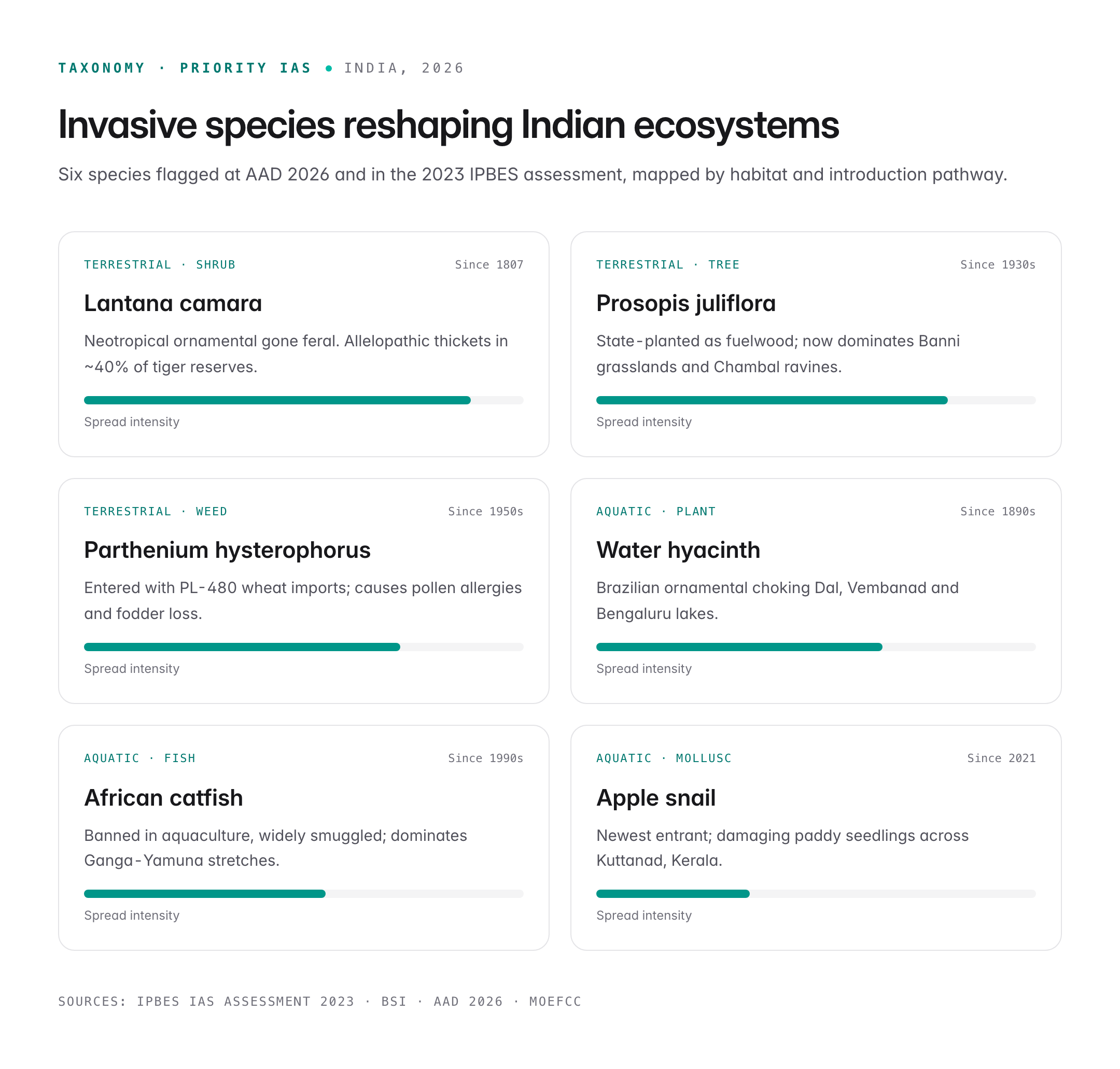
The history is instructive. Lantana camara arrived in the National Botanic Garden, Calcutta, in 1807 as an ornamental hedge plant. Prosopis juliflora was planted across arid Rajasthan and Gujarat from the 1930s onwards as a drought-hardy fuelwood and soil-binder, with sustained state backing until the 1970s. Parthenium hysterophorus, the notorious Congress grass, piggybacked on US wheat imports in the 1950s under the PL-480 programme. Water hyacinth, originally a Brazilian ornamental, now chokes lakes from Dal in Kashmir to Vembanad in Kerala.
The 2023 IPBES assessment placed IAS among the five leading direct drivers of global biodiversity loss, alongside land-use change, direct exploitation, climate change and pollution. For India, the ranking is particularly sharp inside protected areas where, unlike land-use change, the IAS threat is not blocked by a legal boundary.
Key Features of the AAD 2026 Keynote and the IAS Framework
Lantana camara: the tiger reserve invader
Krishnaswamy’s keynote drew on long-term vegetation plots in Bandipur, BRT Hills and Mudumalai to describe how lantana has reshaped forest understory across the Deccan. Where canopy gaps open, it germinates within days, reaches two metres within a growing season, and forms thickets that are allelopathic, suppressing native grass and sapling regeneration. Fire, once a friendly disturbance in Indian dry forests, now acts as a lantana amplifier because the shrub resprouts faster than native saplings. Estimates presented at the conference suggest lantana infestation in parts of 40 per cent of India’s 58 tiger reserves, with the heaviest load in the Western Ghats, central Indian highlands and the Terai.
Prosopis juliflora and the Banni transition
The second headline species was Prosopis juliflora, locally called gando bawal in Gujarat and seemai karuvelam in Tamil Nadu. In the Banni grasslands of Kachchh, successive state plantations since the 1960s have seeded a runaway invasion. Satellite time-series shared at AAD 2026 show thorn scrub cover rising from under 5 per cent in the early 1980s to over 50 per cent in recent mapping, with pastoralist Maldhari livelihoods squeezed as fodder grasses retreat. Similar dynamics are unfolding in the Chambal ravines and the Point Calimere region.
Invasive fauna and aquatic systems
The conference also profiled invasive animals. The African catfish (Clarias gariepinus), banned from aquaculture but widely smuggled, now dominates stretches of the Ganga and Yamuna. Nile tilapia has displaced native carps in peninsular reservoirs. The red-eared slider, an aquarium turtle, has been reported breeding in Yamuna wetlands near Delhi. The suckermouth armoured catfish clogs Kolkata’s East Calcutta Wetlands. The apple snail (Pomacea) has emerged since 2021 as a paddy pest in Kerala’s Kuttanad and parts of Karnataka, damaging young seedlings and shifting pest management budgets.
Legal and institutional architecture
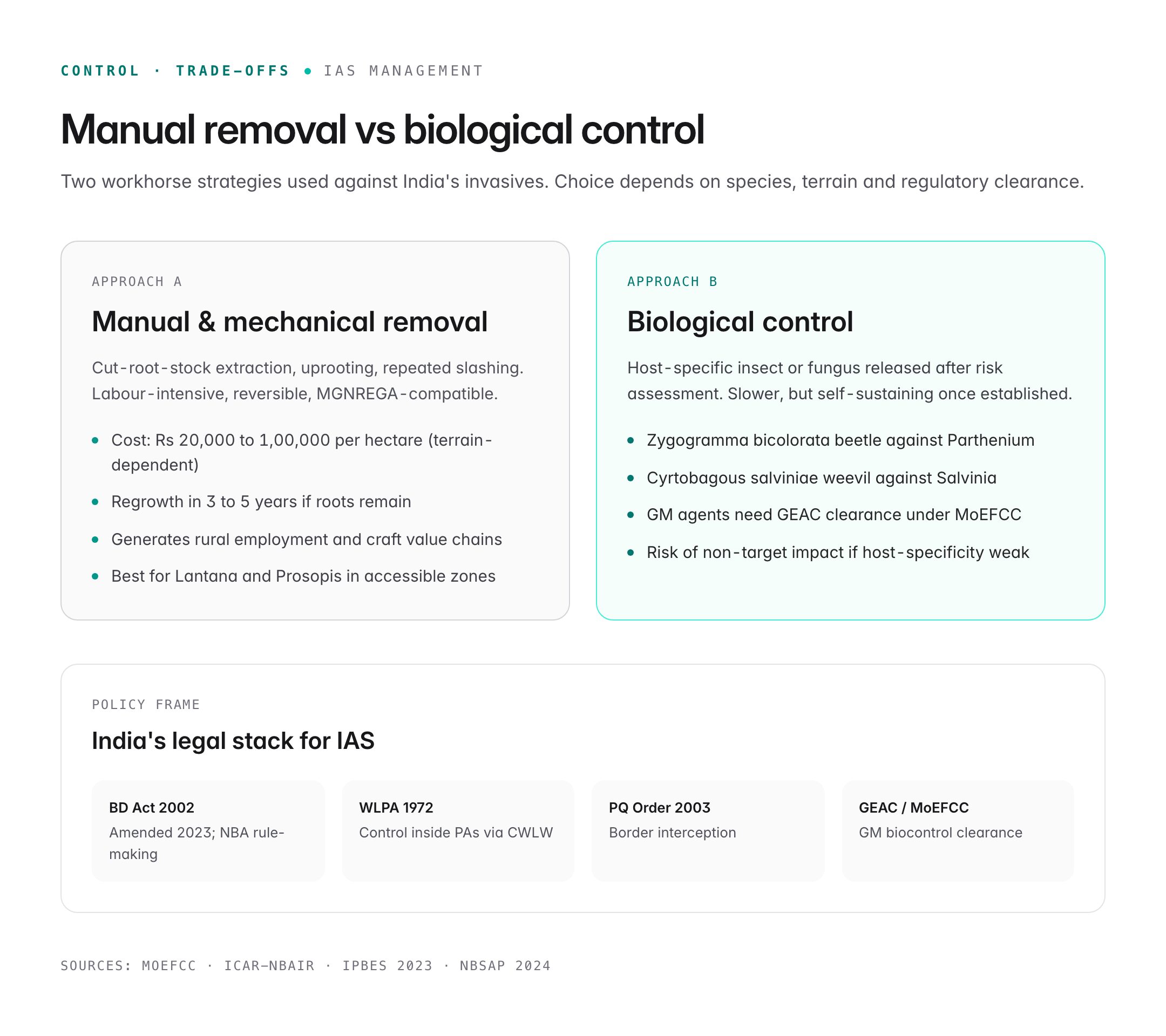
The Biological Diversity Act, 2002, amended in 2023, authorises the National Biodiversity Authority to regulate access to biological resources but treats IAS management largely through the rule-making power of the Centre. The Wildlife Protection Act, 1972 allows control operations inside protected areas with Chief Wildlife Warden approval. The Plant Quarantine Order, 2003 governs border interception. The Genetic Engineering Appraisal Committee (GEAC), under the Ministry of Environment, Forest and Climate Change, clears any proposal to use genetically modified biocontrol agents, which keeps a tight regulatory leash on novel control options.
India’s target alignment
Target 6 of the Kunming-Montreal Global Biodiversity Framework, adopted under the Convention on Biological Diversity in December 2022, commits signatories to cut the rate of introduction of priority invasive species by at least 50 per cent by 2030, eradicate or control them on priority sites, and minimise their impact on native species. India’s 2024 NBSAP operationalises this through a dedicated target, linking it to the 7th national biodiversity report submitted to the CBD Secretariat.
Significance
- IAS management is now central to biodiversity policy, not peripheral. The 2024 NBSAP shift moves funding lines from a diffuse forestry head into a targeted strategic pillar, which is the precondition for measurable action.
- Lantana and Prosopis directly affect tiger prey densities, ungulate movement corridors and fire regimes, so the IAS agenda plugs into the conservation logic behind Project Tiger and biosphere reserves.
- The pastoralist economy of the Banni and the Thar, and the paddy economy of Kuttanad, show that IAS is a livelihood issue. Invasion reduces fodder, groundwater and farm incomes, pushing adaptation costs onto the rural poor.
- Aligning NBSAP with GBF Target 6 gives India a diplomatic platform at the CBD Conferences of the Parties, useful when negotiating on biodiversity finance and on Digital Sequence Information benefits.
- Early detection and rapid response models, if institutionalised, can avert the eradication-cost escalations that Australia faced with cane toads and South Africa with Prosopis.
- IAS data and mapping create downstream value in climate adaptation planning, since invasions often peak where rainfall regimes are shifting and where fire seasons are lengthening.
Concerns and Challenges
The Indian IAS response faces structural gaps. First, there is no single law dedicated to invasive species, and no statutory national list of priority IAS with binding management obligations. The closest instrument, the Plant Quarantine Order, 2003, works at ports and airports but has little grip on species already established inland. Second, control operations are fragmented across forest departments, agriculture departments, inland fisheries, irrigation departments and municipal bodies, with no shared budget line.
Third, biological control has a mixed record. Zygogramma bicolorata, a Mexican beetle, has reduced Parthenium in some pockets, yet the earlier mongoose-release experiment in the Caribbean is a standing warning against naïve introductions. The GEAC route for GM biocontrol is slow and politically charged. Fourth, manual removal of lantana costs between twenty thousand and one lakh rupees per hectare depending on terrain, and regrowth within three to five years is common if root systems are not extracted. Employment guarantee convergence remains patchy.
Fifth, there is a data problem. The Botanical Survey of India, Zoological Survey of India, ICAR institutes and state forest departments each maintain overlapping lists. A unified national IAS database, promised under the NBSAP, is still in pilot stage. Without it, Target 6 reporting to the CBD depends on ad-hoc pulls from literature. Sixth, climate change is widening the fundamental niche of several invaders, including water hyacinth at higher elevations and Prosopis deeper into the Deccan, which means today’s modest problem can become tomorrow’s eradication target.
Comparative / Historical Perspective
Australia and South Africa offer instructive benchmarks. Australia’s Biosecurity Act, 2015, is a unified federal statute covering pre-border, border and post-border IAS management with mandatory emergency response protocols. South Africa’s National Environmental Management: Biodiversity Act, 2004, read with the Alien and Invasive Species Regulations, 2014, created a national IAS list, permit system and Working for Water programme that combines control with rural employment. India has neither of these instruments.
| Jurisdiction | Lead law | National IAS list | Dedicated programme |
|---|---|---|---|
| India | BD Act 2002 plus PQ Order 2003 | Proposed under NBSAP 2024 | None unified; MGNREGA convergence in pockets |
| Australia | Biosecurity Act 2015 | Yes, statutory | National Biosecurity Committee |
| South Africa | NEMBA 2004 and AIS Regs 2014 | Yes, statutory, four categories | Working for Water |
Historically, India has been a reluctant regulator of IAS because the same species have delivered short-term ecological services, Prosopis for fuelwood and Lantana for fencing, for example. The 2020s mark a pivot, where the ecological and livelihood costs have crossed the benefit line and where international obligations add a ratchet.
Way Forward
- The Ministry of Environment, Forest and Climate Change should notify a statutory list of priority IAS with management categories modelled on the South African template, under rules framed through the Biological Diversity Act as amended in 2023.
- The Botanical Survey of India and Zoological Survey of India should co-host a unified national IAS database with annual updates, integrated with state biodiversity boards and the India Biodiversity Portal.
- The Ministry of Rural Development should issue a formal circular allowing convergence of MGNREGA labour budgets with lantana and Prosopis removal in forest fringes, on the Working for Water model.
- The Ministry of Agriculture and Farmers Welfare should strengthen Plant Quarantine Order enforcement at seaports and land customs, with digital interception records, and include e-commerce imports in its scope.
- The ICAR National Bureau of Agricultural Insect Resources should be made the nodal agency for risk-assessed biological control, with a published pipeline and transparent GEAC interface.
- State forest departments should build early detection and rapid response cells at the division level, with satellite and citizen-science inputs, so that new invasions are caught at under ten hectares rather than ten thousand.
- MoEFCC and NITI Aayog should cost the lantana-Prosopis management gap and include it in Finance Commission recommendations for ecological fiscal transfers.
Conclusion
The AAD 2026 keynote has pushed a long-standing research concern into mainstream policy space. India now has the diagnostic consensus, the international framework and the domestic strategic target to treat invasive alien species as a first-order conservation challenge. What it lacks is the statutory spine, the unified list, the shared database and the sustained field budget to act at the scale the problem demands.
Getting this right is not only a biodiversity question. It shapes tiger reserve management, pastoralist livelihoods in the Banni, paddy productivity in Kuttanad, wetland health around Delhi and carbon stocks in dry forests. If the next five years match the ambition of Target 6 with the execution of a Working for Water-style programme, India can credibly claim progress at the 2030 stocktake under the Kunming-Montreal Global Biodiversity Framework.
Prelims Pointers
- An invasive alien species is a non-native organism whose spread threatens native biodiversity or ecosystem services.
- IPBES released its first dedicated Assessment Report on Invasive Alien Species and their Control in 2023.
- IPBES places IAS among the five leading direct drivers of global biodiversity loss.
- Target 6 of the Kunming-Montreal GBF seeks a 50 per cent cut in introduction rates of priority IAS by 2030.
- India’s updated NBSAP, 2024, lists IAS as a standalone strategic target for the first time.
- Lantana camara is native to tropical America and was introduced in Calcutta in 1807 as an ornamental.
- Prosopis juliflora is native to Mexico, Central and South America, planted in India from the 1930s.
- Parthenium hysterophorus entered India with PL-480 wheat imports in the 1950s.
- The African catfish Clarias gariepinus is banned from Indian aquaculture but is widespread in rivers.
- The Biological Diversity Act, 2002, was amended in 2023 to ease research access and tighten penalties.
- The Genetic Engineering Appraisal Committee clears GM biocontrol proposals under MoEFCC.
- Around two-thirds of India’s natural systems are mapped as vulnerable to IAS.
Mains Practice Question
Question (15 marks, 250 words): Invasive alien species have emerged as a first-order driver of biodiversity loss in India. Examine the ecological and socio-economic impact of species such as Lantana camara and Prosopis juliflora, and suggest a policy architecture that aligns with Target 6 of the Kunming-Montreal Global Biodiversity Framework.
Answer skeleton:
- Frame IAS as one of five IPBES drivers, cite 2,000 plus invasive plants in India, link to NBSAP 2024 and Target 6.
- Map ecological impact, lantana in tiger reserves, Prosopis in Banni, and socio-economic impact on Maldhari pastoralists, Kuttanad paddy farmers and forest-fringe communities.
- Recommend a statutory national IAS list, MGNREGA convergence on Working for Water lines, unified BSI-ZSI database, risk-assessed biocontrol via NBAIR, and Finance Commission ecological transfers.
Frequently Asked Questions
What is an invasive alien species?
An invasive alien species is a non-native plant, animal or microorganism whose introduction and spread cause measurable harm to native biodiversity, ecosystem services or human wellbeing. Not all exotic species qualify; only those that establish self-sustaining wild populations and displace native flora or fauna, such as Lantana camara and Prosopis juliflora in India.
Why are invasive species in India in the news in 2026?
The Annual Conference on Applied Biodiversity for Development 2026 featured a keynote by ecologist Jagdish Krishnaswamy of IIHS and ATREE flagging Lantana camara and Prosopis juliflora as India’s most damaging invasive plants. Down To Earth covered the address. It coincides with India’s 2024 NBSAP, which for the first time treats invasive alien species as a standalone strategic target.
How does this topic help UPSC aspirants?
The issue sits squarely in GS3 Environment, linking biodiversity conservation, ecology, climate adaptation and federal governance. It yields factual pointers for Prelims, an analytical Mains answer frame around IPBES 2023, Kunming-Montreal GBF Target 6 and the Biological Diversity Act 2023 amendment, and case studies for essays on sustainable development, pastoralist livelihoods and science policy.
Which invasive species are most damaging in India?
Lantana camara now infests parts of roughly 40 per cent of India’s tiger reserves. Prosopis juliflora has converted much of the Banni grasslands in Kachchh into thorn scrub. Parthenium hysterophorus and water hyacinth are widespread. Invasive fauna include African catfish, Nile tilapia, red-eared slider, suckermouth catfish and the apple snail in Kerala paddy fields.
What is Target 6 of the Kunming-Montreal Global Biodiversity Framework?
Target 6 commits parties to the Convention on Biological Diversity to reduce the introduction and establishment rate of priority invasive alien species by at least 50 per cent by 2030, to eradicate or control them on priority sites such as islands, and to minimise the impact of IAS on biodiversity and ecosystem services.
What does the IPBES 2023 assessment say about invasive species?
The 2023 IPBES Assessment Report on Invasive Alien Species and their Control identifies IAS as one of the five leading direct drivers of global biodiversity loss, alongside land-use change, direct exploitation, climate change and pollution. It estimates global annual costs above 400 billion US dollars and documents growing invasion pressure in tropical regions including India.
What Indian laws regulate invasive species?
The Biological Diversity Act, 2002, amended in 2023, provides the umbrella framework. The Wildlife Protection Act, 1972, covers control inside protected areas. The Plant Quarantine Order, 2003, regulates border interception. The Genetic Engineering Appraisal Committee under MoEFCC clears any genetically modified biocontrol agents. No dedicated national invasive species law yet exists.
What should India do next on invasive species?
Priorities include notifying a statutory national list of priority IAS, creating a unified BSI-ZSI database, allowing MGNREGA convergence for lantana and Prosopis removal on the South African Working for Water model, strengthening plant quarantine at ports, and empowering ICAR-NBAIR to drive risk-assessed biological control with clearer GEAC timelines for GM biocontrol proposals.
Tell Google you want more of this.
Add Anantam IAS as a preferred sourceOne tap, and this site shows up more often in your own Top Stories, AI Overviews and AI Mode. Remove it any time.