Why in News?
In early 2026, the Ministry of Environment, Forest and Climate Change (MoEFCC) announced the addition of two new wetlands to India’s Ramsar list, taking the national tally to 98. The designations came in the run-up to World Wetlands Day on 2 February and were formally notified by the Ramsar Secretariat based in Gland, Switzerland.
The two freshly added sites are the Patna Bird Sanctuary in the Etah district of Uttar Pradesh and the Chhari-Dhand Conservation Reserve in Kutch, Gujarat. With this addition, India now hosts the largest network of Wetlands of International Importance in Asia, surpassing China’s count and underlining the country’s diplomatic and ecological footprint under the Ramsar Convention framework.
The timing is significant. The Central government has been scaling up wetland action through the Amrit Dharohar initiative, the National Plan for Conservation of Aquatic Ecosystems (NPCA), and state-level wetland authorities mandated under the Wetlands (Conservation and Management) Rules, 2017. The two new sites also reinforce India’s position at the upcoming Conference of Contracting Parties of the Ramsar Convention and dovetail with disclosures in the country’s seventh biodiversity report to the CBD.
UPSC Relevance at a Glance
| Dimension | Relevance |
|---|---|
| GS Paper | GS3 — Environment and Biodiversity |
| Prelims | Ramsar Convention, Montreux Record, Central Asian Flyway, Bonn Convention, Amrit Dharohar, Wetlands Rules 2017, Banni grasslands |
| Mains | Wetland governance, transboundary bird conservation, federal wetland management, climate and ecosystem services |
| Syllabus Tags | Conservation, Environmental Pollution and Degradation, Environmental Impact Assessment, International Treaties |
Background and Context
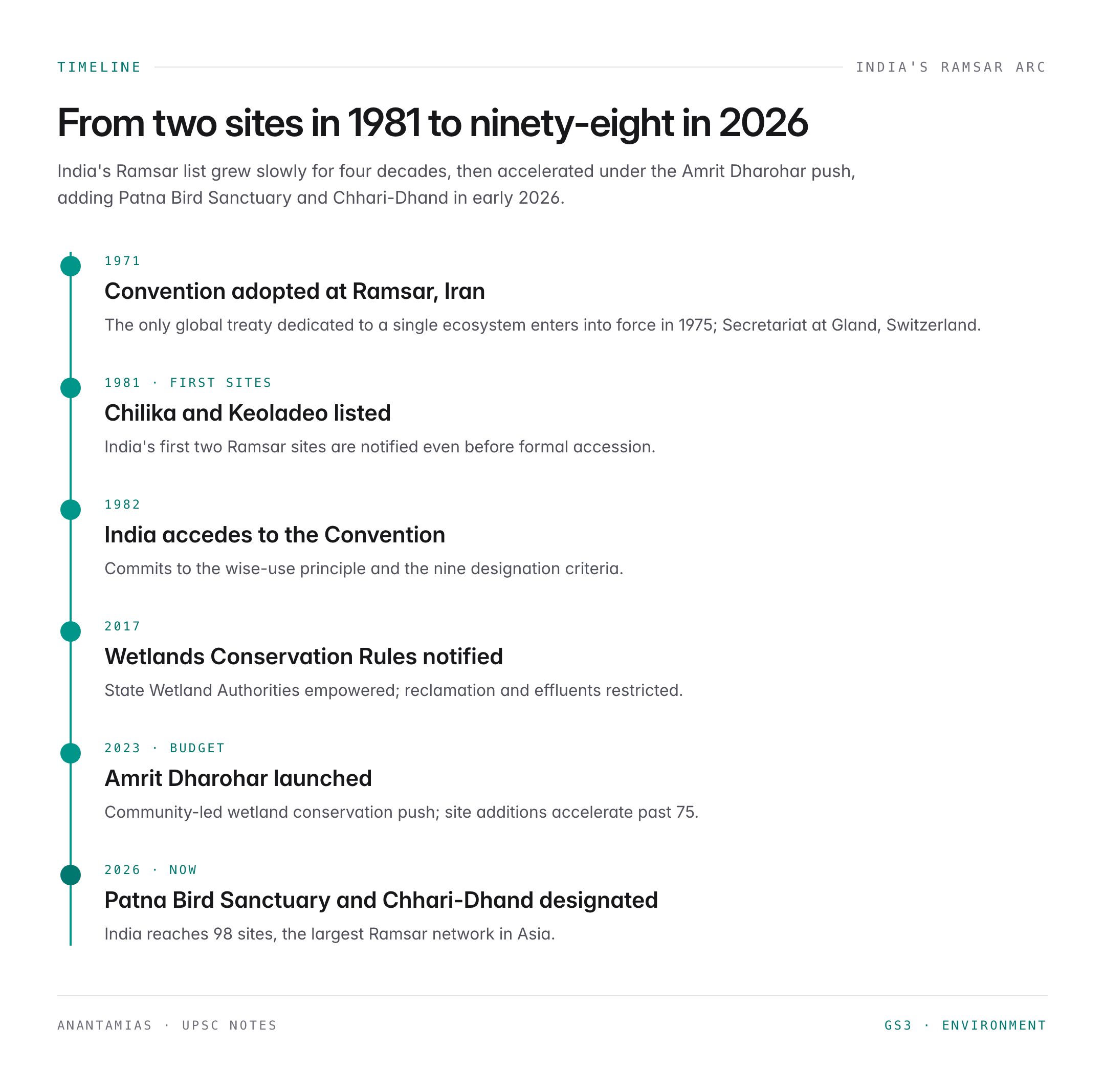
The Ramsar Convention on Wetlands of International Importance especially as Waterfowl Habitat was adopted on 2 February 1971 in the Iranian city of Ramsar on the Caspian coast. It remains the only global treaty focused on a single ecosystem type, and its Secretariat is co-hosted by the International Union for Conservation of Nature in Gland, Switzerland. The Convention entered into force in 1975.
India acceded to the Convention in 1982, becoming one of the earlier contracting parties in South Asia. The first two Indian sites, both designated in 1981, were Chilika Lake in Odisha and the Keoladeo National Park (Bharatpur) in Rajasthan. Over the next four decades the list grew slowly, but the pace accelerated sharply from 2022 onward under the Amrit Dharohar push, crossing 75 sites in the Azadi Ka Amrit Mahotsav year and now reaching 98.
The Convention rests on three pillars: designation of Ramsar sites, commitment to the wise-use principle (sustainable use that maintains ecological character), and international cooperation on shared wetlands and migratory waterbird flyways. Sites that have suffered or are likely to suffer a change in ecological character are placed on the Montreux Record, a watch-list mechanism. Keoladeo and Loktak remain on this list, and managing their removal is a continuing policy challenge.
Wetland governance within India is anchored by the Wetlands (Conservation and Management) Rules, 2017, which empower State Wetland Authorities, mandate integrated management plans, and regulate activities such as reclamation, solid waste dumping, and industrial effluent discharge. Complementary vehicles include the NPCA, the Amrit Dharohar scheme launched in the 2023-24 Budget, and state-specific ecosystem payments. Unlike biosphere reserves, which rely on UNESCO’s Man and the Biosphere programme, Ramsar sites are legally anchored in an intergovernmental treaty with binding reporting obligations.
Key Features
Patna Bird Sanctuary, Uttar Pradesh
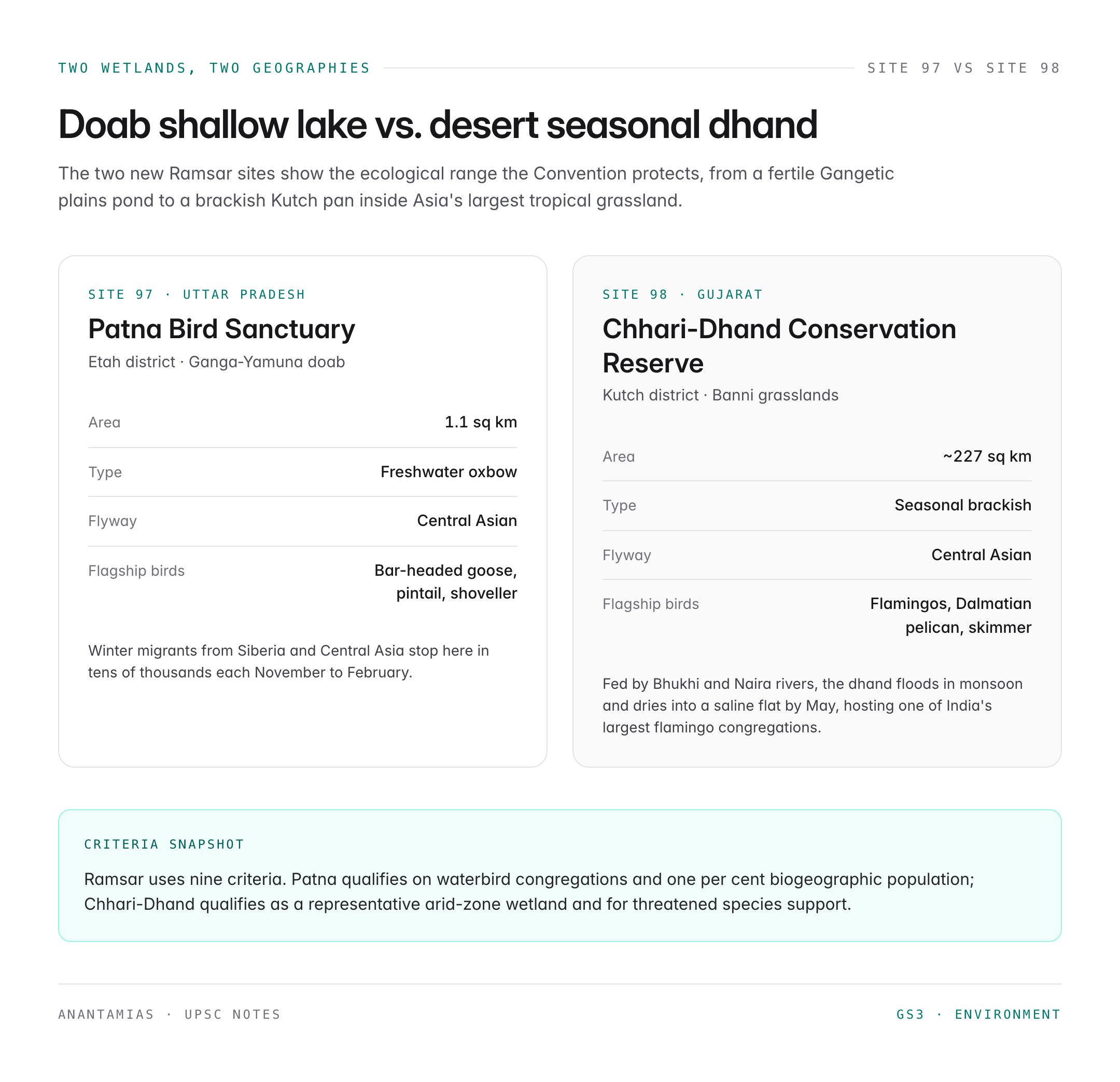
Patna Bird Sanctuary, often called Patna Pakshi Vihar to distinguish it from the Bihar capital, lies in the Etah district of western Uttar Pradesh, roughly 210 km from Delhi. At around 1.1 sq km, it is among the smallest wetlands in India’s Ramsar list but one of the richest in bird density.
- Location and origin: A shallow natural depression on the Ganga-Yamuna doab, fed seasonally by monsoon run-off and a subsurface connection with the Kali Nadi.
- Flyway importance: The sanctuary sits squarely on the Central Asian Flyway (CAF), one of nine global migratory bird flyways, stretching from the Arctic to the Indian Ocean through roughly 30 countries.
- Key avifauna: Bar-headed goose (Anser indicus), northern pintail, northern shoveller, common teal, ruddy shelduck, cotton pygmy goose, spot-billed duck and sarus crane.
- Protection status: Notified as a sanctuary under the Wild Life (Protection) Act, 1972, with the UP Forest Department as the lead management authority.
Chhari-Dhand Conservation Reserve, Gujarat
Chhari-Dhand is a seasonal desert wetland inside the Banni grasslands ecosystem of the Kutch district. Chhari means salt-affected in Kutchi and dhand means a shallow wetland, together describing a mosaic of brackish pools that form during the monsoon.
- Hydrology: Fed by rivers such as the Bhukhi, Naira and Mathal, plus run-off from the Kala Dungar hills, the wetland dries out in summer into a saline flat.
- Ecological value: Supports one of India’s largest congregations of greater and lesser flamingos, along with cranes, raptors such as the Eurasian marsh harrier, Dalmatian pelicans and Indian skimmers.
- Landscape matrix: Embedded within the Banni grasslands, Asia’s largest tropical grassland, and adjacent to the Kutch Biosphere Reserve and the Lala-Parjan bustard sanctuary.
- Community link: The pastoral Maldhari community depends on Banni for livestock grazing, making Chhari-Dhand a test case for integrating conservation with pastoral livelihoods.
Criteria Used for Designation
Ramsar uses nine scientific criteria, grouped into two sets. Group A (Criterion 1) covers representative, rare or unique wetland types. Group B (Criteria 2 to 9) covers sites of international importance for conserving biological diversity, including threatened species, waterbird congregations of at least 20,000 individuals, or sites holding one per cent of a biogeographic population.
Patna Bird Sanctuary qualifies under criteria focused on waterbird assemblages, while Chhari-Dhand meets criteria relating to representative wetland types in a biogeographic region, threatened species support, and large bird congregations.
Significance
- Diplomatic leadership: With 98 sites India now operates the largest Ramsar network in Asia, strengthening its voice at the Convention’s Conference of the Parties and in parallel IUCN fora such as the IUCN World Congress.
- Flyway conservation: Both sites anchor India’s commitments under the Central Asian Flyway Action Plan, a non-binding instrument under the Bonn Convention on Migratory Species, to which India is a signatory.
- Ecosystem services: Wetlands act as carbon sinks, buffer floods and droughts, recharge groundwater and sustain fisheries. The Economics of Ecosystems and Biodiversity exercises value these services in the trillions globally.
- Climate resilience: Seasonal wetlands like Chhari-Dhand become critical drought refuges in arid Kutch, while Patna supports winter migrants fleeing frozen Central Asian breeding grounds.
- Community economies: Ramsar status unlocks eco-tourism, research grants and convergence funding across ministries, benefitting Maldhari pastoralists in Banni and farming communities around Etah.
- Legal shield: Designation strengthens the obligation of state governments to notify integrated management plans and restricts incompatible activities under the 2017 Rules.
Concerns and Challenges
Ramsar status is a label, not an automatic safeguard. India’s record on the ground is uneven. Keoladeo National Park and Loktak Lake remain on the Montreux Record because of shrinking water inflows, invasive species and hydrological interference. Several sites lack up-to-date integrated management plans, a violation of both the 2017 Rules and the Convention’s wise-use obligation.
The Patna Bird Sanctuary faces encroachment from expanding agriculture, eutrophication from fertiliser run-off in the sugarcane and wheat belt of Etah, and pesticide residues that bioaccumulate in piscivorous birds. Its small size, barely a square kilometre, makes buffer-zone management vital but also politically difficult where cultivation abuts the boundary.
Chhari-Dhand sits in a stressed landscape. The spread of the invasive mesquite Prosopis juliflora, locally called gando baval, has converted large tracts of Banni into thorn forest, altering grazing patterns and hydrology. Proposed renewable energy corridors, including solar and wind projects in Kutch, risk fragmenting the flyway. Saline ingress, reduced monsoon dependability and upstream water diversions further threaten the dhand’s seasonal flooding regime.
A structural gap is governance. State Wetland Authorities often lack dedicated budgets, ecologists and enforcement capacity. Citizen-science monitoring is patchy. There is no single national wetland inventory that matches Survey of India mapping with ground-truthed ecological data, limiting adaptive management.
Finally, climate change is a slow-motion threat. Shifting monsoon onset, extreme rainfall events and rising temperatures are reshaping both sites. The Central Asian Flyway itself may reorganise, potentially bypassing smaller stopovers if cues change. The World Heritage Outlook 4 report flags similar concerns for natural sites globally.
Comparative / Historical Perspective
India’s Ramsar journey reflects a shift from token designations to a pan-Indian, state-negotiated network. Tamil Nadu now leads with 18 sites, reflecting a focused state-level push through its Wetlands Mission. Uttar Pradesh follows closely, with the addition of Patna Bird Sanctuary taking its count higher. Gujarat strengthens its coastal-arid wetland portfolio with Chhari-Dhand.
| Parameter | 1981 (First Sites) | 2022 (75 Sites milestone) | 2026 (98 Sites) |
|---|---|---|---|
| Total sites | 2 | 75 | 98 |
| Leading state | Rajasthan, Odisha | Tamil Nadu | Tamil Nadu (18) |
| Flagship addition | Chilika, Keoladeo | Pallikaranai, Khijadiya | Patna BS, Chhari-Dhand |
| Policy frame | Wildlife Protection Act, 1972 | Wetlands Rules, 2017 + Amrit Dharohar | NPCA 2.0, state wetland missions |
| Global rank | Mid-tier | Among top 10 | Largest network in Asia |
Globally, the United Kingdom has the most Ramsar sites, followed by Mexico and Bolivia. India’s progression mirrors a broader Asian trend where China, South Korea and Japan are also rapidly adding sites, but India’s 2026 tally now leads the continent.
Way Forward
- Integrated management plans with teeth: MoEFCC and State Wetland Authorities should publish time-bound, budgeted plans for every Ramsar site, with independent ecological audits every three years.
- Flyway-level action: The Wildlife Institute of India and Bombay Natural History Society should operationalise the Central Asian Flyway National Action Plan through satellite-tagging, eBird-linked citizen science and transboundary coordination.
- Banni landscape approach: Gujarat Forest Department, in partnership with Sahjeevan and Maldhari community institutions, should combine Chhari-Dhand management with Prosopis removal and pastoral livelihood schemes under MGNREGS.
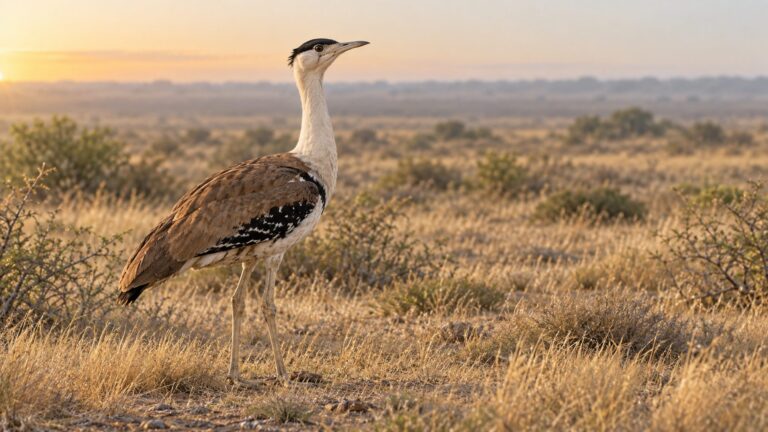
- Sensitive siting of renewables: The Ministry of New and Renewable Energy must align solar and wind corridor planning in Kutch with the CAF migration map and Great Indian Bustard recovery.
- Fertiliser and pesticide controls: The Ministry of Agriculture and Farmers Welfare and state agriculture departments should roll out buffer-zone natural-farming clusters around Patna Bird Sanctuary under Paramparagat Krishi Vikas Yojana.
- Remove Montreux blots: Targeted action to restore Keoladeo inflows from the Panchana dam and address Loktak’s Ithai Barrage regulation is needed to exit the Montreux Record.
- Wetland finance: RBI, SEBI and MoEFCC can together frame green-bond and biodiversity-credit instruments to channel private capital into wetland restoration under the Amrit Dharohar umbrella.
Conclusion
The addition of Patna Bird Sanctuary and Chhari-Dhand to the Ramsar list marks a quiet but consequential milestone in India’s conservation story. A small doab wetland in Uttar Pradesh and a brackish desert pan in Kutch now stand on the same global pedestal as Chilika and Keoladeo. The message is that wetlands come in many forms and each is worth saving.
For the UPSC aspirant, the event is a prompt to think beyond labels. India’s challenge is not to keep adding sites but to make each one function as a living, self-regulating ecosystem that supports biodiversity, livelihoods and climate resilience. The arithmetic of 98 is impressive. The test now is ecological character, community stewardship and the humility to learn from the two sites still on the Montreux Record.
Prelims Pointers
- The Ramsar Convention was adopted in 1971 in Ramsar, Iran, and came into force in 1975.
- India ratified the Convention in 1982. Chilika and Keoladeo were the first Indian Ramsar sites, designated in 1981.
- Wetlands of International Importance are designated against nine scientific criteria.
- The Montreux Record lists sites with adverse changes in ecological character. Keoladeo and Loktak remain on it from India.
- Patna Bird Sanctuary is in the Etah district of Uttar Pradesh, on the Central Asian Flyway.
- Chhari-Dhand Conservation Reserve lies in the Banni grasslands of Kutch, Gujarat.
- The Central Asian Flyway is one of nine global flyways and operates under the Bonn Convention on Migratory Species.
- Tamil Nadu has the largest number of Ramsar sites in India at 18.
- The Wetlands (Conservation and Management) Rules, 2017 govern Indian wetlands and empower State Wetland Authorities.
- Amrit Dharohar was announced in the 2023-24 Union Budget for community-led wetland conservation.
- Banni is Asia’s largest tropical grassland and faces invasion from Prosopis juliflora.
- With 98 Ramsar sites, India has the largest such network in Asia.
Mains Practice Question
Q. Mere designation of wetlands as Ramsar sites has not translated into ecological security on the ground in India. Examine with reference to recent additions and suggest a way forward. (15 marks, 250 words)
- Structure: introduce the Ramsar framework and India’s 98-site network, referencing Patna Bird Sanctuary and Chhari-Dhand.
- Argue the implementation gap using Montreux Record sites, Wetlands Rules 2017 enforcement weaknesses, and landscape pressures such as Prosopis, agriculture run-off and renewable corridors.
- Conclude with reforms: integrated management plans, Central Asian Flyway action, community-led conservation, green finance, and removal from the Montreux Record as a measurable goal.
Frequently Asked Questions
What is the Ramsar Convention and when did India join it?
The Ramsar Convention is a 1971 international treaty adopted in Ramsar, Iran for the conservation and wise use of wetlands. It entered into force in 1975. India acceded to it in 1982, and its first two designated sites were Chilika Lake in Odisha and Keoladeo National Park in Rajasthan, both listed in 1981.
Why are Patna Bird Sanctuary and Chhari-Dhand in the news in 2026?
In early 2026 the Ministry of Environment, Forest and Climate Change notified Patna Bird Sanctuary in Etah, Uttar Pradesh, and Chhari-Dhand Conservation Reserve in Kutch, Gujarat as India’s 97th and 98th Ramsar sites. The designations, made around World Wetlands Day, gave India the largest Ramsar network in Asia.
Where is Patna Bird Sanctuary located and what birds does it host?
Patna Bird Sanctuary, also called Patna Pakshi Vihar, is a small shallow wetland in the Etah district of Uttar Pradesh on the Central Asian Flyway. It hosts bar-headed geese, northern pintails, northern shovellers, common teals, ruddy shelducks, spot-billed ducks and sarus cranes, especially during the winter migration season.
What makes Chhari-Dhand ecologically unique?
Chhari-Dhand is a seasonal desert wetland inside the Banni grasslands of Kutch, Gujarat. Fed by rivers such as the Bhukhi and Naira, it floods in the monsoon into brackish pools that attract flamingos, Dalmatian pelicans, Indian skimmers and raptors, then dries to a saline flat in summer, demonstrating an arid-land wetland cycle.
What is the Central Asian Flyway?
The Central Asian Flyway is one of nine global migratory bird flyways. It spans about 30 countries from Arctic Russia and Siberia to the Indian Ocean, passing through India. It is coordinated through a non-binding action plan under the Bonn Convention on Migratory Species, which India has signed.
What is the Montreux Record and which Indian sites are on it?
The Montreux Record is a list maintained under the Ramsar Convention of wetlands that have suffered or are likely to suffer adverse changes in ecological character. From India, Keoladeo National Park in Rajasthan and Loktak Lake in Manipur remain on this list due to altered hydrology, invasive species and water regulation concerns.
How does the 2017 Wetlands Rules framework work in India?
The Wetlands (Conservation and Management) Rules, 2017 are issued under the Environment (Protection) Act, 1986. They set up State Wetland Authorities, require integrated management plans, prohibit reclamation, solid waste dumping and untreated effluent discharge, and define a regulated zone around notified wetlands to secure ecological character.
How does this topic help in UPSC preparation?
The topic covers Prelims facts on Ramsar, Montreux, flyways, CMS and Wetlands Rules, while supporting Mains GS3 answers on conservation, climate resilience and federal environmental governance. It also links to Amrit Dharohar, NPCA and community-led conservation, enabling cross-cutting answers that blend ecology, policy and diplomacy.
Tell Google you want more of this.
Add Anantam IAS as a preferred sourceOne tap, and this site shows up more often in your own Top Stories, AI Overviews and AI Mode. Remove it any time.