Why in News?
In April 2026, a Supreme Court bench led by Chief Justice Surya Kant issued notice on a public interest litigation that asks the Union government to extend the fundamental right to education under Article 21A of the Constitution to children in the 3 to 6 years age group. At present, the right covers only children aged 6 to 14, the bracket carved out by the 86th Constitutional Amendment Act, 2002 and operationalised through the Right of Children to Free and Compulsory Education Act, 2009.
The petitioner argued that early childhood care and education, now recognised globally as the single most consequential stage of human capital formation, cannot continue to sit outside the fundamental rights architecture when the National Education Policy 2020 itself treats the 3 to 8 years span as the foundational stage of schooling. The bench asked the Ministry of Education, the Ministry of Women and Child Development and the National Commission for Protection of Child Rights to file their responses within eight weeks.
The case has re-opened a long-pending constitutional and policy question, because the reach of Article 21A has remained frozen for more than two decades while the education system around it has been restructured by NEP 2020, the National Curriculum Framework for Foundational Stage 2022, and the integration of Anganwadis with pre-primary schooling under Mission POSHAN 2.0.
UPSC Relevance at a Glance
| Dimension | Details |
|---|---|
| GS Paper | GS2 — Polity and Governance |
| Prelims | Article 21A, 86th CAA 2002, RTE Act 2009, Article 45 DPSP, NEP 2020, NCFFS 2022, Anganwadi-Balvatika, POSHAN 2.0, NIPUN Bharat |
| Mains | Fundamental rights and DPSPs, education as a right, centre-state roles in schooling, ECCE, judicial review of social rights |
| Syllabus Tags | Indian Constitution, Fundamental Rights, Welfare Schemes, Issues relating to Development of Social Sector, Education |
Background and Context
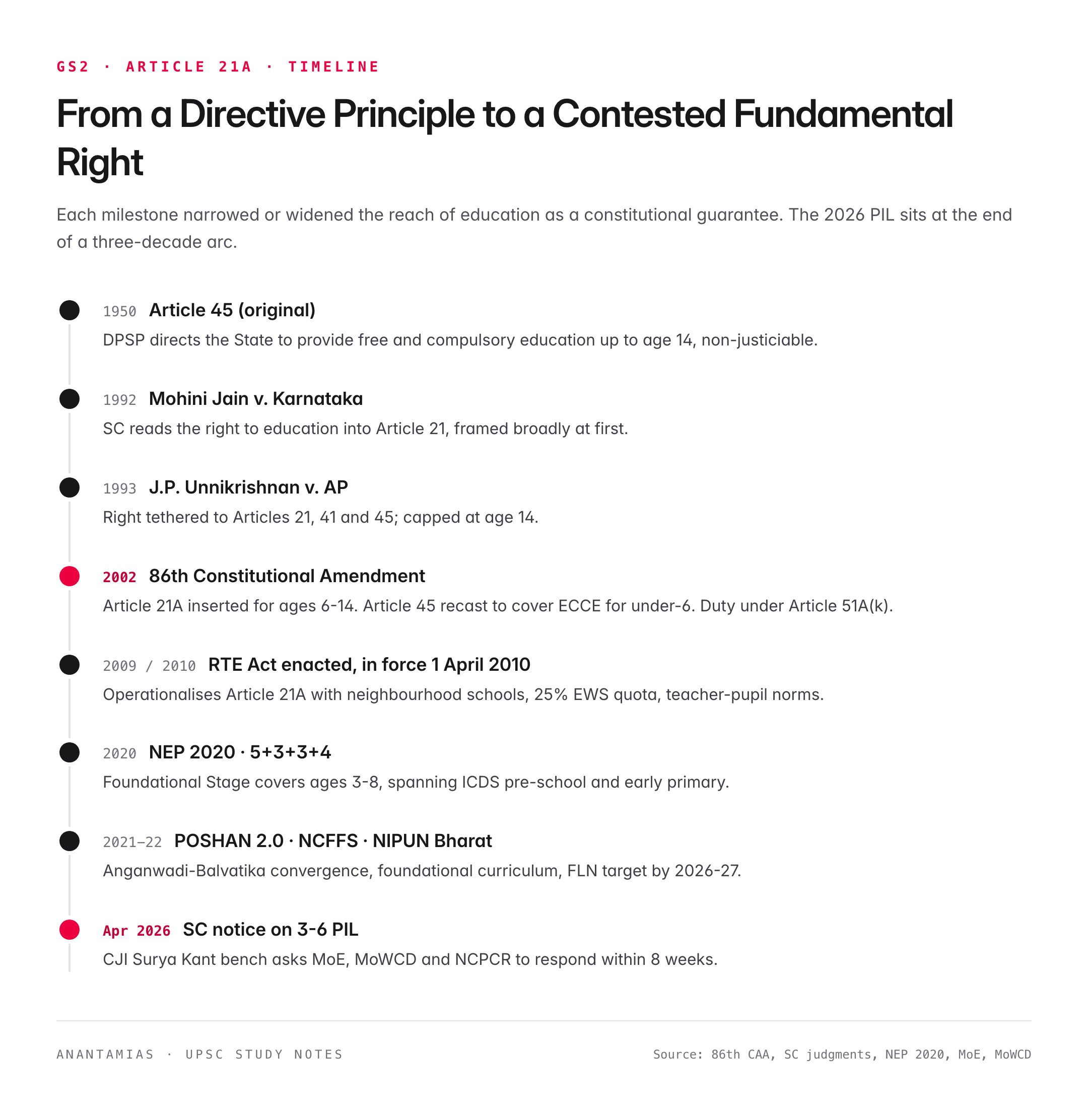
The Indian Constitution originally placed education entirely in the Directive Principles. The pre-2002 Article 45 directed the State to provide free and compulsory education for all children until they completed the age of fourteen years. It was aspirational, non-justiciable and fiscally soft.
Two Supreme Court judgments changed this trajectory. In Mohini Jain v. State of Karnataka (1992) the Court read a right to education into the right to life under Article 21, though framed widely. A year later, J.P. Unnikrishnan v. State of Andhra Pradesh (1993) refined this holding and tethered the right to Article 21 read with Articles 41 and 45, limiting it to children up to fourteen years. These decisions made it politically unsustainable to keep education outside the enforceable portion of the Constitution.
The 86th Constitutional Amendment Act, 2002 therefore inserted Article 21A, which reads that the State shall provide free and compulsory education to all children of the age of six to fourteen years in such manner as the State may, by law, determine. The same amendment recast Article 45, which now directs the State to provide early childhood care and education for all children until they complete the age of six years, and added a parental duty under Article 51A(k). Parliament operationalised Article 21A through the Right of Children to Free and Compulsory Education Act, 2009, which came into force on 1 April 2010.
Two structural gaps were baked into this settlement. The 3 to 6 years bracket, covering pre-primary, was left in the Directive Principles. And the 14 to 18 years bracket, covering secondary education, was left outside the fundamental right altogether. Flagship schemes have tried to paper over these gaps. Sarva Shiksha Abhiyan expanded elementary enrolment, Samagra Shiksha 2.0 integrated pre-school, elementary and secondary funding, and on the pre-school side the Integrated Child Development Services network of roughly 43 lakh Anganwadis reaches close to 8 crore beneficiaries. None of these schemes however carry the enforceable bite of a fundamental right.
Key Features of the PIL and the Policy Landscape
What the PIL seeks
The petition makes three linked prayers. First, a declaration that the phrase six to fourteen years in Article 21A be read down or read up to include children from three years onward, on the reasoning that the constitutional object of universal foundational education cannot be met if pre-primary is excluded. Second, a direction to amend the RTE Act, 2009 so that its neighbourhood school guarantee, free entitlement and teacher-pupil norms extend to Anganwadi-Balvatika pre-school sections. Third, a time-bound roadmap from the Union to converge ICDS pre-school with NEP 2020’s foundational stage.
The NEP 2020 foundational stage
NEP 2020 restructured school education into a 5+3+3+4 design. The first five years form the foundational stage and cover children from age three to eight. This cuts across the pre-school years of ICDS and the first two years of elementary school, making the ICDS-RTE boundary administratively awkward. The National Curriculum Framework for the Foundational Stage (NCFFS) 2022 then translated this design into a curriculum for play-based, activity-based learning across this unbroken five-year span.
Anganwadi-Balvatika integration under POSHAN 2.0
Mission POSHAN 2.0, launched in 2021, merged the erstwhile ICDS, POSHAN Abhiyaan and Scheme for Adolescent Girls. It has pushed for upgrading a subset of Anganwadis into Saksham Anganwadis with smart infrastructure, and for attaching Balvatika pre-school sections to primary schools. The architecture now looks like a shared 3 to 6 pre-school space supervised jointly by the Ministry of Women and Child Development and the Ministry of Education, with no single statutory guarantee of quality, attendance or teacher norms.
The learning crisis backdrop
ASER 2023 found that over 25 per cent of children in the 14 to 18 age group could not fluently read a Class 2 level text. The National Achievement Survey 2021 showed steep learning losses across Classes 3, 5, 8 and 10. The World Bank’s learning poverty metric, the share of 10 year olds unable to read a simple text, stood at over 50 per cent for India in post-pandemic assessments. NIPUN Bharat (2021) set a target of universal foundational literacy and numeracy by 2026-27, but the PIL argues that the target is impossible to meet when the first three years of the foundational stage have no enforceable right.
Who delivers pre-school today
| Provider | Ministry | Children covered |
|---|---|---|
| Anganwadi Centres (ICDS) | MoWCD | 3-6 years pre-school component, nutrition |
| Balvatika in government schools | MoE | Ages 5-6, pre-Class 1 |
| Private pre-schools and play groups | Unregulated | Urban, fee-paying |
| NGO-run ECCE centres | State-aligned | Often first-generation learners |
Significance
- Constitutional completion of Article 21A. Extension would close the gap between the 86th Amendment’s text and NEP 2020’s design, and would give the foundational stage a justiciable floor rather than a policy ceiling.
- Equity dividend. Children from Scheduled Caste, Scheduled Tribe, minority and migrant households depend overwhelmingly on Anganwadis for pre-school. A right-based guarantee would reduce the first-contact learning gap that shapes lifetime outcomes.
- Convergence lever. A constitutional guarantee would force the Ministry of Women and Child Development and the Ministry of Education to reconcile their standards for teachers, infrastructure, curriculum and assessment, a reform that administrative memoranda have failed to deliver.
- Alignment with SDG 4.2. The Sustainable Development Goal target 4.2 calls for universal access to quality early childhood development, care and pre-primary education by 2030. Article 21A extension makes India’s reporting on SDG 4.2 domestically enforceable rather than aspirational.
- Learning outcomes. Evidence from longitudinal studies shows that each additional year of quality pre-school increases learning outcomes at Class 5 by a measurable margin. NIPUN Bharat’s 2026-27 targets cannot be met without universalising quality pre-school.
- Judicial continuity. The PIL continues the trajectory of Mohini Jain and Unnikrishnan, applying a purposive reading of Article 21 that tracks contemporary understanding of child development.
Concerns and Challenges
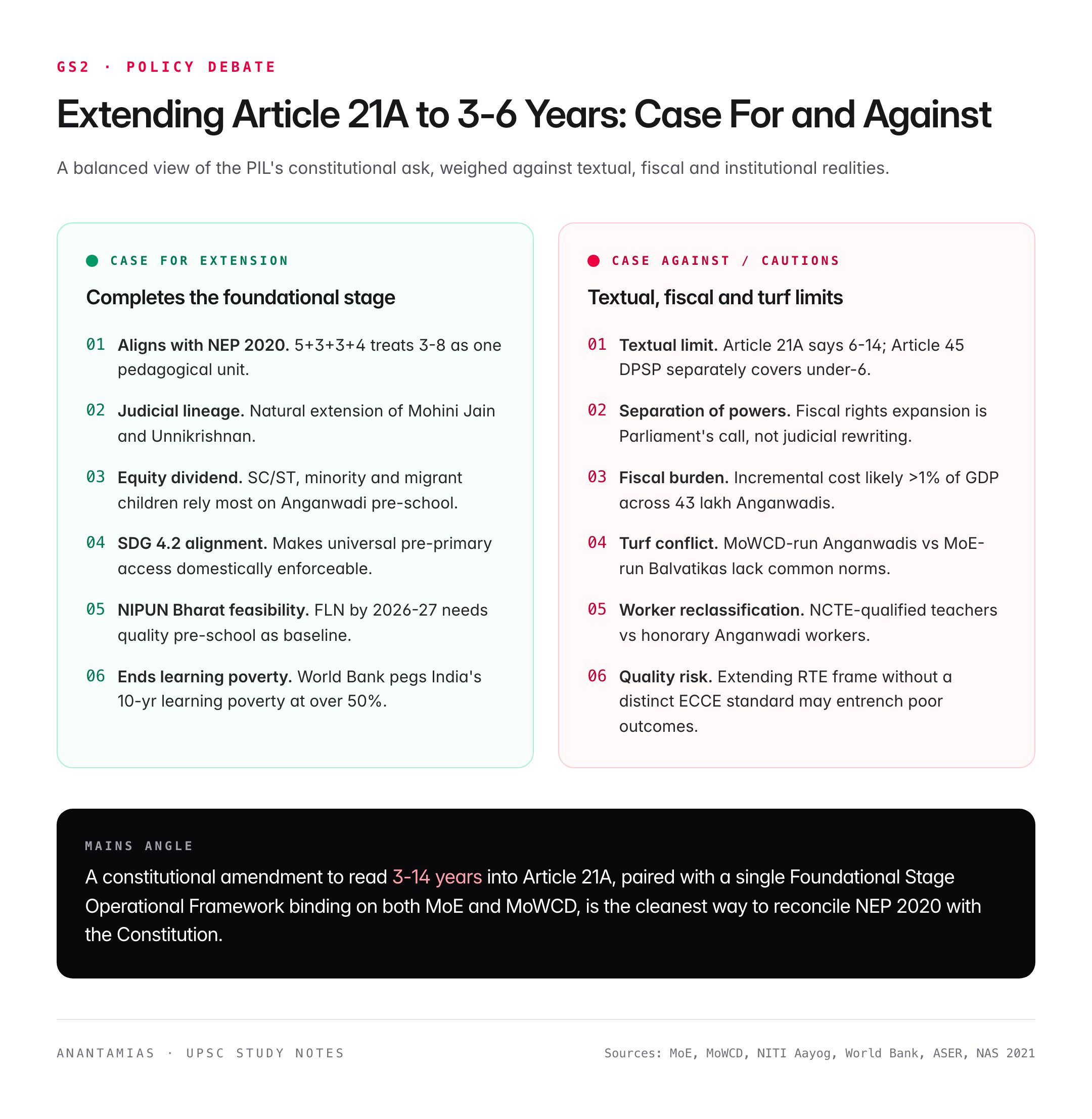
The most immediate objection is textual. Article 21A uses precise age language, six to fourteen years, and reading it to begin at three requires either a constitutional amendment or a very wide interpretive move. Critics argue that courts should not judicially re-write a provision whose drafting history shows Parliament deliberately chose to keep the 3 to 6 years band in Directive Principles under the revised Article 45. A judicial extension could also be politically brittle, since ICDS is a state-run programme in many states with varying fiscal capacity.
The second concern is fiscal. Extending the RTE Act to 3 to 6 years means universalising teacher-pupil ratios of 30:1 at the pre-primary level, upgrading infrastructure at 43 lakh Anganwadis, retraining Anganwadi workers into qualified pre-school educators, and absorbing the cost of neighbourhood school obligations. Rough estimates by policy think tanks place the recurring incremental cost at well over one per cent of GDP.
The third concern is institutional turf. Anganwadi workers are classified as honorary workers, not teachers, under the MoWCD framework. Reclassifying them as pre-primary teachers would collide with the National Council for Teacher Education’s qualification rules, and trigger litigation on service conditions, pay parity and pensionable status. States that have already moved pre-school into primary schools, such as Himachal Pradesh and Kerala, would be less affected than states where the Anganwadi model dominates.
The fourth concern is quality. An enforceable right without quality standards can produce box-ticking. The 25 per cent no-detention clause of the RTE Act was seen, rightly or wrongly, as having weakened accountability. Extending the same regime down to three years without a separate ECCE quality framework could entrench the learning crisis rather than resolve it.
Comparative and Historical Perspective
India’s exclusion of pre-primary from its education right is unusual among comparable economies. Most middle-income and OECD countries either include the last one to two pre-primary years in the compulsory schooling law or run a distinct universal ECCE entitlement.
| Country | Compulsory school age | Pre-primary status |
|---|---|---|
| India | 6-14 (Art 21A) | Directive principle only |
| United Kingdom | 5-16 | Free early education from age 3 |
| France | 3-16 | Compulsory pre-primary from 2019 |
| Brazil | 4-17 | Pre-primary compulsory from age 4 |
| South Africa | 7-15 | Reception year (Grade R) universal |
| China | 6-15 | Three-year pre-school campaign |
Within India, the historical trajectory has moved one step at a time. The Kothari Commission (1964-66) recommended ECCE as part of the school system. The National Policy on Education 1986 committed to a child-centred ECCE programme. The Justice J.S. Verma Committee on Teacher Education (2012) flagged the absence of qualified pre-primary teachers. NEP 2020 is the first policy to give ECCE a structural slot. The Article 21A extension PIL is the logical next move in this arc.
Way Forward
- Amend Article 21A by constitutional amendment to read three to fourteen years, rather than attempting a contested judicial re-reading. This keeps Parliament at the centre of a major fiscal commitment.
- Ministry of Education to publish a single Foundational Stage Operational Framework binding on both MoE-run Balvatikas and MoWCD-run Anganwadi pre-school sections, aligned with NCFFS 2022.
- Ministry of Women and Child Development to reclassify a tiered cadre of Anganwadi workers into a pre-primary educator stream, with NCTE-aligned qualifications, phased over five years.
- NITI Aayog to cost the transition and recommend a Finance Commission grant window dedicated to pre-primary universalisation, earmarked under Samagra Shiksha 2.0.
- NCPCR to be designated the grievance redressal body for pre-primary entitlements, mirroring its current RTE role.
- States to notify neighbourhood pre-school norms under their RTE rules, with a five-year glide path and annual social audits.
- MoE and MoWCD to jointly run an annual Foundational Stage Quality Index, disaggregated by district, gender, Scheduled Caste, Scheduled Tribe and minority status, and published alongside ASER and NAS.
Conclusion
The Article 21A extension question is not a narrow litigation about ages. It is a test of whether India’s rights architecture can keep pace with its policy architecture. NEP 2020, NCFFS 2022 and POSHAN 2.0 already treat the 3 to 6 years band as integral to schooling. Article 21A still does not. Bridging that gap is the unfinished business of the 86th Amendment.
For the examination aspirant, the case is a clean illustration of how fundamental rights, directive principles and statutes interact, and how judicial review, constitutional amendment and administrative convergence each do different work. Whether the Supreme Court reads up Article 21A, nudges Parliament, or simply flags the policy gap, the outcome will shape the foundational years of an entire cohort of Indian children.
Prelims Pointers
- Article 21A inserted by the 86th Constitutional Amendment Act, 2002.
- Article 21A currently guarantees free and compulsory education to children aged 6 to 14.
- Article 45 after 2002 directs the State to provide early childhood care and education for children below 6 years.
- Article 51A(k) makes it a fundamental duty of parents to provide educational opportunities to children between 6 and 14.
- RTE Act, 2009 came into force on 1 April 2010.
- Mohini Jain v. Karnataka (1992) first read right to education into Article 21.
- J.P. Unnikrishnan v. AP (1993) limited the right to children up to 14 years.
- NEP 2020 introduced the 5+3+3+4 structure with a 5-year Foundational Stage covering ages 3 to 8.
- NCFFS 2022 is the National Curriculum Framework for the Foundational Stage.
- Mission POSHAN 2.0 launched in 2021 integrates ICDS, POSHAN Abhiyaan and Scheme for Adolescent Girls.
- Approximately 43 lakh Anganwadis reach around 8 crore beneficiaries.
- NIPUN Bharat (2021) targets universal foundational literacy and numeracy by 2026-27.
- SDG 4.2 covers universal quality early childhood development and pre-primary education.
Mains Practice Question
Q. The current reach of Article 21A of the Constitution does not match the structure of the Foundational Stage under NEP 2020. In light of the recent Supreme Court notice on extending the right to education to children aged 3 to 6 years, examine the constitutional, fiscal and institutional implications of such an extension. (15 marks, 250 words)
Answer skeleton:
- Map the constitutional setting: 86th CAA 2002 text, Article 45 DPSP, Unnikrishnan lineage, and the 3-to-6 gap that sits outside Article 21A while NEP 2020 and NCFFS 2022 treat it as foundational.
- Evaluate the implications: fiscal load of universalising pre-primary, institutional turf between MoE and MoWCD, Anganwadi worker reclassification, NCTE qualification issues, and quality risk of extending RTE without a separate ECCE standard.
- Conclude with a balanced way forward: prefer a constitutional amendment over judicial re-reading, converge Balvatika and Anganwadi pre-school under a single operational framework, assign NCPCR grievance redressal, and cost the transition through a Finance Commission grant tied to Samagra Shiksha 2.0.
Frequently Asked Questions
What is Article 21A of the Indian Constitution?
Article 21A is a fundamental right inserted by the 86th Constitutional Amendment Act, 2002. It directs the State to provide free and compulsory education to all children aged six to fourteen years in such manner as the State may, by law, determine. Parliament operationalised it through the Right of Children to Free and Compulsory Education Act, 2009, which came into force on 1 April 2010.
Why is Article 21A in news in 2026?
In April 2026, a Supreme Court bench led by Chief Justice Surya Kant issued notice on a PIL seeking to extend the right to education under Article 21A to children in the three to six years age group. The petition argues that NEP 2020 treats ages three to eight as the foundational stage, yet this band sits outside the fundamental right, and seeks a constitutional or statutory bridge.
Which Supreme Court judgments shaped the right to education?
Mohini Jain v. State of Karnataka (1992) first read the right to education into Article 21. J.P. Unnikrishnan v. State of Andhra Pradesh (1993) refined this, tethering the right to Articles 21, 41 and 45 and capping it at fourteen years. These rulings created the political momentum for the 86th Constitutional Amendment Act, 2002, which inserted Article 21A as a standalone fundamental right.
What does NEP 2020 say about early childhood education?
NEP 2020 restructured school education into a 5+3+3+4 design. The first five years form the Foundational Stage and cover children aged three to eight, cutting across pre-school and the first two years of primary school. The National Curriculum Framework for the Foundational Stage 2022 translated this into a play-based, activity-based curriculum delivered jointly through Anganwadis and Balvatikas.
How do Anganwadis fit into pre-primary education?
About 43 lakh Anganwadi Centres under Mission POSHAN 2.0 reach close to 8 crore beneficiaries and run the pre-school component for ages three to six, alongside nutrition services. These are supervised by the Ministry of Women and Child Development. Balvatika sections in government schools, run by the Ministry of Education, cover ages five to six. The two systems operate in parallel without a common statutory floor.
What are the main concerns about extending Article 21A to 3-6 years?
Key concerns include textual limits of the provision, which speaks of ages six to fourteen, significant fiscal costs of universalising teacher-pupil ratios and infrastructure across 43 lakh Anganwadis, institutional turf between the Ministry of Education and the Ministry of Women and Child Development, reclassification of Anganwadi workers as teachers, and the risk of extending the RTE framework without a distinct ECCE quality standard.
How does India compare internationally on pre-primary rights?
Most comparable economies include pre-primary within compulsory schooling or run a universal ECCE entitlement. France made schooling compulsory from age three in 2019, Brazil from age four, the United Kingdom offers free early education from age three, and South Africa universalised its Grade R reception year. India is an outlier in keeping the 3 to 6 years band in the Directive Principles rather than within Article 21A.
How does this topic help UPSC preparation?
The case cleanly illustrates the interaction of fundamental rights, Directive Principles, constitutional amendments and statutes, which is central to GS2. It links Article 21A, Article 45, the 86th CAA, RTE Act 2009, NEP 2020, NCFFS 2022, Mission POSHAN 2.0, NIPUN Bharat and SDG 4.2 into a single chain, offering high-yield material for both Prelims factual questions and a Mains analytical answer on education as a right.
Tell Google you want more of this.
Add Anantam IAS as a preferred sourceOne tap, and this site shows up more often in your own Top Stories, AI Overviews and AI Mode. Remove it any time.