Why in News?
The Centre for Science and Environment (CSE) and its fortnightly magazine Down To Earth released the annual State of India’s Environment 2026 report in April 2026. The headline finding is that seven of the nine planetary boundaries defined by the Stockholm Resilience Centre have now been crossed, with ocean acidification added to the list of breached thresholds in the 2026 update.
The report stitches together India-specific data on air quality, groundwater, land-use change, biodiversity loss, chemical pollution and greenhouse gas emissions, and compares the 2026 picture with the State of Environment 2024-25 volume. It argues that the global diagnosis is no longer an abstract Earth-system warning but a practical input for domestic policies on clean air, water security and Panchamrit climate targets announced at COP26 in Glasgow.
For the UPSC aspirant, the report revives the Rockström framework of 2009, tracks how the 2023 Richardson et al. update in Science Advances raised the count of breached boundaries to six, and situates India’s Lifestyle for Environment (LiFE) Mission and National Adaptation Plan within a planet under stress.
UPSC Relevance at a Glance
| Field | Mapping |
|---|---|
| GS Paper | GS3 — Environment, Conservation, Pollution, Climate Change |
| Prelims | Planetary boundaries, Rockström 2009, Richardson 2023, CSE, DTE, IPCC AR6, Panchamrit, LiFE, CGWA |
| Mains | Earth-system science for policy; India’s air and water stress; Panchamrit progress; reconciling growth with planetary limits |
| Syllabus Tags | Environment, Biodiversity, Pollution, Climate Change, Sustainable Development |
Background and Context
The planetary boundaries framework was first proposed in 2009 by Johan Rockström and colleagues in Nature and Ecology and Society. It identified nine Earth-system processes that together regulate the stability of the Holocene-like conditions in which human civilisation evolved. The original paper placed three boundaries in the breached zone: climate change, biosphere integrity and the nitrogen cycle.
A 2015 update by Will Steffen and co-authors refined the metrics, split biosphere integrity into genetic and functional diversity, and introduced the novel entities boundary to capture synthetic chemicals and plastics. The 2023 reassessment led by Katherine Richardson quantified all nine for the first time and concluded that six boundaries were outside the safe operating space: climate change, biosphere integrity (both components), land-system change, freshwater change, biogeochemical flows (nitrogen and phosphorus) and novel entities.
Domestically, the Ministry of Environment, Forest and Climate Change has tracked environmental health through the State of Environment Report, the India State of Forest Report and the India State of Air publications. The CSE’s parallel State of India’s Environment volume, first published in the 1980s by Anil Agarwal, has become a widely cited civil-society tracker. India has also made five international commitments at COP26, branded as Panchamrit, covering 500 GW non-fossil capacity, 50 percent renewable electricity, one billion tonnes cumulative emission reduction, 45 percent emissions intensity cut by 2030 and net zero by 2070.
The 2026 report argues that these national commitments must now be read against a biosphere where the ocean acidification boundary, rooted in the aragonite saturation of surface waters, has also slipped into the unsafe zone.
Key Findings
The nine boundaries, after 2026
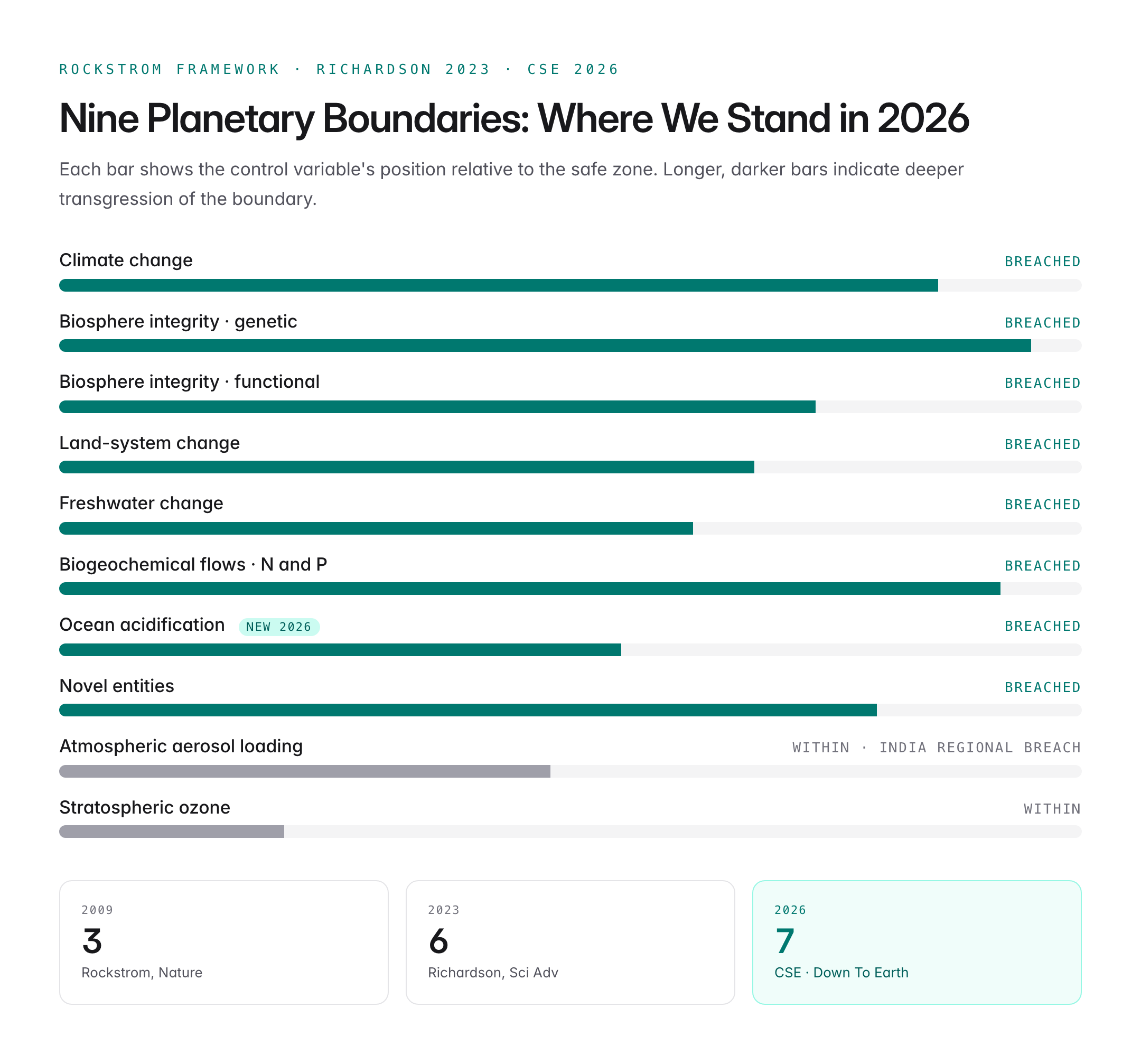
The framework tracks nine control variables. The 2026 edition maps them as follows.
| Boundary | Indicator | 2009 | 2023 | 2026 |
|---|---|---|---|---|
| Climate change | CO2 ppm, radiative forcing | Breached | Breached | Breached |
| Biosphere integrity (genetic) | Extinction rate | Breached | Breached | Breached |
| Biosphere integrity (functional) | BII | Not defined | Breached | Breached |
| Land-system change | Forest cover | Within | Breached | Breached |
| Freshwater change | Blue and green water | Within | Breached | Breached |
| Biogeochemical flows (N, P) | Reactive flows | Breached | Breached | Breached |
| Ocean acidification | Aragonite saturation | Within | Within | Breached |
| Atmospheric aerosol loading | AOD | Within | Within | Within (India regional breach) |
| Stratospheric ozone | O3 column | Within | Within | Within |
| Novel entities | Synthetic chemicals, plastics | Not defined | Breached | Breached |
Only stratospheric ozone and the global aerosol mean remain clearly within the safe space, the latter masking sharp regional exceedances over the Indo-Gangetic Plain.
India-specific signals
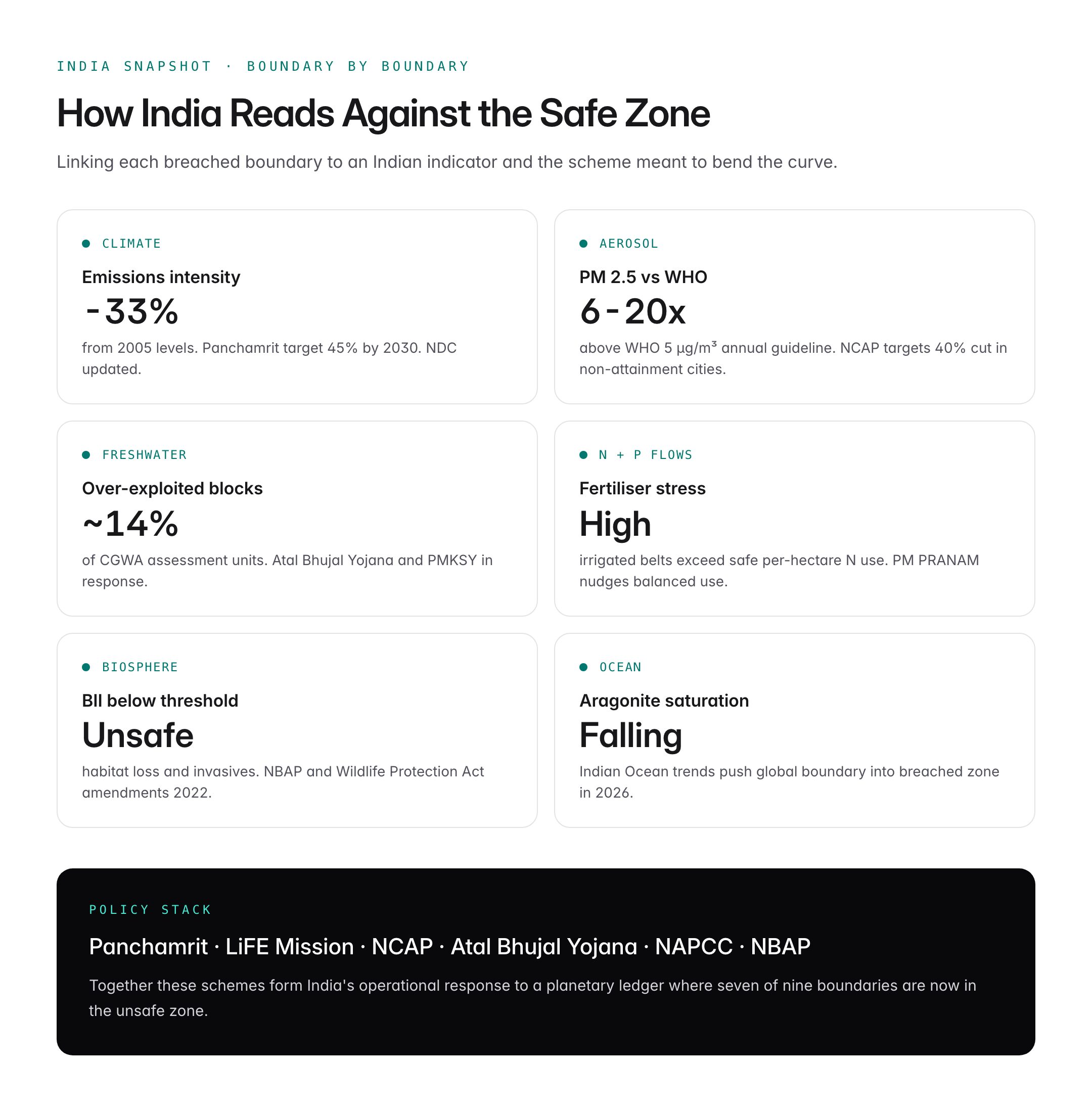
Air quality. The report reiterates that Indian cities continue to breach the World Health Organization’s 2021 PM 2.5 guideline of 5 micrograms per cubic metre annual average by a factor of six to twenty. The National Clean Air Programme target of a 40 percent reduction over 2017 levels by 2026 has been met in a minority of non-attainment cities.
Water. The Central Ground Water Authority classification, updated in the 2024 assessment, flags that roughly 14 percent of assessment units are over-exploited. Punjab, Haryana, Rajasthan and parts of western Uttar Pradesh remain structural hotspots, aligning India with the freshwater-change boundary breach.
Land and forests. The India State of Forest Report 2023 showed a marginal increase in total forest and tree cover, but CSE’s analysis flags loss of very dense forest in the Northeast and encroachment pressure in central India, consistent with the land-system change boundary.
Biodiversity. The report draws on IUCN assessments and the National Biodiversity Action Plan to argue that the Biosphere Integrity Index for India sits below the safe threshold, driven by habitat fragmentation and invasive species.
GHG trajectory. India’s emissions intensity of GDP has fallen by more than 33 percent from 2005 levels, meeting the pre-2030 milestone ahead of schedule, while absolute emissions continue to rise with growth.
Ocean acidification added
The 2026 report highlights new measurements of aragonite saturation in the Indian Ocean showing a sustained decline through the 2020s, which, combined with the global mean, pushes the ocean acidification variable into the unsafe zone. This matters for Indian fisheries and coral systems in the Lakshadweep and Andaman seas.
Significance
- It moves the planetary boundaries concept from a research frame to an operational one by linking each boundary to Indian indicators and schemes.
- It strengthens the case for the LiFE Mission launched at COP26 in Glasgow and formally adopted by the Union Cabinet, as it quantifies how consumption patterns press on multiple boundaries simultaneously.
- It offers a framework to read IPCC AR6 findings through an Indian lens, particularly the Working Group II chapter on Asia and the Synthesis Report of 2023.
- It provides a measurable baseline to judge Panchamrit delivery and the updated Nationally Determined Contribution submitted to the UNFCCC.
- It widens the policy conversation from carbon alone to nitrogen, phosphorus, freshwater and novel entities such as microplastics and PFAS compounds.
- It equips sub-national actors, including State Action Plans on Climate Change and city Clean Air Action Plans, with a comparable yardstick.
Concerns and Challenges
The report is not without pushback. Several Earth-system scientists argue that converting a global safe operating space into national dashboards risks double counting, since boundaries interact and national shares are contested. The nitrogen boundary is a familiar example. India’s per-hectare fertiliser use exceeds global safe levels in irrigated belts, yet per-capita consumption remains below that of several OECD economies, raising a fairness question already flagged in the Common But Differentiated Responsibilities principle of the UNFCCC.
Data gaps pose a second problem. The novel entities boundary depends on inventories of synthetic chemicals and plastic flows that India is only beginning to build through the Extended Producer Responsibility framework under the Plastic Waste Management Rules 2016, as amended in 2022 and 2024. Without granular monitoring, the assessment remains qualitative.
A third concern is the risk of a counsel of despair. If seven boundaries are already breached, policy can slip into fatalism or, worse, into a narrative that justifies slowing the energy transition because the damage is done. The report pushes back by using the language of return to the safe space, emphasising that boundary transgression is not a cliff but a rising probability of abrupt change.
Finally, questions of equity remain central. India houses about 18 percent of humanity on about 2.4 percent of the land and contributes around 7 percent of current annual CO2 emissions and under 4 percent of cumulative emissions since 1850. Mapping national responsibility for global boundaries must grapple with this historical asymmetry.
Comparative / Historical Perspective
| Year | Milestone | Breached boundaries |
|---|---|---|
| 2009 | Rockström et al., Nature | 3: climate, biosphere integrity, nitrogen |
| 2015 | Steffen et al., Science | 4: adds land-system change |
| 2023 | Richardson et al., Science Advances | 6: adds freshwater, novel entities, biosphere functional |
| 2026 | CSE State of India’s Environment | 7: adds ocean acidification |
The progression tells a familiar story. Each iteration has added variables or reclassified existing ones as the science has sharpened, and each has tightened the window for course correction. The Indian trajectory maps onto this arc, with the National Action Plan on Climate Change of 2008, the Swachh Bharat Mission of 2014, the National Clean Air Programme of 2019 and the LiFE Mission of 2022 acting as policy responses to successive boundary concerns.
Way Forward
- The Ministry of Environment, Forest and Climate Change should publish an annual Planetary Boundaries and India dashboard, integrating CPCB, CGWA and Forest Survey of India data.
- The Ministry of Agriculture and Farmers Welfare, working with the Indian Council of Agricultural Research, should accelerate the shift to balanced fertilisation under the PM PRANAM scheme to address the nitrogen and phosphorus flows boundary.
- The Central Ground Water Authority should move from notifying critical blocks to enforcing demand-side pricing reforms in over-exploited units, aligned with the Atal Bhujal Yojana.
- The Ministry of Earth Sciences should expand aragonite saturation and chlorophyll monitoring in the Bay of Bengal and Arabian Sea to feed into the ocean acidification tracker.
- The Ministry of Chemicals and Fertilizers and the Central Pollution Control Board should build a novel entities inventory covering PFAS, pharmaceuticals and microplastics under the Chemicals Management Rules framework.
- The Ministry of Power and the Ministry of New and Renewable Energy should hold the Panchamrit line on 500 GW non-fossil capacity while hardening the grid through storage and transmission reform.
- NITI Aayog and the Finance Commission should price ecosystem services into devolution formulae, building on the forest-cover weight introduced by the Fifteenth Finance Commission.
Conclusion
The State of India’s Environment 2026 report delivers a blunt message. The Earth system has moved further out of its Holocene safe space, and ocean acidification has joined the list of breached boundaries. For India, the utility of the framework lies in its capacity to connect what feel like separate problems, Delhi’s winter smog, Punjab’s falling water table, the Nilgiris’ thinning biodiversity and the warming Bay of Bengal, into a single diagnosis of planetary pressure.
The policy task is to translate this diagnosis into schemes that already exist, from the National Clean Air Programme to the Atal Bhujal Yojana to the LiFE Mission, and to build the data infrastructure that lets India hold itself and others accountable. A civilisation that has crossed seven of nine boundaries cannot afford another decade of incremental action.
Prelims Pointers
- The planetary boundaries framework was proposed by Johan Rockström and colleagues in 2009.
- The 2015 update was led by Will Steffen and published in Science.
- The 2023 update led by Katherine Richardson identified six breached boundaries.
- The nine boundaries are climate change, biosphere integrity, land-system change, freshwater change, biogeochemical flows, ocean acidification, atmospheric aerosol loading, stratospheric ozone and novel entities.
- Biosphere integrity is split into genetic diversity and functional diversity.
- The novel entities boundary covers synthetic chemicals, plastics and engineered materials.
- The CSE was founded by Anil Agarwal and publishes Down To Earth.
- Panchamrit was announced by Prime Minister at COP26 Glasgow in 2021.
- The LiFE Mission was launched in 2022.
- The WHO 2021 PM 2.5 annual guideline is 5 micrograms per cubic metre.
- The Central Ground Water Authority classifies blocks as safe, semi-critical, critical and over-exploited.
- IPCC AR6 Synthesis Report was released in 2023.
Mains Practice Question
Question, 15 marks. The planetary boundaries framework has evolved from three breached thresholds in 2009 to seven in the 2026 assessment. Examine its usefulness in designing India’s environmental policy, with reference to air, water and biodiversity indicators.
Answer skeleton:
- Introduce the framework, trace the 2009 to 2026 arc, and name the seven breached boundaries, highlighting ocean acidification as the 2026 addition.
- Map each boundary to an Indian indicator and scheme, for example PM 2.5 and NCAP for aerosols, CGWA for freshwater, BII for biodiversity, Panchamrit for climate.
- Conclude with a balanced view on limits of the framework, equity concerns, and the integration agenda for a national planetary boundaries dashboard.
Frequently Asked Questions
What is the planetary boundaries framework?
It is an Earth-system science framework first proposed by Johan Rockstrom and colleagues in 2009 that identifies nine biophysical processes regulating the stability of the planet. Each boundary has a control variable and a safe threshold, and crossing it raises the risk of abrupt, non-linear change in the Earth system.
Why is the State of India’s Environment 2026 report in news?
The Centre for Science and Environment and Down To Earth released the April 2026 edition. Its headline finding is that seven of the nine planetary boundaries are now breached, with ocean acidification added for the first time, and it maps India-specific air, water, land and biodiversity signals against these boundaries.
Which seven boundaries are breached in 2026?
Climate change, biosphere integrity covering genetic and functional diversity, land-system change, freshwater change, biogeochemical flows of nitrogen and phosphorus, novel entities, and now ocean acidification. Stratospheric ozone and atmospheric aerosol loading remain within the global safe space, although India shows strong regional aerosol breach.
How does the 2023 Richardson update differ from the 2009 Rockstrom paper?
The 2009 paper flagged three breached boundaries: climate change, biosphere integrity and the nitrogen cycle. The 2023 Richardson et al update in Science Advances quantified all nine for the first time, split biosphere integrity into genetic and functional diversity and pushed the count of breached boundaries to six.
What is Panchamrit and how is it linked to this report?
Panchamrit is the five-fold climate commitment India announced at COP26 Glasgow in 2021, covering 500 GW non-fossil capacity, 50 percent renewable electricity, a billion tonne cumulative emission cut, 45 percent emissions intensity reduction by 2030 and net zero by 2070. The report uses Panchamrit as the benchmark for India’s contribution to the climate boundary.
What does the report say about India’s air and water stress?
It notes that most Indian cities breach the WHO PM 2.5 guideline of 5 micrograms per cubic metre by a wide margin and that the Central Ground Water Authority classifies around one in seven assessment units as over-exploited, with Punjab, Haryana and Rajasthan as structural hotspots for the freshwater boundary.
What is the LiFE Mission?
Lifestyle for Environment is a mission launched by India in 2022 and formally adopted by the Union Cabinet to nudge individual and community behaviour toward sustainable consumption. The 2026 report treats it as a demand-side complement to the supply-side Panchamrit targets and to the National Action Plan on Climate Change.
How does this help UPSC preparation?
The topic cuts across GS3 Environment, Conservation, Pollution and Climate Change, and feeds prelims with names, years and numbers such as Rockstrom 2009, Richardson 2023, Panchamrit, NCAP and the nine boundaries. It also anchors a strong mains answer that links global Earth-system science to Indian schemes and data.
Tell Google you want more of this.
Add Anantam IAS as a preferred sourceOne tap, and this site shows up more often in your own Top Stories, AI Overviews and AI Mode. Remove it any time.