Daily Digest
UPSC · Civil Services Examination
Current Affairs · Wednesday, 15 July 2026
Current affairs curated and edited by Anantam IAS faculty — pulled from The Hindu, PIB, IDSA, Foreign Affairs and the ministries. Read, annotate, revise.
Old Rajinder Nagar · Delhi 110005 · anantamias.com
Food-delivery platforms and the duty to delist unlicensed outlets
Why in News?
The Cyberabad Municipal Corporation (CMC) issued compliance directions on 14 July 2026 requiring Swiggy and Zomato to allow only food outlets with a valid FSSAI licence or registration and a valid municipal trade licence on their platforms.
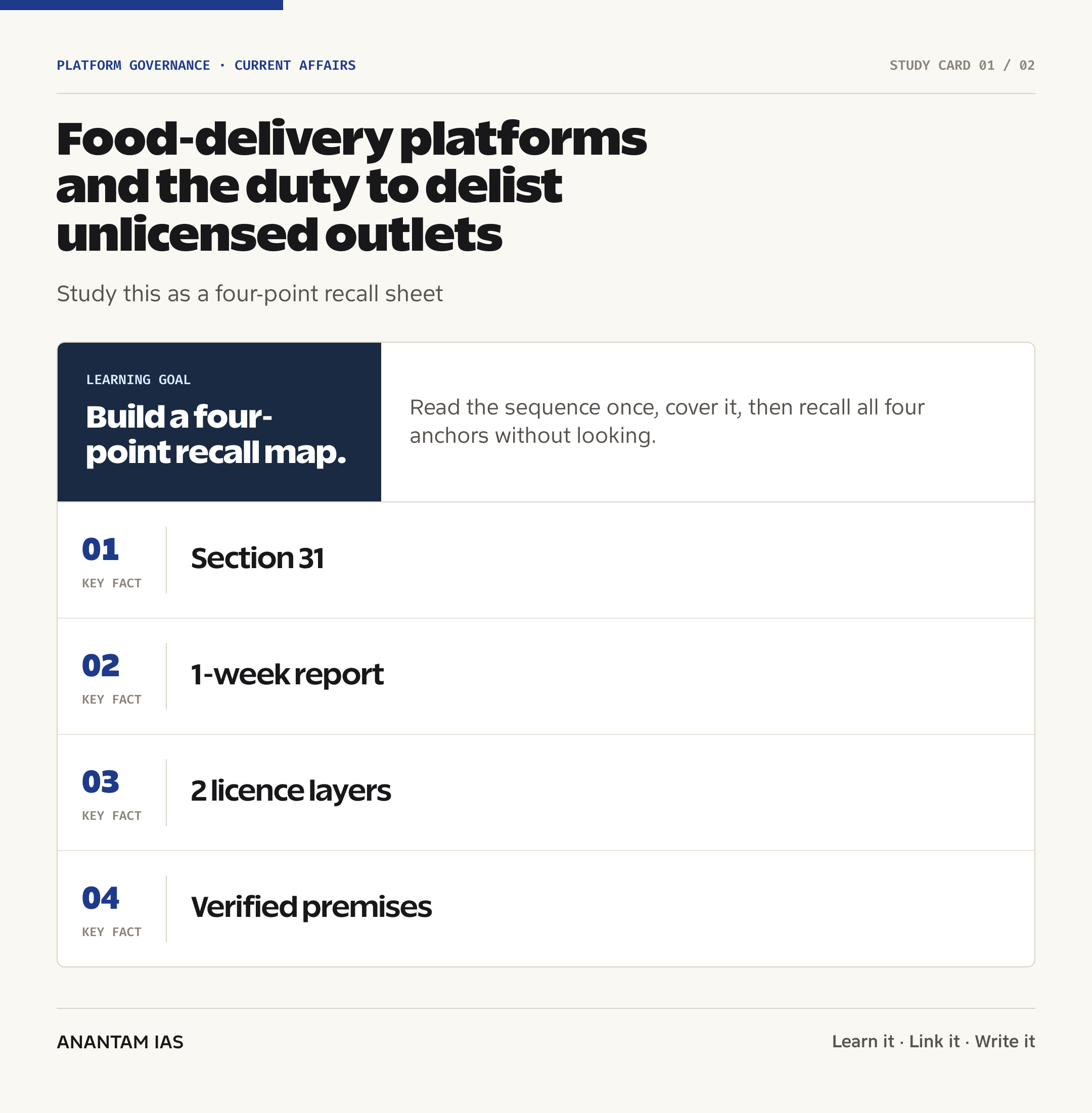
The Hindu reported that the platforms must delist non-compliant outlets, verify the geo-location and approved premises of sellers, disclose how ratings and reviews are handled, appoint a nodal officer and submit a compliance report within one week.
- CMC’s Health and Sanitation section issued the notice as part of food-safety enforcement within the civic body’s jurisdiction.
- An outlet must be removed if its licence is expired, suspended or cancelled, or if a competent authority has ordered its delisting.
- Food must be prepared and dispatched only from the approved and registered premises whose geo-location appears on the platform.
- The platforms were asked to explain their criteria for food ratings, hygiene ratings and customer reviews.
- The notice sought the policy governing removal, alteration or suppression of negative customer reviews.
The development matters in the context of:
- The case turns a platform from a passive listing service into a compliance gatekeeper when it facilitates a food transaction.
- It links national food-safety regulation with municipal licensing and inspection, showing India’s multi-level regulatory structure.
- Accurate outlet identity, licence status and location reduce the gap between a digital storefront and the physical kitchen that prepares food.
UPSC Relevance
Prelims Relevance
- The Food Safety and Standards Authority of India (FSSAI) is a statutory authority under the Food Safety and Standards Act, 2006.
- Under Section 31 of the 2006 Act, every Food Business Operator must obtain the applicable licence or registration.
- The Food Safety and Standards (Licensing and Registration of Food Businesses) Regulations, 2011 govern licensing, registration and hygiene conditions.
- An e-commerce entity that both lists food businesses and facilitates orders or transactions requires a central FSSAI licence.
- FSSAI’s e-commerce rules require sellers’ valid licence or registration details to be displayed on the platform.
- FoSCoS is FSSAI’s Food Safety Compliance System for licensing, registration and related regulatory services.
- A municipal trade licence and an FSSAI licence serve different regulatory purposes; possession of one doesn’t replace the other.
- The Food Safety Connect system lets consumers submit food-safety grievances, including complaints involving online aggregators.
Mains Relevance
GS Paper 2
- Regulatory governance of digital intermediaries and allocation of responsibility across platforms, sellers and public authorities.
- Public-health enforcement through coordination among FSSAI, State food-safety authorities and urban local bodies.
- Transparency in digital ratings, grievance redressal and protection against information asymmetry.
GS Paper 3
- Formalisation of food businesses and traceability across the digital food supply chain.
- Balancing innovation and ease of doing business with risk-based food-safety compliance.
Essay
- Trust in the digital economy depends on institutions that connect online claims with physical accountability.
- Technology can widen markets, but public regulation must ensure that convenience doesn’t dilute safety.
Background and Context
India's food-safety architecture
India uses a national standards framework with decentralised enforcement across States and local jurisdictions.
- The Food Safety and Standards Act, 2006 consolidated several food laws and created a common legal framework for food standards and safety.
- FSSAI sets standards and issues regulations, advisories and directions, while State and Union Territory authorities carry out much of the licensing, inspection and enforcement work.
- A Food Business Operator (FBO) is the person or entity responsible for ensuring that the requirements of food law are met within the food business under its control.
- Licensing isn’t merely an entry formality: it identifies the responsible business, its premises and the activities for which approval has been granted.
- The broader syllabus connection includes India’s State Food Safety Index, which compares institutional food-safety performance across States and Union Territories.

Why platforms carry compliance duties
A platform that enables orders shapes market access and can prevent an unverified seller from reaching consumers at scale.
- The e-commerce licensing framework distinguishes a mere listing or directory from an entity that facilitates orders or transactions; the latter falls within the regulated food-business ecosystem.
- FSSAI’s December 2024 advisory reiterated that no e-commerce FBO should list a seller without displaying a valid FSSAI licence or registration.
- Platforms must build verification into onboarding and conduct periodic revalidation, because a licence that was valid at entry can later expire, be suspended or be cancelled.
- A delisting direction is a form of preventive regulation: it limits exposure to a potentially non-compliant outlet before harm spreads across a large customer base.
- Platform responsibility doesn’t erase the seller’s primary duty. It creates layered accountability in which the outlet, aggregator and regulator each control a different risk point.
Licence, premises and traceability
A valid number on an app is insufficient if the displayed restaurant and the kitchen preparing the meal aren’t the same regulated premises.
- CMC required the platforms to maintain the accurate geo-location of every listed food establishment.
- The order seeks to prevent food being prepared at an unapproved cloud kitchen or alternate premises that inspectors and consumers can’t reliably identify.
- A municipal trade licence addresses local permission to carry on the business, while FSSAI approval addresses the food-safety regulatory identity of the operator and premises.
- Reliable mapping among the outlet name, physical address, licence number and platform account makes inspections and recalls more effective.
- Traceability also matters when authorities investigate adulteration, unsafe handling or misleading labelling, themes explained in the food adulteration and FSSAI rules notes.
Ratings, reviews and information integrity
Digital ratings influence consumer choice, but popularity scores aren’t the same as verified regulatory compliance.
- CMC asked for the criteria used to assign food ratings, hygiene ratings and customer reviews, bringing algorithmic and moderation practices into regulatory scrutiny.
- A customer may interpret a high app score as a safety signal even when it largely measures taste, price, packaging or delivery experience.
- Platforms should clearly separate user-generated ratings from an official hygiene rating or verified licence status.
- Rules on removal or suppression of negative reviews affect consumer information; opaque moderation can hide recurring complaints or create a misleading impression of quality.
- Review governance needs procedural safeguards against fake reviews and abusive content without allowing genuine safety complaints to disappear without a traceable reason.
Cooperative and local governance
Food delivery crosses administrative layers, so enforcement works only when information moves quickly between them.
- FSSAI provides the national standards framework, but local inspections reveal whether a listed kitchen actually follows sanitation and licensing requirements.
- CMC’s demand for a designated nodal officer creates a clear point of responsibility for notices, inspection findings and compliance reports.
- An official communication channel can shorten the delay between a regulator’s order and the platform’s delisting action.
- Shared data should follow purpose limitation and data minimisation; regulators need compliance information, not unrestricted access to customer data.
- Comparable challenges appear in regulated food programmes such as food fortification in India, where standards, labelling and field enforcement must work together.
Benefits, risks and implementation gaps
Platform-based verification can scale enforcement, but poor design can create false assurance or exclude small legitimate businesses.
- Automated licence checks can reduce the cost of monitoring thousands of listings and make expiry-based suspension faster.
- A verified badge must reflect current official records; stale or mismatched data can produce false compliance signals.
- Small food businesses may need assisted registration and clear notice before delisting, except where an immediate public-health risk requires urgent action.
- A grievance system should support consumers in reporting unsafe food and should route complaints to the relevant platform, food authority or municipal body.
- Enforcement metrics should measure verified compliance, time taken to act and repeat violations, not just the raw number of outlets removed.
Way Forward
Build licence checks into the platform
- Connect onboarding and periodic reviews with FoSCoS-backed verification wherever secure, lawful interoperability is available.
- Trigger alerts before expiry and automatically pause a listing when a licence becomes invalid, subject to a documented correction process.
Make the physical outlet traceable
- Match each platform listing with the approved premises, address and geo-location, and prevent dispatch from an unregistered alternate kitchen.
- Give inspectors a fast channel to flag a mismatch and require platforms to preserve an auditable action trail.
Separate safety signals from popularity
- Display the seller’s verified licence status distinctly from customer star ratings and explain what each score measures.
- Publish a transparent review-moderation policy with reasons, appeal routes and safeguards for genuine public-health complaints.
Use proportionate, coordinated enforcement
- Create standard protocols among food-safety departments, municipal bodies and platforms for notice, delisting, reinstatement and repeat violations.
- Combine penalties for wilful evasion with registration support and clear compliance guidance for small food businesses.
Conclusion
The Cyberabad notice shows that platform governance isn’t separate from public-health governance. When an app controls discovery and orders, it also controls a practical checkpoint for keeping unlicensed outlets away from consumers.
The durable solution is a transparent chain of responsibility: verified sellers, traceable premises, intelligible ratings, responsive platforms and coordinated regulators. That approach protects consumers without treating every small business as a bad actor.
UPSC Practice Questions
Prelims MCQ 1
With reference to food-business regulation in India, consider the following statements:
- FSSAI is a statutory authority established under the Food Safety and Standards Act, 2006.
- Section 31 of the Act deals with licensing and registration of food businesses.
- A municipal trade licence automatically substitutes for FSSAI licensing or registration.
How many of the above statements are correct?
(a) Only one (b) Only two (c) All three (d) None
Answer: (b) Only two
Explanation:
Statements 1 and 2 are correct. A municipal trade licence and an FSSAI licence or registration serve distinct legal purposes; one doesn’t automatically replace the other.
Prelims MCQ 2
Which one of the following best explains why a food-delivery platform may be treated as an e-commerce Food Business Operator?
(a) It publishes customer reviews without moderating them (b) It owns every restaurant listed on its interface (c) It lists food businesses and facilitates orders or transactions (d) It delivers only packaged food across State boundaries
Answer: (c) It lists food businesses and facilitates orders or transactions
Explanation:
The regulatory distinction turns on facilitating food orders or transactions, not on owning every seller or operating across State borders.
UPSC Mains Questions
- Digital food-delivery platforms are no longer neutral directories; they are compliance checkpoints in the public-health system. Discuss this proposition with reference to FSSAI licensing, municipal regulation, traceability and consumer grievance redressal.
- How can India make ratings and reviews on online marketplaces more transparent without weakening legitimate content moderation? Suggest a governance framework that balances consumer protection, platform accountability and procedural fairness for small businesses.
Sources: Food Safety and Standards Authority of India and The Hindu.
Frequently Asked Questions
What did Cyberabad direct the platforms to do?
CMC directed Swiggy and Zomato to retain only outlets with valid FSSAI approval and municipal trade licences, remove outlets with invalid licences, verify premises and geo-locations, disclose rating and review methods, appoint a nodal officer and file a compliance report within one week.
Why does an outlet need FSSAI approval?
Section 31 of the Food Safety and Standards Act, 2006 requires every Food Business Operator to obtain the applicable licence or registration. The approval links the responsible operator and premises to food-safety duties, regulatory oversight and enforcement.
Is a trade licence the same as FSSAI registration?
No. A municipal trade licence permits a business to operate under applicable local law, while FSSAI licensing or registration identifies and regulates the food business under the national food-safety framework. An outlet may need both approvals.
Why must platforms verify the kitchen location?
Location verification connects the digital listing to the physical premises where food is prepared and dispatched. It helps prevent unapproved kitchens from operating behind another outlet’s identity and lets inspectors, consumers and regulators identify the responsible establishment.
Are app ratings official hygiene ratings?
Not necessarily. Customer ratings may reflect taste, price, packaging or delivery, while an official hygiene rating follows a defined food-safety assessment. Platforms should label these signals separately so consumers don’t mistake popularity for verified regulatory compliance.
What is the main governance lesson?
Responsibility should follow control. Sellers control food preparation, platforms control listing and transaction access, and regulators control standards and enforcement. Connecting these roles through verification, traceability, transparent reviews and time-bound communication produces stronger public-health protection.
Source: https://anantamias.com/current-affairs/food-delivery-platforms-unlicensed-outlets/
Nepal’s New Government: Governance Reform and Civic-Space Concerns
Why in News?
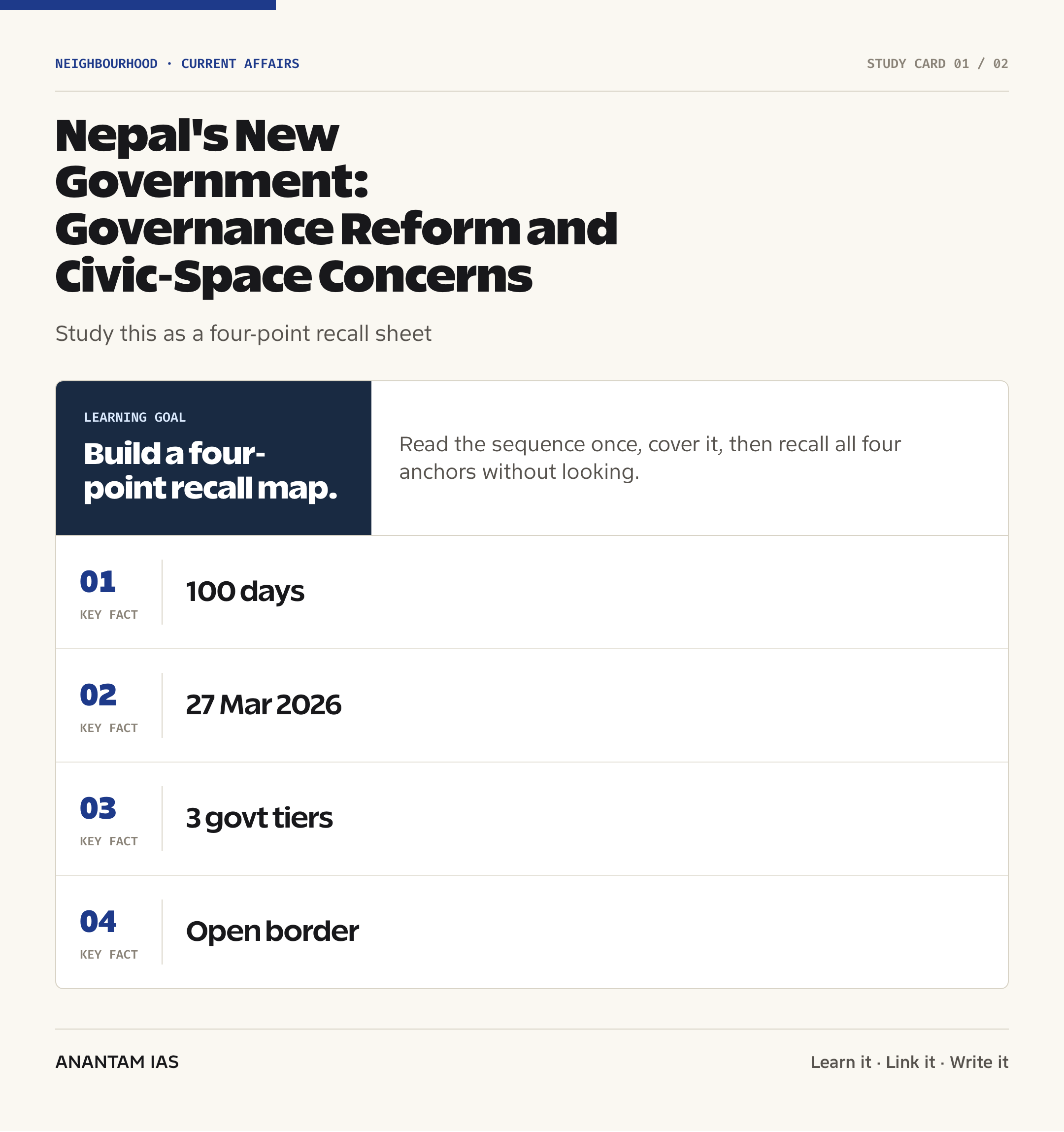
The government led by Prime Minister Balendra Shah completed its first 100 days in July 2026. The Hindu reported that the administration is confronting questions about governance, dissent and a shrinking civic space similar to those raised before Nepal’s 2025 youth protests.
The milestone presents a mixed early record: a 100-point governance reform agenda and new delivery commitments on one side, and concerns about press freedom, institutional autonomy, protest accountability and the treatment of criticism on the other.
- Balendra Shah took office on 27 March 2026 after the Rastriya Swatantra Party’s victory in the 5 March election.
- The Cabinet announced a 100-point agenda covering administrative reform, anti-corruption, digital governance and public-service delivery.
- A July commitment paper proposed monitoring by a Prime Minister’s Delivery Unit under the Prime Minister’s Office.
- Media groups have raised concerns about official warnings, hostile online speech, advertising policy and court-ordered removal of reports.
- The debate tests whether a popular reform mandate can remain subject to constitutional checks, open scrutiny and due process.
The development matters in the context of:
- Nepal is a close Indian neighbour with an open border, dense social ties and cooperation in trade, transit, energy and water resources.
- Political stability in Kathmandu affects India’s Neighbourhood First policy, border management, connectivity and Himalayan security.
- The episode connects democratic accountability with the broader idea of civic space: the environment in which people, media and associations participate without fear.
UPSC Relevance
Prelims Relevance
- Nepal is a federal democratic republican state under its 2015 Constitution.
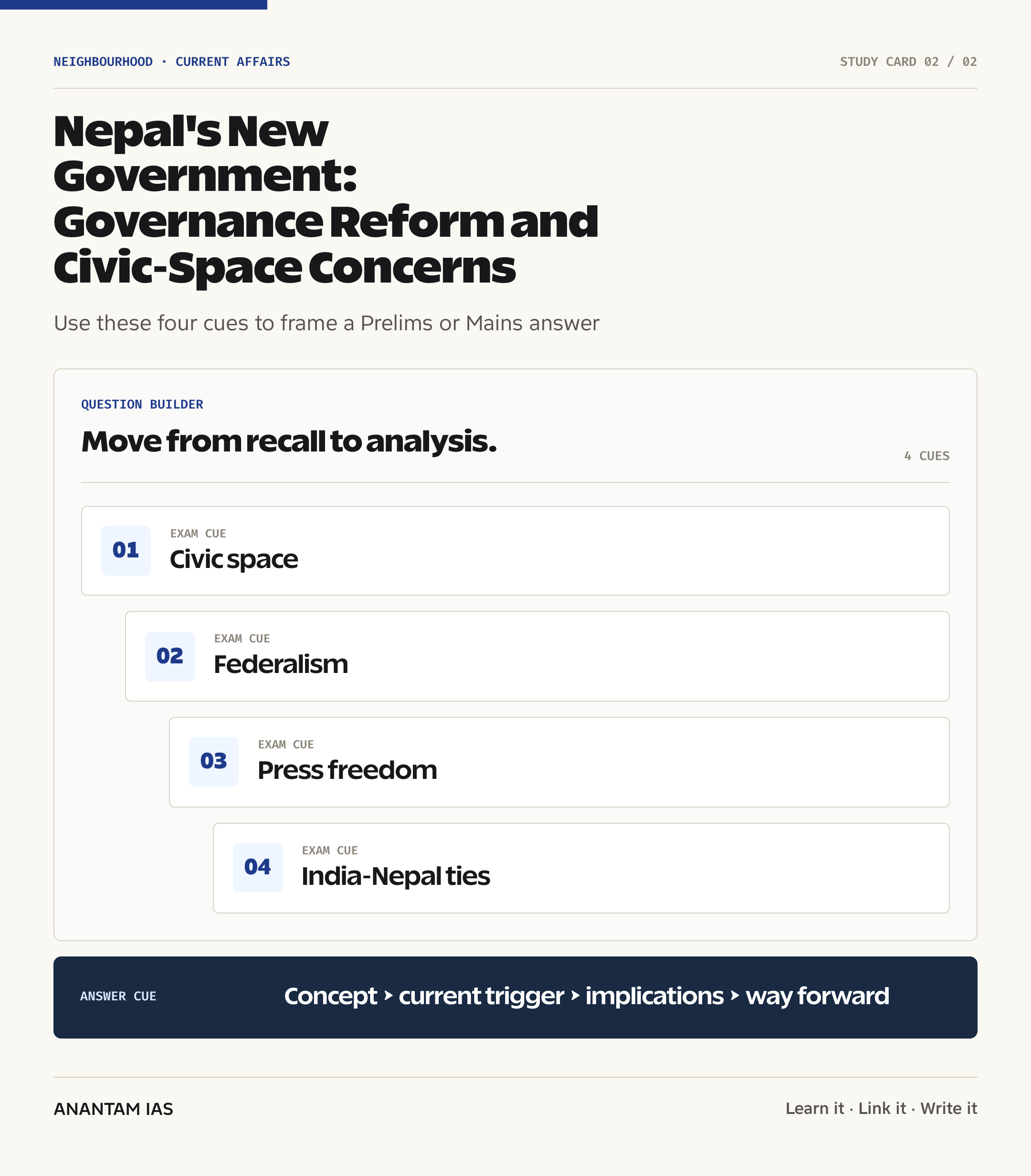
- Its federal structure has three levels: federation, province and local level.
- Nepal follows a parliamentary form of government with a bicameral Federal Parliament.
- The House of Representatives is the lower house; the National Assembly is the permanent upper house.
- Article 17 of Nepal’s Constitution protects freedoms including opinion, expression, assembly and association, subject to law.
- Article 19 protects communication and restricts prior censorship, subject to constitutional limitations.
- Article 27 grants citizens the right to demand and receive information on matters of public interest.
- Kathmandu is Nepal’s capital, and the country hosts the SAARC Secretariat.
- India and Nepal share extensive trade, transit, hydropower and people-to-people links.
Mains Relevance
GS Paper 2
- India and its neighbourhood: political developments in Nepal and their implications for India.
- Comparative constitutionalism: parliamentary democracy, federalism, fundamental freedoms and institutional checks.
- Governance and accountability: balancing a reform mandate with due process, transparency and media freedom.
GS Paper 3
- Border management, cross-border connectivity, hydropower trade and the security effects of instability in the Himalayan region.
Essay
- A democratic mandate is authority to govern, not immunity from scrutiny.
- Strong institutions convert popular energy into durable reform.
- Freedom of criticism is an early-warning system for governance failure.
Background and Context
Political Transition and the 2026 Mandate
Nepal’s new political phase emerged from a crisis of confidence in established parties and public institutions.
- Youth-led protests in September 2025 began after restrictions on social-media platforms and widened into anger over corruption, privilege and poor governance.
- A subsequent political transition led to an early election on 5 March 2026, in which the Rastriya Swatantra Party secured a clear governing mandate.
- President Ram Chandra Paudel administered the oath to Balendra Shah on 27 March, making the former Kathmandu mayor the head of government.
- The new leadership presented itself as anti-establishment, digitally fluent and focused on delivery, raising expectations of fast institutional change.
- The first 100 days are an early indicator of intent, not a conclusive performance audit; durable evaluation requires outcomes, budget execution and institutional behaviour.
Nepal's Constitutional Architecture
The 2015 Constitution created a federal parliamentary republic whose institutions distribute power vertically and horizontally.
- Article 56 places state power at the federal, provincial and local levels, making intergovernmental coordination central to service delivery.
- Article 74 defines Nepal’s system as a multiparty, competitive, federal democratic republican parliamentary form based on pluralism.
- The President is the constitutional head, while executive authority is exercised through the Council of Ministers under the Prime Minister.
- Federalism was designed not only for administrative convenience but also for inclusion, identity and power-sharing after a long political transition.
- Any restructuring of provincial institutions must respect constitutional amendment procedures, fiscal arrangements and the political compact behind federalisation.
What Civic Space Means
Civic space is the legal and practical environment that allows citizens to organise, speak, assemble and influence public decisions.
- Its core freedoms are expression, peaceful assembly and association; access to information and media pluralism make these rights usable.
- A civic space can contract without formal suspension of rights when threats, selective enforcement, online intimidation or financial pressure create self-censorship.
- Reasonable restrictions may protect security, reputation and public order, but must be prescribed by law, pursue a legitimate aim and satisfy necessity and proportionality.
- Independent courts, a professional police, human-rights bodies and autonomous media regulators help distinguish lawful regulation from executive control.
- The relevant democratic test is not whether criticism is uncomfortable; it is whether public power responds through law and accountable institutions.
Press-Freedom Concerns in the First 100 Days
The concerns involve both direct state action and an enabling environment that may discourage scrutiny.
- Nepali media reports cited warning-laden remarks by senior officials about action against allegedly insulting or defamatory coverage, even though the Press Council Nepal has an established regulatory role.
- Journalists’ groups criticised an April 2026 advertising directive that routed official notices to state-owned media, arguing that it economically disadvantaged independent outlets.
- A Kathmandu court’s prison sentence in a defamation case and a separate order to remove dozens of reports intensified debate about criminal defamation and prior restraints.
- Observers also reported cyberbullying and intimidation by partisan supporters; these are distinct from direct government censorship but can still produce a chilling effect.
- Claims of shrinking space require evidence-based assessment: the source, legal basis, remedy and institutional responsibility for each restriction should be examined separately.
Governance-Reform Agenda: Promise and Risks
The government’s reform programme seeks measurable delivery, yet speed and central control can create institutional risks.
- The 100-point agenda covers corruption control, bureaucratic reform, digitalisation, economic management and faster public services.
- The proposed Delivery Unit can improve target-setting and monitoring if its data, responsibilities and performance reports are publicly accessible.
- Digital public services can reduce discretion and rent-seeking, but they require data protection, cyber security, accessibility and a non-digital route for excluded citizens.
- Central coordination may solve fragmentation, but excessive concentration in the Prime Minister’s Office can weaken ministerial responsibility and federal autonomy.
- Anti-corruption action gains legitimacy when investigations follow consistent standards, protect defence rights and remain insulated from partisan selection.
Why Political Stability in Nepal Matters to India
India’s relationship with Nepal combines strategic interests with unusually dense everyday interdependence.
- The two countries share an open border and deep familial, cultural and labour links, so political and economic disruptions travel quickly across the frontier.
- India is central to Nepal’s access to seaports and transit routes; Nepal is important to India’s connectivity with the Himalayan neighbourhood.
- Cross-border electricity trade, hydropower projects and transmission lines link Nepal’s development choices with India’s energy security and clean-power transition.
- Shared rivers require cooperation on irrigation, flood forecasting, embankments and disaster response, especially for communities in the Terai and Gangetic plains.
- A stable, democratic and sovereign Nepal reduces space for zero-sum external competition and supports predictable implementation of bilateral projects.
India's Appropriate Policy Approach
India benefits most from a democratic, stable Nepal whose institutions command domestic legitimacy.
- Engagement should be government-wide and society-wide, reaching federal institutions, provinces, local bodies, businesses, universities and civil society.
- New Delhi should avoid appearing to choose political winners; the guiding principles should be sovereign equality, non-interference and mutual sensitivity.
- Project delivery in connectivity, power and development cooperation should be timely and transparent so that bilateral ties generate visible public value.
- Border and security coordination must preserve the benefits of legitimate movement while targeting trafficking, organised crime and misuse through intelligence-led policing.
- Quiet support for constitutionalism, free media and accountable institutions is more sustainable than personalised diplomacy with any single leader.
Way Forward
Institutionalise Reform
- Publish time-bound indicators for the 100-point agenda, assign accountable agencies and release periodic progress data.
- Route complaints against media and citizens through competent independent bodies, with notice, hearing and judicial review.
- Make major anti-corruption and administrative decisions traceable through written reasons, procurement disclosure and parliamentary scrutiny.
Protect Civic Freedoms
- Review media, defamation and digital-governance rules against Nepal’s Constitution and the International Covenant on Civil and Political Rights.
- Investigate threats against journalists and activists impartially while also providing lawful remedies for privacy violations and incitement.
- Use the least restrictive means for public-order regulation and publish protocols governing protest policing and use of force.
Deepen Federal Democracy
- Clarify functions, finance and staff across Nepal’s three tiers instead of treating centralisation as the default answer to weak capacity.
- Consult provinces, local bodies, opposition parties and affected communities before structural reforms.
- Strengthen parliamentary committees, audit bodies and constitutional commissions so reform survives beyond a leader’s popularity.
Build a Stable India-Nepal Partnership
- Keep bilateral mechanisms active on trade, transit, power, water and border management regardless of political turnover.
- Prioritise completed, community-visible projects and jointly communicate timelines and benefits.
- Treat Nepal’s democratic resilience as a shared regional good, while leaving domestic political choices to Nepali citizens.
Conclusion
Nepal’s new government carries a strong mandate for cleaner and faster governance. Its lasting achievement will depend less on the volume of announcements than on whether reform strengthens constitutional institutions, federal capacity and public trust.
For India, the sound approach is patient and institutional: support Nepal’s sovereignty and democratic resilience, deliver on bilateral commitments and keep relations broader than any one administration. Civic freedom and effective government are complements when accountability improves policy before failures become crises.
UPSC Practice Questions
Prelims MCQ 1
With reference to Nepal’s constitutional system, consider the following statements:
- Nepal is a federal democratic republic.
- Its federal structure comprises the federation, provinces and local level.
- Nepal follows a presidential form of government.
How many of the above statements are correct?
(a) Only one (b) Only two (c) All three (d) None
Answer: (b) Only two
Explanation:
Statements 1 and 2 are correct. Nepal is a federal democratic republic with three governmental levels, but it follows a parliamentary, not presidential, form of government.
Prelims MCQ 2
Which one of the following best describes civic space?
(a) Territory reserved only for government offices (b) Legal and practical conditions for expression, assembly and association (c) A special economic zone for civil-society organisations (d) The jurisdiction of municipal governments over public parks
Answer: (b) Legal and practical conditions for expression, assembly and association
Explanation:
Civic space is the environment in which people and organisations can speak, organise, assemble, obtain information and participate in public affairs without unlawful interference.
UPSC Mains Questions
- Nepal’s governance reforms will be judged not only by delivery but also by their effect on constitutional checks and civic freedoms. Discuss this statement with reference to federalism, media freedom and institutional accountability in Nepal.
- Political stability in Nepal is a major Indian interest, but durable influence cannot rest on personalised diplomacy. Examine the principles and policy instruments that should guide India’s engagement with Nepal.
Sources: Office of the Prime Minister and Council of Ministers, Nepal and The Hindu.
Frequently Asked Questions
Why is Nepal’s government in the news?
Prime Minister Balendra Shah’s government completed its first 100 days in July 2026. Attention has focused on its ambitious governance-reform programme as well as concerns about press freedom, treatment of dissent, accountability for past protest violence and the balance between central direction and federal institutions.
What is civic space?
Civic space is the legal and practical environment in which citizens, journalists, associations and civil-society groups can express views, assemble, organise and participate in public affairs. It depends on both formal rights and freedom from intimidation, arbitrary enforcement or economic pressure.
Which freedoms does Nepal’s Constitution protect?
Nepal’s Constitution protects opinion and expression, peaceful assembly and association under Article 17. Article 19 protects communication, while Article 27 provides a right to information on matters of public interest. Restrictions must rest on law and constitutional grounds.
How is Nepal’s federal system organised?
Nepal’s Constitution distributes state power across the federation, seven provinces and local governments. The design seeks to combine national unity with inclusion and local self-government. Effective federalism needs clear responsibilities, adequate finance, administrative staff and regular intergovernmental coordination.
Why does Nepal’s stability matter to India?
India and Nepal share an open border, close people-to-people ties and cooperation in trade, transit, hydropower, rivers, connectivity and security. Instability can delay projects, complicate border governance and create strategic uncertainty, while accountable democratic institutions make agreements more durable.
What should India do?
India should engage Nepal’s institutions and society broadly, respect sovereign equality and avoid partisan alignment. It should deliver bilateral projects transparently, keep trade and security mechanisms active, and support constitutional democracy through quiet, consistent diplomacy rather than dependence on any single leader.
Source: https://anantamias.com/current-affairs/nepal-government-governance-civic-space/
Anil Menon reaches the ISS aboard Soyuz MS-29
Why in News?
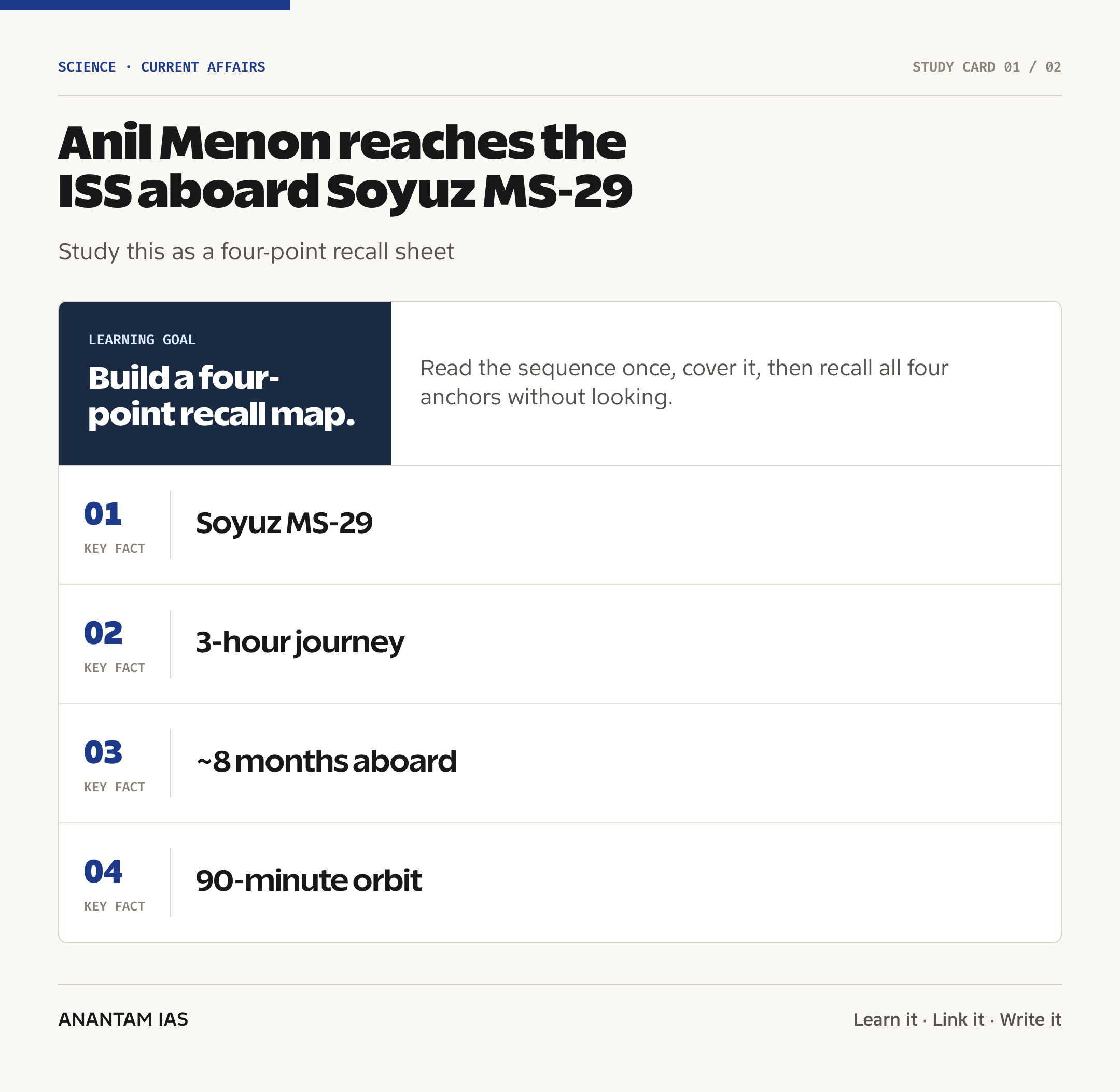
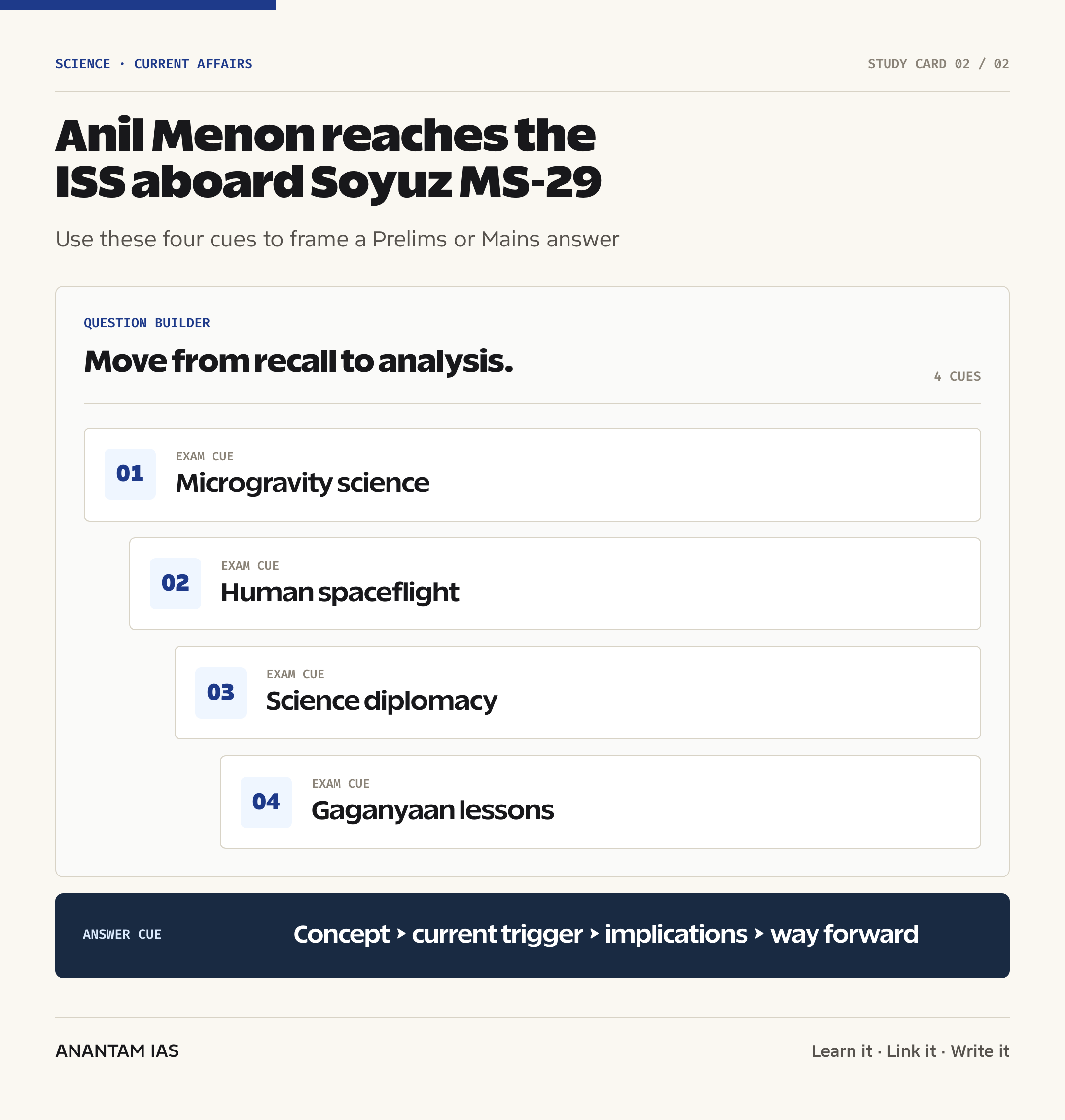
NASA astronaut Anil Menon and Roscosmos cosmonauts Pyotr Dubrov and Anna Kikina reached the International Space Station on July 14, 2026, aboard the Soyuz MS-29 spacecraft.
NASA confirmed that the crew will spend about eight months on the orbiting laboratory. The mission links a current event to durable UPSC themes: human spaceflight, microgravity research, low-Earth orbit and multinational scientific cooperation.
- The Soyuz MS-29 spacecraft launched from the Baikonur Cosmodrome in Kazakhstan at 7:47 p.m. local time on July 14.
- It completed a three-hour, two-orbit journey before docking with the station’s Prichal module.
- The spacecraft docked at 1:52 p.m. EDT, and the hatch between Soyuz and the station opened at 4:30 p.m. EDT.
- The new arrivals temporarily increased the station’s crew to 10 during the handover period.
- Menon is scheduled to serve as an Expedition 75 flight engineer and return to Earth in April 2027.
The development matters in the context of:
- The mission shows how the ISS partnership continues to coordinate crew transport, research and station operations across national space agencies.
- Menon’s research programme connects spaceflight with semiconductors, medical imaging, human physiology and bioprinting.
- For India, the event is a useful comparison point for Gaganyaan, astronaut training and the development of independent human-spaceflight capabilities.

UPSC Relevance
Prelims Relevance
- The International Space Station is a crewed research platform in low-Earth orbit, not a geostationary satellite.
- The station travels at about 28,000 km per hour and circles Earth roughly once every 90 minutes.
- It completes about 16 orbits, allowing the crew to witness around 16 sunrises and sunsets in 24 hours.
- The ISS partnership comprises NASA, Roscosmos, ESA, JAXA and CSA, representing five agencies and 15 countries.
- The station has been continuously occupied since November 2000.
- Microgravity is an environment in which objects experience apparent near-weightlessness while they and their spacecraft remain in continuous free fall around Earth.
- The Soyuz system is Russia’s crew-transport route to and from the ISS; MS-29 docked with the Prichal node module.
- Baikonur Cosmodrome, the launch site for MS-29, is located in Kazakhstan and is used by Russia under bilateral arrangements.
- India’s space technology syllabus includes launch vehicles, satellites, human spaceflight, applications and the institutional roles of ISRO and private actors.
Mains Relevance
GS Paper 3
- Scientific value of microgravity laboratories for materials science, medicine, biology and human exploration.
- Technological systems needed for human spaceflight: launch, docking, life support, crew health, re-entry and recovery.
- Lessons for Gaganyaan and India’s long-term human-spaceflight ecosystem.
GS Paper 2
- The ISS as an example of science diplomacy and rule-based management of a shared technological platform.
- Role of agreements, divided responsibilities and interdependence in sustaining international cooperation.
Essay
- Science can create practical cooperation even when relations among major powers remain politically strained.
- Human exploration becomes more durable when scientific ambition is matched by institutions, shared rules and mutual dependence.
Background and Context
Mission profile: Soyuz MS-29
The arrival sequence tests the basic vocabulary of a crewed orbital mission.
- NASA said Anil Menon, Pyotr Dubrov and Anna Kikina lifted off from Baikonur and reached the ISS after a two-orbit rendezvous.
- A rendezvous is the controlled process of bringing two spacecraft into the same orbit and close proximity; docking creates a secure physical and operational connection.
- MS-29 attached to Prichal, a Russian node module that provides docking ports for visiting spacecraft and supports the station’s Russian orbital segment.
- The temporary crew strength of 10 reflects a handover: outgoing and incoming crews overlap so duties, experiments and emergency procedures can be transferred safely.
- NASA scheduled Expedition 75 to begin on July 26 after three Expedition 74 members depart. Expedition numbers identify successive long-duration ISS crew periods, not separate stations.
What makes the ISS an orbital laboratory?
The ISS combines a low-Earth orbit, continuous human presence and reusable research facilities.
- The station operates roughly 400 km above Earth. At about 28,000 km per hour, it remains in orbit because its forward motion and gravitational fall continuously balance.
- Its approximately 90-minute orbital period provides repeated observations across daylight and darkness, useful for Earth observation and atmospheric studies.
- Unlike a geostationary satellite, the ISS does not remain fixed over one longitude. A geostationary satellite orbits near 35,786 km above the equator with a 24-hour period.
- The ISS supports hands-on crew operations, external exposure experiments, long-duration biological studies and instruments that can be returned or serviced.
- The station has been continuously inhabited since November 2000, creating long records of how people, materials and systems behave during extended spaceflight.
Why microgravity changes experiments
Microgravity lets researchers observe processes that are masked by gravity-driven effects on Earth.
- NASA explains that microgravity reduces the effects of buoyancy, sedimentation and convection, changing how fluids, flames, cells and crystals behave.
- The term does not mean that gravity is absent. The spacecraft and its contents are in continuous free fall, producing apparent near-weightlessness inside the orbiting laboratory.
- Crystals may grow with different structures because gravity-driven settling and fluid mixing are reduced. This is relevant to advanced materials, proteins and semiconductor research.
- Human bodies experience fluid shifts, muscle and bone loss, cardiovascular changes and altered balance in space. Long-duration missions make the ISS a test bed for space medicine.
- The same research supports future missions beyond low-Earth orbit, where crews may have less immediate access to Earth-based medical help and resupply.
Anil Menon's planned research
NASA’s mission release identifies experiments that connect exploration needs with possible benefits on Earth.
- Menon will continue work on the in-space production of semiconductor crystals, with potential applications in high-performance computing, artificial intelligence and medical devices.
- He will perform ultrasound using augmented-reality and artificial-intelligence methods designed to reduce dependence on real-time medical support from Earth.
- As a research subject, he will help investigators study how blood flow changes during spaceflight and how such changes may affect astronaut health.
- He will test bioprinting of vascular constructs in microgravity. Reduced gravitational deformation may help researchers examine three-dimensional tissues and ageing-related processes.
- These studies show why human spaceflight is more than transportation: the crew operates experiments, maintains equipment and supplies observations that automated platforms may not provide.
International partnership and legal framework
The ISS is both an engineering system and an institution built on divided responsibilities.
- Five agencies operate the station: the United States’ NASA, Russia’s Roscosmos, the European Space Agency, Japan’s JAXA and the Canadian Space Agency.
- NASA describes the partnership as involving 15 countries, with each partner primarily responsible for the hardware and capabilities it provides.
- The 1998 Intergovernmental Agreement established the overall cooperative framework and addressed operational responsibility, jurisdiction and intellectual property.
- Memoranda of understanding and implementing arrangements translate the intergovernmental framework into agency roles, crew opportunities, hardware contributions and use of research capacity.
- The station’s interdependence makes science diplomacy concrete: propulsion, attitude control, power, laboratories, transport and ground support are distributed across partners.
Relevance for India's human-spaceflight programme
The ISS mission is a comparison point, not a substitute, for understanding India’s own programme.
- India’s Gaganyaan mission seeks to demonstrate an indigenous capability to carry a crew to low-Earth orbit and return it safely.
- A human-spaceflight system needs reliable launch and abort systems, environmental control and life support, crew training, tracking, communications, recovery and human-rating of hardware.
- International missions can provide experience in crew operations, space medicine and scientific payloads, while sovereign capability gives India greater control over mission timing and objectives.
- India can connect human spaceflight with universities, start-ups, materials research, medicine and manufacturing so the programme creates a wider space-science ecosystem.
- The policy question is not crewed versus robotic exploration. A balanced programme assigns each platform the work it performs best and subjects expensive missions to clear scientific and strategic goals.
Way Forward
Build mission capability as a system
- Test life-support, abort, re-entry and recovery systems through incremental missions and publish safety lessons where security permits.
- Expand Indian capacity in space medicine, human factors, radiation protection and closed-loop environmental control.
Link missions to measurable science
- Select microgravity experiments through transparent scientific review and connect payloads with universities, hospitals and industry.
- Define Earth-facing outcomes, such as new materials, medical methods or operational technologies, without overstating uncertain commercial benefits.
Use cooperation without losing autonomy
- Pursue astronaut training, payload and data partnerships while strengthening India’s independent launch, tracking and crew-recovery capabilities.
- Develop clear Indian positions on space safety, debris mitigation, rescue and liability as crewed activity in low-Earth orbit expands.
Conclusion
Anil Menon’s arrival aboard Soyuz MS-29 is more than a biographical milestone. It is a compact case study of orbital mechanics, microgravity science, crewed-spaceflight systems and the institutional cooperation needed to operate a permanent laboratory above Earth.
For UPSC preparation, the strongest answer links the event to durable concepts and then brings the analysis home to Gaganyaan: safe capability, useful science, international cooperation and clearly defined public value.
UPSC Practice Questions
Prelims MCQ 1
With reference to the International Space Station, consider the following statements:
- It is operated through a partnership of five space agencies.
- It completes about 16 orbits of Earth in 24 hours.
- It is positioned in geostationary orbit above the equator.
How many of the above statements are correct?
(a) Only one (b) Only two (c) All three (d) None
Answer: (b) Only two
Explanation:
Statements 1 and 2 are correct. The ISS is operated by NASA, Roscosmos, ESA, JAXA and CSA, and circles Earth about every 90 minutes. Statement 3 is incorrect because the ISS is in low-Earth orbit, not geostationary orbit.
Prelims MCQ 2
Why is microgravity useful for some experiments aboard the ISS?
(a) It completely removes Earth’s gravitational field (b) It reduces buoyancy, sedimentation and gravity-driven convection (c) It keeps the station fixed over one point on Earth (d) It blocks all cosmic radiation from reaching samples
Answer: (b) It reduces buoyancy, sedimentation and gravity-driven convection
Explanation:
Objects inside the ISS remain under Earth’s gravity but share the station’s continuous free fall. The resulting microgravity environment reduces several gravity-driven effects and lets researchers study fluids, cells, crystals and combustion differently.
UPSC Mains Questions
- The International Space Station is as much an institutional achievement as a technological one. Discuss how scientific interdependence, divided responsibilities and a rules-based framework have sustained international cooperation in low-Earth orbit.
- Microgravity research connects human spaceflight with materials science, medicine and future exploration. Explain these linkages and assess the lessons they offer for India’s Gaganyaan programme and wider space-science ecosystem.
Sources: NASA and The Hindu.
Frequently Asked Questions
Who travelled aboard Soyuz MS-29?
NASA astronaut Anil Menon travelled with Roscosmos cosmonauts Pyotr Dubrov and Anna Kikina. They launched from Baikonur Cosmodrome in Kazakhstan on July 14, 2026, and docked with the International Space Station after a three-hour, two-orbit journey.
How long will Anil Menon stay?
NASA said the new crew members will spend about eight months living and working aboard the ISS, with a planned return in April 2027. Menon is scheduled to serve as a flight engineer during Expedition 75.
What is microgravity?
Microgravity is apparent near-weightlessness experienced when a spacecraft and everything inside it fall continuously around Earth together. Gravity is still present, but the shared free fall greatly reduces support forces and changes processes such as convection, sedimentation and fluid movement.
Which agencies operate the ISS?
The five principal agencies are NASA of the United States, Roscosmos of Russia, the European Space Agency, the Japan Aerospace Exploration Agency and the Canadian Space Agency. Their partnership represents 15 countries and distributes hardware and operational responsibilities across the station.
Why does ISS research matter on Earth?
Microgravity experiments can reveal how crystals, tissues, fluids and the human body behave when gravity-driven effects are reduced. Findings can inform advanced materials, medical devices, remote healthcare and protection of astronauts, although practical applications still require testing and validation on Earth.
How is this relevant to Gaganyaan?
The mission highlights the complete system behind human spaceflight: safe launch, life support, docking or orbital operations, crew health, research, re-entry and recovery. Gaganyaan can draw lessons from this experience while building India’s independent capability and a domestic research ecosystem.
Source: https://anantamias.com/current-affairs/anil-menon-international-space-station/
Round-the-Clock Constitutional Courts: Emergency Access to Justice
Why in News?
On July 14, 2026, the Supreme Court of India agreed to examine a public-interest petition seeking a uniform mechanism through which people can approach constitutional courts outside regular working hours in emergencies involving life and personal liberty.
A Bench led by the Chief Justice of India issued notice to the High Courts while flagging the central design problem: an emergency window must be genuinely accessible, but it must not become a route for obtaining after-hours hearings in matters that can safely wait for the ordinary roster.
- The petition seeks a standard operating procedure for urgent hearings beyond normal court hours.
- The immediate focus is on cases such as illegal detention, imminent arrest, deportation, demolition, medical emergency or any action with irreversible consequences for life and liberty.
- The Court sought the views of the High Courts, whose administrative conditions, territorial spread and existing emergency practices differ widely.
- The Court also raised the risk of forum shopping, privileged access and routine disputes being presented as emergencies.
- The Hindu reported the development as a wider debate over whether constitutional remedies should remain reachable at all hours.
The development matters in the context of:
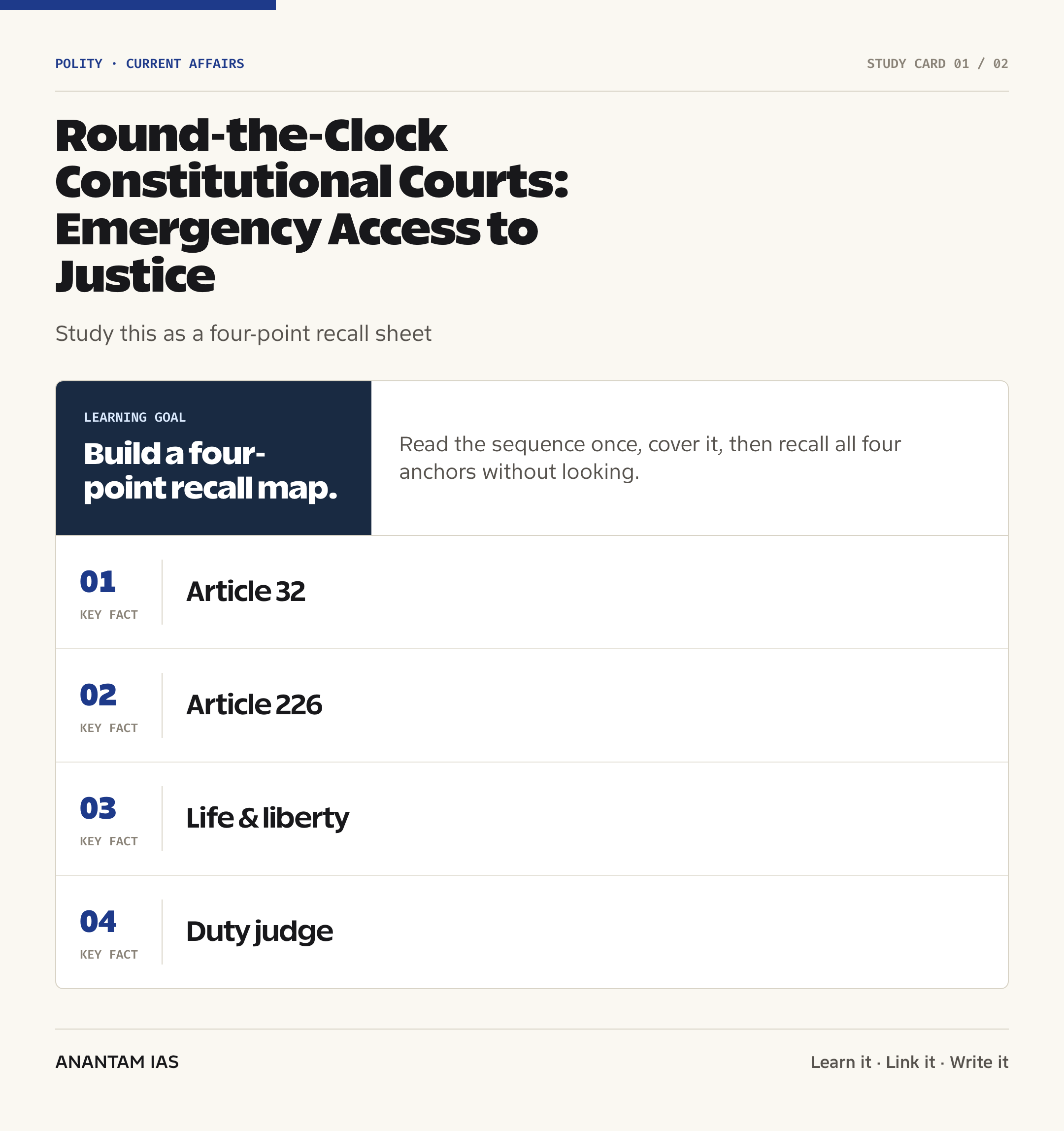
- The issue connects a guaranteed remedy under Article 32 with the practical capacity to obtain a hearing before harm becomes irreversible.
- It tests how judicial independence and High Court autonomy can coexist with minimum national standards for emergency access.
- It also distinguishes a narrow emergency service from the unrealistic idea of running every courtroom and every category of case 24×7.
UPSC Relevance
Prelims Relevance
- Article 32 guarantees the right to move the Supreme Court for enforcement of Fundamental Rights and is itself a Fundamental Right.
- Article 226 empowers High Courts to issue writs for Fundamental Rights and for “any other purpose”, making its substantive scope wider than Article 32.
- The five constitutional writs are habeas corpus, mandamus, prohibition, certiorari and quo warranto.
- A petition for habeas corpus challenges unlawful detention and may be moved by the detained person or another person acting on their behalf.
- Article 21 protects life and personal liberty except according to procedure established by law.
- Article 22 contains safeguards relating to arrest and detention, including production before a magistrate within 24 hours, excluding journey time.
- Article 39A, a Directive Principle, directs the State to secure equal justice and provide free legal aid.
- Under Article 145, the Supreme Court may frame rules regulating its practice and procedure, subject to constitutional conditions.
- High Courts are constitutional courts, not administratively subordinate units of the Supreme Court; consultation is central to a workable national framework.
Mains Relevance
GS Paper 2
- Judiciary and constitutional remedies: converting formal writ jurisdiction into timely and effective protection.
- Governance and institutional design: building transparent triage, accountability and review into an after-hours system.
- Federal judicial administration: balancing common standards with the administrative autonomy and capacities of different High Courts.
GS Paper 4
- Ethics of public institutions: fairness between influential applicants and ordinary citizens seeking the same emergency remedy.
- Competing duties: protecting liberty without normalising exceptional procedure or imposing unsustainable burdens on judges and registry staff.
Essay
- A right delayed beyond the point of irreversible harm can become a right denied.
- Technology can widen the courthouse door, but institutional fairness determines who actually enters.
- Emergency powers need narrow gates, written reasons and public accountability.
Background and Context
Constitutional basis of emergency judicial protection
The proposal is rooted in the Constitution’s promise that enforceable rights must have an effective remedy.
- Article 32 gives the Supreme Court original jurisdiction to enforce Fundamental Rights through directions, orders and writs; the Court’s official jurisdiction page lists this remedial power.
- Article 226 gives every High Court a wider writ power because it covers Fundamental Rights as well as other legal rights and public duties.
- The internal primer on Article 32 and constitutional remedies explains why a paper right is incomplete without direct access to a constitutional court.
- The companion guide to Article 226 writ jurisdiction shows why High Courts are usually the more accessible first constitutional forum.
- Judicial review is part of the Constitution’s basic structure, but the Constitution does not prescribe a single after-hours filing and hearing protocol for every court.
What counts as a legal emergency?
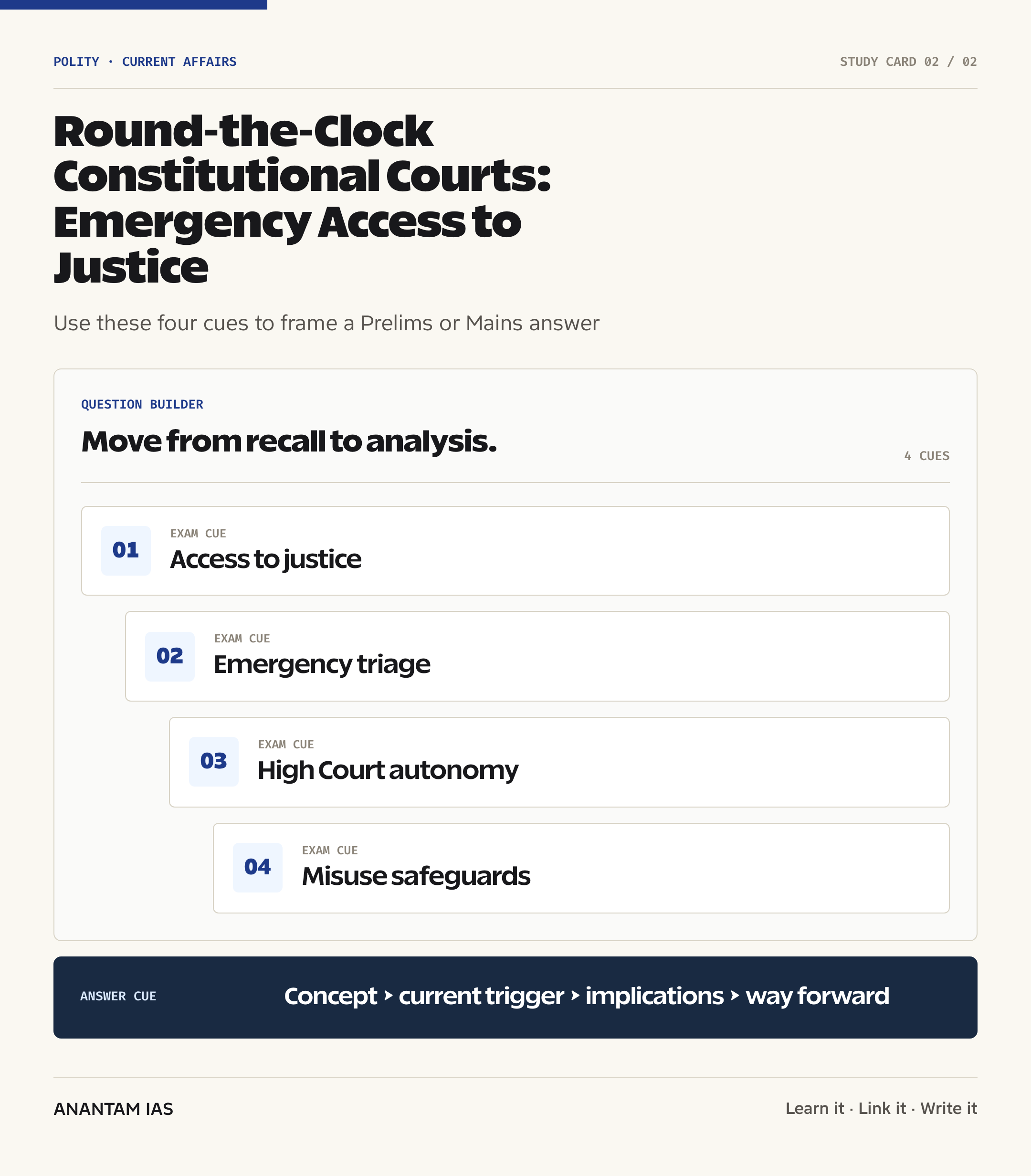
A credible system must define urgency by the threatened harm, not by a party’s status or the publicity around a dispute.
- A strong threshold is whether waiting until the next regular sitting would cause irreversible harm that a later order cannot adequately repair.
- Classic examples include an unlawful loss of liberty, an expiring deportation order, threatened destruction of shelter, denial of time-critical medical care or imminent execution of coercive State action.
- A commercial deadline, reputational discomfort or an avoidable filing delay should not automatically become a constitutional emergency.
- The applicant should disclose earlier proceedings, the exact relief sought, the reason regular listing is inadequate and any attempt already made before the appropriate forum.
- The registry’s first screening should be procedural; the assigned judge must retain the judicial power to decide whether urgency and interim relief are actually made out.
Existing building blocks are not a blank slate
Indian courts already use urgent mentioning, vacation benches, electronic filing and special sittings, so the debate concerns standardisation and equitable access.
- The Supreme Court’s published procedures recognise applications for early hearing, interim relief, bail, interim bail and hearing during vacation.
- During partial court working days, designated vacation benches hear matters of urgent nature rather than leaving the institution entirely closed.
- Special benches have also been constituted outside the ordinary roster when an imminent constitutional consequence requires immediate attention.
- e-filing allows documents to be lodged beyond counter hours, but a digital upload is not the same as real-time scrutiny, service and judicial hearing.
- The eCourts Phase III framework can supply secure filing, digital records, video links and interoperable data, while human decision-making must control urgency and relief.
A workable 24×7 emergency-access architecture
The practical model is a narrow on-call pathway, not continuously operating courts for the entire docket.
- Each constitutional court could maintain a rotating duty registry officer and duty judge, supported by published contact channels and escalation steps.
- A secure portal should accept a standard emergency form, identity details, case documents, requested relief and a signed declaration explaining why the matter cannot wait.
- The system should generate a time-stamped audit trail showing receipt, scrutiny, judicial allocation, hearing mode and outcome.
- Video hearings can reduce distance and speed up participation, but telephone access and physical facilitation points remain necessary for citizens facing a digital divide.
- Legal Services Authorities, police control rooms, prisons and hospitals need a verified escalation channel for people who cannot reach an advocate during the emergency.
- Any ex parte interim order should be brief, reasoned and placed before the regular roster promptly for confirmation, modification or recall.
Benefits for rights and rule of law
Timely access can stop constitutional injury before it becomes irreversible and can improve trust in justice delivery.
- For personal liberty, hours can matter: an immediate habeas corpus or interim-protection hearing may prevent unlawful custody or coercion.
- A known protocol reduces dependence on informal calls, personal networks or media attention, supporting equality before law under Article 14.
- Uniform minimum information requirements help advocates and registries prepare emergency applications without guessing at court-specific conventions.
- A transparent duty roster can make institutional response more predictable while shielding individual judges from ad hoc pressure.
- Aggregate, anonymised data on requests and outcomes can reveal which kinds of State action repeatedly create after-hours emergencies and require administrative correction.
Risks, limits and constitutional cautions
An emergency channel can itself become unequal or unmanageable unless access, triage and workload safeguards are designed together.
- Powerful litigants may try to convert influence into priority access, while unrepresented citizens may struggle to frame urgency in legally familiar language.
- Loose standards can encourage routine bail, commercial or service matters to be relabelled as urgent, producing docket distortion and forum shopping.
- Judges, court masters, registry staff, security personnel and technical teams need protected rotations; 24×7 access cannot mean permanent availability for the same workers.
- A single rigid national process could overlook differences in geography, connectivity, language and staffing across the 25 High Courts and their benches.
- Cybersecurity, confidential filings, identity verification and reliable service on the opposing party become harder during compressed timelines.
- Emergency relief is often based on incomplete records, so safeguards against suppression of facts and a rapid return to the ordinary adversarial process are essential.
UPSC distinction: access is not disposal
A 24×7 pathway addresses urgent entry into the system; it does not by itself solve judicial delay or the wider pendency problem.
- Emergency access concerns the small class of matters where the timing of first judicial intervention determines whether a right can still be protected.
- Pendency requires separate reforms in appointments, infrastructure, adjournments, case management, government litigation and alternative dispute resolution.
- The broader judicial reforms framework is needed because digital filing cannot substitute for adequate judges, courtrooms and support staff.
- A balanced Mains answer should support an emergency-access guarantee while rejecting the simplistic claim that every court and every case must function continuously.
Way Forward
Adopt a model emergency-access SOP
- The Supreme Court, High Courts and e-Committee should frame a consultative model protocol that states minimum standards but permits locally suitable implementation.
- Define urgency through illustrative categories and an irreversible-harm test, while preserving judicial discretion for exceptional facts.
Make triage transparent and reviewable
- Publish duty contacts, filing requirements, response targets and escalation steps in major regional languages and accessible formats.
- Record brief reasons for accepting or declining an after-hours hearing, with sensitive information protected and a regular-bench review available.
Build inclusion into the channel
- Connect the system with NALSA, State Legal Services Authorities, district legal aid offices and prison legal-aid clinics.
- Retain telephone and assisted physical routes alongside digital filing so poverty, disability, language or connectivity doesn’t decide access.
Protect institutional capacity
- Use rotating on-call teams, compensatory rest, secure technology and adequate registry staffing instead of adding invisible labour to the regular judicial day.
- Audit anonymised data on applications, acceptance rates, response times and later modification of emergency orders to improve the system without compromising case privacy.
Conclusion
A constitutional remedy is meaningful only if it can arrive before the threatened harm becomes irreversible. A carefully designed 24×7 emergency-access mechanism would strengthen Articles 21, 32 and 226 by making urgent protection less dependent on informal influence or the accident of court hours.
But the sound reform is a narrow, transparent and inclusive on-call system, not the continuous operation of the entire judicial docket. Clear triage, recorded reasons, legal-aid access, High Court consultation and humane staffing can reconcile liberty with institutional sustainability.
UPSC Practice Questions
Prelims MCQ 1
With reference to the writ jurisdiction of constitutional courts in India, consider the following statements:
- The right to move the Supreme Court under Article 32 for enforcement of Fundamental Rights is itself a Fundamental Right.
- A High Court under Article 226 may issue writs only for enforcement of Fundamental Rights.
- Habeas corpus is a remedy used to test the legality of detention.
How many of the above statements are correct?
(a) Only one (b) Only two (c) All three (d) None
Answer: (b) Only two
Explanation:
Statements 1 and 3 are correct. Article 226 is wider than Article 32 because High Courts may issue writs both for Fundamental Rights and for any other purpose.
Prelims MCQ 2
Which constitutional provision directs the State to secure equal justice and provide free legal aid?
(a) Article 39A (b) Article 50 (c) Article 136 (d) Article 226
Answer: (a) Article 39A
Explanation:
Article 39A is a Directive Principle requiring equal justice and free legal aid so that economic or other disabilities don’t deny opportunities for securing justice.
UPSC Mains Questions
- A constitutional remedy that cannot be reached before irreversible harm occurs may offer only formal, not effective, protection. In this context, examine the case for round-the-clock emergency access to the Supreme Court and High Courts, along with safeguards needed against misuse and unequal access.
- Digital filing can widen the courthouse door, but it cannot by itself guarantee access to justice. Discuss how an after-hours constitutional-court mechanism should combine technology, legal aid, transparent triage, judicial discretion and humane staffing while respecting the administrative autonomy of High Courts.
Sources: Supreme Court of India and The Hindu.
Frequently Asked Questions
What did the Supreme Court examine?
The Supreme Court agreed to examine a petition seeking a standard mechanism for approaching constitutional courts outside regular hours in urgent life-and-liberty cases. It issued notice to the High Courts and also highlighted the need to prevent routine disputes from being presented as emergencies.
Would all courts operate continuously?
Not necessarily. The practical proposal is a narrow on-call system involving a duty registry officer and a duty judge for exceptional cases. Regular civil, commercial and criminal dockets would continue through ordinary rosters rather than being heard continuously throughout the day and night.
Which constitutional articles are relevant?
Articles 21, 32 and 226 are central. Article 21 protects life and personal liberty. Article 32 guarantees access to the Supreme Court for enforcing Fundamental Rights, while Article 226 gives High Courts wider writ jurisdiction for Fundamental Rights and other legal purposes.
How should an emergency be identified?
The best test is whether waiting for the next regular sitting could cause irreversible harm that a later order cannot repair. Illegal detention, imminent deportation or time-critical denial of medical care may qualify; publicity, inconvenience or a self-created deadline ordinarily should not.
What is the main misuse risk?
Influential litigants could seek priority hearings, and routine matters could be labelled urgent to bypass the normal roster. Written thresholds, disclosure requirements, reasoned triage, an audit trail and prompt review by the regular bench can reduce forum shopping and unequal access.
How can poor litigants access it?
The mechanism should connect with NALSA, State Legal Services Authorities, prisons, hospitals and district legal-aid offices. It should offer regional-language instructions, accessible digital forms, telephone escalation and assisted physical filing so that money, disability or connectivity doesn’t determine emergency protection.
Source: https://anantamias.com/current-affairs/round-the-clock-constitutional-courts/
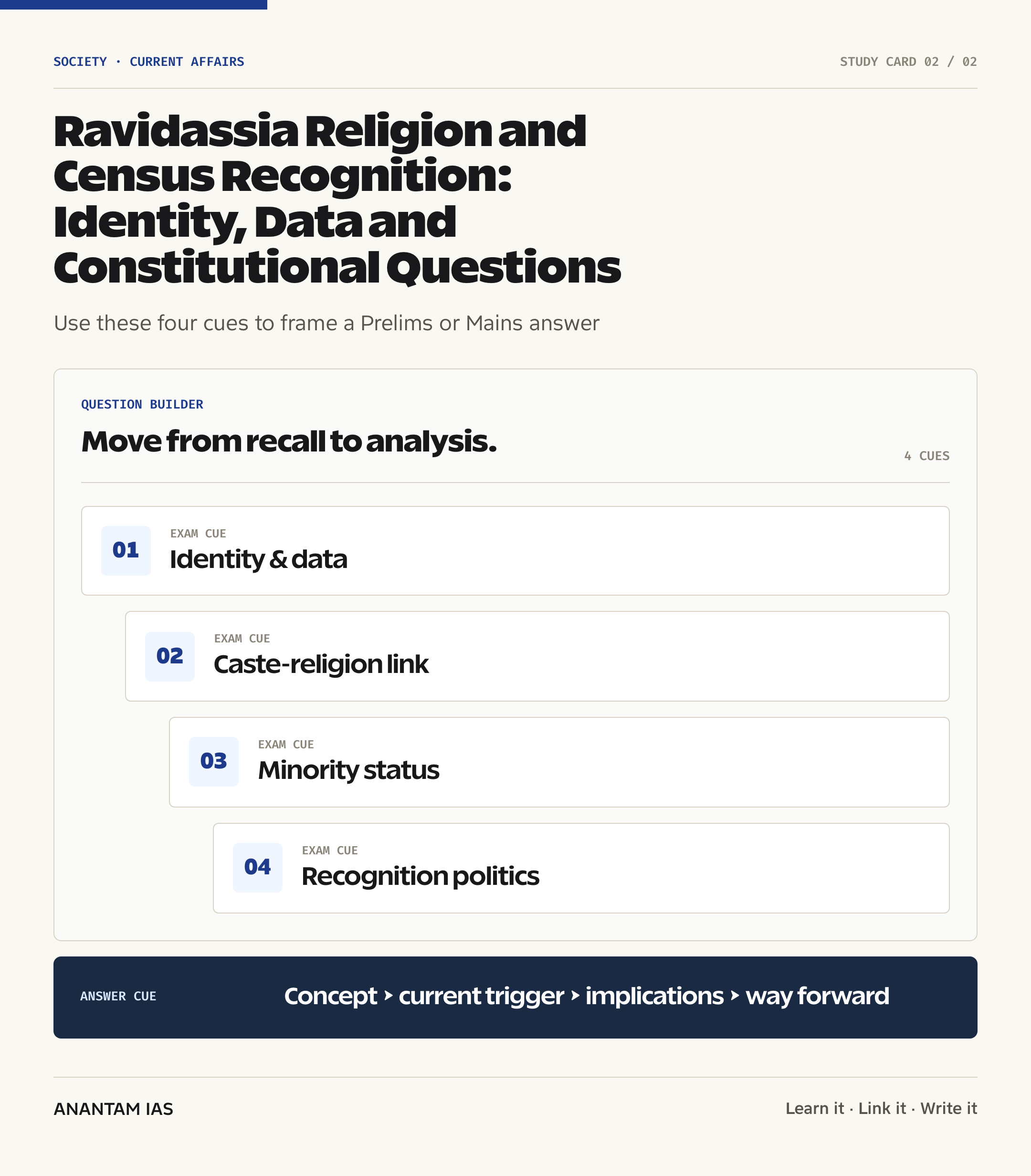
Ravidassia Religion and Census Recognition: Identity, Data and Constitutional Questions
Why in News?
The Indian Express reported in July 2026 that Ravidassia representatives had renewed their demand for a separate religion category in the forthcoming Census 2027. The demand seeks visible recognition of a religious identity centred on Guru Ravidas, rather than its statistical absorption within a larger community.
The issue is not merely about adding a box to a questionnaire. It connects religious self-identification, the history of Dalit assertion in Punjab, Census classification and the separate legal process through which the Union government notifies a community as a religious minority.
- A community conference in Punjab pressed for Ravidassia Religion to be shown separately in Census 2027.
- The demand has an institutional centre in Dera Sachkhand Ballan near Jalandhar and a strong social base in Punjab’s Doaba region.
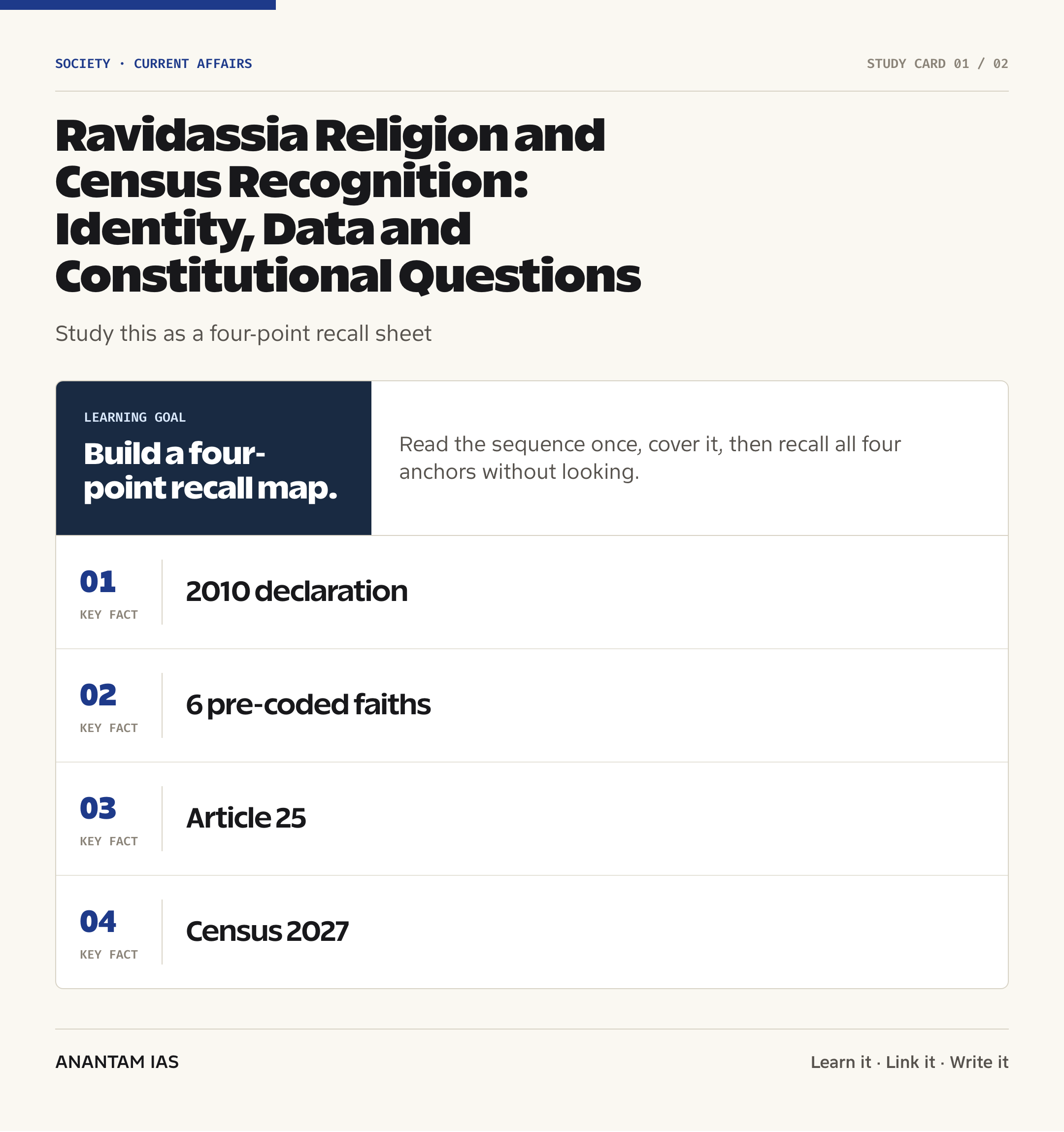
- Dera Sachkhand Ballan publicly proclaimed a separate Ravidassia religion in 2010, following a deadly 2009 attack on its leaders in Vienna.
- The official Census methodology says every respondent’s stated religion must be recorded faithfully, including a religion outside the six pre-coded major religions.
- A distinct Census return does not by itself produce minority notification, reservation rights or a new legal status.
The development matters in the context of:
- The demand illustrates how a marginalised group may use religious identity to claim dignity, institutional autonomy and visibility beyond caste hierarchy.
- It also shows that enumeration, classification and recognition are related but legally different acts of the State.
- For Census design, the challenge is to preserve self-identification while producing data that remain comparable, transparent and statistically useful.
UPSC Relevance
Prelims Relevance
- The Census is a Union subject under Entry 69 of the Union List and is conducted under the Census Act, 1948.
- The Office of the Registrar General and Census Commissioner, India functions under the Ministry of Home Affairs.
- Since Census 2001, the schedule has used numeric codes for six major religions: Hindu, Muslim, Christian, Sikh, Buddhist and Jain.
- The Census Commissioner states that these numeric codes are for data processing and confer no advantage or privilege.
- A respondent may state another religion or no religion; the enumerator must record the answer without argument or presumption.
- The 2011 C-01 table grouped smaller returns under Other Religions and Persuasions, with an appendix providing a further break-up for qualifying returns.
- Article 25 protects freedom of conscience and the right freely to profess, practise and propagate religion, subject to its constitutional limits.
- Under Section 2(c) of the National Commission for Minorities Act, 1992, a minority is a community notified by the Central Government for that Act.
- The six centrally notified religious minorities are Muslims, Christians, Sikhs, Buddhists, Parsis and Jains.
- The Constitution (Scheduled Castes) Order, 1950, as amended, links Scheduled Caste recognition to professing Hinduism, Sikhism or Buddhism.
Mains Relevance
GS Paper 1
- Salient features of Indian society, caste and religious diversity
- The Bhakti tradition and its challenge to hierarchy and exclusion
- Identity movements, social mobility and the politics of recognition
- Regional concentration of Dalit communities in Punjab’s Doaba region
GS Paper 2
- Freedom of religion under Articles 25 and 26
- Minority notification, equal citizenship and social justice
- Census governance, data classification and evidence-based public policy
Essay
- What the State counts influences what society can see.
- Dignity requires both freedom of belief and freedom from inherited hierarchy.
- Recognition can empower a community, but official categories can also harden fluid identities.
Background and Context
Who Are the Ravidassias?
Ravidassias are followers of Guru Ravidas whose contemporary identity intersects devotion, caste experience and institutional organisation.
- Guru Ravidas was a fifteenth-sixteenth century Bhakti saint associated with Varanasi whose compositions challenged ritual hierarchy and affirmed human equality.
- His vision of Begampura, a city without sorrow, fear or oppressive taxation, has become a powerful language of emancipation and equal citizenship.
- Ravidas’s verses are included in the Guru Granth Sahib, creating a deep historical connection between his followers and Sikh religious practice.
- Many followers come from communities historically treated as Dalit, especially leather-working groups subjected to untouchability and occupational stigma.
- The community is especially influential in Doaba, the Punjab region between the Beas and Sutlej rivers, and also has a sizeable diaspora.
- Ravidassia identity is not perfectly uniform: some people identify with a distinct religion, while others retain Sikh, Hindu, Ad Dharmi or overlapping identities.
From Ad Dharm Assertion to a Separate Religious Identity
The present demand draws on a longer history of lower-caste organisation and independent identity-making in colonial Punjab.
- The Ad Dharm movement, founded in Punjab in the 1920s, urged oppressed castes to reject imposed inferiority and identify as an original religious community.
- Its leaders treated the colonial Census as a field of political and social assertion, because a separately counted population could demonstrate numerical presence.
- The 1931 Census recorded Ad Dharm as a distinct return in Punjab, an episode that remains important to current recognition claims.
- After Independence, many related populations were enumerated under broader religious identities even as caste-based social distinctions persisted within them.
- Dera Sachkhand Ballan developed into a major religious and social institution, supporting congregations, pilgrimage and welfare networks around Guru Ravidas.
- This history explains why Census classification is viewed as a question of collective dignity and historical continuity, not only statistical convenience.
The 2009 Vienna Attack and the 2010 Declaration
A violent episode abroad accelerated the institutional separation promoted by Dera Sachkhand Ballan.
- On 24 May 2009, attackers targeted a congregation at a Guru Ravidas temple in Vienna, killing Sant Ramanand and injuring Dera head Sant Niranjan Dass and others.
- The attack produced grief and unrest in Punjab and sharpened a sense that the community required an autonomous religious and organisational identity.
- At a Guru Ravidas anniversary congregation in Varanasi on 30 January 2010, Dera Sachkhand Ballan announced the formation of the Ravidassia religion.
- The Dera foregrounded the Amritbani Guru Ravidas, a compilation centred on the saint’s teachings, in its distinct devotional practice.
- A separate name, scripture-centred practice and symbols help explain the claim to a distinct religion, but they do not erase internal differences among Ravidas-following groups.
- A sound Mains answer should avoid presenting either complete separation or complete assimilation as an uncontested fact.
How the Census Records Religion
The official method combines six pre-coded options with an open-ended duty to record any other self-declared religion faithfully.
- The Registrar General’s Social Studies Division note says religion is recorded separately for every household member because members may profess different faiths.
- Enumerators must not assume that the respondent or household head speaks for every person’s religious identity without an answer being returned for that member.
- The six numeric codes placed on the schedule since 2001 serve operational convenience; the government explicitly says they don’t grant privilege.
- If a person states another religion, the enumerator must write its actual name rather than force it into one of the six major categories.
- The 2011 C-01 religion table published six major communities separately and combined smaller returns under Other Religions and Persuasions.
- Its appendix broke out many smaller religion names meeting the publication threshold, including Adi Dharm; enumeration and headline tabulation are separate stages.
Census Entry, Religious Recognition and Minority Status
Three ideas often merged in public debate must be kept analytically separate.
- Self-identification means the Census records the religion stated by a respondent; it protects data accuracy and personal agency.
- A separate published category or code determines how visibly that return appears in schedules, tables and public datasets.
- A notified minority is a legal status under the National Commission for Minorities Act and depends on Central Government notification, not Census coding alone.
- The National Commission for Minorities lists six notified communities: Muslims, Christians, Sikhs, Buddhists, Parsis and Jains.
- Article 25 protects the freedom to profess a religion, but it doesn’t create an automatic right for every religious denomination to receive a separate prominent Census code.
- Any government decision needs a transparent test covering self-identification, continuity, distinct institutions, response volume and statistical usability.
The Caste-Religion Intersection
Ravidassia assertion shows why caste and religion cannot always be treated as isolated social categories in India.
- The movement’s egalitarian theology responds to the lived effects of untouchability and caste exclusion, including forms of segregation within religious communities.
- Adopting a distinct religious identity can be an act of social mobility and dignity, but discrimination may continue after a change in official label.
- Paragraph 3 of the Constitution (Scheduled Castes) Order, 1950, as amended, limits Scheduled Caste recognition to persons professing Hinduism, Sikhism or Buddhism.
- A distinct Ravidassia classification could raise concerns about the continuity of Scheduled Caste protections unless the legal position is clarified in advance.
- Census 2027’s wider caste enumeration adds another layer: the State may record a person’s religion and caste as distinct variables rather than treating one as a proxy for the other.
- See the Anantam IAS guides to Census 2027 caste enumeration and religious diversity in India for the wider syllabus link.
Why Official Classification Matters
Public categories can distribute visibility and shape research even when they do not directly allocate legal benefits.
- Separate tabulation can reveal a community’s geographic distribution, sex ratio, literacy and urban-rural profile when cross-tables are released.
- Reliable numbers can improve cultural policy, academic research and the design of services without reducing individuals to a single fixed identity.
- Aggregation may make smaller communities statistically invisible, while excessive fragmentation can make comparisons unstable and invite competitive identity politics.
- Standard spelling, synonym mapping and publication thresholds are needed so that variations such as Ravidassia, Ravidasia and related returns aren’t misclassified or double-counted.
- The State must publish its classification rules and preserve anonymised raw return categories so researchers can examine how aggregation decisions were made.
- The democratic objective should be accurate representation with privacy, not official judgment about the truth of a belief.
Way Forward
Protect self-identification
- Train enumerators to record the religion returned by each person faithfully and to avoid imposing a household-level assumption.
- Provide an open-text route in digital and paper forms for identities outside the six pre-coded religions.
Publish a transparent classification protocol
- Release rules for spelling variants, synonyms, minimum publication thresholds and placement under Other Religions and Persuasions.
- Consult community bodies, independent demographers and constitutional experts before finalising the output tables.
Separate data questions from legal benefits
- Explain publicly that a Census return, a separate code, notified minority status and Scheduled Caste eligibility arise under different legal processes.
- Clarify the reservation implications before any new religious classification so people aren’t forced to choose between identity and protection.
Preserve plural identities
- Avoid treating all Ravidas followers as a single bloc when the community includes distinct Ravidassia, Sikh, Hindu and Ad Dharmi identifications.
- Pair recognition with stronger enforcement against caste discrimination across every religious setting.
Conclusion
The Ravidassia demand asks a basic democratic question: can official data make a community visible without allowing the State to define its faith for it? The Census method already accepts open-ended religious self-identification; the unresolved issue is how those returns should be classified and published.
A balanced approach would record identity faithfully, publish transparent aggregation rules and distinguish Census visibility from minority notification and reservation law. Recognition is meaningful only when it strengthens dignity without creating a fresh loss of rights.
UPSC Practice Questions
Prelims MCQ 1
With reference to the enumeration of religion in the Indian Census, consider the following statements:
- Since Census 2001, six numerically major religions have pre-assigned codes in the schedule.
- Enumerators must record a religion outside those six as returned by the respondent.
- The pre-assigned numeric code itself confers notified-minority status on a religion.
How many of the above statements are correct?
(a) Only one (b) Only two (c) All three (d) None
Answer: (b) Only two
Explanation:
Statements 1 and 2 are correct. The six codes are for operational data processing, and other returned religions must still be recorded faithfully. Statement 3 is wrong because notified-minority status requires a separate Central Government notification under the National Commission for Minorities Act.
Prelims MCQ 2
Which statement best distinguishes a separate Census religion entry from notified-minority status?
(a) Both arise automatically under Article 25 (b) Census classification is statistical, while minority status requires legal notification (c) Only Parliament may record a religion in the Census (d) A Census code automatically creates reservation rights
Answer: (b) Census classification is statistical, while minority status requires legal notification
Explanation:
The Census records and classifies population data. For the National Commission for Minorities Act, a community becomes a notified minority through Central Government notification; Census coding alone doesn’t create that status or reservation rights.
UPSC Mains Questions
- The demand for a separate Ravidassia category in Census 2027 is as much about caste dignity and political recognition as religious classification. Discuss the historical roots of the demand and the constitutional questions it raises.
- Differentiate religious self-identification in Census enumeration from a separate published category and notified-minority status. Suggest principles for classifying India’s smaller religious communities without erasing internal diversity.
Sources: Office of the Registrar General and Census Commissioner, India and Indian Express Explained.
Frequently Asked Questions
Who are the Ravidassias?
Ravidassias are followers of Guru Ravidas, the Bhakti saint who preached equality and opposed caste hierarchy. The community has a strong presence in Punjab’s Doaba region and in the diaspora. Some followers identify with a distinct Ravidassia religion, while others retain Sikh, Hindu, Ad Dharmi or overlapping identities.
Why is Census recognition being demanded?
Supporters argue that separate tabulation would make their religious identity and population visible instead of absorbing the return under a larger faith or a residual category. They also connect recognition with the Ad Dharm movement, the 2010 declaration of Ravidassia religion and the community’s search for dignity.
Does the Census record smaller religions?
Yes. The official methodology instructs enumerators to record faithfully any religion stated by a respondent, even when it is outside the six pre-coded major religions. The later statistical tables may publish smaller returns separately or aggregate them under Other Religions and Persuasions according to classification rules.
Does a Census code grant minority status?
No. A Census code is an operational and statistical device. Under the National Commission for Minorities Act, 1992, minority status for that Act depends on notification by the Central Government. A separate Census entry also does not automatically create reservation, educational or institutional rights.
When was Ravidassia religion declared?
Dera Sachkhand Ballan announced the formation of Ravidassia religion at a Guru Ravidas anniversary congregation in Varanasi on 30 January 2010. The move followed the May 2009 Vienna temple attack in which Sant Ramanand was killed and Dera head Sant Niranjan Dass was injured.
Could recognition affect Scheduled Caste status?
It could raise a legal concern. The Constitution (Scheduled Castes) Order, 1950, as amended, presently limits Scheduled Caste recognition to persons professing Hinduism, Sikhism or Buddhism. Any separate classification should be accompanied by clear legal guidance so that religious self-identification does not unintentionally remove social-protection eligibility.
Source: https://anantamias.com/current-affairs/ravidassias-separate-religion-census-category/
India-UK trade deal: tariff gains, mobility benefits and adjustment costs
Why in News?
The India-UK Comprehensive Economic and Trade Agreement (CETA) entered into force on 15 July 2026, converting the concessions negotiated in 2025 into usable tariff preferences, services commitments and customs rules.
The Hindu examined who gains from the pact and where adjustment pressures remain. The Ministry of Commerce and Industry said the companion Double Contribution Convention (DCC) also took effect on the same day, creating a combined framework for trade and temporary professional mobility.
- The agreement was concluded on 6 May 2025, signed in London on 24 July 2025, and implemented after both countries completed their domestic procedures.
- The United Kingdom grants zero-duty access on about 99% of Indian tariff lines, covering nearly the entire value of India’s exports to the UK.
- The pact covers 30 chapters, including goods, services, customs, digital trade, government procurement, intellectual property, SMEs, labour and the environment.
- The services package covers 137 sub-sectors of export interest to India, while the DCC prevents double social-security contributions for eligible temporary workers.
- Tariff removal creates an opportunity, but exporters must still satisfy rules of origin, product standards, certification and buyer requirements to claim the preference.
The development matters in the context of:
- The development matters in the context of India’s shift from defensive trade policy towards selective integration with major developed markets.
- It illustrates why an FTA’s result depends on preference utilisation, services access and domestic competitiveness, not tariff schedules alone.
- It also links trade policy with labour mobility, social-security coordination and safeguards for politically sensitive sectors.

UPSC Relevance
Prelims Relevance
- A free trade agreement (FTA) reduces tariffs and other barriers on substantially all trade between the parties; it does not create a common external tariff.
- CETA is the official name of the India-UK trade agreement that entered into force on 15 July 2026.
- A tariff line is a product category in a customs schedule; coverage by tariff lines differs from coverage by the value of trade.
- Rules of origin determine whether a product has sufficient originating content or processing to receive the preferential tariff.
- The Double Contribution Convention coordinates contribution liability; it does not itself create a new immigration route or confer access to welfare benefits.
- A detached worker is temporarily posted abroad by a home-country employer and may remain covered by the home social-security system under the DCC.
- A bilateral safeguard can temporarily raise tariffs or suspend a concession when an import surge causes or threatens serious injury to domestic industry.
- The agreement protects sensitive Indian products such as dairy, cereals, millets, edible oils, oilseeds and apples through exclusions or limited concessions.
- India’s market-access gain is strongest in labour-intensive exports such as textiles, garments, leather, footwear, marine products and processed food.
Mains Relevance
GS Paper 3
- Assess how tariff liberalisation affects exports, employment, consumer welfare, competition and structural transformation in the Indian economy.
- Examine the role of rules of origin, standards infrastructure, logistics and trade finance in turning negotiated preferences into realised exports.
- Evaluate the need for adjustment assistance and trade remedies when import competition affects vulnerable firms or workers.
GS Paper 2
- Use CETA as a case study of India-UK bilateral relations and economic diplomacy with a G7 economy.
- Analyse how services mobility and social-security coordination can deepen a strategic partnership without replacing immigration law.
Essay
- Open markets create durable gains only when domestic institutions help firms and workers adjust.
- Modern economic diplomacy links goods, services, skills, standards and strategic trust.
Background and Context
What changed on 15 July
Entry into force is the operational stage at which an agreed treaty begins changing the terms of actual commerce.
- India and the UK began negotiations in 2022, concluded them after 14 rounds in May 2025 and signed CETA in July 2025; implementation followed ratification and customs preparation.
- The pact is broader than a goods-only FTA: it joins tariff schedules with services commitments, investment-related disciplines, digital trade, customs facilitation and government procurement.
- The companion DCC, signed on 10 February 2026, entered into force with CETA so employers can treat trade access and eligible temporary postings within one operating framework.
- For a fuller foundation on the pact’s design and negotiating history, see the India-UK FTA guide.
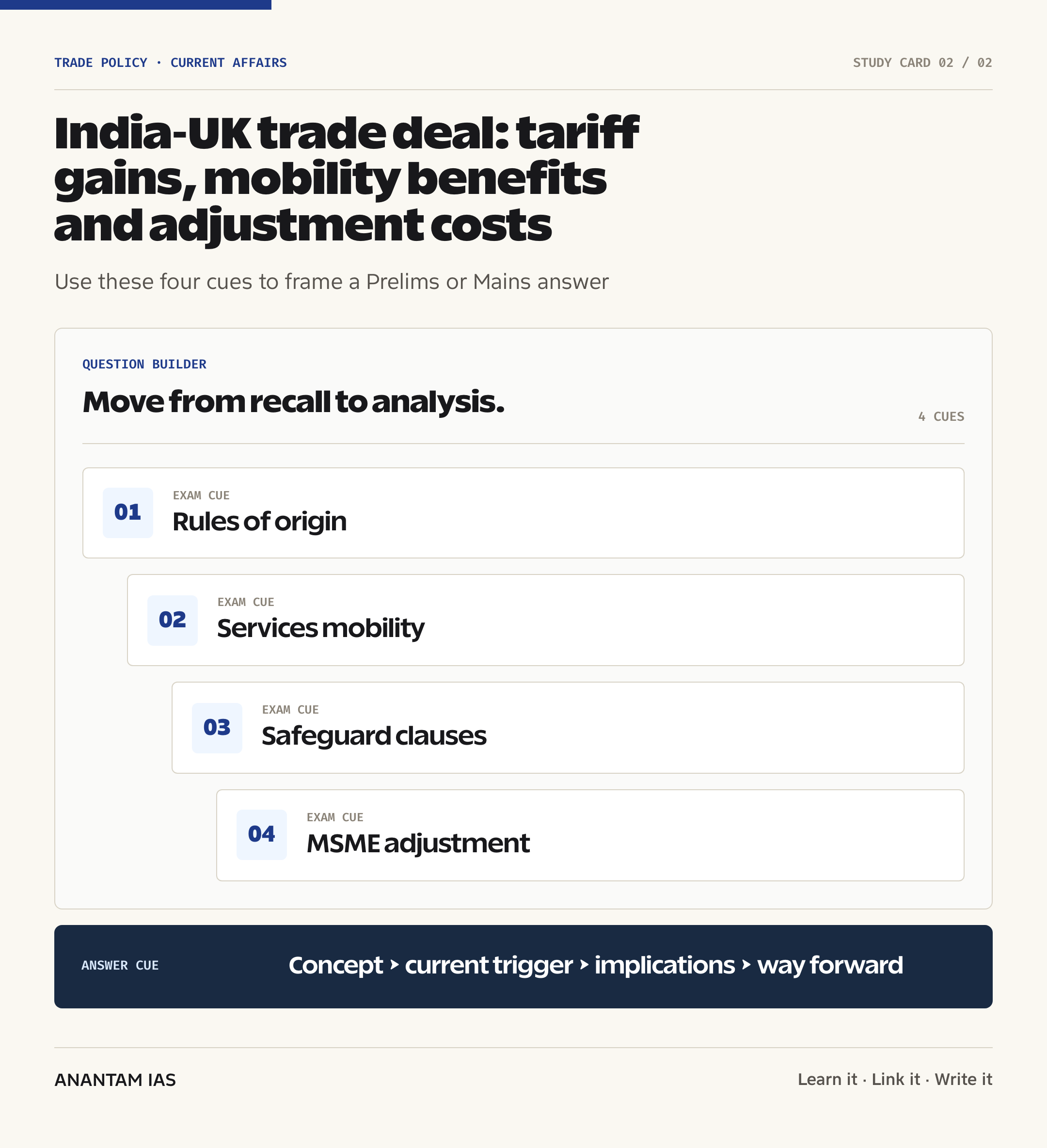
Tariff gains for Indian exports
The most immediate Indian gain is the removal of UK import duties from products in which India has established manufacturing and employment strengths.
- PIB said duties that had reached 70% on some processed foods, 21.5% on marine products and 18% on engineering goods and auto components fall to zero under the relevant schedules.
- Tariffs of up to 16% on leather and footwear, 12% on textiles and clothing, and 8% on chemicals and pharmaceuticals are also removed for qualifying originating goods.
- The price advantage can support labour-intensive employment, especially in apparel, leather, food processing, fisheries and small manufacturing clusters.
- The gain is not automatic: an exporter must prove origin, meet UK safety and labelling rules, secure buyers and absorb logistics, certification and marketing costs.
- Zero duty can improve India’s relative position against suppliers that lack equivalent preferences, but exchange rates, shipping costs, quality and delivery reliability can outweigh the tariff edge.
What India conceded and protected
Reciprocity gives British products greater access to India while allowing phased liberalisation and exclusions for sensitive Indian sectors.
- India will liberalise about 90% of its tariff lines over time, so many reductions are staged rather than delivered on day one.
- British whisky and gin receive deep phased tariff cuts, while automotive duties fall sharply within a quota; these concessions can increase competition and consumer choice.
- The government retained protection for dairy, cereals, millets, edible oils, oilseeds, apples and several vegetables, reflecting livelihood and food-security concerns.
- The agreement includes a bilateral safeguard against injurious import surges and preserves WTO-consistent anti-dumping and countervailing remedies.
- Selective exclusions show that trade agreements distribute gains and costs unevenly; national welfare estimates don’t remove the need to identify sector-specific exposure.
Services and mobility package
Services access matters to India because its export advantage extends beyond merchandise to knowledge-intensive and professional work.
- The UK commitments cover 137 sub-sectors, including IT and IT-enabled services, finance, healthcare, education, engineering, telecommunications and consultancy.
- CETA provides more predictable routes for business visitors, intra-corporate transferees, contractual service suppliers, independent professionals and investors under existing immigration rules.
- A dedicated annual opportunity covers 1,800 Indian chefs, yoga instructors and classical musicians, subject to the applicable conditions.
- Market access isn’t the same as automatic employment: visa sponsorship, professional licensing, salary thresholds and domestic regulation continue to apply.
- The mobility package can lower uncertainty for Indian firms delivering contracts in Britain, but firms still need recognised qualifications, data compliance and credible local networks.
How the DCC works
The social-security convention prevents duplicate contributions during qualifying temporary assignments while keeping the worker in the home system.
- Eligible detached workers and their employers pay into only one country’s system for assignments of up to 60 months, replacing a shorter 52-week UK default exemption.
- An India-based employee temporarily sent to the UK continues contributing to India’s Employees’ Provident Funds Scheme at an amount designed to be similar to the relevant UK contribution.
- The UK government’s explainer states that the convention covers contribution liability, not access to benefits, and doesn’t change either country’s immigration rules.
- PIB estimated that more than 75,000 Indian professionals and 900 companies could benefit from the arrangement.
- Avoiding duplicate payments reduces assignment costs and fragmented contribution records, strengthening India’s competitiveness in cross-border services without creating a general tax exemption.
Adjustment costs and implementation gaps
A negotiated tariff preference has economic value only when businesses can claim it and workers can manage the resulting reallocation.
- Small exporters may struggle with origin documentation, testing, certification, packaging and customs data; the fixed cost per shipment is proportionately higher for an MSME.
- British suppliers gain better Indian access in selected beverages, automobiles, medical devices and advanced manufacturing, creating pressure for affected Indian firms to improve quality and productivity.
- Non-tariff measures remain central: sanitary standards, technical regulations, carbon-related rules and private buyer standards can restrict market access even after customs duty reaches zero.
- Some services commitments lock in existing access rather than opening every sector; domestic licensing and qualification recognition can still limit commercial delivery.
- The earlier dispute over UK steel safeguards shows that an FTA operates inside a wider trade-policy environment. PIB said 85% of India’s steel exports were outside the 2026 measures, with other interests managed through quota and authorised-use routes.
Why the agreement matters for India's trade strategy
CETA tests whether India can combine strategic market opening with domestic capability-building and protection of core sensitivities.
- The agreement links India with a major G7 economy and complements New Delhi’s recent trade engagement with the UAE, Australia, EFTA and the European Union.
- It supports export diversification at a time of tariff conflict, supply-chain fragmentation and geopolitical risk in larger markets.
- Its government-procurement, digital-trade, SME and sustainability provisions show how modern FTAs shape regulatory cooperation as well as border taxes.
- The comparison with the India-EU FTA helps distinguish tariff access from harder questions involving carbon rules, standards and strategic autonomy.
- India’s success should be measured through preference utilisation, export diversification, MSME participation, services earnings and quality employment, not only headline trade growth.
Economic concepts for evaluating the deal
The welfare effect of an FTA depends on what new trade it creates, what existing trade it diverts and how producers respond to competition.
- Trade creation occurs when lower barriers replace higher-cost domestic production with more efficient imports from the partner, reducing prices and freeing resources for more productive activity.
- Trade diversion occurs when a preferential tariff shifts sourcing away from a more efficient non-member towards the partner merely because the partner receives a lower duty; this can reduce the welfare gain.
- The effective rate of protection can differ from the headline tariff because duties on imported inputs and final products affect domestic value addition differently; firms need the full schedule, not a single percentage.
- Preference erosion is possible when the UK later gives comparable access to other suppliers. Indian firms need productivity and product differentiation so their advantage survives beyond the first tariff window.
- Dynamic benefits can arise through scale, investment, technology transfer and learning by exporting, but these require reliable infrastructure, finance, skills and competitive input markets at home.
- Distribution matters: consumers may gain through lower prices while some producers face adjustment. Policy should help viable firms improve and workers retrain rather than freeze the pre-agreement production structure.
Way Forward
Turn preferences into actual exports
- Create sector-specific rules-of-origin toolkits, standard certificates and customs help desks so smaller firms can claim concessions without prohibitive advisory costs.
- Expand testing laboratories, mutual-recognition work and support for UK technical, sanitary and sustainability standards.
- Track utilisation at the tariff-line level and intervene where duty-free access exists on paper but exporter participation remains weak.
Support firms and workers through adjustment
- Offer time-bound technology, skilling and affordable-credit support to exposed MSMEs and industrial clusters, tied to measurable productivity gains.
- Use safeguards transparently when the legal injury threshold is met, while avoiding routine protection that would erase competitive pressure.
- Strengthen labour-market information and portable skills so workers can move towards expanding export sectors.
Deepen services gains
- Pursue practical recognition of professional qualifications and publish clear guidance on mobility categories, visas, DCC certificates and employer obligations.
- Help Indian firms comply with UK data, consumer and sectoral regulation, especially in digital, health, finance and education services.
- Review the agreement through evidence-based committees with participation from exporters, unions, states and small businesses.
Conclusion
The India-UK CETA is a significant market-access agreement, but its strongest Indian gains lie in the combination of labour-intensive exports, services access and contribution portability. The duty cut is the opening, not the outcome.
A high-quality implementation strategy must help firms prove origin, meet standards and move up value chains while giving exposed sectors a credible adjustment path. That balance can turn CETA from a tariff document into a durable instrument of growth, resilience and economic diplomacy.
UPSC Practice Questions
Prelims MCQ 1
With reference to the India-UK CETA and its companion Double Contribution Convention, consider the following statements:
- CETA entered into force on 15 July 2026.
- The DCC changes the United Kingdom’s immigration rules for Indian workers.
- The DCC can prevent duplicate social-security contributions for qualifying temporary postings.
How many of the above statements are correct?
(a) Only one (b) Only two (c) All three (d) None
Answer: (b) Only two
Explanation:
Statements 1 and 3 are correct. The two agreements took effect on 15 July 2026, and the DCC coordinates contribution liability for eligible detached workers. It doesn’t alter immigration rules or create a visa route.
Prelims MCQ 2
Which provision primarily prevents a third country’s goods from receiving India-UK preferential tariffs through minimal processing?
(a) Bilateral safeguard (b) Rules of origin (c) Double Contribution Convention (d) National treatment in services
Answer: (b) Rules of origin
Explanation:
Rules of origin identify the economic nationality of a product and set the processing or value-content conditions required for preferential tariff treatment.
UPSC Mains Questions
- The India-UK CETA offers immediate tariff opportunities, but its developmental impact will depend on domestic competitiveness and adjustment capacity. Examine the likely gains for Indian goods and services exports, and suggest measures to ensure broad-based benefits for MSMEs and workers.
- Trade agreements now regulate much more than customs duties. Discuss with reference to the India-UK CETA’s provisions on services mobility, social-security contributions, government procurement and safeguards. How should India assess implementation beyond headline trade values?
Sources: PIB, Ministry of Commerce and Industry and The Hindu.
Frequently Asked Questions
When did India-UK CETA take effect?
The India-UK Comprehensive Economic and Trade Agreement entered into force on 15 July 2026. Negotiations concluded on 6 May 2025, and the agreement was signed in London on 24 July 2025. Entry into force made its tariff schedules, rules and services commitments operational.
What is India’s main tariff gain?
The UK provides zero-duty access on about 99% of Indian tariff lines, covering nearly all current export value. Textiles, garments, leather, footwear, marine products, engineering goods, chemicals, pharmaceuticals and processed foods are among the sectors expected to gain from lower landed prices.
What does the DCC provide?
The Double Contribution Convention ensures that eligible detached workers and their employers pay social-security contributions in only one country during a qualifying temporary assignment, for up to 60 months. It coordinates contribution liability but doesn’t change immigration rules or independently grant access to welfare benefits.
Are all tariff gains automatic?
No. Exporters must satisfy rules of origin, submit the required documentation, meet product and safety standards, and find commercial buyers. Certification, logistics, finance and private market standards can still weaken the usable value of a nominally zero tariff, especially for smaller enterprises.
Which Indian sectors remain protected?
India retained protection for sensitive agricultural and rural products, including dairy, cereals, millets, edible oils, oilseeds, apples and several vegetables. Phased concessions, quotas, exclusions and trade-remedy provisions help manage import competition while the wider agreement gradually opens other sectors.
How should CETA’s success be measured?
Assessment should include preference-utilisation rates, export diversification, MSME participation, services earnings, investment, productivity and quality jobs. It should also track import surges, adjustment needs and whether firms can meet standards. A rise in total trade alone cannot show how gains and costs are distributed.
Source: https://anantamias.com/current-affairs/india-uk-trade-deal-gains/
West Bengal Border Fencing: Land Transfer and Security Coordination
Why in News?
The Hindu reported that the West Bengal government had, as of July 14, 2026, formally handed over 1,024.75 acres to support fencing across 172.6 km of the India-Bangladesh border.
The transfer gives the Border Security Force (BSF) access to land needed for physical barriers and brings a long-standing implementation bottleneck into focus: border guarding is a Union responsibility, but land records, acquisition and local administration depend heavily on the State government.
- The reported transfer covers 1,024.75 acres linked to 172.6 km of proposed or completed fencing.
- Reported district highlights include Murshidabad, where about 337 acres were linked to 45.4 km of fencing.
- In North 24 Parganas, 241.03 acres were linked to a 42.07-km stretch.
- In Cooch Behar, 135.33 acres were linked to 39.39 km, while Malda accounted for about 176.78 acres and 20.15 km.
- The land is being handed to the BSF, India’s border-guarding force for the Bangladesh and Pakistan frontiers.
The development matters in the context of:
- The development is a live example of cooperative federalism in internal-security infrastructure.
- It shows why fencing progress can’t be judged only by sanctioned kilometres; land availability, terrain and bilateral protocols shape execution.
- It also supports a wider shift from fence-only thinking to integrated border management using patrols, sensors, roads, intelligence and local development.
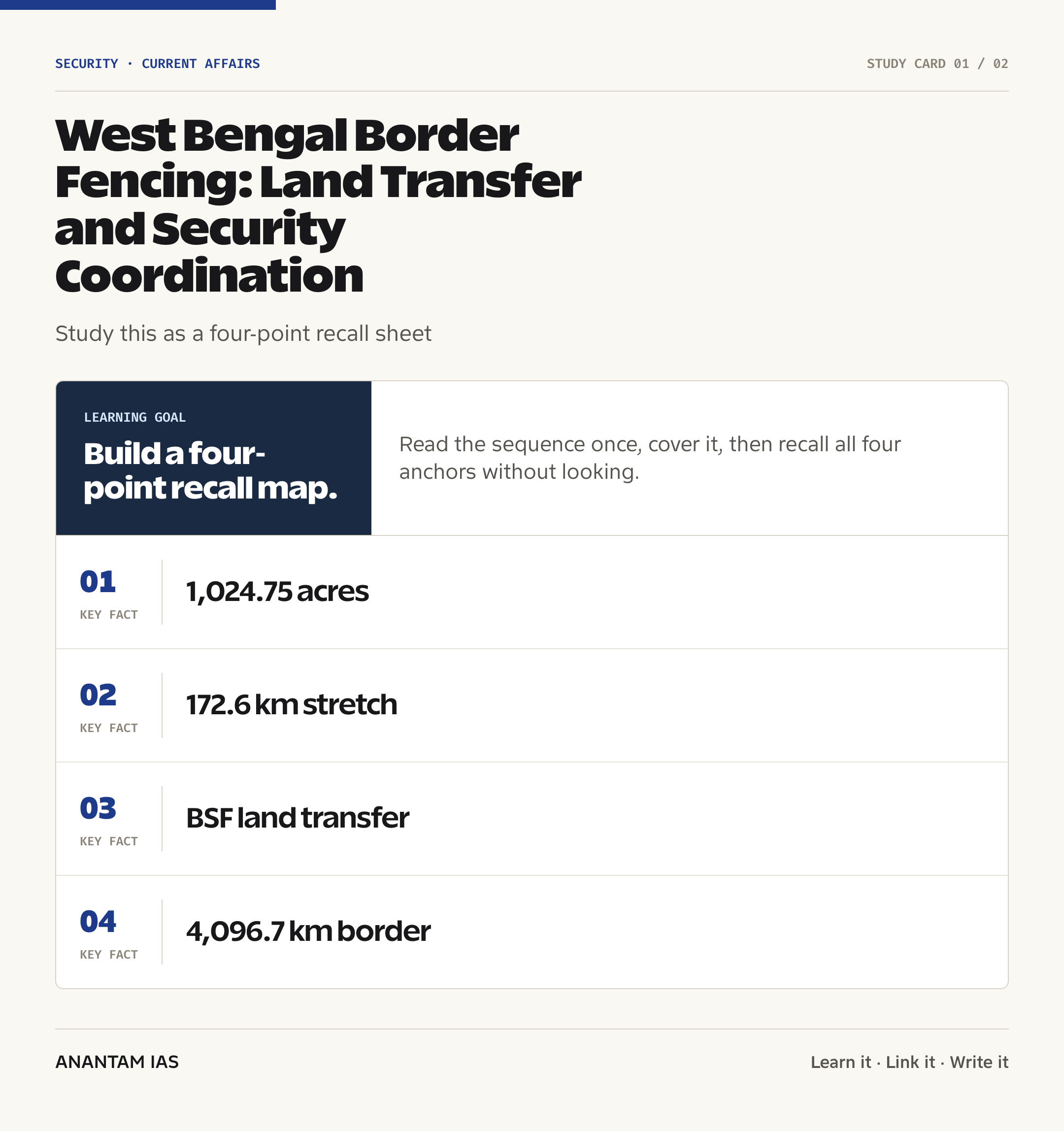
UPSC Relevance
Prelims Relevance
- The India-Bangladesh border is 4,096.7 km long and runs through West Bengal, Assam, Meghalaya, Tripura and Mizoram.
- West Bengal shares about 2,216.7 km of this border, the longest share among Indian States.
- The BSF is a Central Armed Police Force under the Ministry of Home Affairs and guards India’s borders with Bangladesh and Pakistan.
- The BSF Act, 1968 provides the statutory basis for the force.
- The Border Management-I Division of the Ministry of Home Affairs handles fencing, floodlighting, roads, Border Out Posts and technological solutions on several international borders.
- The Comprehensive Integrated Border Management System (CIBMS) combines sensors, networks, intelligence and command-and-control systems.
- BOLD-QIT is a technology project used on the riverine India-Bangladesh border in Assam under CIBMS.
- Physical fencing may be impracticable in riverine, marshy and densely populated terrain, making technology and patrolling necessary complements.
Mains Relevance
GS Paper 3
- Challenges of border management, cross-border crime, trafficking and illegal movement.
- Role of the BSF, fencing and technology-led surveillance in internal security.
- Balancing hard infrastructure with border-community welfare and legitimate cross-border movement.
GS Paper 2
- Centre-State coordination when Union security projects require State-controlled land and district administration.
- Institutional accountability, rehabilitation and consultation in land transfer for public purposes.
Essay
- Security infrastructure works best when federal coordination converts policy intent into local implementation.
- A secure border must act as both a barrier to crime and a gateway for lawful trade, travel and cultural contact.
Background and Context
The India-Bangladesh Border
India’s eastern frontier is long, inhabited and geographically varied, so it can’t be secured by a uniform barrier.
- The Ministry of Home Affairs records the boundary at 4,096.7 km across West Bengal, Assam, Meghalaya, Tripura and Mizoram.
- The border crosses plains, rivers, chars, marshes and settlements; seasonal flooding and shifting river channels can alter ground conditions.
- Many communities have family, livelihood and cultural ties across the frontier, while formal movement and trade pass through notified land ports such as Petrapole.
- The operational challenge is to stop smuggling, trafficking and unauthorised crossings without obstructing lawful trade or daily life in border villages.
- For a deeper static foundation, revise India’s land and maritime border-management framework.
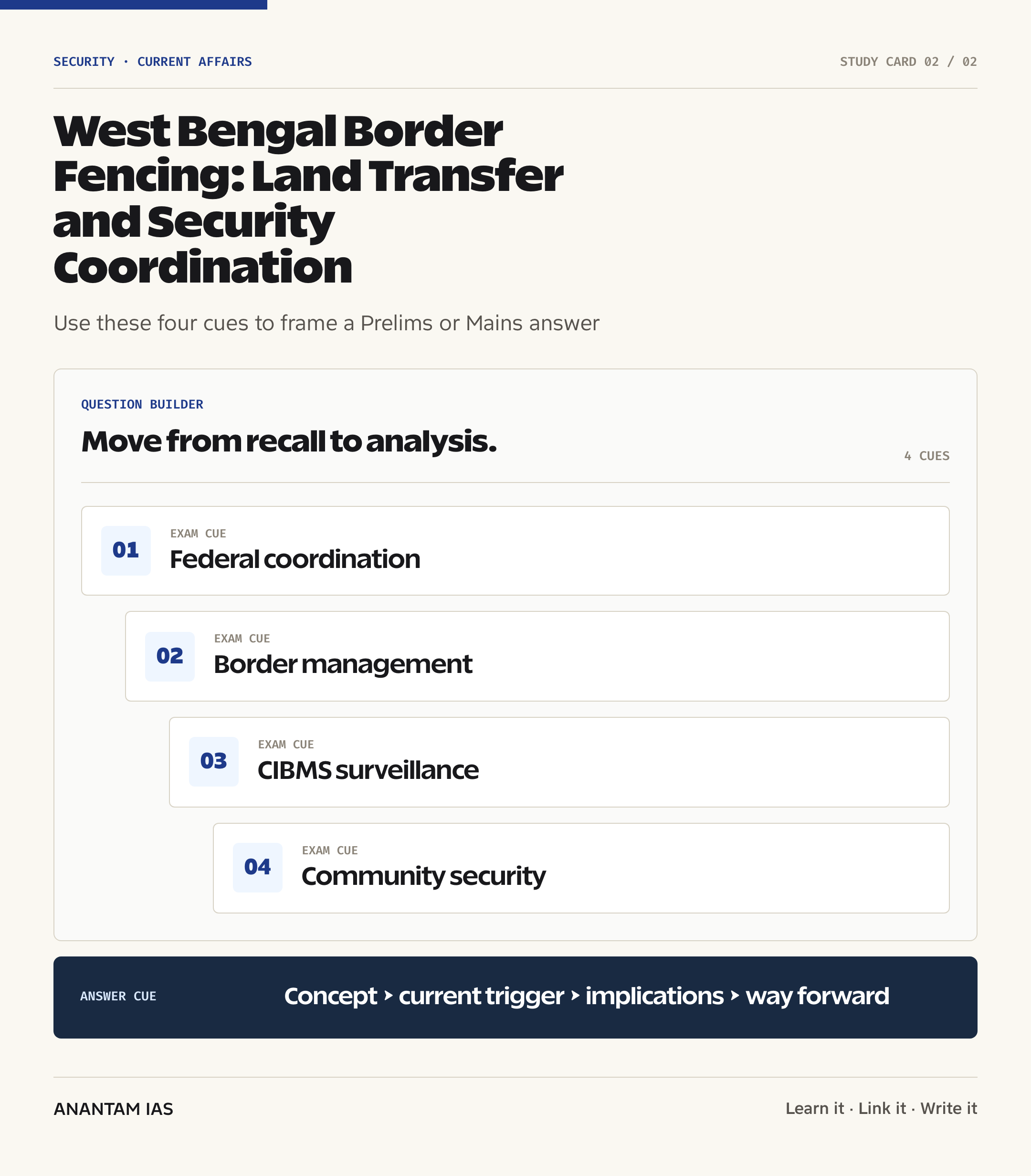
What the New Land Transfer Covers
The July 2026 announcement converts land parcels under State control into work fronts available for BSF-linked fencing.
- The reported statewide total is 1,024.75 acres associated with 172.6 km of fencing.
- The largest reported district component was Murshidabad, with about 337 acres associated with 45.4 km.
- North 24 Parganas accounted for 241.03 acres and 42.07 km, while Cooch Behar accounted for 135.33 acres and 39.39 km.
- Malda accounted for about 176.78 acres and 20.15 km in the district-wise details reported by The Hindu.
- The figures should be read as land made available for works, not proof that every kilometre became operational on the announcement date.
- Construction still requires surveys, contracting, local access, technical design and resolution of site-specific objections.
Why Land Becomes a Federal Bottleneck
Border security has a national command structure, but the ground needed for fencing sits inside State and district administrative systems.
- The Union government, through the Ministry of Home Affairs, plans border infrastructure and deploys the BSF.
- State departments maintain land records, identify ownership and coordinate acquisition, transfer, compensation and local access.
- District magistrates, revenue officials, police and local bodies are essential for survey and possession of scattered parcels.
- Delays can arise from title disputes, fragmented holdings, compensation concerns, public protests and the need to preserve roads, farms and habitation access.
- The case shows cooperative federalism as an operational requirement, not only a constitutional slogan.
- Students can connect this example with the broader institutional framework of India’s internal security.
National Fencing Status and Constraints
Official data show high coverage, but the remaining gaps are often the hardest and most sensitive stretches.
- In a February 2025 parliamentary reply, the Ministry of Home Affairs said 3,232.218 km of the 4,096.7-km India-Bangladesh border had been fenced.
- The same reply placed the unfenced length at 864.482 km, including 174.514 km classified as a non-feasible gap.
- Officially listed constraints included land acquisition, objections by Border Guard Bangladesh, a limited working season, landslides and marshy terrain.
- A 2020 parliamentary reply recorded that 1,637 km of West Bengal’s 2,216.7-km boundary had physical fencing at that time; the figure is useful as historical context, not a current completion count.
- India has stated that fencing work observes applicable bilateral protocols and understandings with Bangladesh.
- The key exam point is that an unfenced stretch isn’t automatically unguarded; BSF patrols and non-physical barriers may still cover it.
From Physical Fence to Smart Border Management
A fence delays and channels movement, while a layered system detects, assesses and responds to attempted crossings.
- The CIBMS integrates thermal imagers, infrared and laser-based alarms, radars, cameras, ground sensors and communication networks.
- Sensor feeds reach command-and-control centres, allowing quick assessment and deployment of reaction teams.
- The BOLD-QIT project covered a difficult 61-km riverine stretch around the Brahmaputra in Assam, where conventional fencing wasn’t feasible.
- Technology can improve detection in fog, marshes and river channels, but it still needs trained personnel, maintenance and reliable power and connectivity.
- Physical works also include border roads, floodlighting and Border Out Posts, which support mobility and sustained presence.
- The July 14 digest on new threats identified by India’s border districts adds the police and intelligence layer to this infrastructure story.
Security, Rights and Border Communities
Durable security depends on public legitimacy because fencing can reshape access to farms, markets, schools and family networks.
- Land transfer should follow clear records, fair compensation and accessible grievance mechanisms for affected owners and users.
- Fence alignment must account for habitations and cultivated plots that may lie close to the international boundary.
- Gates, regulated access and predictable timings may be needed where farmers must reach land near or beyond a fence line.
- Border residents can provide valuable local intelligence, but trust erodes when security practices are arbitrary or livelihoods are ignored.
- Development of roads, health services, communications and jobs reduces the vulnerability that smuggling networks may exploit.
- Success should be measured through fewer crimes, quicker lawful movement and safer communities, not only kilometres fenced.
Way Forward
Complete Land and Work-Front Coordination
- Create a shared parcel-level dashboard for the Ministry of Home Affairs, BSF, State revenue departments and district administrations.
- Track each stretch from survey and title verification to possession, construction and commissioning, with named responsibility at every stage.
- Resolve compensation and access disputes through time-bound local hearings before they become prolonged litigation.
Use Terrain-Specific Security Design
- Build physical fencing where feasible and deploy CIBMS-type surveillance across riverine, marshy or densely inhabited gaps.
- Link sensors to patrol routes and quick-reaction protocols so detection produces a timely field response.
- Audit equipment for downtime, false alarms and monsoon resilience instead of counting only installed devices.
Protect Communities and Lawful Connectivity
- Publish clear procedures for compensation, gate access and grievance redressal in affected villages.
- Coordinate fencing with border roads, communications, schools, health facilities and legitimate trade infrastructure.
- Use community liaison and local police intelligence while protecting civil liberties and avoiding the stigmatisation of border residents.
Sustain Bilateral and Institutional Channels
- Address alignment objections and construction protocols through regular BSF-BGB coordination.
- Review progress using outcomes such as reduced trafficking and smuggling, safer patrols and faster lawful crossings.
- Keep parliamentary data current and State-specific so public debate distinguishes feasible works from non-feasible gaps.
Conclusion
West Bengal’s land transfer is important because it addresses the administrative step that turns a sanctioned fence into a buildable project. The episode captures the practical meaning of Centre-State coordination in internal security.
But a secure India-Bangladesh border needs more than barbed wire. The stronger model combines physical barriers, smart surveillance, responsive forces, bilateral coordination and community-centred development, with success judged by safer borders and protected lawful movement.
UPSC Practice Questions
Prelims MCQ 1
With reference to the India-Bangladesh border, consider the following statements:
- The Border Security Force guards India’s borders with both Bangladesh and Pakistan.
- West Bengal has the longest State-wise share of India’s boundary with Bangladesh.
- BOLD-QIT was developed as a technology solution for a riverine border stretch in Assam.
How many of the above statements are correct?
(a) Only one (b) Only two (c) All three (d) None
Answer: (c) All three
Explanation:
The BSF guards the Bangladesh and Pakistan borders. West Bengal shares about 2,216.7 km with Bangladesh, and BOLD-QIT was deployed on a difficult riverine stretch in Dhubri, Assam.
Prelims MCQ 2
Which one of the following best describes the Comprehensive Integrated Border Management System (CIBMS)?
(a) A customs tariff platform used only at land ports (b) A system integrating surveillance sensors, communication networks and command centres (c) A bilateral tribunal that settles boundary disputes (d) A State police database for recording land titles
Answer: (b) A system integrating surveillance sensors, communication networks and command centres
Explanation:
CIBMS combines technologies such as thermal imagers, alarms, radars, cameras and sensors with communications and command-and-control systems to strengthen border surveillance.
UPSC Mains Questions
- Border fencing is as much a challenge of federal coordination and local administration as it is of national security. Discuss with reference to the land, institutional and community issues involved along the India-Bangladesh border.
- Physical fencing alone can’t secure India’s geographically diverse borders. Examine how technology, intelligence, bilateral mechanisms and border-area development can create an integrated border-management system.
Sources: Ministry of Home Affairs, Government of India and The Hindu.
Frequently Asked Questions
What did West Bengal transfer for border fencing?
The State government reportedly handed over 1,024.75 acres associated with fencing across 172.6 km of the India-Bangladesh border as of July 14, 2026. The transfer makes land available to the BSF-linked fencing process; it doesn’t mean every kilometre was completed that day.
Which force guards the Bangladesh border?
The Border Security Force, a Central Armed Police Force under the Ministry of Home Affairs, guards India’s borders with Bangladesh and Pakistan. Its duties combine patrolling, surveillance, interception and coordination with other agencies and the counterpart border force.
Why does border fencing need State cooperation?
The Union plans border-security infrastructure and deploys the BSF, while State and district authorities manage land records, ownership verification, acquisition or transfer, compensation and local access. A fence can’t be built until the required parcels are lawfully identified and made available.
How much India-Bangladesh border was fenced?
A Ministry of Home Affairs reply in February 2025 said 3,232.218 km of the 4,096.7-km border had been fenced. It listed 864.482 km as unfenced, including 174.514 km of non-feasible gap. These are national figures from that reply.
What is smart fencing under CIBMS?
CIBMS integrates sensors, cameras, thermal imagers, radars, communication networks and command centres to detect and respond to crossings. It supplements physical fencing, especially in riverine, marshy or densely populated stretches where a conventional barrier is difficult to build.
Can every border stretch be physically fenced?
No. Rivers, marshes, landslide-prone terrain, settlements, land disputes and bilateral objections can make physical fencing difficult or non-feasible. Such stretches require a mix of patrols, electronic surveillance, intelligence, local cooperation and carefully designed access controls.
Source: https://anantamias.com/current-affairs/west-bengal-international-border-fencing-land/
Air India crash inquiry: Why the October draft report will not be public immediately
Why in News?
The Aircraft Accident Investigation Bureau (AAIB) told the Supreme Court that investigative activity in the Air India Flight AI171 crash inquiry could be completed in about six weeks, subject to external dependencies, and that a draft final report is expected around October 2026.
The October document will not automatically become a public final report. Under Rule 14 of the Aircraft (Investigation of Accidents and Incidents) Rules, 2025 and ICAO Annex 13, the draft must first go to participating states for significant and substantiated comments. This makes the case a useful study of aviation safety governance, protected evidence and institutional accountability.
- The Hindu reported the timeline from an affidavit filed by the Ministry of Civil Aviation and AAIB in petitions seeking an independent or court-monitored inquiry.
- The affidavit said 49 of 66 mandatory procedural steps had been completed and placed the likely draft-report stage in October 2026.
- The crash occurred on 12 June 2025, when the London Gatwick-bound Boeing 787-8, VT-ANB, went down shortly after take-off from Ahmedabad.
- The accident killed 260 people: 241 of the 242 persons on board and 19 people on the ground; one passenger survived.
- AAIB’s official interim statement of 12 June 2026 said analysis covered aircraft systems, flight-recorder data, engine components, maintenance and operational records, and human factors.
- No final cause has been announced. AAIB has repeatedly asked the public and media to avoid speculation while the evidence is still being integrated.
The development matters in the context of:
- A draft final report is a consultation document, not the same thing as the final report released to the public.
- An Annex 13 investigation seeks prevention and safety learning; it is legally separate from proceedings that determine civil, administrative or criminal liability.
- Confidentiality protects candid testimony and safety analysis, but the final report must still explain causes, contributing factors and safety recommendations well enough to sustain public trust.
- For disaster management, the crash tests the full chain from prevention and emergency response to forensic investigation, regulatory correction and institutional learning.
UPSC Relevance
Prelims Relevance
- The Aircraft Accident Investigation Bureau is India’s designated authority for investigating aircraft accidents and serious incidents.
- AAIB functions under the Ministry of Civil Aviation; the 2025 Rules define it with reference to Section 7 of the Bharatiya Vayuyan Adhiniyam, 2024.
- ICAO is a specialised agency of the United Nations created under the Chicago Convention, 1944; its headquarters is in Montreal, Canada.
- Annex 13 to the Chicago Convention contains international standards and recommended practices for aircraft accident and incident investigation.
- The State of Occurrence normally institutes the investigation; the States of Registry, Operator, Design and Manufacture can participate through accredited representatives.
- Under Rule 14 of the 2025 Rules, the usual consultation period on a draft final report is 30 days and may extend to 60 days when a participating state seeks more time.
- An accident investigation aims to identify causes, contributing factors and safety recommendations, not to assign blame or liability.
- Protected records include witness statements, operational communications, medical or private information, cockpit voice recordings, air-traffic-control recordings and opinions in safety analysis.
- A preliminary report rapidly communicates factual information gathered early in the inquiry; it does not necessarily establish the probable cause.
- AI171 involved a Boeing 787-8 registered VT-ANB and operating from Ahmedabad to London Gatwick.
Mains Relevance
GS Paper 3
- Disaster management: connect prevention, emergency response, forensic investigation, safety recommendations and organisational learning rather than treating an accident as a one-time relief event.
- Science and technology: flight recorders, aircraft-system data, engine examination and human-factors analysis show how multiple evidence streams are integrated in a complex technical inquiry.
- Infrastructure safety: a credible civil-aviation system needs an independent investigation authority, a responsive regulator, trained airport emergency services and measurable implementation of recommendations.
GS Paper 2
- Governance and accountability: examine how statutory independence, judicial scrutiny, confidentiality and public disclosure can coexist in a high-stakes investigation.
- International institutions: ICAO Annex 13 makes accident investigation a cooperative process involving states connected to the aircraft, operator, design and manufacture.
- Rule of law: distinguish a safety inquiry from civil or criminal proceedings so that preliminary technical facts aren’t converted into premature findings of culpability.
Essay
- Trust in institutions depends not only on speed, but on the visible integrity of their method.
- Confidentiality can protect truth-seeking, but secrecy without eventual explanation weakens accountability.
- A disaster becomes a second tragedy when institutions fail to learn from it.
Background and Context
The AI171 accident and the limits of preliminary facts
The preliminary report established a time sequence and evidence trail, but it did not announce a probable cause.
- Air India Flight AI171 was a scheduled passenger service from Ahmedabad to London Gatwick on 12 June 2025, operated by a Boeing 787-8 bearing registration VT-ANB.
- There were 230 passengers and 12 crew members on board. The preliminary report recorded 241 onboard fatalities, one serious injury to the surviving passenger and 19 fatalities on the ground.
- The aircraft lifted off from Runway 23 at about 08:08:39 UTC. The Enhanced Airborne Flight Recorder showed the two engine fuel-control switches transition from RUN to CUTOFF one after the other, with a gap of about one second.
- The switches later returned to RUN and the engines entered relight sequences, but the aircraft had already begun losing altitude. A Mayday transmission was recorded at about 08:09:05 UTC.
- Fuel samples from the bowsers and tanks used to refuel the aircraft were found satisfactory, and the preliminary report observed no significant bird activity near the flight path.
- These are recorded facts, not a finding about why the switch transitions occurred. Treating sequence as causation would go beyond the report.
What AAIB has examined since the crash
A modern accident inquiry combines technical, operational, organisational and human evidence rather than searching for a single dramatic clue.
- AAIB recovered two Enhanced Airborne Flight Recorders (EAFRs). The forward unit yielded about 49 hours of flight data covering six flights and two hours of cockpit audio that included the event flight.
- The official one-year interim statement listed continuing analysis of aircraft systems, flight-recorder data, engine-related components, maintenance records and operational records.
- It also identified human factors and organisational evidence as part of the inquiry. This matters because an accident can emerge from interacting design, maintenance, procedural, environmental and decision-making failures.
- Accredited representatives, technical advisers and subject-matter experts from relevant organisations support the inquiry while the Investigator-in-Charge retains control of the investigation.
- The United States participates because it is the State of Design and Manufacture; its National Transportation Safety Board (NTSB) appointed an accredited representative, supported by advisers from Boeing, GE and the FAA.
- AAIB’s June 2026 statement said additional specialist examinations would continue wherever needed so that findings rest on verified evidence and sound scientific analysis.
AAIB, DGCA and the separation of functions
India’s aviation-safety architecture separates accident investigation from day-to-day regulation, even though both institutions sit within the civil-aviation system.
- The AAIB conducts or controls investigations into accidents and serious incidents to identify safety lessons, causes, contributing factors and recommendations.
- The Directorate General of Civil Aviation (DGCA) is the civil-aviation regulator. It sets and enforces safety requirements, oversees operators and personnel, and acts on regulatory implications emerging from investigations.
- This functional separation reduces the risk of the same body investigating the adequacy of its own regulatory decisions. It also aligns India with the institutional logic of ICAO Annex 13.
- Under the 2025 Rules, AAIB controls relevant evidence and wreckage for the safety inquiry. Parallel judicial or criminal bodies may address liability, but they serve a different legal purpose.
- A safety recommendation does not create a presumption of blame. Its test is whether acting on it could prevent recurrence or reduce the severity of future accidents.
- Students can revise this distinction with the wider prevention-to-recovery framework in Anantam IAS’s GS3 disaster management guide.
How a draft becomes a public final report
The October target marks an important stage, but international consultation stands between a draft and publication.
- A draft final report is the investigators’ report forwarded for consultation under Rule 14; it is not an interim press note or the final public document.
- The draft goes to the State of Registry, State of Operator, State of Design, State of Manufacture and any other state that participated in the investigation under the Rules.
- Those states may submit significant and substantiated comments. The usual consultation window is 30 days and can extend to 60 days when a state notifies that it needs more time.
- The investigator may incorporate the substance of comments or append them when the commenting state requests this. If no comment arrives within the agreed period, the final report may be issued.
- For an aircraft above 5,700 kg, the public final report is also forwarded to ICAO. A Boeing 787-8 is far above this threshold.
- The sequence is worth memorising: investigation → draft final report → state consultation → consideration of comments → public final report → safety follow-up.
Why some investigation records remain protected
Confidentiality is meant to preserve the quality of safety evidence, not to erase the duty to publish defensible findings.
- Rule 17 protects witness statements, communications among persons involved in operating the aircraft, medical and private information, cockpit voice recordings, air-traffic-control recordings and opinions expressed during analysis.
- The logic is a just-culture principle: investigators need candid testimony and unfiltered operational evidence. Automatic public exposure can make witnesses defensive and damage future investigations.
- Cockpit audio itself isn’t disclosed publicly. Relevant information may enter the final report only to the extent needed for analysing the accident, while irrelevant personal material should stay out.
- The final report must not disclose the names of persons involved in the accident. This keeps the safety analysis focused on systems, decisions and contributing conditions rather than public vilification.
- Protection isn’t absolute. The Central Government may determine that disclosure outweighs the adverse domestic and international impact on the present or future investigations.
- The governance challenge is to protect raw records while publishing a sufficiently reasoned final report, clear recommendations and a visible record of corrective action.
Accountability without a premature blame game
The Supreme Court proceedings place two legitimate concerns side by side: investigative integrity and confidence among victims’ families and the public.
- Petitioners have sought an independent or court-monitored inquiry, while the government argues that AAIB is the specialised and legally designated authority under India’s Annex 13 obligations.
- Judicial review can examine whether the statutory process is being followed, whether the authority acts fairly and whether legal duties are discharged. It needn’t substitute judges for technical investigators.
- Families are entitled to timely, accurate information and a final account that addresses evidence-based questions. But a deadline that rewards speed over validation can produce a weaker safety result.
- Investigative independence requires adequate staffing, laboratory capability, budget, freedom from conflicts and transparent handling of comments from manufacturers, operators and foreign authorities.
- Public communication should clearly label preliminary facts, unresolved questions and final conclusions. This prevents news cycles from converting partial data into accusations.
- The best accountability test comes after publication: whether the safety recommendations are assigned, implemented, independently tracked and closed with evidence.
Way Forward
Protect the investigation's technical integrity
- Complete outstanding examinations and resolve external dependencies without announcing a cause before the integrated analysis supports one.
- Maintain a documented chain of custody for wreckage, flight-recorders, laboratory samples and digital evidence.
- Record how substantive comments from participating states were accepted, rejected or appended while preserving the Investigator-in-Charge’s independence.
Communicate the process more clearly
- Publish periodic procedural updates that distinguish completed work, pending work and the next statutory stage without disclosing protected evidence.
- Explain that an October draft isn’t an October public report, and state the 30-to-60-day consultation mechanism in plain language.
- Use a single authoritative information page linking the preliminary report, interim updates, applicable rules and the final report once released.
Turn the final report into measurable safety reform
- Give every recommendation a responsible institution, response deadline and public status such as open, accepted, implemented or closed.
- Require the DGCA, airport operator, airline and manufacturers to publish evidence-backed action taken where recommendations fall within their remit.
- Feed lessons into simulator training, maintenance systems, emergency-response exercises, aircraft certification oversight and India’s wider State Safety Programme.
Strengthen long-term institutional capacity
- Invest in AAIB’s investigator cadre, recorder laboratories, metallurgy and digital-forensics capability, human-factors expertise and international training.
- Create parliamentary and public dashboards for recommendation follow-up without allowing political bodies to rewrite technical findings.
- Revise aviation-safety developments through the current-affairs hub and monthly consolidation at Anantam IAS monthly current affairs.
Conclusion
The October 2026 target matters because it moves the AI171 inquiry toward its decisive analytical stage. It shouldn’t be mistaken for a publication date: the draft must pass through the consultation procedure built into Rule 14 and ICAO Annex 13 before a final report is issued.
The durable UPSC lesson is institutional. Aviation safety improves when investigators can protect sensitive evidence, work free of a blame-first narrative and still produce a transparent final account with trackable recommendations. Independence, scientific rigour and public accountability are complements when the process is designed well.
UPSC Practice Questions
Prelims MCQ 1
With reference to aircraft accident investigations in India, consider the following statements:
- AAIB is India’s designated authority for investigating aircraft accidents and serious incidents.
- The sole objective of an Annex 13 investigation is to determine criminal liability.
- A draft final report is circulated to specified participating states for significant and substantiated comments.
How many of the above statements are correct?
(a) Only one (b) Only two (c) All three (d) None
Answer: (b) Only two
Explanation:
Statements 1 and 3 are correct. AAIB is India’s accident-investigation authority, and Rule 14 provides for consultation with specified states on the draft final report. Statement 2 is incorrect because the inquiry seeks accident prevention and safety learning, not the assignment of blame or criminal liability.
Prelims MCQ 2
Under India’s Aircraft (Investigation of Accidents and Incidents) Rules, 2025, what is the usual consultation period for comments on a draft final report?
(a) 15 days (b) 30 days (c) 90 days (d) 180 days
Answer: (b) 30 days
Explanation:
Rule 14 sets the usual consultation period at 30 days from transmittal. It may extend to 60 days if a state invited to comment notifies that it needs additional time.
UPSC Mains Questions
- Aircraft accident investigation is a safety-learning process rather than a trial for assigning liability. Explain how this distinction shapes the powers, confidentiality rules and final-report procedure of India’s Aircraft Accident Investigation Bureau. (250 words)
- The AI171 inquiry illustrates the tension between investigative confidentiality and public accountability. Suggest an institutional framework that protects sensitive evidence while assuring victims’ families and the public of independence, timeliness and meaningful safety reform. (250 words)
- A final accident report has limited value unless its safety recommendations are implemented and tracked. Examine the roles of AAIB, DGCA, operators and Parliament in closing India’s aviation-safety learning loop. (150 words)
Sources: Aircraft Accident Investigation Bureau, Ministry of Civil Aviation and The Hindu.
Frequently Asked Questions
When will the AI171 draft report be ready?
AAIB told the Supreme Court that investigative activity could finish in about six weeks, subject to external dependencies, and that the draft final report is expected around October 2026. The date is an estimate for the draft stage, not a guaranteed public-release date.
Will the October draft report be public?
Not immediately. Rule 14 requires the draft to be shared with specified participating states for significant and substantiated comments. The usual consultation period is 30 days and may extend to 60 days. A public final report follows consideration of those comments.
What is the role of AAIB?
The Aircraft Accident Investigation Bureau is India’s designated accident-investigation authority. It gathers and analyses evidence, determines causes and contributing factors, and issues safety recommendations. Its inquiry aims to prevent recurrence and is separate from proceedings that decide civil, administrative or criminal liability.
What does ICAO Annex 13 cover?
Annex 13 to the Chicago Convention sets international standards and recommended practices for investigating aircraft accidents and incidents. It covers state responsibilities, participation by accredited representatives, handling of reports, protection of records and the safety-focused objective of investigations.
Has AAIB identified the crash cause?
No final cause has been published. The preliminary report recorded factual evidence, including the flight sequence and fuel-control-switch transitions, while AAIB’s interim statement said technical, operational, organisational and human-factor evidence remained under integrated analysis.
Why are cockpit recordings kept confidential?
Protected records encourage candid cooperation and prevent sensitive personal material from being misused outside the safety inquiry. Relevant information can be reflected in the final analysis, but cockpit audio itself is not released publicly under the 2025 Rules.
Source: https://anantamias.com/current-affairs/air-india-crash-aaib-final-report/
Article 32 and Social-Media Regulation: Supreme Court Stresses the Proper Legal Route
Why in News?
On 15 July 2026, the Supreme Court refused to entertain a writ petition seeking curbs on podcasts and social-media reels carrying allegedly derogatory religious comments. The Hindu reported that a Bench of Justices P.S. Narasimha and Alok Aradhe said the freedom to approach the Court under Article 32 couldn’t become a route for politicising an issue.
The Bench treated the dispute as one requiring the ordinary legal process, not direct constitutional intervention. It advised the petitioner to pursue a complaint and FIR where an offence was alleged, act under the applicable law, or approach the competent authority under the 2009 IT interception rules.
- The petition was filed by Mohd. Anas Chaudhary over the online circulation of allegedly derogatory comments about Prophet Muhammed.
- The petitioner sought broader regulation of reels and podcasts, arguing that communally hurtful comments were circulating online.
- The Bench said the grievance didn’t present a fit case for a direct petition under Article 32.
- The Court pointed to remedies before the police and competent statutory authority instead of creating an immediate pan-India restriction.
- An earlier Vacation Bench had also declined to short-circuit standard procedure when the controversy was mentioned for urgent hearing in early July.
The development matters in the context of:
- The episode tests the boundary between the Supreme Court’s role as guardian of fundamental rights and the need to respect ordinary investigative and regulatory processes.
- It separates a genuine constitutional-remedy question from a request that effectively asks the Court to design platform-wide content policy in the first instance.
- It also shows why online-speech disputes must distinguish unpopular or offensive expression from speech that crosses a restriction recognised by law.
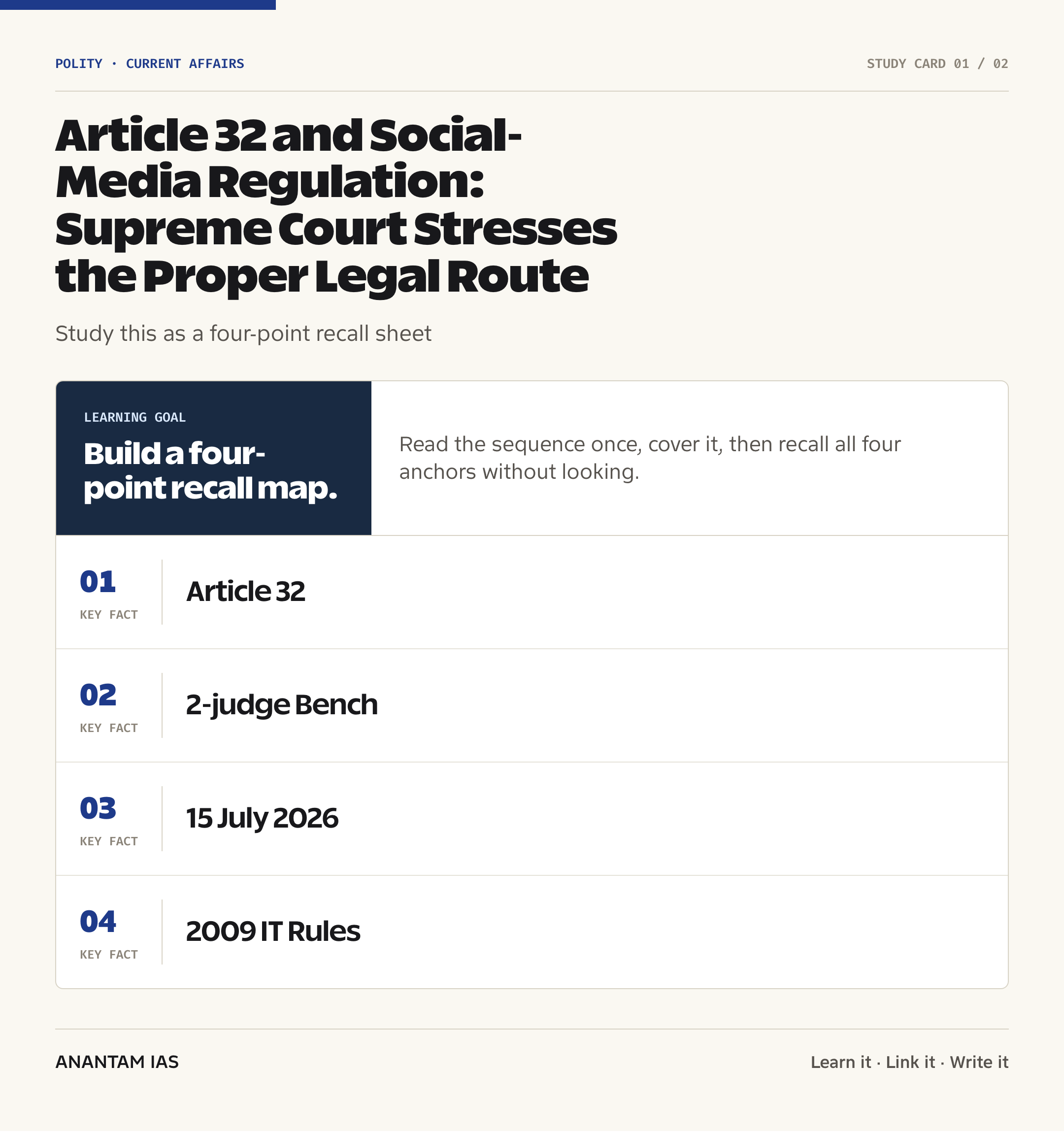
UPSC Relevance
Prelims Relevance
- Article 32 guarantees the right to move the Supreme Court for enforcement of fundamental rights.
- The Supreme Court may issue the writs of habeas corpus, mandamus, prohibition, certiorari and quo warranto under Article 32.
- Article 226 gives High Courts a wider writ jurisdiction: for fundamental rights and for other legal rights.
- Article 19(1)(a) protects freedom of speech and expression, subject to reasonable restrictions under Article 19(2).
- Public interest litigation relaxed the traditional rule of standing, but it isn’t a separate constitutional jurisdiction.
- Section 69 of the Information Technology Act concerns interception, monitoring and decryption, while Section 69A concerns blocking public access to information.
- The 2009 interception rules and the 2009 blocking rules serve different legal functions and shouldn’t be conflated.
- A court’s oral observation during a hearing must be distinguished from the binding ratio of a reasoned judicial decision.
Mains Relevance
GS Paper 2
- Scope of Article 32, constitutional remedies and judicial review
- Evolution, democratic value and possible misuse of public interest litigation
- Judicial restraint, institutional competence and separation of powers
- Accountability of digital platforms and the design of grievance-redress mechanisms
GS Paper 1
- Communal harmony, responsible public discourse and the social impact of viral content
- Interaction between technological change, social institutions and freedom of expression
Essay
- A constitutional remedy is strongest when used with constitutional discipline.
- Digital freedom and social responsibility aren’t opposites; each gives the other democratic legitimacy.
- Courts protect rights best when every institution performs its assigned role.
Background and Context
Article 32: The Guaranteed Constitutional Remedy
Article 32 is both a fundamental right and the constitutional gateway for enforcing other fundamental rights before the Supreme Court.
- Clause (1) guarantees the right to move the Supreme Court through appropriate proceedings for enforcement of rights in Part III of the Constitution.
- Clause (2) empowers the Court to issue directions, orders or the five named constitutional writs needed to enforce those rights.
- The remedy is available when a fundamental right is infringed; Article 32 isn’t the general forum for every illegality, policy disagreement or criminal allegation.
- The Constitution permits suspension of this right only as constitutionally provided. During an Emergency, Article 359 can suspend the right to move a court for specified Part III rights, but Articles 20 and 21 are protected from such suspension.
- Dr. B.R. Ambedkar famously described Article 32 as the Constitution’s heart and soul, yet that importance doesn’t erase thresholds of standing, evidence, alternative process and institutional competence.
- The official Constitution of India should be read with Supreme Court doctrine on judicial review and access to justice.
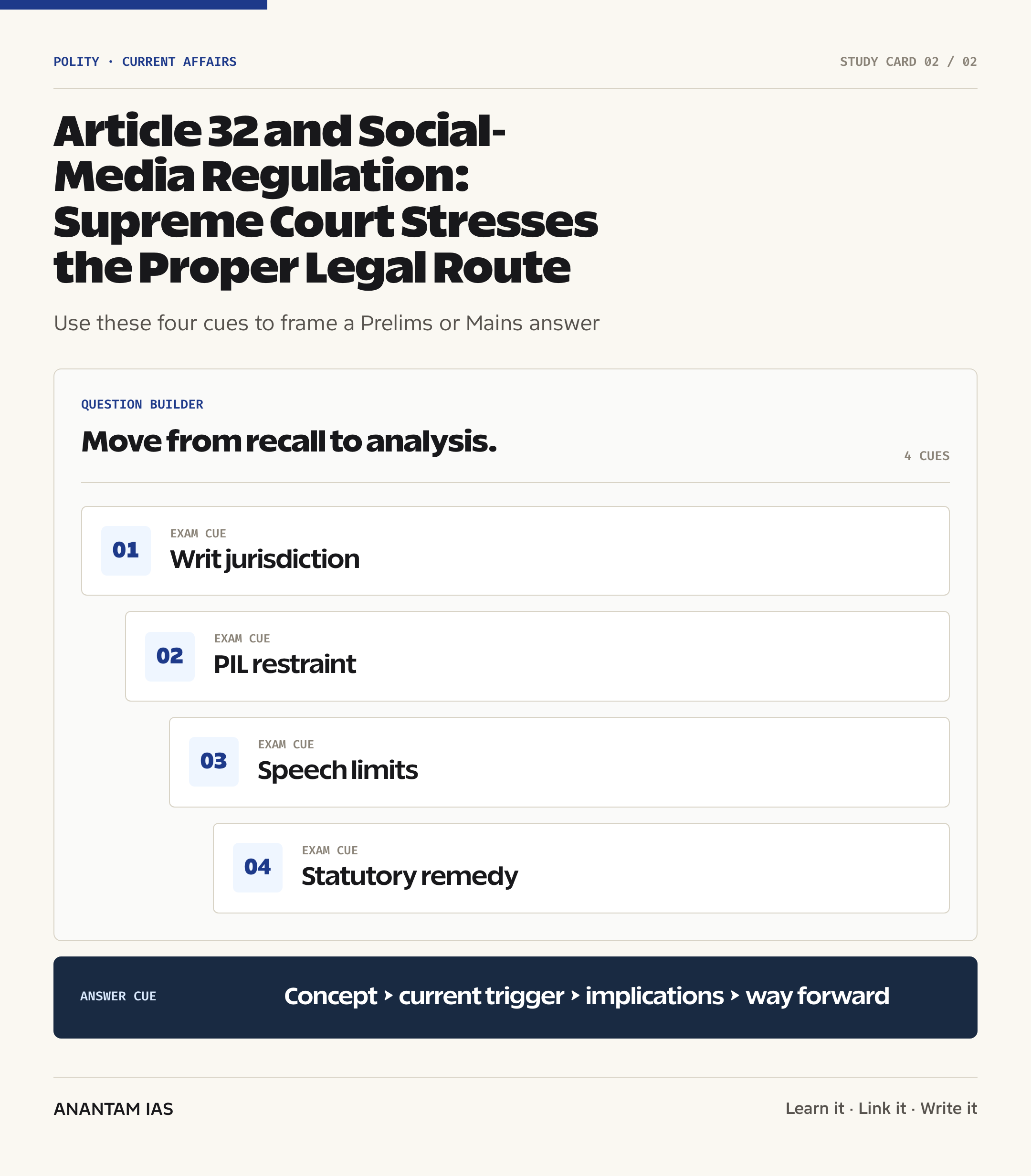
Writ Jurisdiction and the Choice of Forum
India’s constitutional design distributes public-law remedies across the Supreme Court and the High Courts rather than treating every grievance as a first-instance Supreme Court case.
- A petition under Article 32 directly invokes the Supreme Court’s original jurisdiction to enforce a fundamental right.
- A petition under Article 226 may enforce fundamental rights as well as other legal rights, making the High Court’s substantive writ reach wider.
- The existence of another remedy doesn’t automatically extinguish Article 32, but the Court may examine whether the case really requires direct constitutional intervention.
- When facts require a complaint, collection of evidence and identification of an offence, the investigative process is normally better placed to begin the inquiry.
- When a specialist statute creates a regulator or designated authority, using that statutory channel first builds a factual record and respects the scheme enacted by Parliament.
- The larger issue of when the Court acts on its own motion is explained in Anantam IAS’s note on Supreme Court suo motu cognisance.
Public Interest Litigation: Access with Safeguards
PIL widened access to constitutional justice, especially for people unable to reach courts themselves, but it also requires judicial screening against private, publicity-driven or political claims.
- Traditional locus standi required the person directly affected to approach the court; PIL relaxed that rule for diffuse public injury and disadvantaged groups.
- The innovation helped courts address bonded labour, custodial abuse, environmental harm and failures affecting groups with weak access to legal representation.
- Relaxed standing doesn’t remove the need to show a justiciable injury, credible facts, a proper respondent and relief a court can lawfully supervise.
- Courts guard against publicity-interest, private-interest and politically motivated litigation because weak petitions consume scarce judicial time and can distort democratic debate.
- A request for nationwide control of speech demands close scrutiny: an overbroad judicial direction can burden lawful expression without the definitions, safeguards and review mechanisms expected of a valid restriction.
- The Bench’s warning in this case was about preserving Article 32’s remedial purpose, not reducing its status as a guaranteed constitutional right.
Free Speech and Lawful Restrictions Online
The Constitution protects speech across media, while Article 19(2) permits only reasonable restrictions connected to its listed grounds.
- Article 19(1)(a) covers the freedom to express and receive ideas; the protection isn’t lost merely because expression travels through a podcast, reel or platform.
- Article 19(2) lists grounds such as sovereignty and integrity of India, security of the State, public order, decency or morality, defamation, contempt of court and incitement to an offence.
- A restriction must have legal authority, a rational connection with a listed ground and safeguards against arbitrary or disproportionate action.
- In Shreya Singhal v. Union of India, the Supreme Court struck down Section 66A of the IT Act for vagueness and overbreadth, while upholding Section 69A’s blocking framework with procedural safeguards.
- Offence, annoyance and disagreement can’t by themselves become open-ended standards for silencing speech. The constitutional focus is on the specific legal threshold and the speech’s connection to the prohibited harm.
- Related distinctions appear in the notes on the Supreme Court’s hate-speech test and its ruling that vulgarity alone isn’t obscenity.
Which Legal Route Applies to Harmful Online Content?
Online-speech disputes can engage several legal pathways, and each pathway has a distinct trigger, authority and safeguard.
- A person alleging a cognisable offence may approach the police; investigation establishes authorship, context, circulation and the applicable penal provision.
- Platform-level complaints can use the intermediary’s grievance officer mechanism under the Information Technology (Intermediary Guidelines and Digital Media Ethics Code) Rules, 2021.
- Section 69 of the IT Act and the 2009 interception rules concern authorised interception, monitoring or decryption for specified statutory grounds and subject to safeguards.
- Section 69A and its separate 2009 blocking rules govern government directions to block public access to information on listed grounds; they aren’t the same as the interception framework.
- Criminal-law provisions relating to promoting enmity, deliberate religious insult, public mischief, threats or defamation may apply depending on the exact words, intent, context and evidence.
- Policy responses to children and platforms require a different evidence base, discussed in India’s approach to children’s social-media use.
What the Bench's Response Does and Does Not Mean
For exam answers, the safest reading is procedural and institution-specific, not a sweeping verdict on all social-media regulation.
- The Bench refused to entertain this Article 32 petition; it didn’t declare that harmful online speech is beyond legal control.
- It directed attention to ordinary remedies, including the complaint process and the authority operating under the applicable IT-law framework.
- It didn’t create a new pan-India ban on podcasts or reels, and it didn’t author a comprehensive code for permissible platform speech.
- The reported remarks were made during a hearing. Students should distinguish oral observations from a signed judgment’s binding ratio decidendi.
- The Court’s procedural stance also prevents the highest constitutional forum from becoming the first factual investigator in every viral-content dispute.
- At the same time, the State remains bound to investigate legally cognisable complaints and protect public order and equal citizenship without selective enforcement.
Constitutional and Governance Significance
The episode illustrates how rights protection depends on both judicial access and a functioning chain of ordinary institutions.
- Judicial restraint can preserve institutional legitimacy when a requested remedy needs legislative definitions, executive fact-finding or technical regulatory design.
- Access to justice suffers if police and regulators fail, because citizens then treat constitutional courts as the only credible point of entry.
- Rule of law requires content restrictions to be viewpoint-neutral, traceable to enacted law and reviewable by an independent court.
- Platform accountability should combine prompt grievance handling, transparent decisions, preservation of evidence and protection against automated over-removal.
- Communal harmony can’t rest on indiscriminate censorship; it needs targeted enforcement against legally defined harm alongside counterspeech and digital literacy.
- For a balanced Mains answer, connect rights, remedies, procedure and institutional capacity instead of presenting free speech and regulation as an all-or-nothing choice.
Way Forward
Use the Correct First Forum
- File a specific police complaint where facts disclose an offence, preserve URLs and timestamps, and allow lawful investigation of authorship and context.
- Use the platform and statutory grievance mechanisms before seeking a judicial command, unless urgent fundamental-rights injury makes immediate court protection necessary.
Apply Narrow, Rights-Compatible Standards
- Tie every restriction to Article 19(2), a valid law and a clearly identified harm rather than vague claims that speech is merely hurtful.
- Prefer content-specific and proportionate measures over blanket controls on an entire medium such as podcasts or reels.
Strengthen Institutional Capacity
- Train police and regulators in digital evidence, speech doctrine and communal-sensitivity assessment so complaints don’t fail through delay or overreach.
- Require platforms to publish meaningful data on complaints, response times, removals, appeals and restoration while protecting user privacy.
Protect the Integrity of PIL
- Screen petitions for bona fides, affected rights, factual foundation and workable relief at an early stage.
- Keep Article 32 readily available for genuine rights violations while discouraging attempts to make the Court a political or publicity forum.
Conclusion
The Supreme Court’s response places constitutional discipline beside constitutional access. Article 32 remains a guaranteed remedy, but its purpose is enforcement of fundamental rights, not substitution for every complaint, investigation or regulatory decision.
A durable digital-speech framework needs precise law, capable institutions, proportionate remedies and judicial review. That combination can protect public order and dignity without converting every controversial reel or podcast into a case for blanket censorship.
UPSC Practice Questions
Prelims MCQ 1
With reference to writ jurisdiction in India, consider the following statements:
- Article 32 guarantees the right to move the Supreme Court for enforcement of fundamental rights.
- High Courts may issue writs under Article 226 only for enforcement of fundamental rights.
- The Supreme Court and High Courts can both issue the writ of quo warranto.
How many of the above statements are correct?
(a) Only one (b) Only two (c) All three (d) None
Answer: (b) Only two
Explanation:
Statements 1 and 3 are correct. Article 226 is wider than Article 32 because High Courts may issue writs for fundamental rights and for other legal purposes.
Prelims MCQ 2
Which one of the following correctly distinguishes Sections 69 and 69A of the Information Technology Act, 2000?
(a) Section 69 concerns intermediary safe harbour, while Section 69A concerns cybercrime investigation (b) Section 69 concerns interception, monitoring or decryption, while Section 69A concerns blocking public access to information (c) Section 69 concerns data protection, while Section 69A concerns digital signatures (d) Both provisions deal only with private platform moderation
Answer: (b) Section 69 concerns interception, monitoring or decryption, while Section 69A concerns blocking public access to information
Explanation:
The provisions have different objects and operate through separate safeguards and rules. They shouldn’t be treated as one generic power to regulate online content.
UPSC Mains Questions
- Article 32 is a guaranteed constitutional remedy, but direct access to the Supreme Court doesn’t make it the first forum for every public grievance. Discuss this proposition with reference to PIL, alternative statutory remedies, judicial restraint and the institutional role of investigation.
- India’s response to harmful social-media content must protect public order without creating vague or disproportionate speech controls. Examine the constitutional test under Article 19(2), the distinct statutory routes under the IT Act, and the safeguards needed for platform accountability.
Sources: The Hindu and Constitution of India, Legislative Department.
Frequently Asked Questions
What does Article 32 guarantee?
Article 32 guarantees the right to move the Supreme Court for enforcement of fundamental rights. It also empowers the Court to issue directions, orders and constitutional writs. The provision doesn’t convert the Supreme Court into a general first forum for every statutory, criminal or policy grievance.
Did the Court ban reels or podcasts?
No. The reported hearing ended with the Court declining to entertain a petition seeking broad curbs. The Bench pointed the petitioner toward ordinary complaint and statutory routes. It didn’t impose a nationwide ban or formulate a general code governing all reels and podcasts.
Why did the Court mention politicisation?
The Bench cautioned that Article 32’s direct constitutional access shouldn’t be used as a device to politicise an issue. The point concerned the suitability and bona fides of the chosen remedy, not a reduction in Article 32’s importance as a fundamental-rights guarantee.
How is Article 226 different?
Article 32 lets the Supreme Court enforce fundamental rights. Article 226 authorises High Courts to issue writs for fundamental rights and for other legal purposes. So Article 226 has a wider substantive scope, though each court’s territorial and institutional setting also shapes the remedy.
Can harmful online speech be prosecuted?
Yes, when the facts satisfy a legally defined offence. Police and courts must examine the exact words, intent, context, likely harm and evidence. Merely offensive or unpopular speech can’t be punished through vague standards; any restriction must follow valid law and constitutional safeguards.
Are oral observations binding precedent?
Ordinarily, no. A court’s oral remarks help conduct a hearing but must be distinguished from the ratio in a signed, reasoned decision. For exam answers, describe this episode as a reported procedural stance unless an authoritative order supplies a binding legal proposition.
Source: https://anantamias.com/current-affairs/supreme-court-article-32-social-media-plea/