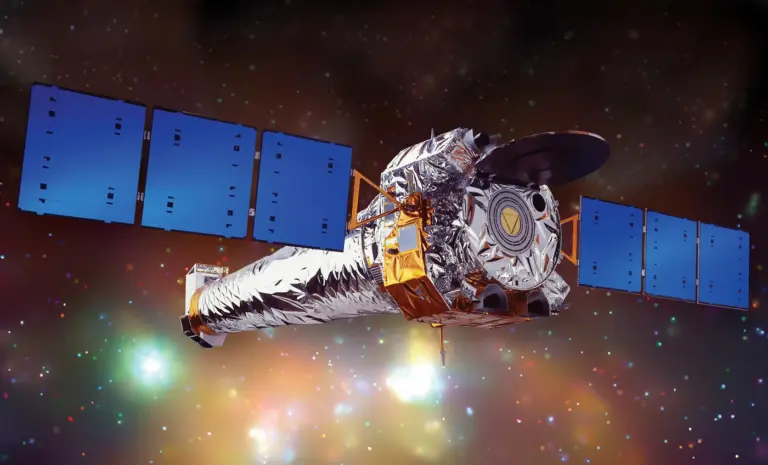
Gaganyaan is India's flagship human spaceflight mission. It will launch a crew of three astronauts — Gaganyatris — to a low Earth orbit of about 400 km for a three-day mission and recover them safely in Indian waters. Once accomplished, India will become the fourth nation after Russia, the United States and China to conduct independent crewed spaceflight. For UPSC GS Paper III, Gaganyaan touches on frontier technology, defence, industrial policy, international cooperation and inspiring youth towards STEM.
Mission Overview
- Orbit: Low Earth Orbit at about 400 km.
- Crew: Three astronauts.
- Duration: Up to three days.
- Launch vehicle: Human-rated LVM3 (formerly GSLV Mk-III).
- Recovery: Splashdown in Indian sea waters.
- Coordination: Human Space Flight Centre (HSFC) at ISRO.
ISRO and the Indian Air Force shortlisted four IAF test pilots — Group Captain Prasanth Balakrishnan Nair, Group Captain Ajit Krishnan, Group Captain Angad Pratap and Wing Commander Shubhanshu Shukla — as Gaganyatri-designates in February 2024.
Key Components of Gaganyaan
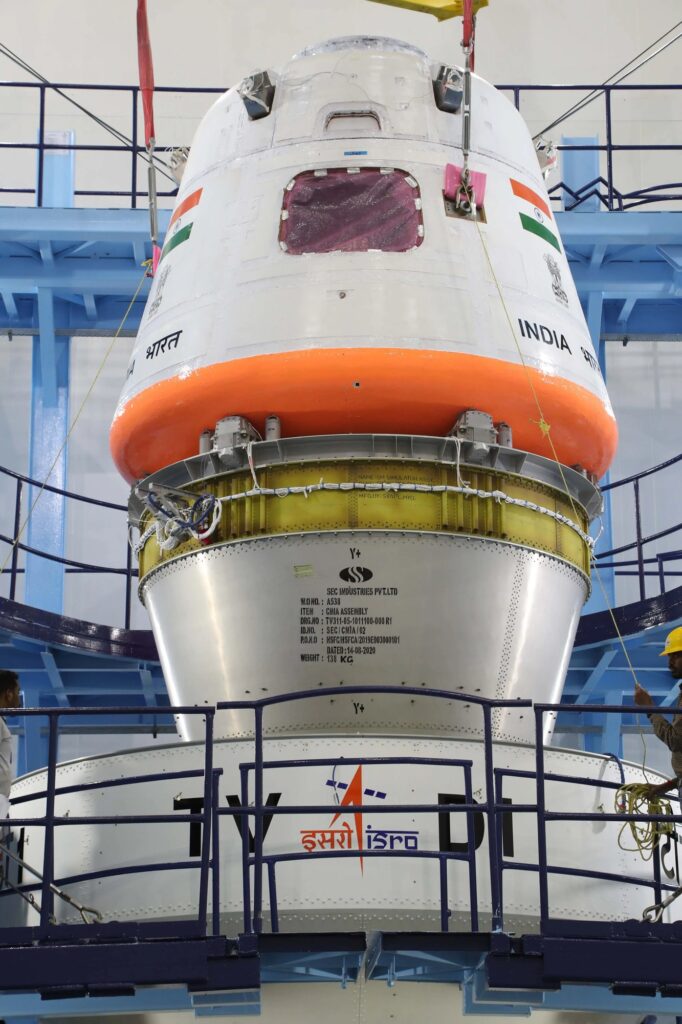
Crew Module (CM)
The crew module weighs approximately 5.3 tons and, along with the service module, forms an orbital module of nearly 7 tons. Crew members will conduct microgravity experiments during the mission.
Crew Module Atmospheric Re-entry Experiment (CARE)
A critical re-entry experiment was carried out in 2014 with LVM3-X, when the CARE capsule survived atmospheric re-entry at high temperature, validating thermal protection and re-entry dynamics.
Crew Escape System (CES)
An emergency abort system that can pull the crew capsule away from the launch vehicle in case of launch anomaly. In July 2018, ISRO completed the first successful "pad abort test". Subsequent TV-D1 (Test Vehicle Demonstration) in October 2023 validated in-flight abort capability.
Environmental Control and Life Support System (ECLSS)
ECLSS will:
- Maintain steady cabin pressure and air composition.
- Remove carbon dioxide and harmful gases.
- Control temperature and humidity.
- Manage fire detection and suppression.
Vyommitra
ISRO's female humanoid robot developed at the Inertial Systems Unit, Thiruvananthapuram. Vyommitra will fly on an uncrewed Gaganyaan test flight to simulate crew parameters, interact with systems and demonstrate life support viability.
SAKHI App
Space-borne Assistant and Knowledge Hub for Crew Interaction — a digital platform integrated into space suits to:
- Serve technical documents and training manuals digitally.
- Monitor astronaut vitals — blood pressure, heart rate, oxygen saturation, hydration and sleep.
- Maintain mission logs and keep the crew connected with onboard computers and ground stations.
IADS — Integrated Air Drop Tests
Validate parachute deployment, descent profile and recovery at sea.
Technical Challenges
- Pressure and atmosphere maintenance — creating Earth-like atmosphere in a small volume for three days.
- Crew Escape System reliability under all flight phases.
- Environmental Control and Life Support still maturing; spacesuits and crew support systems in development.
- Precision re-entry and recovery — even a minor deviation can be catastrophic.
- Radiation protection — space station crews receive over ten times the radiation experienced on Earth.
- Gravity transitions — hand-eye and head-eye coordination disturbances during gravity changes.
- Psychological preparedness — isolation-related depression, fatigue and sleep disorders.
- Space debris — growing threat of cabin depressurisation from micro-debris impact.
Benefits of Gaganyaan
Science and Technology
- Builds research ecosystem for microgravity experiments.
- Develops advanced materials, pressure control, navigation and life-support technologies.
Polity and Governance
- IN-SPACe has been established to increase private participation in space.
- Broader collaboration between ISRO, academia, industry, DRDO and defence services.
Social
- Inspires youth; strengthens STEM pipeline.
- Trains human resource in advanced technologies.
International Relations
- HSFC has collaborated with Glavkosmos (Russia) for astronaut training on Soyuz systems.
- Ground stations planned in cooperation with Australia.
- Joint experiments with NASA, including the Axiom-4 mission that will fly Indian astronaut Shubhanshu Shukla to the ISS in 2025 — an important precursor to Gaganyaan.
Economy
- Expected to source nearly 60 percent of equipment from Indian private sector.
- Anticipated generation of 15,000+ employment opportunities.
- Spin-offs in medicine, agriculture, industrial safety and water and food resource management.
Security
- Quantum mechanics and sensing experiments support quantum computing and QKD.
- Strengthens ISR (intelligence, surveillance, reconnaissance) payload capability.
India's Position
Gaganyaan makes India only the fourth nation to conduct independent human spaceflight. It places India on the roadmap to a larger architecture — the Bharatiya Antariksh Station (first module targeted by 2028, station operational by 2035) and a crewed lunar mission by 2040.
Ethical and Policy Concerns
- Safety and risk — the inherent risk to astronaut lives requires rigorous safety culture.
- Resource allocation — critics question prioritising human spaceflight over pressing social needs; proponents emphasise spin-offs and strategic dividends.
- Militarisation risks — human spaceflight capability closely intersects with ballistic missile and dual-use know-how.
- International cooperation equity — ensuring meaningful joint outcomes with smaller nations.
Latest Developments (2024-26)
- AI Action Summit, Paris (February 2025) — Gaganyaan mission management integrates AI for health telemetry and mission planning.
- India Semiconductor Mission — strengthens indigenous supply of radiation-hardened electronics for future crewed missions.
- Chandrayaan-4 — leverages Gaganyaan re-entry heritage for lunar sample-return capsule design.
- National Quantum Mission — future Gaganyaan experiments may include quantum communication demonstrations.
- DPDP Act informs how astronaut health telemetry and personal data are stored and shared.
- TV-D1 (October 2023) successfully demonstrated in-flight abort.
- Uncrewed Gaganyaan G1 with Vyommitra slated for 2025, followed by G2 uncrewed, and crewed flight targeted for late 2025 or 2026.
- Axiom-4 Mission (2025) — Shubhanshu Shukla becomes the first Indian to visit the ISS since Rakesh Sharma's Soyuz flight in 1984.
- Bharatiya Antariksh Station first module targeted for 2028, with full operations by 2035.
UPSC Relevance
For Prelims, remember LVM3 as the launch vehicle, HSFC as the coordinating centre, CARE and TV-D1 as milestones, Vyommitra, SAKHI, Bharatiya Antariksh Station (2028 first module, 2035 full), and crewed lunar target by 2040. For GS III Mains, Gaganyaan is a headline example for science, technology, industrial policy and strategic posture. For GS II, it connects to international cooperation (Russia, NASA, Japan, Australia). Essay questions on India's scientific temper, self-reliance and inspirational national missions all benefit from a compact Gaganyaan case study.
Tell Google you want more of this.
Add Anantam IAS as a preferred sourceOne tap, and this site shows up more often in your own Top Stories, AI Overviews and AI Mode. Remove it any time.