Why in News?
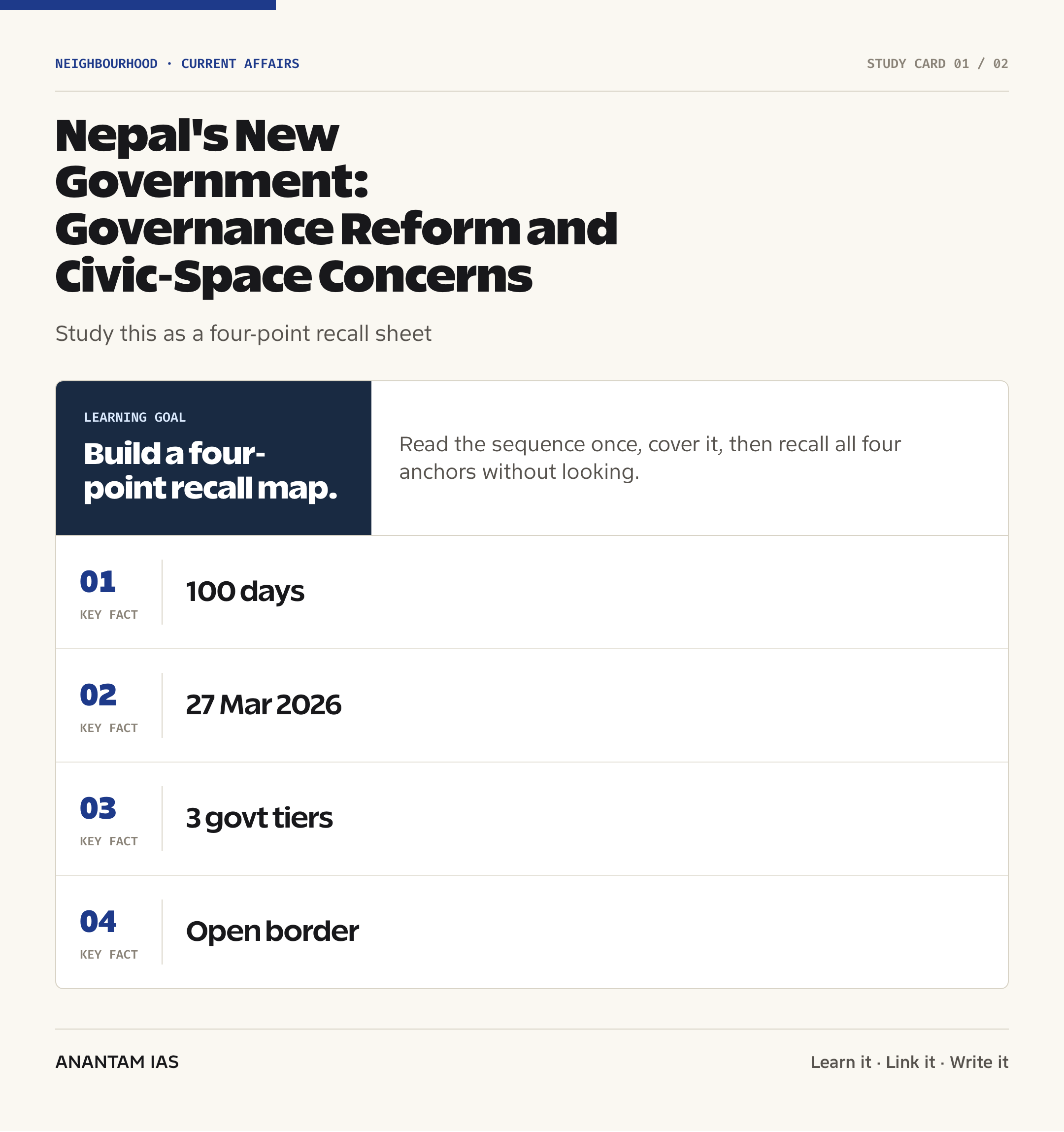
The government led by Prime Minister Balendra Shah completed its first 100 days in July 2026. The Hindu reported that the administration is confronting questions about governance, dissent and a shrinking civic space similar to those raised before Nepal’s 2025 youth protests.
The milestone presents a mixed early record: a 100-point governance reform agenda and new delivery commitments on one side, and concerns about press freedom, institutional autonomy, protest accountability and the treatment of criticism on the other.
- Balendra Shah took office on 27 March 2026 after the Rastriya Swatantra Party’s victory in the 5 March election.
- The Cabinet announced a 100-point agenda covering administrative reform, anti-corruption, digital governance and public-service delivery.
- A July commitment paper proposed monitoring by a Prime Minister’s Delivery Unit under the Prime Minister’s Office.
- Media groups have raised concerns about official warnings, hostile online speech, advertising policy and court-ordered removal of reports.
- The debate tests whether a popular reform mandate can remain subject to constitutional checks, open scrutiny and due process.
The development matters in the context of:
- Nepal is a close Indian neighbour with an open border, dense social ties and cooperation in trade, transit, energy and water resources.
- Political stability in Kathmandu affects India’s Neighbourhood First policy, border management, connectivity and Himalayan security.
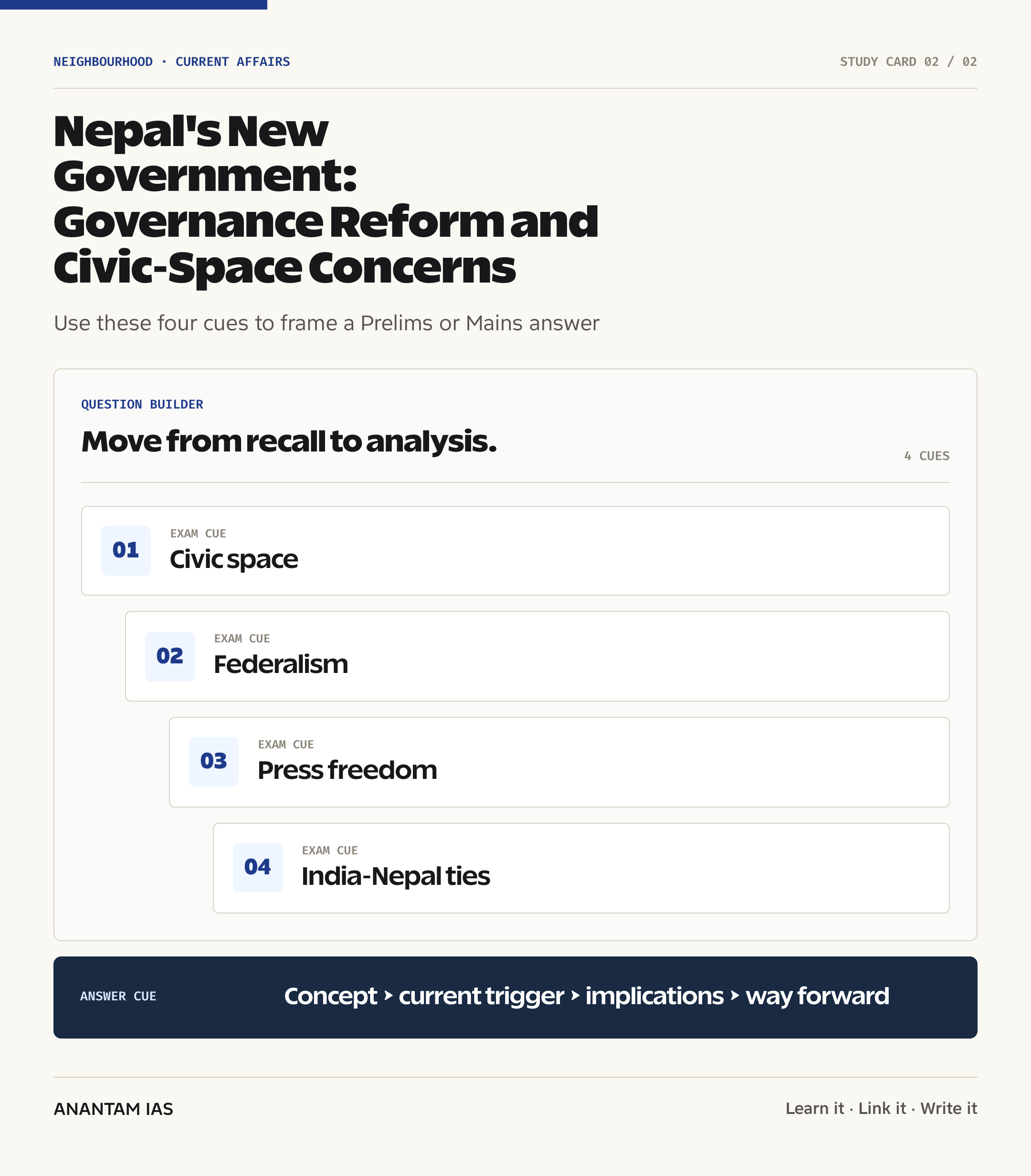
- The episode connects democratic accountability with the broader idea of civic space: the environment in which people, media and associations participate without fear.
UPSC Relevance
Prelims Relevance
- Nepal is a federal democratic republican state under its 2015 Constitution.
- Its federal structure has three levels: federation, province and local level.
- Nepal follows a parliamentary form of government with a bicameral Federal Parliament.
- The House of Representatives is the lower house; the National Assembly is the permanent upper house.
- Article 17 of Nepal’s Constitution protects freedoms including opinion, expression, assembly and association, subject to law.
- Article 19 protects communication and restricts prior censorship, subject to constitutional limitations.
- Article 27 grants citizens the right to demand and receive information on matters of public interest.
- Kathmandu is Nepal’s capital, and the country hosts the SAARC Secretariat.
- India and Nepal share extensive trade, transit, hydropower and people-to-people links.
Mains Relevance
GS Paper 2
- India and its neighbourhood: political developments in Nepal and their implications for India.
- Comparative constitutionalism: parliamentary democracy, federalism, fundamental freedoms and institutional checks.
- Governance and accountability: balancing a reform mandate with due process, transparency and media freedom.
GS Paper 3
- Border management, cross-border connectivity, hydropower trade and the security effects of instability in the Himalayan region.
Essay
- A democratic mandate is authority to govern, not immunity from scrutiny.
- Strong institutions convert popular energy into durable reform.
- Freedom of criticism is an early-warning system for governance failure.
Background and Context
Political Transition and the 2026 Mandate
Nepal’s new political phase emerged from a crisis of confidence in established parties and public institutions.
- Youth-led protests in September 2025 began after restrictions on social-media platforms and widened into anger over corruption, privilege and poor governance.
- A subsequent political transition led to an early election on 5 March 2026, in which the Rastriya Swatantra Party secured a clear governing mandate.
- President Ram Chandra Paudel administered the oath to Balendra Shah on 27 March, making the former Kathmandu mayor the head of government.
- The new leadership presented itself as anti-establishment, digitally fluent and focused on delivery, raising expectations of fast institutional change.
- The first 100 days are an early indicator of intent, not a conclusive performance audit; durable evaluation requires outcomes, budget execution and institutional behaviour.
Nepal's Constitutional Architecture
The 2015 Constitution created a federal parliamentary republic whose institutions distribute power vertically and horizontally.
- Article 56 places state power at the federal, provincial and local levels, making intergovernmental coordination central to service delivery.
- Article 74 defines Nepal’s system as a multiparty, competitive, federal democratic republican parliamentary form based on pluralism.
- The President is the constitutional head, while executive authority is exercised through the Council of Ministers under the Prime Minister.
- Federalism was designed not only for administrative convenience but also for inclusion, identity and power-sharing after a long political transition.
- Any restructuring of provincial institutions must respect constitutional amendment procedures, fiscal arrangements and the political compact behind federalisation.
What Civic Space Means
Civic space is the legal and practical environment that allows citizens to organise, speak, assemble and influence public decisions.
- Its core freedoms are expression, peaceful assembly and association; access to information and media pluralism make these rights usable.
- A civic space can contract without formal suspension of rights when threats, selective enforcement, online intimidation or financial pressure create self-censorship.
- Reasonable restrictions may protect security, reputation and public order, but must be prescribed by law, pursue a legitimate aim and satisfy necessity and proportionality.
- Independent courts, a professional police, human-rights bodies and autonomous media regulators help distinguish lawful regulation from executive control.
- The relevant democratic test is not whether criticism is uncomfortable; it is whether public power responds through law and accountable institutions.
Press-Freedom Concerns in the First 100 Days
The concerns involve both direct state action and an enabling environment that may discourage scrutiny.
- Nepali media reports cited warning-laden remarks by senior officials about action against allegedly insulting or defamatory coverage, even though the Press Council Nepal has an established regulatory role.
- Journalists’ groups criticised an April 2026 advertising directive that routed official notices to state-owned media, arguing that it economically disadvantaged independent outlets.
- A Kathmandu court’s prison sentence in a defamation case and a separate order to remove dozens of reports intensified debate about criminal defamation and prior restraints.
- Observers also reported cyberbullying and intimidation by partisan supporters; these are distinct from direct government censorship but can still produce a chilling effect.
- Claims of shrinking space require evidence-based assessment: the source, legal basis, remedy and institutional responsibility for each restriction should be examined separately.
Governance-Reform Agenda: Promise and Risks
The government’s reform programme seeks measurable delivery, yet speed and central control can create institutional risks.
- The 100-point agenda covers corruption control, bureaucratic reform, digitalisation, economic management and faster public services.
- The proposed Delivery Unit can improve target-setting and monitoring if its data, responsibilities and performance reports are publicly accessible.
- Digital public services can reduce discretion and rent-seeking, but they require data protection, cyber security, accessibility and a non-digital route for excluded citizens.
- Central coordination may solve fragmentation, but excessive concentration in the Prime Minister’s Office can weaken ministerial responsibility and federal autonomy.
- Anti-corruption action gains legitimacy when investigations follow consistent standards, protect defence rights and remain insulated from partisan selection.
Why Political Stability in Nepal Matters to India
India’s relationship with Nepal combines strategic interests with unusually dense everyday interdependence.
- The two countries share an open border and deep familial, cultural and labour links, so political and economic disruptions travel quickly across the frontier.
- India is central to Nepal’s access to seaports and transit routes; Nepal is important to India’s connectivity with the Himalayan neighbourhood.
- Cross-border electricity trade, hydropower projects and transmission lines link Nepal’s development choices with India’s energy security and clean-power transition.
- Shared rivers require cooperation on irrigation, flood forecasting, embankments and disaster response, especially for communities in the Terai and Gangetic plains.
- A stable, democratic and sovereign Nepal reduces space for zero-sum external competition and supports predictable implementation of bilateral projects.
India's Appropriate Policy Approach
India benefits most from a democratic, stable Nepal whose institutions command domestic legitimacy.
- Engagement should be government-wide and society-wide, reaching federal institutions, provinces, local bodies, businesses, universities and civil society.
- New Delhi should avoid appearing to choose political winners; the guiding principles should be sovereign equality, non-interference and mutual sensitivity.
- Project delivery in connectivity, power and development cooperation should be timely and transparent so that bilateral ties generate visible public value.
- Border and security coordination must preserve the benefits of legitimate movement while targeting trafficking, organised crime and misuse through intelligence-led policing.
- Quiet support for constitutionalism, free media and accountable institutions is more sustainable than personalised diplomacy with any single leader.
Way Forward
Institutionalise Reform
- Publish time-bound indicators for the 100-point agenda, assign accountable agencies and release periodic progress data.
- Route complaints against media and citizens through competent independent bodies, with notice, hearing and judicial review.
- Make major anti-corruption and administrative decisions traceable through written reasons, procurement disclosure and parliamentary scrutiny.
Protect Civic Freedoms
- Review media, defamation and digital-governance rules against Nepal’s Constitution and the International Covenant on Civil and Political Rights.
- Investigate threats against journalists and activists impartially while also providing lawful remedies for privacy violations and incitement.
- Use the least restrictive means for public-order regulation and publish protocols governing protest policing and use of force.
Deepen Federal Democracy
- Clarify functions, finance and staff across Nepal’s three tiers instead of treating centralisation as the default answer to weak capacity.
- Consult provinces, local bodies, opposition parties and affected communities before structural reforms.
- Strengthen parliamentary committees, audit bodies and constitutional commissions so reform survives beyond a leader’s popularity.
Build a Stable India-Nepal Partnership
- Keep bilateral mechanisms active on trade, transit, power, water and border management regardless of political turnover.
- Prioritise completed, community-visible projects and jointly communicate timelines and benefits.
- Treat Nepal’s democratic resilience as a shared regional good, while leaving domestic political choices to Nepali citizens.
Conclusion
Nepal’s new government carries a strong mandate for cleaner and faster governance. Its lasting achievement will depend less on the volume of announcements than on whether reform strengthens constitutional institutions, federal capacity and public trust.
For India, the sound approach is patient and institutional: support Nepal’s sovereignty and democratic resilience, deliver on bilateral commitments and keep relations broader than any one administration. Civic freedom and effective government are complements when accountability improves policy before failures become crises.
UPSC Practice Questions
Prelims MCQ 1
With reference to Nepal’s constitutional system, consider the following statements:
- Nepal is a federal democratic republic.
- Its federal structure comprises the federation, provinces and local level.
- Nepal follows a presidential form of government.
How many of the above statements are correct?
(a) Only one (b) Only two (c) All three (d) None
Answer: (b) Only two
Explanation:
Statements 1 and 2 are correct. Nepal is a federal democratic republic with three governmental levels, but it follows a parliamentary, not presidential, form of government.
Prelims MCQ 2
Which one of the following best describes civic space?
(a) Territory reserved only for government offices (b) Legal and practical conditions for expression, assembly and association (c) A special economic zone for civil-society organisations (d) The jurisdiction of municipal governments over public parks
Answer: (b) Legal and practical conditions for expression, assembly and association
Explanation:
Civic space is the environment in which people and organisations can speak, organise, assemble, obtain information and participate in public affairs without unlawful interference.
UPSC Mains Questions
- Nepal’s governance reforms will be judged not only by delivery but also by their effect on constitutional checks and civic freedoms. Discuss this statement with reference to federalism, media freedom and institutional accountability in Nepal.
- Political stability in Nepal is a major Indian interest, but durable influence cannot rest on personalised diplomacy. Examine the principles and policy instruments that should guide India’s engagement with Nepal.
Sources: Office of the Prime Minister and Council of Ministers, Nepal and The Hindu.
Frequently Asked Questions
Why is Nepal’s government in the news?
Prime Minister Balendra Shah’s government completed its first 100 days in July 2026. Attention has focused on its ambitious governance-reform programme as well as concerns about press freedom, treatment of dissent, accountability for past protest violence and the balance between central direction and federal institutions.
What is civic space?
Civic space is the legal and practical environment in which citizens, journalists, associations and civil-society groups can express views, assemble, organise and participate in public affairs. It depends on both formal rights and freedom from intimidation, arbitrary enforcement or economic pressure.
Which freedoms does Nepal’s Constitution protect?
Nepal’s Constitution protects opinion and expression, peaceful assembly and association under Article 17. Article 19 protects communication, while Article 27 provides a right to information on matters of public interest. Restrictions must rest on law and constitutional grounds.
How is Nepal’s federal system organised?
Nepal’s Constitution distributes state power across the federation, seven provinces and local governments. The design seeks to combine national unity with inclusion and local self-government. Effective federalism needs clear responsibilities, adequate finance, administrative staff and regular intergovernmental coordination.
Why does Nepal’s stability matter to India?
India and Nepal share an open border, close people-to-people ties and cooperation in trade, transit, hydropower, rivers, connectivity and security. Instability can delay projects, complicate border governance and create strategic uncertainty, while accountable democratic institutions make agreements more durable.
What should India do?
India should engage Nepal’s institutions and society broadly, respect sovereign equality and avoid partisan alignment. It should deliver bilateral projects transparently, keep trade and security mechanisms active, and support constitutional democracy through quiet, consistent diplomacy rather than dependence on any single leader.
Tell Google you want more of this.
Add Anantam IAS as a preferred sourceOne tap, and this site shows up more often in your own Top Stories, AI Overviews and AI Mode. Remove it any time.