Why in News?
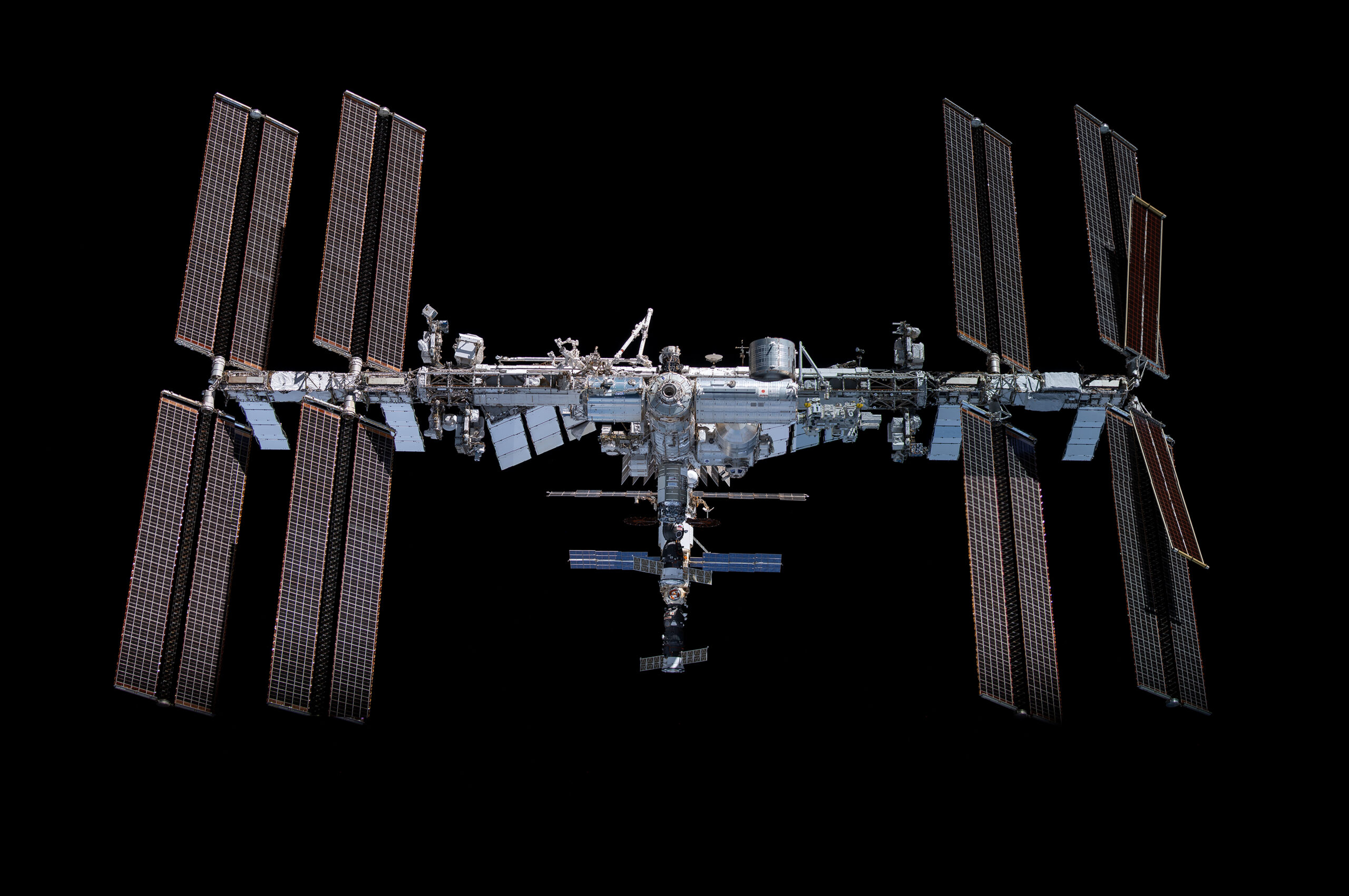
NASA astronaut Anil Menon and Roscosmos cosmonauts Pyotr Dubrov and Anna Kikina reached the International Space Station on July 14, 2026, aboard the Soyuz MS-29 spacecraft.
NASA confirmed that the crew will spend about eight months on the orbiting laboratory. The mission links a current event to durable UPSC themes: human spaceflight, microgravity research, low-Earth orbit and multinational scientific cooperation.
- The Soyuz MS-29 spacecraft launched from the Baikonur Cosmodrome in Kazakhstan at 7:47 p.m. local time on July 14.
- It completed a three-hour, two-orbit journey before docking with the station’s Prichal module.
- The spacecraft docked at 1:52 p.m. EDT, and the hatch between Soyuz and the station opened at 4:30 p.m. EDT.
- The new arrivals temporarily increased the station’s crew to 10 during the handover period.
- Menon is scheduled to serve as an Expedition 75 flight engineer and return to Earth in April 2027.
The development matters in the context of:
- The mission shows how the ISS partnership continues to coordinate crew transport, research and station operations across national space agencies.
- Menon’s research programme connects spaceflight with semiconductors, medical imaging, human physiology and bioprinting.
- For India, the event is a useful comparison point for Gaganyaan, astronaut training and the development of independent human-spaceflight capabilities.
UPSC Relevance
Prelims Relevance
- The International Space Station is a crewed research platform in low-Earth orbit, not a geostationary satellite.
- The station travels at about 28,000 km per hour and circles Earth roughly once every 90 minutes.
- It completes about 16 orbits, allowing the crew to witness around 16 sunrises and sunsets in 24 hours.
- The ISS partnership comprises NASA, Roscosmos, ESA, JAXA and CSA, representing five agencies and 15 countries.
- The station has been continuously occupied since November 2000.
- Microgravity is an environment in which objects experience apparent near-weightlessness while they and their spacecraft remain in continuous free fall around Earth.
- The Soyuz system is Russia’s crew-transport route to and from the ISS; MS-29 docked with the Prichal node module.
- Baikonur Cosmodrome, the launch site for MS-29, is located in Kazakhstan and is used by Russia under bilateral arrangements.
- India’s space technology syllabus includes launch vehicles, satellites, human spaceflight, applications and the institutional roles of ISRO and private actors.
Mains Relevance
GS Paper 3
- Scientific value of microgravity laboratories for materials science, medicine, biology and human exploration.
- Technological systems needed for human spaceflight: launch, docking, life support, crew health, re-entry and recovery.
- Lessons for Gaganyaan and India’s long-term human-spaceflight ecosystem.
GS Paper 2
- The ISS as an example of science diplomacy and rule-based management of a shared technological platform.
- Role of agreements, divided responsibilities and interdependence in sustaining international cooperation.
Essay
- Science can create practical cooperation even when relations among major powers remain politically strained.
- Human exploration becomes more durable when scientific ambition is matched by institutions, shared rules and mutual dependence.
Background and Context
Mission profile: Soyuz MS-29
The arrival sequence tests the basic vocabulary of a crewed orbital mission.
- NASA said Anil Menon, Pyotr Dubrov and Anna Kikina lifted off from Baikonur and reached the ISS after a two-orbit rendezvous.
- A rendezvous is the controlled process of bringing two spacecraft into the same orbit and close proximity; docking creates a secure physical and operational connection.
- MS-29 attached to Prichal, a Russian node module that provides docking ports for visiting spacecraft and supports the station’s Russian orbital segment.
- The temporary crew strength of 10 reflects a handover: outgoing and incoming crews overlap so duties, experiments and emergency procedures can be transferred safely.
- NASA scheduled Expedition 75 to begin on July 26 after three Expedition 74 members depart. Expedition numbers identify successive long-duration ISS crew periods, not separate stations.
What makes the ISS an orbital laboratory?
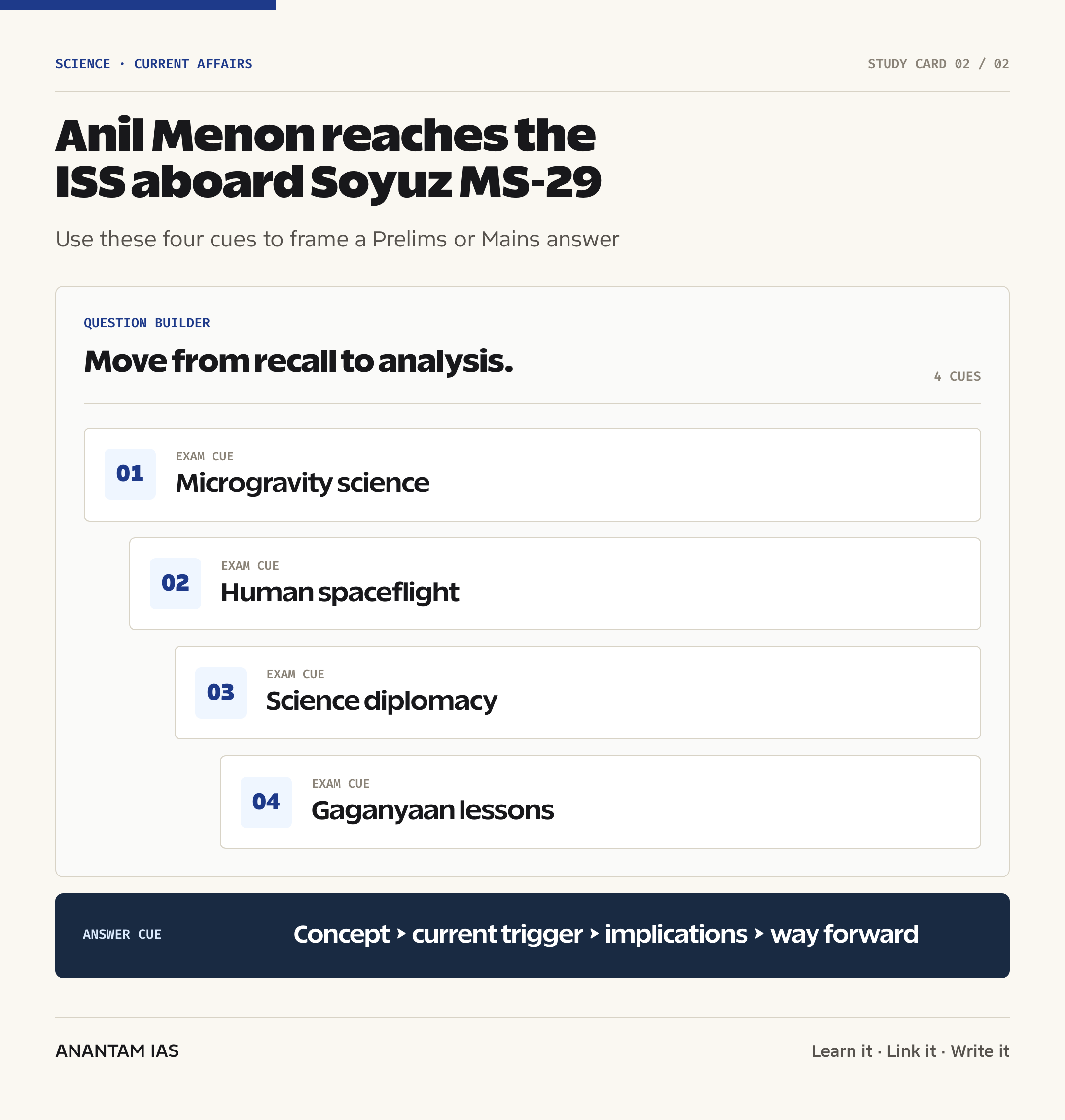
The ISS combines a low-Earth orbit, continuous human presence and reusable research facilities.
- The station operates roughly 400 km above Earth. At about 28,000 km per hour, it remains in orbit because its forward motion and gravitational fall continuously balance.
- Its approximately 90-minute orbital period provides repeated observations across daylight and darkness, useful for Earth observation and atmospheric studies.
- Unlike a geostationary satellite, the ISS does not remain fixed over one longitude. A geostationary satellite orbits near 35,786 km above the equator with a 24-hour period.
- The ISS supports hands-on crew operations, external exposure experiments, long-duration biological studies and instruments that can be returned or serviced.
- The station has been continuously inhabited since November 2000, creating long records of how people, materials and systems behave during extended spaceflight.
Why microgravity changes experiments
Microgravity lets researchers observe processes that are masked by gravity-driven effects on Earth.
- NASA explains that microgravity reduces the effects of buoyancy, sedimentation and convection, changing how fluids, flames, cells and crystals behave.
- The term does not mean that gravity is absent. The spacecraft and its contents are in continuous free fall, producing apparent near-weightlessness inside the orbiting laboratory.
- Crystals may grow with different structures because gravity-driven settling and fluid mixing are reduced. This is relevant to advanced materials, proteins and semiconductor research.
- Human bodies experience fluid shifts, muscle and bone loss, cardiovascular changes and altered balance in space. Long-duration missions make the ISS a test bed for space medicine.
- The same research supports future missions beyond low-Earth orbit, where crews may have less immediate access to Earth-based medical help and resupply.
Anil Menon's planned research
NASA’s mission release identifies experiments that connect exploration needs with possible benefits on Earth.
- Menon will continue work on the in-space production of semiconductor crystals, with potential applications in high-performance computing, artificial intelligence and medical devices.
- He will perform ultrasound using augmented-reality and artificial-intelligence methods designed to reduce dependence on real-time medical support from Earth.
- As a research subject, he will help investigators study how blood flow changes during spaceflight and how such changes may affect astronaut health.
- He will test bioprinting of vascular constructs in microgravity. Reduced gravitational deformation may help researchers examine three-dimensional tissues and ageing-related processes.
- These studies show why human spaceflight is more than transportation: the crew operates experiments, maintains equipment and supplies observations that automated platforms may not provide.
International partnership and legal framework
The ISS is both an engineering system and an institution built on divided responsibilities.
- Five agencies operate the station: the United States’ NASA, Russia’s Roscosmos, the European Space Agency, Japan’s JAXA and the Canadian Space Agency.
- NASA describes the partnership as involving 15 countries, with each partner primarily responsible for the hardware and capabilities it provides.
- The 1998 Intergovernmental Agreement established the overall cooperative framework and addressed operational responsibility, jurisdiction and intellectual property.
- Memoranda of understanding and implementing arrangements translate the intergovernmental framework into agency roles, crew opportunities, hardware contributions and use of research capacity.
- The station’s interdependence makes science diplomacy concrete: propulsion, attitude control, power, laboratories, transport and ground support are distributed across partners.
Relevance for India's human-spaceflight programme
The ISS mission is a comparison point, not a substitute, for understanding India’s own programme.
- India’s Gaganyaan mission seeks to demonstrate an indigenous capability to carry a crew to low-Earth orbit and return it safely.
- A human-spaceflight system needs reliable launch and abort systems, environmental control and life support, crew training, tracking, communications, recovery and human-rating of hardware.
- International missions can provide experience in crew operations, space medicine and scientific payloads, while sovereign capability gives India greater control over mission timing and objectives.
- India can connect human spaceflight with universities, start-ups, materials research, medicine and manufacturing so the programme creates a wider space-science ecosystem.
- The policy question is not crewed versus robotic exploration. A balanced programme assigns each platform the work it performs best and subjects expensive missions to clear scientific and strategic goals.
Way Forward
Build mission capability as a system
- Test life-support, abort, re-entry and recovery systems through incremental missions and publish safety lessons where security permits.
- Expand Indian capacity in space medicine, human factors, radiation protection and closed-loop environmental control.
Link missions to measurable science
- Select microgravity experiments through transparent scientific review and connect payloads with universities, hospitals and industry.
- Define Earth-facing outcomes, such as new materials, medical methods or operational technologies, without overstating uncertain commercial benefits.
Use cooperation without losing autonomy
- Pursue astronaut training, payload and data partnerships while strengthening India’s independent launch, tracking and crew-recovery capabilities.
- Develop clear Indian positions on space safety, debris mitigation, rescue and liability as crewed activity in low-Earth orbit expands.
Conclusion
Anil Menon’s arrival aboard Soyuz MS-29 is more than a biographical milestone. It is a compact case study of orbital mechanics, microgravity science, crewed-spaceflight systems and the institutional cooperation needed to operate a permanent laboratory above Earth.
For UPSC preparation, the strongest answer links the event to durable concepts and then brings the analysis home to Gaganyaan: safe capability, useful science, international cooperation and clearly defined public value.
UPSC Practice Questions
Prelims MCQ 1
With reference to the International Space Station, consider the following statements:
- It is operated through a partnership of five space agencies.
- It completes about 16 orbits of Earth in 24 hours.
- It is positioned in geostationary orbit above the equator.
How many of the above statements are correct?
(a) Only one (b) Only two (c) All three (d) None
Answer: (b) Only two
Explanation:
Statements 1 and 2 are correct. The ISS is operated by NASA, Roscosmos, ESA, JAXA and CSA, and circles Earth about every 90 minutes. Statement 3 is incorrect because the ISS is in low-Earth orbit, not geostationary orbit.
Prelims MCQ 2
Why is microgravity useful for some experiments aboard the ISS?
(a) It completely removes Earth’s gravitational field (b) It reduces buoyancy, sedimentation and gravity-driven convection (c) It keeps the station fixed over one point on Earth (d) It blocks all cosmic radiation from reaching samples
Answer: (b) It reduces buoyancy, sedimentation and gravity-driven convection
Explanation:
Objects inside the ISS remain under Earth’s gravity but share the station’s continuous free fall. The resulting microgravity environment reduces several gravity-driven effects and lets researchers study fluids, cells, crystals and combustion differently.
UPSC Mains Questions
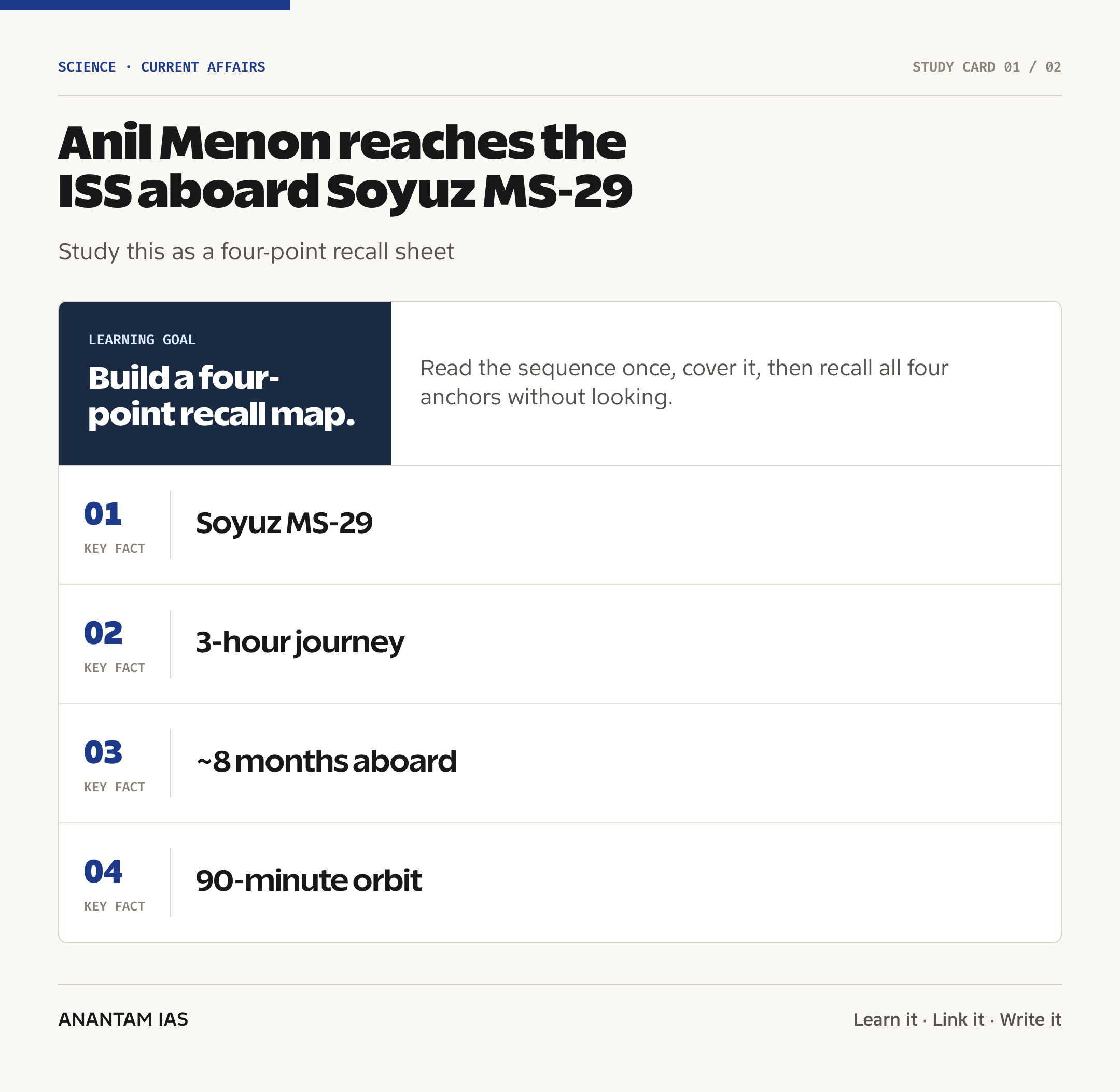
- The International Space Station is as much an institutional achievement as a technological one. Discuss how scientific interdependence, divided responsibilities and a rules-based framework have sustained international cooperation in low-Earth orbit.
- Microgravity research connects human spaceflight with materials science, medicine and future exploration. Explain these linkages and assess the lessons they offer for India’s Gaganyaan programme and wider space-science ecosystem.
Sources: NASA and The Hindu.
Frequently Asked Questions
Who travelled aboard Soyuz MS-29?
NASA astronaut Anil Menon travelled with Roscosmos cosmonauts Pyotr Dubrov and Anna Kikina. They launched from Baikonur Cosmodrome in Kazakhstan on July 14, 2026, and docked with the International Space Station after a three-hour, two-orbit journey.
How long will Anil Menon stay?
NASA said the new crew members will spend about eight months living and working aboard the ISS, with a planned return in April 2027. Menon is scheduled to serve as a flight engineer during Expedition 75.
What is microgravity?
Microgravity is apparent near-weightlessness experienced when a spacecraft and everything inside it fall continuously around Earth together. Gravity is still present, but the shared free fall greatly reduces support forces and changes processes such as convection, sedimentation and fluid movement.
Which agencies operate the ISS?
The five principal agencies are NASA of the United States, Roscosmos of Russia, the European Space Agency, the Japan Aerospace Exploration Agency and the Canadian Space Agency. Their partnership represents 15 countries and distributes hardware and operational responsibilities across the station.
Why does ISS research matter on Earth?
Microgravity experiments can reveal how crystals, tissues, fluids and the human body behave when gravity-driven effects are reduced. Findings can inform advanced materials, medical devices, remote healthcare and protection of astronauts, although practical applications still require testing and validation on Earth.
How is this relevant to Gaganyaan?
The mission highlights the complete system behind human spaceflight: safe launch, life support, docking or orbital operations, crew health, research, re-entry and recovery. Gaganyaan can draw lessons from this experience while building India’s independent capability and a domestic research ecosystem.
Tell Google you want more of this.
Add Anantam IAS as a preferred sourceOne tap, and this site shows up more often in your own Top Stories, AI Overviews and AI Mode. Remove it any time.