Why in News?
The Cyberabad Municipal Corporation (CMC) issued compliance directions on 14 July 2026 requiring Swiggy and Zomato to allow only food outlets with a valid FSSAI licence or registration and a valid municipal trade licence on their platforms.
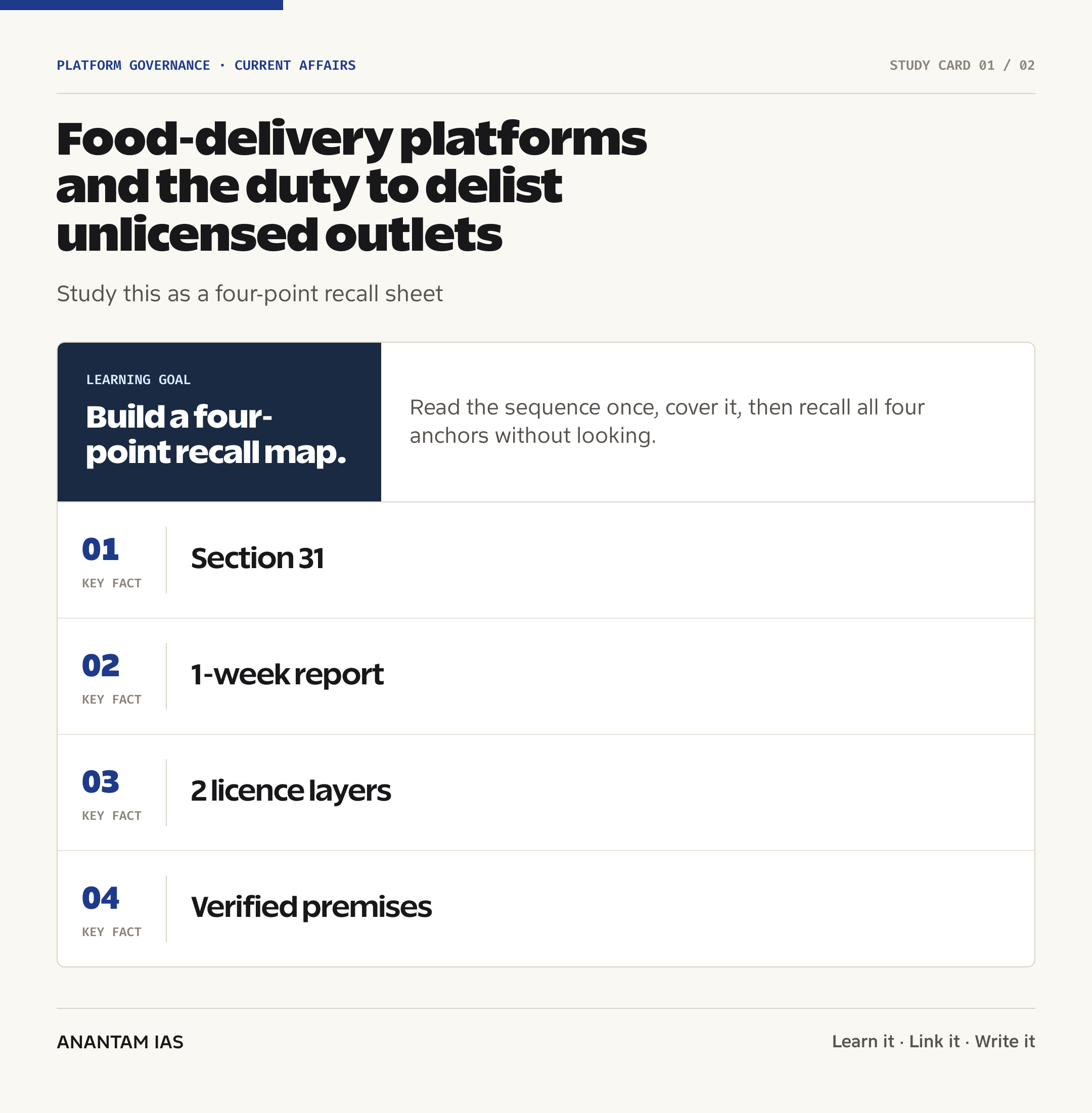
The Hindu reported that the platforms must delist non-compliant outlets, verify the geo-location and approved premises of sellers, disclose how ratings and reviews are handled, appoint a nodal officer and submit a compliance report within one week.
- CMC’s Health and Sanitation section issued the notice as part of food-safety enforcement within the civic body’s jurisdiction.
- An outlet must be removed if its licence is expired, suspended or cancelled, or if a competent authority has ordered its delisting.
- Food must be prepared and dispatched only from the approved and registered premises whose geo-location appears on the platform.
- The platforms were asked to explain their criteria for food ratings, hygiene ratings and customer reviews.
- The notice sought the policy governing removal, alteration or suppression of negative customer reviews.
The development matters in the context of:
- The case turns a platform from a passive listing service into a compliance gatekeeper when it facilitates a food transaction.
- It links national food-safety regulation with municipal licensing and inspection, showing India’s multi-level regulatory structure.
- Accurate outlet identity, licence status and location reduce the gap between a digital storefront and the physical kitchen that prepares food.
UPSC Relevance
Prelims Relevance
- The Food Safety and Standards Authority of India (FSSAI) is a statutory authority under the Food Safety and Standards Act, 2006.
- Under Section 31 of the 2006 Act, every Food Business Operator must obtain the applicable licence or registration.
- The Food Safety and Standards (Licensing and Registration of Food Businesses) Regulations, 2011 govern licensing, registration and hygiene conditions.
- An e-commerce entity that both lists food businesses and facilitates orders or transactions requires a central FSSAI licence.
- FSSAI’s e-commerce rules require sellers’ valid licence or registration details to be displayed on the platform.
- FoSCoS is FSSAI’s Food Safety Compliance System for licensing, registration and related regulatory services.
- A municipal trade licence and an FSSAI licence serve different regulatory purposes; possession of one doesn’t replace the other.
- The Food Safety Connect system lets consumers submit food-safety grievances, including complaints involving online aggregators.
Mains Relevance
GS Paper 2
- Regulatory governance of digital intermediaries and allocation of responsibility across platforms, sellers and public authorities.
- Public-health enforcement through coordination among FSSAI, State food-safety authorities and urban local bodies.
- Transparency in digital ratings, grievance redressal and protection against information asymmetry.
GS Paper 3
- Formalisation of food businesses and traceability across the digital food supply chain.
- Balancing innovation and ease of doing business with risk-based food-safety compliance.
Essay
- Trust in the digital economy depends on institutions that connect online claims with physical accountability.
- Technology can widen markets, but public regulation must ensure that convenience doesn’t dilute safety.
Background and Context
India's food-safety architecture
India uses a national standards framework with decentralised enforcement across States and local jurisdictions.
- The Food Safety and Standards Act, 2006 consolidated several food laws and created a common legal framework for food standards and safety.
- FSSAI sets standards and issues regulations, advisories and directions, while State and Union Territory authorities carry out much of the licensing, inspection and enforcement work.
- A Food Business Operator (FBO) is the person or entity responsible for ensuring that the requirements of food law are met within the food business under its control.
- Licensing isn’t merely an entry formality: it identifies the responsible business, its premises and the activities for which approval has been granted.
- The broader syllabus connection includes India’s State Food Safety Index, which compares institutional food-safety performance across States and Union Territories.
Why platforms carry compliance duties
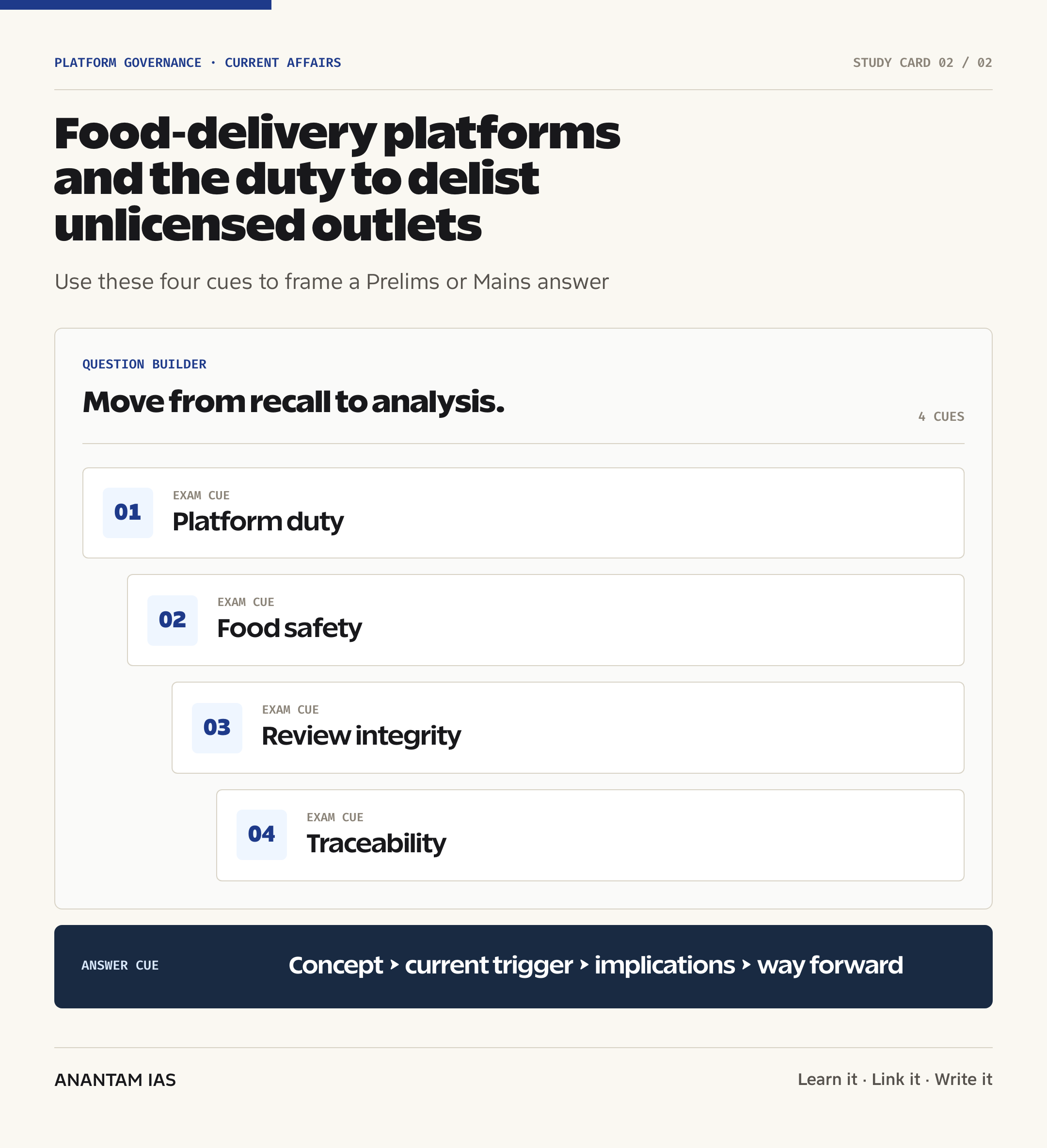
A platform that enables orders shapes market access and can prevent an unverified seller from reaching consumers at scale.
- The e-commerce licensing framework distinguishes a mere listing or directory from an entity that facilitates orders or transactions; the latter falls within the regulated food-business ecosystem.
- FSSAI’s December 2024 advisory reiterated that no e-commerce FBO should list a seller without displaying a valid FSSAI licence or registration.
- Platforms must build verification into onboarding and conduct periodic revalidation, because a licence that was valid at entry can later expire, be suspended or be cancelled.
- A delisting direction is a form of preventive regulation: it limits exposure to a potentially non-compliant outlet before harm spreads across a large customer base.
- Platform responsibility doesn’t erase the seller’s primary duty. It creates layered accountability in which the outlet, aggregator and regulator each control a different risk point.
Licence, premises and traceability
A valid number on an app is insufficient if the displayed restaurant and the kitchen preparing the meal aren’t the same regulated premises.
- CMC required the platforms to maintain the accurate geo-location of every listed food establishment.
- The order seeks to prevent food being prepared at an unapproved cloud kitchen or alternate premises that inspectors and consumers can’t reliably identify.
- A municipal trade licence addresses local permission to carry on the business, while FSSAI approval addresses the food-safety regulatory identity of the operator and premises.
- Reliable mapping among the outlet name, physical address, licence number and platform account makes inspections and recalls more effective.
- Traceability also matters when authorities investigate adulteration, unsafe handling or misleading labelling, themes explained in the food adulteration and FSSAI rules notes.
Ratings, reviews and information integrity
Digital ratings influence consumer choice, but popularity scores aren’t the same as verified regulatory compliance.
- CMC asked for the criteria used to assign food ratings, hygiene ratings and customer reviews, bringing algorithmic and moderation practices into regulatory scrutiny.
- A customer may interpret a high app score as a safety signal even when it largely measures taste, price, packaging or delivery experience.
- Platforms should clearly separate user-generated ratings from an official hygiene rating or verified licence status.
- Rules on removal or suppression of negative reviews affect consumer information; opaque moderation can hide recurring complaints or create a misleading impression of quality.
- Review governance needs procedural safeguards against fake reviews and abusive content without allowing genuine safety complaints to disappear without a traceable reason.
Cooperative and local governance
Food delivery crosses administrative layers, so enforcement works only when information moves quickly between them.
- FSSAI provides the national standards framework, but local inspections reveal whether a listed kitchen actually follows sanitation and licensing requirements.
- CMC’s demand for a designated nodal officer creates a clear point of responsibility for notices, inspection findings and compliance reports.
- An official communication channel can shorten the delay between a regulator’s order and the platform’s delisting action.
- Shared data should follow purpose limitation and data minimisation; regulators need compliance information, not unrestricted access to customer data.
- Comparable challenges appear in regulated food programmes such as food fortification in India, where standards, labelling and field enforcement must work together.
Benefits, risks and implementation gaps
Platform-based verification can scale enforcement, but poor design can create false assurance or exclude small legitimate businesses.
- Automated licence checks can reduce the cost of monitoring thousands of listings and make expiry-based suspension faster.
- A verified badge must reflect current official records; stale or mismatched data can produce false compliance signals.
- Small food businesses may need assisted registration and clear notice before delisting, except where an immediate public-health risk requires urgent action.
- A grievance system should support consumers in reporting unsafe food and should route complaints to the relevant platform, food authority or municipal body.
- Enforcement metrics should measure verified compliance, time taken to act and repeat violations, not just the raw number of outlets removed.
Way Forward
Build licence checks into the platform
- Connect onboarding and periodic reviews with FoSCoS-backed verification wherever secure, lawful interoperability is available.
- Trigger alerts before expiry and automatically pause a listing when a licence becomes invalid, subject to a documented correction process.
Make the physical outlet traceable
- Match each platform listing with the approved premises, address and geo-location, and prevent dispatch from an unregistered alternate kitchen.
- Give inspectors a fast channel to flag a mismatch and require platforms to preserve an auditable action trail.
Separate safety signals from popularity
- Display the seller’s verified licence status distinctly from customer star ratings and explain what each score measures.
- Publish a transparent review-moderation policy with reasons, appeal routes and safeguards for genuine public-health complaints.
Use proportionate, coordinated enforcement
- Create standard protocols among food-safety departments, municipal bodies and platforms for notice, delisting, reinstatement and repeat violations.
- Combine penalties for wilful evasion with registration support and clear compliance guidance for small food businesses.
Conclusion
The Cyberabad notice shows that platform governance isn’t separate from public-health governance. When an app controls discovery and orders, it also controls a practical checkpoint for keeping unlicensed outlets away from consumers.
The durable solution is a transparent chain of responsibility: verified sellers, traceable premises, intelligible ratings, responsive platforms and coordinated regulators. That approach protects consumers without treating every small business as a bad actor.
UPSC Practice Questions
Prelims MCQ 1
With reference to food-business regulation in India, consider the following statements:
- FSSAI is a statutory authority established under the Food Safety and Standards Act, 2006.
- Section 31 of the Act deals with licensing and registration of food businesses.
- A municipal trade licence automatically substitutes for FSSAI licensing or registration.
How many of the above statements are correct?
(a) Only one (b) Only two (c) All three (d) None
Answer: (b) Only two
Explanation:
Statements 1 and 2 are correct. A municipal trade licence and an FSSAI licence or registration serve distinct legal purposes; one doesn’t automatically replace the other.
Prelims MCQ 2
Which one of the following best explains why a food-delivery platform may be treated as an e-commerce Food Business Operator?
(a) It publishes customer reviews without moderating them (b) It owns every restaurant listed on its interface (c) It lists food businesses and facilitates orders or transactions (d) It delivers only packaged food across State boundaries
Answer: (c) It lists food businesses and facilitates orders or transactions
Explanation:
The regulatory distinction turns on facilitating food orders or transactions, not on owning every seller or operating across State borders.
UPSC Mains Questions
- Digital food-delivery platforms are no longer neutral directories; they are compliance checkpoints in the public-health system. Discuss this proposition with reference to FSSAI licensing, municipal regulation, traceability and consumer grievance redressal.
- How can India make ratings and reviews on online marketplaces more transparent without weakening legitimate content moderation? Suggest a governance framework that balances consumer protection, platform accountability and procedural fairness for small businesses.
Sources: Food Safety and Standards Authority of India and The Hindu.
Frequently Asked Questions
What did Cyberabad direct the platforms to do?
CMC directed Swiggy and Zomato to retain only outlets with valid FSSAI approval and municipal trade licences, remove outlets with invalid licences, verify premises and geo-locations, disclose rating and review methods, appoint a nodal officer and file a compliance report within one week.
Why does an outlet need FSSAI approval?
Section 31 of the Food Safety and Standards Act, 2006 requires every Food Business Operator to obtain the applicable licence or registration. The approval links the responsible operator and premises to food-safety duties, regulatory oversight and enforcement.
Is a trade licence the same as FSSAI registration?
No. A municipal trade licence permits a business to operate under applicable local law, while FSSAI licensing or registration identifies and regulates the food business under the national food-safety framework. An outlet may need both approvals.
Why must platforms verify the kitchen location?
Location verification connects the digital listing to the physical premises where food is prepared and dispatched. It helps prevent unapproved kitchens from operating behind another outlet’s identity and lets inspectors, consumers and regulators identify the responsible establishment.
Are app ratings official hygiene ratings?
Not necessarily. Customer ratings may reflect taste, price, packaging or delivery, while an official hygiene rating follows a defined food-safety assessment. Platforms should label these signals separately so consumers don’t mistake popularity for verified regulatory compliance.
What is the main governance lesson?
Responsibility should follow control. Sellers control food preparation, platforms control listing and transaction access, and regulators control standards and enforcement. Connecting these roles through verification, traceability, transparent reviews and time-bound communication produces stronger public-health protection.
Tell Google you want more of this.
Add Anantam IAS as a preferred sourceOne tap, and this site shows up more often in your own Top Stories, AI Overviews and AI Mode. Remove it any time.