

Why in News?
The Indian Express reported in July 2026 that Ravidassia representatives had renewed their demand for a separate religion category in the forthcoming Census 2027. The demand seeks visible recognition of a religious identity centred on Guru Ravidas, rather than its statistical absorption within a larger community.
The issue is not merely about adding a box to a questionnaire. It connects religious self-identification, the history of Dalit assertion in Punjab, Census classification and the separate legal process through which the Union government notifies a community as a religious minority.
- A community conference in Punjab pressed for Ravidassia Religion to be shown separately in Census 2027.
- The demand has an institutional centre in Dera Sachkhand Ballan near Jalandhar and a strong social base in Punjab’s Doaba region.
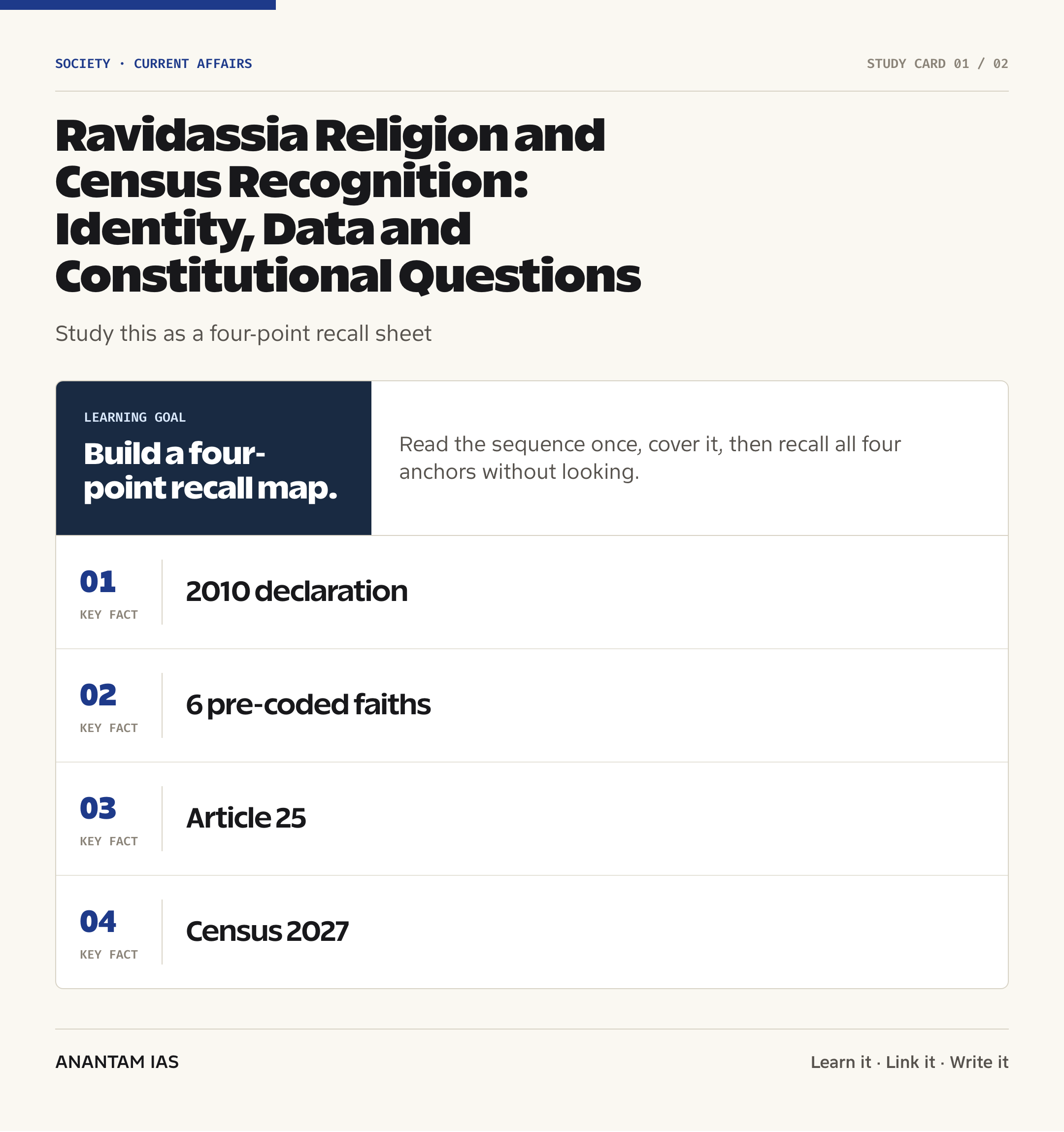
- Dera Sachkhand Ballan publicly proclaimed a separate Ravidassia religion in 2010, following a deadly 2009 attack on its leaders in Vienna.
- The official Census methodology says every respondent’s stated religion must be recorded faithfully, including a religion outside the six pre-coded major religions.
- A distinct Census return does not by itself produce minority notification, reservation rights or a new legal status.
The development matters in the context of:
- The demand illustrates how a marginalised group may use religious identity to claim dignity, institutional autonomy and visibility beyond caste hierarchy.
- It also shows that enumeration, classification and recognition are related but legally different acts of the State.
- For Census design, the challenge is to preserve self-identification while producing data that remain comparable, transparent and statistically useful.
UPSC Relevance
Prelims Relevance
- The Census is a Union subject under Entry 69 of the Union List and is conducted under the Census Act, 1948.
- The Office of the Registrar General and Census Commissioner, India functions under the Ministry of Home Affairs.
- Since Census 2001, the schedule has used numeric codes for six major religions: Hindu, Muslim, Christian, Sikh, Buddhist and Jain.
- The Census Commissioner states that these numeric codes are for data processing and confer no advantage or privilege.
- A respondent may state another religion or no religion; the enumerator must record the answer without argument or presumption.
- The 2011 C-01 table grouped smaller returns under Other Religions and Persuasions, with an appendix providing a further break-up for qualifying returns.
- Article 25 protects freedom of conscience and the right freely to profess, practise and propagate religion, subject to its constitutional limits.
- Under Section 2(c) of the National Commission for Minorities Act, 1992, a minority is a community notified by the Central Government for that Act.
- The six centrally notified religious minorities are Muslims, Christians, Sikhs, Buddhists, Parsis and Jains.
- The Constitution (Scheduled Castes) Order, 1950, as amended, links Scheduled Caste recognition to professing Hinduism, Sikhism or Buddhism.
Mains Relevance
GS Paper 1
- Salient features of Indian society, caste and religious diversity
- The Bhakti tradition and its challenge to hierarchy and exclusion
- Identity movements, social mobility and the politics of recognition
- Regional concentration of Dalit communities in Punjab’s Doaba region
GS Paper 2
- Freedom of religion under Articles 25 and 26
- Minority notification, equal citizenship and social justice
- Census governance, data classification and evidence-based public policy
Essay
- What the State counts influences what society can see.
- Dignity requires both freedom of belief and freedom from inherited hierarchy.
- Recognition can empower a community, but official categories can also harden fluid identities.
Background and Context
Who Are the Ravidassias?
Ravidassias are followers of Guru Ravidas whose contemporary identity intersects devotion, caste experience and institutional organisation.
- Guru Ravidas was a fifteenth-sixteenth century Bhakti saint associated with Varanasi whose compositions challenged ritual hierarchy and affirmed human equality.
- His vision of Begampura, a city without sorrow, fear or oppressive taxation, has become a powerful language of emancipation and equal citizenship.
- Ravidas’s verses are included in the Guru Granth Sahib, creating a deep historical connection between his followers and Sikh religious practice.
- Many followers come from communities historically treated as Dalit, especially leather-working groups subjected to untouchability and occupational stigma.
- The community is especially influential in Doaba, the Punjab region between the Beas and Sutlej rivers, and also has a sizeable diaspora.
- Ravidassia identity is not perfectly uniform: some people identify with a distinct religion, while others retain Sikh, Hindu, Ad Dharmi or overlapping identities.
From Ad Dharm Assertion to a Separate Religious Identity
The present demand draws on a longer history of lower-caste organisation and independent identity-making in colonial Punjab.
- The Ad Dharm movement, founded in Punjab in the 1920s, urged oppressed castes to reject imposed inferiority and identify as an original religious community.
- Its leaders treated the colonial Census as a field of political and social assertion, because a separately counted population could demonstrate numerical presence.
- The 1931 Census recorded Ad Dharm as a distinct return in Punjab, an episode that remains important to current recognition claims.
- After Independence, many related populations were enumerated under broader religious identities even as caste-based social distinctions persisted within them.
- Dera Sachkhand Ballan developed into a major religious and social institution, supporting congregations, pilgrimage and welfare networks around Guru Ravidas.
- This history explains why Census classification is viewed as a question of collective dignity and historical continuity, not only statistical convenience.
The 2009 Vienna Attack and the 2010 Declaration
A violent episode abroad accelerated the institutional separation promoted by Dera Sachkhand Ballan.
- On 24 May 2009, attackers targeted a congregation at a Guru Ravidas temple in Vienna, killing Sant Ramanand and injuring Dera head Sant Niranjan Dass and others.
- The attack produced grief and unrest in Punjab and sharpened a sense that the community required an autonomous religious and organisational identity.
- At a Guru Ravidas anniversary congregation in Varanasi on 30 January 2010, Dera Sachkhand Ballan announced the formation of the Ravidassia religion.
- The Dera foregrounded the Amritbani Guru Ravidas, a compilation centred on the saint’s teachings, in its distinct devotional practice.
- A separate name, scripture-centred practice and symbols help explain the claim to a distinct religion, but they do not erase internal differences among Ravidas-following groups.
- A sound Mains answer should avoid presenting either complete separation or complete assimilation as an uncontested fact.
How the Census Records Religion
The official method combines six pre-coded options with an open-ended duty to record any other self-declared religion faithfully.
- The Registrar General’s Social Studies Division note says religion is recorded separately for every household member because members may profess different faiths.
- Enumerators must not assume that the respondent or household head speaks for every person’s religious identity without an answer being returned for that member.
- The six numeric codes placed on the schedule since 2001 serve operational convenience; the government explicitly says they don’t grant privilege.
- If a person states another religion, the enumerator must write its actual name rather than force it into one of the six major categories.
- The 2011 C-01 religion table published six major communities separately and combined smaller returns under Other Religions and Persuasions.
- Its appendix broke out many smaller religion names meeting the publication threshold, including Adi Dharm; enumeration and headline tabulation are separate stages.
Census Entry, Religious Recognition and Minority Status
Three ideas often merged in public debate must be kept analytically separate.
- Self-identification means the Census records the religion stated by a respondent; it protects data accuracy and personal agency.
- A separate published category or code determines how visibly that return appears in schedules, tables and public datasets.
- A notified minority is a legal status under the National Commission for Minorities Act and depends on Central Government notification, not Census coding alone.
- The National Commission for Minorities lists six notified communities: Muslims, Christians, Sikhs, Buddhists, Parsis and Jains.
- Article 25 protects the freedom to profess a religion, but it doesn’t create an automatic right for every religious denomination to receive a separate prominent Census code.
- Any government decision needs a transparent test covering self-identification, continuity, distinct institutions, response volume and statistical usability.
The Caste-Religion Intersection
Ravidassia assertion shows why caste and religion cannot always be treated as isolated social categories in India.
- The movement’s egalitarian theology responds to the lived effects of untouchability and caste exclusion, including forms of segregation within religious communities.
- Adopting a distinct religious identity can be an act of social mobility and dignity, but discrimination may continue after a change in official label.
- Paragraph 3 of the Constitution (Scheduled Castes) Order, 1950, as amended, limits Scheduled Caste recognition to persons professing Hinduism, Sikhism or Buddhism.
- A distinct Ravidassia classification could raise concerns about the continuity of Scheduled Caste protections unless the legal position is clarified in advance.
- Census 2027’s wider caste enumeration adds another layer: the State may record a person’s religion and caste as distinct variables rather than treating one as a proxy for the other.
- See the Anantam IAS guides to Census 2027 caste enumeration and religious diversity in India for the wider syllabus link.
Why Official Classification Matters
Public categories can distribute visibility and shape research even when they do not directly allocate legal benefits.
- Separate tabulation can reveal a community’s geographic distribution, sex ratio, literacy and urban-rural profile when cross-tables are released.
- Reliable numbers can improve cultural policy, academic research and the design of services without reducing individuals to a single fixed identity.
- Aggregation may make smaller communities statistically invisible, while excessive fragmentation can make comparisons unstable and invite competitive identity politics.
- Standard spelling, synonym mapping and publication thresholds are needed so that variations such as Ravidassia, Ravidasia and related returns aren’t misclassified or double-counted.
- The State must publish its classification rules and preserve anonymised raw return categories so researchers can examine how aggregation decisions were made.
- The democratic objective should be accurate representation with privacy, not official judgment about the truth of a belief.
Way Forward
Protect self-identification
- Train enumerators to record the religion returned by each person faithfully and to avoid imposing a household-level assumption.
- Provide an open-text route in digital and paper forms for identities outside the six pre-coded religions.
Publish a transparent classification protocol
- Release rules for spelling variants, synonyms, minimum publication thresholds and placement under Other Religions and Persuasions.
- Consult community bodies, independent demographers and constitutional experts before finalising the output tables.
Separate data questions from legal benefits
- Explain publicly that a Census return, a separate code, notified minority status and Scheduled Caste eligibility arise under different legal processes.
- Clarify the reservation implications before any new religious classification so people aren’t forced to choose between identity and protection.
Preserve plural identities
- Avoid treating all Ravidas followers as a single bloc when the community includes distinct Ravidassia, Sikh, Hindu and Ad Dharmi identifications.
- Pair recognition with stronger enforcement against caste discrimination across every religious setting.
Conclusion
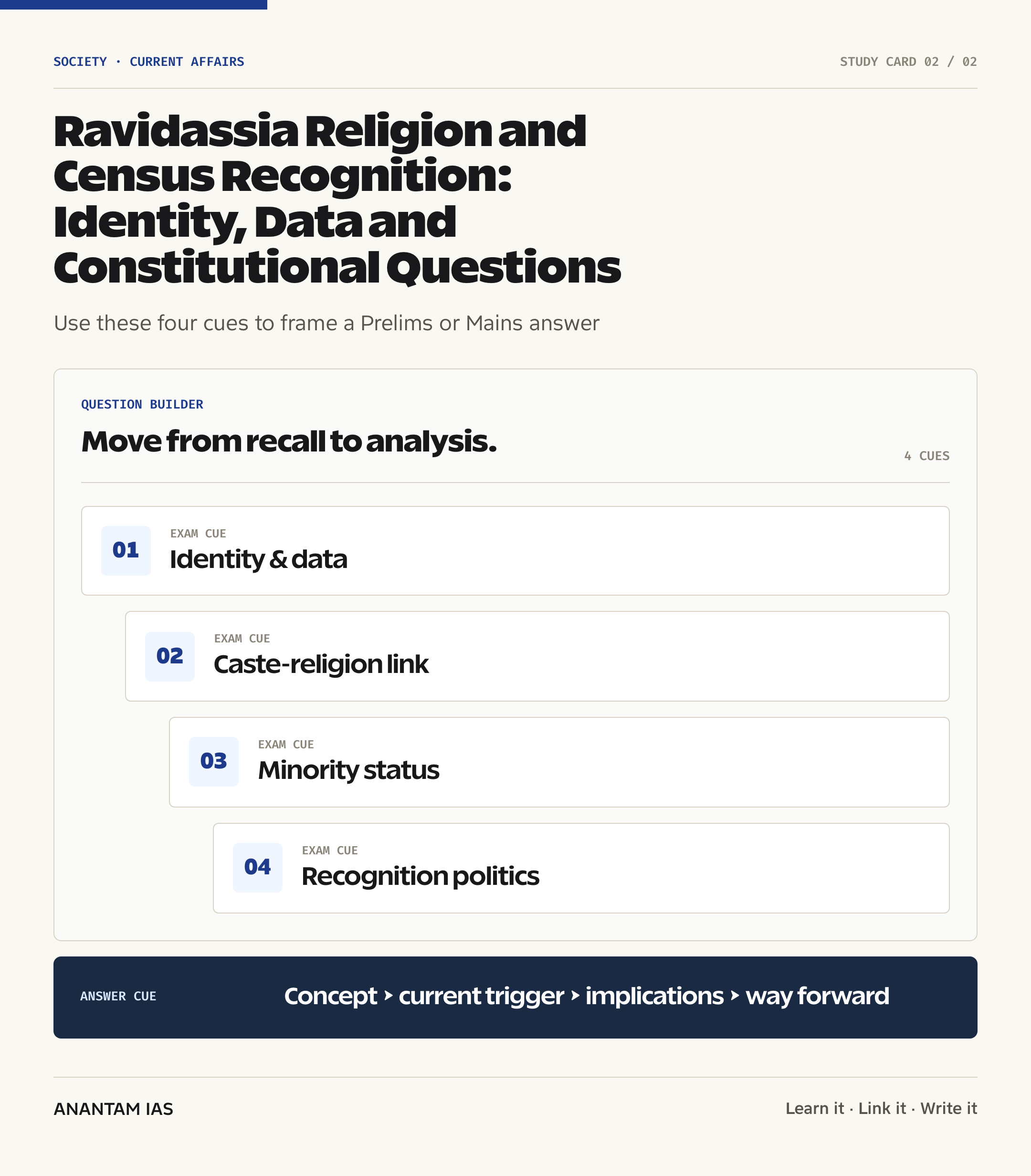
The Ravidassia demand asks a basic democratic question: can official data make a community visible without allowing the State to define its faith for it? The Census method already accepts open-ended religious self-identification; the unresolved issue is how those returns should be classified and published.
A balanced approach would record identity faithfully, publish transparent aggregation rules and distinguish Census visibility from minority notification and reservation law. Recognition is meaningful only when it strengthens dignity without creating a fresh loss of rights.
UPSC Practice Questions
Prelims MCQ 1
With reference to the enumeration of religion in the Indian Census, consider the following statements:
- Since Census 2001, six numerically major religions have pre-assigned codes in the schedule.
- Enumerators must record a religion outside those six as returned by the respondent.
- The pre-assigned numeric code itself confers notified-minority status on a religion.
How many of the above statements are correct?
(a) Only one (b) Only two (c) All three (d) None
Answer: (b) Only two
Explanation:
Statements 1 and 2 are correct. The six codes are for operational data processing, and other returned religions must still be recorded faithfully. Statement 3 is wrong because notified-minority status requires a separate Central Government notification under the National Commission for Minorities Act.
Prelims MCQ 2
Which statement best distinguishes a separate Census religion entry from notified-minority status?
(a) Both arise automatically under Article 25 (b) Census classification is statistical, while minority status requires legal notification (c) Only Parliament may record a religion in the Census (d) A Census code automatically creates reservation rights
Answer: (b) Census classification is statistical, while minority status requires legal notification
Explanation:
The Census records and classifies population data. For the National Commission for Minorities Act, a community becomes a notified minority through Central Government notification; Census coding alone doesn’t create that status or reservation rights.
UPSC Mains Questions
- The demand for a separate Ravidassia category in Census 2027 is as much about caste dignity and political recognition as religious classification. Discuss the historical roots of the demand and the constitutional questions it raises.
- Differentiate religious self-identification in Census enumeration from a separate published category and notified-minority status. Suggest principles for classifying India’s smaller religious communities without erasing internal diversity.
Sources: Office of the Registrar General and Census Commissioner, India and Indian Express Explained.
Frequently Asked Questions
Who are the Ravidassias?
Ravidassias are followers of Guru Ravidas, the Bhakti saint who preached equality and opposed caste hierarchy. The community has a strong presence in Punjab’s Doaba region and in the diaspora. Some followers identify with a distinct Ravidassia religion, while others retain Sikh, Hindu, Ad Dharmi or overlapping identities.
Why is Census recognition being demanded?
Supporters argue that separate tabulation would make their religious identity and population visible instead of absorbing the return under a larger faith or a residual category. They also connect recognition with the Ad Dharm movement, the 2010 declaration of Ravidassia religion and the community’s search for dignity.
Does the Census record smaller religions?
Yes. The official methodology instructs enumerators to record faithfully any religion stated by a respondent, even when it is outside the six pre-coded major religions. The later statistical tables may publish smaller returns separately or aggregate them under Other Religions and Persuasions according to classification rules.
Does a Census code grant minority status?
No. A Census code is an operational and statistical device. Under the National Commission for Minorities Act, 1992, minority status for that Act depends on notification by the Central Government. A separate Census entry also does not automatically create reservation, educational or institutional rights.
When was Ravidassia religion declared?
Dera Sachkhand Ballan announced the formation of Ravidassia religion at a Guru Ravidas anniversary congregation in Varanasi on 30 January 2010. The move followed the May 2009 Vienna temple attack in which Sant Ramanand was killed and Dera head Sant Niranjan Dass was injured.
Could recognition affect Scheduled Caste status?
It could raise a legal concern. The Constitution (Scheduled Castes) Order, 1950, as amended, presently limits Scheduled Caste recognition to persons professing Hinduism, Sikhism or Buddhism. Any separate classification should be accompanied by clear legal guidance so that religious self-identification does not unintentionally remove social-protection eligibility.
Tell Google you want more of this.
Add Anantam IAS as a preferred sourceOne tap, and this site shows up more often in your own Top Stories, AI Overviews and AI Mode. Remove it any time.




