Daily Digest
UPSC · Civil Services Examination
Current Affairs · Tuesday, 7 July 2026
Current affairs curated and edited by Anantam IAS faculty — pulled from The Hindu, PIB, IDSA, Foreign Affairs and the ministries. Read, annotate, revise.
Old Rajinder Nagar · Delhi 110005 · anantamias.com
Census 2027 Caste Enumeration: ‘Open Column’ Method Tested in Rehearsal
Why in News?
The Hindu reported that the rehearsal for the second phase of Census 2027 — Population Enumeration (PE) — began on July 6, 2026 in 16 States and Union Territories, with a form that carries an ‘open column’ in which enumerators record whatever caste a respondent declares.
It’s the first concrete signal of how India may conduct its first full caste enumeration since 1931. Officials called the exercise, ending July 20, 2026, only a ‘pre-test’: the final methodology and questionnaire will be settled from field feedback by September 2026.
- The pre-test runs July 1–20, 2026; a self-enumeration portal was open from July 1 to 5 in the rehearsal areas, and enumerator visits started on July 6.
- Scheduled Castes and Scheduled Tribes stay on pre-assigned codes from the notified SC/ST lists; every other respondent gets a free-text open column for caste.
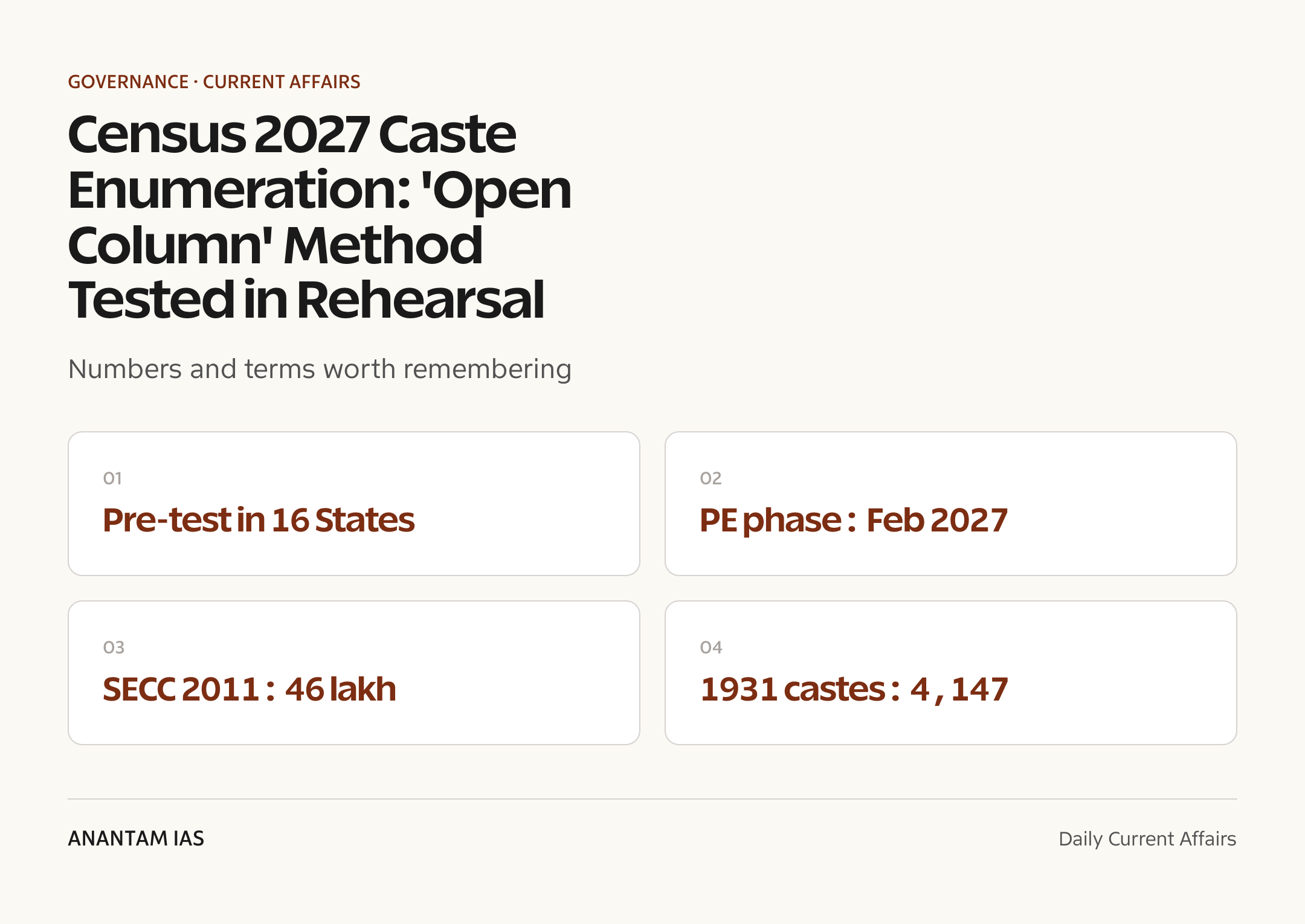
- In Faridabad, Haryana, the rehearsal covers Ward No. 24 — 17 enumeration blocks of roughly 150–180 residential units and 650–800 people each.
- The PE phase runs nationwide in February 2027; in Ladakh and the snow-bound areas of Jammu & Kashmir, Himachal Pradesh and Uttarakhand it will finish by September 30, 2026.
- Phase one — Housing and House Listing Operations (HLO) — is still incomplete in eight States: Himachal Pradesh, Kerala, Nagaland, Tamil Nadu, Tripura, West Bengal, Assam and Manipur.
The development matters in the context of:
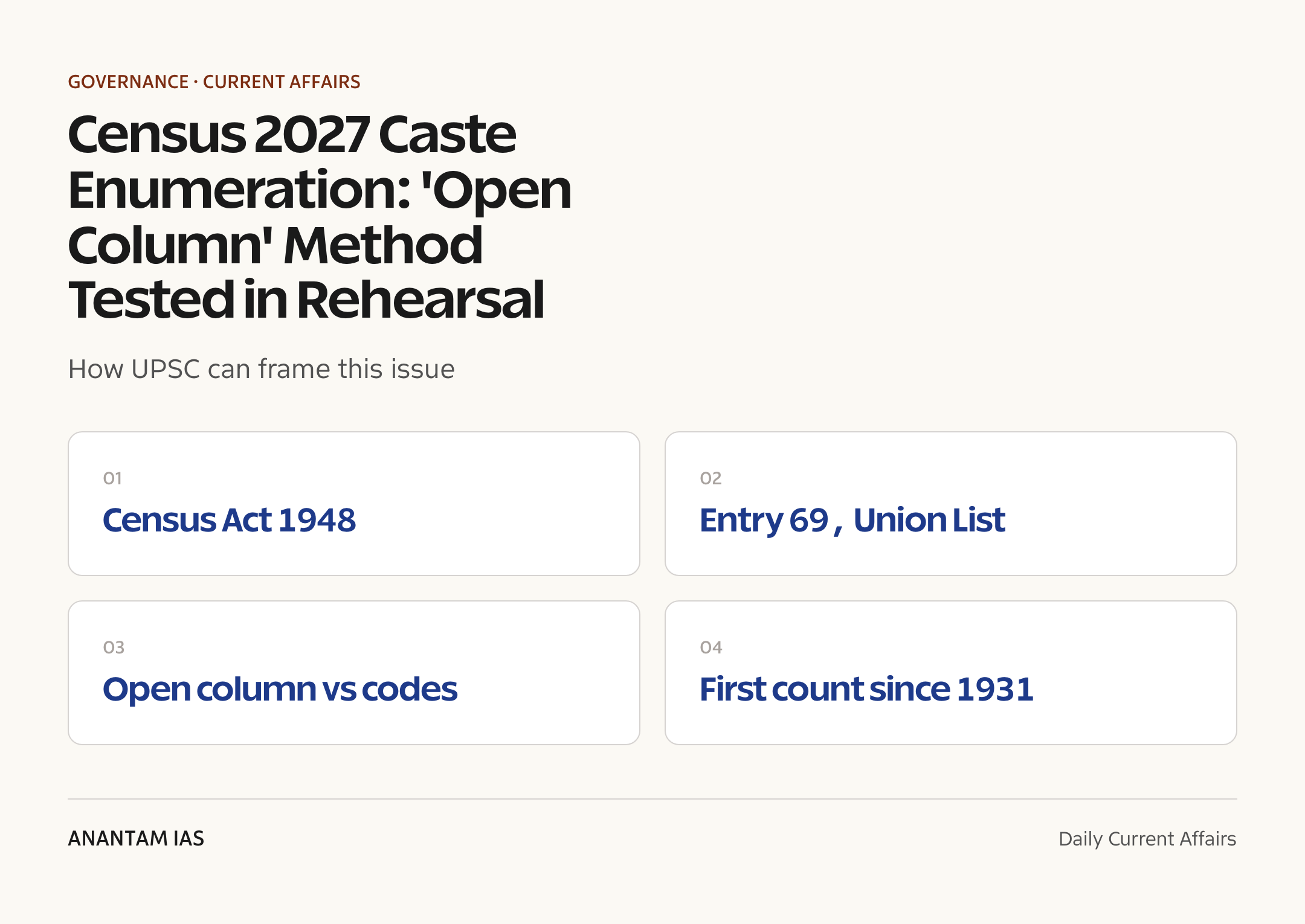
- The Union Cabinet approved caste enumeration on April 30, 2025; Census 2027 was notified in the Gazette on June 16, 2025 under the Census Act, 1948.
- Methodology is the make-or-break question: the SECC 2011 used an open column and returned over 46 lakh different caste names — data the government has called unreliable.
- The count will feed OBC sub-categorisation, reservation-ceiling debates, welfare targeting and the delimitation-linked politics of the 2030s.
UPSC Relevance
Prelims Relevance
- Census 2027: 16th census (8th since Independence), the first fully digital census, and the first in independent India to enumerate all castes.
- Legal basis: the Census Act, 1948; ‘Census’ is Entry 69 of the Union List, so only the Union can conduct one.
- Nodal authority: the Registrar General and Census Commissioner of India (office set up 1949), Ministry of Home Affairs.
- Two phases: HLO then Population Enumeration (February 2027); reference date March 1, 2027 — October 1, 2026 for Ladakh and snow-bound areas.
- Open column: self-declared caste recorded as stated, no pre-coded list; codes apply only to SCs and STs.
- SECC 2011: run by the Rural Development and Housing & Urban Poverty Alleviation ministries outside the Census Act; its caste data were never released.
- Bihar Caste-Based Survey 2022–23: a State survey using a pre-coded caste list; results published in 2023.
- 1931 Census: last tabulated caste count — 4,147 castes; basis of the Mandal Commission’s 52% OBC estimate.
Mains Relevance
GS Paper 2
- Governance: how enumeration design — open column versus coded list — decides whether caste data become usable evidence or another SECC-style dead end
- Federal frame of the census; Centre–State coordination when HLO is incomplete in eight States and States run rival caste surveys
- E-governance: India’s first digital census, self-enumeration, and confidentiality safeguards under the Census Act, 1948
GS Paper 1
- Salient features of Indian society: caste as a lived, self-described identity versus an administrative category with fixed codes
- Regional variation in caste nomenclature — why one community can report itself under dozens of names
Essay
- Counting is never neutral: what a state measures, it makes visible — and governable.
- Social justice in the age of data: evidence, identity and the arithmetic of fairness.
Background and Context
The Census Machine: Act, Authority and Federal Design
The census is one of India’s oldest continuous administrative exercises, with a clear statutory and constitutional home.
- The Census Act, 1948 makes answering obligatory (Section 8), penalises false answers (Section 11), and keeps individual records confidential — not open to inspection or admissible in evidence (Section 15).
- ‘Census’ sits at Entry 69 of the Union List: only the Union can conduct a census; States may run ‘surveys’ — as Bihar did — but can’t call them a census.
- The operation is run by the Office of the Registrar General and Census Commissioner, India, set up in 1949 under the Ministry of Home Affairs, through State census directorates.
- India has held a census every decade since 1881; the 2021 round was deferred by the pandemic. A fuller timeline is in our note on Indian census history.
- The 2011 Census counted about 121 crore people with a 29-question PE schedule covering literacy, migration, marital status, fertility and travel to work.
Census 2027: Phases, Dates and the Digital Shift
The 2027 exercise is a two-phase, app-driven operation working to fixed reference dates.
- Notified in the Gazette on June 16, 2025, with a reference date of 00:00 hours, March 1, 2027 — and October 1, 2026 for Ladakh and the snow-bound, non-synchronous areas of J&K, Himachal Pradesh and Uttarakhand.
- Phase 1, the HLO, maps houses, amenities and assets; The Hindu reported it is yet to finish in eight States, including Kerala, Tamil Nadu, West Bengal and Assam.
- Phase 2, Population Enumeration (February 2027), is where the caste of every resident will be recorded for the first time.
- It is India’s first digital census: app-based collection, a household self-enumeration option, and central digital monitoring instead of paper schedules.
- The rehearsal is formally a pre-test ‘to evaluate field procedures, digital applications and operational arrangements’, as the Faridabad Deputy Commissioner’s office put it; the final questionnaire is expected by September 2026.
Caste and the Census: 1881 to 2027
Counting caste isn’t new — it’s a colonial practice that independent India deliberately discontinued.
- Every census from 1881 to 1931 recorded caste; the 1931 Census — the last tabulated count — listed 4,147 castes. The 1941 data were collected but never tabulated in wartime.
- After Independence, only Scheduled Castes and Scheduled Tribes were counted — a deliberate choice to avoid hardening caste identities in a new republic.
- The gap had costs: the Mandal Commission (1980) estimated OBCs at 52% by extrapolating 1931 data, and Indra Sawhney (1992) — source of the 50% ceiling — underlined the need for contemporary evidence.
- On April 30, 2025, the Union Cabinet approved caste enumeration in the census itself. The arguments on both sides are unpacked in our explainer on the caste census debate.
- Nomenclature is hard: with the 105th Amendment restoring separate State OBC lists, one community can carry different names and sub-caste labels across lists.
Open Column vs Coded List: What the Rehearsal Is Testing
Two rival methodologies dominate the caste-count debate, and each has a track record.
- Open column: the enumerator writes whatever the respondent declares. No community is excluded — but people answer with jati, sub-caste, surname, gotra or occupation, so the data get noisy.
- The SECC 2011 used this method and returned over 46 lakh distinct ‘caste names’; the government has long held those data unreliable, and never published the caste figures.
- Coded list: the Bihar Caste-Based Survey 2022–23 gave enumerators a pre-coded list of over 200 castes plus an ‘other’ option — clean tables (OBCs and EBCs near 63%), but a list can miss groups or force identities into boxes.
- The pre-test signals a split design: SCs/STs keep code lists, everyone else gets the open column, with enumerators entering whatever a resident says, an official told The Hindu.
- Nothing is final: pre-test feedback on the form, app and field procedure will shape the methodology announced with the September questionnaire.
Why the Stakes Are High: What Caste Data Will Decide
The caste count isn’t a statistical curiosity — it plugs straight into India’s biggest policy levers.
- OBC sub-categorisation: the Justice G. Rohini Commission reported in 2023, but splitting the OBC quota fairly needs credible population shares.
- Reservation ceilings: States citing their own surveys keep pushing past the Indra Sawhney 50% ceiling; a national count will be the reference evidence in every such battle.
- Welfare targeting: caste-disaggregated data on housing, education and jobs would move schemes from proxy targeting to direct evidence.
- Political arithmetic: the first post-2026 census also triggers delimitation and operationalises the 106th Amendment (women’s reservation).
- Federal pressure: Bihar, Karnataka and Telangana have run State caste surveys with divergent methods; only a credible national count yields comparable data.
Concerns: Accuracy, Privacy and Politics
Even strong supporters of a caste count flag serious execution risks.
- Classification chaos: with a pure open column, one jati can appear under dozens of spellings and synonyms; enumerators can’t verify or standardise — which is how SECC 2011 hit 46 lakh entries.
- Privacy: caste is sensitive personal information; Section 15 shields individual records, but the aggregation level for published caste tables is a fresh, contested call.
- Political contestation: results that shift community shares away from Mandal-era assumptions will be challenged, so the method must survive scrutiny.
- Operational strain: the HLO backlog in eight States compresses timelines, and training enumerators for a caste column is harder than for age or literacy.
- Digital divide: if better-off households self-enumerate while others rely on enumerators, error patterns could themselves become caste-skewed.
Way Forward
Standardise before counting
- Build a master caste directory with States — spellings, synonyms and sub-castes mapped to standard codes — and publish a draft for objections before February 2027.
- Reconcile the directory with Central and State SC, ST and OBC lists so census categories can be read against reservation categories.
Design the digital form smartly
- Combine both methods in the census app: an auto-suggest field drawing on the directory, with an open-text fallback routed to supervisor adjudication.
- Run real-time validation to flag improbable or duplicate caste strings during fieldwork — fixing in-flight what SECC 2011 discovered only afterwards.
Protect the data, publish the method
- Announce in advance the aggregation level for caste tables, keeping individual records within the Census Act’s confidentiality shield.
- Release a full methodology paper with the results — question wording, coding rules, error rates — so the count earns the credibility SECC 2011 never had.
Conclusion
The rehearsal answers one question and raises a bigger one. India now knows roughly how the state proposes to ask about caste; whether the answers add up to usable knowledge depends on the standardisation, validation and disclosure choices still to be made before February 2027.
For aspirants, the durable core is the frame: the Census Act, 1948, the Union’s exclusive competence, the two-phase digital design, and the SECC 2011–Bihar contrast. Remember the ‘open column’ not as a headline but as a live experiment in how a diverse republic converts identity into evidence.
UPSC Practice Questions
Prelims MCQ 1
With reference to the Census of India, consider the following statements:
- The Census is conducted under the Census Act, 1948, and ‘Census’ is a subject in the Union List.
- The Socio-Economic Caste Census (SECC) 2011 was conducted under the Census Act, 1948.
- Census 2027 will be the first census in independent India to enumerate all castes.
How many of the above statements are correct?
(a) Only one (b) Only two (c) All three (d) None
Answer: (b) Only two
Explanation:
Statements 1 and 3 are correct: the census rests on the Census Act, 1948 and Entry 69 of the Union List, and Census 2027 will record all castes for the first time (earlier rounds counted only SCs and STs). Statement 2 is wrong — SECC 2011 was run outside the Census Act by other ministries.
Prelims MCQ 2
The ‘open column’ method of caste enumeration, tested in the Census 2027 pre-test, refers to:
(a) Enumerating only those castes that appear in a pre-approved government list (b) Recording whatever caste name a respondent self-declares, without a pre-coded list (c) Counting caste exclusively through the online self-enumeration portal (d) Leaving the caste field blank for Scheduled Caste and Scheduled Tribe respondents
Answer: (b) Recording whatever caste name a respondent self-declares, without a pre-coded list
Explanation:
In the open-column design the enumerator enters the respondent’s caste exactly as stated, with no drop-down list — the approach SECC 2011 used, which produced over 46 lakh distinct caste names. SCs and STs continue on pre-assigned codes from the notified lists.
UPSC Mains Questions
- “The credibility of India’s first full caste enumeration since 1931 will depend less on the decision to count than on how the counting is done.” Examine the open-column and coded-list methodologies for Census 2027 in the light of the SECC 2011 and Bihar Caste-Based Survey experiences.
- Describe the constitutional and statutory framework governing the Census in India. How do census data shape delimitation, reservation policy and welfare targeting, and what safeguards should govern the collection and release of caste data?
- “Data is the new instrument of social justice.” In the context of caste enumeration in Census 2027, discuss how better data can improve affirmative action — and the risks of counting identity.
Sources: The Hindu and Office of the Registrar General & Census Commissioner, India.
Frequently Asked Questions
What is the open column in Census 2027?
It is a free-text field where the enumerator records whatever caste a respondent declares, without a pre-coded list. The Census 2027 pre-test, which began on July 6, 2026 in 16 States and UTs, is testing this design; SCs and STs continue to be recorded through codes.
When will caste be counted in Census 2027?
During the second phase, Population Enumeration, scheduled nationwide for February 2027 with a March 1, 2027 reference date. In Ladakh and the snow-bound areas of J&K, Himachal Pradesh and Uttarakhand it finishes by September 30, 2026. It is independent India’s first full caste count.
Why was SECC 2011 caste data never released?
Its open column returned over 46 lakh distinct caste names — the same community appeared under many spellings, sub-castes and surnames — and the government has maintained the data were error-ridden. The SECC was also conducted outside the Census Act, 1948, without the census’s statutory rigour.
Who conducts the Census in India?
The Office of the Registrar General and Census Commissioner, India — set up in 1949 under the Ministry of Home Affairs — conducts it under the Census Act, 1948. ‘Census’ is Entry 69 of the Union List, so only the Union can hold one; States may only run surveys.
How did Bihar count caste differently?
Bihar’s Caste-Based Survey 2022–23 gave enumerators a pre-coded list of over 200 recognised castes with an ‘other’ option, instead of a free-text column. That produced clean, publishable tables — OBCs and EBCs together near 63% — but a fixed list risks omitting unlisted communities.
Is Census 2027 India’s first digital census?
Yes. Enumerators will collect data on a mobile app instead of paper schedules, households get a self-enumeration option through an online portal, and operations are tracked digitally. It is the 16th census in the series that began in 1881 and the 8th since Independence.
Source: https://anantamias.com/current-affairs/census-2027-caste-enumeration-open-column/
India–Indonesia Partnership: Defence, Critical Minerals and the Malacca Strait Angle
Why in News?
Prime Minister Narendra Modi began a three-nation tour of Indonesia, Australia and New Zealand on 6 July 2026, landing in Jakarta as the first stop. President Prabowo Subianto personally received him at the airport, and the two leaders held delegation-level talks on 7 July covering defence and maritime partnership, critical minerals, food security and the digital economy.
The Indian Express reported that this is Modi’s fourth visit to Indonesia but his first bilateral visit since the two countries elevated ties to a Comprehensive Strategic Partnership (CSP) in May 2018 — with a BrahMos missile sale, an Indonesian liaison officer at India’s IFC-IOR, and nickel-centred critical-mineral cooperation all on the table.
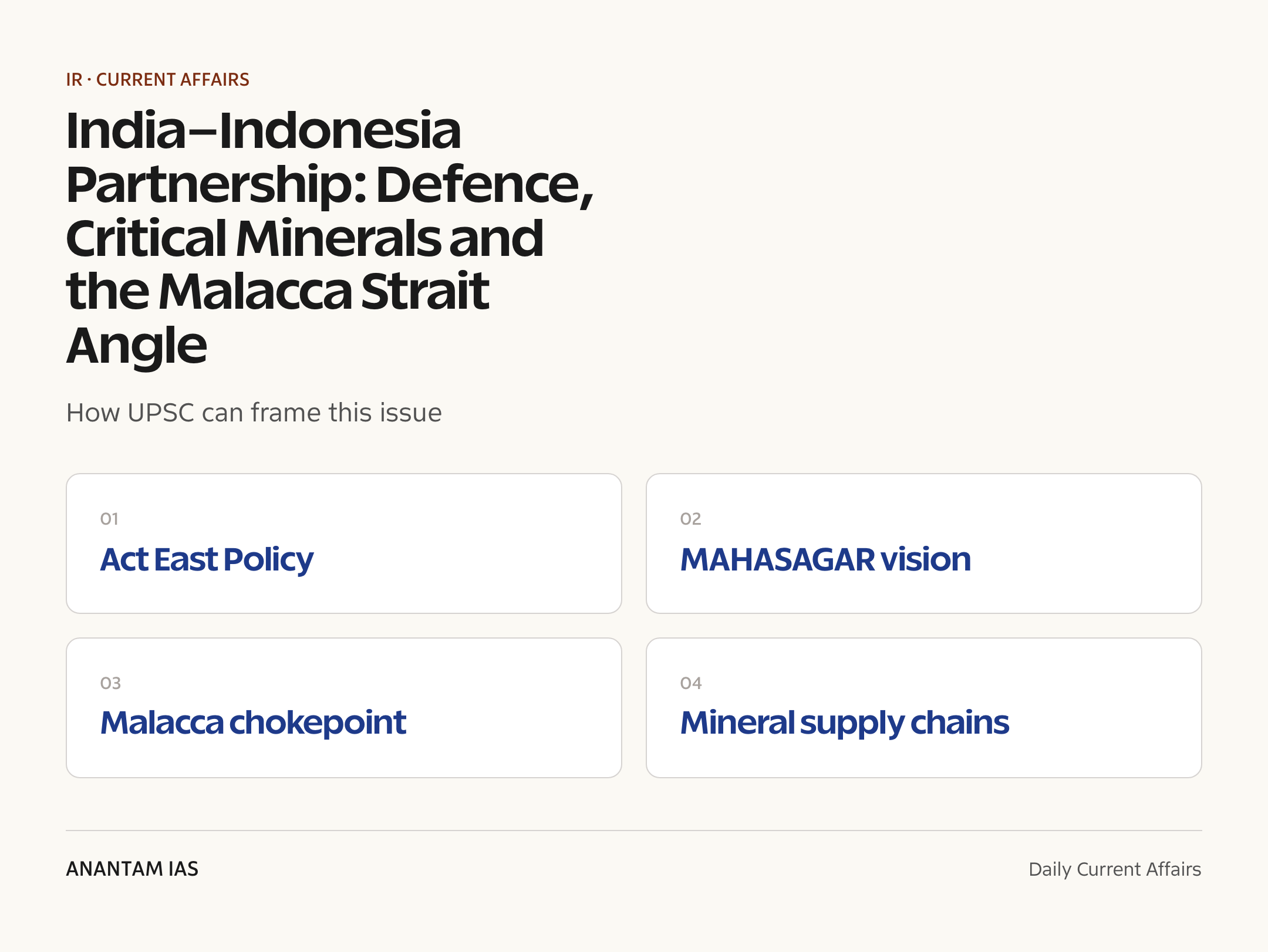
- The tour runs 6–11 July 2026; Modi said it will strengthen the Act East Policy, the MAHASAGAR Vision and India’s outlook towards a free and open Indo-Pacific.
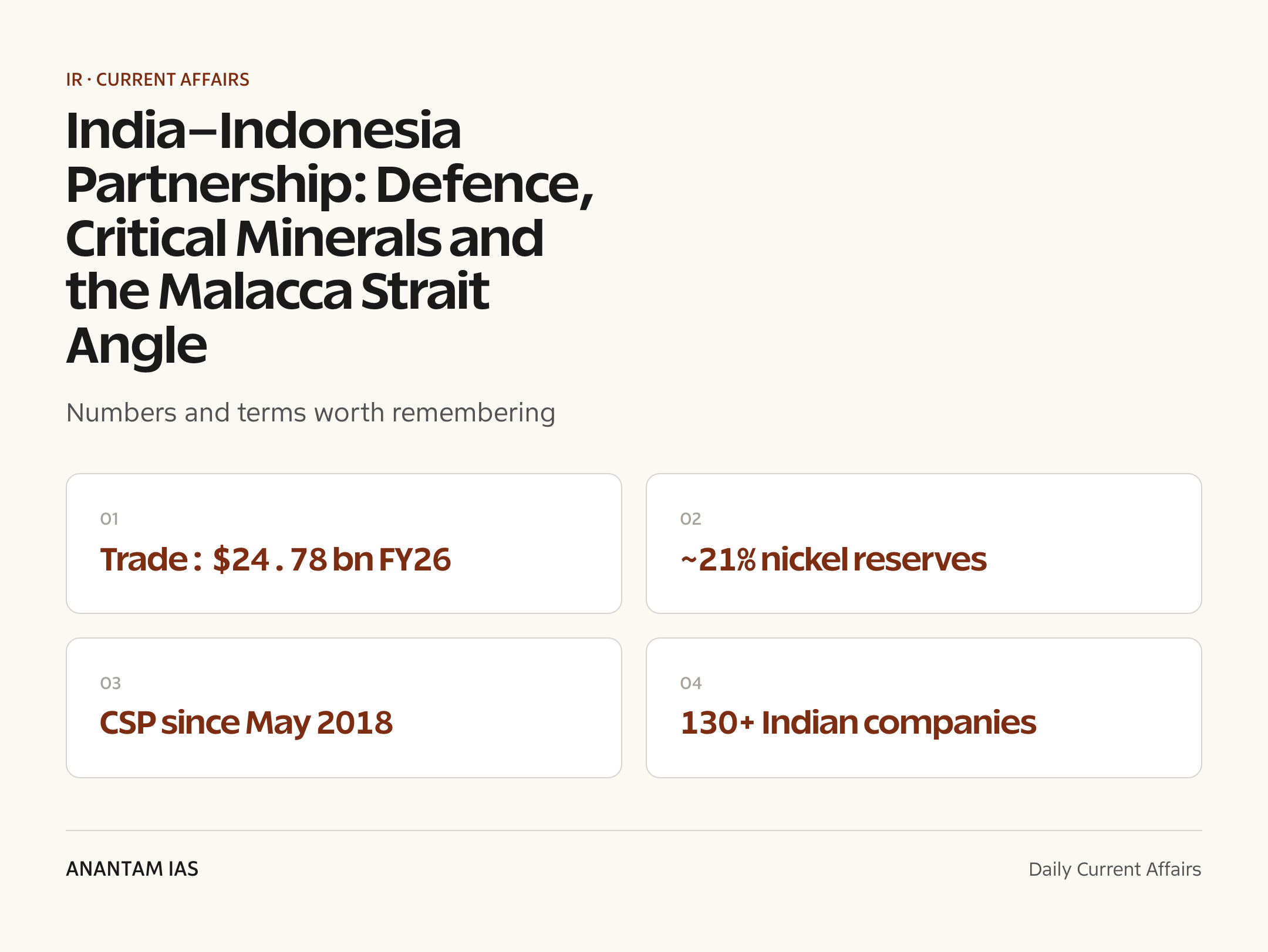
- Bilateral trade touched US$ 24.78 billion in 2025-26, making Indonesia India’s second-largest trading partner in ASEAN; over 130 Indian companies are invested there.
- Defence deliverables flagged by officials: defence-industry cooperation including the sale of BrahMos missiles, an Indonesian liaison officer at the Information Fusion Centre – Indian Ocean Region (IFC-IOR), and training slots at the NDA and Defence Services Staff College.
- Officials noted Indonesia commands roughly 21% of the world’s nickel reserves and ranks among the top producers of copper, bauxite and tin.
- The two leaders are set to visit the Prambanan temple complex at Yogyakarta; India will mark the centenary of Rabindranath Tagore’s Indonesia visit in 2027.
The development matters in the context of:
- Indonesia sits astride the Strait of Malacca; Observer Research Foundation studies estimate about 60% of India’s sea-borne trade transits this single chokepoint.
- Indonesian mineral processing is dominated by Chinese capital; Deccan Herald reported India is seeking a foothold in the nickel value chain to de-risk its clean-energy transition.
- The visit tests whether Act East rhetoric can convert civilisational goodwill into hard outcomes — defence sales, mineral access and maritime domain awareness.

UPSC Relevance
Prelims Relevance
- Comprehensive Strategic Partnership — India–Indonesia ties elevated in May 2018 during PM Modi’s Jakarta visit.
- MAHASAGAR — Mutual and Holistic Advancement for Security and Growth Across Regions; the upgrade of SAGAR (2015) announced at Mauritius in March 2025.
- IFC-IOR — Indian Navy’s maritime information hub at Gurugram (2018); Indonesia to station a liaison officer.
- Bilateral exercises — Garuda Shakti (army), Samudra Shakti (navy), IND-INDO CORPAT patrols since 2002.
- Strait of Malacca — links the Andaman Sea to the South China Sea between the Malay Peninsula and Sumatra; about 2.5 km at its narrowest.
- Sabang port (Aceh) — India gained development access in 2018 near the strait’s western approaches.
- Nickel — Indonesia holds ~21% of global reserves; key input for EV battery cathodes and stainless steel.
- National Critical Mineral Mission (2025) — Cabinet-approved with a ₹16,300-crore outlay; KABIL is India’s overseas mineral-acquisition JV.
- Prambanan — 9th-century Hindu temple complex (Trimurti) near Yogyakarta; a UNESCO World Heritage Site.
- Bandung Conference (1955) — Afro-Asian solidarity meet hosted by Indonesia; a precursor to the Non-Aligned Movement.
Mains Relevance
GS Paper 2
- India–Indonesia as the pivot of the Act East policy: how bilateral CSPs give substance to ASEAN centrality in India’s Indo-Pacific strategy.
- Defence diplomacy as statecraft — BrahMos exports, training slots and liaison postings as instruments of strategic trust-building.
- Comparative developmental visions: convergence of Viksit Bharat 2047 and Indonesia Emas 2045 as a template for South–South cooperation.
GS Paper 3
- Critical-mineral supply chains: de-risking nickel, copper and tin sourcing for India’s energy transition amid Chinese processing dominance.
- Maritime security of chokepoints: the Malacca Strait, the Andaman and Nicobar Islands and maritime domain awareness as internal-security multipliers.
Essay
- Geography is destiny: how straits and seas script the fates of nations.
- From Bandung to batteries: the reinvention of Asian solidarity in a multipolar world.
Background and Context
From Bandung to Comprehensive Strategic Partnership
India and Indonesia are old friends whose relationship has repeatedly reinvented itself.
- President Sukarno was the chief guest at India’s first Republic Day in 1950, and the two nations co-anchored the Bandung Conference of 1955 that seeded the Non-Aligned Movement.
- Ties were elevated to a Comprehensive Strategic Partnership during PM Modi’s Jakarta visit in May 2018, alongside the Shared Vision of India-Indonesia Maritime Cooperation in the Indo-Pacific.
- President Prabowo Subianto was chief guest at India’s 76th Republic Day in January 2025, signalling the personal investment of both leaderships.
- The current trip is Modi’s fourth visit to Indonesia but the first bilateral one since 2018; Bloomberg reported the two leaders were set to sign a defence pact plus agreements spanning education, health and technology.
- Officials see “strong synergies” between Viksit Bharat 2047 and Indonesia Emas (Golden Indonesia) 2045 — both target developed-economy status around their independence centenaries.
Defence Cooperation: BrahMos, Exercises and Training
Defence has moved from ceremonial exchanges to hardware, training and industrial partnership.
- Negotiations on the BrahMos supersonic cruise missile are at an advanced stage; Jakarta Globe and Indian media reports describe a proposed coastal-defence battery sale of roughly US$ 450 million, which Jakarta reportedly wants to scale up.
- A BrahMos sale would make Indonesia the second ASEAN buyer after the Philippines (2022) — consolidating India’s shift from arms importer to defence exporter.
- The armies exercise together in Garuda Shakti, the navies in Samudra Shakti, and both navies have run the IND-INDO CORPAT coordinated patrol near the Andaman Sea since 2002.
- India will earmark seats for Indonesian cadets at the National Defence Academy and Defence Services Staff College — long-horizon capacity building that shapes future military elites.
- An Indonesian liaison officer will join IFC-IOR, the Indian Navy’s Gurugram fusion centre set up in 2018, plugging Jakarta into India’s maritime domain awareness network.
The Maritime Geography: Why the Strait of Malacca Matters
Everything about this partnership ultimately routes through one narrow waterway.
- The Strait of Malacca runs between the Malay Peninsula and Sumatra, connecting the Andaman Sea (Indian Ocean) to the South China Sea (Pacific); it narrows to about 2.5 km at its tightest point.
- Observer Research Foundation studies estimate roughly 30% of global trade and about 60% of India’s sea-based trade pass through the strait; the US Energy Information Administration ranks it among the world’s biggest oil-transit chokepoints.
- India’s Great Nicobar Island lies only about 40 nautical miles (74 km) from the strait’s western approaches — the strategic logic behind the Andaman and Nicobar Command, India’s only tri-service theatre command, headquartered at Sri Vijaya Puram (formerly Port Blair).
- In 2018, Indonesia gave India access to develop the deep-sea port of Sabang in Aceh, at the strait’s northern mouth — a rare physical foothold at the chokepoint.
- China’s dependence on the same waterway — its “Malacca dilemma” — makes the strait a point where Indian, Chinese and ASEAN anxieties intersect; the Malacca Strait Patrol grouping (Indonesia, Malaysia, Singapore, Thailand) polices it, and India is not a member.
Critical Minerals: Nickel and the China Factor
The newest pillar of the relationship is dug out of Sulawesi’s mines.
- Indonesia holds roughly 21% of the world’s nickel reserves — the largest share of any country — and is a top producer of copper, bauxite and tin, all on India’s critical-minerals list.
- Nickel is indispensable for lithium-ion battery cathodes and stainless steel; India has minimal domestic supply, making imports a hard constraint on its EV and clean-energy targets.
- Deccan Herald reported that Indonesian nickel smelting is dominated by Chinese firms, so New Delhi is negotiating joint ventures and processing partnerships to enter the value chain rather than just buy ore.
- At home, the National Critical Mineral Mission (Cabinet-approved January 2025, ₹16,300-crore outlay) and KABIL — the NALCO–HCL–MECL overseas-assets JV — provide the institutional machinery for such deals.
- The Ministry of Mines’ 30-mineral critical list (2023) frames the demand side; Indonesia is the single most consequential partner for its battery-metals slice.
Trade, Food Security and Development Learning
The economic agenda pairs headline trade numbers with quieter policy exchange.
- Bilateral trade of US$ 24.78 billion in 2025-26 makes Indonesia India’s second-largest ASEAN trading partner, with over 130 Indian companies invested across sectors.
- Indonesian delegations have studied India’s Public Distribution System, fortified rice scheme and fertiliser-subsidy reforms; officials say Indonesia’s free nutritious meals initiative is modelled on India’s midday meal programme.
- The 7 July talks also cover food security and the digital economy — areas where India exports governance templates, not just goods.
- A deeper India–ASEAN economic relationship, including the review of the ASEAN–India Trade in Goods Agreement (AITIGA), gives the bilateral push regional scaffolding.
The Civilisational Connect
Culture is the oldest, and still the most disarming, bridge between the two nations.
- Modi and Prabowo are set to visit Prambanan, the 9th-century Trimurti temple complex near Yogyakarta and a UNESCO World Heritage Site; Indonesia also hosts Borobudur, the world’s largest Buddhist monument.
- The Ramayana and Mahabharata live on in Javanese and Balinese performance, and Indonesia’s national emblem is the Garuda — testimony to centuries of Indic exchange.
- Odisha’s Bali Jatra festival commemorates the Kalinga mariners who sailed to the Indonesian archipelago — the maritime link the modern partnership consciously invokes.
- India will mark the centenary of Rabindranath Tagore’s visit to Indonesia in 2027; Indonesia remains the world’s largest Muslim-population country with a syncretic Hindu-Buddhist heritage.
Way Forward
Consolidate the security partnership
- Close the BrahMos contract and deliver on time — credibility as a defence exporter is built on execution, not announcements.
- Operationalise the IFC-IOR liaison into real-time shipping-data exchange, and expand CORPAT into joint exercises with wider ASEAN participation.
- Invest visibly in Sabang and Andaman and Nicobar infrastructure so geography translates into presence at the Malacca approaches.
Build the minerals bridge
- Negotiate a government-to-government critical-minerals framework covering nickel, copper, bauxite and tin, with KABIL and private players taking equity in mining and processing.
- Prioritise midstream processing partnerships — refining and precursor production — over ore imports, to capture value and cut dependence on any single country’s smelters.
- Use the AITIGA review and the Viksit Bharat 2047–Indonesia Emas 2045 synergy to anchor mineral ties in a broader, balanced trade relationship.
Conclusion
The Jakarta leg of this tour shows India’s Indonesia policy graduating from symbolism to substance. A BrahMos sale, a liaison officer inside India’s maritime nerve-centre and NDA training pipelines are the unglamorous, compounding investments that turn a Comprehensive Strategic Partnership from a communiqué phrase into working strategy.
The stakes are structural. The country that co-owns the Malacca chokepoint also holds a fifth of the world’s nickel — the metal on which India’s EV and clean-energy ambitions depend. Few relationships map so neatly onto both of India’s core vulnerabilities: sea-lane security and mineral supply.
For the exam, anchor this visit to the durable frames — Act East, MAHASAGAR, ASEAN centrality and critical-mineral supply chains — because the news will fade, but the geography and the geology will not.
UPSC Practice Questions
Prelims MCQ 1
With reference to the Strait of Malacca, consider the following statements:
- It connects the Andaman Sea with the South China Sea.
- India is a member of the Malacca Strait Patrol grouping that polices the strait.
- India’s Great Nicobar Island lies about 40 nautical miles from the strait’s western approaches.
How many of the above statements are correct?
(a) Only one (b) Only two (c) All three (d) None
Answer: (b) Only two
Explanation:
Statements 1 and 3 are correct. Statement 2 is incorrect — the Malacca Strait Patrol comprises Indonesia, Malaysia, Singapore and Thailand; India is not a member.
Prelims MCQ 2
Indonesia, a key partner in India’s critical-mineral diplomacy, holds roughly 21% of the world’s reserves of which one of the following minerals?
(a) Lithium (b) Nickel (c) Cobalt (d) Graphite
Answer: (b) Nickel
Explanation:
Indonesia commands about 21% of global nickel reserves — the world’s largest share — and is a leading producer of copper, bauxite and tin. Nickel is critical for lithium-ion battery cathodes, which is why it anchors the India–Indonesia minerals agenda.
UPSC Mains Questions
- “India–Indonesia relations have moved from civilisational familiarity to strategic necessity.” Discuss in the light of the defence, maritime and critical-mineral dimensions of the Comprehensive Strategic Partnership under India’s Act East policy.
- The Strait of Malacca is as central to India’s security calculus as it is to its trade. Examine the role of the Andaman and Nicobar Islands and of partnerships with littoral states such as Indonesia in securing this chokepoint.
- Critical-mineral supply chains have become the new theatre of geoeconomic competition. Evaluate how mineral partnerships with resource-rich states like Indonesia can de-risk India’s clean-energy transition, and identify the institutional mechanisms India has built for this.
Sources: The Indian Express and The Hindu.
Frequently Asked Questions
Why is PM Modi’s 2026 Indonesia visit significant?
It is his first bilateral visit to Indonesia since ties were raised to a Comprehensive Strategic Partnership in May 2018, and the opening leg of a July 6–11 three-nation tour. The agenda spans a BrahMos sale, an Indonesian liaison officer at IFC-IOR, critical-mineral joint ventures, food security and the digital economy.
What is the India–Indonesia Comprehensive Strategic Partnership?
It is the highest tier of bilateral engagement, adopted in May 2018 during PM Modi’s Jakarta visit alongside a Shared Vision of Maritime Cooperation in the Indo-Pacific. It frames cooperation across defence, maritime security, trade, connectivity and culture — from BrahMos talks to nickel diplomacy.
Why does India want Indonesian nickel?
Indonesia holds about 21% of global nickel reserves, the world’s largest share, while India has negligible domestic supply. Nickel is essential for lithium-ion battery cathodes and stainless steel. Since Chinese firms dominate Indonesian smelting, India is negotiating joint ventures so its EV and clean-energy plans are not hostage to one country’s processors.
Why is the Strait of Malacca important for India?
The strait between the Malay Peninsula and Sumatra is the shortest route linking the Indian Ocean to East Asia. Research estimates suggest around 60% of India’s sea-borne trade transits it, and Great Nicobar lies about 40 nautical miles away. Partnership with Indonesia, its largest littoral state, directly serves India’s economic and naval security.
What is the MAHASAGAR vision?
MAHASAGAR — Mutual and Holistic Advancement for Security and Growth Across Regions — is India’s upgraded maritime doctrine announced at Mauritius in March 2025. It widens the SAGAR (2015) framework from the Indian Ocean neighbourhood to the broader Indo-Pacific, stressing security cooperation, capacity building and development partnership.
Which military exercises do India and Indonesia conduct?
The armies hold Garuda Shakti and the navies Samudra Shakti. Since 2002 the two navies have also run IND-INDO CORPAT, coordinated patrols along their maritime boundary near the Andaman Sea. India is now adding training slots for Indonesian cadets at the National Defence Academy and Defence Services Staff College.
Source: https://anantamias.com/current-affairs/india-indonesia-defence-critical-minerals-partnership/
Heatwave Deaths in India: Why the Official Count Misses the Real Toll
Why in News?
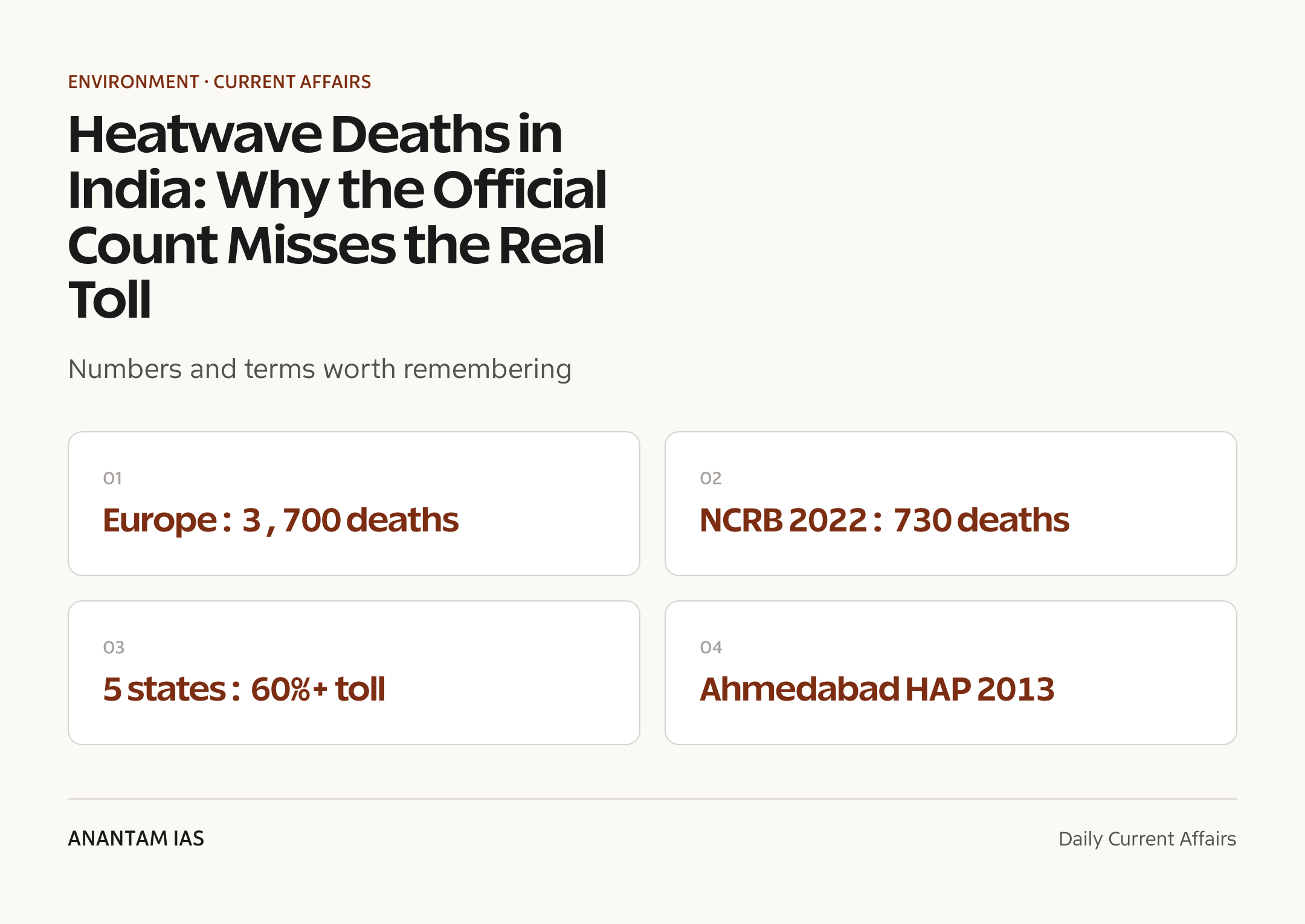
Europe has just lived through its deadliest June heatwave: between June 20 and 28, 2026, France, Belgium and the Netherlands together recorded about 3,700 excess deaths, with power supplies disrupted and hospitals overwhelmed. Scientists attributed the extreme heat almost entirely to climate change. The United States, in the grip of a heat dome, reported at least 25 deaths over the Fourth of July weekend, with more than 20 states crossing 38°C.
Experts writing in The Indian Express’s Explained section (July 7) drew the uncomfortable comparison with India — where heatwaves are more frequent, last longer and expose hundreds of millions of people each year, yet there is still no comprehensive system to measure heat-related mortality. The official count captures only certified heatstroke deaths, leaving the true human cost of rising temperatures largely unknown.
- Europe estimates excess deaths during heat events within days; India has no comparable near-real-time mortality surveillance.
- India’s official data counts only heatstroke deaths, not the far larger category of heat-related deaths triggered by cardiac, renal and respiratory failure.
- The NCRB’s Accidental Deaths and Suicides in India (ADSI) series recorded just 730 heat/sun-stroke deaths for 2022 — a figure researchers treat as a floor, not the toll.
- Official series exclude undigitised records and the private health sector, which delivers nearly two-thirds of all inpatient care.
- A 2026 mortality study found five states — Uttar Pradesh, Bihar, Madhya Pradesh, Rajasthan and Gujarat — account for over 60% of estimated heatwave deaths.
The development matters in the context of:
- Undercounting is not a statistical quibble: mortality data drives Heat Action Plan design, compensation, and the case for treating heat as a notified disaster.
- With climate change making heatwaves longer and more intense, measurement is core adaptation infrastructure — you cannot manage what you refuse to count.
- The issue knits together GS3 disaster management, GS2 public health and the political economy of informal-sector work — a ready case study for Mains.
UPSC Relevance
Prelims Relevance
- IMD heatwave criteria — maximum temperature at least 40°C in the plains, 37°C on the coast, 30°C in the hills, with a departure of 4.5–6.4°C from normal (severe heatwave: above 6.4°C); declared when met at 2+ stations in a meteorological sub-division for 2 consecutive days.
- Actual-temperature route: maximum of 45°C or more is a heatwave; 47°C or more is a severe heatwave, irrespective of departure.
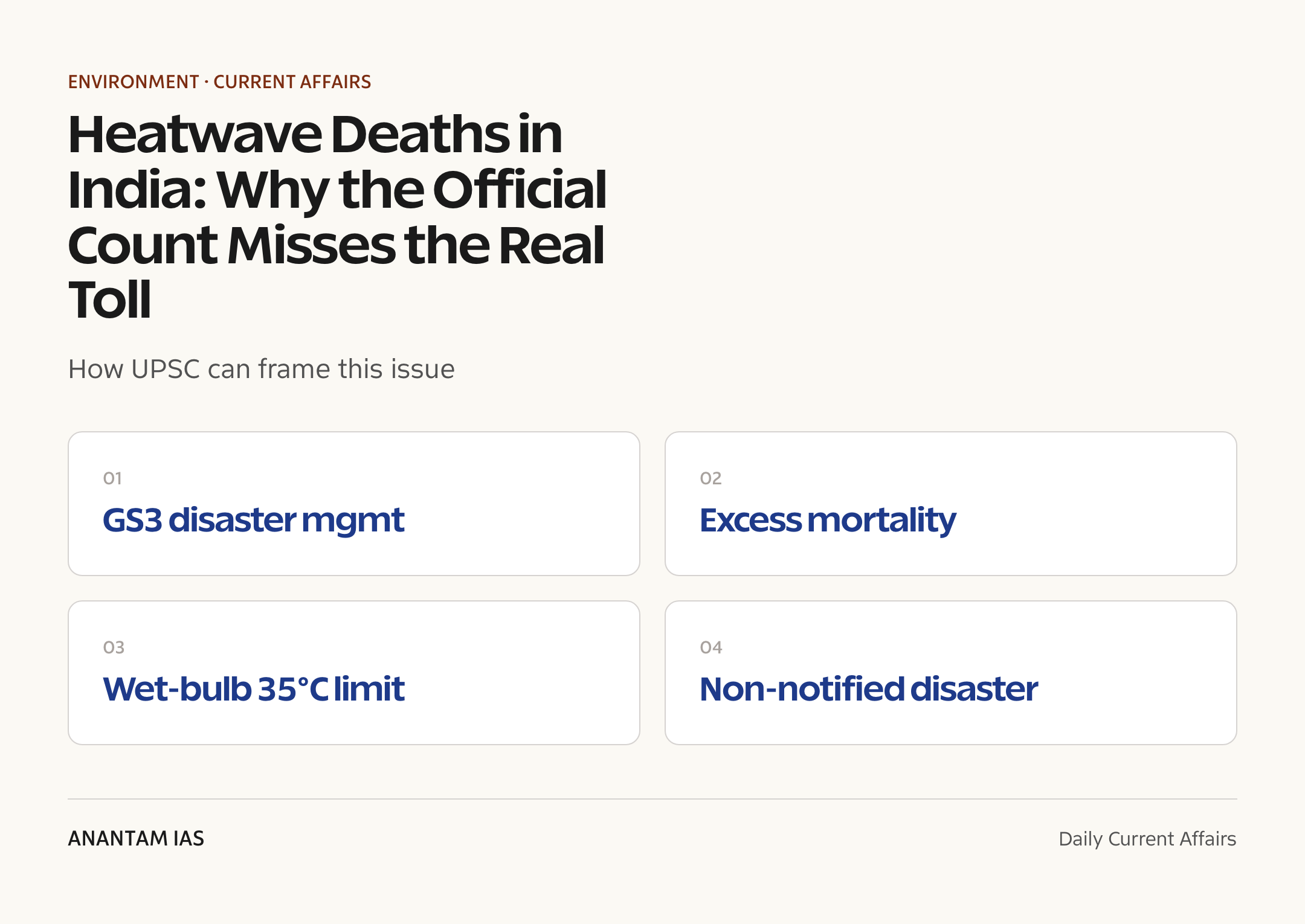
- Wet-bulb temperature combines heat and humidity; prolonged exposure above 35°C wet-bulb can be fatal even for healthy, acclimatised people, since sweat cannot evaporate.
- Excess mortality — observed all-cause deaths during an event minus the baseline expected from historical trends; captures indirect deaths that death certificates miss.
- NCRB ADSI is the official series recording deaths by ‘heat/sun stroke’ — 730 deaths in 2022; NDMA and Ministry of Earth Sciences counts differ widely, a documented data discrepancy.
- Heatwave is NOT among the 12 notified disasters under SDRF/NDRF norms (cyclone, drought, earthquake, fire, flood, tsunami, hailstorm, landslide, avalanche, cloudburst, pest attack, frost and cold wave) — cold wave is in, heat is out.
- States may spend up to 10% of their SDRF allocation on state-notified ‘local disasters’ — the window some states use for heatwave ex gratia.
- Ahmedabad Heat Action Plan (2013) — South Asia’s first HAP; an evaluation credits it with avoiding 1,000+ deaths a year.
- NDMA guidelines for prevention and management of heat wave (2016, updated 2019) anchor state and city HAPs.
- Short-lived climate pollutants (SLCPs) — black carbon, methane, tropospheric ozone, HFCs; a UNEP–WMO assessment found global SLCP action could avoid about 0.5°C of warming by 2050.
Mains Relevance
GS Paper 3
- Disaster management by data: how a heatstroke-only definition, undigitised records and excluded private hospitals cripple evidence-based heat governance.
- Heat as a test of climate adaptation: Heat Action Plans, urban heat islands, cool roofs, and why alerts without enforceable on-ground action fail wage-dependent workers.
- The notified-disaster question: SDRF/NDRF architecture, the 10% local-disaster window, and the fiscal case for treating heat as a standing public-health threat.
- SLCP mitigation (black carbon, refrigerants) as the bridge between mitigation and adaptation — cooling the planet within years, not centuries.
GS Paper 2
- Health-system weakness as governance failure: death certification and registration gaps, and the case for integrating private-sector data into public surveillance.
- Protecting vulnerable sections: outdoor and informal workers with no paid sick leave, and instruments like SEWA’s parametric heat insurance.
Essay
- What gets measured gets managed — the invisible deaths of a warming India.
- Climate adaptation is ultimately a public-health project, not an engineering one.
Background and Context
Why the official count misses most heat deaths
The undercount is structural — it follows directly from how deaths are certified and collated in India.
- Heat is treated as a contributing factor, not a cause: when extreme heat strains a weak heart, the death certificate records a heart attack. Heat rarely appears on the certificate at all.
- Official data counts only heatstroke — the direct, clinically certified death — and not the broader category of heat-related deaths from cardiac, kidney and respiratory failure that heat silently triggers in people with co-morbidities.
- The count excludes undigitised records and the entire private health sector, which delivers nearly two-thirds of all inpatient care in India.
- Sources are fragmented, each with its own definition: the NCRB, the India Meteorological Department and state relief departments routinely publish divergent heat-death numbers for the same year.
- NCRB’s ADSI report recorded 730 heat/sun-stroke deaths in 2022 — while excess-mortality research suggests actual heat-attributable deaths in bad years run far higher. The gap is the story.
Excess mortality: the method India lacks
Europe’s 3,700 figure was possible because of a counting method India has never institutionalised.
- Excess mortality compares total observed deaths during a heat episode with the baseline expected from historical data for the same period; the difference is attributed to the event.
- The method captures indirect deaths — heart attacks, strokes, kidney failure — that certificate-based counting misses, which is why it typically yields tolls several times the official one.
- European public-health agencies run near-real-time death surveillance, letting them publish credible estimates within days of a heatwave.
- India’s Civil Registration System and medical certification of cause of death remain incomplete, so daily all-cause mortality cannot yet be matched against daily temperature.
- The Indian Express experts note that juxtaposing heat-related deaths with the day’s temperature would give policymakers the evidence base to design tailor-made heat-management solutions — the missing first step.
The science: IMD criteria, wet-bulb heat and city heat traps
The metrics that decide when heat turns lethal are precise — and worth memorising.
- The India Meteorological Department declares a heatwave when the maximum reaches 40°C in the plains (37°C coast, 30°C hills) with a departure of 4.5–6.4°C from normal — above 6.4°C it is a severe heatwave. An actual maximum of 45°C (or 47°C for severe) qualifies on its own. The criteria must hold at two stations in a sub-division for two consecutive days; details in this site’s explainer on the heat wave in India.
- Absolute temperature understates danger — which is why forecasts report a ‘feels like’ temperature. The key variable is wet-bulb temperature, which tracks humidity alongside heat.
- Sweat must evaporate to cool the body; humidity blocks evaporation. So the same 38°C is far deadlier on a humid coast than in dry Rajasthan. Prolonged exposure above a 35°C wet-bulb reading can kill even fit, acclimatised people.
- Indians are adapted, not biologically evolved, to heat: ventilated architecture, coolers, fans and clay matkas evolved around a hot climate. Europe never built for heat, which is why its heatwaves prove so deadly — but India’s adaptation buffer erodes as thresholds climb.
- Cities add the urban heat island penalty: concrete, waste heat and lost tree cover keep nights warm and deny the body recovery time — the governance angle covered in heat as an urban governance test.
Who bears the risk: the geography and sociology of heat death
Heat mortality is not randomly distributed — it maps onto work, age and poverty.
- The most exposed are outdoor workers: farmers, construction labourers, street vendors and delivery riders, who face the sun for a living.
- Most of them are in the informal sector — no paid sick leave, no shade norms, no cover under formal protection measures. Unable to afford a lost day’s wage, they work through red alerts.
- Research flags infants, the elderly, pregnant women and people with chronic illness as the other high-risk demographics.
- Geography concentrates the danger: a 2026 mortality study found Uttar Pradesh, Bihar, Madhya Pradesh, Rajasthan and Gujarat account for more than 60% of estimated heatwave deaths.
- Poverty runs through all of it — those who cannot afford cooling or rest carry the greatest risk, which makes heat mortality an inequality indicator as much as a weather statistic.
The policy stack: NDMA guidelines, HAPs and heat insurance
India’s heat governance toolkit exists and works where implemented — the gaps are coverage, money and enforcement.
- The NDMA issued national guidelines for the prevention and management of heat wave in 2016 (updated 2019), anchoring state, district and city Heat Action Plans (HAPs) across heat-prone states.
- HAPs bundle early-warning colour alerts, cooling centres and water points, public-awareness drives, and adjusted hours for outdoor work and schools.
- The template is the Ahmedabad HAP, piloted in 2013 — South Asia’s first. An evaluation estimated it avoids 1,000+ deaths a year, at modest cost.
- But a widely cited Centre for Policy Research assessment of 37 HAPs found most lack local vulnerability mapping, dedicated funding and any legal mandate — plans on paper, not in the field.
- New instruments are emerging: SEWA’s parametric heat insurance pays women workers part of their lost wages when temperature crosses a threshold for three consecutive days — covering 50,000 women across 22 districts.
- The biggest gap is implementation: a heat alert that reaches a labourer who cannot afford to stop working protects nobody. Alerts must trigger mandatory on-ground action — rescheduled work, rest, shade and water.
A disaster that isn't: heat outside the notified list
India’s disaster-finance architecture still treats heat as a seasonal nuisance rather than a killer.
- SDRF/NDRF norms recognise 12 notified disasters — cyclone, drought, earthquake, fire, flood, tsunami, hailstorm, landslide, avalanche, cloudburst, pest attack, and frost and cold wave. Cold wave is in; heatwave is out.
- Non-notified status keeps heat outside dedicated relief funding — no automatic ex gratia for families, no earmarked response money, unlike floods and cyclones.
- The partial workaround: states may spend up to 10% of their SDRF on ‘local disasters’ they notify themselves, and several heat-prone states have used this window for heatwave relief.
- Successive Finance Commissions have kept the national list unchanged, even as heat exposure has grown — the institutional design question examined in this site’s guide to disaster management for GS3.
- Undercounting and non-notification feed each other in a loop: low official tolls weaken the case for notification, and non-notification removes the incentive to count deaths properly.
Way Forward
Count honestly
- Widen the definition from heatstroke-only to heat-related mortality, with clear clinical protocols for certifying heat as a contributing cause.
- Digitise death records and pull the private sector — two-thirds of inpatient care — into a single mortality surveillance system.
- Build an Indian excess-mortality system that matches daily all-cause deaths against daily temperature, giving HAPs a real evidence base.
Protect the exposed
- Convert alerts into enforceable triggers: mandatory rescheduling of outdoor work, rest breaks, shade and water at worksites on red-alert days.
- Scale parametric heat insurance and wage-protection schemes so informal workers can afford to stop working when it is dangerous.
- Treat heat as a standing public-health threat in disaster finance — either notify it nationally or standardise the SDRF local-disaster route with clear ex gratia norms.
- Cool cities structurally: trees, shade and reflective ‘cool’ roofs, prioritising informal settlements that trap the most night-time heat.
Cut the fast climate levers
- Act on short-lived climate pollutants — black carbon and HFC refrigerants — which warm intensely but briefly, so cuts slow warming within years, not centuries.
- A UNEP–WMO assessment found global SLCP action could avoid about 0.5°C of warming by 2050 — preventing millions of heat-related deaths.
- Push climate-friendly refrigerants and sustainable cooling access under the India Cooling Action Plan, treating cooling as a development need, not a luxury.
Conclusion
Europe’s 3,700 excess deaths in nine days made headlines because Europe counted them. India’s heat toll stays out of the headlines for the opposite reason: a heatstroke-only definition, paper records and an excluded private sector keep most heat deaths invisible. Invisible deaths buy no funding, notify no disasters and reform no labour norms.
The fixes are unglamorous — better death certification, digitised registries, an excess-mortality baseline — but they are the foundation on which every Heat Action Plan, insurance product and cool-roof programme must stand. As climate change loads the dice toward longer, wetter, hotter heatwaves, counting the dead honestly is the first act of protecting the living.
UPSC Practice Questions
Prelims MCQ 1
With reference to heatwaves in India, consider the following statements:
- The India Meteorological Department considers a heatwave in the plains only when the maximum temperature reaches at least 40°C.
- A departure of more than 6.4°C from the normal maximum temperature qualifies as a severe heat wave.
- Heatwave is one of the notified disasters eligible for relief under the national SDRF/NDRF norms.
How many of the above statements are correct?
(a) Only one (b) Only two (c) All three (d) None
Answer: (b) Only two
Explanation:
Statements 1 and 2 are correct: IMD’s plains threshold is 40°C (37°C coastal, 30°C hilly), with a 4.5–6.4°C departure marking a heatwave and above 6.4°C a severe heatwave. Statement 3 is incorrect — heatwave is not among the 12 notified disasters (frost and cold wave are included, heat is not); states can only use the 10% SDRF local-disaster window.
Prelims MCQ 2
Which one of the following best describes the ‘excess mortality’ method of estimating heatwave deaths?
(a) Counting only deaths clinically certified as heatstroke in government hospitals (b) Comparing total observed deaths during a heat event with the baseline expected from historical data, capturing indirect deaths (c) Multiplying the number of heatwave days by a fixed mortality coefficient set by WHO (d) Surveying households in affected districts after the heatwave ends
Answer: (b) Comparing total observed deaths during a heat event with the baseline expected from historical data, capturing indirect deaths
Explanation:
Excess mortality measures the gap between all-cause deaths observed during an event and the historical baseline for the same period. It captures indirect deaths — cardiac, renal, respiratory — that heat triggers but death certificates attribute to other causes, which is why it usually far exceeds the official heatstroke count.
UPSC Mains Questions
- India’s official heatwave mortality data captures only a fraction of actual deaths. Examine the structural reasons for this undercounting and discuss how an excess-mortality surveillance system would strengthen heat governance and Heat Action Plans.
- Heat Action Plans have proven effective where implemented, yet heatwave remains outside India’s list of notified disasters. Critically evaluate the institutional and financial architecture for heatwave management and suggest reforms to protect outdoor and informal workers.
- “Cutting short-lived climate pollutants is the fastest lever against heat mortality.” Discuss the role of SLCP mitigation, urban cooling and adaptive infrastructure in reducing India’s heat-related deaths.
Sources: NDMA, Heat Wave and Indian Express Explained.
Frequently Asked Questions
Why are India’s heatwave deaths undercounted?
Heat is treated as a contributing factor, not a cause, so it rarely appears on death certificates. Official data counts only certified heatstroke deaths, excludes undigitised records, and leaves out the private sector, which delivers nearly two-thirds of inpatient care. Fragmented agencies also use different definitions, producing widely divergent numbers.
What is excess mortality?
Excess mortality compares total deaths observed during an event with the baseline expected from historical data; the difference is attributed to the event. It captures indirect deaths — heart attacks, strokes, kidney failure triggered by heat — which is how Europe estimated about 3,700 deaths in the June 2026 heatwave within days.
How does IMD define a heatwave?
IMD declares a heatwave when the maximum temperature reaches 40°C in the plains (37°C coastal, 30°C hilly) with a 4.5–6.4°C departure from normal; above 6.4°C it is severe. An actual maximum of 45°C (47°C for severe) also qualifies. Criteria must hold at two stations for two consecutive days.
Is heatwave a notified disaster in India?
No. The 12 notified disasters under SDRF/NDRF norms include frost and cold wave but not heat. So heat deaths attract no automatic relief funding or ex gratia. States can, however, notify heatwave as a local disaster and spend up to 10% of their SDRF allocation on it.
What are Heat Action Plans and do they work?
Heat Action Plans bundle early-warning alerts, cooling centres, water points, awareness drives and adjusted work and school hours. Ahmedabad’s 2013 plan — South Asia’s first — is estimated to avoid over 1,000 deaths a year. But assessments find most HAPs lack local vulnerability mapping, dedicated funding and legal enforcement.
Which groups face the highest heat-death risk?
Outdoor workers — farmers, construction labourers, street vendors, delivery riders — mostly informal, with no paid sick leave. Infants, the elderly, pregnant women and the chronically ill are also high-risk. A 2026 study found Uttar Pradesh, Bihar, Madhya Pradesh, Rajasthan and Gujarat account for over 60% of estimated heatwave deaths.
Source: https://anantamias.com/current-affairs/india-heatwave-deaths-undercounting-climate/
INS Mahendragiri: Sixth Project 17A Stealth Frigate Set for Commissioning
Why in News?
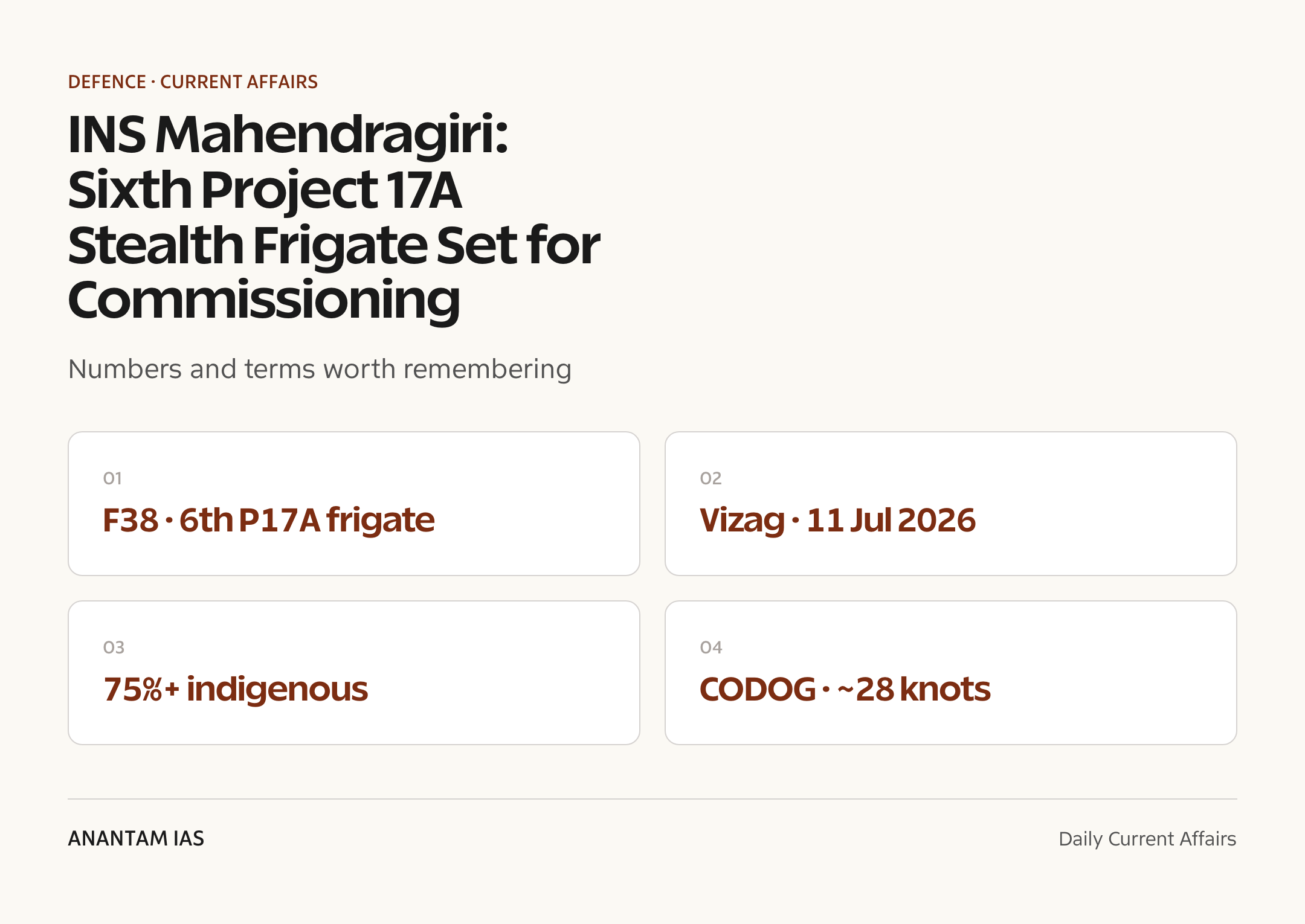
The Indian Navy will commission Mahendragiri (F38), the sixth Project 17A indigenous stealth frigate, at Visakhapatnam on 11 July 2026. PIB confirmed the schedule in a Ministry of Defence release on 6 July 2026.
The frigate was designed in-house by the Navy’s Warship Design Bureau (WDB) and built by Mazagon Dock Shipbuilders Limited (MDL), Mumbai, with over 75 per cent indigenous content — a working example of Aatmanirbhar Bharat in warship building. Her motto: ‘Mighty–Majestic–Matchless’.
- Sixth of seven Project 17A (Nilgiri-class) frigates to enter service; commissioning venue is Naval Dockyard, Visakhapatnam.
- Named after the Mahendragiri peak in the Eastern Ghats (Gajapati district, Odisha); PIB notes she is the first Indian naval warship to carry the name.
- Launched at MDL’s Mumbai yard in September 2023; now delivered as a mission-primed unit ready for fleet duties.
- Powered by a Combined Diesel or Gas (CODOG) propulsion package for high-speed sprints with long endurance.
- Carries surface-to-surface and surface-to-air missiles, anti-submarine warfare (ASW) systems, electronic warfare suites and an integrated Combat Management System.
The development matters in the context of:
- Project 17A is the largest single class of frigates India has built at home — a barometer of the defence industrial base that GS3 repeatedly tests.
- The commissioning strengthens the Navy’s pitch as the ‘Preferred Security Partner’ in the Indian Ocean Region at a time of contested Indo-Pacific waters.
- With five sisters already in service by mid-2026, the class shows what assembly-line warship building across two public shipyards can deliver.

UPSC Relevance
Prelims Relevance
- INS Mahendragiri (F38) — sixth Project 17A stealth frigate; commissioning at Visakhapatnam, 11 July 2026.
- Project 17A — seven stealth frigates; follow-on of Project 17 (Shivalik-class); four built at MDL Mumbai, three at GRSE Kolkata.
- Designer: Warship Design Bureau (WDB) — the Indian Navy’s in-house design organisation.
- CODOG (Combined Diesel or Gas) — diesel engines for economical cruise, gas turbines for high-speed dashes; the ship uses one or the other, not both together.
- Indigenous content: over 75 per cent, with a large MSME supplier base.
- Name source: Mahendragiri peak, Eastern Ghats, Odisha — Nilgiri-class ships are named after Indian hill ranges.
- Roles: anti-air, anti-surface and anti-submarine operations plus HADR, SAR and presence missions.
- Class in service (mid-2026): Nilgiri, Himgiri, Udaygiri, Taragiri, Dunagiri; Vindhyagiri is the seventh and last.
Mains Relevance
GS Paper 3
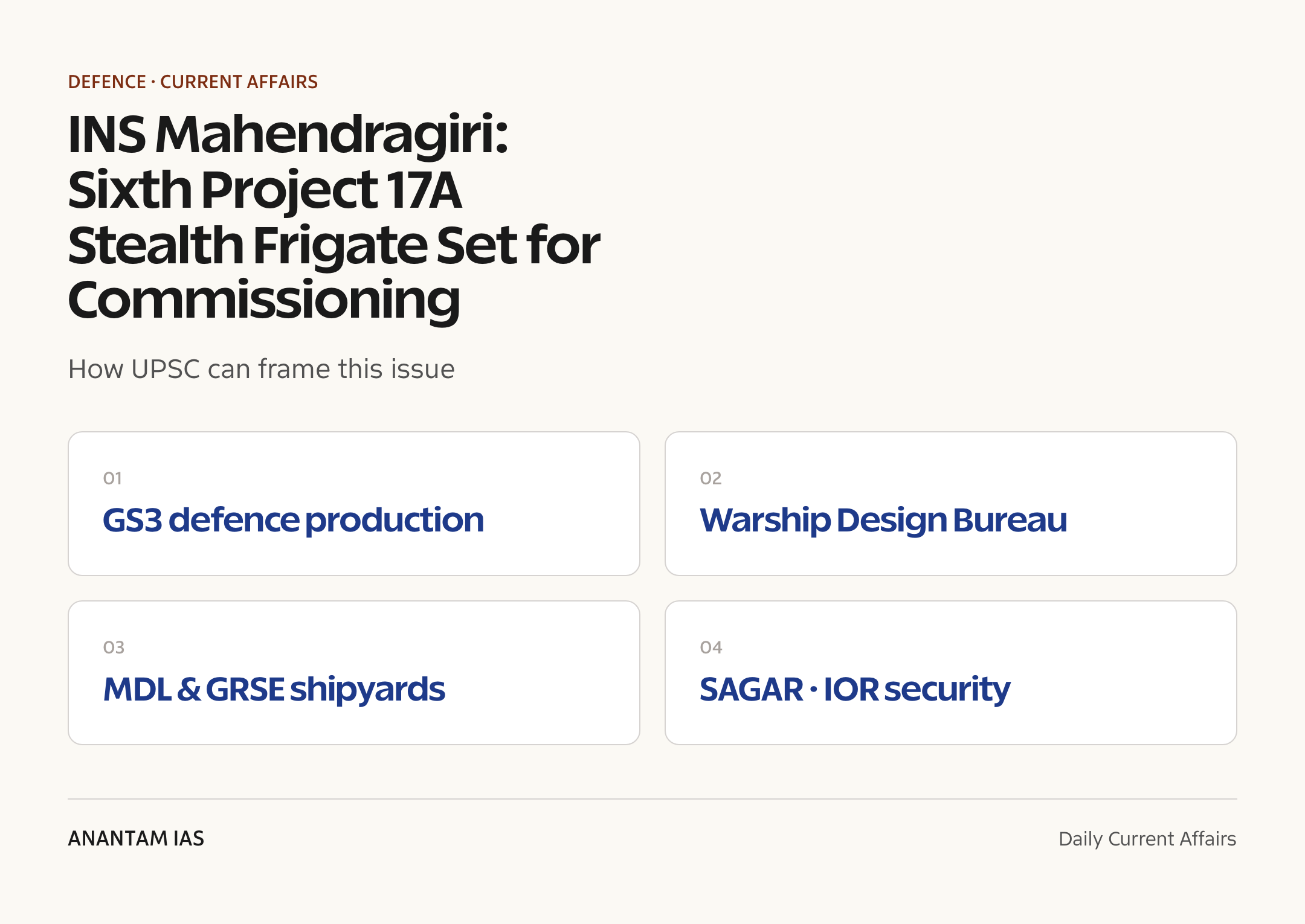
- Indigenisation of defence production — Project 17A as a case study of design (WDB), build (MDL/GRSE) and supply chain (MSMEs) all being domestic.
- Maritime security and the Navy’s role in securing sea lanes, EEZ and the Indian Ocean Region.
- Public-sector shipyard capacity, modular construction and the economics of a ₹45,000-crore-scale warship programme.
GS Paper 2
- India as ‘Preferred Security Partner’ — naval capability as an instrument of foreign policy under SAGAR/MAHASAGAR.
- Government policy design: Aatmanirbhar Bharat in strategic sectors and its institutional levers.
Essay
- Self-reliance is built ship by ship: technology sovereignty as national power.
- The ocean is the new strategic frontier — sea power and India’s rise.
Background and Context
Project 17A: the programme at a glance
Project 17A is India’s largest indigenous frigate programme, conceived as a stealthier, more automated follow-on to the Shivalik class.
- Seven stealth frigates sanctioned as a follow-on of Project 17 (Shivalik-class), whose three ships were commissioned between 2010 and 2012.
- Contracts were placed in 2015: four ships with Mazagon Dock Shipbuilders Limited (MDL), Mumbai, and three with Garden Reach Shipbuilders & Engineers (GRSE), Kolkata, at a reported programme outlay of about ₹45,000 crore.
- The class uses integrated (modular) construction — hull blocks pre-fitted with equipment before assembly — cutting build time at the slipway.
- Ships are named after Indian hill ranges: Nilgiri, Himgiri, Udaygiri, Taragiri, Dunagiri, Vindhyagiri and Mahendragiri. Six names revive the original Leander-based Nilgiri-class frigates of the 1970s–80s; Mahendragiri is the one all-new name in the family.
- For a wider fleet picture — destroyers, frigates and corvettes — see this primer on the warships of India.
The commissioning ladder so far
Five sisters have joined the fleet since January 2025, making the class a study in serial warship production.
- INS Nilgiri, the lead ship (MDL), was commissioned at Mumbai on 15 January 2025 — part of a triple commissioning with the destroyer INS Surat and submarine INS Vaghsheer.
- INS Himgiri (first GRSE-built ship of the class) and INS Udaygiri (MDL) were commissioned together at Visakhapatnam in August 2025 — the first twin commissioning of frontline combatants built at two different shipyards.
- INS Taragiri (F41), delivered in November 2025, was commissioned at Visakhapatnam on 3 April 2026.
- INS Dunagiri (GRSE) was delivered in March 2026 and commissioned at Kolkata in June 2026, alongside the survey vessel Sanshodhak and the anti-submarine craft Agray.
- Mahendragiri follows on 11 July 2026; only Vindhyagiri — launched at GRSE by President Droupadi Murmu in August 2023 — remains to complete the seven-ship class.
What makes Mahendragiri a stealth frigate
Stealth here means shrinking the ship’s signatures — radar, infrared, acoustic — so she is harder to detect, track and target.
- PIB highlights reduced radar signature, enhanced survivability and a high degree of automation that lowers crewing needs.
- Propulsion is CODOG — diesels for fuel-efficient patrol, gas turbines for combat sprints — giving both endurance and speed across mission profiles.
- The class measures about 149 metres and displaces roughly 6,670 tonnes, with a top speed near 28 knots, per official descriptions of earlier sister ships.
- Weapons and sensors include surface-to-surface and surface-to-air missile systems, comprehensive ASW systems, sophisticated electronic warfare capability and an integrated Combat Management System.
- Mission set spans anti-air, anti-surface and anti-submarine operations, maritime security, power projection, HADR, search and rescue, and sustained presence deployments.
The institutional engine: WDB, MDL and GRSE
The programme’s real story is institutional — an in-house design bureau feeding two public shipyards working in parallel.
- The Warship Design Bureau (WDB), the Navy’s in-house design organisation, designed the class end-to-end; PIB noted at Udaygiri’s delivery in July 2025 that she was the 100th ship of the Bureau’s design lineage.
- MDL (Mumbai) and GRSE (Kolkata) are Defence Public Sector Undertakings; splitting one class across two yards built parallel capacity and let both learn the same modern construction methods.
- The twin commissioning of August 2025 — two frontline frigates from two different yards on one day — showcased that parallel-build model.
- Owning the design means refits, upgrades and follow-on classes don’t depend on a foreign design house — a quieter but strategic form of self-reliance.
Indigenisation and the defence industrial base
Mahendragiri is as much an industrial-policy artefact as a warship.
- Over 75 per cent indigenous content, with construction drawing in a large network of Indian firms, including numerous MSMEs, generating employment while deepening the defence industrial base — PIB frames this squarely within Aatmanirbhar Bharat.
- Warship building has among the longest domestic value chains in defence — steel, propulsion auxiliaries, sensors, cabling, combat software — so each hull multiplies orders across the economy.
- The wider policy stack supports this: positive indigenisation lists, licence and FDI liberalisation, and innovation pipelines like iDEX.
- Gaps persist: gas turbines and some high-end sensors remain of foreign origin or licence-built, keeping full propulsion sovereignty on the to-do list.
- For the broader production picture — initiatives, prospects and challenges — see defence manufacturing in India.
Maritime security: SAGAR, IOR and the Indo-Pacific
New frigates are instruments of policy, not just platforms of war.
- PIB links the commissioning to India’s role as the ‘Preferred Security Partner’ in the Indian Ocean Region and to a secure, stable Indo-Pacific.
- The doctrinal anchor is SAGAR (Security and Growth for All in the Region, 2015), broadened in 2025 into MAHASAGAR — Mutual and Holistic Advancement for Security and Growth Across Regions.
- Frigates are the Navy’s workhorses for mission-based deployments — escorting shipping, anti-piracy patrols, chokepoint surveillance and rapid HADR response.
- A credible, home-built surface fleet underwrites deterrence in waters where extra-regional navies, including China’s, maintain a growing presence.
Way Forward
Finish the class, bank the lessons
- Commission Vindhyagiri on schedule to close out the seven-ship programme, then roll the modular-construction learning curve into the next-generation frigate and destroyer lines.
- Institutionalise the two-yard parallel-build model so future classes are delivered in years, not decades.
Deepen self-reliance where it is thinnest
- Prioritise indigenous marine gas turbines, high-end sensors and combat-system components — the residual import dependencies in an otherwise domestic ship.
- Widen private shipyard participation and component exports so the naval supply chain isn’t a two-yard monoculture.
- Keep the MSME base in long-term order pipelines; predictable demand is what turns vendors into a defence industrial ecosystem.
Conclusion
INS Mahendragiri closes the penultimate chapter of Project 17A: six of seven stealth frigates delivered by a Navy-designed, PSU-built, MSME-supplied production system. That system — more than any single hull — is the strategic asset.
For the exam, anchor the story to its durable scaffolding: Project 17A as the Shivalik follow-on, the Warship Design Bureau, MDL and GRSE, CODOG propulsion, 75 per cent indigenisation, and the SAGAR-to-MAHASAGAR maritime doctrine the ship will serve.
When Vindhyagiri joins, India will have turned a frigate class into proof that indigenous design and serial domestic construction can coexist — the precondition for every bigger naval ambition that follows.
UPSC Practice Questions
Prelims MCQ 1
With reference to the Project 17A (Nilgiri-class) frigates, consider the following statements:
- They are a follow-on of the Project 17 Shivalik-class frigates and are designed by the Indian Navy’s Warship Design Bureau.
- All seven ships of the class are being built by Mazagon Dock Shipbuilders Limited, Mumbai.
- INS Mahendragiri, the sixth ship of the class to be commissioned, has over 75 per cent indigenous content.
How many of the above statements are correct?
(a) Only one (b) Only two (c) All three (d) None
Answer: (b) Only two
Explanation:
Statements 1 and 3 are correct. Statement 2 is wrong: the seven ships are split between two shipyards — four at MDL, Mumbai and three at GRSE, Kolkata.
Prelims MCQ 2
INS Mahendragiri, set to be commissioned at Visakhapatnam in July 2026, takes its name from a peak located in:
(a) The Aravalli range (b) The Western Ghats (c) The Eastern Ghats (d) The Shivalik hills
Answer: (c) The Eastern Ghats
Explanation:
The frigate is named after the Mahendragiri peak in the Eastern Ghats (Gajapati district, Odisha). Project 17A ships are named after Indian hill ranges.
UPSC Mains Questions
- Indigenous warship building has moved beyond hull fabrication to full-spectrum design, integration and supply-chain localisation. With Project 17A as your case study, examine how naval shipbuilding strengthens India’s defence industrial base, and identify the dependencies that remain.
- Warships are as much instruments of foreign policy as of war-fighting. Discuss the Indian Navy’s role in realising the SAGAR/MAHASAGAR vision and India’s positioning as the ‘Preferred Security Partner’ in the Indian Ocean Region.
- Public-sector shipyards remain the backbone of India’s naval expansion. Critically examine the capacity, cost and timeline challenges of Indian warship construction, and suggest reforms to speed up fleet modernisation.
Source: PIB, Ministry of Defence.
Frequently Asked Questions
What is INS Mahendragiri?
INS Mahendragiri (F38) is the sixth Project 17A stealth frigate of the Indian Navy, set for commissioning at Visakhapatnam on 11 July 2026. Designed by the Warship Design Bureau and built by Mazagon Dock Shipbuilders, Mumbai, she carries over 75 per cent indigenous content and the motto ‘Mighty–Majestic–Matchless’.
What is Project 17A?
Project 17A is a seven-ship class of indigenous stealth frigates (Nilgiri-class), the follow-on to Project 17 Shivalik-class ships. Contracted in 2015, four ships are built at MDL Mumbai and three at GRSE Kolkata, using modular integrated construction and an in-house Navy design.
Why is the ship named Mahendragiri?
She is named after the Mahendragiri peak in the Eastern Ghats, in Odisha’s Gajapati district. Project 17A frigates all carry hill-range names, most revived from the original 1970s Nilgiri-class. PIB notes Mahendragiri is the first Indian naval warship to bear this name.
What is CODOG propulsion?
CODOG — Combined Diesel or Gas — pairs diesel engines for fuel-efficient cruising with gas turbines for high-speed operations. The ship runs on one mode at a time, switching to turbines when speed matters. It gives frigates like Mahendragiri both long endurance and sprint capability.
Which Project 17A ships are already in service?
Five: INS Nilgiri (commissioned January 2025, Mumbai), INS Himgiri and INS Udaygiri (twin commissioning at Visakhapatnam, August 2025), INS Taragiri (April 2026, Visakhapatnam) and INS Dunagiri (June 2026, Kolkata). Mahendragiri is sixth; Vindhyagiri will complete the class.
How does Mahendragiri support Aatmanirbhar Bharat?
The frigate has over 75 per cent indigenous content, with design by the Navy’s own bureau, construction at an Indian public shipyard, and equipment sourced from a wide network of Indian industries including MSMEs — generating employment and deepening the domestic defence industrial base.
Source: https://anantamias.com/current-affairs/mahendragiri-project-17a-stealth-frigate-commissioning/
Indian Divorce Act, 1869: Kerala HC Seeks Jurisdiction Reform for Christian Women
Why in News?
On June 30, 2026, a single-judge bench of Justice Bechu Kurian Thomas of the Kerala High Court urged Parliament to amend the Divorce Act, 1869 — the statute governing divorce among Indian Christians — so that a wife can file her divorce petition before the court where she resides. The Indian Express Explained analysed the ruling on July 7.
The court found “no justifiable reason” for the omission of a wife’s-residence forum, but held that supplying it is a legislative task. Parliament, it said, “ought to earnestly consider incorporating a provision” enabling the wife to file where she resides.
- The petitioner married in Kasaragod in 2011, alleged severe domestic violence, and moved in with her parents in Wayanad.
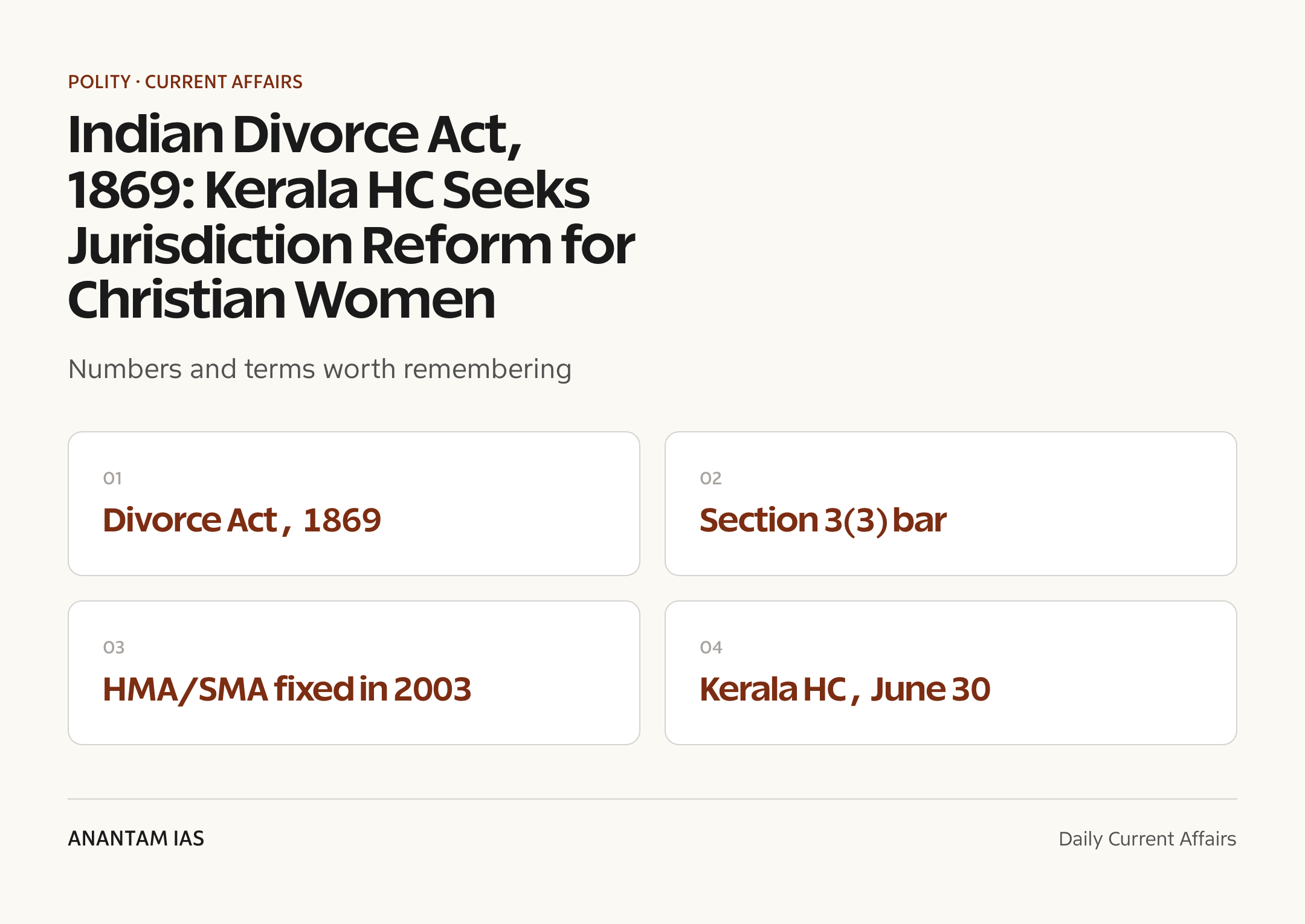
- The Family Court at Kalpetta returned her petition for lack of territorial jurisdiction under Section 3(3) of the Divorce Act, 1869.
- She asked the High Court to read Section 3(3) as including the district where the wife resides; the court declined, calling the provision “simple, plain and unambiguous”.
- It pointed to Section 24 of the Code of Civil Procedure (CPC) — transfer of a filed case — as the interim remedy.
- Parliament fixed this exact gap for Hindu and civil marriages through the Marriage Laws (Amendment) Act, 2003, but never touched the Divorce Act.
The development matters in the context of:
- The ruling revives the personal-law reform question: Christian divorce grounds were equalised in 2001, but the procedural clause on where a woman can sue was left untouched.
- It is a live access-to-justice issue — jurisdiction rules decide whether a survivor litigates near her parental home or must return to the district she fled.
- It feeds the Article 44 debate: a uniform civil code versus harmonising personal laws piecemeal, as the Law Commission suggested in 2018.
UPSC Relevance
Prelims Relevance
- Divorce Act, 1869 — colonial-era statute governing divorce among Christians; the word “Indian” was dropped from its short title by the 2001 amendment.
- Section 3(3) — a petition lies only where the marriage was solemnised or where the couple reside or last resided together; no wife’s-residence forum.
- Indian Divorce (Amendment) Act, 2001 — equalised divorce grounds under Section 10; inserted Section 10A (mutual consent).
- Marriage Laws (Amendment) Act, 2003 — added the wife’s-residence forum to Section 19, HMA 1955 and Section 31, SMA 1954.
- Personal-law map: HMA, 1955 — Hindus, Buddhists, Jains, Sikhs; SMA, 1954 — civil/interfaith marriages; Parsi Marriage and Divorce Act, 1936; Muslims under Islamic law.
- Section 24 CPC — transfer of suits; Section 3(3) governs only where a case is first filed.
- Family Courts Act, 1984 — family courts hear matrimonial disputes across personal laws.
- Article 44 (DPSP: uniform civil code); Article 39A (equal justice and free legal aid).
Mains Relevance
GS Paper 2
- Separation of powers — a court finding a statutory gap unjust yet refusing to fill it: literal interpretation vs judicial law-making.
- Personal laws and gender justice — procedural clauses (forum, limitation) matter as much as substantive grounds.
- Access to justice for vulnerable sections — jurisdiction rules, legal aid, family-court reach.
- Role of the Law Commission and Parliament in family-law reform; the Article 44 debate.
GS Paper 1
- Indian society — domestic violence, matrimonial litigation burdens, and how law shapes women’s mobility and security.
- Secularism dimension — reforming religious personal laws without majoritarian imposition.
Essay
- Justice inaccessible is justice denied — procedure as the gatekeeper of rights.
- Reforming personal laws: piecemeal repair or a uniform code?
Background and Context
The Case Before the Kerala High Court
The petition arose from a domestic-violence survivor who could not file for divorce in the district where she now lives.
- The woman married in Kasaragod in 2011; alleging severe domestic violence (FIR registered in 2023), she moved to her parents’ home in Wayanad.
- The Family Court, Kalpetta returned her divorce petition citing lack of territorial jurisdiction under Section 3(3).
- As written, the clause let her file only where the marriage was solemnised or where the couple last resided together — not where she lives now.
- She asked the High Court to read the wife’s residence into Section 3(3); the court held the words leave no room for that.

Divorce Act, 1869: The Law Governing Christian Marriages
Christians in India are governed by a colonial-era divorce statute that has been reformed in substance but not in procedure.
- The Divorce Act, 1869 (text on India Code) applies to persons professing the Christian religion; until the 2001 amendment it was the Indian Divorce Act.
- Section 3(3) defines the competent district court as the one within whose jurisdiction “the marriage was solemnized or the husband and wife reside or last resided together”.
- The Indian Divorce (Amendment) Act, 2001 equalised the divorce grounds under Section 10 — earlier a wife had to prove adultery plus another fault, while a husband could rely on adultery alone.
- The 2001 amendment inserted Section 10A (mutual consent); in 2022 the Kerala HC, in Anup Disalva v Union of India, struck down its two-year separation requirement, aligning it with the one-year norm elsewhere.
- The jurisdiction clause was left untouched in every round of reform — the gap the High Court has now asked Parliament to close.
How Other Personal Laws Handle Jurisdiction
Parliament closed the same gap for most other communities more than two decades ago.
- The Marriage Laws (Amendment) Act, 2003 amended Section 19 of the Hindu Marriage Act, 1955 to let a wife-petitioner file where she is residing on the date of the petition.
- The same Act made the identical change to Section 31 of the Special Marriage Act, 1954, covering civil and interfaith marriages.
- Both statutes also allow filing where the marriage was solemnised, where the respondent resides, or where the parties last resided together — a wider menu than Section 3(3).
- Parsis are covered by the Parsi Marriage and Divorce Act, 1936; Muslim women can seek dissolution under the Dissolution of Muslim Marriages Act, 1939.
- The anomaly: among major matrimonial statutes, the Christian divorce law alone denies the wife a forum at her own residence.
What the Court Held — and Why It Did Not Rewrite the Law
The judgment is a textbook illustration of the literal rule of interpretation and of judicial restraint.
- Justice Bechu Kurian Thomas held the provision “simple, plain and unambiguous”: when statutory words carry only one meaning, courts must give effect to it “irrespective of the consequences”.
- Reading a wife’s-residence forum into Section 3(3) would be judicial legislation — supplying a casus omissus (an omission in the statute), which is Parliament’s job.
- The court rejected the discrimination argument: personal laws of different religious communities may differ without the variation being unconstitutional by itself.
- Relying on the 2024 division-bench ruling in Eldho Varghese v Liya Jose, it held that Section 3(3) controls only the initial filing; a filed petition can be transferred under Section 24 CPC.
- No relief by interpretation, but a formal appeal to Parliament — flagging a legislative gap while respecting the separation of powers.
Access to Justice: Why Forum Rules Matter for Women
A jurisdiction clause looks technical, but it decides who can realistically litigate at all.
- A woman leaving a violent matrimonial home typically returns to her parental home, often in another district; suing where the marriage took place loads travel, cost and safety burdens on the weaker party.
- Per NFHS-5 (2019–21), about 29% of ever-married women aged 18–49 report spousal violence — the population for whom forum rules bite hardest.
- Article 39A directs the State to secure equal justice and free legal aid; a forum rule that prices out the poorer spouse cuts against that promise.
- Every avoidable transfer petition adds a layer of litigation to already stretched family courts — see how delay compounds in India’s judicial pendency crisis.
- Workarounds — Section 24 CPC transfers, virtual hearings, NALSA legal aid — still make the woman first navigate a forum she cannot easily reach.
The Larger Personal-Law Reform Debate
The nudge to Parliament sits inside a long arc of court-prompted reform of religious personal laws.
- Mary Roy v State of Kerala (1986) secured equal inheritance rights for Syrian Christian women; Shayara Bano v Union of India (2017) struck down instant triple talaq.
- The 21st Law Commission (2018) said a uniform civil code was “neither necessary nor desirable at this stage” and favoured removing discriminatory provisions within each personal law.
- The 22nd Law Commission reopened consultation on the uniform civil code in 2023, and Uttarakhand enacted a state UCC in 2024 — keeping the Article 44 debate live.
- The Kerala ruling shows a middle path: procedural harmonisation — uniform forum, limitation and transfer rules — advances gender justice without touching religious substance.
- The constitutional fault line traces to State of Bombay v Narasu Appa Mali (1951), which held uncodified personal laws outside fundamental-rights review — questioned since, never fully overruled.
Way Forward
Legislative fix
- Amend Section 3(3) of the Divorce Act, 1869 to add a wife’s-residence forum, mirroring the clause the 2003 amendment gave the HMA and SMA — a one-line, low-controversy change.
- Task the Law Commission with a clause-by-clause audit of the 1869 Act so its procedure matches the post-2001 substantive equality.
- Adopt procedural uniformity first: harmonise forum and transfer rules across matrimonial statutes, leaving substantive religious questions to wider consultation.
Administrative and judicial measures
- Expand e-filing and video-conference hearings in family courts so distance from the forum stops deciding outcomes.
- Make Section 24 CPC transfers fast and affordable in matrimonial matters, with NALSA and legal-aid institutions assisting women petitioners.
- Strengthen family-court capacity — judges, counsellors, protection officers — so relocated survivors are not re-victimised by process.
Conclusion
The Kerala High Court did what a constitutional court can: it named the injustice, declined to legislate from the bench, and placed the file before Parliament. The gap is narrow, technical and easy to close — which makes its persistence two decades after the 2003 amendment harder to defend.
For UPSC, the episode packages three durable themes: the literal rule and the limits of judicial law-making, the gap between substantive and procedural equality in personal laws, and access to justice as the working face of Article 39A. Whatever one’s view on Article 44, letting every wife sue for divorce from where she actually lives needs no grand settlement — only a short amending Bill.
UPSC Practice Questions
Prelims MCQ 1
With reference to matrimonial jurisdiction under Indian personal laws, consider the following statements:
- The Divorce Act, 1869 governs divorce among Christians in India.
- Under Section 3(3) of the Divorce Act, 1869, a wife may file a divorce petition in the district where she resides at the time of filing.
- The Hindu Marriage Act, 1955 and the Special Marriage Act, 1954 allow a wife-petitioner to file where she is residing on the date of the petition.
How many of the above statements are correct?
(a) Only one (b) Only two (c) All three (d) None
Answer: (b) Only two
Explanation:
Statements 1 and 3 are correct. Statement 2 is wrong — Section 3(3) permits filing only where the marriage was solemnised or where the couple reside or last resided together; the wife’s-residence forum entered the HMA and SMA via the Marriage Laws (Amendment) Act, 2003.
Prelims MCQ 2
The Marriage Laws (Amendment) Act, 2003 is best known for which of the following changes?
(a) Introducing divorce by mutual consent for Christian couples (b) Letting a wife file matrimonial petitions where she resides, under the HMA and the SMA (c) Transferring all matrimonial disputes to family courts (d) Making registration of marriages compulsory across all religions
Answer: (b) Letting a wife file matrimonial petitions where she resides, under the HMA and the SMA
Explanation:
The 2003 Act added the wife’s-residence forum to Section 19 of the HMA, 1955 and Section 31 of the SMA, 1954. Mutual-consent divorce for Christians came via Section 10A, inserted by the 2001 amendment.
UPSC Mains Questions
- Procedural gaps in personal laws can defeat substantive rights. In the light of the Kerala High Court’s plea to Parliament on the Divorce Act, 1869, examine how jurisdiction rules affect women’s access to justice in matrimonial disputes, and suggest reforms.
- Courts must give effect to plain statutory language “irrespective of the consequences”. Discuss the limits of judicial law-making and the appropriate institutional route for reforming personal laws, with reference to the Kerala High Court’s ruling on the Divorce Act, 1869.
- “Uniformity of procedure can precede uniformity of substance.” Evaluate this approach to family-law reform in India with reference to the 21st Law Commission’s 2018 consultation paper and Article 44.
Sources: India Code, Divorce Act 1869 and Indian Express Explained.
Frequently Asked Questions
What did the Kerala High Court ask Parliament to do?
On June 30, 2026, Justice Bechu Kurian Thomas urged Parliament to amend the Divorce Act, 1869 so a Christian wife can file for divorce before the court where she resides. The court found no justifiable reason for the omission but said only the legislature can add the provision.
What is Section 3(3) of the Divorce Act, 1869?
It is the jurisdiction clause of the Christian divorce law. A petition can be filed only in the district where the marriage was solemnised or where the couple reside or last resided together. It gives the wife no option to file from her current place of residence.
How do Hindu and civil marriage laws differ on jurisdiction?
The Marriage Laws (Amendment) Act, 2003 amended Section 19 of the Hindu Marriage Act, 1955 and Section 31 of the Special Marriage Act, 1954, letting a wife-petitioner file where she resides on the date of the petition. The Divorce Act, 1869 never got this forum.
Why did the court refuse to rewrite the provision?
The court called Section 3(3) simple, plain and unambiguous. When statutory words allow only one meaning, judges must apply them regardless of consequences; supplying an omitted provision would be judicial legislation. Differences between religious personal laws are not, by themselves, unconstitutional discrimination.
What remedy does the petitioner have for now?
Section 3(3) governs only where a case is first filed. Following the 2024 division-bench ruling in Eldho Varghese v Liya Jose, a properly instituted petition can be transferred under Section 24 of the Code of Civil Procedure to a court convenient to the wife.
How does this link to the Uniform Civil Code debate?
Article 44 asks the State to strive for a uniform civil code. The 21st Law Commission in 2018 preferred fixing discriminatory provisions within each personal law. The Kerala ruling supports that path: harmonising procedure, like forum rules, advances gender justice without settling contested religious questions.
Source: https://anantamias.com/current-affairs/kerala-hc-christian-divorce-jurisdiction-reform/
National Food Security Act Amendment: What Changes for Antyodaya Entitlements
Why in News?
The Department of Food and Public Distribution has circulated the draft National Food Security (Amendment) Bill, 2026, proposing to replace the flat 35 kg monthly foodgrain quota of Antyodaya Anna Yojana (AAY) households with a per-person entitlement of 7 kg, subject to a ceiling of 35 kg per household. Public comments on the draft are open till 13 July 2026.
The Hindu reported that Tamil Nadu Chief Minister C. Joseph Vijay wrote to the Prime Minister on 6 July 2026 urging the Centre to retain the household-based norm, warning that the change would shrink the rations of nearly 70 lakh of the state’s most vulnerable citizens. The letter has turned a technical proviso into a national debate on how India designs food entitlements for its poorest.
- The draft amends the first proviso to Section 3(1) of the National Food Security Act, 2013 — the clause that guarantees every AAY household 35 kg of foodgrains per month irrespective of family size.
- Proposed formula: 7 kg per person per month, capped at 35 kg per household; the Department of Food and Public Distribution has invited stakeholder comments till 13 July 2026.
- The Centre’s stated aim is to remove intra-category inequities: small AAY households now draw far more grain per head than large ones, whose per-capita share can fall below the 5 kg that priority households receive.
- Tamil Nadu has 18,64,600 AAY ration cards covering 69,26,983 beneficiaries; with an average family size of 3.54, a typical AAY household in the state would draw about 25 kg instead of 35 kg.
- The Chief Minister’s letter argues that a per-capita formula with a household ceiling penalises states with smaller families — the very states that delivered on family planning goals.
The development matters in the context of:
- The proposal tests whether a rights-based food law can be re-engineered in the name of equity without diluting its last-resort protection for the poorest.
- The southern states’ objection mirrors the delimitation debate: demographic success translating into a smaller share of national resources.
- It lands at a moment when NFSA coverage is still frozen at Census 2011 numbers and foodgrains are free for all beneficiaries under PMGKAY till December 2028.
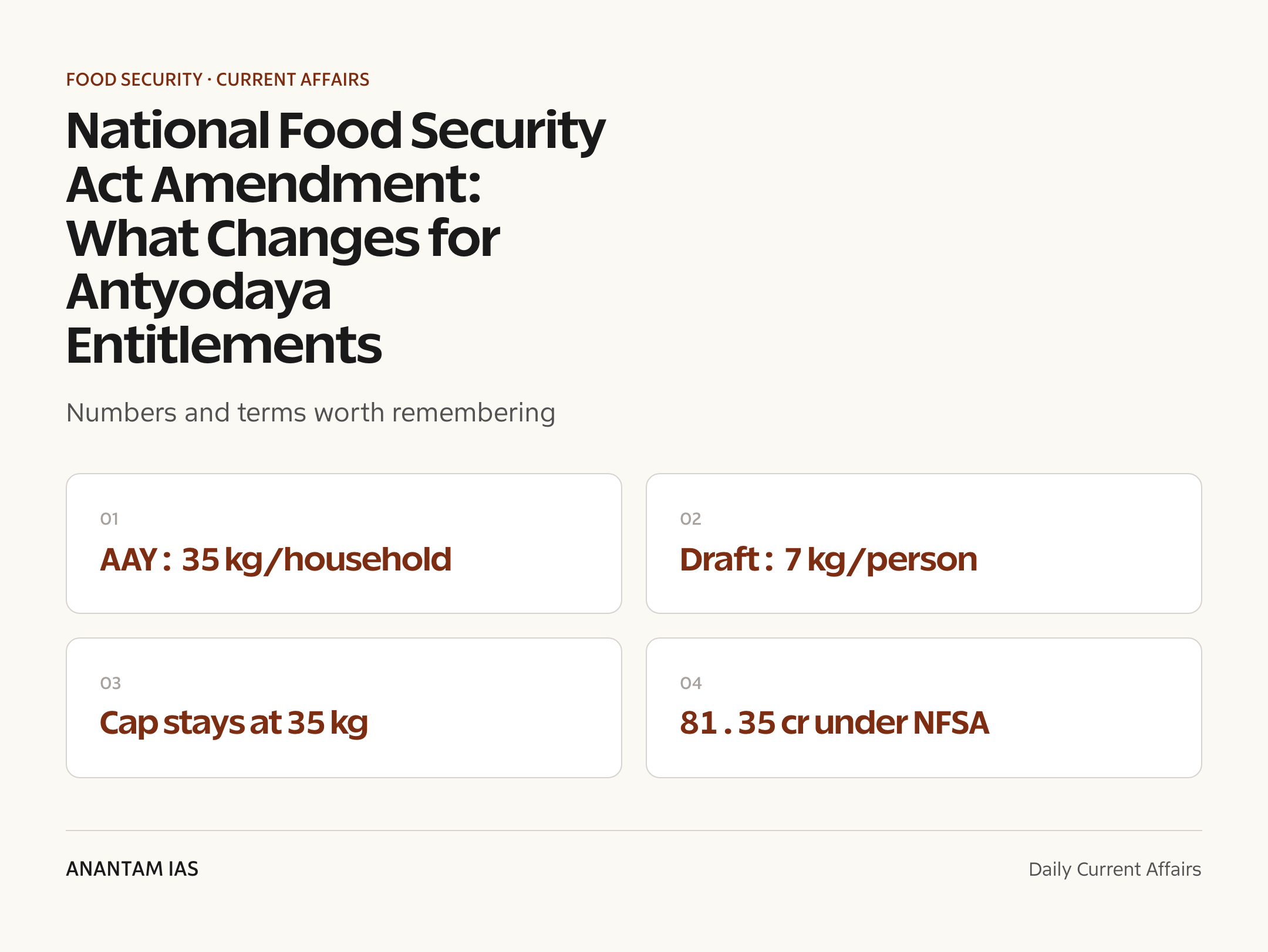
UPSC Relevance
Prelims Relevance
- NFSA, 2013: legal entitlement to subsidised foodgrains for up to 75% of the rural and 50% of the urban population — about two-thirds of India, roughly 81.35 crore people.
- Two beneficiary categories: Antyodaya Anna Yojana (AAY) households and Priority Households (PHH); PHH members get 5 kg per person per month.
- The AAY quota flows from the first proviso to Section 3(1): 35 kg per household per month, regardless of family size.
- AAY was launched on 25 December 2000 for the poorest of the poor; the quota rose from 25 kg to 35 kg in 2002; about 2.37 crore households hold AAY cards today.
- Draft National Food Security (Amendment) Bill, 2026: 7 kg per person with a 35 kg household ceiling; floated by the Department of Food and Public Distribution.
- NFSA issue prices — ₹3/₹2/₹1 per kg for rice, wheat and coarse grains — stand suspended: grain is free under PMGKAY since 1 January 2023, extended till 31 December 2028.
- The 7-kg figure tracks the revised ICMR guideline of 250 g of cereals per adult per day, about 7.5 kg a month.
- Other NFSA features: the eldest woman (18+) as head of household, a ₹6,000 maternity benefit, a food security allowance, and State Food Commissions for grievance redressal.
- One Nation One Ration Card (ONORC) makes NFSA entitlements portable across all 36 states and UTs; food supply and distribution sit in Entry 33 of the Concurrent List.
Mains Relevance
GS Paper 2
- Welfare design for vulnerable sections: household-based vs per-capita entitlements, and the equity trade-offs built into each.
- Federalism in welfare: a central law implemented by states, amended without formal state concurrence — the consultation gap in shared-responsibility schemes.
- Rights-based governance: NFSA as the statutory face of the right to food read into Article 21 since PUCL v. Union of India (2001).
GS Paper 3
- Food security economics: FCI operations, buffer stocks and the fiscal arithmetic of a free-grain regime under PMGKAY.
- Calorie security vs nutrition security: a cereal-centric PDS and the absent pulses-and-oils basket.
Essay
- Welfare design as moral choice: what a society owes its poorest when arithmetic and empathy collide.
- Demographic success and its penalties: the paradox of states punished for performing.
Background and Context
NFSA 2013: The Rights-Based Architecture
The 2013 Act converted food from a discretionary welfare handout into an enforceable legal right.
- The National Food Security Act, 2013 entitles up to 75% of the rural and 50% of the urban population to subsidised foodgrains through the Targeted Public Distribution System (TPDS).
- That works out to about 81.35 crore people — two-thirds of the population as counted in Census 2011.
- Beneficiaries fall into two buckets: AAY (the poorest of the poor) and Priority Households; states identify eligible families while the Centre allocates grain through the Food Corporation of India (FCI).
- The legal core is Section 3(1): 5 kg per person per month for priority households; its first proviso protects the AAY quota of 35 kg per household.
- The Act codified what the Supreme Court had been building since PUCL v. Union of India (2001) — a right to food derived from Article 21.
- Beyond grain: a ₹6,000 maternity entitlement, meals for children up to 14 years, the eldest woman as head of household, and grievance redressal through State Food Commissions.
- Since 1 January 2023 the grain has been free under PMGKAY, a regime extended to December 2028.
Antyodaya Anna Yojana: Who the 35 kg Protects
AAY is the deepest layer of India’s food safety net — deliberately simple, unconditional and household-based.
- Launched on 25 December 2000 to reach the poorest of the poor; the initial 25 kg household quota was raised to 35 kg from 2002.
- Eligibility targets acute distress: households headed by widows or the terminally ill, persons with disabilities, elderly persons without assured income, vulnerable tribal groups, landless labourers and daily-wage earners.
- About 2.37 crore AAY households — nearly 8.9 crore people — hold these cards nationwide.
- The design logic, as the Tamil Nadu letter puts it, was last-resort protection: an assured, unconditional quantum so that no family, whatever its size, faces hidden hunger.
- For most AAY families the PDS ration is not a supplement but the staple for all three meals; open-market substitution is unaffordable.
What the Draft Amendment Actually Changes
One proviso, one formula change — and a very different distribution of grain across household sizes.
- The draft rewrites the first proviso to Section 3(1): every person in an AAY household gets 7 kg per month, with the household capped at 35 kg.
- A single-person household drops from 35 kg to 7 kg; a two-member household to 14 kg; a four-member household to 28 kg.
- Households of five or more members stay at 35 kg — the cap means a six-member family entitled to 42 kg on the per-person formula still draws 35 kg, under 6 kg per head, barely above the priority-household norm.
- Tamil Nadu’s average family size of 3.54 means the typical AAY household there would draw about 25 kg — a cut of nearly 30%.
- The government anchors the 7-kg figure in the revised ICMR norm of 250 g of cereals per adult per day; the earlier norm was 400 g.
- Down To Earth reported that the draft justifies the change as removing intra-category inequities, since smaller AAY households currently receive far more grain per head than larger ones.
The Equity Argument — and Its Critics
Both sides claim fairness; they disagree on what the baseline for fairness should be.
- The Centre’s case: a household norm gives a one-member family 35 kg and a seven-member family 5 kg per head — per-capita rationalisation treats equals equally.
- Critics answer that the 35 kg cap contradicts the per-capita logic itself: if the entitlement is individual, larger households should not be truncated.
- The amendment covers cereals only — no pulses, no edible oil — while the ICMR’s lower cereal norm assumes a diversified diet the poorest cannot buy.
- Food-rights researchers told Down To Earth that actual cereal consumption among poor households runs to 400–500 g a day, making 250 g an unrealistic policy baseline.
- Development economists concede one point: many single-member AAY households genuinely do not need 35 kg a month — the anomaly is real even if the fix is contested.
- A lower aggregate entitlement also trims the food subsidy bill at a time when grain is free under PMGKAY — a fiscal gain that critics read as the quiet driver of the reform.
The Federal Fault Line
A single central formula meets very different state demographies — and the smaller-family states lose most.
- Tamil Nadu’s letter, reported by The Hindu, says the change would shrink rations for nearly 70 lakh people across 18.65 lakh AAY cards in the state.
- Southern states average 3–4 members per family against 4–5 in the north; a per-capita formula with a cap cuts deepest where family planning succeeded.
- The grievance rhymes with the delimitation debate: performance on population policy translating into smaller shares of central resources.
- Under the NFSA, states identify beneficiaries and run fair price shops while the Centre sets entitlements and allocates grain — food is a shared enterprise under Entry 33 of the Concurrent List.
- Tamil Nadu runs a universal PDS that predates the NFSA and tops up central norms; a shrunken central quota shifts the fiscal burden of protection onto state budgets.
- The letter’s core ask is procedural as much as substantive: consult states before amending a law they must implement.
The Wider PDS Reform Canvas
The AAY debate sits inside a larger set of unresolved food-security questions.
- NFSA coverage is still pegged to Census 2011; researchers Reetika Khera, Jean Drèze and Meghana Mungikar estimated in 2021 that over 10 crore people are excluded because the quotas were never updated.
- Down To Earth has reported how e-KYC and biometric authentication drives lock out the elderly, manual labourers and people without stable addresses — exclusion by technology rather than by design.
- ONORC has made rations portable across all 36 states and UTs, a real gain for migrant workers.
- The Shanta Kumar Committee (2015) had recommended trimming NFSA coverage to around 40% and restructuring the FCI — the opposite direction from the expansion that food-rights groups demand.
- Nutrition outcomes remain the weak link: a cereal-heavy PDS coexists with stubborn child stunting and anaemia.
- Poverty measurement has moved to multidimensional metrics — see the Multidimensional Poverty Index — while PDS targeting still leans on decade-old beneficiary lists.
Way Forward
Fix the anomaly without lowering the floor
- Adopt the per-capita principle but remove or raise the 35 kg cap, so larger households gain rather than merely not losing.
- Add a no-loss grandfathering clause: no existing AAY household should draw less than its current entitlement.
- Publish a state-wise impact assessment of the formula before finalisation, not after.
Move from calorie security to nutrition security
- Pair any cereal rationalisation with pulses, millets and edible oil in the AAY basket, as food-rights experts have long demanded.
- Align PDS design with POSHAN 2.0 and the ICMR’s dietary-diversity logic — if the cereal quantum falls, non-cereal support must rise.
Repair the process and the data
- Institutionalise Centre-State consultation — a standing mechanism or pre-legislative reference before amendments to shared welfare laws.
- Re-base NFSA coverage on Census 2027 data as soon as it is available, ending the Census-2011 freeze.
- Audit and fix e-KYC exclusions: an authentication failure should trigger assisted delivery, not denial of grain.
Conclusion
The draft amendment is not a trivial tidying-up. The 35-kg household quota was the NFSA’s bluntest and most protective instrument — blunt because it ignored family size, protective for the same reason. Replacing it with a capped per-capita formula redistributes grain away from small households — often headed by widows or the elderly — that the Antyodaya Anna Yojana was invented to shield.
The way through is not to freeze the status quo but to fix the anomaly generously: per-capita entitlements without a regressive cap, a nutrition basket that goes beyond cereals, and a federal process that treats states as co-authors of food security rather than as implementing agencies. How the Centre responds after the consultation closes on 13 July will show which version of equity it has in mind.
UPSC Practice Questions
Prelims MCQ 1
With reference to the National Food Security Act (NFSA), 2013, consider the following statements:
- The Act legally entitles up to 75 per cent of the rural population and 50 per cent of the urban population to subsidised foodgrains.
- Under the Act, Antyodaya Anna Yojana households receive 35 kg of foodgrains per household per month, while priority households receive 5 kg per person per month.
- The Antyodaya Anna Yojana was created by the National Food Security Act, 2013.
How many of the above statements are correct?
(a) Only one (b) Only two (c) All three (d) None
Answer: (b) Only two
Explanation:
Statements 1 and 2 are correct — they state the NFSA’s coverage ratios and the two entitlement categories. Statement 3 is incorrect: AAY was launched on 25 December 2000 as a scheme for the poorest of the poor; the NFSA, 2013 later absorbed and protected its 35-kg household entitlement through the first proviso to Section 3(1).
Prelims MCQ 2
The draft National Food Security (Amendment) Bill, 2026 proposes which of the following changes for Antyodaya Anna Yojana households?
(a) Replacing foodgrain entitlements with direct cash transfers (b) Raising the household entitlement from 35 kg to 42 kg per month (c) A per-person entitlement of 7 kg per month, capped at 35 kg per household (d) Merging AAY households into the priority category at 5 kg per person
Answer: (c) A per-person entitlement of 7 kg per month, capped at 35 kg per household
Explanation:
The draft amends the first proviso to Section 3(1) of the NFSA to give every member of an AAY household 7 kg of foodgrains a month, subject to an overall ceiling of 35 kg per household. Households of five or more members keep 35 kg; all smaller households would draw less than they do now.
UPSC Mains Questions
- The proposed shift from a household-based to a per-capita foodgrain entitlement under the National Food Security Act pits horizontal equity against last-resort protection. Examine the trade-offs in the draft amendment and suggest a design that reconciles the two objectives. (250 words)
- Centrally legislated but state-implemented welfare makes food security a shared federal enterprise. In the light of states’ objections to the draft NFSA amendment, discuss the case for institutionalised Centre-State consultation in the design of welfare entitlements. (250 words)
- India’s food security challenge has moved from grain availability to entitlement design and nutritional adequacy. Discuss with reference to the Antyodaya Anna Yojana, PMGKAY and the revised ICMR dietary norms. (250 words)
Sources: Department of Food and Public Distribution and The Hindu.
Frequently Asked Questions
What is the Antyodaya Anna Yojana?
AAY, launched on 25 December 2000, is the deepest layer of the Public Distribution System, covering the poorest of the poor — about 2.37 crore households headed by widows, elderly persons, persons with disabilities, landless labourers and vulnerable tribal groups. Each household gets 35 kg of foodgrains a month, currently free under PMGKAY.
What does the draft NFSA amendment propose?
The draft National Food Security (Amendment) Bill, 2026 rewrites the first proviso to Section 3(1) of the NFSA. Instead of a flat 35 kg per AAY household, every member would get 7 kg a month, with the household capped at 35 kg. The Department of Food and Public Distribution invited public comments till 13 July 2026.
Who loses grain under the proposed formula?
Households with fewer than five members. A single-person household falls from 35 kg to 7 kg, a two-member household to 14 kg and a four-member household to 28 kg. Families of five or more keep 35 kg, though the cap denies larger families the full per-person amount.
Why is Tamil Nadu opposing the change?
The Hindu reported that the Chief Minister’s letter warns nearly 70 lakh beneficiaries across 18.65 lakh AAY cards would lose grain, because the state’s average family size is only 3.54. He argues the formula penalises states that succeeded at family planning, in a state where PDS rice is the staple food.
What do priority households get under the NFSA?
Priority households — the larger of the Act’s two categories — receive 5 kg of foodgrains per person per month. Together with AAY, the Act covers about 81.35 crore people: up to 75 per cent of the rural and 50 per cent of the urban population, based on Census 2011.
Are NFSA foodgrains free at present?
Yes. The original issue prices of ₹3, ₹2 and ₹1 per kg for rice, wheat and coarse grains were suspended from 1 January 2023, when the Centre made NFSA grain free under PMGKAY. The free-grain regime has been extended for five years, till 31 December 2028.
Source: https://anantamias.com/current-affairs/nfsa-amendment-aay-entitlements-debate/
Gaza Transition: Hamas Dissolves Its Government for a UN-Backed Committee
Why in News?
On 6 July 2026, Hamas announced it had dissolved its government in the Gaza Strip and is preparing to transfer civil power to a technocratic body backed by the United Nations, as required under the US-brokered ceasefire deal. The Hindu reported, carrying an AP dispatch, that Ismail al-Thawabta, head of the Hamas-run Government Media Office, made the announcement in Deir al-Balah.
The handover is a core step in the peace architecture built by UN Security Council Resolution 2803 (17 November 2025), which endorsed the 20-point Comprehensive Plan to End the Gaza Conflict, welcomed a transitional Board of Peace and authorised an International Stabilization Force. But Hamas stayed silent on the harder question — disarmament — and Israel dismissed the move as cosmetic.
- Hamas said only “technical and professional staff” will stay in their posts to run day-to-day services in the enclave.
- The successor body is the National Committee for the Administration of Gaza — Cairo-based technocrats chaired by Ali Shaath, a Gaza-born engineer and former Palestinian Authority official.
- The Board of Peace, led by US President Donald Trump, said it would judge the step by “actions, not promises” and insisted the committee must control all weapons in Gaza.
- Israel called the resignation “a spin that has no significance”, since Hamas-era employees stay in their positions.
- The ceasefire took effect on 10 October 2025; nine months on, phase-two talks on Hamas’s disarmament and reconstruction remain deadlocked.
The development matters in the context of:
- The transition tests whether the UN peace architecture can convert a truce into functioning governance — a rare live experiment in externally supervised administration.
- For India, the stakes run through its two-state policy, the Gulf diaspora, energy and shipping security, and stalled projects such as IMEC and I2U2.
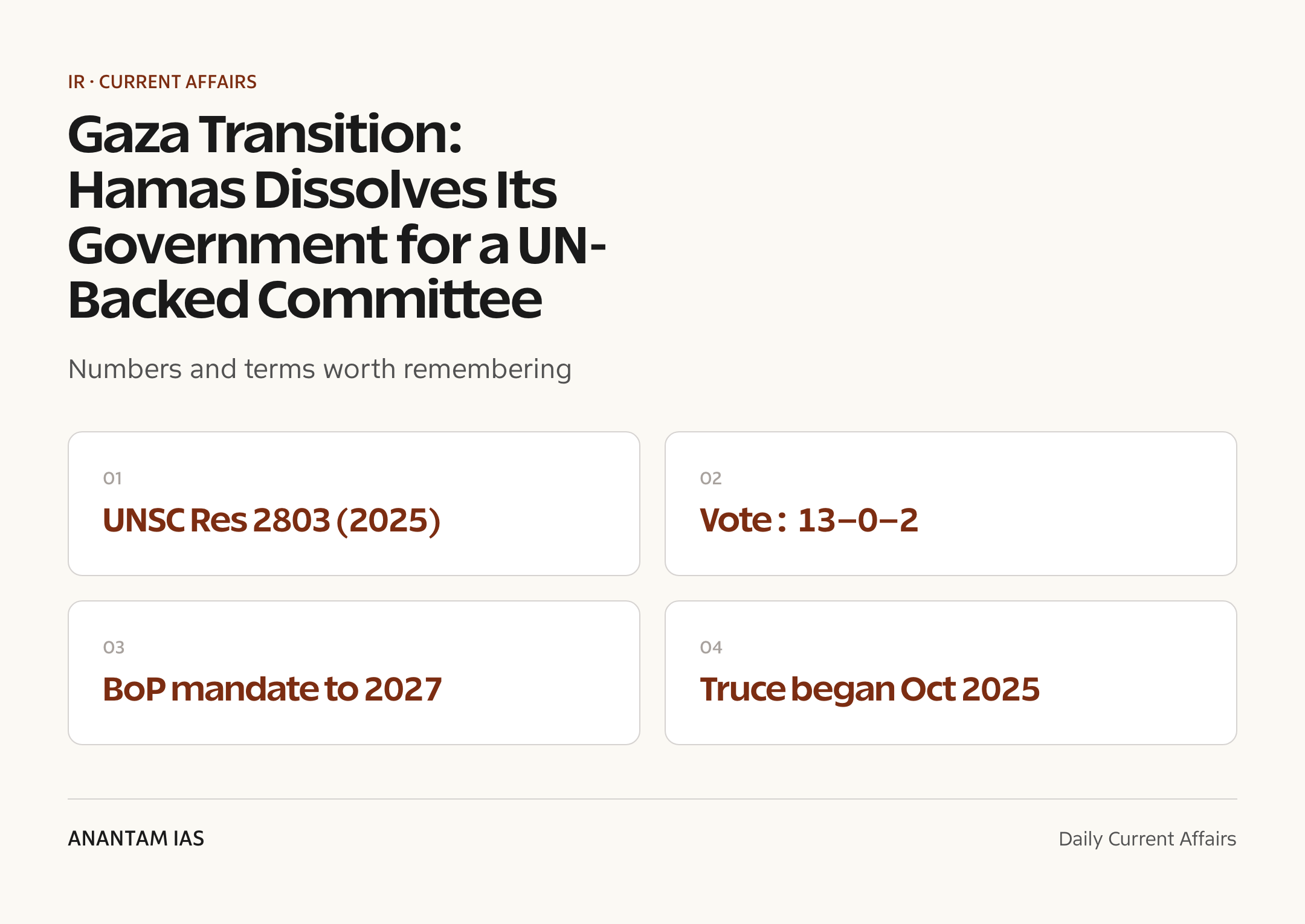
UPSC Relevance
Prelims Relevance
- UNSC Resolution 2803 (2025): adopted 17 November 2025; 13 votes in favour, Russia and China abstained, none against.
- It endorsed the 20-point Comprehensive Plan to End the Gaza Conflict behind the October 2025 ceasefire.
- Board of Peace (BoP): transitional body chaired by Donald Trump; authorised until 31 December 2027; reports to the Council every six months.
- International Stabilization Force (ISF): temporary force for border security, protecting civilians and aid corridors, supporting demilitarisation, and training a vetted Palestinian police force.
- National Committee for the Administration of Gaza: Cairo-based technocratic committee chaired by Ali Shaath; restores services and oversees civilian affairs under UN and BoP supervision.
- Timeline: 7 October 2023 attack (about 1,200 killed in Israel, 251 hostages) → ceasefire effective 10 October 2025.
- Hamas won the 2006 Palestinian Legislative Council elections and has controlled Gaza since June 2007 after splitting with Fatah.
- The Oslo Accords (1993) created the Palestinian Authority; Israel unilaterally disengaged from Gaza in 2005.
- UNRWA: UN agency for Palestine refugees (est. 1949); India contributes US$5 million a year.
- Abraham Accords (2020); I2U2 (India-Israel-UAE-US); IMEC announced at the G20 New Delhi Summit, September 2023.
Mains Relevance
GS Paper 2
- Effect of West Asian politics on India’s interests: energy, diaspora, connectivity corridors and de-hyphenated ties with Israel and Palestine.
- UN peace architecture in practice: Resolution 2803’s shift from classical peacekeeping to stabilisation-and-administration mandates.
- Transitional administrations as a governance model: legitimacy, local ownership and exit strategy (compare Kosovo and East Timor).
GS Paper 3
- Disarmament, demobilisation and reintegration (DDR) of non-state armed groups as the hardest phase of any peace deal.
- Security of trade and energy routes: Red Sea shipping disruptions and the economics of IMEC.
Essay
- Peace is not merely the absence of war but the presence of institutions.
- Can the UN still build states, or only freeze conflicts?
Background and Context
From 7 October 2023 to the October 2025 Ceasefire
The current transition sits at the end of a two-year war and a phased, US-brokered peace plan.
- On 7 October 2023, a Hamas-led attack killed about 1,200 people in Israel; 251 hostages were taken into Gaza.
- Israel’s retaliatory offensive killed 73,098 Palestinians per the Gaza Health Ministry — figures UN agencies treat as broadly reliable; women and children are around half the toll.
- In late September 2025, the US unveiled the 20-point Comprehensive Plan to End the Gaza Conflict; a ceasefire based on it took effect on 10 October 2025.
- Phase one delivered hostage releases, a partial Israeli redeployment and a scale-up of humanitarian aid.
- Phase two — Hamas’s disarmament and reconstruction — has been deadlocked for nine months; Hamas insists phase one must finish before it discusses its weapons.
- Violence continues: Israeli strikes killed at least five people on the announcement day; five Israeli soldiers have died since the truce began.
What Hamas Announced — and What It Left Out
The dissolution is significant on paper but heavily hedged in practice.
- Speaking at Al-Aqsa Hospital in Deir al-Balah, al-Thawabta said service employees are ready to work under the National Committee for the Administration of Gaza.
- Hamas made no commitment on disarming or handing security to an international force — the ceasefire’s most difficult clause.
- Hamas spokesperson Hazem Qassem framed the move as “a positive step forward” for the deal.
- An Israeli official dismissed it as “spin”: Hamas members simply remain in their positions under a new label.
- The Board of Peace said it would assess the impact based on “actions, not promises”, stressing the committee must control all weapons in Gaza.
The National Committee for the Administration of Gaza
The successor body is technocratic, externally supervised and still untested on the ground.
- A committee of technocrats based in Cairo, chaired by Ali Shaath, a Gaza-born engineer and former Palestinian Authority official.
- Mandate: restore essential services and oversee civilian affairs under the supervision of the UN and the Board of Peace.
- It flows from Resolution 2803, which empowers the Board of Peace to appoint a Palestinian technocratic committee for day-to-day governance.
- The design separates politics from administration: the Board holds transitional political authority while the committee delivers services — a classic post-conflict model.
- Open questions: control of the payroll of former government employees, the policing interface with the ISF, and when Gaza folds back under a reformed Palestinian Authority.
UNSC Resolution 2803: The Legal Scaffolding
Resolution 2803 is the durable, examinable core of this story — learn its provisions, not just the headline.
- Adopted on 17 November 2025 by 13 votes with abstentions by China and Russia; full text on the UN documents portal (S/RES/2803).
- It endorses the Comprehensive Plan and welcomes the Board of Peace as the transitional body supporting Gaza’s administration and reconstruction.
- It authorises a temporary International Stabilization Force to secure border areas, protect civilians and aid corridors, support demilitarisation, and train a vetted Palestinian police force.
- The Board and international presences are authorised until 31 December 2027, with written progress reports every six months.
- It holds out a conditional pathway to Palestinian self-determination and statehood once the Palestinian Authority’s reform programme is carried out.
- Critics, echoed in the two abstentions, flagged weak Palestinian ownership and sweeping powers for an unelected international board.
Who Has Governed Gaza? A 75-Year Institutional History
Gaza’s administration has changed hands repeatedly — a useful map for both Prelims and Mains.
- 1949–1967: Egyptian military administration after the first Arab-Israeli war.
- 1967: Israel captured Gaza in the Six-Day War and ran it under military occupation.
- 1993–94: the Oslo Accords created the Palestinian Authority with partial self-rule.
- 2005: Israel’s unilateral disengagement from Gaza.
- 2006–07: Hamas won the 2006 elections, then seized full control of Gaza in June 2007 after its split with Fatah; the PA was confined to parts of the West Bank.
- 2026: the first externally supervised technocratic administration under a UNSC-endorsed framework — if the handover proceeds beyond paper.
India's Stakes and Stated Positions
India reads the Gaza transition through a de-hyphenated West Asia policy that pairs principle with interests.
- India backs a negotiated two-state solution — a sovereign, viable Palestine within secure, recognised borders, at peace with Israel — and welcomed the October 2025 ceasefire.
- Humanitarian track: multiple consignments of medicines and relief material to Gaza routed through Egypt, plus US$5 million annually to UNRWA.
- India’s UN voting balanced both principles: it abstained on an October 2023 General Assembly resolution that omitted the terror attacks, then backed the December 2023 humanitarian-ceasefire resolution.
- Hard interests: roughly nine million Indians in the Gulf, heavy crude-oil dependence, and Red Sea shipping disruptions that raised freight costs.
- A stabilised Gaza improves the prospects of IMEC and I2U2, both slowed by the conflict since 2023.
- Track the wider arc in our current affairs digests and monthly compilations.
Way Forward
Sequencing disarmament with governance
- A verifiable weapons-control mechanism — inventories, decommissioning timelines, ISF monitoring — is the test the Board of Peace has set; announcements alone won’t move phase two.
- A phased DDR programme with livelihood options for cadres reduces the risk that armed men migrate to clan militias.
- A vetted Palestinian police force, trained under the ISF mandate, must fill the policing gap before criminal networks do.
Making the technocratic committee credible
- Early, visible service delivery — power, water, payrolls, rubble clearance — will decide whether Gazans treat the committee as a government or a letterhead.
- Reconstruction finance needs transparent channels: donor pledges tied to audited damage assessments, insulated from capture.
- A stated timeline to fold Gaza back under a reformed Palestinian Authority would restore Palestinian ownership and answer the legitimacy critique.
What India can do
- Scale up humanitarian and UNRWA support, and offer ITEC-style capacity-building for Palestinian administrators.
- Keep backing the statehood pathway diplomatically while deepening the strategic partnership with Israel — de-hyphenation in practice.
- Position Indian firms for Gaza’s reconstruction economy and push the IMEC file as stability returns.
Conclusion
Hamas dissolving its Gaza government is the kind of step peace plans are built on — and the kind that can remain a press conference unless it is followed by verifiable transfers of power, payrolls and, hardest of all, weapons. The gap between Israel’s “spin” and Hamas’s “positive step” shows how thin the trust beneath Resolution 2803 still is.
Gaza is now a live case study in transitional administration: a UNSC-endorsed board, a technocratic committee and a stabilisation force attempting to rebuild governance itself. Whether the model earns legitimacy will shape UN practice beyond West Asia.
India’s interest is direct: a stable Gaza anchors the wider calm on which its diaspora, energy security and IMEC ambitions depend, while a credible statehood pathway vindicates the two-state position New Delhi has held for decades.
UPSC Practice Questions
Prelims MCQ 1
With reference to UN Security Council Resolution 2803 (2025), consider the following statements:
- It endorsed the Comprehensive Plan to End the Gaza Conflict and welcomed the establishment of a transitional Board of Peace.
- It authorised the deployment of a temporary International Stabilization Force (ISF) in Gaza.
- Russia and China voted against the resolution.
How many of the above statements are correct?
(a) Only one (b) Only two (c) All three (d) None
Answer: (b) Only two
Explanation:
Statements 1 and 2 are correct: Resolution 2803 (17 November 2025) endorsed the Comprehensive Plan, welcomed the Board of Peace and authorised the ISF until 31 December 2027. Statement 3 is wrong — the vote was 13 in favour, none against; Russia and China abstained.
Prelims MCQ 2
The ‘National Committee for the Administration of Gaza’, recently in the news, is best described as:
(a) An elected Palestinian legislature replacing the Palestinian Authority (b) A technocratic transitional body for Gaza’s civil administration under UN and Board of Peace supervision (c) A UN peacekeeping mission deployed under the UN Charter (d) A joint Israeli-Egyptian mechanism to administer Gaza’s border crossings
Answer: (b) A technocratic transitional body for Gaza's civil administration under UN and Board of Peace supervision
Explanation:
It is a Cairo-based technocratic committee chaired by Ali Shaath, mandated to restore essential services and oversee civilian affairs under UN and Board of Peace supervision, within the framework of UNSC Resolution 2803.
UPSC Mains Questions
- The Gaza transition under UNSC Resolution 2803 marks a rare experiment in externally supervised territorial administration. Examine the opportunities and risks of such transitional governance models for durable peace, drawing on earlier UN experiences.
- India’s West Asia policy rests on de-hyphenation, diaspora welfare, energy security and connectivity. Discuss how a stabilised Gaza and a revived peace process would affect India’s strategic and economic interests in the region.
- “Ceasefires end wars; institutions end conflicts.” In the light of the Gaza peace architecture — the Board of Peace, the International Stabilization Force and a technocratic administration — critically analyse the conditions necessary for post-conflict governance to succeed.
Sources: The Hindu (AP) and United Nations (Security Council press release on Resolution 2803).
Frequently Asked Questions
Why did Hamas dissolve its government in Gaza?
Hamas announced on 6 July 2026 that it had dissolved its Gaza government to transfer civil power to a UN-backed technocratic committee, as required under the US-brokered ceasefire and UNSC Resolution 2803. It framed the move as proof of its commitment to Gaza’s reconstruction.
What is the National Committee for the Administration of Gaza?
It is a Cairo-based committee of Palestinian technocrats chaired by Ali Shaath, a Gaza-born engineer and former Palestinian Authority official. Its mandate is to restore essential services and oversee civilian affairs in Gaza under the supervision of the United Nations and the transitional Board of Peace.
What is UNSC Resolution 2803?
Adopted on 17 November 2025 by 13 votes with Russia and China abstaining, Resolution 2803 endorsed the Comprehensive Plan to End the Gaza Conflict, welcomed the Board of Peace as Gaza’s transitional authority and authorised an International Stabilization Force. The arrangements run until 31 December 2027, with six-monthly reports.
What is the Board of Peace?
The Board of Peace is the transitional international body created under the Gaza peace plan and welcomed by Resolution 2803, chaired by US President Donald Trump. It supports Gaza’s governance and reconstruction, appoints the technocratic administration committee, and can establish the temporary International Stabilization Force.
What will the International Stabilization Force do?
The ISF is a temporary multinational force authorised by Resolution 2803. Its tasks include securing Gaza’s border areas, protecting civilians and humanitarian corridors, supporting the demilitarisation of the territory, and training a vetted Palestinian police force that can take over day-to-day law and order.
What is India’s position on the Gaza transition?
India supports a negotiated two-state solution — a sovereign, viable Palestine within secure, recognised borders, at peace with Israel. It welcomed the October 2025 ceasefire, has sent humanitarian aid through Egypt, contributes US$5 million a year to UNRWA, and ties regional stability to its diaspora and IMEC.
Source: https://anantamias.com/current-affairs/hamas-dissolves-gaza-government-un-committee/
India–EFTA TEPA: New Openings for the Seafood Sector
Why in News?
PIB confirmed that the Department of Commerce organised a Chintan Shivir on “Opportunities for the Seafood Sector under the India–EFTA Trade and Economic Partnership Agreement (TEPA)” on 3 July 2026 at the Chennai Trade Centre, on the sidelines of Seafood Expo Bharat 2026.
The brainstorming session brought exporters face-to-face with officials from the Department of Commerce, Invest India, DGFT, the Export Inspection Council and FIEO to work out how the pact’s tariff concessions and its USD 100 billion investment ambition can be converted into concrete gains for India’s fishermen and seafood businesses.
- The Chintan Shivir was held on 3 July 2026 at the Chennai Trade Centre, alongside Seafood Expo Bharat 2026; Joint Secretary Mohit Yadav of the Department of Commerce addressed the participants.
- Under TEPA, Iceland has eliminated its 55 per cent import duty on feed, including fish feed.
- Switzerland has cut the import duty on fats and oils of fish (other than liver oil) from 18.05 per cent to zero; Norway has scrapped its 13.16 per cent duty on fish and shrimp feed.
- An open-house session let exporters raise market access, regulatory compliance and quality-standard issues directly with policymakers.
- PIB noted TEPA also opens avenues for technology transfer and joint ventures with niche EFTA firms, with coastal states such as Tamil Nadu among the biggest potential gainers.
The development matters in the context of:
- TEPA is India’s first trade agreement with a European bloc and the first Indian FTA with a binding, investment-linked commitment — USD 100 billion over 15 years and one million direct jobs.
- India’s seafood exports stood at USD 7.45 billion (16.98 lakh tonnes) in 2024-25 as per MPEDA — the Chennai exercise is about widening this basket into high-value EFTA markets.
- The event illustrates the FTA utilisation problem: signing a pact is only the start; sector-level outreach turns paper concessions into orders and investment.
UPSC Relevance
Prelims Relevance
- TEPA — Trade and Economic Partnership Agreement between India and EFTA; signed on 10 March 2024, entered into force on 1 October 2025.
- EFTA members: Iceland, Liechtenstein, Norway and Switzerland — none of them is a member of the European Union.
- EFTA economies have a combined GDP of about USD 1.79 trillion (PIB).
- TEPA’s investment chapter: USD 100 billion of investment into India over 15 years plus one million direct jobs — a first in any Indian FTA.
- Seafood-relevant tariff cuts: Iceland’s 55% feed duty, Norway’s 13.16% fish/shrimp-feed duty and Switzerland’s 18.05% duty on fish fats and oils all brought to zero.
- MPEDA — statutory body under the MPEDA Act, 1972; headquarters Kochi; works under the Department of Commerce.
- Export Inspection Council (EIC) — statutory body under the Export (Quality Control and Inspection) Act, 1963; certifies export quality.
- India’s seafood exports 2024-25: USD 7.45 billion / 16,98,170 tonnes; frozen shrimp is the largest item and the USA the largest market (MPEDA).
Mains Relevance
GS Paper 3
- FTAs as instruments of export-led growth — how tariff concessions translate (or fail to) into sector-level gains.
- TEPA’s investment-linked design as a new template for Indian trade agreements.
- Fisheries and the Blue Economy: value addition, quality compliance and market diversification in seafood exports.
- Non-tariff barriers — SPS standards, traceability, certification — as the real frontier of market access.
GS Paper 2
- India’s layered engagement with Europe: EFTA (TEPA), the ongoing India–EU FTA negotiations and the India–UK agreement.
- Institutional coordination — Commerce Department, DGFT, EIC, MPEDA, FIEO, Invest India — in implementing international agreements domestically.
Essay
- Trade agreements are signed in capitals but succeed in coastal villages — the last mile of globalisation.
- From protection to promotion: how open trade can serve, not sink, small producers.
Background and Context
TEPA in Brief: India's First European Trade Pact
TEPA is India’s first operational trade agreement with a European economic bloc, negotiated intermittently over nearly 16 years.
- The pact was signed on 10 March 2024 in New Delhi and, as PIB announced, entered into force on 1 October 2025 after ratification by all five parties.
- It has 14 chapters covering trade in goods, rules of origin, services, investment promotion, intellectual property, government procurement, trade and sustainable development, and dispute settlement.
- EFTA — the European Free Trade Association — groups Iceland, Liechtenstein, Norway and Switzerland: developed, high-income economies that sit outside the EU but are deeply integrated with the European market.
- EFTA states will eliminate or reduce tariffs covering about 99.6 per cent of India’s export value to the bloc, giving Indian goods near-comprehensive duty-free access.
- India has kept sensitive sectors — dairy, soya and coal among them — protected, and the effective duty on gold is unchanged.
- TEPA complements India’s other Europe tracks: the ongoing India–EU FTA negotiations and the trade agreement concluded with the United Kingdom.
The Investment-Linked Novelty: Why TEPA Is a Template
TEPA is the first Indian trade agreement in which tariff concessions are tied to a binding investment commitment.
- EFTA states have committed to facilitate USD 100 billion of investment into India over 15 years — USD 50 billion in the first ten years and another USD 50 billion in the following five.
- The commitment is paired with a target of creating one million direct jobs in India through this investment.
- A built-in review mechanism gives the commitment teeth: if the targets are not met after consultations and a grace period, India can proportionately rebalance its tariff concessions.
- This inverts the usual FTA logic — instead of trading market access for market access alone, India traded access for capital, technology and jobs.
- For sectors like seafood, the investment channel matters as much as tariffs: Norway is a world leader in cold-water aquaculture, fish-feed technology and cold-chain logistics, all of which India’s fisheries value chain needs.
What TEPA Puts on the Table for Seafood
The pact combines direct tariff relief on inputs and products with openings for joint ventures across the fisheries value chain.
- Iceland has eliminated its steep 55 per cent import duty on feed, including fish feed — one of the sharpest single cuts in the agreement.
- Switzerland has reduced the duty on fats and oils of fish (other than liver oil) from 18.05 per cent to zero, helping marine-ingredient exporters.
- Norway has removed its 13.16 per cent duty on feed, including fish and shrimp feed, widening access for Indian feed manufacturers.
- PIB highlighted openings for technology transfer and collaboration with niche EFTA firms — from hatchery genetics to processing equipment.
- Coastal states, particularly Tamil Nadu, stand to gain through demand for fishermen’s catch, processing jobs and port-linked logistics — the reason the Chintan Shivir was held in Chennai.
India's Seafood Economy: The MPEDA Picture
Seafood is one of India’s most successful agri-allied export stories, but the basket remains concentrated in one product and a few markets.
- MPEDA data show India exported 16,98,170 tonnes of seafood worth ₹62,408 crore (USD 7.45 billion) in 2024-25 — see our note on India’s record seafood exports.
- Frozen shrimp dominates: about 7.42 lakh tonnes worth roughly USD 5.18 billion, close to 70 per cent of total export value.
- The USA is the largest frozen-shrimp market, followed by China, the EU, South-East Asia, Japan and the Middle East — concentration that exposes exporters to shocks in one or two markets.
- MPEDA (Marine Products Export Development Authority), set up under the MPEDA Act, 1972 with headquarters in Kochi, promotes exports and runs quality programmes such as SHAPHARI certification for aquaculture.
- The wider fisheries sector supports around 3 crore fishers and fish farmers; India is the world’s second-largest fish producer with roughly 8 per cent of global output.
- Flagship schemes back the sector: PMMSY (Pradhan Mantri Matsya Sampada Yojana, ₹20,050-crore outlay) and the FIDF (Fisheries and Aquaculture Infrastructure Development Fund).
Institutions in the Room: Who Does What
The Chintan Shivir doubled as a map of India’s export-promotion machinery — worth knowing institution by institution.
- Department of Commerce — negotiates trade agreements and steers their implementation; convened the Chintan Shivir.
- Invest India — the national investment promotion agency; presented investment opportunities across the seafood value chain.
- DGFT (Directorate General of Foreign Trade) — administers the Foreign Trade Policy; its Chennai Regional Office briefed exporters on facilitation schemes.
- Export Inspection Council (EIC) — statutory body under the Export (Quality Control and Inspection) Act, 1963; certifies that consignments meet importing-country standards.
- FIEO (Federation of Indian Export Organisations) — the apex export-promotion body; shared strategies for using TEPA benefits.
- Together these bodies span negotiation, investment facilitation, licensing, certification and outreach — a ready GS2 example of institutional coordination in implementing international agreements.
The Real Test: From Signed FTA to Utilised FTA
India’s older FTAs were often under-used by exporters — the Chintan Shivir model is designed to close that gap.
- Studies and parliamentary reviews have repeatedly flagged low utilisation of India’s earlier FTAs — rules-of-origin paperwork, certification costs and information gaps often outweighed tariff savings; see our explainer on India’s experience with FTAs.
- For seafood, tariffs are half the battle: SPS (sanitary and phytosanitary) standards, antibiotic-residue limits, traceability and catch certification decide whether consignments clear European borders.
- TEPA sits in a new generation of Indian pacts — the UAE CEPA (2022), the Australia ECTA (2022) and the agreement with the UK — where signing is paired with sector-specific outreach.
- The open-house format lets policymakers hear compliance bottlenecks directly from exporters, feeding into scheme design rather than leaving concessions unused on paper.
- The Chennai session closed with a shared government–industry commitment to maximise TEPA benefits and expand seafood exports to EFTA markets.
Way Forward
Convert concessions into orders
- Run EFTA-specific exporter handholding — market intelligence, buyer matchmaking and rules-of-origin help — through MPEDA and Export Promotion Councils.
- Push value-added products (ready-to-eat, marinated, retail-pack seafood) rather than bulk frozen commodity, since high-income EFTA consumers pay for processing done in India.
Use the investment channel deliberately
- Court Norwegian and Icelandic aquaculture, feed-technology and cold-chain firms for joint ventures in coastal states, converging with PMMSY infrastructure spending.
- Track the USD 100-billion commitment transparently so the review mechanism remains credible and sectors can plan around incoming capital.
Fix the compliance frontier
- Scale residue-monitoring, traceability and SHAPHARI-type certification so Indian consignments meet European SPS norms by default, not exception.
- Institutionalise the Chintan Shivir format — periodic, sector-wise, port-city consultations for every operational FTA.
Conclusion
The Chennai Chintan Shivir is a small event with a large signal: India’s trade policy is moving past the signing ceremony. TEPA’s seafood concessions — Iceland’s 55 per cent feed duty gone, Swiss and Norwegian lines at zero — are real, but they earn nothing until exporters in Tamil Nadu, Andhra Pradesh and Kerala can navigate certification, standards and buyers.
For aspirants, TEPA is the reference case for a new FTA architecture — investment-linked, enforceable and paired with domestic outreach. Whether India’s USD 7.45-billion seafood trade diversifies beyond frozen shrimp and the American market will be an early, measurable test of that design.
UPSC Practice Questions
Prelims MCQ 1
With reference to the India–EFTA Trade and Economic Partnership Agreement (TEPA), consider the following statements:
- TEPA is India’s first operational trade agreement with a European economic bloc.
- All four EFTA members — Iceland, Liechtenstein, Norway and Switzerland — are also members of the European Union.
- The agreement includes a commitment to facilitate USD 100 billion of investment into India over 15 years.
How many of the above statements are correct?
(a) Only one (b) Only two (c) All three (d) None
Answer: (b) Only two
Explanation:
Statements 1 and 3 are correct: TEPA, in force since 1 October 2025, is India’s first trade pact with a European bloc and carries a binding USD 100-billion, 15-year investment commitment with a one-million-jobs target. Statement 2 is incorrect — EFTA states are NOT members of the European Union; EFTA is a separate grouping.
Prelims MCQ 2
The Marine Products Export Development Authority (MPEDA), often seen in the news, functions under which of the following?
(a) Ministry of Fisheries, Animal Husbandry and Dairying (b) Department of Commerce, Ministry of Commerce and Industry (c) Ministry of Food Processing Industries (d) NITI Aayog
Answer: (b) Department of Commerce, Ministry of Commerce and Industry
Explanation:
MPEDA is a statutory body established under the MPEDA Act, 1972, headquartered in Kochi. It promotes marine-product exports and works under the Department of Commerce — not the Fisheries Ministry, which handles production-side schemes like PMMSY.
UPSC Mains Questions
- “India’s recent trade agreements mark a shift from tariff-centric pacts to investment-linked partnerships.” Discuss this statement with reference to the India–EFTA Trade and Economic Partnership Agreement, highlighting how its design differs from India’s earlier FTAs.
- Despite being the world’s second-largest fish producer, India’s seafood exports remain concentrated in frozen shrimp and a handful of markets. Examine the structural constraints behind this concentration and evaluate how agreements like TEPA can aid diversification.
- “Signing a free trade agreement is only the beginning; utilisation is the real test.” In the light of India’s FTA experience, discuss the institutional and compliance measures needed to convert negotiated market access into actual export gains.
Sources: PIB, Ministry of Commerce & Industry and MPEDA (seafood export data 2024-25).
Frequently Asked Questions
What is the India–EFTA TEPA?
The Trade and Economic Partnership Agreement (TEPA) is a free trade pact between India and the four-member European Free Trade Association. Signed on 10 March 2024 and in force since 1 October 2025, it is India’s first operational trade agreement with a European economic bloc, covering goods, services, investment promotion and sustainable development across 14 chapters.
Which countries are members of EFTA?
EFTA comprises Iceland, Liechtenstein, Norway and Switzerland. These are developed European economies with a combined GDP of about USD 1.79 trillion, but none of them belongs to the European Union — a distinction Prelims frequently tests. TEPA with EFTA is separate from India’s ongoing FTA negotiations with the EU.
What makes TEPA different from India’s earlier FTAs?
TEPA is the first Indian trade agreement with a binding, investment-linked commitment: EFTA states are to facilitate USD 100 billion of investment into India over 15 years and support one million direct jobs. If targets are missed after consultations, India can proportionately rebalance its tariff concessions — giving the promise enforceable teeth.
What does TEPA offer India’s seafood sector?
Iceland has eliminated its 55 per cent import duty on feed including fish feed, Norway has scrapped its 13.16 per cent duty on fish and shrimp feed, and Switzerland has cut the 18.05 per cent duty on fish fats and oils to zero. The pact also opens technology-transfer and joint-venture routes with EFTA’s aquaculture and cold-chain firms.
What is MPEDA and what does it do?
The Marine Products Export Development Authority is a statutory body created under the MPEDA Act, 1972, headquartered in Kochi and working under the Department of Commerce. It promotes seafood exports, sets quality and traceability programmes such as SHAPHARI certification, and publishes India’s official seafood export statistics.
How large are India’s seafood exports?
As per MPEDA, India exported 16,98,170 tonnes of seafood worth ₹62,408 crore (USD 7.45 billion) in 2024-25. Frozen shrimp was the largest item at roughly USD 5.18 billion — close to 70 per cent of export value — with the USA as the biggest market, followed by China and the European Union.
Source: https://anantamias.com/current-affairs/india-efta-tepa-seafood-sector-opportunities/
Waqf (Amendment) Act in Action: Madhya Pradesh Reconstitutes Its Waqf Board
Why in News?
The Hindu reported that the Madhya Pradesh government has reconstituted the State Waqf Board as a 10-member body that includes two non-Muslim (Hindu) members — making it the first state in India to reorganise its Waqf Board under the Waqf (Amendment) Act, 2025.
The reconstitution came through a gazette notification dated July 4, 2026, issued by the state’s Backward Classes and Minority Welfare Department. It has drawn criticism because key provisions of the amended Act — including non-Muslim membership — are sub judice before the Supreme Court.
- The new 10-member Board includes two Hindu members — Manoj Malpani of Indore and Animesh Bhargava of Guna district.
- BJP leader Sanwar Patel is retained as Chairperson; former Union Minister Najma Heptulla continues as an elected-category member until April 18, 2028.
- IAS officer Satyendra Singh is the ex officio member; Congress MLA Atif Aqueel and four women members are also on the Board.
- Congress MLA Arif Masood (Bhopal North) called the move “completely wrong” and said he would approach the Supreme Court.
- The Waqf (Amendment) Act, 2025, notified in April 2025, mandates at least two non-Muslim members on waqf bodies.
The development matters in the context of:
- The first big state-level implementation test of the amended waqf law, operationalised while its contested provisions face judicial scrutiny.
- MP’s composition — two non-Muslims out of ten — sits within the Supreme Court’s interim cap of three non-Muslim members on an 11-member State Waqf Board.
- The story bundles durable GS2 themes: Article 26, statutory endowment boards, judicial review and interim orders.
UPSC Relevance
Prelims Relevance
- Waqf: permanent dedication of property by a person professing Islam for pious, religious or charitable purposes; managed by a mutawalli.
- The Waqf (Amendment) Act, 2025 renames the Waqf Act, 1995 as the Unified Waqf Management, Empowerment, Efficiency and Development (UMEED) Act, 1995.
- Central Waqf Council: a 22-member national advisory body under the Union Ministry of Minority Affairs; it doesn’t directly control waqf properties.
- State Waqf Boards: statutory bodies supervising waqf properties in each state; the standard board has 11 members.
- SC interim caps (September 2025): non-Muslims limited to 4 of 22 on the Council and 3 of 11 on a State Board.
- The amendment prospectively ends waqf-by-user (waqf status from long religious use without a deed) and omits Section 40.
- Appeals against Waqf Tribunal orders now lie to the High Court within 90 days.
- Article 26: a denomination’s right to manage its own religious affairs and administer property in accordance with law.
Mains Relevance
GS Paper 2
- Article 26 and the line between a denomination’s religious affairs and state regulation of the secular administration of endowment property.
- Judicial review in action: interim orders, presumption of constitutionality, and how states should act when a law is sub judice.
- Statutory-body design: composition, transparency and accountability of State Waqf Boards and the Central Waqf Council.
- Federal implementation: a central law rolled out through state notifications.
GS Paper 1
- Secularism and state regulation of religious endowments across communities — waqf boards, Hindu endowment boards and the principled distance model.
- Representation, trust and minority perceptions of institutional reform.
Essay
- Reform of religious institutions: who reforms, who consents, who adjudicates?
- The space between legality and propriety in governance.
Background and Context
Waqf and Its Governance Architecture
Waqf is one of India’s oldest institutional forms of religious charity, regulated by statute since before Independence.
- A waqf is a permanent dedication of property by a person professing Islam for pious, religious or charitable purposes; ownership is treated as vesting in God and a mutawalli manages the property.
- The Waqf Act, 1954 created the first national framework; the Waqf Act, 1995 replaced it and was tightened by a 2013 amendment.
- The 1995 Act built a three-tier structure: State Waqf Boards, Waqf Tribunals, and the Central Waqf Council (est. 1964) as national advisory body under the Ministry of Minority Affairs.
- The stakes are large: government data cited during the 2025 debate put registered waqf assets at over 8.7 lakh immovable properties — often described as India’s third-largest landholding.
- Long-flagged problems — encroachment, poor records, weak audits, allegations of capture — were the declared rationale for the overhaul. See the full note on the Waqf (Amendment) Act, 2025.
Waqf (Amendment) Act, 2025: The Key Changes
Passed by Parliament and notified in April 2025 after Joint Parliamentary Committee scrutiny, the amendment rewrote large parts of the 1995 law.
- Renames the parent law the Unified Waqf Management, Empowerment, Efficiency and Development (UMEED) Act, 1995.
- Composition: mandates at least two non-Muslim members on the Central Waqf Council and every State Waqf Board, plus Muslim women members.
- Ends waqf-by-user prospectively — new waqfs need a written waqf deed; only a person practising Islam for at least five years and owning the property may declare a waqf.
- Omits Section 40, which had let a Waqf Board itself decide whether a property was waqf.
- Disputes over property claimed as government land go to a designated senior officer above Collector rank — taking that call away from waqf bodies.
- Recasts Waqf Tribunals, allows appeals to the High Court within 90 days, and applies the Limitation Act, 1963.
- Requires registration on a central portal (UMEED portal), strengthens audits (including CAG-nominated auditors), and permits separate Bohra and Aghakhani boards.
What Madhya Pradesh Has Notified
The July 4 gazette notification makes Madhya Pradesh the first state to turn the amended composition rules into an actual board.
- The reconstituted Madhya Pradesh Waqf Board has 10 members, with BJP leader Sanwar Patel retained as Chairperson.
- The two non-Muslim members — Manoj Malpani (Indore) and Animesh Bhargava (Guna) — meet the Act’s statutory minimum of two.
- Former Union Minister Najma Heptulla, appointed in the elected category in April 2023, is retained until her tenure ends on April 18, 2028.
- Other members include Congress MLA Atif Aqueel, Faizan Khan, and four women — Heptulla, Fatema Choudhary, Shaista Sultan and Shabana Khan; IAS officer Satyendra Singh, Commissioner of the notifying department, sits ex officio.
- Chairperson Patel praised the law’s mandatory inclusion of women and non-Muslim “expert” members; Congress MLA Arif Masood countered that reconstitution is premature while the Act is sub judice.
The Supreme Court Challenge and the September 2025 Interim Order
A batch of petitions against the amendment is pending before the Supreme Court, which refused a blanket stay but froze specific provisions.
- Petitioners argue the amendment violates Articles 14, 25 and 26 by diluting Muslim control over Muslim endowments.
- In September 2025, a Bench headed by the Chief Justice of India declined to stay the whole Act, citing the presumption of constitutionality.
- It stayed the five-year practising-Islam requirement until governments frame rules creating a verification mechanism, and protected waqf properties in government-land disputes from dispossession pending adjudication.
- On composition, the order capped non-Muslim membership — at most 4 of 22 on the Council and 3 of 11 on a State Board — and said the Board CEO should, as far as possible, be Muslim.
- There is no stay on reconstituting boards within these caps — the legal window Madhya Pradesh has used; the final verdict is awaited.
The Constitutional Debate: Article 26 and Secular Administration
The core doctrinal question is where a religious denomination’s autonomy ends and the state’s regulatory power begins.
- Article 26 lets denominations manage their own affairs in matters of religion; property administration is expressly “in accordance with law”. Primer: right to freedom of religion (Articles 25–28).
- Since Shirur Mutt (1954), courts distinguish the religious core from the secular administration of endowment property, which the state may regulate; the essential religious practices doctrine polices that line.
- The government’s position: waqf boards are statutory, secular bodies handling land records, leases and audits — so membership is administrative design, not religious interference.
- The petitioners’ position: mandating non-Muslim members in bodies governing Islamic endowments breaches denominational autonomy under Article 26(b) and 26(d).
- The comparison is itself contested — state control of temples under Hindu endowment laws is also challenged — making waqf one theatre in a wider debate on Indian secularism.
Significance and Concerns
As a first-mover, Madhya Pradesh sets a template other states will study — which is why supporters and critics are both watching closely.
- Implementation signal: the amended Act is now being operationalised on the ground, not just litigated; other states may follow the MP pattern.
- Legally cautious design: two non-Muslims out of ten stays inside the Supreme Court’s interim cap of three.
- Propriety question: acting while core provisions are sub judice may need unwinding if they’re struck down — the tension between legality (no stay) and propriety (restraint pending verdict).
- Trust deficit: reform of minority institutions without perceived consultation risks alienation, even where individual changes enjoy support.
- Governance upside: a fully constituted board is the precondition for the Act’s record-keeping, registration and audit machinery to work.
Way Forward
For Governments
- Keep reconstitutions strictly within the Supreme Court’s interim caps and publish transparent selection criteria, including for non-Muslim “expert” members.
- Fast-track the rules and verification mechanisms the court sought on the five-year practising requirement.
- Prioritise uncontested reforms — surveys, digitisation of records, audits, encroachment removal — and sequence contentious steps to the final verdict.
For Institutional Credibility
- Boards should show early wins in protecting waqf property — recovering encroached land, publishing accounts — so composition debates don’t crowd out performance.
- Structured consultation with stakeholders, including mutawallis and women beneficiaries, can rebuild trust.
- Strengthen Waqf Tribunals and use the new High Court appeal route to clear the dispute backlog.
Conclusion
Madhya Pradesh’s reconstitution of its Waqf Board is the moment the Waqf (Amendment) Act, 2025 moved from the statute book into actual state administration — with a composition calibrated to the amended law and the Supreme Court’s interim caps.
But the deeper questions remain open before the Supreme Court: whether mandating non-Muslim members in bodies administering Islamic endowments crosses Article 26, and how far the state may redesign religious institutions for better governance. For aspirants, this is a live case study in judicial review, interim relief and denominational autonomy.
UPSC Practice Questions
Prelims MCQ 1
With reference to the Waqf (Amendment) Act, 2025, consider the following statements:
- It renames the Waqf Act, 1995 as the Unified Waqf Management, Empowerment, Efficiency and Development (UMEED) Act, 1995.
- It mandates the inclusion of non-Muslim members in the Central Waqf Council and State Waqf Boards.
- The Supreme Court has stayed the operation of the Act in its entirety pending final adjudication.
How many of the above statements are correct?
(a) Only one (b) Only two (c) All three (d) None
Answer: (b) Only two
Explanation:
Statements 1 and 2 are correct. Statement 3 is wrong — in September 2025 the Supreme Court refused to stay the whole Act; it stayed only specific provisions and capped non-Muslim membership (4 of 22 on the Council, 3 of 11 on a State Board).
Prelims MCQ 2
The Central Waqf Council, sometimes seen in the news, is best described as:
(a) A constitutional body that adjudicates disputes over waqf properties (b) A statutory advisory body under the Union Ministry of Minority Affairs (c) A tribunal whose orders are appealable directly to the Supreme Court (d) A registered society that owns and manages all waqf properties in India
Answer: (b) A statutory advisory body under the Union Ministry of Minority Affairs
Explanation:
The Central Waqf Council (est. 1964) is a 22-member statutory advisory body under the Ministry of Minority Affairs. It neither owns waqf property nor adjudicates disputes — those go to Waqf Tribunals, with appeals now lying to the High Court.
UPSC Mains Questions
- The inclusion of non-Muslim members in Waqf Boards tests the boundary between a religious denomination’s right to manage its own affairs and the state’s power to regulate the secular administration of endowment property. Discuss with reference to Article 26 and the Waqf (Amendment) Act, 2025.
- When a law’s constitutional validity is pending before the Supreme Court without a stay, state governments face a choice between legality and propriety in implementing it. Examine this tension in the context of the reconstitution of State Waqf Boards under the Waqf (Amendment) Act, 2025.
- The Waqf (Amendment) Act, 2025 claims to fix a governance problem, while its critics see a violation of denominational autonomy. Evaluate the Act’s key changes to waqf administration and the constitutional concerns they raise.
Sources: The Hindu and Ministry of Minority Affairs.
Frequently Asked Questions
What has Madhya Pradesh done to its Waqf Board?
Through a gazette notification dated July 4, 2026, Madhya Pradesh reconstituted its Waqf Board as a 10-member body including two Hindu members — Manoj Malpani and Animesh Bhargava. The Hindu reported it is the first state to reorganise its board under the Waqf (Amendment) Act, 2025, with Sanwar Patel retained as Chairperson.
What is the Waqf (Amendment) Act, 2025?
Notified in April 2025, it overhauls the Waqf Act, 1995 — renamed the UMEED Act — by mandating non-Muslim and women members on waqf bodies, ending waqf-by-user prospectively, removing boards’ power to declare property waqf, shifting government-land disputes to senior officers, allowing High Court appeals, and requiring registration on a central portal.
Did the Supreme Court stay the Waqf (Amendment) Act?
No, not entirely. In September 2025 the court refused a blanket stay, citing the presumption of constitutionality. It stayed specific provisions — including the five-year practising-Islam requirement — protected waqf properties in government-land disputes during adjudication, and capped non-Muslim members on waqf bodies. The final verdict is still awaited.
How many non-Muslim members can waqf bodies have?
The Act mandates at least two non-Muslim members on the Central Waqf Council and each State Waqf Board. The Supreme Court’s interim order capped this at four non-Muslims on the 22-member Council and three on an 11-member State Board. Madhya Pradesh’s new board has two, within the cap.
What exactly is a waqf?
A waqf is a permanent dedication of movable or immovable property by a person professing Islam for purposes recognised by Muslim law as pious, religious or charitable — mosques, dargahs, graveyards, madrasas or charities. Ownership is treated as vesting in God, the dedication is irrevocable, and a caretaker called a mutawalli manages it.
Why is the reconstitution controversial?
Critics, including Congress MLA Arif Masood, argue the state acted while the Act’s validity — especially non-Muslim membership — is sub judice before the Supreme Court, and that Article 26 protects denominational control of Islamic endowments. Supporters say no stay bars reconstitution, the composition respects the court’s caps, and the law improves governance.
Source: https://anantamias.com/current-affairs/mp-waqf-board-reconstitution-waqf-amendment-act/
China’s ICBM Test: US Concern and the Strategic Stability Question
Why in News?
China on July 6, 2026 test-fired a long-range strategic missile carrying a dummy warhead from one of its nuclear-powered submarines in the Pacific Ocean. The Hindu, carrying an AP report, said the US State Department monitored the launch of an unarmed intercontinental-range ballistic missile that landed in the southern Pacific.
Washington voiced concern over Beijing’s “rapid and opaque nuclear weapons buildup“, urged “meaningful arms control discussions”, and pressed for a regularised launch-notification arrangement for intercontinental-range missile and space launches, consistent with commitments made by the other P5 members of the UN Security Council.
- Test date Monday, July 6, 2026: a dummy warhead, fired from a nuclear-powered submarine in the Pacific Ocean.
- Tommy Pigott, US State Department spokesperson, said the US “monitored” the launch of an unarmed intercontinental-range ballistic missile that “landed in the southern Pacific Ocean”.
- He called Beijing’s buildup “of great concern to the region and the world” and said the US “remains steadfast” in its defence commitments to allies and partners.
- Washington’s ask: a “regularized notification arrangement” for all ICBM and space launches, in line with commitments made by “all other P5 members”.
- China’s PLA Navy called the launch routine annual training, said “relevant countries” were notified in advance and that it targeted no one — without identifying the missile or its range.
The development matters in the context of:
- The exchange lands in an arms-control vacuum: New START, the last treaty capping US and Russian strategic arsenals, expired on February 5, 2026 without a successor.
- It is China’s second publicly confirmed intercontinental-range Pacific test in under two years, after the September 25, 2024 ICBM test — the first announced since 1980.
- For India, China’s expanding arsenal and the absence of India–China nuclear confidence-building measures form the backdrop to its own credible minimum deterrence.
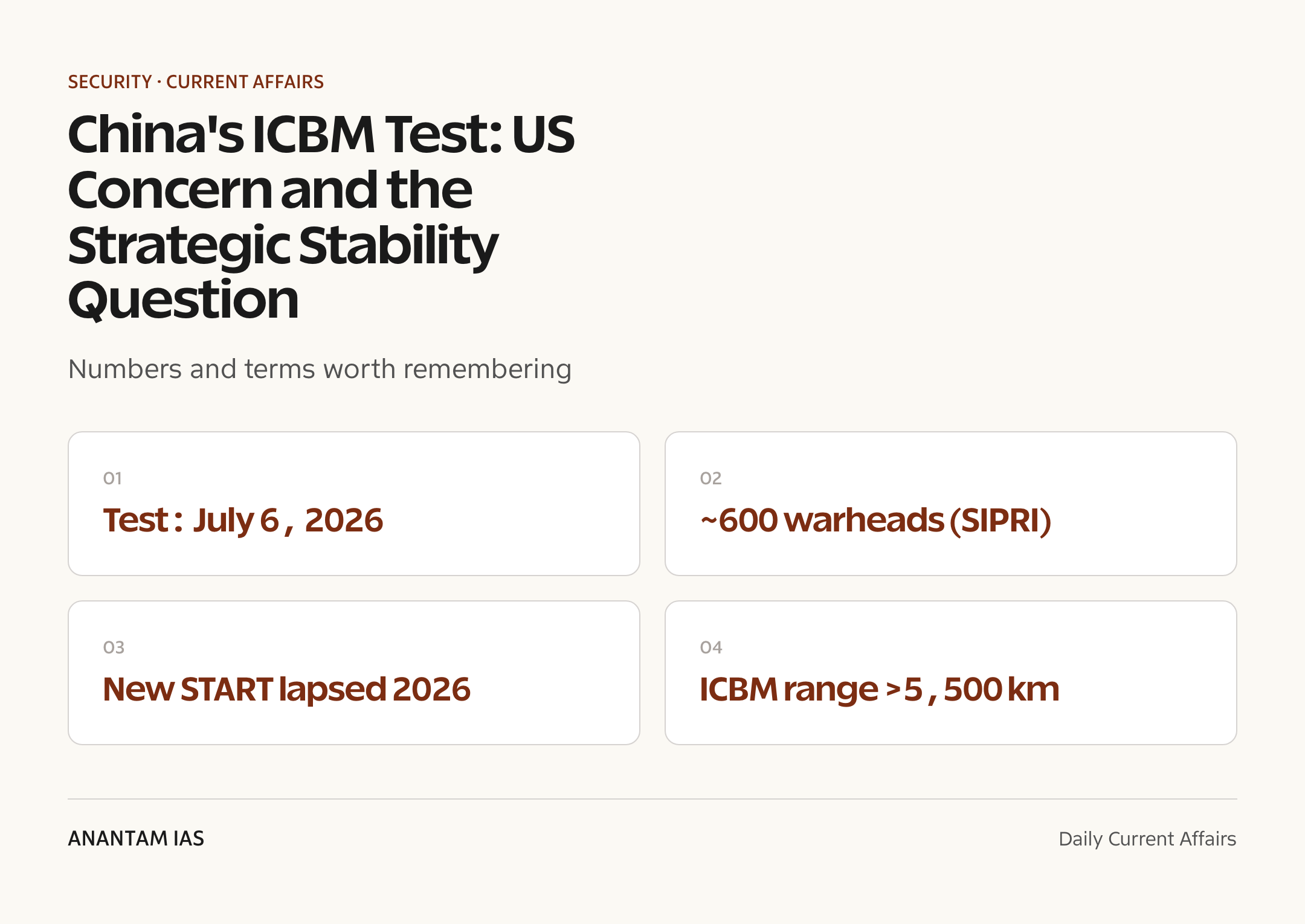
UPSC Relevance
Prelims Relevance
- ICBM — a ballistic missile with range above 5,500 km; fired from a nuclear-powered submarine (SSBN) it is an SLBM.
- P5 — the five permanent UNSC members, also the five recognised nuclear-weapon states under the NPT (1968).
- Hague Code of Conduct (HCoC), 2002 — politically binding pre-launch notification regime; India subscribed in 2016; China is the only P5 state outside it.
- New START — 2010 US–Russia treaty capping each side at 1,550 deployed strategic warheads; expired February 5, 2026.
- SIPRI Yearbook 2025 — China at about 600 warheads, the fastest-growing arsenal, adding roughly 100 a year since 2023.
- India–Pakistan CBMs — the 2005 pre-notification agreement on missile flight tests; the 1988 Non-Attack Agreement (lists exchanged every January 1).
- Bilateral launch-notification pacts — US–Russia (1988), China–Russia (2009); none exists between the US and China, or India and China.
- India’s nuclear doctrine (2003) — credible minimum deterrence, No First Use, massive retaliation, Nuclear Command Authority.
- India’s nuclear triad — completed with INS Arihant’s first deterrence patrol in November 2018.
Mains Relevance
GS Paper 2
- US–China competition and extended deterrence: alliance reassurance in the Indo-Pacific order India operates in.
- Erosion of the arms-control architecture — INF gone (2019), New START lapsed (2026) — and the case for bringing China into P5-wide frameworks.
- Launch notifications and CBMs as low-cost risk reduction — lessons from the India–Pakistan 2005 agreement for India–China ties.
GS Paper 3
- Credible minimum deterrence under stress: what China’s buildup means for the survivability of India’s second-strike capability.
- India’s two-front nuclear environment and the maturation of the SSBN leg of the triad.
Essay
- “Trust, but verify”: transparency, not weaponry, is the true currency of strategic stability.
- Deterrence keeps the peace only as long as rivals keep talking — the paradox of nuclear order.
Background and Context
What China Tested: The Sea Leg of Deterrence
A submarine-launched intercontinental-range test is less about the missile and more about the message — a survivable second strike.
- The launch came from an SSBN; sea-based missiles are the most survivable leg of a nuclear triad — submarines are hard to find and destroy in a first strike.
- A secure second-strike capability is the bedrock of deterrence — if a state can absorb an attack and still retaliate, striking first gains nothing: strategic stability.
- The PLA Navy framed the launch as routine annual training, said “relevant countries” were notified in advance, and declined to identify the missile or its range — the opacity Washington highlighted.
- Precedent: the September 25, 2024 ICBM test into the Pacific was China’s first announced since 1980; July 2026 extends visible testing to the sea leg. Basics: the cruise missile vs ballistic missile explainer.
How Washington Responded: Assurance Plus Arms Control
The US reply had two audiences — allies who need reassurance, and Beijing, which it wants at the table.
- Reassurance first: the US “remains steadfast” in defence commitments — extended deterrence signalling to treaty allies such as Japan, South Korea and Australia.
- Pressure second: spokesperson Tommy Pigott said that while the US works to prevent nuclear proliferation, “China is doing the opposite”.
- The concrete ask: “meaningful arms control discussions” plus a “regularized notification arrangement” for all intercontinental-range missile and space launches.
- The benchmark of “all other P5 members”: the US, Russia, UK and France subscribe to the Hague Code of Conduct; Washington and Moscow have also exchanged notifications bilaterally since 1988.
- Dialogue is thin: a rare US–China arms-control consultation in November 2023 ended with Beijing suspending talks in July 2024 over US arms sales to Taiwan.
China's Arsenal: The Numbers Behind the Concern
Independent estimates back the US description of a fast-growing force, even as China professes restraint.
- The SIPRI Yearbook 2025 put China’s stockpile at about 600 warheads — the world’s fastest-growing arsenal, up roughly 100 a year since 2023.
- The US Department of Defense projects over 1,000 operational warheads by 2030, supported by new silo fields in China’s western deserts and a growing SSBN fleet.
- China trails the two superpowers — Russia and the US hold about 90% of all warheads — but is the only P5 state expanding at this pace.
- Beijing’s declared posture is restraint — an unconditional No First Use (NFU) pledge since October 1964 and a “lean and effective” deterrent.
- The credibility gap: China publishes no warhead numbers, joins no data exchanges and accepts no treaty caps — opacity, not size alone, anchors the US complaint.
The Arms-Control Architecture: What Is Left Standing
Five decades of treaty scaffolding has thinned to almost nothing, which raises the stakes of every new test.
- NPT (1968) — the cornerstone regime recognising five nuclear-weapon states and committing them to disarmament negotiations under Article VI; see the UN Office for Disarmament Affairs NPT page. India is not a party.
- INF Treaty — the US–Russia ban on intermediate-range land-based missiles collapsed in 2019.
- New START — the last US–Russia cap (1,550 deployed warheads each) expired on February 5, 2026, leaving the two largest arsenals unbound for the first time in over five decades.
- CTBT — never entered into force (China has signed but not ratified; India has not signed); a Fissile Material Cut-off Treaty (FMCT) stays stalled in the Conference on Disarmament.
- The P5 Joint Statement of January 3, 2022 — “a nuclear war cannot be won and must never be fought” — remains the rare common ground, and the political hook for the US notification proposal.
Launch Notifications: Small Measure, Big Stakes
Pre-launch notification is the cheapest insurance in the nuclear world — it stops a test being mistaken for an attack.
- Early-warning radars cannot easily tell a test from a strike; notification buys decision time and prevents escalation from misinterpretation.
- Hague Code of Conduct (HCoC), 2002 — over 140 states give pre-launch notifications of missile and space launches; it is politically, not legally, binding.
- India subscribed to the HCoC in June 2016, the year it also joined the MTCR; China is the only P5 member outside the Code.
- Bilateral pacts fill gaps: US–Russia (1988) and China–Russia (2009) exchange launch notifications — but no US–China arrangement exists.
- South Asia’s example: the India–Pakistan pre-notification agreement (2005) has survived every crisis, with the 1988 Non-Attack Agreement and its January 1 lists.
- The conspicuous gap: India and China have no nuclear or missile CBM at all — no pre-notification pact, no dedicated nuclear hotline.
The India Angle: Deterrence in a Two-Front Nuclear Environment
India reads China’s testing through the lens of its own doctrine of restraint and a hard two-front reality.
- India’s nuclear doctrine (January 2003) rests on credible minimum deterrence, No First Use, massive retaliation, and civilian control through the Nuclear Command Authority chaired by the Prime Minister.
- India completed its triad when INS Arihant finished its first deterrence patrol in November 2018; INS Arighaat followed in 2024 — see India’s nuclear triad and the submarine fleet of India.
- On land, Agni-V (range above 5,000 km) covers all of China, and Mission Divyastra (March 2024) tested MIRV technology — detailed in the Agni missile series explainer.
- The asymmetry is stark: SIPRI 2025 estimates India at about 180 warheads and Pakistan at about 170, against China’s ~600 and rising — India’s “minimum” must stay credible without triggering an arms race.
- China’s growing sea-based deterrent also deepens the anti-submarine-warfare challenge for India and its Quad partners; India’s wider positioning is mapped in India and the US–China–Russia triangle.
Way Forward
Rebuild the Arms-Control Conversation
- A P5-wide launch-notification arrangement is the lowest-hanging fruit — no cuts, only transparency, on the HCoC template four P5 peers follow.
- Resume the US–China strategic-stability dialogue, insulating risk reduction from disputes such as Taiwan arms sales.
- Open framework talks on a post-New START order that reflects a three-player nuclear balance.
Risk Reduction in Asia
- India and China should negotiate a missile pre-notification pact and dedicated hotline, mirroring the India–Pakistan 2005 model.
- Push HCoC universalisation through UN forums so pre-launch notification becomes a global norm.
- Keep conventional and nuclear signalling distinct in crises — ambiguity between the two invites inadvertent escalation.
India's Own Posture
- Consolidate a survivable second-strike — longer-range SLBMs, more SSBN patrols, hardened command and control — not warhead numbers.
- Invest in space-based early warning and maritime domain awareness to verify tests and deployments independently.
- Stay active in the Conference on Disarmament and keep championing the FMCT — a fissile-material cap bites hardest on the fastest-growing arsenal.
Conclusion
On its own terms, China’s July 6 test was routine — a dummy warhead, advance word to “relevant countries”, a training-cycle framing. What made it news is the world it landed in: no US–Russia treaty caps, no US–China dialogue, a fast-growing arsenal whose size Beijing won’t discuss. In that vacuum, even routine tests read as signals.
The US response asks for very little — not cuts, just talks and notifications. That even this is contested shows how far strategic trust among the P5 has fallen.
For India, the lesson is double-edged: keep the deterrent credible and survivable, and keep arguing — with the Pakistan-facing CBMs as proof — that transparency between nuclear neighbours is the cheapest form of security.
UPSC Practice Questions
Prelims MCQ 1
With reference to the Hague Code of Conduct against Ballistic Missile Proliferation (HCoC), consider the following statements:
- It is a legally binding treaty negotiated under the United Nations.
- China is not a subscribing state to the HCoC.
- India subscribed to the HCoC in 2016.
How many of the above statements are correct?
(a) Only one (b) Only two (c) All three (d) None
Answer: (b) Only two
Explanation:
The HCoC (2002) is politically binding, not a treaty — statement 1 is wrong. China is the only P5 state outside it, and India subscribed in June 2016 — statements 2 and 3 are correct.
Prelims MCQ 2
The New START treaty, which expired in February 2026, limited the deployed strategic nuclear arsenals of which of the following pairs of countries?
(a) The United States and China (b) The United States and Russia (c) Russia and China (d) The United States, Russia and China
Answer: (b) The United States and Russia
Explanation:
New START (2010) capped the US and Russia at 1,550 deployed strategic warheads each; it expired on February 5, 2026. China has never been party to any warhead-limiting treaty.
UPSC Mains Questions
- China’s rapid and opaque nuclear expansion is altering Asia’s deterrence calculus. Examine its implications for India’s credible minimum deterrence and the survivability of its second-strike capability. (250 words)
- With New START’s expiry in 2026, the global arms-control architecture has thinned dramatically. Can transparency measures such as launch-notification arrangements substitute for binding treaties in preserving strategic stability? Discuss. (250 words)
- India and Pakistan sustain missile pre-notification and non-attack agreements through crises, yet India and China have no nuclear CBMs. Analyse the case for, and obstacles to, India–China nuclear confidence-building. (250 words)
Source: The Hindu (AP report).
Frequently Asked Questions
What did China test on July 6, 2026?
China test-fired a long-range strategic missile with a dummy warhead from a nuclear-powered submarine in the Pacific Ocean. The US State Department said it monitored the launch of an unarmed intercontinental-range ballistic missile that landed in the southern Pacific. Beijing called it routine annual PLA Navy training, notified in advance to relevant countries.
Why did the United States object to the test?
Washington called Beijing’s nuclear buildup rapid and opaque, and of great concern to the region. It urged China to join meaningful arms-control talks and adopt a regularised notification arrangement for ICBM and space launches, matching commitments by the other P5 members, while reaffirming US defence commitments to allies.
What counts as an intercontinental-range ballistic missile?
By arms-control convention, an ICBM is a ballistic missile with a range above 5,500 km, able to cross continents on a high arcing trajectory. When fired from a nuclear-powered submarine it is called an SLBM, forming the most survivable, second-strike leg of a nuclear triad.
What is the Hague Code of Conduct?
The HCoC (2002) is a politically binding transparency regime with over 140 subscribing states. Members give pre-launch notifications of ballistic-missile and space launches and annual declarations. India subscribed in June 2016. China is the only P5 member that has stayed outside the Code.
What happened to the New START treaty?
New START (2010) capped the US and Russia at 1,550 deployed strategic warheads each. It expired on February 5, 2026 without a successor, leaving the world’s two largest nuclear arsenals without any legally binding limit for the first time in over five decades.
How does China’s test matter for India?
China’s roughly 600-warhead and growing arsenal, per SIPRI 2025, deepens India’s two-front nuclear environment. India relies on credible minimum deterrence, No First Use and a triad anchored by INS Arihant and INS Arighaat. The absence of any India-China nuclear CBM makes transparency diplomacy directly relevant to Indian security.
Source: https://anantamias.com/current-affairs/china-icbm-test-us-concern-strategic-stability/
India’s Steel Sector in Q1 FY26: Production Up, Prices Soften, Consumption Surges
Why in News?
The Ministry of Steel released its monthly performance summary on 6 July 2026, and PIB confirmed that India’s steel sector recorded growth across production, consumption and trade in Q1 FY26 (April–June 2026). The figures are provisional Joint Plant Committee (JPC) data — the official statistics for the iron and steel industry.
Crude steel production rose 3.0% year-on-year to 42.1 million tonnes (Mt), finished steel consumption jumped 8.3% to 41.6 Mt, and benchmark prices softened month-on-month even as imports surged nearly 50%. India remained a net importer of finished steel for the quarter.
- Crude steel: 42.1 Mt in April–June 2026, up 3.0% over the corresponding period last year; June alone stood at 14.1 Mt (+3.9% YoY).
- Finished steel production reached 41.0 Mt (+5.9%), while finished steel consumption hit 41.6 Mt (+8.3%) — demand grew faster than output.
- Prices eased in June: TMT bars (10 mm) averaged ₹60,068/tonne (−4.7% month-on-month); HR coil at ₹70,108/tonne (−0.5% MoM) but still +11.2% YoY.
- Trade: finished steel imports touched 2.06 Mt (+49.2%) against exports of 1.59 Mt (+31.4%) — India stayed a net importer in quantity terms.
The development matters in the context of:
- Steel is one of the eight core industries, so this dataset is direct evidence for questions on industrial growth, IIP trends and infrastructure-led demand.
- The import surge sits behind live policy action — a fresh DGTR anti-dumping investigation into hot-rolled flat steel from China, Japan and Russia — making this a ready case study on trade remedies.
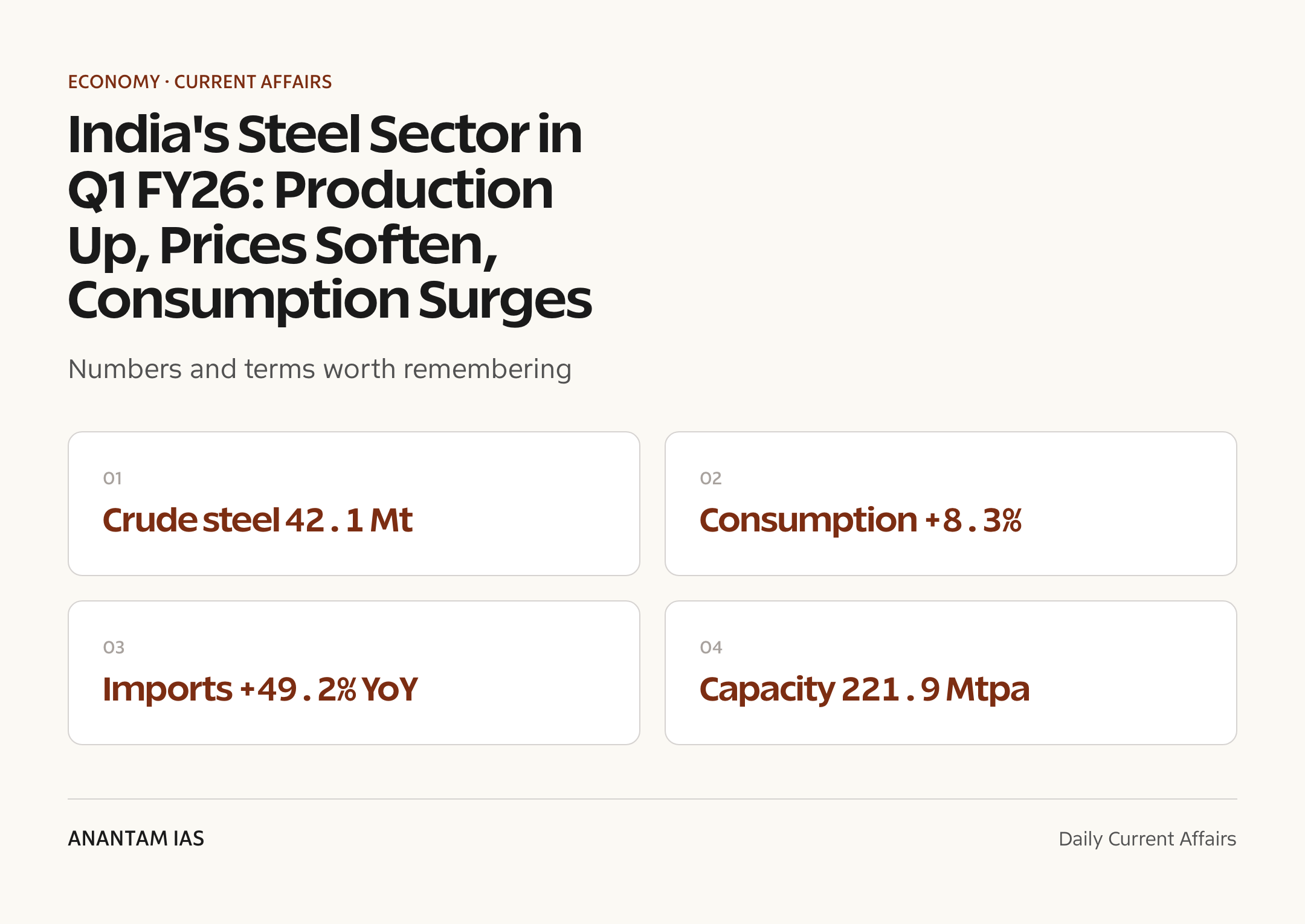
UPSC Relevance
Prelims Relevance
- Steel is one of the eight core industries, with about a 17.92% weight in the Index of Eight Core Industries (ICI) — behind only refinery products and electricity.
- The eight core industries together carry a 40.27% weight in the Index of Industrial Production (IIP).
- The Joint Plant Committee (JPC), under the Ministry of Steel, is the only body officially empowered to collect data on the Indian iron and steel industry.
- India has been the world’s second-largest crude steel producer since 2018, behind China; it is also the second-largest consumer of finished steel.
- Q1 FY26 scorecard: crude steel 42.1 Mt (+3.0%), finished steel consumption 41.6 Mt (+8.3%), India a net importer in quantity terms.
- National Steel Policy 2017 targets: 300 Mtpa crude steel capacity and 160 kg per-capita finished steel consumption by 2030-31.
- PLI Scheme for Specialty Steel (2021): ₹6,322 crore outlay across five product categories; PLI 1.1 launched in January 2025.
- SAIL supplied all 5,700 tonnes of special steel for three new Indian Navy vessels — INS Dunagiri, INS Agray and INS Sanshodhak.
Mains Relevance
GS Paper 3
- Steel as a lead indicator of infrastructure-led growth — consumption rising 8.3% signals construction and capital-expenditure momentum in the wider economy.
- Trade policy design: weighing anti-dumping and safeguard duties against cost pressures on steel-using industries such as construction, autos and MSME fabricators.
- Decarbonising a hard-to-abate sector: the green steel taxonomy, plant-level CO₂ dashboards and the challenge of carbon border measures like CBAM.
GS Paper 2
- Government policies and interventions for industrial development — National Steel Policy 2017, PLI for specialty steel and CPSE autonomy (Miniratna status) as instruments of state capacity.
Essay
- Infrastructure as the engine of development — steel demand as the measurable footprint of nation-building.
- Growth versus climate: can a late industrialiser build big and build green at the same time?
Background and Context
Steel as a Core Sector: Why One Monthly Release Matters
Steel data is a proxy for the wider economy, which is why examiners keep returning to it.
- Steel is one of the eight core industries, carrying about a 17.92% weight in the Index of Eight Core Industries (ICI) — third after refinery products and electricity; the eight together hold 40.27% of the IIP.
- All figures are provisional Joint Plant Committee (JPC) data for June 2026 — the JPC is the sole official agency for iron and steel statistics under the Ministry of Steel.
- India has been the world’s second-largest crude steel producer since 2018, when it overtook Japan, and is second only to China in finished steel consumption.
- Steel demand tracks construction, railways, defence and capital goods, so a consumption spike signals an infrastructure-led investment cycle in the broader manufacturing sector.
The Q1 FY26 Production Scorecard
PIB’s headline tables show growth across the value chain, with finished steel outpacing crude.
- Crude steel: 42.1 Mt against 40.8 Mt a year earlier (+3.0%); June output was 14.1 Mt (+3.9% YoY).
- Hot metal — molten iron tapped from blast furnaces — grew 1.4% to 23.5 Mt; finished steel production rose 5.9% to 41.0 Mt.
- The top 7 producers — SAIL, RINL, NSL, TSL Group, AM/NS, JSL(JSPL) and JSW Group — made 23.2 Mt of crude steel, roughly 55% of the total.
- The public sector share was 15.7% of crude steel but 30.4% of hot metal — a marker of the PSU fleet’s blast-furnace-heavy route.
- Capacity held at 221.9 Mtpa against the National Steel Policy’s 300 Mtpa goal; JSW Group began building a 2 MTPA integrated plant at Kadapa, Andhra Pradesh.
- Upstream, NMDC produced 5.15 Mt of iron ore in June (up 44% YoY), taking Q1 output to 15.10 Mt despite the monsoon.
Demand and Prices: Consumption Outpaces Output
The demand side is the strongest signal in this release.
- Finished steel consumption reached 41.6 Mt, up 8.3% over the corresponding period last year; June alone was 14.2 Mt (+7.2%).
- Consumption growth (8.3%) ran ahead of finished-production growth (5.9%) — a gap bridged largely by imports.
- All four benchmark products got cheaper month-on-month in June: TMT (10 mm) at ₹60,068/tonne (−4.7%), HR coil at ₹70,108 (−0.5%), CR coil at ₹77,053 (−1.1%) and GP sheet at ₹86,505 (−2.8%).
- Year-on-year, though, every product was costlier — GP sheet +15.8%, HR coil +11.2%, TMT +4.4% — so June’s softening is a monthly correction, not a slump. Prices are GST-inclusive averages across four metros.
- Raw materials were mixed: NMDC Bailadila iron ore lump rose 3.6% MoM to ₹5,700/tonne, while MOIL manganese ore fell 5.0% and HMS-II scrap fell 4.4%.
- Market signals stayed constructive: the Nifty Metal Index averaged 12,971.9 in June (+39.3% YoY) and the PMI Manufacturing read 54.2 (above 50 = expansion).
Trade Dynamics: The Import Surge and Trade Remedies
Trade is where the stress shows — imports rose faster than exports and India stayed a net buyer.
- Imports of finished steel hit 2,063.9 thousand tonnes, up 49.2%, worth ₹20,214.5 crore; June alone jumped 57.9% YoY.
- Exports grew a slower 31.4% to 1,592.8 thousand tonnes — PIB states India was a net importer of finished steel in quantity terms for the quarter.
- In response, the DGTR (Directorate General of Trade Remedies, Ministry of Commerce and Industry) initiated an anti-dumping investigation into hot-rolled flat steel imports from China, Japan and Russia.
- Concept check: an anti-dumping duty targets goods priced below normal value from specific countries; a safeguard duty targets an import surge from all sources; a countervailing duty offsets foreign subsidies.
- India imposed a 12% safeguard duty on certain flat-steel products in 2025 after a similar surge, so the new probe extends an established trade-defence playbook.
- The Steel Import Monitoring System (SIMS), running since 2019, requires advance registration of steel imports — the government’s early-warning radar.
- The GS3 trade-off to argue: duties shield producers but raise input costs for steel-using MSMEs, construction and automakers — protection is never free.
Policy Framework: NSP 2017, PLI and the Institutional Push
The durable syllabus behind this data is the policy stack that steers capacity, quality and self-reliance.
- National Steel Policy 2017: 300 Mtpa crude capacity, 255 Mt production and 160 kg per-capita consumption by 2030-31; current capacity of 221.9 Mtpa shows the distance left.
- The PLI Scheme for Specialty Steel (2021, ₹6,322 crore) incentivises five value-added categories, from coated products to electrical steel; PLI 1.1 opened in January 2025.
- The DMI&SP policy gives preference to domestic iron and steel in government procurement; the Steel Scrap Recycling Policy 2019 formalises the scrap ecosystem.
- PIB highlighted a Chintan Shivir on Digitalisation in the Steel Sector (24 June 2026), pushing AI, automation, digital mining and predictive maintenance.
- MECON Limited received Miniratna Category-I status — such CPSEs can invest up to ₹500 crore or their net worth, whichever is lower, without government approval.
- Import substitution in defence steel: SAIL supplied all 5,700 tonnes of special steel for INS Dunagiri, INS Agray and INS Sanshodhak — a self-reliance data point that pairs with the National Manufacturing Mission.
Green Steel: Decarbonising a Hard-to-Abate Sector
Steel’s carbon intensity is now a first-order policy question, and this release flags the early institutional responses.
- Iron and steel account for roughly 10–12% of India’s CO₂ emissions (about 7–8% globally), making the sector central to any net-zero pathway.
- India’s Green Steel Taxonomy (December 2024) defines green steel by emission intensity below 2.2 tCO₂e per tonne of finished steel, with star ratings — five-star for under 1.6.
- SAIL’s Rourkela Steel Plant launched a first-of-its-kind CO₂ Dashboard with 100% ERP-SAP data integration to track decarbonisation.
- Hydrogen-based DRI (direct reduced iron) is the long-term technology bet: steel is a named focus sector of the National Green Hydrogen Mission.
- The external pressure is real: the EU’s Carbon Border Adjustment Mechanism (CBAM) starts pricing the embedded carbon of steel imports from 2026, directly hitting Indian exporters.
Way Forward
Calibrate trade defence
- Conclude the DGTR hot-rolled steel probe on evidence and on schedule; prefer targeted, time-limited duties over blanket protection.
- Use SIMS data as a genuine early-warning system, and track the cost pass-through to steel-using MSMEs before extending any measure.
Close the capacity and raw-material gap
- Bridging 221.9 to 300 Mtpa needs faster brownfield expansion plus greenfield clusters like Kadapa, supported by logistics planning under PM Gati Shakti.
- Reduce dependence on imported coking coal (around 85% of requirement) through beneficiation, blending and scrap-based capacity under the Steel Scrap Recycling Policy 2019.
Make the growth green
- Operationalise the green steel taxonomy through green public procurement of star-rated steel in government projects.
- Scale hydrogen-DRI pilots under the National Green Hydrogen Mission and replicate plant-level CO₂ dashboards, so exporters are CBAM-ready by design.
Conclusion
Q1 FY26 is a good-news release with one caveat. Demand is the standout — consumption growing 8.3% is unambiguous evidence of an infrastructure and construction upcycle. But output grew only 3%, and the near-50% import surge shows domestic supply is not yet meeting that demand at competitive prices.
For the exam, memorise the direction rather than the decimals: production up, consumption up faster, prices softening month-on-month, India a net importer, capacity at 221.9 Mtpa against the 300 Mtpa target — and the policy stack (NSP 2017, PLI, trade remedies, green steel taxonomy) that hangs off these numbers.
UPSC Practice Questions
Prelims MCQ 1
With reference to India’s steel sector data for Q1 FY26 (April–June 2026), consider the following statements:
- Crude steel production grew year-on-year, while finished steel consumption grew faster than crude steel production.
- India was a net exporter of finished steel in quantity terms during the quarter.
- The official data on the Indian iron and steel industry is collected by the Joint Plant Committee under the Ministry of Steel.
How many of the above statements are correct?
(a) Only one (b) Only two (c) All three (d) None
Answer: (b) Only two
Explanation:
Statements 1 and 3 are correct: crude output rose 3.0% while consumption rose 8.3%, and the JPC is the sole official data agency. Statement 2 is wrong — India was a net IMPORTER of finished steel in quantity terms.
Prelims MCQ 2
Which of the following best describes the difference between an anti-dumping duty and a safeguard duty?
(a) An anti-dumping duty applies to all imports of a product, while a safeguard duty targets specific countries (b) An anti-dumping duty counters below-normal-value pricing from specific countries, while a safeguard duty counters an import surge from all sources (c) An anti-dumping duty is imposed by the WTO, while a safeguard duty is imposed by the importing country (d) Both duties require proof that the exporting government subsidised the product
Answer: (b) An anti-dumping duty counters below-normal-value pricing from specific countries, while a safeguard duty counters an import surge from all sources
Explanation:
Anti-dumping duties are country-specific remedies against dumping; safeguard duties respond to import surges irrespective of pricing. Subsidies are countered by countervailing duties. DGTR investigates and recommends; the Department of Revenue notifies.
UPSC Mains Questions
- India’s finished steel consumption grew 8.3% in Q1 FY26 even as finished steel imports surged nearly 50%. Examine the factors driving steel demand in India and evaluate how far trade remedies can protect domestic producers without raising costs for steel-using industries.
- The National Steel Policy 2017 targets 300 Mtpa of crude steel capacity by 2030-31, while current capacity stands at about 222 Mtpa. Discuss the raw-material, financing and carbon-intensity constraints on this target and suggest policy measures to overcome them.
- Steel is among the hardest industrial sectors to decarbonise. Discuss how India’s green steel taxonomy and the National Green Hydrogen Mission can align steel-capacity expansion with the net-zero commitment, in the context of carbon border measures such as the EU’s CBAM.
Source: PIB, Ministry of Steel.
Frequently Asked Questions
How did India’s steel sector perform in Q1 FY26?
Per provisional JPC data released by PIB, crude steel production rose 3.0% year-on-year to 42.1 million tonnes in April–June 2026, finished steel production rose 5.9% to 41.0 Mt, and consumption grew 8.3% to 41.6 Mt. Prices softened month-on-month in June, and India remained a net importer of finished steel.
Why is steel called a core sector industry?
Steel is one of the eight core industries, holding roughly a 17.92% weight in the Index of Eight Core Industries. The eight together carry a 40.27% weight in the Index of Industrial Production, so steel output directly moves India’s headline industrial-growth numbers and signals infrastructure activity.
What is the Joint Plant Committee?
The Joint Plant Committee (JPC) is the only body officially empowered to collect data on India’s iron and steel industry. It functions under the Ministry of Steel, and its provisional monthly figures — like the June 2026 numbers in this release — form the sector’s official statistical record.
Is India a net importer or exporter of steel?
For April–June 2026, India was a net importer of finished steel in quantity terms. Imports rose 49.2% to about 2.06 million tonnes while exports grew 31.4% to about 1.59 million tonnes. The surge has triggered a DGTR anti-dumping probe into hot-rolled flat steel from China, Japan and Russia.
What counts as green steel in India?
Under the Green Steel Taxonomy released in December 2024, steel earns a green star rating if its emission intensity is below 2.2 tonnes of CO₂ equivalent per tonne of finished steel, with five-star status under 1.6. The framework enables green public procurement and prepares exporters for measures like CBAM.
Source: https://anantamias.com/current-affairs/india-steel-sector-q1-fy26-growth/
AI in Financial Services: UK Regulator Flags Systemic Risks
Why in News?
The Hindu (via Reuters) reported on 7 July 2026 that a review commissioned by the Financial Conduct Authority (FCA) — the United Kingdom’s conduct regulator for financial services — has urged it to consider regulating large language models (LLMs) such as ChatGPT, Claude and Gemini because of their growing influence on consumer financial decisions. The review, led by FCA Executive Director Sheldon Mills, was published on 6 July 2026.
The headline finding: more than a quarter of UK consumers already trust general-purpose AI chatbots for financial advice, with little awareness that regulated-service protections don’t extend to them. The review also warned that reliance on a handful of technology providers could create system-wide risks. The FCA calls itself the first regulator globally to study AI’s impact on financial services this way.
- The review recommends the FCA decide within 3–6 months whether to “secure and adapt” the regulatory perimeter in response to AI models sitting outside it.
- A survey cited in the review found 81% of financial firms globally adopting AI at some level, with 40% at more advanced stages.
- Most use cases sit in lower-risk back-office functions, but UK firms are pushing AI into customer-facing roles such as complaints handling and investment guidance.
- A week earlier, Bank of England Deputy Governor Sarah Breeden signalled, for the first time, the need for bespoke AI regulation to contain risks from increasingly capable agentic systems.
- The FCA isn’t bound to act on the recommendations — an advisory exercise, much like the RBI’s own FREE-AI committee report of August 2025.
The development matters in the context of:
- The review matters for India because the Reserve Bank of India (RBI) has walked the same road: its FREE-AI committee delivered a full framework for responsible AI in finance in August 2025.
- It hands GS3 answers a ready comparative frame — the EU’s binding AI Act, the UK’s sectoral approach, and India’s advisory, pro-innovation model.
- The risks it names — concentration risk, herding, model risk, blurred advice boundaries — are durable syllabus concepts, not one-off news.
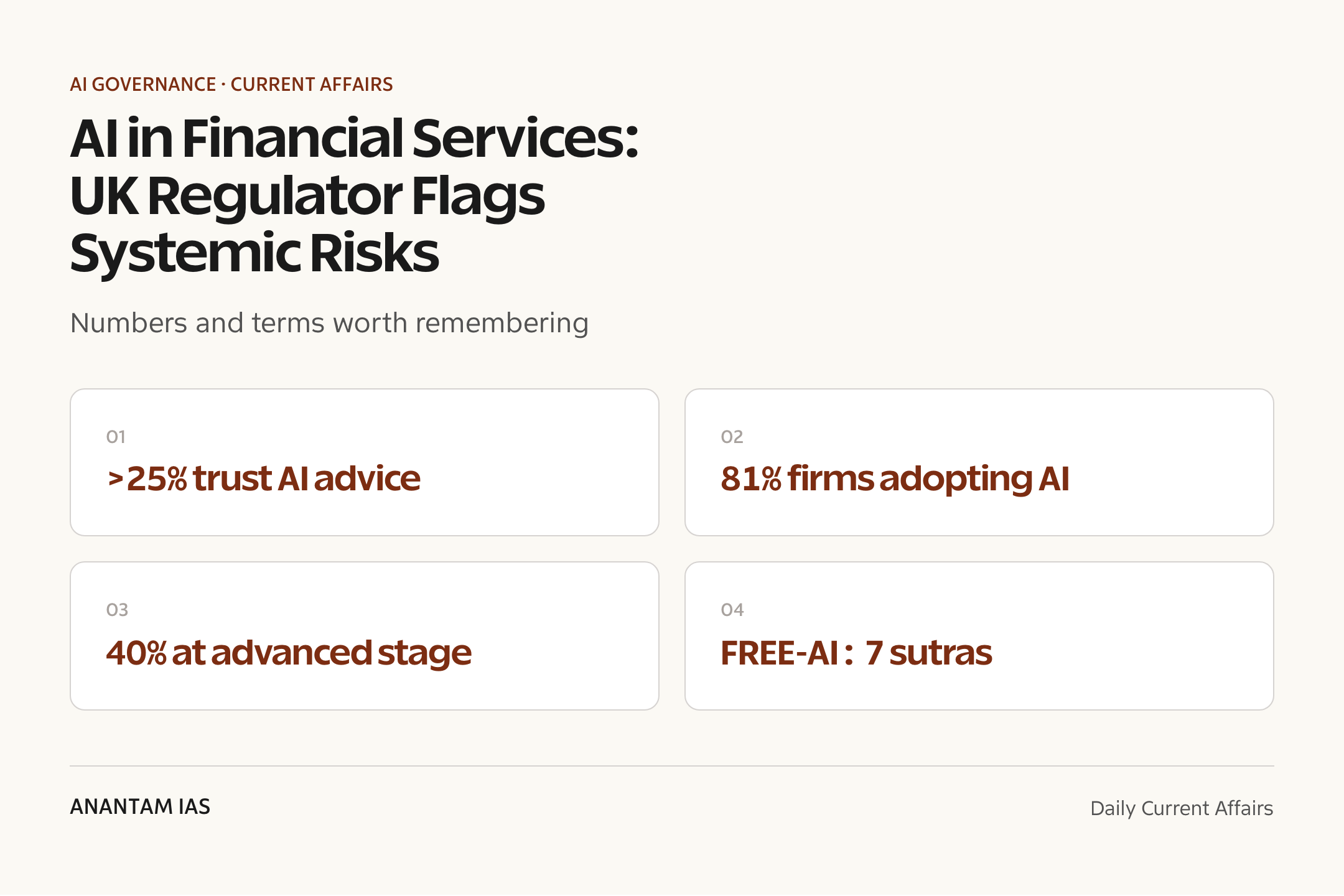
UPSC Relevance
Prelims Relevance
- Financial Conduct Authority (FCA) — the UK’s conduct regulator for financial services; first regulator globally to study AI’s impact on the sector.
- Regulatory perimeter — the legal boundary between activities needing regulatory authorisation (like personalised financial advice) and those outside a regulator’s remit.
- FREE-AI — RBI’s Framework for Responsible and Ethical Enablement of Artificial Intelligence; committee chaired by Dr Pushpak Bhattacharyya (IIT Bombay), report released 13 August 2025.
- FREE-AI architecture — 7 sutras and 26 recommendations under 6 pillars: Infrastructure, Policy, Capacity, Governance, Protection, Assurance.
- Agentic AI — AI systems that plan and act toward goals with limited human intervention, unlike chatbots that only respond to prompts.
- Concentration risk — many firms depending on a few AI-model or cloud providers, creating common points of failure; related: herding (correlated behaviour from shared models).
- EU AI Act — the world’s first comprehensive, binding AI law; risk-based tiers; entered into force in August 2024.
- RBI Regulatory Sandbox (2019) — live-testing framework for fintech products; MuleHunter.AI — Reserve Bank Innovation Hub model that helps banks detect mule accounts.
Mains Relevance
GS Paper 3
- Systemic risk from AI in finance — concentration, herding, correlated failures — as a new category of financial-stability threat.
- Regulating emerging technology in critical sectors: the EU’s binding law versus the UK’s review-led approach versus India’s FREE-AI advisory framework.
- Consumer protection when unregulated LLM chatbots give quasi-financial advice outside the regulatory perimeter.
GS Paper 2
- Capacity of statutory regulators (RBI, SEBI) to keep pace with general-purpose technologies; the case for coordination through the FSDC.
- Comparative governance — structuring accountability for AI without a single dedicated law.
Essay
- Trust is the real currency of finance — and machines are now minting it.
- Regulation in the age of AI: guarding the perimeter of a borderless technology.
Background and Context
What the FCA Review Actually Says
The review is a diagnosis of how fast AI has moved from the back office to the customer’s phone — and how far behind the rulebook sits.
- Commissioned by the FCA and led by Executive Director Sheldon Mills, the review was published on 6 July 2026; the regulator isn’t bound to act on it.
- It found more than a quarter of UK consumers trust tools such as ChatGPT, Claude and Gemini for financial advice — with limited awareness that regulated-service protections don’t extend to those AI services.
- It cited survey data showing 81% of financial firms globally adopting AI, and 40% at advanced stages — a primer on how these models work is in this generative AI and LLMs explainer.
- Central recommendation: within 3–6 months, the FCA should consider whether to “secure and adapt” the regulatory perimeter by reviewing the scale, nature and impact of AI models sitting outside it.
The Regulatory Perimeter Problem
The sharpest issue in the review is definitional: when does a chatbot’s answer become regulated financial advice?
- The regulatory perimeter is the boundary between activities that require a regulator’s authorisation (and carry consumer protections) and activities outside its remit.
- In the UK, financial advice is a regulated activity only authorised businesses may provide — so an AI chatbot should offer nothing beyond generic financial guidance.
- Mills warned that personal recommendations by a chatbot blur this boundary, and “continuous and adaptive” recommendations may start to look like regulated advice.
- The consumer harm is concrete: a user misled by an unregulated LLM has none of the compensation and grievance protections that apply to authorised advisers.
- Jonathan Herbst of law firm Norton Rose Fulbright noted the review proposes no immediate crackdown — the question is whether rules must evolve to match how financial services are actually delivered.
Concentration Risk: Why AI Is a Financial-Stability Issue
The deeper worry isn’t one bad answer to one consumer — it’s the whole system leaning on the same few machines.
- Widespread adoption could leave firms dependent on a small number of technology providers for critical operational capabilities.
- Shared reliance on the same models or cloud providers could create correlated behaviour, herding and common points of failure across the financial system — the classic anatomy of systemic risk.
- Regulators are also tracking frontier AI models and agentic systems — AI that acts with limited human intervention; see this explainer on agentic AI.
- Bank of England Deputy Governor Sarah Breeden put it bluntly: “Our frameworks were not built to contemplate autonomous agents, and relying on a human in the loop for all agent actions is unlikely to be realistic.”
- Model risk — a model’s errors or opacity producing bad decisions at scale — turns system-wide when everyone runs the same model; the Financial Stability Board flagged these vulnerabilities in November 2024.
India's Answer: RBI's FREE-AI Framework
India didn’t wait for London — the RBI commissioned its own AI framework well before the FCA review appeared.
- In December 2024, the RBI constituted an 8-member expert committee chaired by Dr Pushpak Bhattacharyya (IIT Bombay); its FREE-AI report came on 13 August 2025.
- It rests on 7 sutras: Trust is the Foundation; People First; Innovation over Restraint; Fairness and Equity; Accountability; Understandable by Design; Safety, Resilience and Sustainability.
- It makes 26 recommendations across 6 pillars — Infrastructure, Policy, Capacity, Governance, Protection and Assurance.
- Key asks: board-approved AI policies in every regulated entity, independent model validation and audits, disclosure to customers when AI materially affects outcomes, and AI-specific safeguards in vendor contracts.
- It explicitly targets third-party concentration — the same risk the FCA now flags — by clarifying how RBI’s outsourcing guidelines apply to AI providers.
- Like the FCA review, FREE-AI is advisory, not binding; supporting rails exist in the RBI Regulatory Sandbox (2019) and MuleHunter.AI, the Reserve Bank Innovation Hub’s mule-account detection model.
The Wider Indian AI-Governance Stack
FREE-AI sits inside a broader, deliberately sectoral Indian approach to AI governance.
- SEBI has required market intermediaries to report their AI/ML applications since 2019, and in June 2025 floated a consultation paper on responsible AI/ML use in securities markets.
- The IndiaAI Mission (approved March 2024, about ₹10,372 crore) builds the enabling side — shared GPU compute, datasets, indigenous models and an AI Safety Institute.
- The Digital Personal Data Protection Act, 2023 — Rules notified in November 2025 — governs the personal data financial AI systems train on; see this note on the DPDP Act 2023.
- India has no standalone AI statute: the strategy is pro-innovation, resting on sectoral frameworks like FREE-AI plus existing IT and data-protection law — mapped in AI governance in India.
Three Models of AI Regulation: EU, UK, India
The FCA review is a live case study in the middle path between hard law and no law.
- European Union — the EU AI Act (in force since August 2024) is a binding, horizontal law sorting AI uses into risk tiers, with the heaviest obligations on high-risk systems such as credit scoring.
- United Kingdom — no single AI law; sectoral regulators (FCA, Bank of England) apply principles and existing powers, commissioning reviews like this one before deciding whether the perimeter must move.
- India — an enabling, sector-led model: advisory frameworks (FREE-AI, SEBI’s draft norms), a state-funded capability push (IndiaAI Mission) and general statutes (DPDP Act, IT Act) rather than one omnibus AI law.
- The trade-off: binding rules give certainty but can freeze innovation; advisory frameworks stay flexible but lean on voluntary compliance and regulator vigilance.
Way Forward
For financial regulators
- Adopt risk-proportionate rules: light touch for back-office AI, hard obligations for customer-facing and credit-decision systems.
- Run periodic regulatory-perimeter reviews so adaptive chatbot ‘guidance’ can’t quietly become unregulated advice.
- Map and stress-test concentration risk: identify the models and cloud providers the sector collectively depends on, and require fallback plans; build AI incident-reporting channels so model failures surface the way cyber incidents do.
For India specifically
- Convert FREE-AI’s 26 recommendations into phased supervisory expectations, starting with board-approved AI policies and model audits.
- Use the FSDC platform for RBI–SEBI–IRDAI coordination, since the same foundation models cut across banking, securities and insurance.
- Expand the Regulatory Sandbox to test agentic-AI use cases under supervision before they reach customers at scale.
- Invest in consumer literacy: users must know a chatbot’s confident answer carries none of the protections of regulated advice.
Conclusion
The FCA review marks a turn in how supervisors think about AI: the question is no longer whether banks may use it, but whether the financial system’s plumbing — shared models, shared clouds, autonomous agents — is quietly becoming a single point of failure. Concentration, herding and blurred advice boundaries are now financial-stability vocabulary.
For India, the moment is validating rather than alarming. The FREE-AI framework anticipated nearly every risk the UK review names — a year earlier. The harder task is execution: turning sutras into supervision before an AI-driven failure, not after. For the aspirant, FCA review plus FREE-AI is a ready-made GS3 answer on regulating AI in critical sectors.
UPSC Practice Questions
Prelims MCQ 1
With reference to the RBI’s FREE-AI framework, consider the following statements:
- FREE-AI stands for the Framework for Responsible and Ethical Enablement of Artificial Intelligence, prepared by an expert committee constituted by the Reserve Bank of India.
- The committee’s report is built around seven guiding principles or ‘sutras’, the first being ‘Trust is the Foundation’.
- The report’s 26 recommendations are legally binding on all banks and NBFCs from the date of its release.
How many of the above statements are correct?
(a) Only one (b) Only two (c) All three (d) None
Answer: (b) Only two
Explanation:
Statements 1 and 2 are correct: the 8-member committee chaired by Dr Pushpak Bhattacharyya released the FREE-AI report on 13 August 2025, built on 7 sutras beginning with ‘Trust is the Foundation’. Statement 3 is wrong — the report is advisory, not a binding regulation.
Prelims MCQ 2
The term ‘regulatory perimeter’, recently seen in news in the context of artificial intelligence in finance, best describes:
(a) The physical jurisdiction within which a central bank can conduct inspections (b) The boundary separating activities that require regulatory authorisation from those outside a regulator’s remit (c) The minimum capital buffer a financial firm must hold against technology risks (d) The requirement that financial data be stored on servers located within the country
Answer: (b) The boundary separating activities that require regulatory authorisation from those outside a regulator's remit
Explanation:
The regulatory perimeter is the legal line between regulated activities (like personalised financial advice, which only authorised firms may give) and unregulated ones. The FCA review asks whether AI chatbots giving adaptive recommendations have drifted across this line.
UPSC Mains Questions
- “The systemic risk from artificial intelligence in finance arises less from any single model and more from concentration and correlated behaviour.” Examine this statement in light of recent regulatory reviews in the United Kingdom and the RBI’s FREE-AI framework. (250 words)
- General-purpose AI chatbots increasingly offer quasi-financial advice outside the regulatory perimeter. Discuss the consumer-protection challenges this creates and suggest how Indian regulators should respond without stifling innovation. (250 words)
- Compare the European Union’s binding AI Act with the sectoral, advisory approaches of the United Kingdom and India for regulating AI in the financial sector. Which model suits India’s development stage, and why? (250 words)
Sources: The Hindu (Reuters) and RBI FREE-AI Committee Report.
Frequently Asked Questions
What did the UK FCA’s AI review find?
The review, led by FCA Executive Director Sheldon Mills and published on 6 July 2026, found over a quarter of UK consumers trust chatbots like ChatGPT for financial advice without regulatory protection. It urged the FCA to decide within 3–6 months whether to adapt the regulatory perimeter, and flagged concentration risk from shared AI providers.
What is the regulatory perimeter?
It is the legal boundary separating activities that need a regulator’s authorisation — such as personalised financial advice — from activities outside its remit. Consumers dealing with authorised firms get protections like grievance redress and compensation; those relying on unregulated AI chatbots get none. The FCA fears adaptive chatbot recommendations are blurring this line.
What is RBI’s FREE-AI framework?
FREE-AI is the Framework for Responsible and Ethical Enablement of Artificial Intelligence, prepared by an 8-member RBI committee chaired by Dr Pushpak Bhattacharyya of IIT Bombay. Released on 13 August 2025, it offers 26 advisory recommendations across six pillars — Infrastructure, Policy, Capacity, Governance, Protection and Assurance.
What are the seven sutras of FREE-AI?
The seven guiding principles are: Trust is the Foundation; People First; Innovation over Restraint; Fairness and Equity; Accountability; Understandable by Design; and Safety, Resilience and Sustainability. They steer both the RBI’s policy choices and how banks, NBFCs and fintechs design, deploy and monitor AI systems.
Why is AI a systemic risk in finance?
Because many firms depend on the same few AI models, cloud platforms and vendors, a flaw in one provider can hit the whole system at once. Shared models can also produce herding — correlated decisions that amplify market moves. Agentic systems acting with limited human oversight add further unpredictability.
How do the EU, UK and India regulate AI differently?
The EU has a binding, risk-tiered AI Act in force since August 2024. The UK uses no single law — sectoral regulators like the FCA apply existing powers. India follows a pro-innovation, sectoral path: advisory frameworks like FREE-AI, the IndiaAI Mission for capability, and the DPDP Act for data.
Source: https://anantamias.com/current-affairs/uk-fca-ai-financial-services-risk-review/