

Why in News?
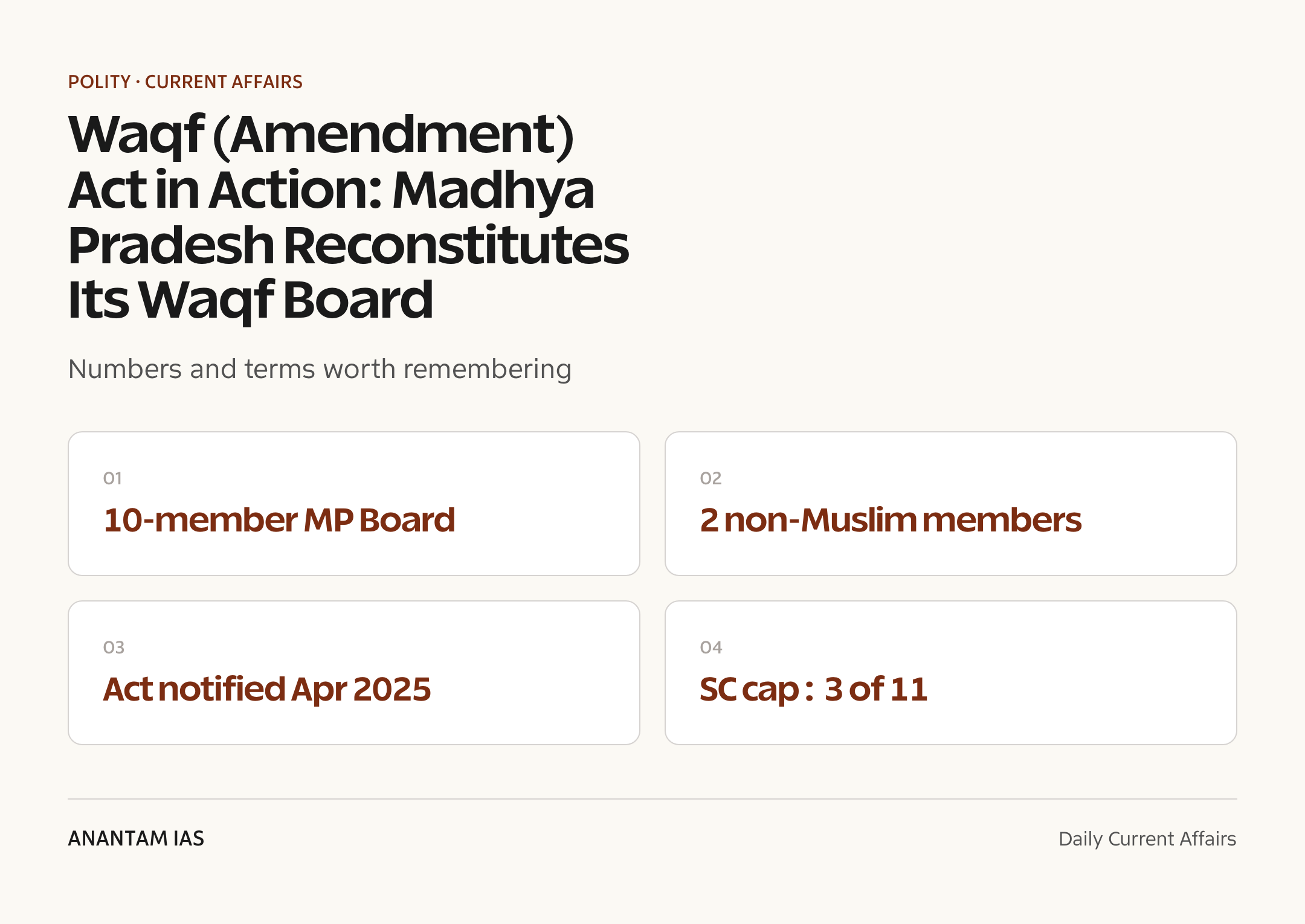
The Hindu reported that the Madhya Pradesh government has reconstituted the State Waqf Board as a 10-member body that includes two non-Muslim (Hindu) members — making it the first state in India to reorganise its Waqf Board under the Waqf (Amendment) Act, 2025.
The reconstitution came through a gazette notification dated July 4, 2026, issued by the state’s Backward Classes and Minority Welfare Department. It has drawn criticism because key provisions of the amended Act — including non-Muslim membership — are sub judice before the Supreme Court.
- The new 10-member Board includes two Hindu members — Manoj Malpani of Indore and Animesh Bhargava of Guna district.
- BJP leader Sanwar Patel is retained as Chairperson; former Union Minister Najma Heptulla continues as an elected-category member until April 18, 2028.
- IAS officer Satyendra Singh is the ex officio member; Congress MLA Atif Aqueel and four women members are also on the Board.
- Congress MLA Arif Masood (Bhopal North) called the move “completely wrong” and said he would approach the Supreme Court.
- The Waqf (Amendment) Act, 2025, notified in April 2025, mandates at least two non-Muslim members on waqf bodies.
The development matters in the context of:
- The first big state-level implementation test of the amended waqf law, operationalised while its contested provisions face judicial scrutiny.
- MP’s composition — two non-Muslims out of ten — sits within the Supreme Court’s interim cap of three non-Muslim members on an 11-member State Waqf Board.
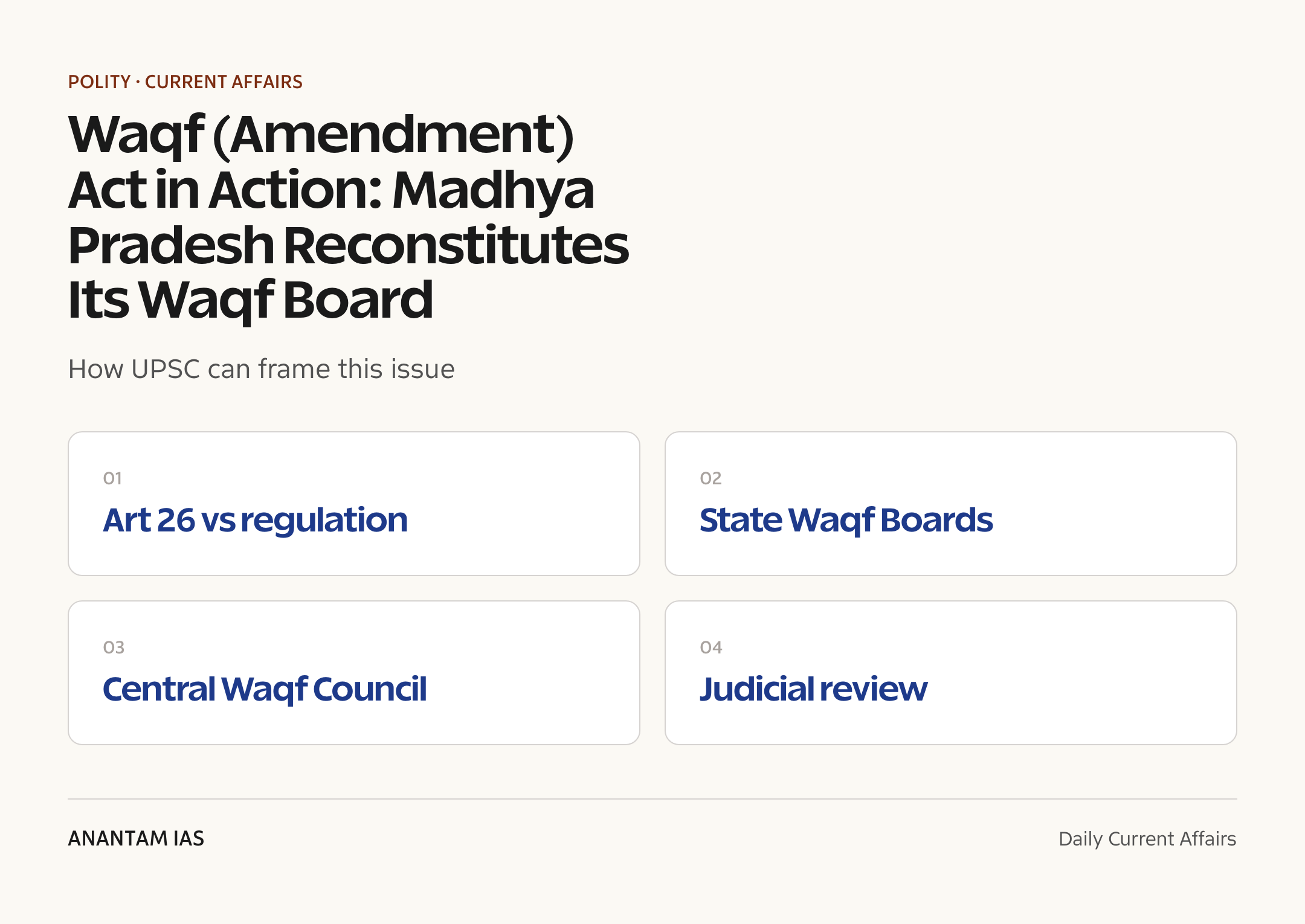
- The story bundles durable GS2 themes: Article 26, statutory endowment boards, judicial review and interim orders.
UPSC Relevance
Prelims Relevance
- Waqf: permanent dedication of property by a person professing Islam for pious, religious or charitable purposes; managed by a mutawalli.
- The Waqf (Amendment) Act, 2025 renames the Waqf Act, 1995 as the Unified Waqf Management, Empowerment, Efficiency and Development (UMEED) Act, 1995.
- Central Waqf Council: a 22-member national advisory body under the Union Ministry of Minority Affairs; it doesn’t directly control waqf properties.
- State Waqf Boards: statutory bodies supervising waqf properties in each state; the standard board has 11 members.
- SC interim caps (September 2025): non-Muslims limited to 4 of 22 on the Council and 3 of 11 on a State Board.
- The amendment prospectively ends waqf-by-user (waqf status from long religious use without a deed) and omits Section 40.
- Appeals against Waqf Tribunal orders now lie to the High Court within 90 days.
- Article 26: a denomination’s right to manage its own religious affairs and administer property in accordance with law.
Mains Relevance
GS Paper 2
- Article 26 and the line between a denomination’s religious affairs and state regulation of the secular administration of endowment property.
- Judicial review in action: interim orders, presumption of constitutionality, and how states should act when a law is sub judice.
- Statutory-body design: composition, transparency and accountability of State Waqf Boards and the Central Waqf Council.
- Federal implementation: a central law rolled out through state notifications.
GS Paper 1
- Secularism and state regulation of religious endowments across communities — waqf boards, Hindu endowment boards and the principled distance model.
- Representation, trust and minority perceptions of institutional reform.
Essay
- Reform of religious institutions: who reforms, who consents, who adjudicates?
- The space between legality and propriety in governance.
Background and Context
Waqf and Its Governance Architecture
Waqf is one of India’s oldest institutional forms of religious charity, regulated by statute since before Independence.
- A waqf is a permanent dedication of property by a person professing Islam for pious, religious or charitable purposes; ownership is treated as vesting in God and a mutawalli manages the property.
- The Waqf Act, 1954 created the first national framework; the Waqf Act, 1995 replaced it and was tightened by a 2013 amendment.
- The 1995 Act built a three-tier structure: State Waqf Boards, Waqf Tribunals, and the Central Waqf Council (est. 1964) as national advisory body under the Ministry of Minority Affairs.
- The stakes are large: government data cited during the 2025 debate put registered waqf assets at over 8.7 lakh immovable properties — often described as India’s third-largest landholding.
- Long-flagged problems — encroachment, poor records, weak audits, allegations of capture — were the declared rationale for the overhaul. See the full note on the Waqf (Amendment) Act, 2025.
Waqf (Amendment) Act, 2025: The Key Changes
Passed by Parliament and notified in April 2025 after Joint Parliamentary Committee scrutiny, the amendment rewrote large parts of the 1995 law.
- Renames the parent law the Unified Waqf Management, Empowerment, Efficiency and Development (UMEED) Act, 1995.
- Composition: mandates at least two non-Muslim members on the Central Waqf Council and every State Waqf Board, plus Muslim women members.
- Ends waqf-by-user prospectively — new waqfs need a written waqf deed; only a person practising Islam for at least five years and owning the property may declare a waqf.
- Omits Section 40, which had let a Waqf Board itself decide whether a property was waqf.
- Disputes over property claimed as government land go to a designated senior officer above Collector rank — taking that call away from waqf bodies.
- Recasts Waqf Tribunals, allows appeals to the High Court within 90 days, and applies the Limitation Act, 1963.
- Requires registration on a central portal (UMEED portal), strengthens audits (including CAG-nominated auditors), and permits separate Bohra and Aghakhani boards.
What Madhya Pradesh Has Notified
The July 4 gazette notification makes Madhya Pradesh the first state to turn the amended composition rules into an actual board.
- The reconstituted Madhya Pradesh Waqf Board has 10 members, with BJP leader Sanwar Patel retained as Chairperson.
- The two non-Muslim members — Manoj Malpani (Indore) and Animesh Bhargava (Guna) — meet the Act’s statutory minimum of two.
- Former Union Minister Najma Heptulla, appointed in the elected category in April 2023, is retained until her tenure ends on April 18, 2028.
- Other members include Congress MLA Atif Aqueel, Faizan Khan, and four women — Heptulla, Fatema Choudhary, Shaista Sultan and Shabana Khan; IAS officer Satyendra Singh, Commissioner of the notifying department, sits ex officio.
- Chairperson Patel praised the law’s mandatory inclusion of women and non-Muslim “expert” members; Congress MLA Arif Masood countered that reconstitution is premature while the Act is sub judice.
The Supreme Court Challenge and the September 2025 Interim Order
A batch of petitions against the amendment is pending before the Supreme Court, which refused a blanket stay but froze specific provisions.
- Petitioners argue the amendment violates Articles 14, 25 and 26 by diluting Muslim control over Muslim endowments.
- In September 2025, a Bench headed by the Chief Justice of India declined to stay the whole Act, citing the presumption of constitutionality.
- It stayed the five-year practising-Islam requirement until governments frame rules creating a verification mechanism, and protected waqf properties in government-land disputes from dispossession pending adjudication.
- On composition, the order capped non-Muslim membership — at most 4 of 22 on the Council and 3 of 11 on a State Board — and said the Board CEO should, as far as possible, be Muslim.
- There is no stay on reconstituting boards within these caps — the legal window Madhya Pradesh has used; the final verdict is awaited.
The Constitutional Debate: Article 26 and Secular Administration
The core doctrinal question is where a religious denomination’s autonomy ends and the state’s regulatory power begins.
- Article 26 lets denominations manage their own affairs in matters of religion; property administration is expressly “in accordance with law”. Primer: right to freedom of religion (Articles 25–28).
- Since Shirur Mutt (1954), courts distinguish the religious core from the secular administration of endowment property, which the state may regulate; the essential religious practices doctrine polices that line.
- The government’s position: waqf boards are statutory, secular bodies handling land records, leases and audits — so membership is administrative design, not religious interference.
- The petitioners’ position: mandating non-Muslim members in bodies governing Islamic endowments breaches denominational autonomy under Article 26(b) and 26(d).
- The comparison is itself contested — state control of temples under Hindu endowment laws is also challenged — making waqf one theatre in a wider debate on Indian secularism.
Significance and Concerns
As a first-mover, Madhya Pradesh sets a template other states will study — which is why supporters and critics are both watching closely.
- Implementation signal: the amended Act is now being operationalised on the ground, not just litigated; other states may follow the MP pattern.
- Legally cautious design: two non-Muslims out of ten stays inside the Supreme Court’s interim cap of three.
- Propriety question: acting while core provisions are sub judice may need unwinding if they’re struck down — the tension between legality (no stay) and propriety (restraint pending verdict).
- Trust deficit: reform of minority institutions without perceived consultation risks alienation, even where individual changes enjoy support.
- Governance upside: a fully constituted board is the precondition for the Act’s record-keeping, registration and audit machinery to work.
Way Forward
For Governments
- Keep reconstitutions strictly within the Supreme Court’s interim caps and publish transparent selection criteria, including for non-Muslim “expert” members.
- Fast-track the rules and verification mechanisms the court sought on the five-year practising requirement.
- Prioritise uncontested reforms — surveys, digitisation of records, audits, encroachment removal — and sequence contentious steps to the final verdict.
For Institutional Credibility
- Boards should show early wins in protecting waqf property — recovering encroached land, publishing accounts — so composition debates don’t crowd out performance.
- Structured consultation with stakeholders, including mutawallis and women beneficiaries, can rebuild trust.
- Strengthen Waqf Tribunals and use the new High Court appeal route to clear the dispute backlog.
Conclusion
Madhya Pradesh’s reconstitution of its Waqf Board is the moment the Waqf (Amendment) Act, 2025 moved from the statute book into actual state administration — with a composition calibrated to the amended law and the Supreme Court’s interim caps.
But the deeper questions remain open before the Supreme Court: whether mandating non-Muslim members in bodies administering Islamic endowments crosses Article 26, and how far the state may redesign religious institutions for better governance. For aspirants, this is a live case study in judicial review, interim relief and denominational autonomy.
UPSC Practice Questions
Prelims MCQ 1
With reference to the Waqf (Amendment) Act, 2025, consider the following statements:
- It renames the Waqf Act, 1995 as the Unified Waqf Management, Empowerment, Efficiency and Development (UMEED) Act, 1995.
- It mandates the inclusion of non-Muslim members in the Central Waqf Council and State Waqf Boards.
- The Supreme Court has stayed the operation of the Act in its entirety pending final adjudication.
How many of the above statements are correct?
(a) Only one (b) Only two (c) All three (d) None
Answer: (b) Only two
Explanation:
Statements 1 and 2 are correct. Statement 3 is wrong — in September 2025 the Supreme Court refused to stay the whole Act; it stayed only specific provisions and capped non-Muslim membership (4 of 22 on the Council, 3 of 11 on a State Board).
Prelims MCQ 2
The Central Waqf Council, sometimes seen in the news, is best described as:
(a) A constitutional body that adjudicates disputes over waqf properties (b) A statutory advisory body under the Union Ministry of Minority Affairs (c) A tribunal whose orders are appealable directly to the Supreme Court (d) A registered society that owns and manages all waqf properties in India
Answer: (b) A statutory advisory body under the Union Ministry of Minority Affairs
Explanation:
The Central Waqf Council (est. 1964) is a 22-member statutory advisory body under the Ministry of Minority Affairs. It neither owns waqf property nor adjudicates disputes — those go to Waqf Tribunals, with appeals now lying to the High Court.
UPSC Mains Questions
- The inclusion of non-Muslim members in Waqf Boards tests the boundary between a religious denomination’s right to manage its own affairs and the state’s power to regulate the secular administration of endowment property. Discuss with reference to Article 26 and the Waqf (Amendment) Act, 2025.
- When a law’s constitutional validity is pending before the Supreme Court without a stay, state governments face a choice between legality and propriety in implementing it. Examine this tension in the context of the reconstitution of State Waqf Boards under the Waqf (Amendment) Act, 2025.
- The Waqf (Amendment) Act, 2025 claims to fix a governance problem, while its critics see a violation of denominational autonomy. Evaluate the Act’s key changes to waqf administration and the constitutional concerns they raise.
Sources: The Hindu and Ministry of Minority Affairs.
Frequently Asked Questions
What has Madhya Pradesh done to its Waqf Board?
Through a gazette notification dated July 4, 2026, Madhya Pradesh reconstituted its Waqf Board as a 10-member body including two Hindu members — Manoj Malpani and Animesh Bhargava. The Hindu reported it is the first state to reorganise its board under the Waqf (Amendment) Act, 2025, with Sanwar Patel retained as Chairperson.
What is the Waqf (Amendment) Act, 2025?
Notified in April 2025, it overhauls the Waqf Act, 1995 — renamed the UMEED Act — by mandating non-Muslim and women members on waqf bodies, ending waqf-by-user prospectively, removing boards’ power to declare property waqf, shifting government-land disputes to senior officers, allowing High Court appeals, and requiring registration on a central portal.
Did the Supreme Court stay the Waqf (Amendment) Act?
No, not entirely. In September 2025 the court refused a blanket stay, citing the presumption of constitutionality. It stayed specific provisions — including the five-year practising-Islam requirement — protected waqf properties in government-land disputes during adjudication, and capped non-Muslim members on waqf bodies. The final verdict is still awaited.
How many non-Muslim members can waqf bodies have?
The Act mandates at least two non-Muslim members on the Central Waqf Council and each State Waqf Board. The Supreme Court’s interim order capped this at four non-Muslims on the 22-member Council and three on an 11-member State Board. Madhya Pradesh’s new board has two, within the cap.
What exactly is a waqf?
A waqf is a permanent dedication of movable or immovable property by a person professing Islam for purposes recognised by Muslim law as pious, religious or charitable — mosques, dargahs, graveyards, madrasas or charities. Ownership is treated as vesting in God, the dedication is irrevocable, and a caretaker called a mutawalli manages it.
Why is the reconstitution controversial?
Critics, including Congress MLA Arif Masood, argue the state acted while the Act’s validity — especially non-Muslim membership — is sub judice before the Supreme Court, and that Article 26 protects denominational control of Islamic endowments. Supporters say no stay bars reconstitution, the composition respects the court’s caps, and the law improves governance.
Tell Google you want more of this.
Add Anantam IAS as a preferred sourceOne tap, and this site shows up more often in your own Top Stories, AI Overviews and AI Mode. Remove it any time.






