

Why in News?
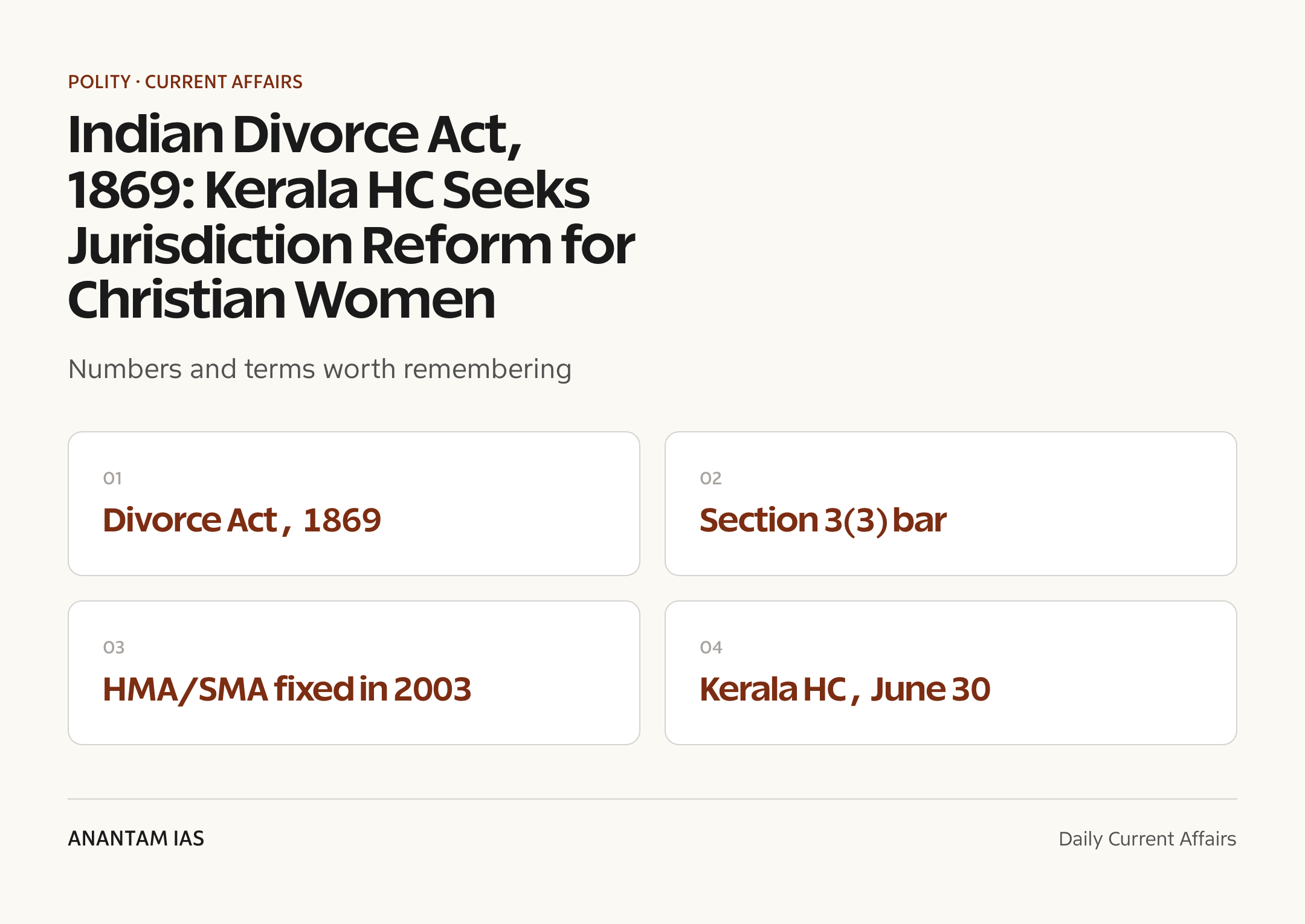
On June 30, 2026, a single-judge bench of Justice Bechu Kurian Thomas of the Kerala High Court urged Parliament to amend the Divorce Act, 1869 — the statute governing divorce among Indian Christians — so that a wife can file her divorce petition before the court where she resides. The Indian Express Explained analysed the ruling on July 7.
The court found “no justifiable reason” for the omission of a wife’s-residence forum, but held that supplying it is a legislative task. Parliament, it said, “ought to earnestly consider incorporating a provision” enabling the wife to file where she resides.
- The petitioner married in Kasaragod in 2011, alleged severe domestic violence, and moved in with her parents in Wayanad.
- The Family Court at Kalpetta returned her petition for lack of territorial jurisdiction under Section 3(3) of the Divorce Act, 1869.
- She asked the High Court to read Section 3(3) as including the district where the wife resides; the court declined, calling the provision “simple, plain and unambiguous”.
- It pointed to Section 24 of the Code of Civil Procedure (CPC) — transfer of a filed case — as the interim remedy.
- Parliament fixed this exact gap for Hindu and civil marriages through the Marriage Laws (Amendment) Act, 2003, but never touched the Divorce Act.
The development matters in the context of:
- The ruling revives the personal-law reform question: Christian divorce grounds were equalised in 2001, but the procedural clause on where a woman can sue was left untouched.
- It is a live access-to-justice issue — jurisdiction rules decide whether a survivor litigates near her parental home or must return to the district she fled.
- It feeds the Article 44 debate: a uniform civil code versus harmonising personal laws piecemeal, as the Law Commission suggested in 2018.
UPSC Relevance
Prelims Relevance
- Divorce Act, 1869 — colonial-era statute governing divorce among Christians; the word “Indian” was dropped from its short title by the 2001 amendment.
- Section 3(3) — a petition lies only where the marriage was solemnised or where the couple reside or last resided together; no wife’s-residence forum.
- Indian Divorce (Amendment) Act, 2001 — equalised divorce grounds under Section 10; inserted Section 10A (mutual consent).
- Marriage Laws (Amendment) Act, 2003 — added the wife’s-residence forum to Section 19, HMA 1955 and Section 31, SMA 1954.
- Personal-law map: HMA, 1955 — Hindus, Buddhists, Jains, Sikhs; SMA, 1954 — civil/interfaith marriages; Parsi Marriage and Divorce Act, 1936; Muslims under Islamic law.
- Section 24 CPC — transfer of suits; Section 3(3) governs only where a case is first filed.
- Family Courts Act, 1984 — family courts hear matrimonial disputes across personal laws.
- Article 44 (DPSP: uniform civil code); Article 39A (equal justice and free legal aid).
Mains Relevance
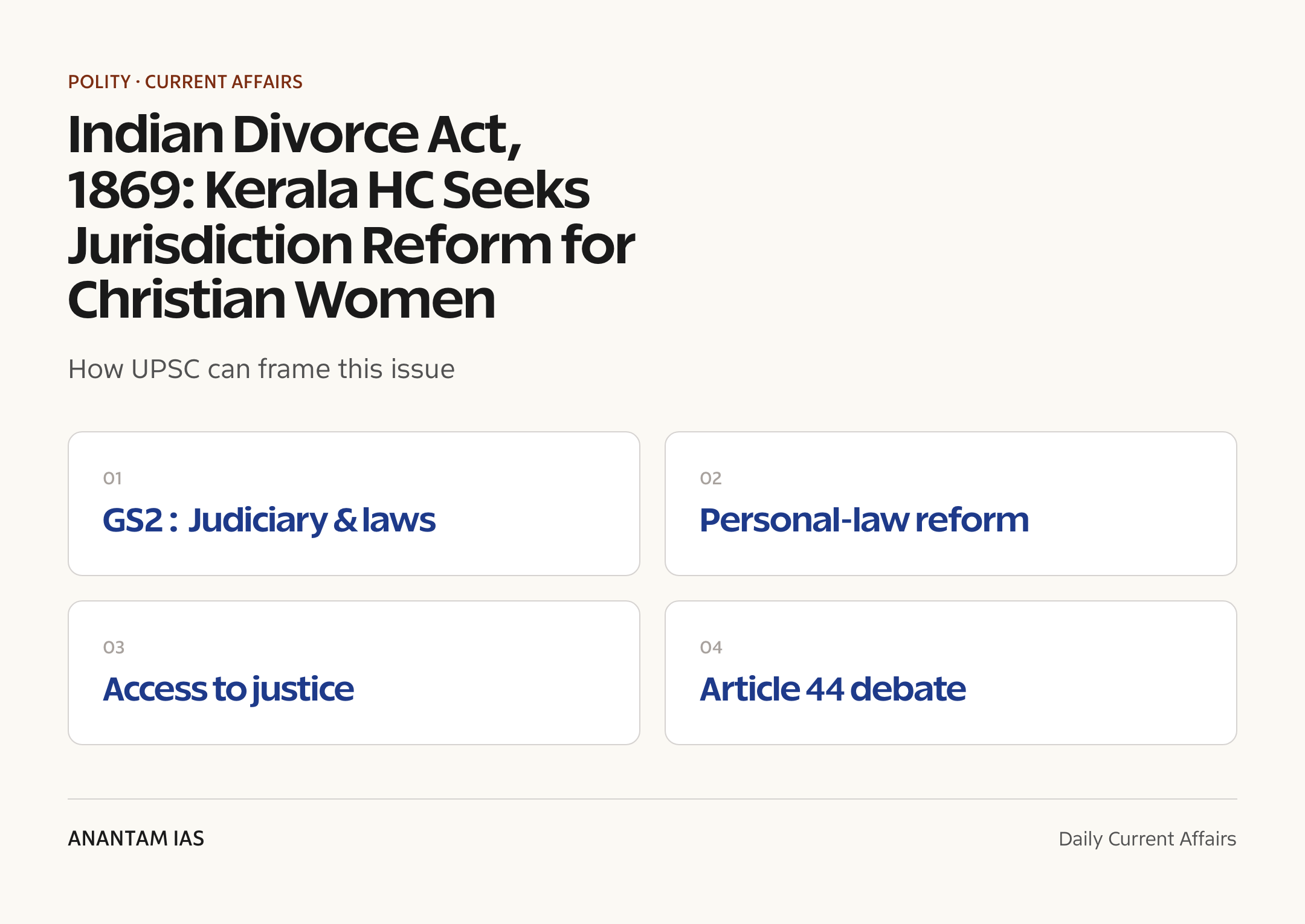
GS Paper 2
- Separation of powers — a court finding a statutory gap unjust yet refusing to fill it: literal interpretation vs judicial law-making.
- Personal laws and gender justice — procedural clauses (forum, limitation) matter as much as substantive grounds.
- Access to justice for vulnerable sections — jurisdiction rules, legal aid, family-court reach.
- Role of the Law Commission and Parliament in family-law reform; the Article 44 debate.
GS Paper 1
- Indian society — domestic violence, matrimonial litigation burdens, and how law shapes women’s mobility and security.
- Secularism dimension — reforming religious personal laws without majoritarian imposition.
Essay
- Justice inaccessible is justice denied — procedure as the gatekeeper of rights.
- Reforming personal laws: piecemeal repair or a uniform code?
Background and Context
The Case Before the Kerala High Court
The petition arose from a domestic-violence survivor who could not file for divorce in the district where she now lives.
- The woman married in Kasaragod in 2011; alleging severe domestic violence (FIR registered in 2023), she moved to her parents’ home in Wayanad.
- The Family Court, Kalpetta returned her divorce petition citing lack of territorial jurisdiction under Section 3(3).
- As written, the clause let her file only where the marriage was solemnised or where the couple last resided together — not where she lives now.
- She asked the High Court to read the wife’s residence into Section 3(3); the court held the words leave no room for that.
Divorce Act, 1869: The Law Governing Christian Marriages
Christians in India are governed by a colonial-era divorce statute that has been reformed in substance but not in procedure.
- The Divorce Act, 1869 (text on India Code) applies to persons professing the Christian religion; until the 2001 amendment it was the Indian Divorce Act.
- Section 3(3) defines the competent district court as the one within whose jurisdiction “the marriage was solemnized or the husband and wife reside or last resided together”.
- The Indian Divorce (Amendment) Act, 2001 equalised the divorce grounds under Section 10 — earlier a wife had to prove adultery plus another fault, while a husband could rely on adultery alone.
- The 2001 amendment inserted Section 10A (mutual consent); in 2022 the Kerala HC, in Anup Disalva v Union of India, struck down its two-year separation requirement, aligning it with the one-year norm elsewhere.
- The jurisdiction clause was left untouched in every round of reform — the gap the High Court has now asked Parliament to close.
How Other Personal Laws Handle Jurisdiction
Parliament closed the same gap for most other communities more than two decades ago.
- The Marriage Laws (Amendment) Act, 2003 amended Section 19 of the Hindu Marriage Act, 1955 to let a wife-petitioner file where she is residing on the date of the petition.
- The same Act made the identical change to Section 31 of the Special Marriage Act, 1954, covering civil and interfaith marriages.
- Both statutes also allow filing where the marriage was solemnised, where the respondent resides, or where the parties last resided together — a wider menu than Section 3(3).
- Parsis are covered by the Parsi Marriage and Divorce Act, 1936; Muslim women can seek dissolution under the Dissolution of Muslim Marriages Act, 1939.
- The anomaly: among major matrimonial statutes, the Christian divorce law alone denies the wife a forum at her own residence.
What the Court Held — and Why It Did Not Rewrite the Law
The judgment is a textbook illustration of the literal rule of interpretation and of judicial restraint.
- Justice Bechu Kurian Thomas held the provision “simple, plain and unambiguous”: when statutory words carry only one meaning, courts must give effect to it “irrespective of the consequences”.
- Reading a wife’s-residence forum into Section 3(3) would be judicial legislation — supplying a casus omissus (an omission in the statute), which is Parliament’s job.
- The court rejected the discrimination argument: personal laws of different religious communities may differ without the variation being unconstitutional by itself.
- Relying on the 2024 division-bench ruling in Eldho Varghese v Liya Jose, it held that Section 3(3) controls only the initial filing; a filed petition can be transferred under Section 24 CPC.
- No relief by interpretation, but a formal appeal to Parliament — flagging a legislative gap while respecting the separation of powers.
Access to Justice: Why Forum Rules Matter for Women
A jurisdiction clause looks technical, but it decides who can realistically litigate at all.
- A woman leaving a violent matrimonial home typically returns to her parental home, often in another district; suing where the marriage took place loads travel, cost and safety burdens on the weaker party.
- Per NFHS-5 (2019–21), about 29% of ever-married women aged 18–49 report spousal violence — the population for whom forum rules bite hardest.
- Article 39A directs the State to secure equal justice and free legal aid; a forum rule that prices out the poorer spouse cuts against that promise.
- Every avoidable transfer petition adds a layer of litigation to already stretched family courts — see how delay compounds in India’s judicial pendency crisis.
- Workarounds — Section 24 CPC transfers, virtual hearings, NALSA legal aid — still make the woman first navigate a forum she cannot easily reach.
The Larger Personal-Law Reform Debate
The nudge to Parliament sits inside a long arc of court-prompted reform of religious personal laws.
- Mary Roy v State of Kerala (1986) secured equal inheritance rights for Syrian Christian women; Shayara Bano v Union of India (2017) struck down instant triple talaq.
- The 21st Law Commission (2018) said a uniform civil code was “neither necessary nor desirable at this stage” and favoured removing discriminatory provisions within each personal law.
- The 22nd Law Commission reopened consultation on the uniform civil code in 2023, and Uttarakhand enacted a state UCC in 2024 — keeping the Article 44 debate live.
- The Kerala ruling shows a middle path: procedural harmonisation — uniform forum, limitation and transfer rules — advances gender justice without touching religious substance.
- The constitutional fault line traces to State of Bombay v Narasu Appa Mali (1951), which held uncodified personal laws outside fundamental-rights review — questioned since, never fully overruled.
Way Forward
Legislative fix
- Amend Section 3(3) of the Divorce Act, 1869 to add a wife’s-residence forum, mirroring the clause the 2003 amendment gave the HMA and SMA — a one-line, low-controversy change.
- Task the Law Commission with a clause-by-clause audit of the 1869 Act so its procedure matches the post-2001 substantive equality.
- Adopt procedural uniformity first: harmonise forum and transfer rules across matrimonial statutes, leaving substantive religious questions to wider consultation.
Administrative and judicial measures
- Expand e-filing and video-conference hearings in family courts so distance from the forum stops deciding outcomes.
- Make Section 24 CPC transfers fast and affordable in matrimonial matters, with NALSA and legal-aid institutions assisting women petitioners.
- Strengthen family-court capacity — judges, counsellors, protection officers — so relocated survivors are not re-victimised by process.
Conclusion
The Kerala High Court did what a constitutional court can: it named the injustice, declined to legislate from the bench, and placed the file before Parliament. The gap is narrow, technical and easy to close — which makes its persistence two decades after the 2003 amendment harder to defend.
For UPSC, the episode packages three durable themes: the literal rule and the limits of judicial law-making, the gap between substantive and procedural equality in personal laws, and access to justice as the working face of Article 39A. Whatever one’s view on Article 44, letting every wife sue for divorce from where she actually lives needs no grand settlement — only a short amending Bill.
UPSC Practice Questions
Prelims MCQ 1
With reference to matrimonial jurisdiction under Indian personal laws, consider the following statements:
- The Divorce Act, 1869 governs divorce among Christians in India.
- Under Section 3(3) of the Divorce Act, 1869, a wife may file a divorce petition in the district where she resides at the time of filing.
- The Hindu Marriage Act, 1955 and the Special Marriage Act, 1954 allow a wife-petitioner to file where she is residing on the date of the petition.
How many of the above statements are correct?
(a) Only one (b) Only two (c) All three (d) None
Answer: (b) Only two
Explanation:
Statements 1 and 3 are correct. Statement 2 is wrong — Section 3(3) permits filing only where the marriage was solemnised or where the couple reside or last resided together; the wife’s-residence forum entered the HMA and SMA via the Marriage Laws (Amendment) Act, 2003.
Prelims MCQ 2
The Marriage Laws (Amendment) Act, 2003 is best known for which of the following changes?
(a) Introducing divorce by mutual consent for Christian couples (b) Letting a wife file matrimonial petitions where she resides, under the HMA and the SMA (c) Transferring all matrimonial disputes to family courts (d) Making registration of marriages compulsory across all religions
Answer: (b) Letting a wife file matrimonial petitions where she resides, under the HMA and the SMA
Explanation:
The 2003 Act added the wife’s-residence forum to Section 19 of the HMA, 1955 and Section 31 of the SMA, 1954. Mutual-consent divorce for Christians came via Section 10A, inserted by the 2001 amendment.
UPSC Mains Questions
- Procedural gaps in personal laws can defeat substantive rights. In the light of the Kerala High Court’s plea to Parliament on the Divorce Act, 1869, examine how jurisdiction rules affect women’s access to justice in matrimonial disputes, and suggest reforms.
- Courts must give effect to plain statutory language “irrespective of the consequences”. Discuss the limits of judicial law-making and the appropriate institutional route for reforming personal laws, with reference to the Kerala High Court’s ruling on the Divorce Act, 1869.
- “Uniformity of procedure can precede uniformity of substance.” Evaluate this approach to family-law reform in India with reference to the 21st Law Commission’s 2018 consultation paper and Article 44.
Sources: India Code, Divorce Act 1869 and Indian Express Explained.
Frequently Asked Questions
What did the Kerala High Court ask Parliament to do?
On June 30, 2026, Justice Bechu Kurian Thomas urged Parliament to amend the Divorce Act, 1869 so a Christian wife can file for divorce before the court where she resides. The court found no justifiable reason for the omission but said only the legislature can add the provision.
What is Section 3(3) of the Divorce Act, 1869?
It is the jurisdiction clause of the Christian divorce law. A petition can be filed only in the district where the marriage was solemnised or where the couple reside or last resided together. It gives the wife no option to file from her current place of residence.
How do Hindu and civil marriage laws differ on jurisdiction?
The Marriage Laws (Amendment) Act, 2003 amended Section 19 of the Hindu Marriage Act, 1955 and Section 31 of the Special Marriage Act, 1954, letting a wife-petitioner file where she resides on the date of the petition. The Divorce Act, 1869 never got this forum.
Why did the court refuse to rewrite the provision?
The court called Section 3(3) simple, plain and unambiguous. When statutory words allow only one meaning, judges must apply them regardless of consequences; supplying an omitted provision would be judicial legislation. Differences between religious personal laws are not, by themselves, unconstitutional discrimination.
What remedy does the petitioner have for now?
Section 3(3) governs only where a case is first filed. Following the 2024 division-bench ruling in Eldho Varghese v Liya Jose, a properly instituted petition can be transferred under Section 24 of the Code of Civil Procedure to a court convenient to the wife.
How does this link to the Uniform Civil Code debate?
Article 44 asks the State to strive for a uniform civil code. The 21st Law Commission in 2018 preferred fixing discriminatory provisions within each personal law. The Kerala ruling supports that path: harmonising procedure, like forum rules, advances gender justice without settling contested religious questions.
Tell Google you want more of this.
Add Anantam IAS as a preferred sourceOne tap, and this site shows up more often in your own Top Stories, AI Overviews and AI Mode. Remove it any time.




