
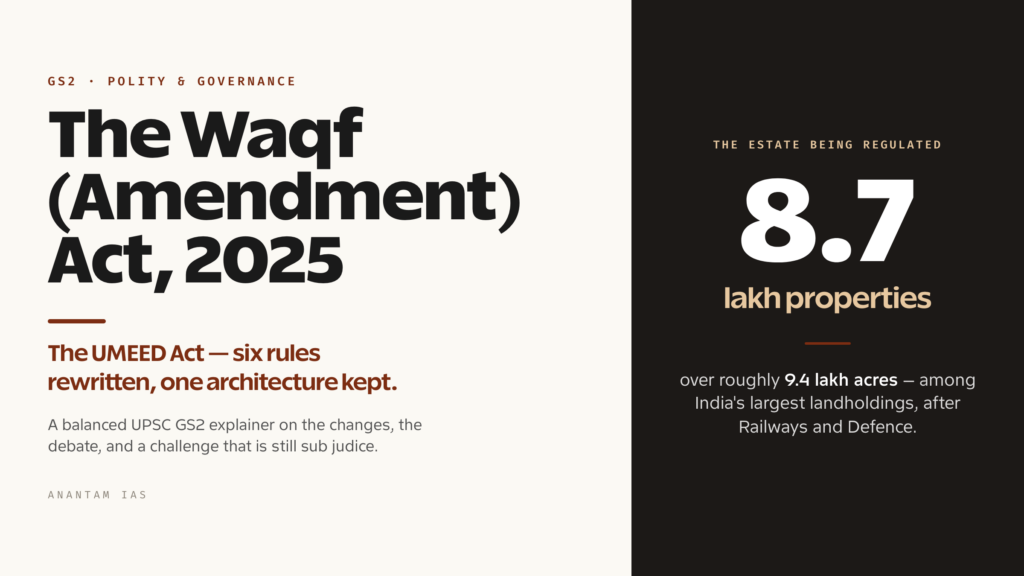
Few laws in recent memory have been fought over as hard as the one Parliament passed in the first week of April 2025. The Lok Sabha cleared the Waqf (Amendment) Bill after a marathon debate that ran past midnight, the Rajya Sabha followed the next day, and within hours of the President’s signature the country had a new statute governing roughly eight-and-a-half lakh properties spread over close to a million acres. The government gave it a hopeful new name — the UMEED Act, short for Unified Waqf Management, Empowerment, Efficiency and Development. Its critics gave it a very different label.
So this is a topic you have to handle the way an examiner wants it handled — with the facts straight and both sides heard. Waqf law sits exactly where a UPSC GS2 paper likes to probe: at the meeting point of fundamental rights, minority institutions, federalism and administrative reform. The questions the Act raises — can the State regulate a religious endowment without trespassing on the freedom to manage religious affairs, and where does cleaning up records end and interfering with a community begin — are the kind that have no slogan for an answer. They have arguments. Let’s lay them out.
What Waqf Is and How It Was Governed
Start with the word itself, because the whole debate turns on it. A waqf is a permanent dedication of property — land, a building, cash, anything of value — by a Muslim, for a purpose recognised as pious, religious or charitable under Islamic law. Once a property is made waqf, the idea is that it belongs to God; it can’t ordinarily be sold, gifted or inherited, and its income is meant to flow to the stated cause forever. The person who creates it is the waqif; the manager who runs it day to day is the mutawalli. The proceeds typically fund mosques, dargahs, graveyards, madrasas, orphanages and the upkeep of the poor. Think of it as the Islamic cousin of a Hindu temple endowment or a Christian charitable trust — a private dedication with a public purpose, locked in perpetuity.
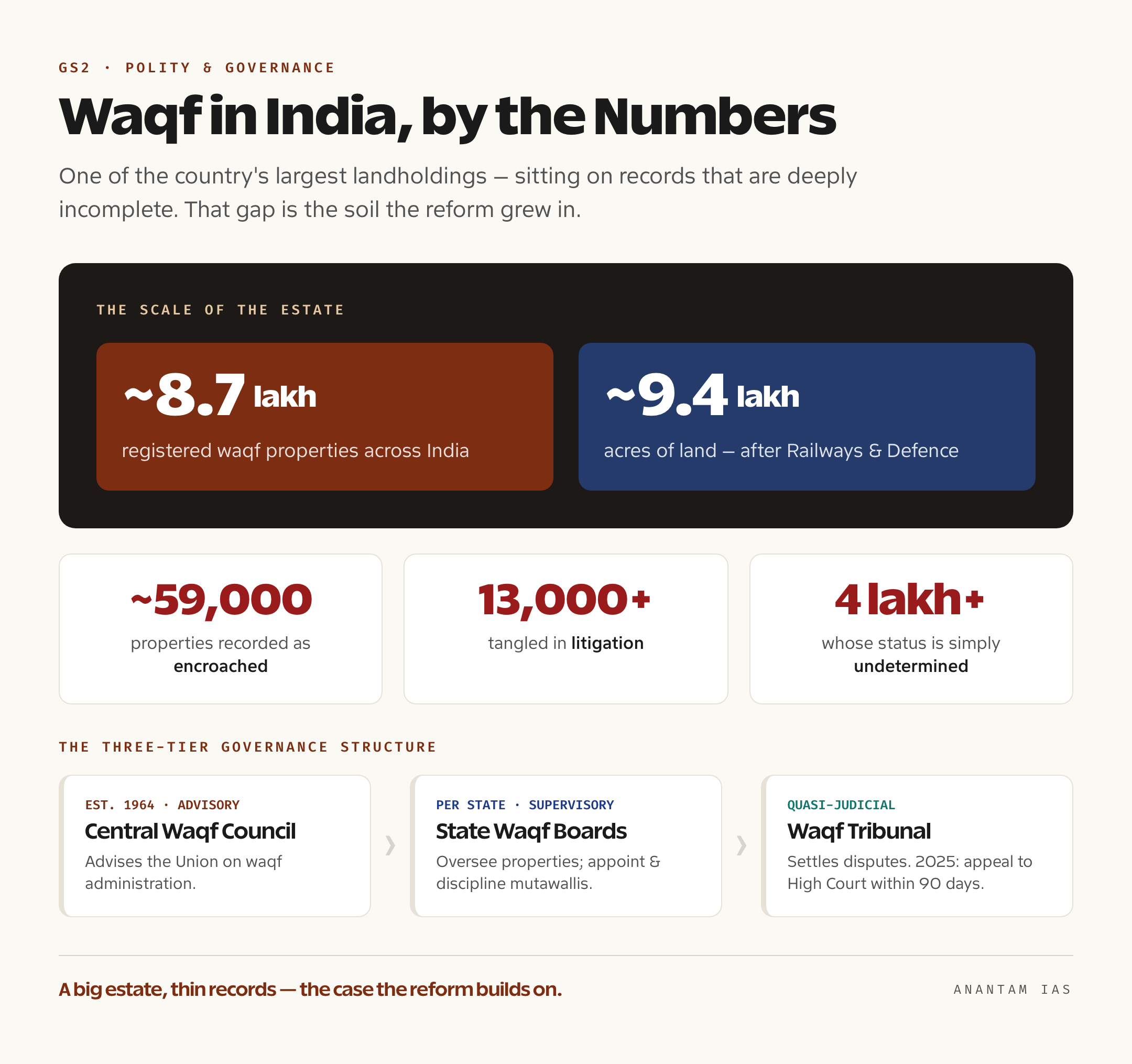
India’s waqf properties are vast. By the government’s own data, there are around 8.7 lakh registered waqf properties covering roughly 9.4 lakh acres, with an estimated value running into lakhs of crores — which, after the Railways and the Defence Ministry, makes the waqf system one of the largest landholders in the country. But the same data tells a messier story. The waqf records counted nearly 59,000 properties as encroached, more than 13,000 tangled in litigation, and over four lakh whose status was simply undetermined. That gap between the size of the estate and the quality of the bookkeeping is the soil in which this whole reform grew.
The administration of all this was, until 2025, built on the Waqf Act, 1995. That law itself replaced an older 1954 Act, and it set up the three-tier machinery the country still uses. At the top sits the Central Waqf Council, a statutory advisory body first created in 1964 to advise the Union government on waqf administration. Below it, each state runs one or more Waqf Boards that supervise the properties in their territory and appoint and discipline mutawallis. And to settle disputes, the 1995 Act created Waqf Tribunals — special quasi-judicial bodies whose decisions were treated as close to final, with High Courts allowed only a narrow supervisory look. Two features of that old framework matter most for what follows: the doctrine of “waqf by user,” under which a property could be treated as waqf simply because it had been used for religious purposes over a long time, even without any deed; and the near-finality of the Tribunal, which kept most waqf disputes out of the regular court ladder.
What the 2025 Act Actually Changes
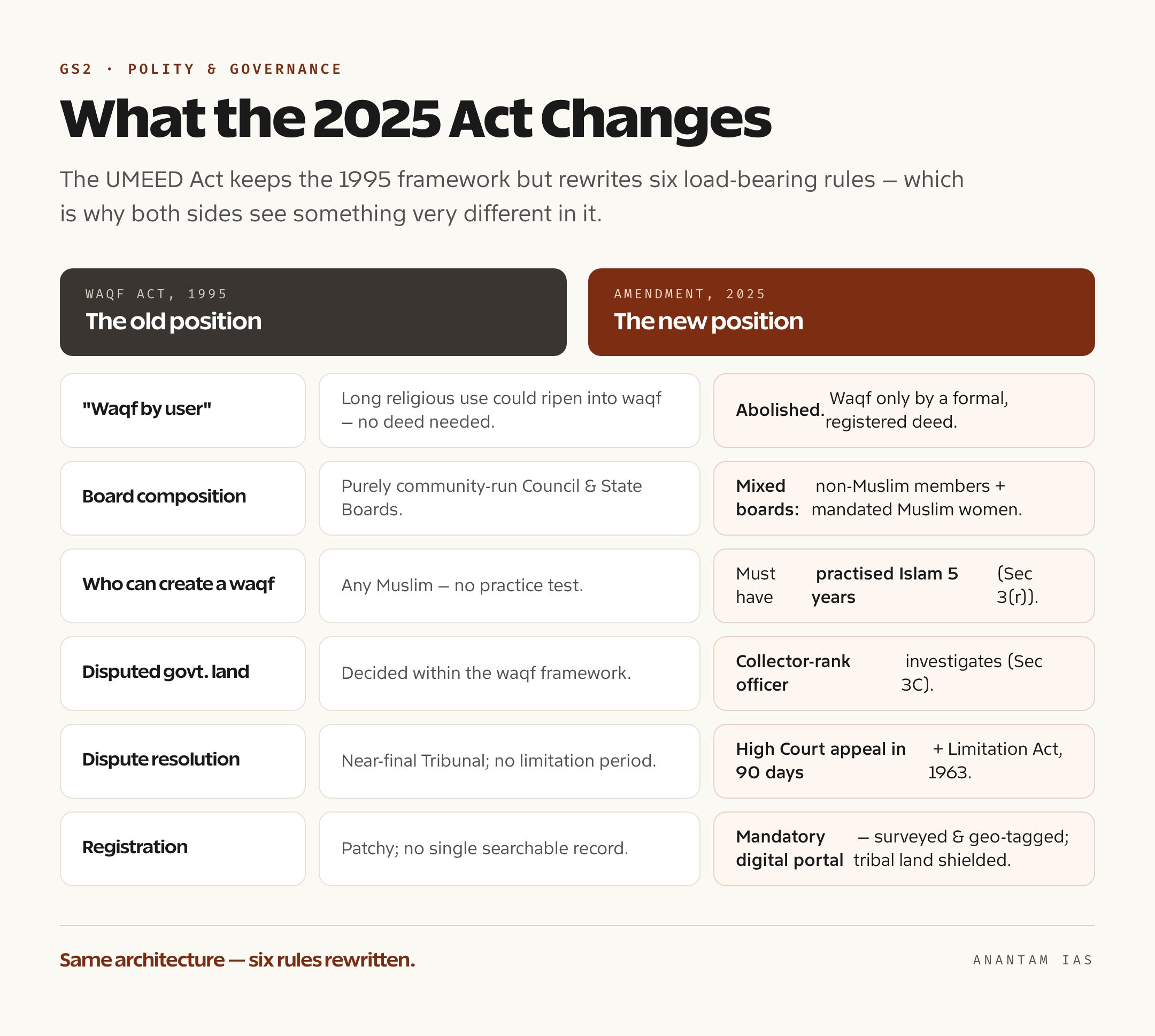
The Waqf (Amendment) Act, 2025 doesn’t repeal the 1995 law — it rewrites large parts of it and renames the whole thing the UMEED Act, 1995. Before it became law it was examined by a 31-member Joint Parliamentary Committee, which heard stakeholders and folded a set of changes into the final text. The amendments are dense, but six of them carry the weight of the debate.
First, and most contested, the Act abolishes “waqf by user.” Going forward, a property can be waqf only if it is formally dedicated, which in practice means a written, registered waqf deed. The long-standing route by which mere religious use over time could ripen into waqf status is closed. Second, the law changes who can sit on waqf bodies: the Central Waqf Council and the State Waqf Boards must now include members from outside the Muslim community, along with a mandated number of Muslim women and representation across Shia, Sunni and other denominations — a move from purely community-run boards toward more mixed ones. Third, it adds a religious-practice test for the waqif: under the new Section 3(r), only a person who has been practising Islam for at least five years can create a waqf, with a carve-out protecting existing waqfs and inheritance-style “waqf-alal-aulad” arrangements.
Fourth — and this is the federalism flashpoint — the Act hands government officers a far bigger role in deciding what is and isn’t waqf. Where a property is claimed as waqf but is also recorded as government land, a senior revenue officer (an official of or above the rank of Collector, under the new Section 3C) is empowered to investigate and determine ownership, and the property is not to be treated as waqf while that inquiry runs. Fifth, the Act reworks the dispute system: it trims and recomposes the Waqf Tribunal and, crucially, opens a right of appeal to the High Court within 90 days against a Tribunal’s order — replacing the old near-finality with normal judicial review. It also applies the Limitation Act, 1963 to waqf claims, removing the earlier exemption that had let some waqf disputes be raised without any time limit. Sixth, the law makes registration on a central digital portal mandatory within a fixed window, so that every waqf is surveyed, geo-tagged and entered in one searchable system; and it adds an explicit protection that land in Scheduled and tribal areas cannot be declared waqf, shielding constitutionally protected tribal land.
The Case the Government Makes
Strip away the heat and the government’s argument rests on one word: transparency. Its case is that the old system was a black box. Eight-and-a-half lakh properties, lakhs of them undocumented, tens of thousands encroached, and a “waqf by user” doctrine that — in the government’s telling — let almost any plot with a tomb or a long history of religious use be claimed as waqf, sometimes including government and private land, with little paperwork to test the claim. The near-final Tribunal and the absence of any limitation period, the argument runs, made those claims very hard to undo once made. So the reform, as the government frames it, is not about faith at all but about property records, audit trails and the ordinary rule that a big estate should be documented and answerable.
From there the official rationale branches into a few clear lines. Curbing misuse: mandatory registration, geo-tagging, audits and a digital portal are pitched as the tools to recover encroached land and stop fresh false claims. Empowerment: the government leans hard on the inclusion of Muslim women on the boards and on what it calls Pasmanda representation — giving a voice to backward and marginalised Muslims who, it says, were shut out of elite-dominated boards. Better adjudication: opening High Court appeals and applying the Limitation Act are presented as bringing waqf disputes into the normal justice system rather than leaving them in a parallel one. And the protection of tribal land is offered as evidence that the law is about boundaries and fairness, not seizure. The government’s framing, in short, is administrative reform of a charitable estate — the same logic, it argues, that the State already applies when it regulates Hindu temple trusts.
The Case the Petitioners Make
The other side reads the very same provisions as an intrusion on a constitutional right. The anchor of the challenge is Article 26, which guarantees every religious denomination the freedom to manage its own religious affairs and to administer its property — read alongside Article 25’s freedom of religion. Petitioners argue that waqf is a religious institution, that managing it is part of that protected freedom, and that putting non-Muslims on the bodies that govern waqf and handing a government officer the power to decide what counts as waqf dilutes a community’s control over its own endowments in a way no comparable law imposes on other faiths. The contrast they draw is pointed: many Hindu temple boards are run by members of the faith, so why, they ask, should waqf boards be the ones required to seat outsiders?
The objections sharpen on specific clauses. The abolition of “waqf by user,” critics warn, threatens older waqfs — mosques and graveyards in use for centuries that were never formally documented, precisely because the doctrine made documentation unnecessary at the time. The Section 3C power for a revenue officer to decide ownership, and to suspend a property’s waqf status while he inquires, is attacked as a violation of the separation of powers — letting the executive act as judge in its own cause over disputed land, and raising Article 300A property-rights and Article 14 equality concerns. The five-year practising-Muslim test is challenged as vague and unworkable: who, the petitioners ask, decides whether someone is a practising Muslim, and on what standard? And there is a federalism strand too, since waqf administration touches the states, and some argue the Union has tilted the balance. There is also an Article 30 nuance worth flagging carefully: Article 30 protects the right of religious and linguistic minorities to establish and administer educational institutions, and while waqf is not itself an Article 30 institution, the wider principle of minority autonomy over their own institutions runs through the petitioners’ arguments. Crucially, attribution matters here — these are arguments advanced by petitioners and opposition voices, not settled findings.
The dispute is now before the Supreme Court, where more than 60 petitions — including those filed by AIMIM’s Asaduddin Owaisi, Congress MP Mohammad Jawed, the All India Muslim Personal Law Board and the Jamiat Ulama-e-Hind — have been clubbed together. On 15 September 2025, a Bench led by Chief Justice B.R. Gavai, sitting with Justice A.G. Masih, delivered an interim order. The Court declined to stay the Act as a whole — finding no case for freezing the entire statute — but it did stay or read down a few provisions while the challenge is heard fully. It put the five-year practising-Muslim requirement on hold until the government frames rules to determine who qualifies; it stayed the part of Section 3C that let a property lose its waqf status merely on an officer’s report, holding that property disputes belong to tribunals and courts, not to an officer’s unilateral say-so; it indicated that non-Muslim members should not exceed four on the Central Council and three on a State Board, and that boards should strive to keep a Muslim ex-officio chairperson; and it recorded that no waqf would be dispossessed and no titles altered until the matter is finally decided. The registration requirement and the abolition of “waqf by user” were not stayed. The essential point for an answer is this: as things stand, the constitutional validity of the Act is sub judice — the final word has not been spoken, and you should write it that way rather than guess at a verdict.
Significance and What to Watch
Set against the long arc of how India governs religion, the 2025 Act is a genuinely big moment, whichever way the Court eventually rules. India follows a model often described as “principled distance” — the State keeps a respectful gap from religion but reserves the right to step in to reform a religious practice or institution in the public interest, which is exactly how it already regulates Hindu temple endowments and Sikh gurdwara bodies. The Waqf amendment is the most ambitious recent test of how far that power reaches into a minority community’s institutions, and how it squares with the Article 25-26 freedoms. The answer the Supreme Court finally gives will become a reference point for the entire law-religion relationship, not just for waqf.
The practical stakes are large too. If the documentation and digital-portal reforms work as intended, India could end up with a far cleaner, geo-tagged record of waqf land — a real gain for governance and for the beneficiaries those properties are meant to serve. If the fears of the petitioners prove well-founded, the same machinery could unsettle long-held community properties and strain trust. Both outcomes are possible from the same text, which is why the implementation rules and the final judgment matter so much. So the things to watch are concrete: the rules the government frames for the practising-Muslim test and for the Collector’s inquiry; how the registration drive plays out on the ground; and, above all, the Supreme Court’s final ruling on whether the Act, in whole or in part, survives the test of Articles 14, 25, 26 and 300A.
For Your Mains Answer
This topic is built for GS Paper 2 — it cuts across the Constitution (Fundamental Rights under Articles 25, 26, 14, 30 and the Article 300A right to property), the functioning of statutory bodies, Centre-State relations, the welfare of minorities, and the broad theme of governance and administrative reform. It can also feed an Essay on secularism, the State and religion, or reforms versus rights. The examiner’s reward goes to the candidate who explains the change precisely and then weighs both sides without taking a partisan position.
How to Build the Answer
Open by defining waqf and the problem the old system had — the scale of waqf land set against the poor quality of its records — so the reform has a context. Then state the key changes crisply (waqf by user, board composition, the practising-Muslim test, the officer’s role under 3C, High Court appeals plus Limitation Act, mandatory digital registration). Devote a balanced middle to arguments for (transparency, women’s and Pasmanda voice, normal judicial review) and against (Article 26 autonomy, separation-of-powers worry over 3C, vagueness of the five-year test, federalism). Close with the constitutional significance and the honest line that the matter is sub judice. That arc — what waqf is → what changed → both sides → significance → status — works for any “discuss this Act” question.
Common Mistakes to Avoid
Don’t take a side; an answer that reads as pro- or anti-government loses marks on a sensitive law. Don’t invent a Supreme Court verdict — say it is sub judice and cite the September 2025 interim order accurately. Don’t confuse the interim stay (the five-year test and part of 3C) with what was not stayed (registration and the abolition of waqf by user). Don’t muddle Article 30, which is about minority educational institutions, with waqf management — flag the nuance rather than overclaiming. And don’t drown the answer in numbers; one or two anchors are enough.
A Compact Answer Spine
Waqf = permanent religious dedication, run via Council-Board-Tribunal under the 1995 Act → problem: ~8.7 lakh properties, weak records, encroachments → 2025 Act (UMEED) changes six things (waqf by user abolished, mixed boards, five-year test, officer role under 3C, High Court appeals + Limitation Act, digital registration, tribal-land protection) → for: transparency, women’s and Pasmanda representation, normal judicial review → against: Article 26 autonomy, separation of powers, vague test, federalism → significance: tests the limits of State regulation of minority institutions → status: challenged in the Supreme Court, interim order of September 2025, matter sub judice.
Diagram or Flowchart Idea
Draw a simple two-column “before and after” table: left column the 1995 position (waqf by user allowed, community boards, near-final Tribunal, no limitation), right column the 2025 position (deed required, mixed boards, officer inquiry under 3C, High Court appeal, Limitation Act, digital portal). A clean comparison table like this signals clarity fast and is quick to reproduce.
A Balanced-Conclusion Line
End on the constitutional tension rather than a verdict: “The Waqf (Amendment) Act, 2025 tests how far the State’s reformist power over religious endowments can extend before it touches the Article 26 freedom of a community to manage its own affairs — a balance that, with the matter sub judice, the Supreme Court is yet to finally strike.”
How to Use Data Without Cramming
Pick two figures and use them as arguments, not decoration. “Around 8.7 lakh waqf properties over roughly 9.4 lakh acres” establishes the scale that justifies regulation; “nearly 59,000 encroached and over four lakh of undetermined status” frames the record-keeping problem the government cites. Pair each number with the point it proves, and skip the rest.
FAQ
What is the Waqf (Amendment) Act, 2025, and why is it also called the UMEED Act? It is a law passed by Parliament in April 2025 that amends the Waqf Act, 1995, which governs the administration of waqf — properties permanently dedicated by Muslims for religious or charitable purposes. The government renamed the amended statute the Unified Waqf Management, Empowerment, Efficiency and Development (UMEED) Act, 1995, signalling a focus on transparency and management reform.
What are the most important changes the Act makes? It abolishes “waqf by user” so a property must now be formally dedicated by deed to count as waqf; it adds non-Muslim members and mandates Muslim women on the Central Waqf Council and State Boards; it requires a waqf creator to have practised Islam for at least five years; it gives a senior revenue officer a role in deciding disputed government-versus-waqf land; it allows appeals to the High Court against Waqf Tribunal orders and applies the Limitation Act; and it makes digital registration mandatory while protecting tribal and Scheduled-Area land.
Why is the Act controversial, and what does the Supreme Court say? Supporters say it brings transparency to a huge, poorly documented estate and gives women and marginalised Muslims a voice; critics argue it dilutes community control over religious endowments and intrudes on the Article 26 freedom to manage religious affairs. More than 60 petitions challenged it. On 15 September 2025 a Supreme Court Bench led by CJI B.R. Gavai issued an interim order — declining to stay the whole Act but staying the five-year practising-Muslim test and part of the officer’s power over disputed land. The constitutional challenge is still pending, so the matter is sub judice.
How does this topic fit UPSC GS2? It links Fundamental Rights (Articles 25, 26, 14 and the Article 300A property right), the functioning of statutory bodies like the Central Waqf Council, Centre-State relations, the welfare of minorities, and administrative reform. The exam-smart approach is to explain the changes precisely, present the arguments on both sides, and treat the legal challenge as unresolved rather than asserting an outcome.
Practice Questions
Prelims MCQs
- With reference to waqf in India, consider the following statements. Which is/are correct?
(a) A waqf is a permanent dedication of property by a Muslim for religious or charitable purposes
(b) The person who manages a waqf is called the mutawalli
(c) The Central Waqf Council was established as a statutory advisory body in 1964
(d) All of the above.
Answer: (d) All three are accurate — waqf is a perpetual dedication, the manager is the mutawalli, and the Central Waqf Council dates to 1964. - The Waqf (Amendment) Act, 2025 amends which earlier law?
(a) The Waqf Act, 1954
(b) The Waqf Act, 1995
(c) The Mussalman Wakf Act, 1923
(d) The Religious Endowments Act, 1863.
Answer: (b) The 2025 Act amends and renames the Waqf Act, 1995, which had itself replaced the 1954 Act. - Which of the following is a change introduced by the Waqf (Amendment) Act, 2025?
(a) Abolition of the “waqf by user” doctrine
(b) A right of appeal to the High Court against Waqf Tribunal orders
(c) Mandatory registration of waqf properties on a central digital portal
(d) All of the above.
Answer: (d) The Act abolishes waqf by user, opens High Court appeals, and mandates digital registration, among other changes. - What is the full form of the UMEED Act, the new name given to the amended waqf law?
(a) Unified Minority Education and Endowment Development Act
(b) Unified Waqf Management, Empowerment, Efficiency and Development Act
(c) United Muslim Endowments and Educational Development Act
(d) Universal Management of Endowments and Development Act.
Answer: (b) UMEED stands for Unified Waqf Management, Empowerment, Efficiency and Development. - Regarding the Supreme Court’s September 2025 interim order on the Waqf (Amendment) Act, 2025, which statement is correct?
(a) The Court struck down the entire Act
(b) The Court stayed the requirement that a waqf creator must have practised Islam for at least five years
(c) The Court ordered the immediate dispossession of all disputed waqf properties
(d) The Court upheld the officer’s power to declare waqf land as government land.
Answer: (b) The Court declined to stay the whole Act but stayed the five-year practising-Muslim test (and part of the officer’s power over disputed land); the challenge remains pending.
Mains Practice Questions
- “The Waqf (Amendment) Act, 2025 reflects the tension between the State’s power to reform religious endowments and a community’s freedom to manage its own affairs.” Discuss this statement with reference to Articles 25 and 26 of the Constitution. (15 marks, 250 words)
- Examine the key changes introduced by the Waqf (Amendment) Act, 2025 to the administration of waqf properties in India, and assess the government’s stated rationale of transparency and empowerment. (15 marks, 250 words)
- The role assigned to revenue officers in determining disputed waqf properties has been criticised on the ground of separation of powers. Critically evaluate this concern in the light of constitutional principles. (15 marks, 250 words)
- Discuss how the regulation of waqf properties fits within India’s model of secularism and the State’s relationship with religious institutions. (10 marks, 150 words)
- “Reform of religious endowments must balance administrative efficiency with the autonomy of minority institutions.” In the context of the Waqf (Amendment) Act, 2025, examine the relevant constitutional and federal considerations. (15 marks, 250 words)
Tell Google you want more of this.
Add Anantam IAS as a preferred sourceOne tap, and this site shows up more often in your own Top Stories, AI Overviews and AI Mode. Remove it any time.