Why in News?
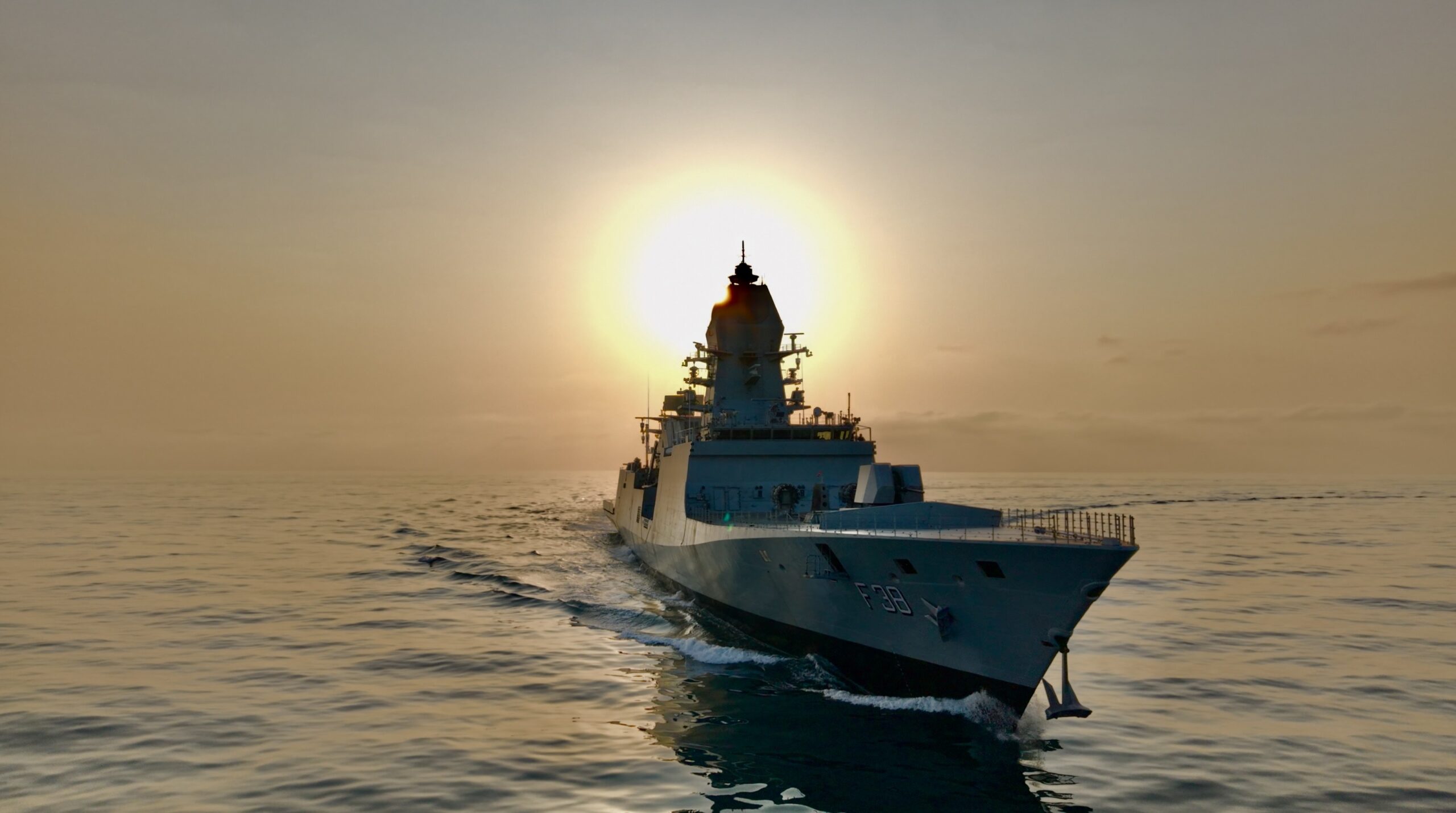
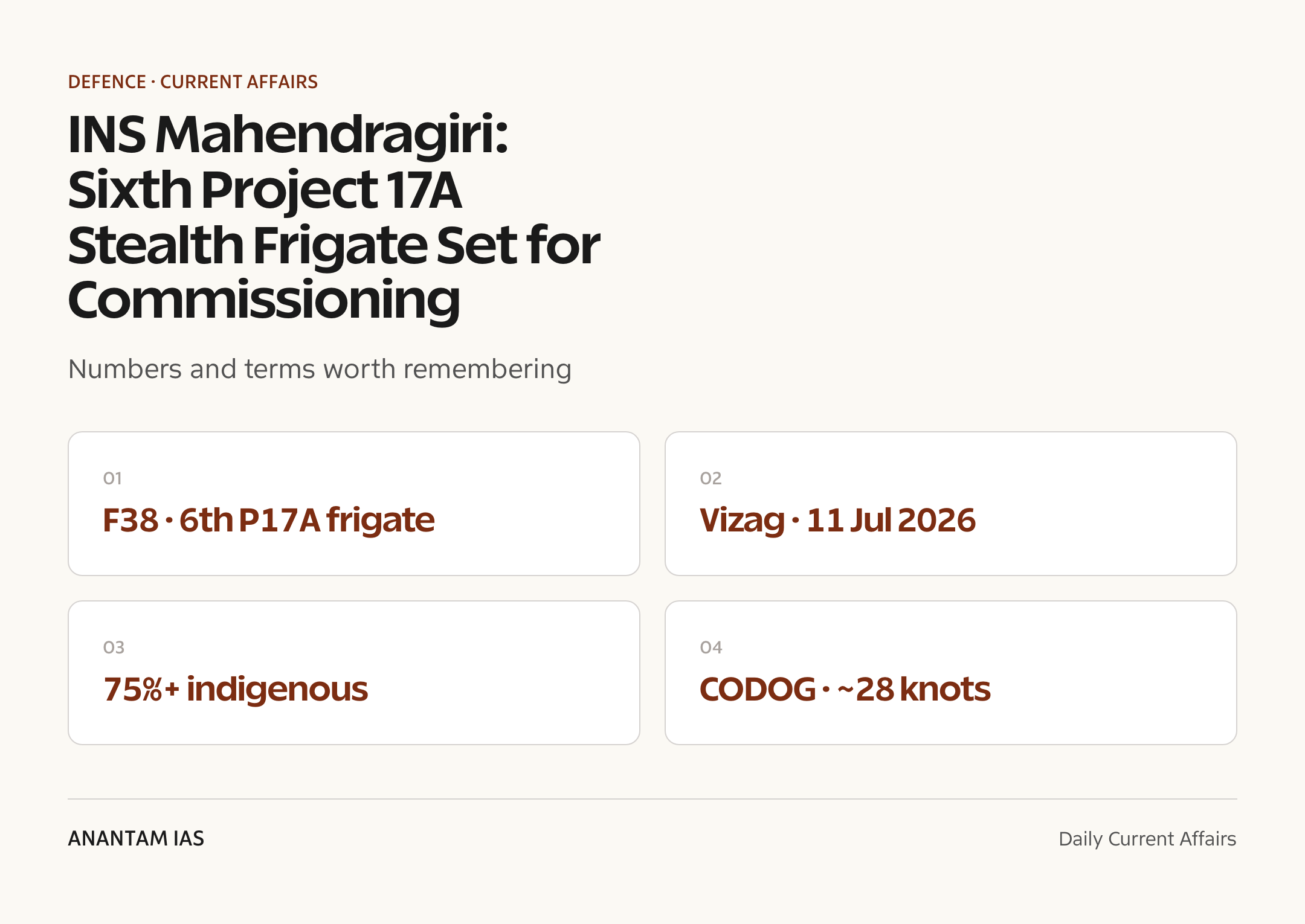
The Indian Navy will commission Mahendragiri (F38), the sixth Project 17A indigenous stealth frigate, at Visakhapatnam on 11 July 2026. PIB confirmed the schedule in a Ministry of Defence release on 6 July 2026.
The frigate was designed in-house by the Navy’s Warship Design Bureau (WDB) and built by Mazagon Dock Shipbuilders Limited (MDL), Mumbai, with over 75 per cent indigenous content — a working example of Aatmanirbhar Bharat in warship building. Her motto: ‘Mighty–Majestic–Matchless’.
- Sixth of seven Project 17A (Nilgiri-class) frigates to enter service; commissioning venue is Naval Dockyard, Visakhapatnam.
- Named after the Mahendragiri peak in the Eastern Ghats (Gajapati district, Odisha); PIB notes she is the first Indian naval warship to carry the name.
- Launched at MDL’s Mumbai yard in September 2023; now delivered as a mission-primed unit ready for fleet duties.
- Powered by a Combined Diesel or Gas (CODOG) propulsion package for high-speed sprints with long endurance.
- Carries surface-to-surface and surface-to-air missiles, anti-submarine warfare (ASW) systems, electronic warfare suites and an integrated Combat Management System.
The development matters in the context of:
- Project 17A is the largest single class of frigates India has built at home — a barometer of the defence industrial base that GS3 repeatedly tests.
- The commissioning strengthens the Navy’s pitch as the ‘Preferred Security Partner’ in the Indian Ocean Region at a time of contested Indo-Pacific waters.
- With five sisters already in service by mid-2026, the class shows what assembly-line warship building across two public shipyards can deliver.
UPSC Relevance
Prelims Relevance
- INS Mahendragiri (F38) — sixth Project 17A stealth frigate; commissioning at Visakhapatnam, 11 July 2026.
- Project 17A — seven stealth frigates; follow-on of Project 17 (Shivalik-class); four built at MDL Mumbai, three at GRSE Kolkata.
- Designer: Warship Design Bureau (WDB) — the Indian Navy’s in-house design organisation.
- CODOG (Combined Diesel or Gas) — diesel engines for economical cruise, gas turbines for high-speed dashes; the ship uses one or the other, not both together.
- Indigenous content: over 75 per cent, with a large MSME supplier base.
- Name source: Mahendragiri peak, Eastern Ghats, Odisha — Nilgiri-class ships are named after Indian hill ranges.
- Roles: anti-air, anti-surface and anti-submarine operations plus HADR, SAR and presence missions.
- Class in service (mid-2026): Nilgiri, Himgiri, Udaygiri, Taragiri, Dunagiri; Vindhyagiri is the seventh and last.
Mains Relevance
GS Paper 3
- Indigenisation of defence production — Project 17A as a case study of design (WDB), build (MDL/GRSE) and supply chain (MSMEs) all being domestic.
- Maritime security and the Navy’s role in securing sea lanes, EEZ and the Indian Ocean Region.
- Public-sector shipyard capacity, modular construction and the economics of a ₹45,000-crore-scale warship programme.
GS Paper 2
- India as ‘Preferred Security Partner’ — naval capability as an instrument of foreign policy under SAGAR/MAHASAGAR.
- Government policy design: Aatmanirbhar Bharat in strategic sectors and its institutional levers.
Essay
- Self-reliance is built ship by ship: technology sovereignty as national power.
- The ocean is the new strategic frontier — sea power and India’s rise.
Background and Context
Project 17A: the programme at a glance
Project 17A is India’s largest indigenous frigate programme, conceived as a stealthier, more automated follow-on to the Shivalik class.
- Seven stealth frigates sanctioned as a follow-on of Project 17 (Shivalik-class), whose three ships were commissioned between 2010 and 2012.
- Contracts were placed in 2015: four ships with Mazagon Dock Shipbuilders Limited (MDL), Mumbai, and three with Garden Reach Shipbuilders & Engineers (GRSE), Kolkata, at a reported programme outlay of about ₹45,000 crore.
- The class uses integrated (modular) construction — hull blocks pre-fitted with equipment before assembly — cutting build time at the slipway.
- Ships are named after Indian hill ranges: Nilgiri, Himgiri, Udaygiri, Taragiri, Dunagiri, Vindhyagiri and Mahendragiri. Six names revive the original Leander-based Nilgiri-class frigates of the 1970s–80s; Mahendragiri is the one all-new name in the family.
- For a wider fleet picture — destroyers, frigates and corvettes — see this primer on the warships of India.
The commissioning ladder so far
Five sisters have joined the fleet since January 2025, making the class a study in serial warship production.
- INS Nilgiri, the lead ship (MDL), was commissioned at Mumbai on 15 January 2025 — part of a triple commissioning with the destroyer INS Surat and submarine INS Vaghsheer.
- INS Himgiri (first GRSE-built ship of the class) and INS Udaygiri (MDL) were commissioned together at Visakhapatnam in August 2025 — the first twin commissioning of frontline combatants built at two different shipyards.
- INS Taragiri (F41), delivered in November 2025, was commissioned at Visakhapatnam on 3 April 2026.
- INS Dunagiri (GRSE) was delivered in March 2026 and commissioned at Kolkata in June 2026, alongside the survey vessel Sanshodhak and the anti-submarine craft Agray.
- Mahendragiri follows on 11 July 2026; only Vindhyagiri — launched at GRSE by President Droupadi Murmu in August 2023 — remains to complete the seven-ship class.
What makes Mahendragiri a stealth frigate
Stealth here means shrinking the ship’s signatures — radar, infrared, acoustic — so she is harder to detect, track and target.
- PIB highlights reduced radar signature, enhanced survivability and a high degree of automation that lowers crewing needs.
- Propulsion is CODOG — diesels for fuel-efficient patrol, gas turbines for combat sprints — giving both endurance and speed across mission profiles.
- The class measures about 149 metres and displaces roughly 6,670 tonnes, with a top speed near 28 knots, per official descriptions of earlier sister ships.
- Weapons and sensors include surface-to-surface and surface-to-air missile systems, comprehensive ASW systems, sophisticated electronic warfare capability and an integrated Combat Management System.
- Mission set spans anti-air, anti-surface and anti-submarine operations, maritime security, power projection, HADR, search and rescue, and sustained presence deployments.
The institutional engine: WDB, MDL and GRSE
The programme’s real story is institutional — an in-house design bureau feeding two public shipyards working in parallel.
- The Warship Design Bureau (WDB), the Navy’s in-house design organisation, designed the class end-to-end; PIB noted at Udaygiri’s delivery in July 2025 that she was the 100th ship of the Bureau’s design lineage.
- MDL (Mumbai) and GRSE (Kolkata) are Defence Public Sector Undertakings; splitting one class across two yards built parallel capacity and let both learn the same modern construction methods.
- The twin commissioning of August 2025 — two frontline frigates from two different yards on one day — showcased that parallel-build model.
- Owning the design means refits, upgrades and follow-on classes don’t depend on a foreign design house — a quieter but strategic form of self-reliance.
Indigenisation and the defence industrial base
Mahendragiri is as much an industrial-policy artefact as a warship.
- Over 75 per cent indigenous content, with construction drawing in a large network of Indian firms, including numerous MSMEs, generating employment while deepening the defence industrial base — PIB frames this squarely within Aatmanirbhar Bharat.
- Warship building has among the longest domestic value chains in defence — steel, propulsion auxiliaries, sensors, cabling, combat software — so each hull multiplies orders across the economy.
- The wider policy stack supports this: positive indigenisation lists, licence and FDI liberalisation, and innovation pipelines like iDEX.
- Gaps persist: gas turbines and some high-end sensors remain of foreign origin or licence-built, keeping full propulsion sovereignty on the to-do list.
- For the broader production picture — initiatives, prospects and challenges — see defence manufacturing in India.
Maritime security: SAGAR, IOR and the Indo-Pacific
New frigates are instruments of policy, not just platforms of war.
- PIB links the commissioning to India’s role as the ‘Preferred Security Partner’ in the Indian Ocean Region and to a secure, stable Indo-Pacific.
- The doctrinal anchor is SAGAR (Security and Growth for All in the Region, 2015), broadened in 2025 into MAHASAGAR — Mutual and Holistic Advancement for Security and Growth Across Regions.
- Frigates are the Navy’s workhorses for mission-based deployments — escorting shipping, anti-piracy patrols, chokepoint surveillance and rapid HADR response.
- A credible, home-built surface fleet underwrites deterrence in waters where extra-regional navies, including China’s, maintain a growing presence.
Way Forward
Finish the class, bank the lessons
- Commission Vindhyagiri on schedule to close out the seven-ship programme, then roll the modular-construction learning curve into the next-generation frigate and destroyer lines.
- Institutionalise the two-yard parallel-build model so future classes are delivered in years, not decades.
Deepen self-reliance where it is thinnest
- Prioritise indigenous marine gas turbines, high-end sensors and combat-system components — the residual import dependencies in an otherwise domestic ship.
- Widen private shipyard participation and component exports so the naval supply chain isn’t a two-yard monoculture.
- Keep the MSME base in long-term order pipelines; predictable demand is what turns vendors into a defence industrial ecosystem.
Conclusion
INS Mahendragiri closes the penultimate chapter of Project 17A: six of seven stealth frigates delivered by a Navy-designed, PSU-built, MSME-supplied production system. That system — more than any single hull — is the strategic asset.
For the exam, anchor the story to its durable scaffolding: Project 17A as the Shivalik follow-on, the Warship Design Bureau, MDL and GRSE, CODOG propulsion, 75 per cent indigenisation, and the SAGAR-to-MAHASAGAR maritime doctrine the ship will serve.
When Vindhyagiri joins, India will have turned a frigate class into proof that indigenous design and serial domestic construction can coexist — the precondition for every bigger naval ambition that follows.
UPSC Practice Questions
Prelims MCQ 1
With reference to the Project 17A (Nilgiri-class) frigates, consider the following statements:
- They are a follow-on of the Project 17 Shivalik-class frigates and are designed by the Indian Navy’s Warship Design Bureau.
- All seven ships of the class are being built by Mazagon Dock Shipbuilders Limited, Mumbai.
- INS Mahendragiri, the sixth ship of the class to be commissioned, has over 75 per cent indigenous content.
How many of the above statements are correct?
(a) Only one (b) Only two (c) All three (d) None
Answer: (b) Only two
Explanation:
Statements 1 and 3 are correct. Statement 2 is wrong: the seven ships are split between two shipyards — four at MDL, Mumbai and three at GRSE, Kolkata.
Prelims MCQ 2
INS Mahendragiri, set to be commissioned at Visakhapatnam in July 2026, takes its name from a peak located in:
(a) The Aravalli range (b) The Western Ghats (c) The Eastern Ghats (d) The Shivalik hills
Answer: (c) The Eastern Ghats
Explanation:
The frigate is named after the Mahendragiri peak in the Eastern Ghats (Gajapati district, Odisha). Project 17A ships are named after Indian hill ranges.
UPSC Mains Questions
- Indigenous warship building has moved beyond hull fabrication to full-spectrum design, integration and supply-chain localisation. With Project 17A as your case study, examine how naval shipbuilding strengthens India’s defence industrial base, and identify the dependencies that remain.
- Warships are as much instruments of foreign policy as of war-fighting. Discuss the Indian Navy’s role in realising the SAGAR/MAHASAGAR vision and India’s positioning as the ‘Preferred Security Partner’ in the Indian Ocean Region.
- Public-sector shipyards remain the backbone of India’s naval expansion. Critically examine the capacity, cost and timeline challenges of Indian warship construction, and suggest reforms to speed up fleet modernisation.
Source: PIB, Ministry of Defence.
Frequently Asked Questions
What is INS Mahendragiri?
INS Mahendragiri (F38) is the sixth Project 17A stealth frigate of the Indian Navy, set for commissioning at Visakhapatnam on 11 July 2026. Designed by the Warship Design Bureau and built by Mazagon Dock Shipbuilders, Mumbai, she carries over 75 per cent indigenous content and the motto ‘Mighty–Majestic–Matchless’.
What is Project 17A?
Project 17A is a seven-ship class of indigenous stealth frigates (Nilgiri-class), the follow-on to Project 17 Shivalik-class ships. Contracted in 2015, four ships are built at MDL Mumbai and three at GRSE Kolkata, using modular integrated construction and an in-house Navy design.
Why is the ship named Mahendragiri?
She is named after the Mahendragiri peak in the Eastern Ghats, in Odisha’s Gajapati district. Project 17A frigates all carry hill-range names, most revived from the original 1970s Nilgiri-class. PIB notes Mahendragiri is the first Indian naval warship to bear this name.
What is CODOG propulsion?
CODOG — Combined Diesel or Gas — pairs diesel engines for fuel-efficient cruising with gas turbines for high-speed operations. The ship runs on one mode at a time, switching to turbines when speed matters. It gives frigates like Mahendragiri both long endurance and sprint capability.
Which Project 17A ships are already in service?
Five: INS Nilgiri (commissioned January 2025, Mumbai), INS Himgiri and INS Udaygiri (twin commissioning at Visakhapatnam, August 2025), INS Taragiri (April 2026, Visakhapatnam) and INS Dunagiri (June 2026, Kolkata). Mahendragiri is sixth; Vindhyagiri will complete the class.
How does Mahendragiri support Aatmanirbhar Bharat?
The frigate has over 75 per cent indigenous content, with design by the Navy’s own bureau, construction at an Indian public shipyard, and equipment sourced from a wide network of Indian industries including MSMEs — generating employment and deepening the domestic defence industrial base.
Tell Google you want more of this.
Add Anantam IAS as a preferred sourceOne tap, and this site shows up more often in your own Top Stories, AI Overviews and AI Mode. Remove it any time.