Heat is no longer a seasonal inconvenience that can be handled with warnings and water advisories. Warm nights, urban heat islands and outdoor work are turning heat into a governance test. The state that can forecast heat but cannot cool a worker, a classroom, a bus stop or a rented room has only solved the easy half of the problem.
The Issue, Framed
The issue is that heat risk is moving from weather to public administration. Forecasts are better, alerts are faster, and heat action plans exist in many places. Yet people still suffer because the harder tasks are local: shade, ventilation, water, work hours, health surveillance, housing quality and emergency care.
For UPSC, heat is a GS3 disaster management and environment topic, but it also belongs to GS2 governance. It tests coordination between IMD, NDMA, state disaster authorities, municipal bodies, labour departments, health systems and employers. Heat is what happens when climate risk enters the ward office.
My view is that India’s heat policy must move from warning to welfare-plus-design. Alerts save lives, but alerts alone cannot make a tin-roof room breathable or a construction site safe at 2 p.m.
What the Data Says
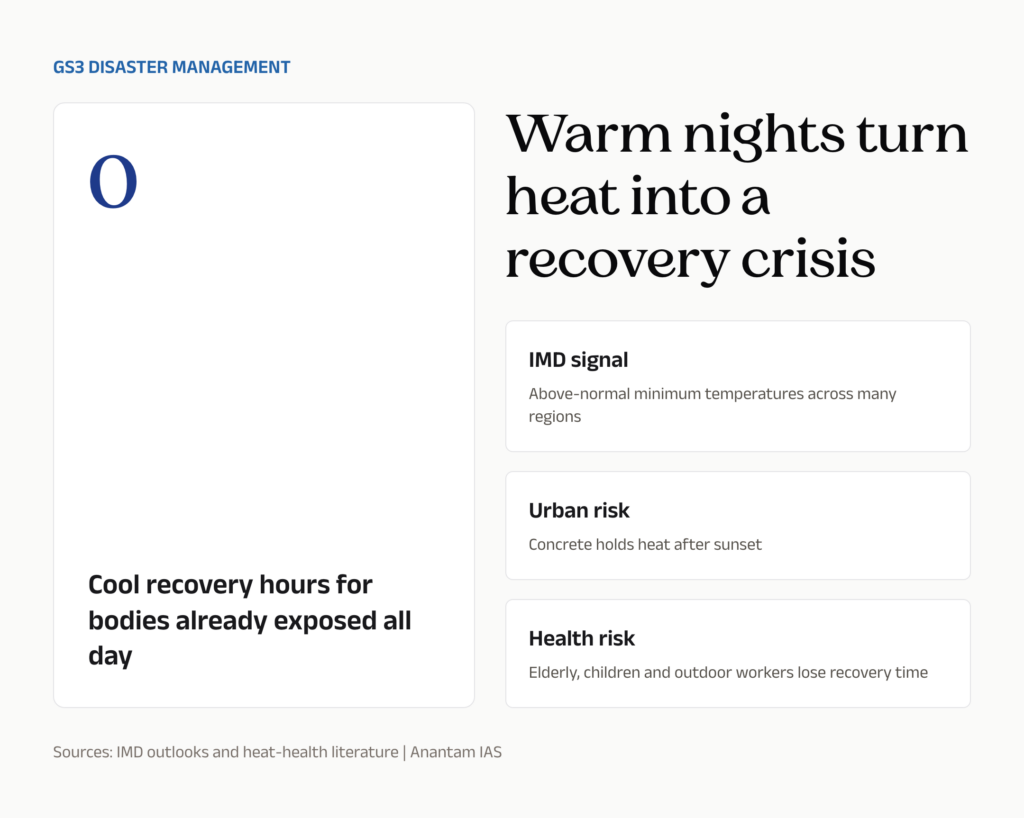
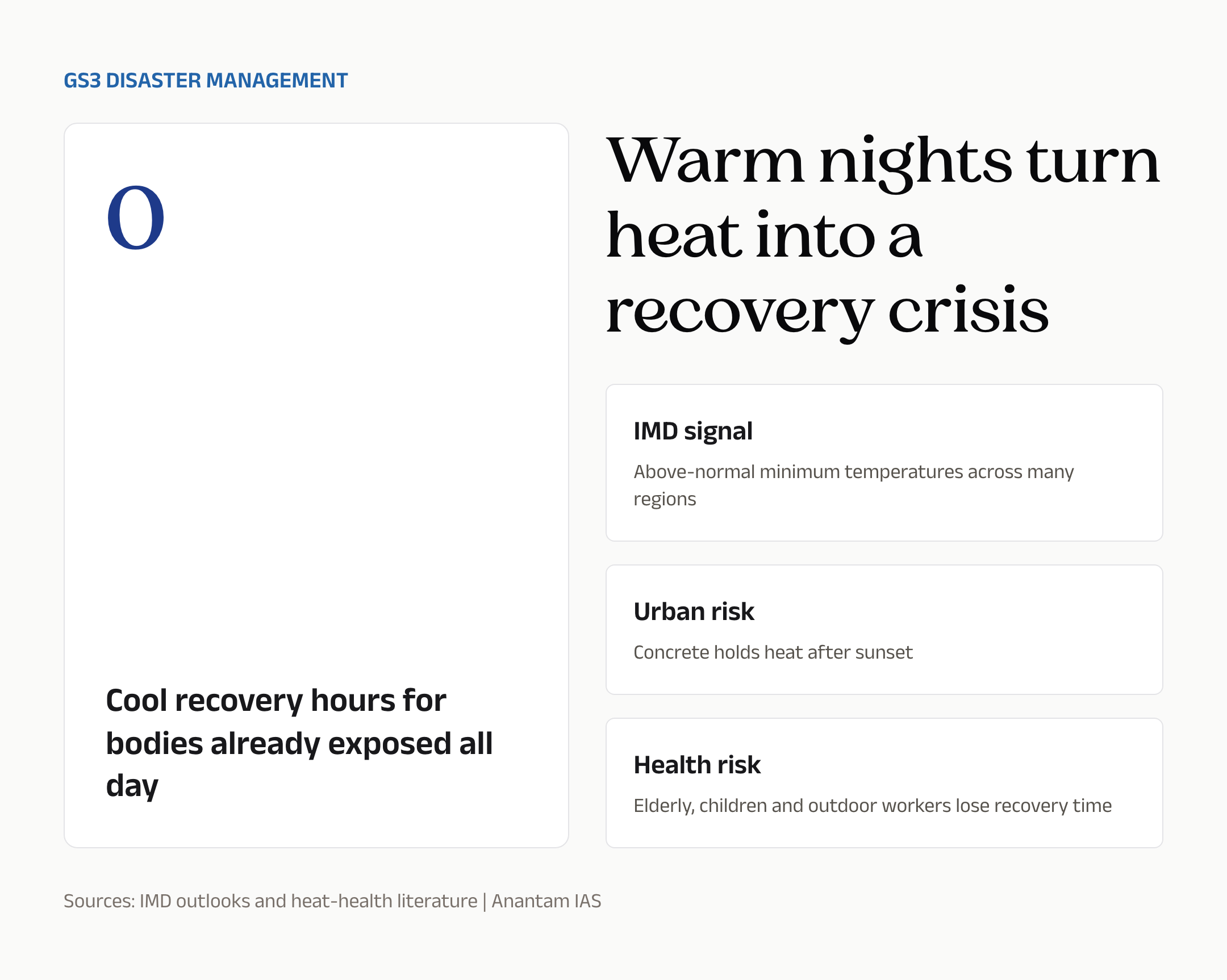
The IMD May 2026 outlook projected above-normal minimum temperatures across many parts of the country and above-normal heatwave days over parts of the Gangetic plains, coastal and western India. Minimum temperatures matter because they decide whether the body gets recovery time at night. For criteria and concepts, use heat wave in India and urban heat island.
The IMD extended heat outlook dated 28 May 2026 flagged warm night conditions in isolated pockets over Vidarbha in Week 1 and above-normal minimum temperatures over parts of East India in Week 2. It also linked heat to public health, water resources, power demand and essential services.
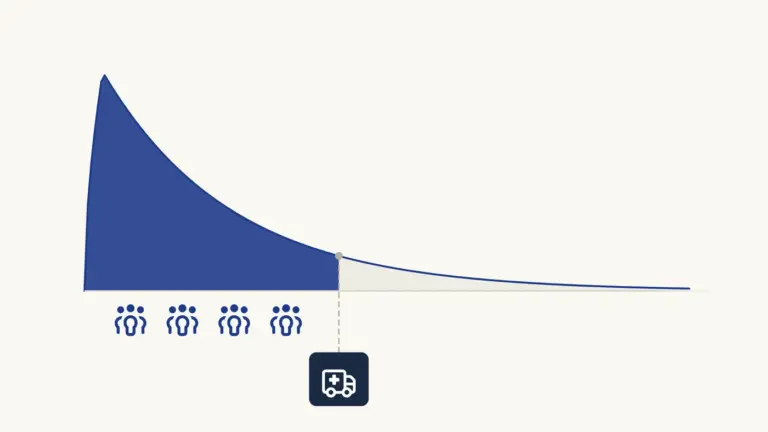
The CPR review of 37 heat action plans found serious design gaps. Only 10 of 37 HAPs listed thresholds different from national IMD heatwave thresholds. Only 2 explicitly carried out and presented vulnerability assessments. Only 11 discussed funding sources. None indicated the legal sources of their authority.
That is the heart of the matter. India has heat plans, but many do not yet behave like enforceable, financed, locally targeted governance plans. They often name vulnerable groups without mapping them, issue advisories without changing work conditions, and recommend infrastructure without saying who pays.
The Case For
The case for India’s current heat response is that it has improved. IMD forecasts, colour-coded alerts, public advisories, school timing changes, health warnings and cooling shelters are not trivial. Compared with a decade ago, many administrations now recognise heat as a disaster-management issue.
Heat action plans also create coordination. They tell health departments, municipalities, disaster authorities and local officials what to do before, during and after heatwave periods. Even a modest plan is better than improvisation during a crisis.
There is evidence from early heat-plan experience, especially Ahmedabad, that warnings plus health-system preparedness can reduce mortality risk. So the answer is not to dismiss HAPs. The answer is to strengthen them.
The Case Against
The case against the current approach is that many plans remain advisory, generic and underfunded. A warning tells a worker to avoid peak heat. It does not replace the day’s wage. A water advisory tells a household to stay hydrated. It does not ensure piped water in an informal settlement.
Warm nights expose another weakness. Heat policy often focuses on daytime maximum temperature. But if minimum temperatures remain high, the body cannot recover. This is especially dangerous for elderly citizens, people with chronic illness, children and workers sleeping in poorly ventilated housing.
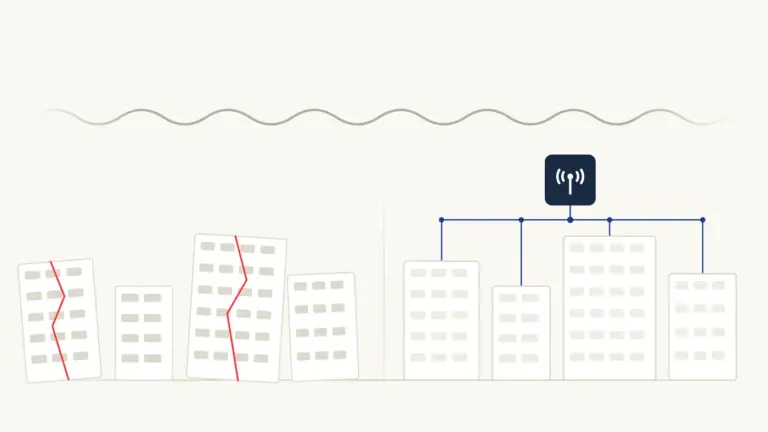
Urban planning is the biggest blind spot. Dark roofs, low tree cover, concrete surfaces, poor rental housing and traffic-heavy roads create heat traps. If municipalities treat heat only as an emergency response issue, they will keep managing symptoms rather than redesigning risk.
The Deeper Structural Read
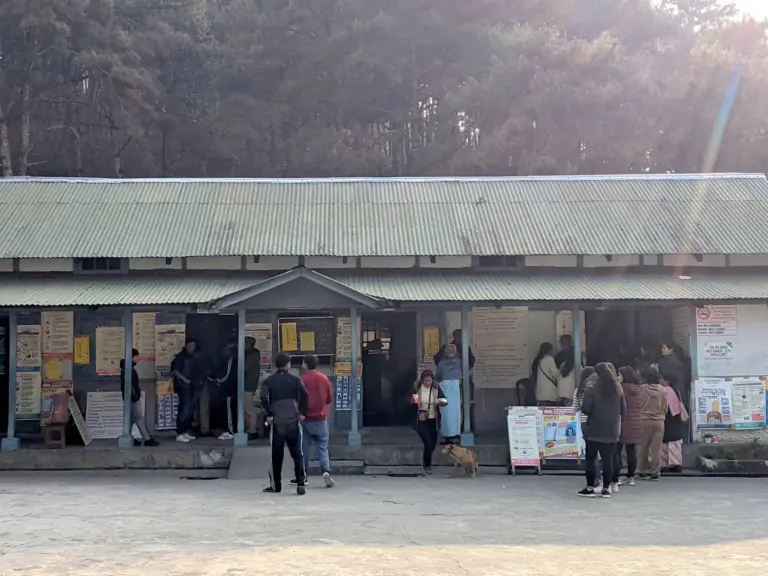
The deeper structural read is that heat reveals inequality in physical form. Two people may face the same IMD alert, but not the same heat. One has an insulated house, an air conditioner, paid leave and a private vehicle. Another has a tin roof, a fan that fails during outages, a daily wage and a bus stop without shade.
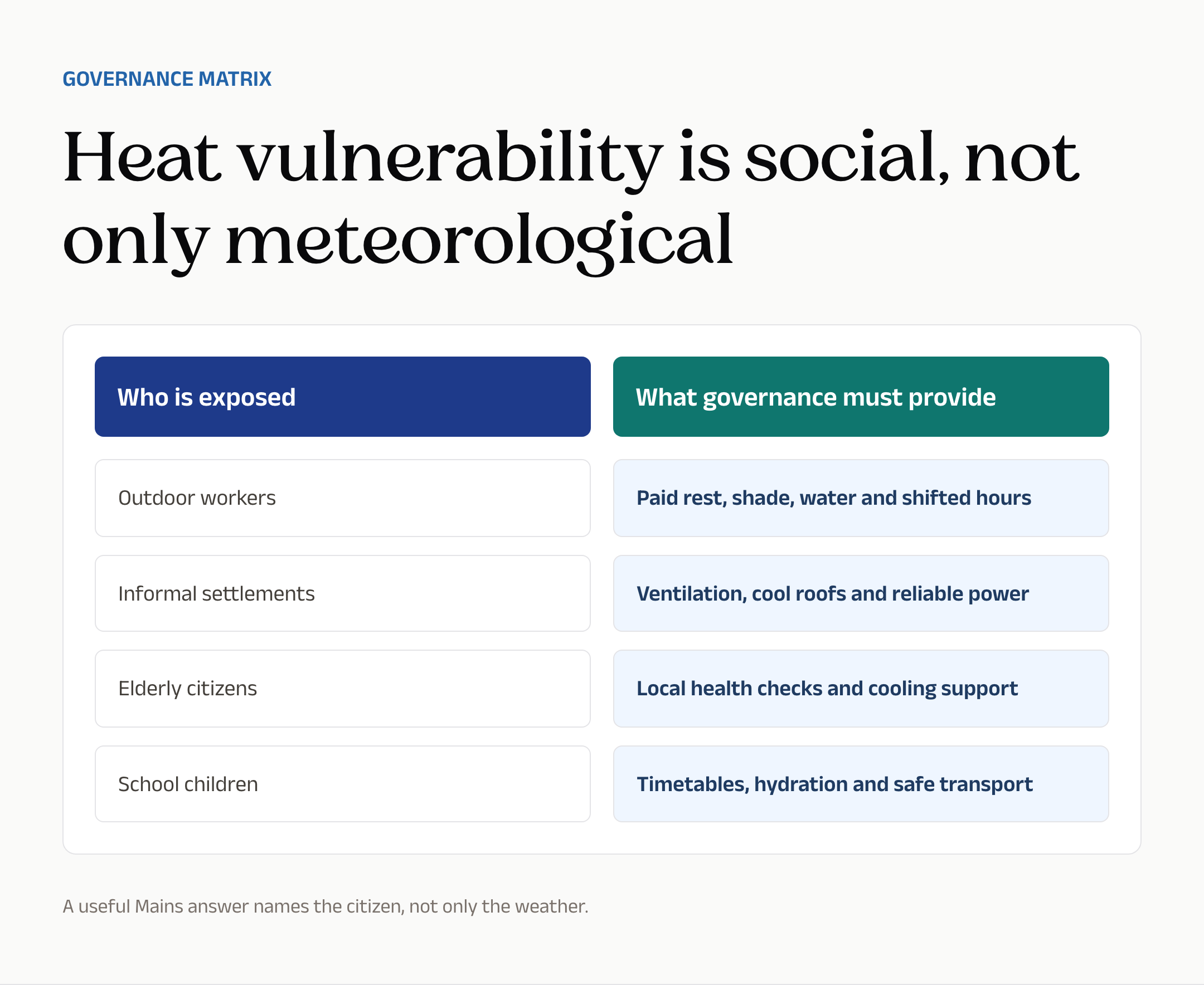
This is why heat governance has to name vulnerable citizens precisely. Outdoor workers, street vendors, traffic police, construction labourers, gig delivery workers, elderly people living alone, pregnant women, school children and informal-settlement residents need different interventions. A generic vulnerable-group list is not enough.
The next phase of HAPs should also integrate humidity and warm nights. Dry heat, humid heat and night heat do different things to the body. A city that tracks only maximum temperature may miss the most dangerous recovery failure.
There is a fiscal dimension too. A plan without money becomes a notice. If cool roofs, shelters, water points, extra health staff, tree cover and worksite enforcement are not budgeted, the HAP is a document, not a capacity.
This also changes how we should think about urban resilience. Heat adaptation is not only a disaster-response line item; it belongs in building codes, labour inspection, school administration, primary health care, transport planning and municipal budgeting. The city has to reduce exposure before the alert is issued. A shaded street, a cool roof and a ventilated rental room are as much heat policy as a warning SMS.
What Should Be Done
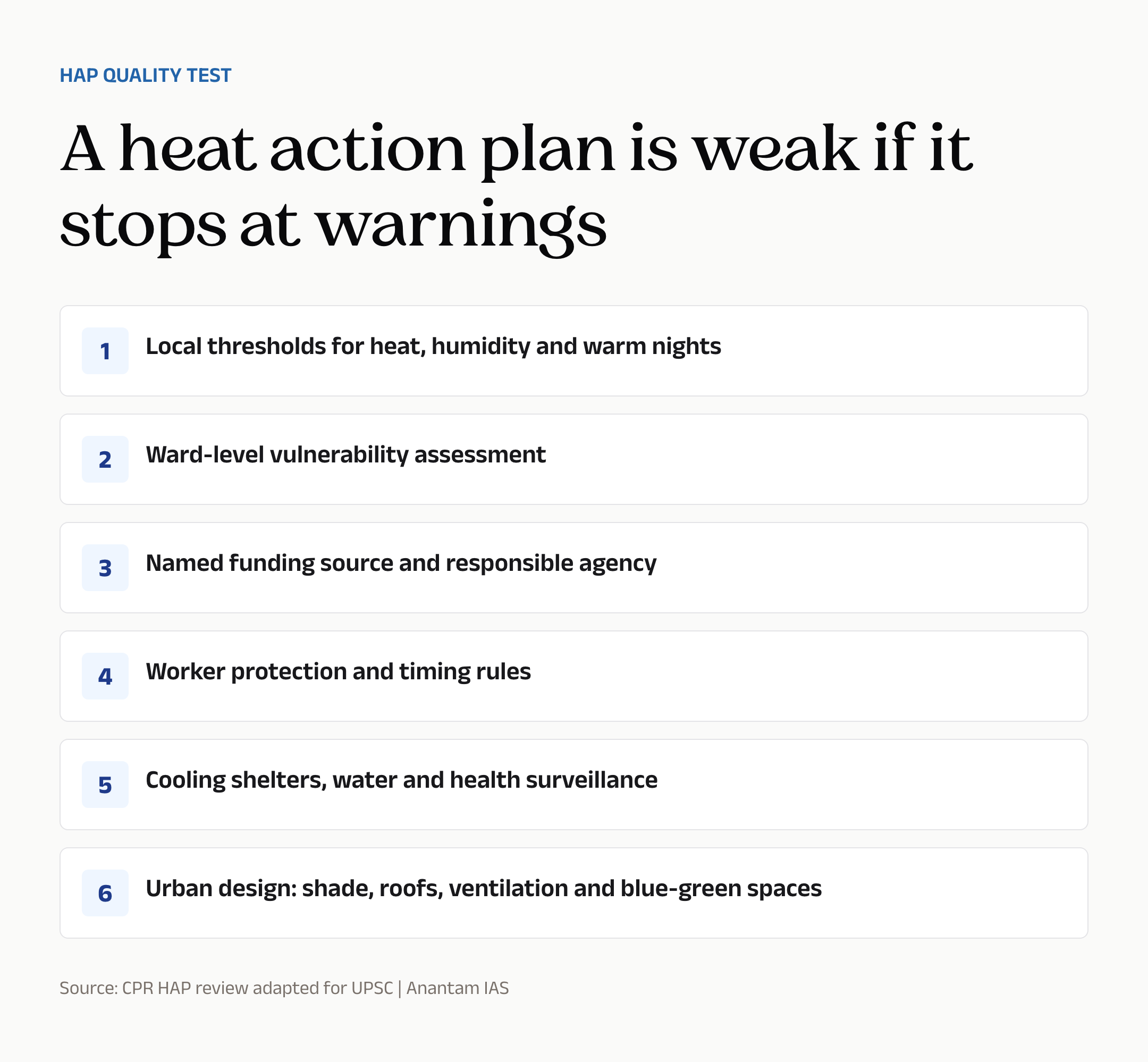
First, every heat action plan should include local thresholds for maximum temperature, minimum temperature, humidity and warm nights. National IMD criteria are a starting point, not a substitute for local risk.
Second, cities should map heat vulnerability at ward level. Use census data, land-surface temperature, tree cover, informal housing, elderly population, worksite density and health records. The goal is not academic perfection. The goal is targeted action.
Third, worker protection must become central. Shift work hours, mandate rest-water-shade rules, protect wages during extreme alerts, and cover informal and gig workers. Otherwise heat policy will ask the poorest to bear the cost of adaptation.
Fourth, urban design must enter the disaster file. Cool roofs, shaded streets, ventilation standards, water bodies, tree cover, reflective surfaces and safe public transport stops are heat infrastructure. They should be funded like infrastructure.
Finally, public health systems need heat surveillance. Primary health centres, ASHA workers, ambulances and hospitals should track heat illness, dehydration, kidney stress and mortality better. What is not measured will keep being dismissed as seasonal discomfort.
For Your Mains Answer
GS paper mapping: GS3: disaster management, climate change, environment; GS2: urban governance, health and welfare.
Likely question frames: – Heat action plans in India must move from warning systems to funded adaptation plans. Discuss. – Warm nights and urban heat islands make heat a public health governance challenge. Examine. – How can Indian cities protect vulnerable groups from rising heat stress?
Quotable data points: – IMD May 2026 outlook projected above-normal minimum temperatures across many regions. – Above-normal heatwave days were likely over parts of the Gangetic plains, coastal and western India. – CPR reviewed 37 HAPs across 18 states. – Only 10 of 37 HAPs listed thresholds different from national IMD thresholds. – Only 2 of 37 HAPs explicitly carried out and presented vulnerability assessments. – Only 11 of 37 HAPs discussed funding sources. – None of the reviewed HAPs indicated legal sources of authority.
Keywords to use: heat action plan, warm nights, urban heat island, climate adaptation, public health surveillance, worker protection, local vulnerability mapping.
Syllabus linkages: Disaster management, Climate change, Urbanisation, Issues relating to health.
Balanced conclusion line: A heat-resilient city is not one that only warns citizens, but one that redesigns work, housing, streets and health systems around rising temperatures.
How to Build the Answer
Start with the central tension, not a textbook definition. For this topic, the tension is: Heat action plans in India must move from warning systems to funded adaptation plans. Discuss. That opening immediately tells the examiner that you understand both the policy problem and the value conflict. A definition can come in the second or third sentence. The first sentence should frame the debate.
Use data early, but do not dump data. A good first body paragraph can carry three numbers: IMD May 2026 outlook projected above-normal minimum temperatures across many regions. Above-normal heatwave days were likely over parts of the Gangetic plains, coastal and western India. CPR reviewed 37 HAPs across 18 states. Then explain what those numbers prove. UPSC rewards the move from fact to inference. The number is the anchor; the inference is the mark-scoring part.
The second body paragraph should handle the other side fairly. If your stance supports reform, first admit why the existing approach has a rationale. If your stance criticises a policy, first say what problem the policy was trying to solve. This is how an answer becomes balanced without becoming vague.
The way forward should be grouped, not scattered. Use headings such as institutional reform, fiscal design, citizen impact, federal coordination and technology. Use the topic’s own vocabulary: heat action plan, warm nights, urban heat island, climate adaptation, public health surveillance. These words help the answer sound like governance analysis rather than a newspaper summary.
Close by returning to the syllabus link: Disaster management, Climate change, Urbanisation. The last line should not repeat the introduction. It should show judgment. One useful pattern is: ‘The goal is not X alone, but X with Y.’ That pattern lets you balance reform with rights, growth with equity, and security with liberty.
Common Mistakes to Avoid
- Do not write only the newspaper argument. Editorials are starting points. Mains answers need constitutional, economic, administrative or ethical structure.
- Do not overuse adjectives. Words like serious, grave, historic and transformative do not earn marks unless tied to evidence.
- Do not make the answer one-sided. Every topic in this batch has a real counter-argument. Steelman it in two or three lines before giving your final view.
- Do not end with a slogan. End with an implementable principle, a measurable reform, or a constitutional value.
- Do not forget the citizen. UPSC likes policy, but it rewards policy that names who gains, who loses and who needs protection.
A Compact Answer Spine
- Introduction: Open with the conflict in one sentence and define the key term in the next sentence.
- Evidence: Use two or three data points from the dossier and connect each to a policy implication.
- Arguments: Present the case for the current policy or trend, then the case against it. Keep both fair.
- Structural diagnosis: Explain the deeper administrative, economic, social or constitutional reason the issue persists.
- Way forward: Give four to five grouped reforms with clear actors: Union government, state government, regulator, court, market, municipality or citizen.
- Conclusion: Use the balanced conclusion line from this section and adapt it to the question wording.
Diagram or Flowchart Idea
Use one small diagram if the question is a 15-marker. Do not draw a decorative mind map. Draw a causal chain. The cleanest format is: problem trigger -> institutional gap -> citizen impact -> reform response. This works because the examiner can read the logic in five seconds.
For a 10-marker, skip the diagram unless it is genuinely simple. A table with two columns, ‘case for’ and ‘case against’, usually works better. The aim is not to show artistic effort. The aim is to make the answer easy to evaluate under time pressure.
Ethics and Governance Angle
Add one ethical line even in a GS2 or GS3 answer. Most current-affairs editorials are not only about efficiency. They also ask who bears the cost of policy failure. A migrant voter, an undertrial, an outdoor worker, a small exporter, a low-income commuter or an elderly citizen is often sitting silently inside the issue. Naming that citizen makes the answer sharper.
The governance angle should then convert empathy into design. Do not merely say ‘protect vulnerable groups’. Say how: targeted transfers, legal aid, local health surveillance, simplified compliance, public transport, transparent dashboards, or periodic judicial review. This is where many answers move from moral language to administrative maturity.
A useful sentence pattern is: ‘The policy is legitimate in aim, but its legitimacy depends on procedure, proportionality and capacity.’ This line works across many topics because it accepts the state’s objective without giving the state a blank cheque. It is especially useful for questions where the examiner expects balance.
How to Use Data Without Sounding Mechanical
Use fewer numbers than you know. Three well-explained data points beat ten scattered facts. Put the most important number near the beginning, use the second number to show contrast, and use the third number to justify the way forward. For example, one national number, one state or sector contrast, and one implementation gap is usually enough.
Never leave a statistic alone. Follow it with a sentence beginning with ‘This means…’ or ‘The policy implication is…’ That tiny move turns data into analysis. It also keeps the answer from reading like a fact sheet. In Mains, facts are raw material. Judgment is the finished answer.
End revision by asking one question: can this answer be understood by a tired examiner in one pass? If the answer needs rereading, simplify the structure. Keep the introduction short, give the data early, mark the two sides cleanly, and place the way forward in grouped points. Clarity is not a lower standard than depth. For UPSC writing, clarity is how depth becomes visible.
One final check: remove any line that sounds impressive but does no work. Replace it with a fact, a cause, a consequence or a reform. That habit is small, but it is the difference between an answer that feels informed and an answer that feels memorised.
Write for marks, not for noise. Every sentence should earn its place. Always be specific.
FAQ
What are warm nights?
Warm nights are periods when minimum temperatures remain unusually high, reducing the body’s recovery time after daytime heat exposure.
Why are heat action plans weak?
Many plans are generic, underfunded, weakly localised and poor at mapping vulnerable groups, according to CPR’s review of 37 HAPs.
Who is most vulnerable to heat?
Outdoor workers, elderly citizens, children, informal-settlement residents, people with chronic illness and low-income households face the highest risks.
What should a Mains answer emphasise?
Emphasise heat as local governance: forecasts plus worker protection, cool roofs, health surveillance, water access, shaded streets and funded municipal action.
Tell Google you want more of this.
Add Anantam IAS as a preferred sourceOne tap, and this site shows up more often in your own Top Stories, AI Overviews and AI Mode. Remove it any time.