The Indian Navy’s surface combatant fleet is organized around three workhorse categories: destroyers, frigates, and corvettes. The categorization is by displacement and role rather than by hull type alone, and the three together carry the bulk of the Navy’s at-sea firepower outside the carrier and submarine arms. Destroyers handle blue-water area defence and protect the carrier battle group. Frigates form the multi-role backbone of the fleet, balancing stealth, speed, and firepower. Corvettes operate in the littoral, hunting submarines in shallow water and defending offshore assets. Each category has multiple classes, each class has a distinctive design, and the active force as of the mid-2020s carries roughly forty surface combatants across these three categories.
For UPSC, warships sit inside GS-III under defence and internal security, with cross-cutting threads into industrial policy (the indigenous shipbuilding programme), foreign policy (the Quad and Indo-Pacific engagement), and current affairs whenever a new hull is commissioned. The fleet has expanded substantially in the last decade through the Project 15B Visakhapatnam-class destroyers, the Project 17A Nilgiri-class stealth frigates, and the Project 28 Kamorta-class anti-submarine corvettes, all built in Indian shipyards under the Atmanirbhar Bharat framework. A candidate who can name the active classes in each category, identify the lead ship, and place the fleet inside the broader push toward indigenous warship design and construction has covered the topic at the depth examiners expect.
This guide treats the surface combatant fleet as a coherent picture organized by role. We cover what each category does, the active classes inside each, the indigenous shipbuilding ecosystem that produces them, the strategic context that drives fleet expansion, and the prelims-style facts and mains-style debates the topic produces.
Quick Facts on Indian Navy Warships
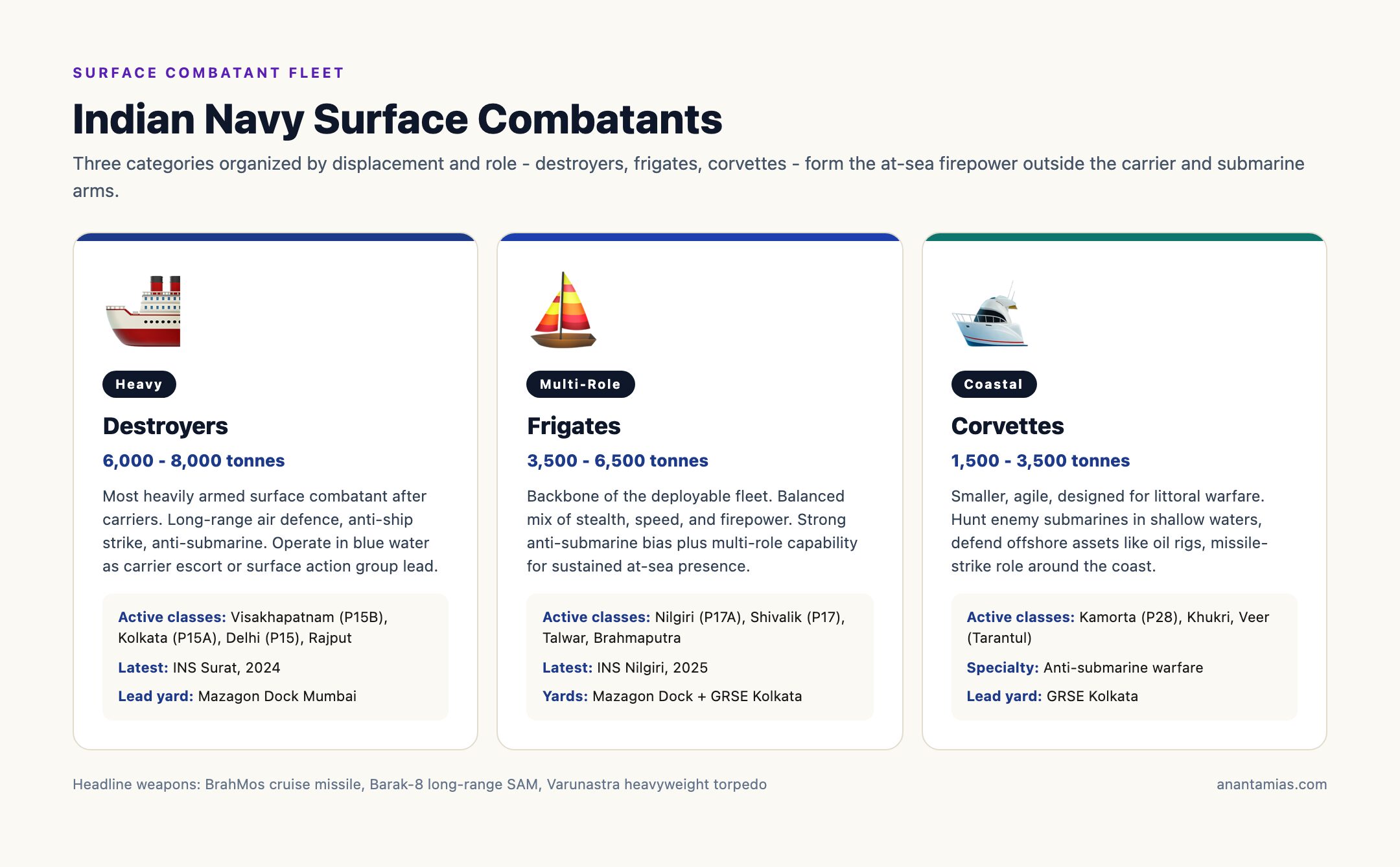
- Three main surface combatant categories: Destroyers, Frigates, Corvettes.
- Lead destroyer class: Visakhapatnam-class (Project 15B), with INS Surat commissioned in 2024.
- Lead frigate class: Nilgiri-class (Project 17A), with INS Nilgiri commissioned in early 2025.
- Lead anti-submarine corvette class: Kamorta-class (Project 28).
- Largest indigenous shipbuilder for warships: Mazagon Dock Shipbuilders Limited (MDL), Mumbai.
- Other key shipyards: Garden Reach Shipbuilders and Engineers (Kolkata), Cochin Shipyard, Goa Shipyard, Hindustan Shipyard (Visakhapatnam).
- Stealth standard: Reduced radar cross-section, infrared signature management, low underwater noise across all new classes.
- Headline missile: BrahMos supersonic cruise missile, Barak-8 long-range surface-to-air missile.
- GS paper relevance: Prelims (Defence, Sci-Tech), GS-III (Internal Security, Defence Indigenisation, Indo-Pacific).
What Indian Navy Warships Are and Why They Matter
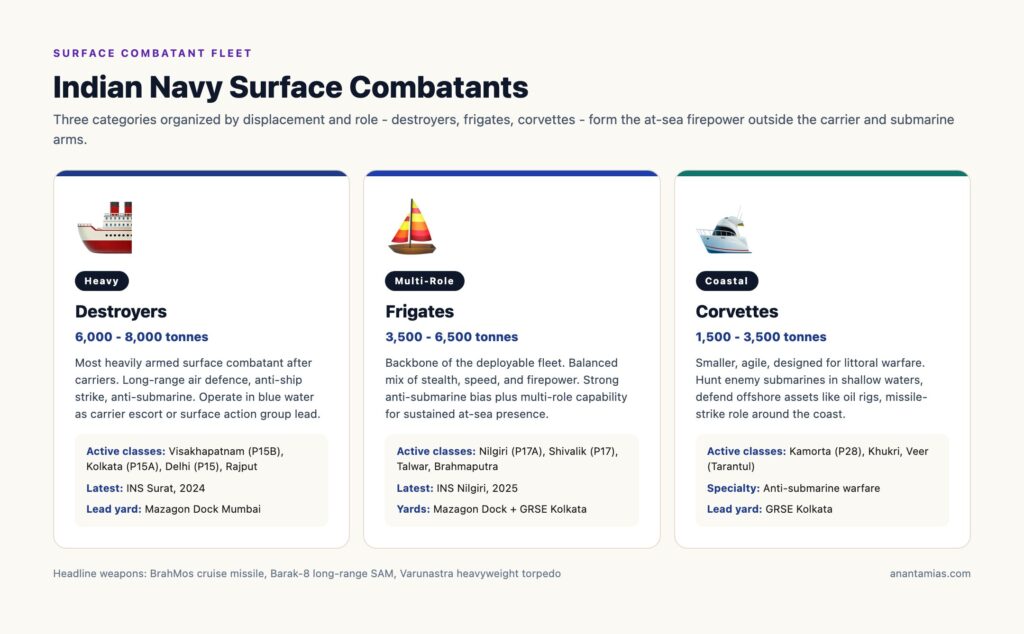
A warship in the modern surface-combatant sense is a multi-mission platform that combines air defence, anti-surface warfare, anti-submarine warfare, and electronic warfare on a single hull. The Indian Navy organizes its surface combatants by displacement and role: destroyers (typically 6,000-8,000 tonnes, heavy multi-role) at the top, frigates (3,500-6,500 tonnes, multi-role with strong anti-submarine bias) in the middle, corvettes (1,500-3,500 tonnes, coastal anti-submarine and missile-strike) at the smaller end.
The three categories are not arranged in a hierarchy of importance. They are arranged by the operating environment they are best suited for. A destroyer provides area air defence over a carrier battle group at sea; a frigate hunts submarines along sea lines of communication; a corvette defends offshore oil rigs and engages enemy submarines in shallow waters where larger ships cannot operate effectively. The Navy’s force planning seeks a balanced mix across the three.
Background and Historical Context
Indian naval shipbuilding began in earnest with the Indian Navy’s transition from a Royal Navy successor force to a self-conscious blue-water navy. Through the 1960s and 1970s, the fleet was largely composed of British-built destroyers and frigates supplied directly or built in India to British designs. The Soviet-supplied Rajput-class destroyers (Kashin-II derivative) joined in the 1980s, and the Soviet-supplied Kilo-class submarines reshaped the underwater arm in the same decade.
The shift toward indigenous design accelerated in the 1990s. The Brahmaputra-class frigates, the Delhi-class destroyers, and the early Khukri-class corvettes were Indian-designed, Indian-built ships built around imported weapons systems but with hull, propulsion, and combat-management integration done domestically. The Project 17 Shivalik-class stealth frigates, commissioned from 2010, marked the country’s entry into modern stealth warship design with reduced radar cross-section and low-signature engineering.
Broader context on the country’s defence manufacturing initiatives, prospects, and challenges frames how this transition fits the larger Atmanirbhar Bharat industrial push. The 2010s and 2020s have seen sustained expansion. The Project 15A Kolkata-class destroyers (three ships, 2014-2016), the Project 15B Visakhapatnam-class destroyers (four ships, 2021-2024), the Project 17A Nilgiri-class stealth frigates (under commissioning), and the Project 28 Kamorta-class anti-submarine corvettes (four ships, 2014-2020) are all products of this push. Indian shipyards now design and build first-rate surface combatants with steadily rising indigenous content (currently above 70 percent for hull and platform systems, with weapons and sensors a continuing import line).
Destroyers of the Indian Navy
Destroyers are the most heavily armed surface combatants below the aircraft carrier in the Indian fleet. They carry long-range surface-to-air missiles, anti-ship cruise missiles, anti-submarine torpedoes and rocket launchers, and embarked helicopters. They are designed for blue-water operations and typically operate as the air-defence escort of a carrier battle group or as the lead ship of a surface action group.
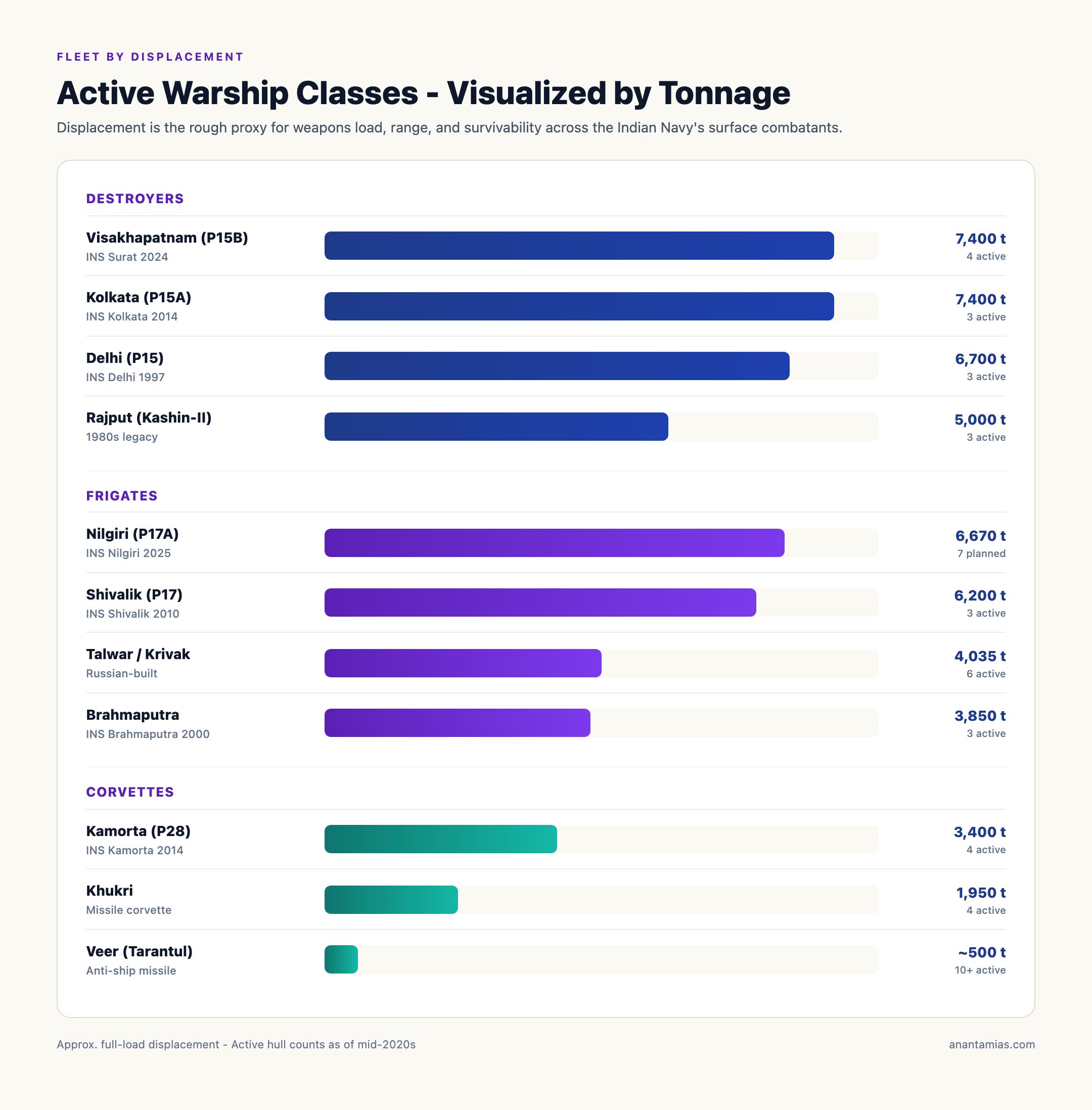
The Visakhapatnam-class (Project 15B) is the latest indigenous destroyer class. Four ships have been commissioned: INS Visakhapatnam (2021), INS Mormugao (2022), INS Imphal (2023), and INS Surat (2024). At about 7,400 tonnes full-load displacement, they carry 32 Barak-8 long-range surface-to-air missiles in vertical launch, 16 BrahMos anti-ship cruise missiles, two RBU-6000 anti-submarine rocket launchers, and embark two helicopters. Stealth design reduces radar cross-section through angled superstructure and low-signature antennas.
The Kolkata-class (Project 15A) preceded Project 15B and shares much of its weapons fit. Three ships are in service: INS Kolkata, INS Kochi, and INS Chennai, commissioned between 2014 and 2016. They were the first Indian destroyers to carry Barak-8 and to introduce vertical launch BrahMos.
The Delhi-class (Project 15) entered service in the 1990s and remains active: INS Delhi, INS Mysore, and INS Mumbai. They are the bridge between the older Soviet-derived designs and the modern stealth-era destroyers, carrying a mix of Russian and indigenous weapons.
The Rajput-class (Kashin-II derivative) is the legacy Soviet design. Active hulls (after a series of decommissionings) include INS Rana, INS Ranvir, and INS Ranvijay. They are gradually being phased out as the Project 15B ships commission and the planned Project 18 next-generation destroyers begin construction.
Frigates of the Indian Navy
Frigates are the multi-role backbone of the fleet. They balance air defence, anti-surface, and anti-submarine capability on a smaller, more numerous platform. They form the bulk of the deployable surface force and handle most of the routine presence missions across the Indian Ocean Region.
The Nilgiri-class (Project 17A) is the newest stealth frigate class, designed by the Indian Navy’s Directorate of Naval Design and built at Mazagon Dock and Garden Reach Shipbuilders. Seven ships are planned. Lead ship INS Nilgiri was delivered for commissioning in early 2025. Sister ships INS Himgiri and INS Udaygiri follow. At about 6,670 tonnes, they carry 32 Barak-8 missiles, 8 BrahMos, twin 76 mm guns, and an integrated sensor suite that emphasizes networked combat management.
The Shivalik-class (Project 17) preceded Project 17A as India’s first stealth frigates. Three ships are in service: INS Shivalik, INS Satpura, and INS Sahyadri, commissioned 2010-2012. They are still front-line but predate the integrated mast and full network-centric design of Project 17A.
The Talwar-class comprises six Russian-built modified Krivak-III hulls: INS Talwar, INS Trishul, INS Tabar, INS Teg, INS Tarkash, and INS Trikand, commissioned in two batches between 2003 and 2013. Two additional Krivak-class hulls (INS Tushil delivered 2024 and INS Tamala expected 2025-26) are completing under a follow-on order. They carry BrahMos vertical launch and Shtil-1 surface-to-air systems.
The Brahmaputra-class is the older indigenous design, with three hulls in service: INS Brahmaputra, INS Betwa, INS Beas, commissioned 2000-2005. They will progressively be decommissioned as Project 17A ships complete commissioning.
Why the Fleet Matters Strategically
Three reasons drive the sustained expansion. First, the Indian Ocean is the world’s most heavily trafficked maritime trade corridor, and India’s interest in keeping it open touches energy security (most crude imports), commerce, and the diaspora. Second, the Indo-Pacific has become the principal theatre of great-power competition, and the Indian Navy’s role in the Quad maritime exercises (Malabar) and bilateral exercises with the US, France, Japan, Australia, and Indonesia depends on a credible surface fleet. The nuclear triad discussion captures the strategic envelope inside which the surface fleet operates, since sea-based deterrence depends on undersea and surface platforms working together. Third, the immediate neighborhood, with Chinese deployments in the Indian Ocean, Pakistani submarine modernization, and persistent piracy concerns off the Horn of Africa, requires sustained presence.
The economic case is also substantial. Each major warship draws on a long supply chain: hull steel from public-sector mills, propulsion (gas turbines, diesel engines), weapons (DRDO, Bharat Dynamics, BEL, BrahMos Aerospace), sensors, and systems integration. The shipbuilding ecosystem supports skilled employment in Mumbai, Kolkata, Visakhapatnam, Cochin, and Goa, and the technology transferred from each generation to the next compounds.
Detailed Analysis: The Indigenous Shipbuilding Ecosystem
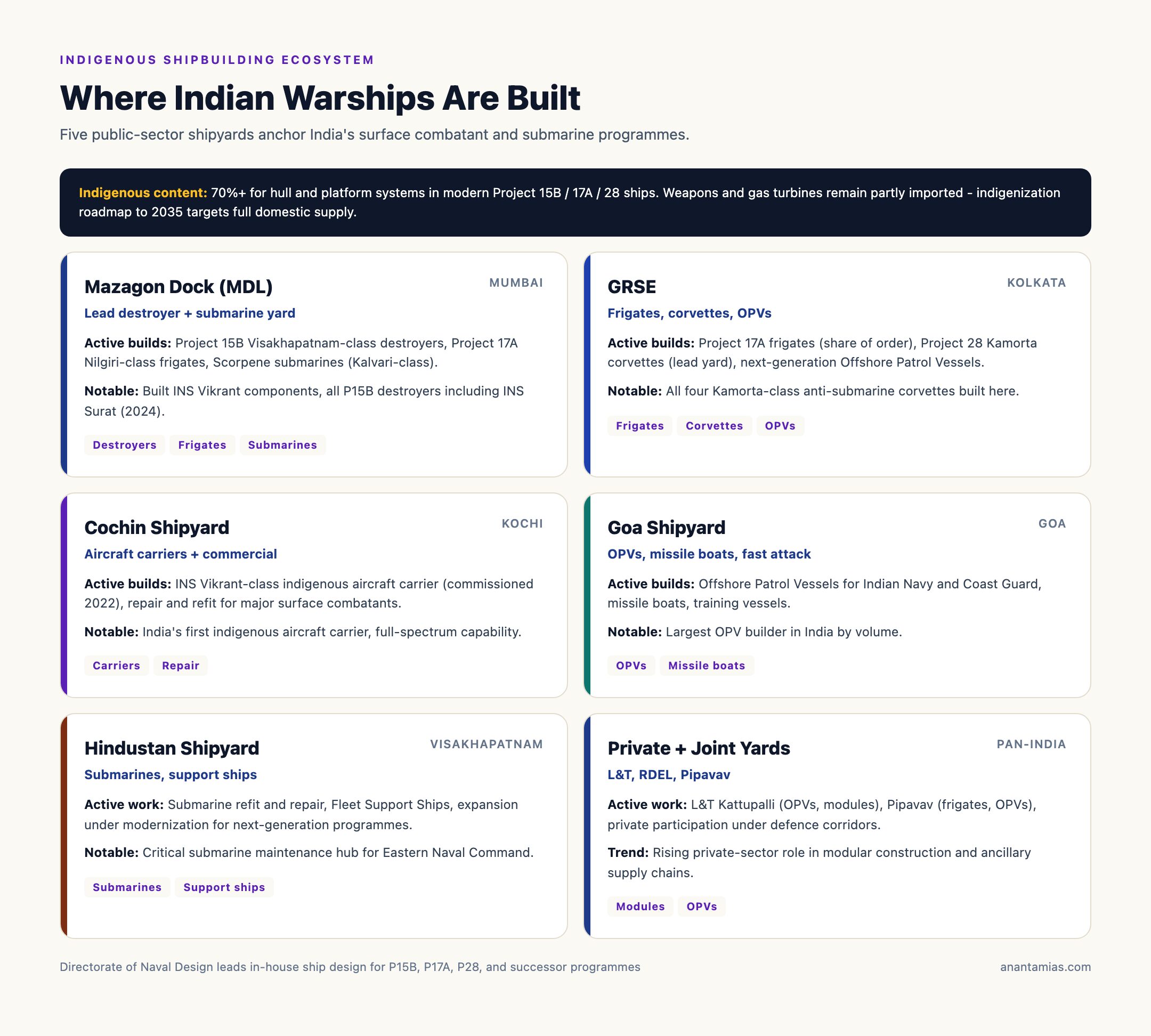
A useful way to read the Indian warship picture is through the shipyards that build them. Mazagon Dock Shipbuilders Limited (MDL) in Mumbai is the lead destroyer and submarine yard, currently building the Project 15B destroyers, the Project 17A frigates, and the Scorpene-class submarines. Garden Reach Shipbuilders and Engineers (GRSE) in Kolkata builds the Project 17A frigates (its share of the order), the Project 28 corvettes, and the next-generation offshore patrol vessels. Cochin Shipyard built the indigenous aircraft carrier INS Vikrant. Goa Shipyard specializes in offshore patrol vessels and missile boats. Hindustan Shipyard in Visakhapatnam is being modernized to handle larger combatants.
Recent developments in AI in defence and the rollout of the Atlas drone swarm in India’s defence ecosystem also feed into the warship modernization story, since combat-management systems, autonomous platforms, and networked sensors are cross-cutting capabilities. Indigenous design capability has improved sharply. The Directorate of Naval Design under the Indian Navy now leads ship design for Project 15B, 17A, and the planned next-generation destroyers (Project 18) and frigates (Project 17B). Combat-management systems and network architectures are increasingly Indian-designed. Weapons remain a hybrid: Russian and Israeli systems are still present alongside BrahMos (Indo-Russian joint venture) and Barak-8 (Indo-Israeli joint venture), with indigenous Akash-NG and homegrown air defence and anti-submarine weapons under development.
Comparative Snapshot: Destroyers vs Frigates vs Corvettes
The simplest way to keep the three categories straight is by displacement, primary mission, and typical operating environment. Destroyers (6,000-8,000 tonnes) carry long-range air defence and anti-ship missiles, operate in blue water, and protect the carrier battle group or lead a surface action group. Frigates (3,500-6,500 tonnes) carry a balanced fit emphasizing anti-submarine warfare and multi-role capability, operate across blue and green water, and form the deployable backbone of the fleet. Corvettes (1,500-3,500 tonnes) carry concentrated anti-submarine and missile-strike capability, operate in the littoral and around offshore infrastructure, and provide flexible local defence.
A useful additional axis is range and endurance. Destroyers and frigates are designed for sustained deployment thousands of nautical miles from home; corvettes typically operate in defined zones and rely on shore-based replenishment. The carrier and the destroyers form the high-end of the order of battle; the frigates and corvettes form the bulk.
Corvettes of the Indian Navy
The Kamorta-class (Project 28) is the newest anti-submarine corvette class, designed and built at GRSE Kolkata. Four ships are in service: INS Kamorta (2014), INS Kadmatt (2016), INS Kiltan (2017), and INS Kavaratti (2020). They carry the indigenous heavyweight torpedo Varunastra, RBU-6000 anti-submarine rockets, and embark a Sea King or ALH-Dhruv helicopter for extended ASW. The class introduces composite superstructure for weight reduction and signature management.
The Khukri-class missile corvettes include INS Kuthar and INS Khanjar among others. They are smaller, fast attack platforms with surface-to-surface missiles for coastal defence.
The Veer-class missile corvettes (Tarantul derivative) include INS Nishank, INS Vibhuti, INS Vipul, and INS Vinash, among others. They are agile missile-strike platforms designed for shallow coastal waters and for swarming-type defence around offshore infrastructure.
The next-generation corvette class is under design. The Project 28A or successor is expected to add stealth, vertical-launch surface-to-air missiles, and networked combat management.
Challenges in Indian Warship Programmes
Several constraints recur across programmes. Cost and schedule overruns affect almost every class; first-of-class hulls regularly take 8-10 years from keel-laying to commissioning, and follow-on ships compress the timeline only modestly. Imported weapons and propulsion remain bottlenecks: gas turbine engines (LM2500), some sensors, and parts of the missile fits depend on continuing supplier relationships with Russia, Israel, France, and the United States.
Submarine production is a parallel concern that affects fleet balance. The Scorpene-class programme at MDL has delivered six boats but the planned Project 75-I successor has been delayed, leaving the submarine arm shorter than fleet planning calls for. The pressure on surface combatants therefore rises.
Manpower is another quiet challenge. Modern warships require highly skilled crews; the Navy’s training pipeline has expanded but is still under pressure as the fleet grows. Retention of specialist talent (combat-management systems, naval architecture, marine engineering) competes with private-sector salaries.
Prelims Pointers
- Visakhapatnam-class destroyers (Project 15B) include INS Visakhapatnam, INS Mormugao, INS Imphal, and INS Surat.
- Kolkata-class destroyers (Project 15A) include INS Kolkata, INS Kochi, and INS Chennai.
- Nilgiri-class frigates (Project 17A) are India’s newest stealth frigates, built at Mazagon Dock and GRSE Kolkata.
- Shivalik-class (Project 17) was the Indian Navy’s first stealth frigate class.
- Kamorta-class (Project 28) is the indigenous anti-submarine corvette class built at GRSE Kolkata.
- BrahMos and Barak-8 are the headline missile systems on Indian destroyers and frigates.
- Mazagon Dock Shipbuilders Limited is the principal yard for destroyers and submarines.
Mains Practice Questions
- “Indian indigenous warship design and construction has matured into a credible national capability.” Discuss with reference to Projects 15B, 17A, and 28. (250 words, GS-III)
- Examine the role of the Indian Navy’s surface combatant fleet in safeguarding maritime interests in the Indo-Pacific. (250 words, GS-III)
- Critically assess the gaps and dependencies that remain in India’s warship programmes despite indigenization. (150 words, GS-III)
Way Forward
Three priorities define the coming decade. First, completion of the Project 17A frigate and Project 15B destroyer programmes on schedule, followed by ramp-up of the next-generation Project 18 destroyer and Project 17B frigate. Second, indigenization of high-end systems where dependence remains: gas turbine engines (a deal for indigenous LM2500 production is under negotiation), advanced sensors, and combat-management network components. Third, fleet modernization of the older Brahmaputra and Rajput classes, with planned replacements rather than ad-hoc life extensions.
The strategic logic is clear. A navy with around 175 commissioned ships by 2035, of which a significant share are modern indigenous surface combatants, gives India a credible Indo-Pacific role and a meaningful deterrent in its own neighborhood. The shipbuilding ecosystem that produces those hulls, in turn, anchors a high-skill industrial base that compounds across decades.
Frequently Asked Questions
What is the difference between a destroyer, a frigate, and a corvette?
Destroyers are the largest of the three, typically 6,000-8,000 tonnes, carrying long-range air defence and anti-ship missiles for blue-water operations. Frigates are mid-size, typically 3,500-6,500 tonnes, with a balanced fit that emphasizes multi-role capability and anti-submarine warfare. Corvettes are the smallest, typically 1,500-3,500 tonnes, designed for littoral operations and concentrated anti-submarine or missile-strike roles close to shore.
Which is the newest destroyer class of the Indian Navy?
The Visakhapatnam-class (Project 15B) is the newest destroyer class. Four ships are in service: INS Visakhapatnam (2021), INS Mormugao (2022), INS Imphal (2023), and INS Surat (2024). They are stealth-designed indigenous destroyers built at Mazagon Dock Shipbuilders Limited.
What is Project 17A?
Project 17A is the Indian Navy’s seven-ship programme to build a new class of stealth frigates known as the Nilgiri class. The lead ship INS Nilgiri was delivered for commissioning in early 2025. The ships are designed by the Indian Navy’s Directorate of Naval Design and built at Mazagon Dock Shipbuilders and Garden Reach Shipbuilders and Engineers.
What weapons do Indian destroyers and frigates carry?
Modern Indian destroyers and frigates typically carry the BrahMos supersonic cruise missile (anti-ship and land-attack), the Barak-8 long-range surface-to-air missile (joint Indian-Israeli system), torpedoes for anti-submarine warfare, RBU-6000 anti-submarine rockets, 76 mm guns, and short-range air defence systems. They also embark one or two helicopters for extended anti-submarine and surface-search work.
Which shipyards build Indian Navy warships?
The principal yards are Mazagon Dock Shipbuilders Limited in Mumbai (destroyers, frigates, conventional submarines), Garden Reach Shipbuilders and Engineers in Kolkata (frigates, corvettes, OPVs), Cochin Shipyard in Kochi (the indigenous aircraft carrier INS Vikrant), Goa Shipyard (OPVs and missile boats), and Hindustan Shipyard in Visakhapatnam.
What is the Kamorta class?
The Kamorta class is India’s first dedicated anti-submarine indigenous corvette class, built under Project 28 at GRSE Kolkata. Four ships are in service: INS Kamorta, INS Kadmatt, INS Kiltan, and INS Kavaratti. They carry the indigenous Varunastra heavyweight torpedo and embark an anti-submarine helicopter.
Are Indian warships indigenous?
Hull, propulsion integration, ship design, and combat-management software are largely indigenous in modern classes (Projects 15B, 17A, 28), with indigenous content above 70 percent for platform systems. Major weapons remain a hybrid: BrahMos and Barak-8 are joint ventures, gas turbines are imported (with a domestic production programme under negotiation), and some sensors continue to be sourced from Russia, Israel, and France.
What is the role of the Indian Navy in the Indo-Pacific?
The Indian Navy is one of the principal navies of the Indo-Pacific, operating from the Persian Gulf to the Strait of Malacca and increasingly into the South China Sea via exercises with Quad partners (United States, Japan, Australia). It conducts the annual Malabar exercise, supports anti-piracy missions off the Horn of Africa, and provides humanitarian assistance and disaster relief across the Indian Ocean Region.
How does the Visakhapatnam class compare to the Kolkata class?
Both are stealth-designed indigenous destroyers built at MDL with similar weapons fits (Barak-8, BrahMos vertical launch). The Visakhapatnam class (Project 15B) introduces design improvements over the Kolkata class (Project 15A): more vertical launch cells, improved stealth shaping, an updated combat-management system, and higher indigenous content. The two classes together form the modern destroyer backbone.
What are the planned next-generation Indian warship programmes?
The Indian Navy has approved or is planning Project 17B (the next-generation frigate after Project 17A), Project 18 (the next-generation destroyer after Project 15B), Project 75I (the successor conventional submarine programme to Scorpene), and indigenous next-generation corvettes. The aim is to maintain a fleet of around 175 ships by 2035 with rising indigenous content across hulls, weapons, and sensors.
Tell Google you want more of this.
Add Anantam IAS as a preferred sourceOne tap, and this site shows up more often in your own Top Stories, AI Overviews and AI Mode. Remove it any time.