Why in News?
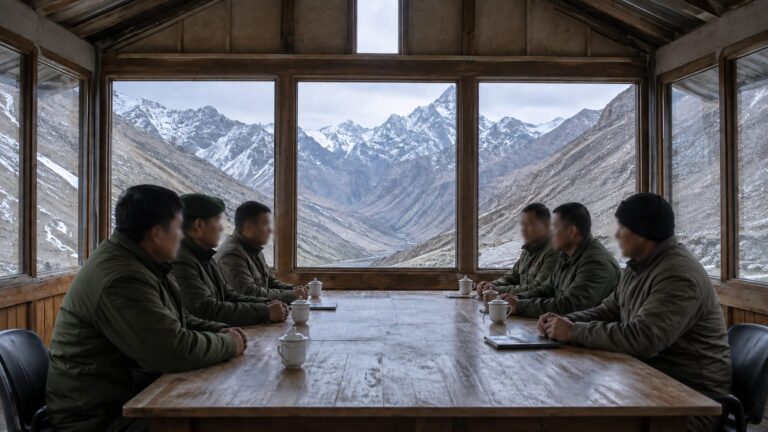
Republic of Korea (ROK) Prime Minister Lee Jae-myung undertook a two-day state visit to India on 20-21 April 2026, anchoring the India-South Korea Summit 2026. It was the first ROK prime ministerial visit since the administration of President Lee Jae-myung took office in Seoul, and the first high-level bilateral exchange of the year for New Delhi that involved a full ministerial delegation across commerce, industry, science and defence.
The visit produced a Joint Statement that formally elevates the bilateral relationship, upgraded to a Special Strategic Partnership in 2015, into a more implementation-oriented compact. Core announcements covered shipbuilding, semiconductor supply chains, electric-vehicle (EV) battery manufacturing, defence co-development, a new climate pillar, and a review of the India-Korea Comprehensive Economic Partnership Agreement (CEPA) in force since 2010.
Symbolically, the delegation travelled from New Delhi to the Lothal National Maritime Heritage Complex (NMHC) in Gujarat, signalling that the maritime-industrial dimension, from ancient Harappan port-trade to modern shipyards, is now the organising frame of the partnership.
UPSC Relevance at a Glance
| Dimension | Details |
|---|---|
| GS Paper | GS2 – International Relations; GS3 – Defence, Economy, Science & Technology |
| Prelims | Special Strategic Partnership (2015); CEPA (2010); IPEF; Lothal NMHC; K9 Vajra; T-50 Golden Eagle; Samsung Noida fab |
| Mains | Act East policy; Indo-Pacific cooperation; semiconductor sovereignty; defence indigenisation; climate diplomacy |
| Syllabus Tags | Bilateral Relations; Regional Groupings; Critical Technologies; Maritime Security |
Background and Context
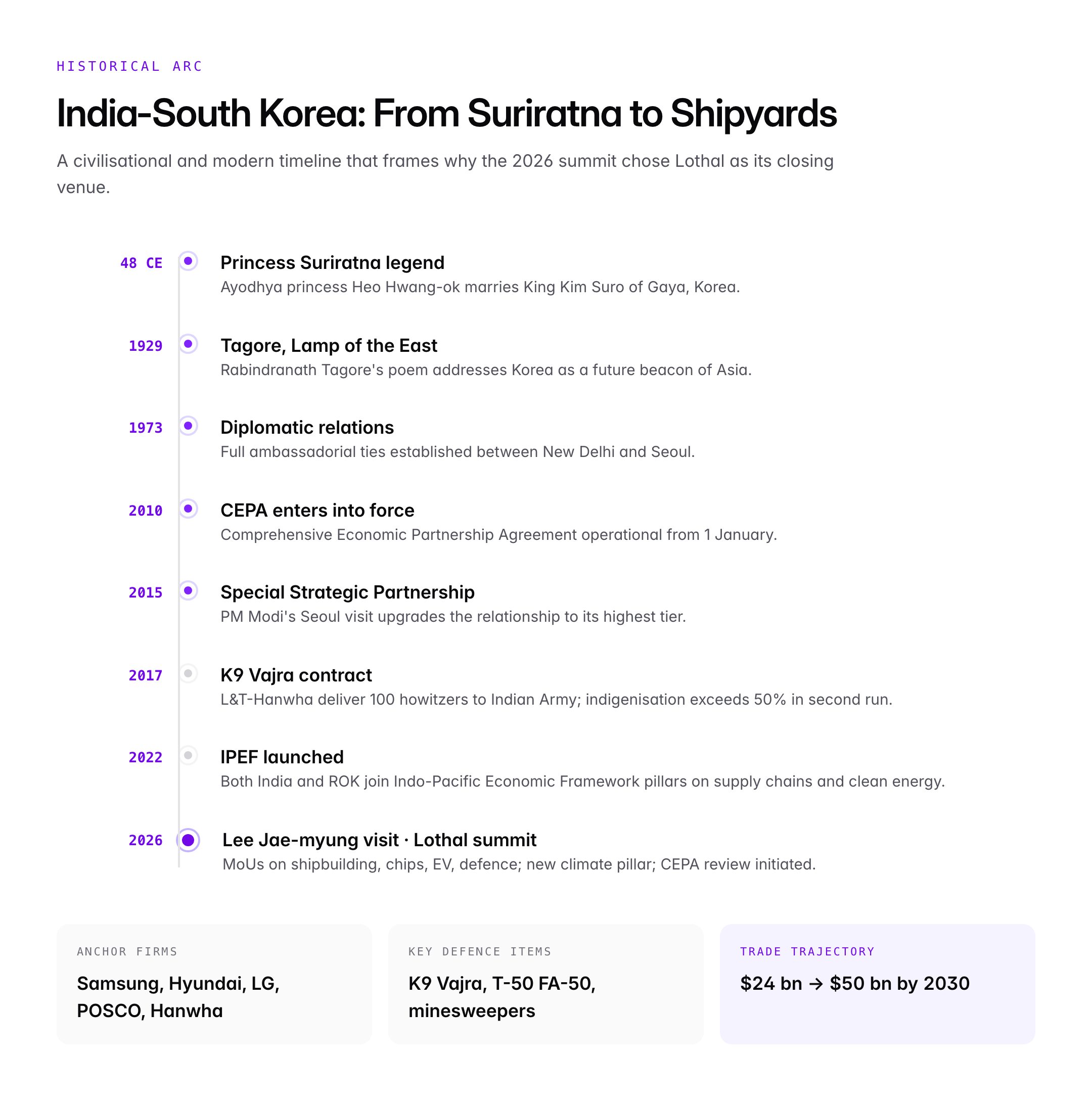
India-ROK ties rest on a long historical substratum. Korean Buddhist chronicles record the legend of Princess Suriratna (Heo Hwang-ok) of Ayodhya marrying King Kim Suro of the Gaya kingdom in 48 CE, a memory that both governments invoke as the oldest people-to-people link. In the modern era, Rabindranath Tagore’s 1929 poem addressing Korea as the “Lamp of the East” remains a cultural touchstone, regularly cited in joint statements.
Diplomatic relations were established in 1973. Economic convergence accelerated after India’s 1991 reforms, and ROK firms such as Hyundai, LG, Samsung and POSCO became anchor investors. The two countries signed the Comprehensive Economic Partnership Agreement (CEPA) in August 2009, which entered into force on 1 January 2010, making it one of India’s earliest trade deals with a major economy.
The relationship was upgraded to a Strategic Partnership in 2010 and to a Special Strategic Partnership during Prime Minister Narendra Modi’s visit to Seoul in May 2015. Under India’s Act East Policy, Seoul became a pillar of the extended eastern neighbourhood along with Japan, ASEAN and Australia. Subsequent summits in 2018 (Modi-Moon Jae-in) and engagements at G20, East Asia Summit and Indo-Pacific Economic Framework (IPEF) deepened convergence on connectivity, supply chains and democratic governance.
Geopolitics has since hardened. The consolidation of a Pyongyang-Beijing-Moscow axis, intensifying semiconductor competition, fragile sea lanes in the Indian Ocean and the South China Sea, and the United States tariff cycle since 2025 have pushed Seoul and New Delhi toward an “implementation decade”. For the ROK, India is the largest reliable democratic market with manufacturing scale; for India, the ROK is a source of capital, precision manufacturing know-how and defence technology unencumbered by sanctions exposure. The 2026 summit must be read against this dual compulsion.
Key Features of the 2026 Summit Outcomes
Maritime and Shipbuilding Pillar
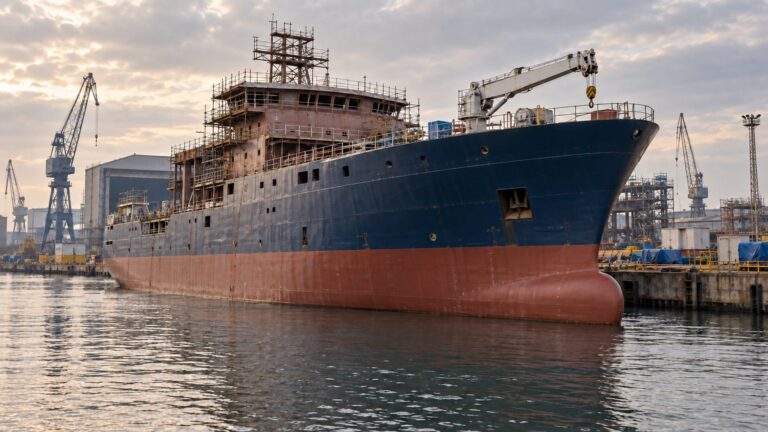
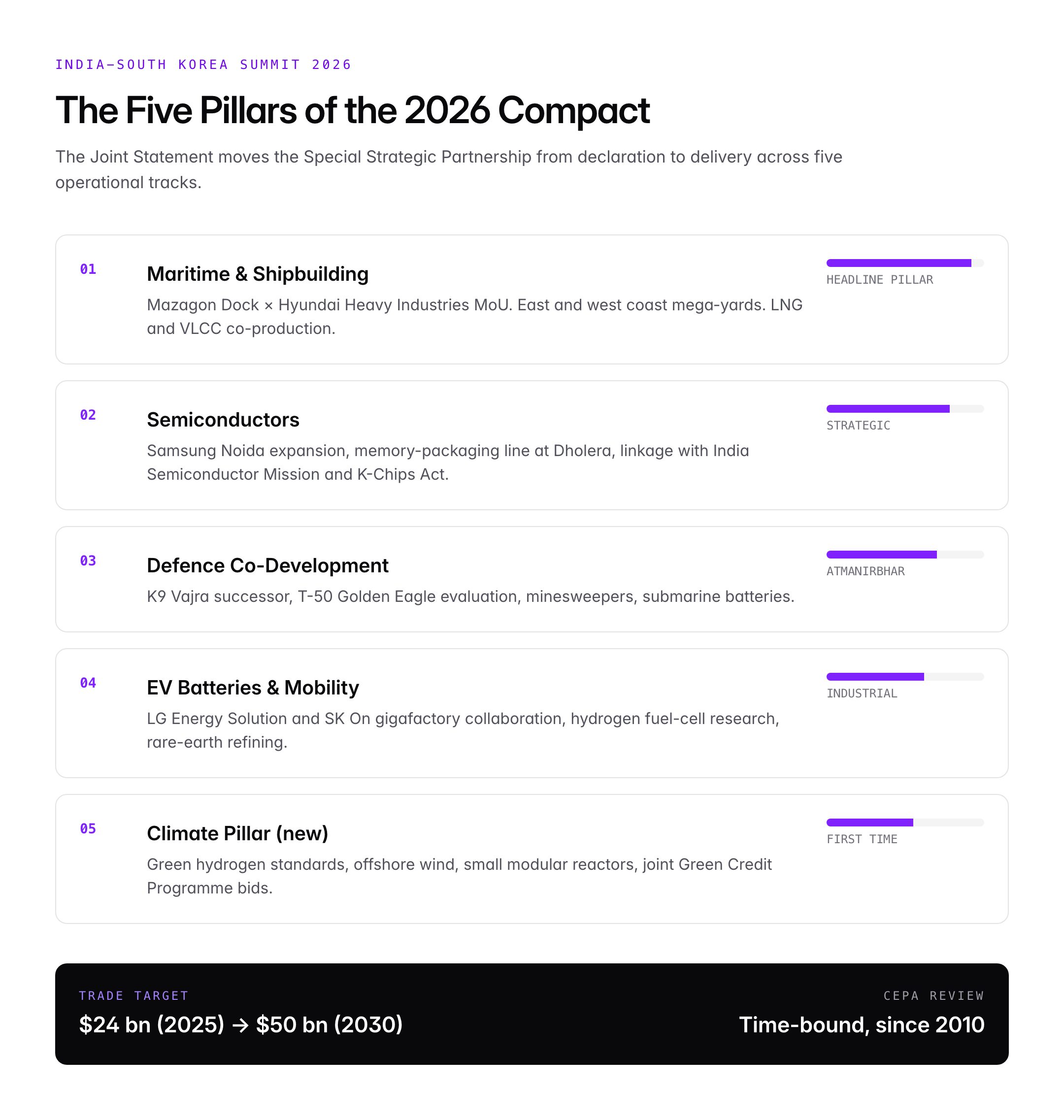
The flagship announcement is a shipbuilding Memorandum of Understanding (MoU) between Mazagon Dock Shipbuilders Limited (MDL) and Hyundai Heavy Industries (HHI), covering commercial vessel co-production, design transfer for LNG carriers and very large crude carriers, and feasibility studies for two mega-shipyards on India’s east and west coasts. A second maritime working group was constituted between India’s Ministry of Ports, Shipping and Waterways and Korea’s Ministry of Oceans and Fisheries to synchronise port-led industrialisation with the Maritime India Vision 2030 and Amrit Kaal Vision 2047. The choice of Lothal NMHC as the visit venue was deliberate: it frames shipbuilding as civilisational continuity, not a new industry.
Semiconductors and Critical Technologies
A Semiconductor Cooperation Framework links the India Semiconductor Mission (ISM) with Korea’s K-Chips Act ecosystem. The existing Samsung display and mobile-component fab at Noida is being expanded, and a new memory-packaging line is under study in Gujarat’s Dholera node. Cooperation extends to materials, photoresists, rare-earth refining, EV battery gigafactory collaboration involving LG Energy Solution and SK On, and hydrogen fuel-cell research.
Defence Technology and Co-Development
The K9 Vajra-T 155mm self-propelled howitzer, co-produced by Hanwha Aerospace and L&T, remains the showcase of defence industrial cooperation. The summit launched talks on a next-generation K9 successor (longer barrel, autoloader), accelerated evaluation of the T-50 Golden Eagle (FA-50) trainer/light combat aircraft for the Indian Air Force, and a joint working group on minesweepers and submarine batteries.
Climate and Clean Energy Pillar
For the first time, the Joint Statement carries a distinct Climate Pillar, covering green hydrogen standards, offshore wind, small modular reactors (SMR), and joint bids under the Green Credit Programme. This mirrors templates India is building with other partners on clean energy.
Trade and CEPA Review
Bilateral trade stood at roughly USD 24 billion in 2025, with a persistent deficit favouring Korea. The two sides committed to a USD 50 billion target by 2030 and a time-bound review of CEPA to correct asymmetries in tariff lines for marine products, textiles, processed food and auto components.
Significance
- Strategic autonomy through diversification: Deepening ties with a middle-power democracy reduces India’s exposure to any single supply chain, particularly in semiconductors, batteries and precision machinery.
- Indo-Pacific balancing: A stronger Delhi-Seoul axis complements the Quad without formal alignment, and offers Seoul a southern anchor amid the Pyongyang-Beijing-Moscow compression.
- Manufacturing depth: Korean participation upgrades the quality ceiling of Make in India in shipbuilding, chips and EV batteries, which require tacit engineering knowledge that only long operational partnerships transmit.
- Defence indigenisation: Co-development models such as K9 Vajra have proven that ROK firms transfer technology at levels European and American suppliers rarely match, making them structurally important for the Atmanirbhar Bharat defence roadmap.
- Maritime economy: Shipbuilding cooperation positions India to recapture global market share that fell below one percent, with the east-coast and west-coast mega-yards potentially anchoring an export-oriented cluster.
- Climate credibility: A dedicated climate pillar with a large OECD economy strengthens India’s case at UNFCCC, G20 and IPEF forums that developing economies can lead, not merely receive, clean technology partnerships.
Concerns and Challenges
The CEPA’s performance is the first pressure point. Since 2010, bilateral trade has grown but the structural deficit has widened because Korea’s export basket (auto parts, electronics, steel, petrochemicals) moves up the tariff ladder faster than India’s export basket (marine, textiles, commodities). Indian exporters argue Seoul offered deeper concessions to the EU and ASEAN, creating a disadvantage. A review is overdue but politically sensitive in Seoul where domestic agriculture and marine lobbies resist reciprocal opening.
Second, Korean FDI, though in the top fifteen sources, remains below potential. Investors cite land acquisition friction, tax predictability and contract-enforcement timelines. POSCO’s withdrawal from the Odisha steel project in 2017 still informs Korean board-room risk models.
Third, defence co-production raises indigenisation depth questions. The K9 Vajra example shows that local value addition can exceed fifty percent only after the second production run; rushed timelines risk creating assembly-only capacity.
Fourth, the semiconductor collaboration faces a talent bottleneck. The ROK’s chip ecosystem demands thousands of process engineers, and India’s present pipeline from IIT and IISc cannot scale without ROK-funded training missions at Indian universities, which are yet to be institutionalised.
Fifth, the Korean political cycle is short and contested. Any downturn in Seoul’s domestic politics, or a sharp turn on North Korea policy, can slow implementation. The summit’s delivery mechanisms, working groups with annual reporting, were designed against this risk but remain untested.
Finally, balancing the United States under renewed tariff pressure, China’s market gravity, and Russian energy exposure requires diplomatic dexterity both capitals share but neither has fully mastered.
Comparative and Historical Perspective
| Partnership | Year Established | Current Tier | Trade (approx, 2025) | Flagship Project |
|---|---|---|---|---|
| India-Japan | 2000 | Special Strategic & Global | USD 22 bn | Mumbai-Ahmedabad HSR |
| India-South Korea | 1973 | Special Strategic | USD 24 bn | K9 Vajra, Samsung Noida |
| India-Australia | 2020 | Comprehensive Strategic | USD 26 bn | ECTA, critical minerals |
| India-ASEAN | 1992 dialogue | Comprehensive Strategic | USD 125 bn | AITIGA review |
Historically, the India-ROK arc has been slower but steadier than the India-Japan track. Japan offered concessional finance and flagship infrastructure; Korea offered private-sector manufacturing density. The 2026 summit aims to combine the best of both templates: government-backed strategic projects (shipyards, chip nodes, climate pillar) matched with commercial-scale private investment. The Lothal symbolism explicitly reaches further back than either post-war partnership, placing the relationship in a civilisational maritime lineage.
Way Forward
- The Ministry of External Affairs and Korea’s Ministry of Foreign Affairs should publish a public CEPA-review roadmap within ninety days, with tariff-line level transparency for domestic industry.
- The Department for Promotion of Industry and Internal Trade (DPIIT) should establish a dedicated Korea-desk with single-window clearance for projects above USD 100 million, mirroring the Japan-Plus template.
- The Ministry of Defence through the Defence Acquisition Council should formalise a K9 successor and T-50 evaluation timeline with explicit indigenisation depth targets of sixty percent within five years.
- The Ministry of Electronics and Information Technology (MeitY) and ISM should co-fund a ROK-India Semiconductor Talent Bridge, sponsoring a thousand Indian engineers annually at Korean fabs and universities.
- The Ministry of Ports, Shipping and Waterways should notify a Shipbuilding Financial Assistance Policy 2.0, with ROK-participation clauses for east-coast and west-coast mega-yards.
- The Ministry of New and Renewable Energy and Korea’s Ministry of Trade, Industry and Energy should operationalise the climate pillar through a joint green-hydrogen certification standard, feeding into India-UK and India-EU parallel tracks.
- NITI Aayog and the Korea Development Institute should co-publish an annual Strategic Partnership Review Report, ensuring political transitions in either capital do not reset the agenda.
Conclusion
The India-South Korea Summit 2026 is less about new headlines and more about moving a mature partnership from declaratory to operational. Shipbuilding, semiconductors, batteries, defence and climate are the five pillars on which the Special Strategic Partnership, conceived in 2015, must finally deliver at scale. The Lothal choice reminds both sides that maritime and industrial destiny for India has always involved partners from the Korean peninsula.
For the UPSC aspirant, the summit is a compact case study in modern middle-power diplomacy: how two democracies, hemmed in by great-power rivalry, use trade reviews, co-development projects and cultural symbolism to manufacture strategic space. Reproducing this logic across Act East partners is the broader test of India’s foreign policy imagination in the Amrit Kaal decade.
Prelims Pointers
- India-ROK diplomatic relations established in 1973.
- CEPA signed August 2009; in force 1 January 2010.
- Relationship upgraded to Special Strategic Partnership in May 2015 (Modi-Park Geun-hye).
- ROK PM Lee Jae-myung visited India on 20-21 April 2026.
- Bilateral trade approximately USD 24 billion in 2025; target USD 50 billion by 2030.
- Lothal National Maritime Heritage Complex is in Gujarat; Lothal is a Harappan dockyard site.
- K9 Vajra-T is a 155mm/52-calibre self-propelled howitzer co-produced by Hanwha Aerospace and L&T.
- T-50 Golden Eagle is a supersonic trainer/light combat aircraft by Korea Aerospace Industries.
- Samsung’s largest mobile factory globally is located at Noida, Uttar Pradesh.
- Princess Suriratna (Heo Hwang-ok) legend links Ayodhya with Korea’s Gaya kingdom (48 CE).
- Rabindranath Tagore called Korea the “Lamp of the East” in 1929.
- ROK is part of the Indo-Pacific Economic Framework (IPEF) along with India.
Mains Practice Question
Q. The India-South Korea Special Strategic Partnership must now move from summitry to delivery. Examine the key pillars of the 2026 bilateral framework and suggest measures to convert intent into outcomes. (15 marks, 250 words)
- Introduce the Special Strategic Partnership (2015) and the 2026 summit’s anchor projects at Lothal.
- Evaluate the five pillars: maritime/shipbuilding, semiconductors, EV batteries, defence co-development, climate; highlight CEPA review.
- Suggest delivery mechanisms: Korea-Plus desk at DPIIT, semiconductor talent bridge, indigenisation-depth targets, joint climate standards, annual partnership review report.
Internal Links
- India Must Reboot Neighbourhood Policy: Trade is the Key
- Raisina Dialogue 2026
- Two Years of the EFTA-India TEPA Revisited
- India Seeks to Join IEA
- Rare Earth Elements and China
- India-UK Offshore Wind Taskforce Deepens Clean Energy Cooperation
- Key Outcomes of the Prime Minister’s Visit to Israel
- G20 Summit
- Trade Deficit
- World Trade Organization and its Issues
Frequently Asked Questions
What is the India-South Korea Special Strategic Partnership?
It is the highest tier of bilateral engagement between India and the Republic of Korea, established during Prime Minister Narendra Modi’s May 2015 visit to Seoul. It upgraded the 2010 Strategic Partnership and covers political, economic, defence, science, maritime and people-to-people tracks, with regular summit-level reviews and joint working groups.
Why is the India-South Korea Summit 2026 in the news?
Republic of Korea Prime Minister Lee Jae-myung made a state visit to India on 20-21 April 2026, culminating at the Lothal National Maritime Heritage Complex in Gujarat. The summit produced MoUs on shipbuilding, semiconductors, EV batteries and defence co-development, launched a climate pillar and committed to a time-bound review of the India-Korea CEPA.
What is CEPA between India and South Korea?
The Comprehensive Economic Partnership Agreement was signed in August 2009 and came into force on 1 January 2010. It liberalises trade in goods, services, investment and intellectual property. Bilateral trade has grown but an asymmetric deficit has prompted Indian exporters to demand a review, which the 2026 summit formally initiated.
How does the K9 Vajra reflect India-Korea defence ties?
The K9 Vajra-T is a 155mm/52-calibre self-propelled howitzer co-produced in India by Larsen & Toubro under licence from Korea’s Hanwha Aerospace. It is the flagship example of Korean technology transfer enabling Atmanirbhar Bharat in artillery, and the 2026 summit opened talks on a next-generation successor and further co-development.
What role does Lothal play in the 2026 summit symbolism?
Lothal in Gujarat hosted one of the world’s earliest known dockyards during the Harappan civilisation, and now houses the National Maritime Heritage Complex. By taking the Korean delegation to Lothal, India framed the shipbuilding and maritime pillar as a civilisational continuity, linking ancient port-trade heritage with modern mega-shipyard ambitions.
How does the summit fit into India’s Act East Policy?
The Republic of Korea is a cornerstone of Act East beyond ASEAN, along with Japan and Australia. The 2026 summit reinforces Act East by converting declaratory partnership into operational projects in shipbuilding, chips and climate, and by complementing India’s Indo-Pacific posture without formal military alignment.
What are the main challenges in the India-Korea economic relationship?
The CEPA has delivered an expanding but structurally lopsided trade deficit. Korean FDI remains below potential due to land, tax and contract-enforcement concerns; POSCO’s 2017 Odisha withdrawal still shapes risk perception. Defence and semiconductor cooperation face indigenisation-depth and talent-pipeline bottlenecks that require institutional responses.
How does the India-South Korea Summit 2026 help UPSC preparation?
It is a high-yield GS2 case study combining bilateral relations, Indo-Pacific strategy, Act East policy, CEPA mechanics and defence indigenisation. Prelims facts include CEPA dates, the 2015 upgrade, K9 Vajra, Samsung Noida, Lothal NMHC and the Tagore and Suriratna linkages, making it useful for factual MCQs and analytical Mains answers.
Tell Google you want more of this.
Add Anantam IAS as a preferred sourceOne tap, and this site shows up more often in your own Top Stories, AI Overviews and AI Mode. Remove it any time.