Daily Digest
UPSC · Civil Services Examination
Current Affairs · Thursday, 9 July 2026
Current affairs curated and edited by Anantam IAS faculty — pulled from The Hindu, PIB, IDSA, Foreign Affairs and the ministries. Read, annotate, revise.
Old Rajinder Nagar · Delhi 110005 · anantamias.com
India-Australia 3rd Annual Summit: Defence Declaration, Uranium Supply and PACTS
Why in News?
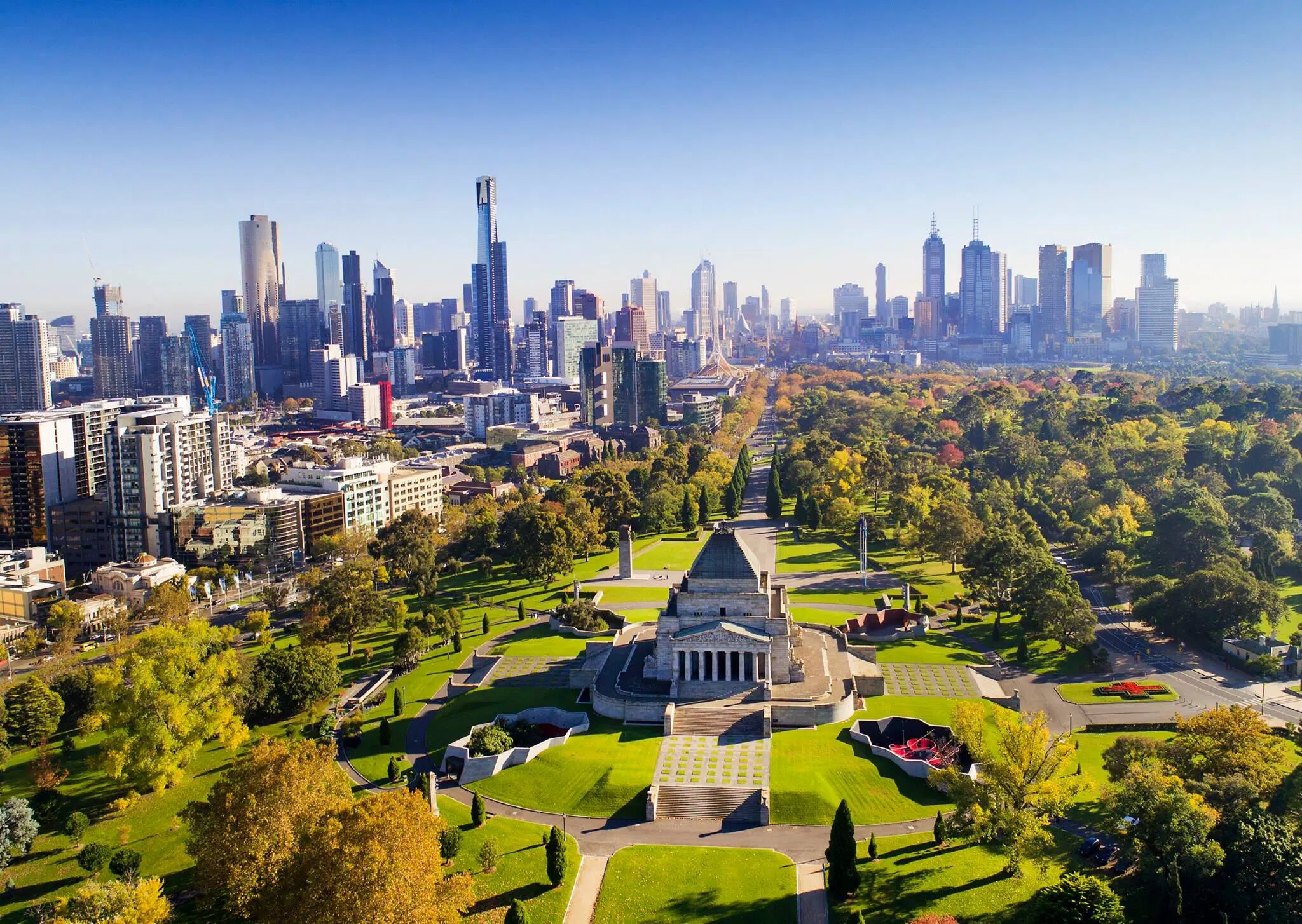
Prime Minister Narendra Modi and Australian Prime Minister Anthony Albanese co-chaired the 3rd India-Australia Annual Summit in Melbourne on 9 July 2026, the centrepiece of the Prime Minister’s 8–10 July visit to Australia — the final leg of a three-nation tour across the Indo-Pacific.
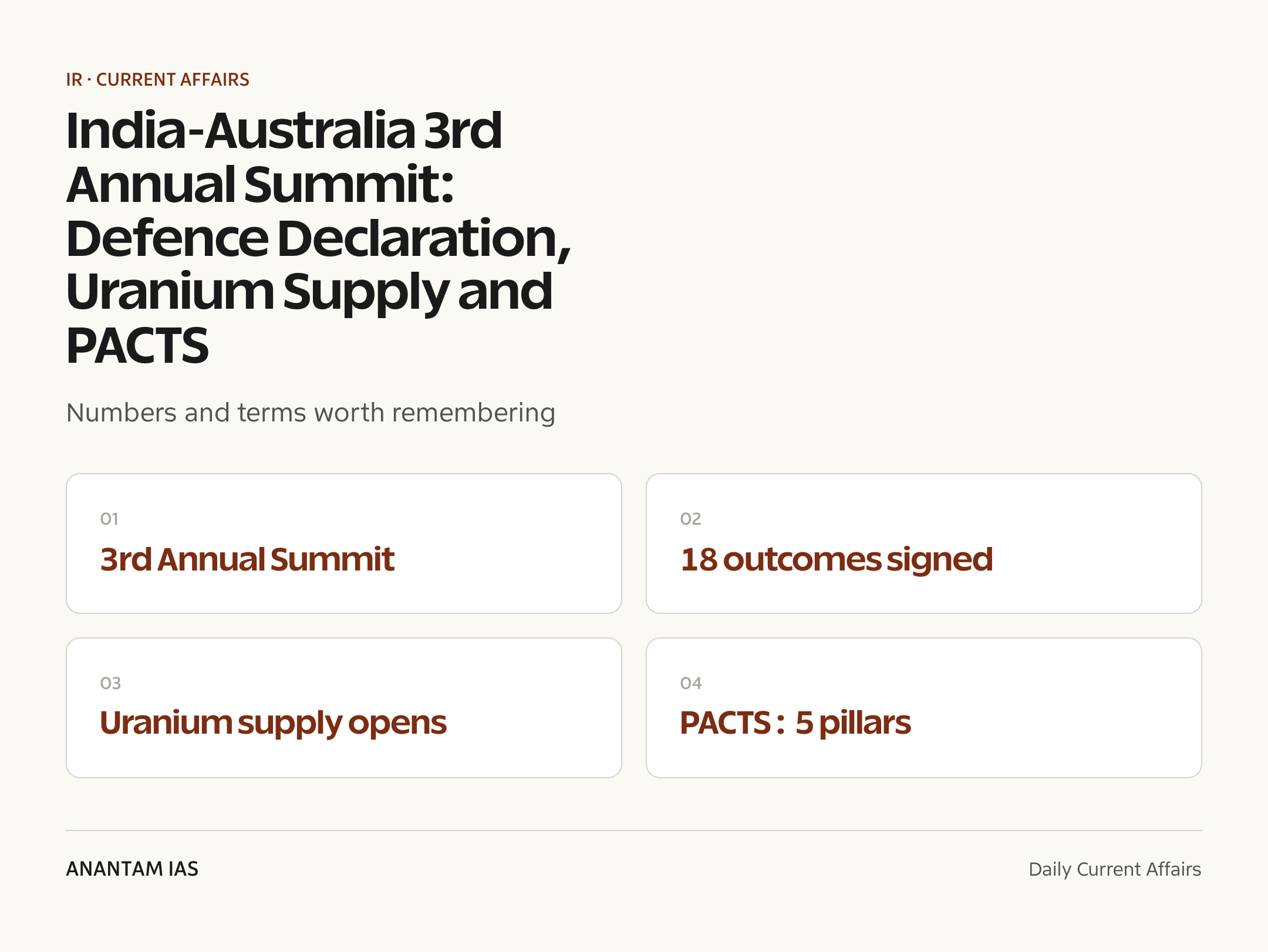
PIB released a list of 18 outcomes, led by a new Joint Declaration on Defence and Security Cooperation (JDDSC), the finalisation of the Administrative Arrangement that operationalises the 2014 Civil Nuclear Agreement and enables uranium supply to India, and a five-pillar Partnership for Cyber, Critical Technologies and Supply Chains (PACTS).
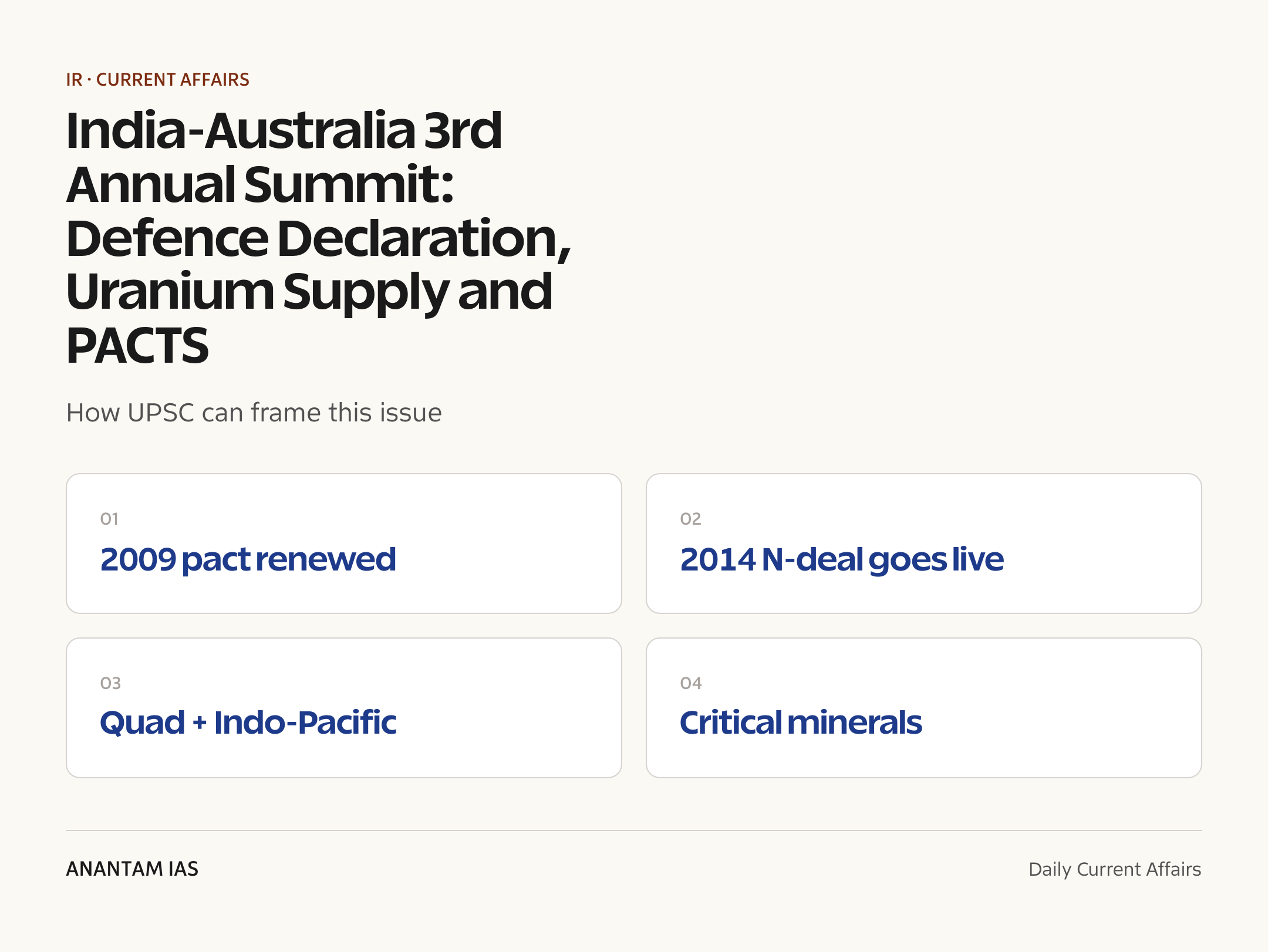
- The JDDSC renews the 2009 Joint Declaration on Security Cooperation — covering interoperability of forces, maritime domain, defence industrial collaboration, cyber security, counter-terrorism and HADR.
- A Maritime Security Collaboration Roadmap (MSCR) was adopted to deepen information sharing, capability development and operational coordination across the Indian Ocean and wider Indo-Pacific.
- The Administrative Arrangement finalised at the summit operationalises the India-Australia Civil Nuclear Agreement (2014), opening the door to Australian uranium supply for Indian reactors.
- PACTS succeeds and replaces the 2020 Framework Arrangement on Cyber and Cyber Enabled Critical Technology Cooperation, with five pillars from supply chains to defence research.
- An MoU links the Indian Coast Guard (ICG) with Australia’s Maritime Border Command (MBC) for maritime law enforcement and domain awareness.
- Cultural diplomacy delivered too: Australia is repatriating 3 Indian antiquities — a granite Nandi, a bronze Bhadrakali trident and a basalt six-headed Skanda, all from Tamil Nadu.
The development matters in the context of:
- The package lands amid geostrategic uncertainty in the Indo-Pacific: The Hindu reported that both leaders called for disputes to be resolved peacefully, without force or coercion, and in line with UNCLOS 1982.
- It converts the Comprehensive Strategic Partnership (2020) from dialogue into instruments — a defence declaration, a nuclear supply channel, a tech-and-supply-chain architecture and institution-to-institution MoUs.
- For India, Australia is now a supplier of strategic inputs — uranium, critical minerals, LNG — as much as a security partner in the Quad.
UPSC Relevance
Prelims Relevance
- 3rd India-Australia Annual Summit — Melbourne, 9 July 2026; co-chaired by PM Modi and PM Anthony Albanese; 18 listed outcomes.
- JDDSC — Joint Declaration on Defence and Security Cooperation; renews the 2009 Joint Declaration on Security Cooperation.
- MSCR — Maritime Security Collaboration Roadmap: information sharing, capability development, operational coordination.
- Civil Nuclear Agreement 2014 — now operationalised via a finalised Administrative Arrangement; enables uranium supply from Australia to India.
- PACTS — Australia-India Partnership on Cyber, Critical Technologies and Supply Chains; replaces the 2020 Framework Arrangement; five pillars; chaired by Australia’s Deputy Secretary (International and Security Group) and India’s Deputy NSA.
- ACITI — Australia-Canada-India Technology and Innovation Partnership (trilateral) — distinct from the bilateral PACTS.
- ICG–MBC MoU — Indian Coast Guard and Australia’s Maritime Border Command: maritime law enforcement, domain awareness, border protection.
- TKDL — CSIR gives IP Australia access to the Traditional Knowledge Digital Library.
- Campuses: Flinders University — Bengaluru (LoI); Victoria University — Gurugram (Letter of Approval).
- Rooftop Solar Training Academy — Pandit Deendayal Energy University, Gandhinagar; to train 2,000 women and youth; supports PM Surya Ghar.
Mains Relevance
GS Paper 2
- Bilateral agreements involving India: how the summit converts the Comprehensive Strategic Partnership into binding instruments (JDDSC, PACTS, nuclear Administrative Arrangement).
- India and its neighbourhood-plus: Australia as a pillar of India’s Indo-Pacific strategy and the Quad; balancing strategic autonomy with alignment.
- Effect of policies of developed countries on India’s interests: Australia’s uranium export policy and university campuses in India under NEP 2020 internationalisation.
GS Paper 3
- Security: maritime domain awareness, coast guard cooperation and defence industrial supply chains as internal-external security interface.
- Technology and economy: critical minerals, semiconductors, undersea cables and cyber resilience under PACTS; energy security and civil nuclear fuel supply.
Essay
- Middle powers together can shape order: India-Australia as an axis of stability in a contested Indo-Pacific.
- From buyers and sellers to co-creators — technology partnerships as the new currency of diplomacy.
Background and Context
The summit at a glance
The Melbourne meeting was the third edition of the annual leaders’ summit that anchors the India-Australia Comprehensive Strategic Partnership.
- India and Australia upgraded ties to a Comprehensive Strategic Partnership (CSP) at the June 2020 virtual summit; annual leaders’ summits now institutionalise it.
- PM Modi visited Australia from 8 to 10 July 2026; the summit was held in Melbourne, with a business round-table and a CEO Forum alongside.
- The joint statement flagged complementarities between Make in India and Australia’s Future Made in Australia agenda across manufacturing, technology and investment.
- The Hindu reported that PM Modi invited Australian businesses to invest in India and pressed for early conclusion of the Comprehensive Economic Cooperation Agreement (CECA) — the full FTA meant to build on the ECTA, in force since December 2022.
- PIB listed 18 outcomes spanning defence, nuclear energy, cyber and critical technologies, skills, education, science and culture.
The defence declaration and maritime roadmap
The JDDSC is the summit’s strategic core — a generational refresh of the 2009 security declaration.
- The Joint Declaration on Defence and Security Cooperation renews the 2009 Joint Declaration on Security Cooperation and names interoperability, capacity building, the maritime domain, defence industry, cyber, counter-terrorism and HADR as pillars.
- The Hindu reported the declaration commits both sides to regular consultations on Indo-Pacific developments, more complex military exercises, faster interoperability and information sharing, and expanded aircraft deployments from each other’s territories.
- It deepens personnel exchanges — education, training, liaison appointments — and even explores cooperation in recruiting skilled personnel for each other’s defence workforces; Australia has invited an Indian military instructor to its Defence College for 2028-29.
- The Maritime Security Collaboration Roadmap operationalises coordination across the Indian Ocean; a separate MoU ties the Indian Coast Guard to Australia’s Maritime Border Command for law enforcement and domain awareness.
- These sit atop an existing lattice: the 2+2 Ministerial Dialogue, the Mutual Logistics Support Arrangement (2020), Australia’s return to Exercise Malabar, and bilateral drills like AUSINDEX and AUSTRAHIND.
- Both sides committed to a unified approach through UNCLOS, ASEAN-led architecture, the Pacific Islands Forum (PIF) and IORA — the regional institutions India also works through in the Quad.
Uranium: the 2014 nuclear deal finally goes live
The quietest line in the outcomes list may be the most consequential for India’s energy security.
- PIB confirmed the finalisation of the Administrative Arrangement of the India-Australia Civil Nuclear Agreement, signed in 2014 — the step that operationalises the pact and enables supply of uranium from Australia to India.
- Australia holds among the world’s largest known uranium resources, and India’s expanding reactor fleet needs assured fuel; a stable supplier reduces dependence on a narrow set of sources.
- The deal is diplomatically notable because India is not a signatory to the NPT; Australia reversed its long-standing policy against uranium sales to non-NPT states for India, building on India’s 2008 NSG waiver and its separation of civil and military facilities (for the regimes involved, see multilateral export control regimes).
- Imported uranium supplements limited domestic mining centred on Jaduguda and Tummalapalle (covered in uranium mining in India) and supports safeguarded reactors under IAEA oversight.
- A companion India-Australia Joint Statement on Energy Security reaffirms both countries’ commitment to stable energy flows amid geopolitical tensions — Australia is already a major supplier of coal and LNG to India.
PACTS decoded: five pillars, one architecture
PACTS upgrades a cyber-era arrangement into a full technology-and-supply-chain compact.
- The Australia-India Partnership on Cyber, Critical Technologies and Supply Chains (PACTS) succeeds and replaces the 2020 Framework Arrangement on Cyber and Cyber Enabled Critical Technology Cooperation.
- Pillar 1 — Supply chain resilience: trusted vendor frameworks, secure undersea cables (via the Quad Partnership for Cable Connectivity and Resilience), semiconductor supply chain research, and critical minerals through coordinated investment and recycling.
- Pillar 2 — Critical technology: joint work on AI standards, space, telecommunications, biotechnology and advanced materials, with consensus-driven international benchmarks grounded in democratic values.
- Pillar 3 — Cybersecurity: countering cybercrime, cooperation in UN cyber processes, joint workshops, and a new cyber tech skill incubator hub.
- Pillar 4 — Digital resilience: scaling India’s Digital Public Infrastructure (DPI) principles and affordable DPI solutions across the Indo-Pacific — health, education, connectivity, social protection.
- Pillar 5 — Defence research: institutional links between Australia’s Defence Science and Technology Group and India’s DRDO, plus start-up ecosystem ties and maritime surveillance technology.
- Governance: chaired by Australia’s Deputy Secretary (International and Security Group, PM&C) and India’s Deputy National Security Adviser, with an annual Senior Officials Meeting; pillar leads include the NSCS, MEA’s Cyber Diplomacy and Oceania divisions, and the Ministry of Defence.
- A separate MoU advances the trilateral Australia-Canada-India Technology and Innovation (ACITI) Partnership — do not confuse the two in Prelims.
Education, skills and culture: the people layer
Beyond hard security, the summit thickened the human and institutional bridge between the two countries.
- Flinders University received a Letter of Intent for a campus in Bengaluru, and Victoria University a Letter of Approval for a campus in Gurugram — foreign campuses that align with NEP 2020’s internationalisation push.
- An NCVET–ASQA Letter of Intent links India’s vocational-training regulator with the Australian Skills Quality Authority for quality assurance and aligned occupational standards.
- An MSDE–TAFE Western Australia MoU sets up a Centre of Excellence in Mining Equipment, Technology and Services (METS) at NSTI Bhubaneswar — skills for the critical-minerals economy.
- The Rooftop Solar Training Academy at Pandit Deendayal Energy University, Gandhinagar, was operationalised to train 2,000 women and youth as solar technicians, feeding the PM Surya Ghar rooftop-solar push.
- Australia is repatriating three Indian antiquities — an 11th–12th century granite Nandi, an 11th century bronze trident with Bhadrakali, and a 12th century basalt six-headed Skanda (Karttikeya) — all from Tamil Nadu.
- Science MoUs round it out: GeoScience Australia–GSI on mineral exploration, CSIR–University of Melbourne on drug-target research, CSIR-IP Australia access to the TKDL, and an SRFTI–Griffith Film School partnership.
Why the relationship is compounding
Structural forces — geography, economics and China’s rise — keep pushing New Delhi and Canberra together.
- Both are Quad members and maritime democracies straddling the Indian Ocean; both worry about coercion, grey-zone activity and threats to undersea cable infrastructure.
- Australia supplies what India’s growth needs — critical minerals (lithium, cobalt, rare earths), uranium, coal, LNG and education — while India offers scale, talent and a manufacturing alternative for supply-chain diversification.
- The ECTA (2022) lifted bilateral trade momentum, and a concluded CECA would widen coverage to services, investment and digital trade.
- A diaspora of nearly a million Indian-origin Australians gives the relationship domestic ballast in both polities.
- The 2009 declaration took 17 years to be renewed; the density of the 2026 package signals that defence, technology and energy are now moving on the same track, not separate ones.
Way Forward
Deliver the instruments
- Convert the JDDSC into visible outputs — a regular exercise calendar, reciprocal aircraft deployments and time-bound interoperability milestones.
- Begin actual uranium shipments under the Administrative Arrangement with transparent safeguards reporting, so the 2014 agreement stops being symbolic.
Institutionalise PACTS
- Hold the first Senior Officials Meeting early, publish pillar-wise project lists, and fund the cyber skill incubator and semiconductor research links so PACTS avoids the fate of dormant frameworks.
- Use the DPI pillar to co-deliver digital public goods in third countries of the Indo-Pacific — a partnership visible beyond the bilateral.
Close the economic loop
- Conclude CECA to match the strategic layer with a full economic one, and fast-track critical-minerals investment vehicles so Indian firms secure offtake, not just MoUs.
Conclusion
The Melbourne summit is the moment the India-Australia relationship moved from declarations of intent to a working architecture: a renewed defence compact, an operational nuclear fuel channel, and a five-pillar technology partnership with named chairs and annual review.
For UPSC, the package is a compact case study in how India builds issue-based coalitions in the Indo-Pacific — combining hard security (JDDSC, MSCR), strategic inputs (uranium, critical minerals) and normative agendas (DPI, AI standards) with one partner.
The test now is execution. Frameworks like the 2020 cyber arrangement lapsed into routine before PACTS replaced them; the 2014 nuclear deal waited over a decade for its administrative plumbing. Delivery, not signing ceremonies, will decide whether 2026 is remembered as the inflection point.
UPSC Practice Questions
Prelims MCQ 1
With reference to the outcomes of the 3rd India-Australia Annual Summit (2026), consider the following statements:
- The Joint Declaration on Defence and Security Cooperation renews the India-Australia Joint Declaration on Security Cooperation of 2009.
- The Administrative Arrangement finalised at the summit operationalises the India-Australia Civil Nuclear Agreement of 2014, enabling uranium supply to India.
- PACTS is a trilateral partnership among India, Australia and Canada.
How many of the above statements are correct?
(a) Only one (b) Only two (c) All three (d) None
Answer: (b) Only two
Explanation:
Statements 1 and 2 are correct per the PIB list of outcomes. Statement 3 is wrong: PACTS is a bilateral India-Australia partnership on cyber, critical technologies and supply chains that replaces the 2020 Framework Arrangement; the trilateral with Canada is the separate ACITI Partnership.
Prelims MCQ 2
The ‘Maritime Security Collaboration Roadmap’, recently in news, is an arrangement between India and which country?
(a) Indonesia (b) France (c) Australia (d) Japan
Answer: (c) Australia
Explanation:
The Maritime Security Collaboration Roadmap was adopted at the 3rd India-Australia Annual Summit in Melbourne (July 2026) to deepen information sharing, capability development and operational coordination across the Indian Ocean and the wider Indo-Pacific.
UPSC Mains Questions
- The 3rd India-Australia Annual Summit converted a decade of declarations into operational instruments. Examine how the new defence declaration, the operationalised civil nuclear agreement and PACTS together reshape India’s Indo-Pacific strategy.
- Critical minerals, uranium and undersea cables are the new currencies of strategic partnership. Discuss with reference to India-Australia relations, highlighting the opportunities and the implementation risks.
Sources: PIB, Prime Minister's Office and The Hindu.
Frequently Asked Questions
What was decided at the India-Australia summit 2026?
The 3rd Annual Summit in Melbourne (9 July 2026) produced 18 outcomes: a new Joint Declaration on Defence and Security Cooperation, a Maritime Security Collaboration Roadmap, operationalisation of the 2014 Civil Nuclear Agreement enabling uranium supply, the PACTS technology partnership, a Coast Guard MoU, education campuses and the return of three Tamil Nadu antiquities.
What is the JDDSC?
The Joint Declaration on Defence and Security Cooperation renews the 2009 India-Australia security declaration. It commits both countries to more complex military exercises, deeper interoperability and information sharing, expanded aircraft deployments from each other’s territories, defence industrial collaboration, counter-terrorism and humanitarian assistance cooperation.
What is PACTS between India and Australia?
PACTS — the Australia-India Partnership on Cyber, Critical Technologies and Supply Chains — replaces the 2020 cyber framework. It has five pillars: supply chain resilience, critical technology, cybersecurity, digital resilience, and defence research. It is chaired by India’s Deputy NSA and a senior Australian official, with annual reviews.
Why is the uranium deal significant?
The Administrative Arrangement finalised at the summit operationalises the 2014 Civil Nuclear Agreement, enabling Australian uranium supply to India. Australia holds some of the world’s largest uranium resources, and supply to non-NPT India — built on the 2008 NSG waiver and IAEA safeguards — diversifies fuel for India’s expanding reactor fleet.
Which Australian universities are opening campuses in India?
At the summit, Flinders University received a Letter of Intent for a campus in Bengaluru, and Victoria University a Letter of Approval for a campus in Gurugram. These add to the internationalisation of higher education that the National Education Policy 2020 encourages.
Which artefacts is Australia returning to India?
Australia is repatriating three antiquities, all from Tamil Nadu: an 11th–12th century granite sculpture of Nandi, an 11th century bronze trident with Bhadrakali, and a 12th century basalt image of the six-headed Skanda (Karttikeya).
Source: https://anantamias.com/current-affairs/india-australia-summit-defence-nuclear-pacts-outcomes/
High Seas Fishing Letters of Authorisation: India’s Push Beyond the EEZ
Why in News?
Vice-President C. P. Radhakrishnan launched the national programme for issuance of Letters of Authorisation (LoAs) for Sustainable Harnessing of Fisheries in the High Seas at Bhubaneswar on 9 July 2026, PIB confirmed. This is the first time India has rolled out a formal, nationwide permit system for its fishermen to fish in waters beyond the country’s Exclusive Economic Zone.
At the same event, organised by the Department of Fisheries, he released the Odisha Deep Sea Fishing Mission document and handed LoAs to ten Fish Farmer Producer Organisations (FFPOs), fisheries cooperatives and fishing-vessel owners from across the country — a decisive move in India’s Blue Economy strategy.
- The LoA is a mandatory permit under the Guidelines for Sustainable Harnessing of Fisheries in the High Seas by Indian-Flagged Fishing Vessels, 2025 — it is vessel-specific, non-transferable and fully online.
- Recipients included the National Cooperative Exports Limited (NCEL) and cooperatives from Gujarat, Maharashtra, Goa, Karnataka, Tamil Nadu and Odisha — including the Paradeep Marine and Malpe Fishermen’s societies.
- The framework operationalises the Union Budget 2025–26 announcement of an enabling framework for fisheries in India’s EEZ and the High Seas, alongside a new Access Pass system.
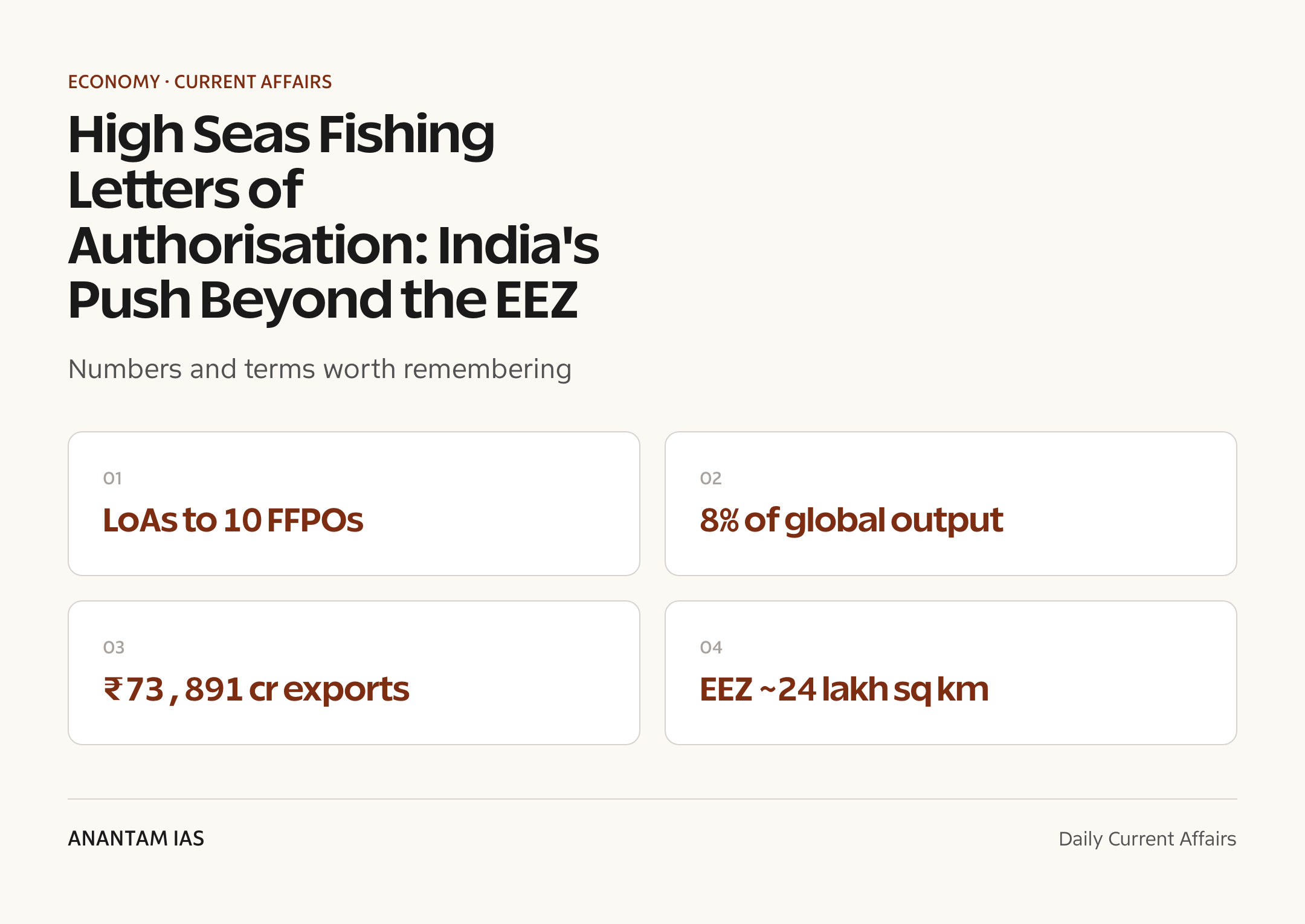
- India is the world’s second-largest fish producer, contributing about 8 per cent of global fish production; the sector supports nearly 3 crore fishers and fish farmers.
- Seafood exports touched a record ₹73,891 crore in 2025–26, and the Union Budget 2026–27 has made fish catch by Indian vessels in the EEZ and High Seas duty-free, with foreign port landings treated as exports.
- About 1,000 fish farmers and fishers, including women, attended the national launch in person along with officials from states, UTs and line ministries.
The development matters in the context of:
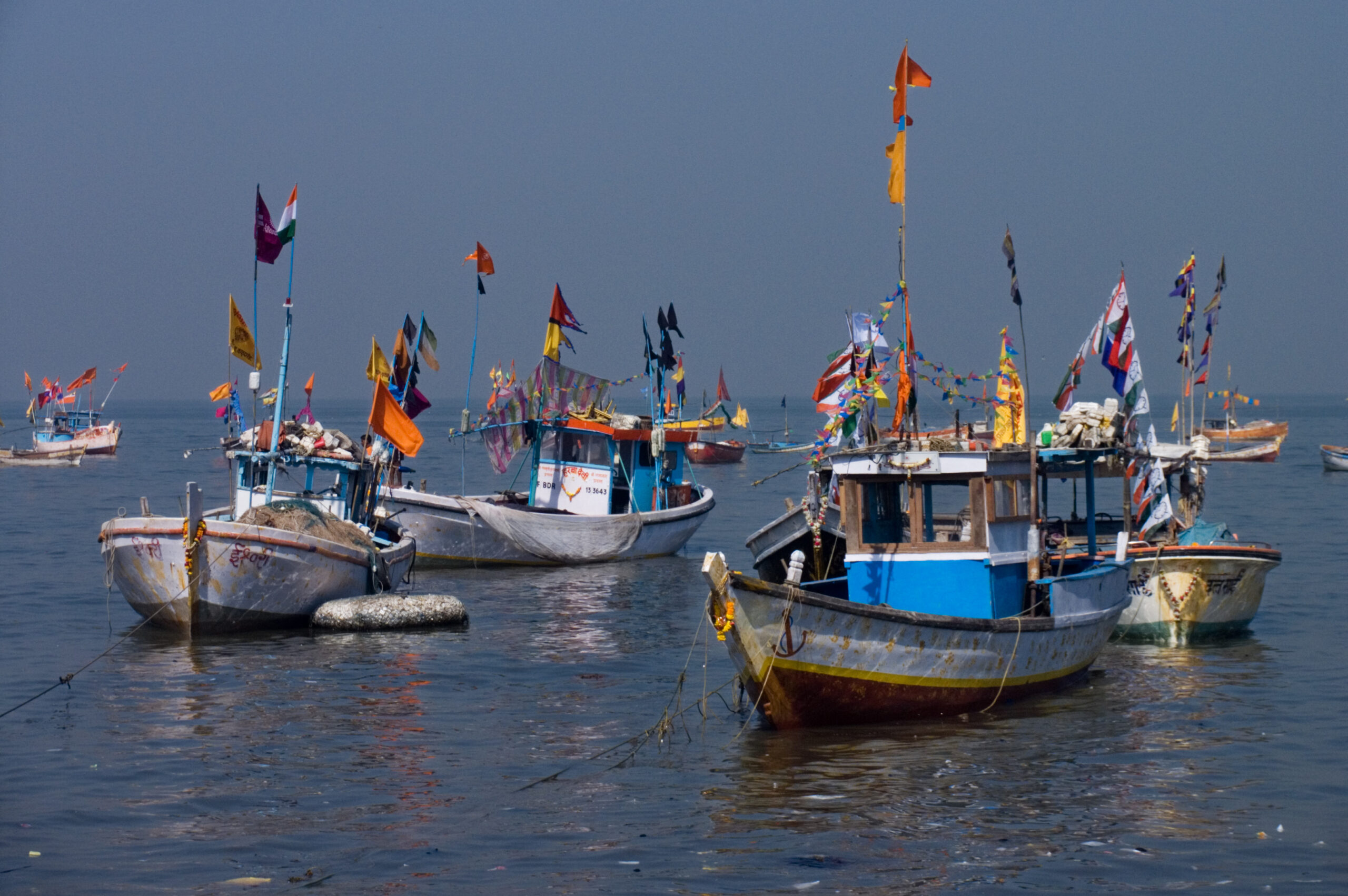
- Indian marine fishing has stayed concentrated near the shore; the deep waters of the EEZ and the high seas — rich in tuna and tuna-like species — remain largely untapped despite over 11,000 km of coastline and an EEZ of nearly 24 lakh sq km (PIB figures).
- Globally, high-seas fishing is regulated through Regional Fisheries Management Organisations (RFMOs) and disciplines against illegal, unreported and unregulated (IUU) fishing — India’s permit system plugs its fleet into that rulebook.
- The launch tests a recurring UPSC theme: how a country converts a legal entitlement under UNCLOS (freedom of fishing on the high seas) into actual economic capability for its coastal communities.
UPSC Relevance
Prelims Relevance
- High Seas — ocean areas beyond the 200-nautical-mile EEZ of any state; open to all states under UNCLOS, 1982 (freedom of fishing, navigation, overflight), but subject to conservation duties.
- Maritime zones under UNCLOS — territorial sea (12 nm), contiguous zone (24 nm), EEZ (200 nm), continental shelf; sovereign rights over resources in the EEZ rest with the coastal state.
- Letter of Authorisation (LoA) — vessel-specific, non-transferable high-seas fishing permit under the 2025 Guidelines; integrated with the ReALCraft fishing-vessel registration portal.
- EEZ Rules, 2025 and High Seas Fisheries Guidelines, 2025 — the twin notified frameworks for regulated fishing beyond territorial waters, cited by the Fisheries Secretary at the launch.
- FFPO — Fish Farmer Producer Organisation; FFPOs, fisheries cooperatives and Indian fishermen get priority in LoA issuance.
- Odisha Deep Sea Fishing Mission (2026–2036) — a 10-year state Blue Economy mission to build deep-sea fishing, processing and export capacity.
- Pradhan Mantri Matsya Sampada Yojana (PMMSY) — flagship fisheries scheme since 2020; total central investment in fisheries exceeds ₹39,000 crore across schemes, with 100%+ growth in fish production.
- RFMOs — treaty bodies (for example the Indian Ocean Tuna Commission, of which India is a member) that set catch limits, gear rules, bycatch mitigation and Fish Aggregating Device (FAD) management on the high seas.
- BBNJ Agreement (High Seas Treaty) — the UNCLOS implementing agreement on marine biodiversity beyond national jurisdiction, adopted in 2023 and signed by India in 2024.
Mains Relevance
GS Paper 3
- Blue Economy as a growth frontier — moving Indian fisheries from near-shore capture to regulated deep-sea and high-seas harvesting of high-value species.
- Doubling fishers’ incomes through value chains — harvesting, processing, cold chain, certification and exports — rather than subsidies alone.
- Sustainability guardrails: digital authorisation, vessel tracking, traceability, RFMO compliance and action against IUU fishing.
GS Paper 2
- Cooperative federalism in action — a Union permit framework launched jointly with a state deep-sea mission (Odisha).
- India’s obligations under UNCLOS and RFMOs; governance of the global commons after the BBNJ Agreement.
GS Paper 1
- Geography of India’s marine resources — coastline, continental shelf, EEZ and the distribution of pelagic fisheries like tuna.
Essay
- The ocean as the next frontier of development — prosperity and stewardship on the global commons.
- Empowering the last-mile producer: when fishermen, not fleets, get the licence.
Background and Context
What exactly are the High Seas?
The high seas are the parts of the ocean that belong to no country — and to everyone.
- Under the UN Convention on the Law of the Sea (UNCLOS), 1982, a coastal state’s zones run outward: territorial sea up to 12 nautical miles, contiguous zone up to 24 nm, and the Exclusive Economic Zone (EEZ) up to 200 nm, where it holds sovereign rights over living and non-living resources.
- Waters beyond every state’s EEZ are the high seas — roughly two-thirds of the world’s ocean — where all states enjoy freedoms of navigation, overflight and fishing, coupled with a duty to conserve living resources.
- Fishing there is not a free-for-all: states must cooperate through Regional Fisheries Management Organisations (RFMOs), and flag states are responsible for what their vessels do.
- India, as per PIB, has over 11,000 km of coastline and an EEZ of nearly 24 lakh sq km, yet its fleet has historically fished close to shore — leaving oceanic stocks such as tuna, tuna-like species and other pelagic resources under-harvested.
- The BBNJ Agreement (High Seas Treaty), adopted in 2023 to protect marine biodiversity beyond national jurisdiction, has sharpened global attention on who uses the high seas, and how.
The LoA framework: how the permit works
The Letter of Authorisation converts a vague freedom into a regulated, traceable right.
- The LoA is a mandatory requirement under the Guidelines for Sustainable Harnessing of Fisheries in the High Seas by Indian-Flagged Fishing Vessels, 2025, for any Indian vessel fishing or supporting fishing beyond the EEZ.
- It is vessel-specific and non-transferable, and integrated with the ReALCraft Fishing Vessel Registration Portal — so every authorised vessel is registered, traceable and monitored.
- The process is end-to-end online, time-bound, issued and renewed at minimal cost, with real-time application tracking — an ease-of-compliance design for small operators, PIB noted.
- Authorised vessels must follow the conservation and management measures of the relevant RFMOs: catch limits, gear regulations, bycatch mitigation, Fish Aggregating Device (FAD) management and voyage reporting.
- Fisheries cooperatives, FFPOs and Indian fishermen get priority in issuance — deliberately putting producer collectives, not just large corporate fleets, at the front of the queue.
- The framework sits alongside the newly notified EEZ Rules, 2025 and a new Access Pass, operationalising the Union Budget 2025–26 commitment on EEZ and high-seas fisheries.
Who received the first LoAs
The first tranche went to producer collectives spread across India’s coasts.
- LoAs were presented to ten FFPOs and fishermen from across the country, along with fisheries cooperative societies and fishing-vessel owners.
- Recipients included the National Cooperative Exports Limited (NCEL), the apex cooperative export body.
- Named cooperatives span the coastline: Shree Mahavir Machhimar Sahakari Mandali (Gujarat), Shri Martanda Prassanna Colaba society (Maharashtra), South Goa Mechanized Boat Owners society, Paradeep Marine society (Odisha), Thengapattanam Deep Sea Fish Producers society (Tamil Nadu) and Malpe Fishermen’s society (Karnataka).
- The spread signals intent: high-seas access is being distributed across both coasts rather than concentrated in one port or company.
India's fisheries economy: the numbers that matter
The sector this reform targets is already one of India’s quiet success stories.
- India is the second-largest fish producer in the world, contributing around 8 per cent of global fish production.
- The sector supports the livelihoods of nearly 3 crore fishermen and fish farmers.
- Seafood exports hit a record ₹73,891 crore in 2025–26 despite global trade headwinds, the Fisheries Minister said at the launch.
- Government investment in fisheries through flagship schemes — led by the Pradhan Mantri Matsya Sampada Yojana (PMMSY) — exceeds ₹39,000 crore, driving more than 100 per cent growth in fish production.
- The Union Budget 2026–27 made fish catch by Indian vessels in the EEZ and high seas duty-free and directed that foreign port landings be treated as exports — removing tax friction from oceanic fishing economics.
- Beyond the catch, the Vice-President flagged employment spillovers in processing, cold chain, transportation, packaging, logistics and export services.
Odisha Deep Sea Fishing Mission (2026–2036)
The host state paired the national launch with a ten-year mission of its own.
- The Mission is a flagship Blue Economy initiative of the Government of Odisha to unlock offshore and deep-sea fisheries and make the state a leading deep-sea fishing and marine export hub.
- Odisha produced 12.70 lakh tonnes of fish in 2025–26 — 8.27 lakh MT freshwater, 1.86 lakh MT brackish-water and 2.56 lakh MT marine — supporting over 16 lakh fishers and fish farmers.
- Its resource base: about 7.12 lakh hectares of freshwater area, 4.18 lakh hectares of brackish water and a 24,000 sq km continental shelf; roughly 95% of the state’s population eats fish (per capita 19.16 kg).
- The state exported 1,00,897 tonnes of seafood worth ₹5,428.67 crore in 2025–26, led by shrimp, from districts such as Balasore, Bhadrak, Jagatsinghpur and Puri.
- Under PMMSY, projects worth over ₹1,301 crore have been approved for Odisha since 2020, including hatcheries, cold storages, cage culture and group accident insurance for about 8.47 lakh fishermen.
- The Mission bets on modern fishing infrastructure, value chains, scientific fisheries management and market linkages over 2026–2036.
The global rulebook: RFMOs, IUU fishing and sustainability
India’s entry into high-seas fishing arrives with sustainability conditions built in.
- RFMOs such as the Indian Ocean Tuna Commission (IOTC) — of which India is a member — allocate quotas and set binding conservation measures for tuna and tuna-like stocks.
- IUU (illegal, unreported and unregulated) fishing is the sector’s biggest governance threat; the Vice-President stressed digital authorisation, vessel tracking, international certification and strict anti-IUU compliance.
- Traceability and quality certification decide market access: certified, traceable catch commands premium prices in the EU, US and Japan.
- Sustainable fishing is a moral responsibility, the Vice-President said — growth must go hand in hand with conservation of marine resources, echoing the SDG 14 (Life Below Water) agenda.
- A regulated Indian presence also carries a strategic dividend: flag-state activity, monitored fleets and data presence in the Indian Ocean where distant-water fishing fleets of other nations already operate.
Way Forward
Build the deep-water fleet and skills
- Support conversion and construction of tuna long-liners and multi-day vessels for FFPOs and cooperatives through PMMSY-linked credit and insurance.
- Train crews in deep-sea navigation, on-board handling and cold-chain practices so high-value catch survives the voyage to premium markets.
Harden the sustainability architecture
- Scale vessel tracking systems and electronic catch documentation across the authorised fleet; publish compliance data.
- Deepen engagement in RFMOs and align domestic rules with the BBNJ Agreement as the high-seas governance regime tightens.
Capture value, not just volume
- Invest in processing, certification and branding so Indian tuna competes on quality; use the 2026–27 duty-free and export-treatment provisions to anchor port-based value chains.
- Keep cooperatives and FFPOs at the centre so incomes accrue to fishing communities, not only aggregators.
Conclusion
The LoA launch is a small permit with a large meaning: India is formally converting its UNCLOS freedom to fish the high seas into an organised, monitored national capability — and it is handing the first keys to fishermen’s cooperatives and FFPOs rather than corporate fleets.
Its success will be measured on two axes at once: whether incomes of coastal communities actually rise across the value chain, and whether India’s new oceanic fleet stays demonstrably clean on IUU fishing and RFMO compliance. Get both right, and the Blue Economy stops being a slogan and becomes a sector.
UPSC Practice Questions
Prelims MCQ 1
With reference to the Letter of Authorisation (LoA) for high seas fishing, launched in July 2026, consider the following statements:
- The high seas are ocean areas lying beyond the Exclusive Economic Zone of any coastal state.
- The LoA is vessel-specific, non-transferable and integrated with the ReALCraft fishing-vessel registration portal.
- India is not a member of any Regional Fisheries Management Organisation.
How many of the above statements are correct?
(a) Only one (b) Only two (c) All three (d) None
Answer: (b) Only two
Explanation:
Statements 1 and 2 are correct: the high seas begin beyond the 200-nm EEZ, and the LoA is a vessel-specific, non-transferable permit linked to ReALCraft. Statement 3 is wrong — India is a member of the Indian Ocean Tuna Commission (IOTC), an RFMO whose conservation measures LoA-holding vessels must follow.
Prelims MCQ 2
Under the UN Convention on the Law of the Sea (UNCLOS), 1982, the ‘high seas’ begin beyond which of the following limits?
(a) The 12-nautical-mile territorial sea (b) The 24-nautical-mile contiguous zone (c) The 200-nautical-mile Exclusive Economic Zone (d) The outer edge of the legal continental shelf in all cases
Answer: (c) The 200-nautical-mile Exclusive Economic Zone
Explanation:
The high seas are waters beyond the EEZ of any state (beyond 200 nm from the baseline). Within the EEZ the coastal state holds sovereign rights over resources; on the high seas all states enjoy freedom of fishing subject to conservation duties and RFMO measures.
UPSC Mains Questions
- India has launched Letters of Authorisation for its fishing vessels to operate in the high seas. Discuss how this initiative can transform India’s marine fisheries economy, and examine the sustainability safeguards it must observe under international law. (250 words)
- The Blue Economy is as much about governance as about resources. In the light of the EEZ Rules, 2025, the High Seas Fisheries Guidelines, 2025 and India’s RFMO commitments, evaluate India’s readiness to become a responsible distant-water fishing nation. (250 words)
- Producer collectives, not corporate fleets, have been given priority in India’s high-seas fishing framework. Analyse the merits and risks of a cooperative-led model for deep-sea fisheries development. (150 words)
Sources: PIB, Vice-President's Secretariat and PIB, Ministry of Fisheries, Animal Husbandry & Dairying.
Frequently Asked Questions
What is a Letter of Authorisation for high seas fishing?
It is a mandatory, vessel-specific and non-transferable permit that allows an Indian-flagged fishing vessel to fish in the high seas. Issued under the 2025 High Seas Fisheries Guidelines through a fully online process linked to the ReALCraft portal, it was launched nationally at Bhubaneswar on 9 July 2026.
What are the high seas under UNCLOS?
The high seas are ocean areas beyond the 200-nautical-mile Exclusive Economic Zone of any country. All states enjoy freedoms of navigation and fishing there, but must conserve living resources and cooperate through Regional Fisheries Management Organisations that set catch limits and gear rules.
Who received the first LoAs?
Ten Fish Farmer Producer Organisations, fisheries cooperatives and vessel owners from across India, including National Cooperative Exports Limited (NCEL) and societies from Gujarat, Maharashtra, Goa, Karnataka, Tamil Nadu and Odisha such as the Paradeep Marine and Malpe Fishermen’s cooperatives.
What is the Odisha Deep Sea Fishing Mission?
A ten-year (2026–2036) Blue Economy mission of the Odisha government to unlock offshore and deep-sea fisheries. It invests in modern fishing infrastructure, value chains, scientific fisheries management and market linkages to make Odisha a leading deep-sea fishing and seafood export hub.
How big is India’s fisheries sector?
India is the world’s second-largest fish producer with about 8 per cent of global output. The sector supports nearly 3 crore fishers and fish farmers, and seafood exports reached a record ₹73,891 crore in 2025–26, backed by over ₹39,000 crore of government investment.
Why do RFMOs matter for Indian fishermen?
Regional Fisheries Management Organisations, like the Indian Ocean Tuna Commission, set binding catch limits, gear regulations and bycatch rules for high-seas stocks. Indian vessels holding an LoA must comply with these measures, which also determine access to premium export markets through traceability and certification.
Source: https://anantamias.com/current-affairs/high-seas-fisheries-loa-odisha-deep-sea-mission/
India-New Zealand FTA: 57% of NZ exports to India to enter tariff-free
Why in News?
A day before Prime Minister Narendra Modi‘s arrival in Auckland, New Zealand Prime Minister Christopher Luxon announced that 57% of New Zealand’s exports to India would be tariff-free from day one under the India-New Zealand Free Trade Agreement. The Hindu reported the announcement, made in a post on X, where Luxon said New Zealand businesses were “set to boom” with the India trade deal.
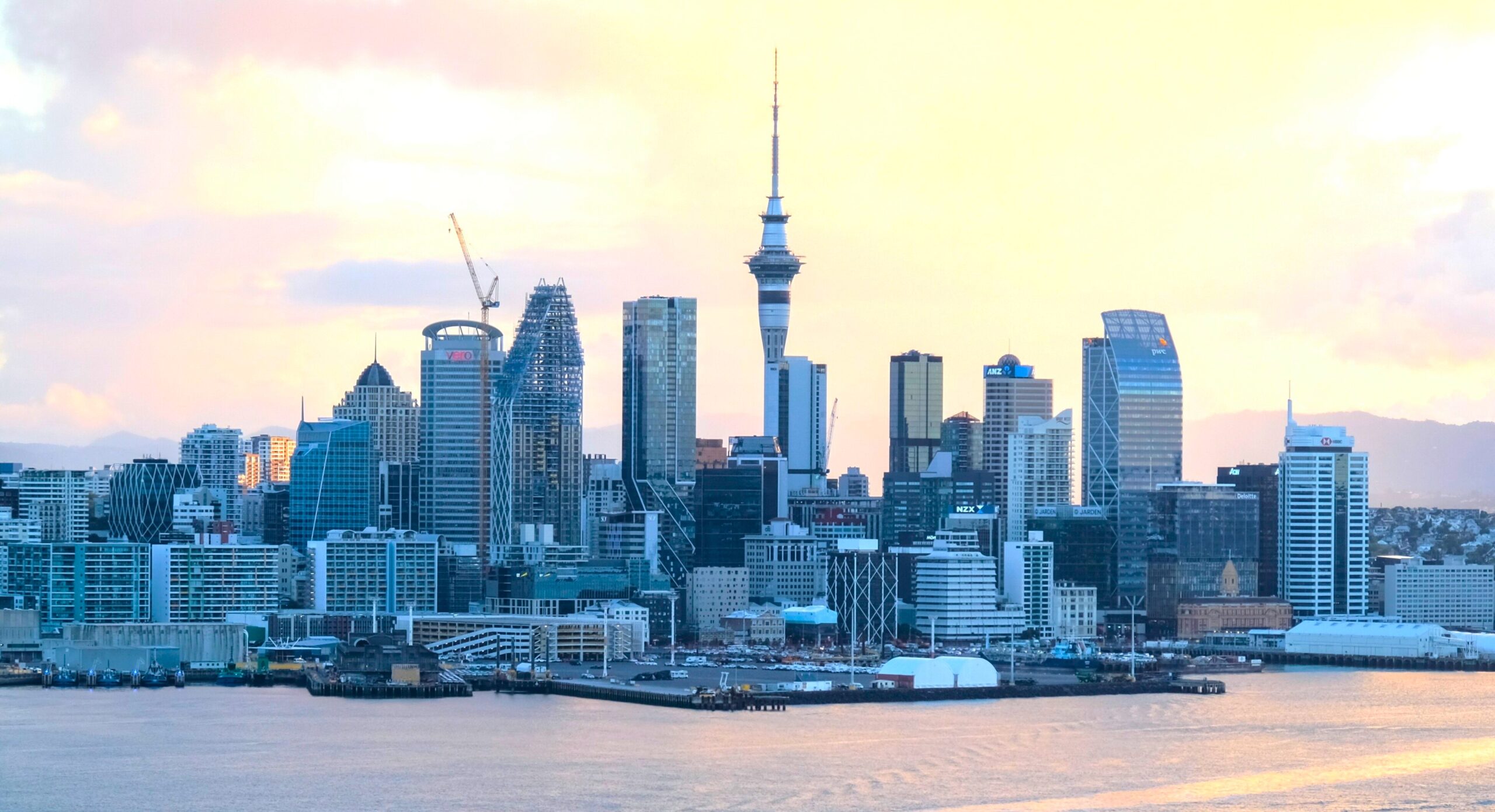
Modi lands in Auckland on July 10, 2026 — the last leg of his three-nation tour — in what Luxon called the first visit by an Indian Prime Minister to New Zealand in 40 years. The visit puts the spotlight back on the FTA signed on 27 April 2026, whose hard numbers make the deal’s architecture directly examinable.
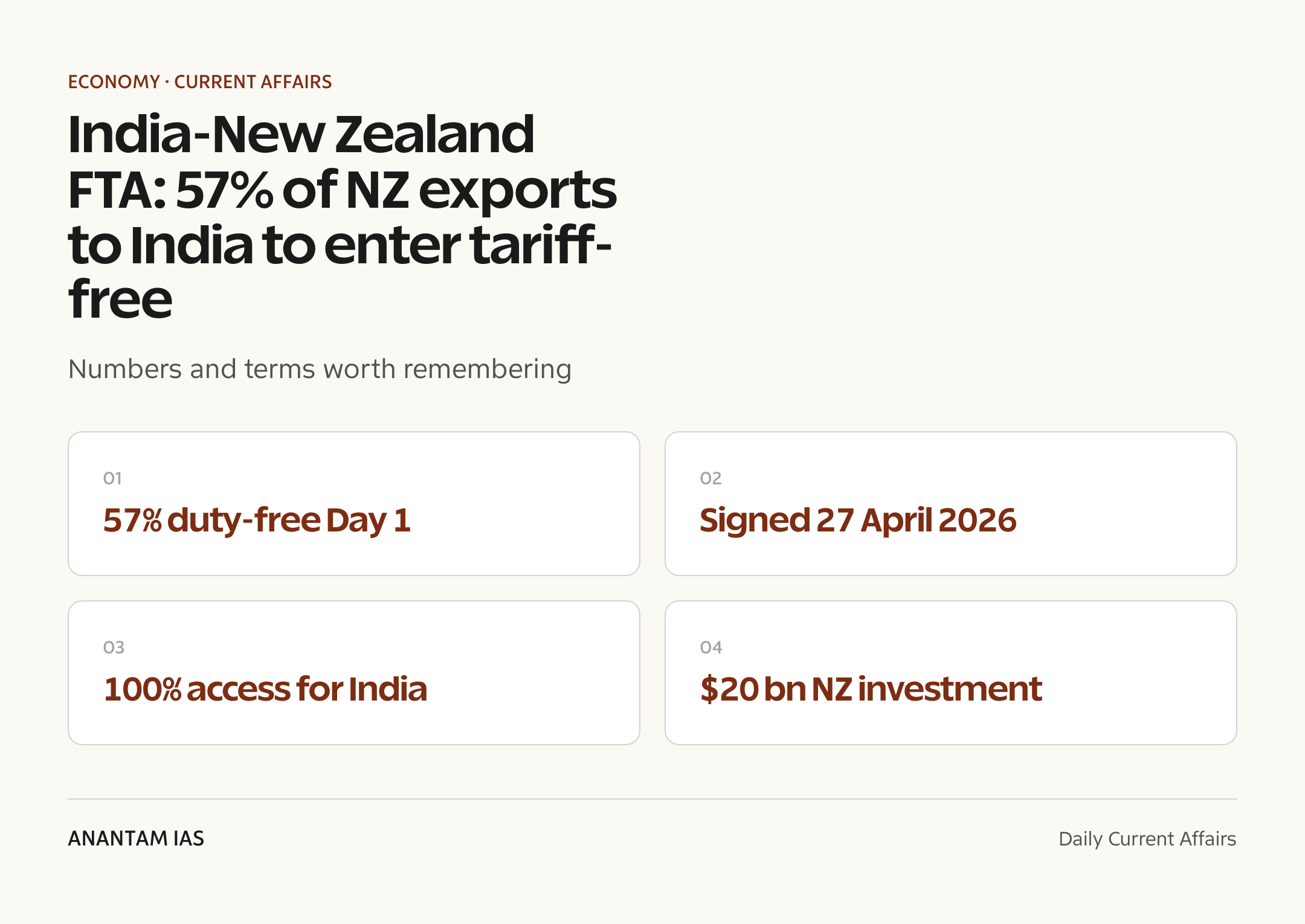
- Luxon’s headline figure: 57% of everything New Zealand exports to India becomes duty-free from day one of the FTA’s entry into force.
- Negotiations launched on 16 March 2025, concluded 22 December 2025 in 5 formal rounds, signature on 27 April 2026 — India’s fastest-concluded FTA, per PIB.
- Tariffs eventually go on 95% of New Zealand’s goods exports to India (by value); New Zealand gives 100% duty-free access to all Indian exports.
- Bilateral merchandise trade was USD 1.3 billion in 2024-25 (up 49%); goods-plus-services trade reached about USD 2.4 billion in 2024.
- Modi framed the tour as strengthening the Act East Policy, the MAHASAGAR vision and a free and open Indo-Pacific.
The development matters in the context of:
- This is India’s first FTA with New Zealand after talks begun in 2010 stalled for a decade — a template case for how India now sequences trade deals with developed economies.
- The 57% day-one figure vs the 95% eventual figure vs India’s 70.03% tariff-line offer is exactly the number-distinction UPSC tests: value coverage, line coverage and phase-in schedules differ.
- The deal shows India’s standard defensive template — dairy excluded, TRQs with minimum import prices for the rest — the same red line held with Australia, the EU and the UK.
- The FTA is the economic arm of India’s Act East and Indo-Pacific outreach covered in the PM’s three-nation tour.
UPSC Relevance
Prelims Relevance
- India-New Zealand FTA — signed 27 April 2026; launched 16 March 2025; 5 formal rounds in ~9 months — India’s fastest FTA.
- 57% of NZ exports to India duty-free from day one; 95% tariff-free after full phase-in; 100% duty-free access for Indian exports to New Zealand.
- India opened 70.03% of tariff lines, excluded 29.97% — exclusions include dairy, sensitive agriculture (onions, chana, corn, almonds), sugar, gems and jewellery, copper and aluminium articles.
- Tariff Rate Quotas with a Minimum Import Price and seasonal windows apply to Mānuka honey, apples, kiwifruit and albumins — only 0.06% of tariff lines.
- USD 20 billion New Zealand investment commitment over 15 years, backed by a Rebalancing Clause for any shortfall.
- Mobility: Temporary Employment Entry (TEE) visa quota of 5,000 skilled Indians (up to 3 years); 1,000 Working Holiday Visas a year; post-study work — STEM Bachelor’s/Master’s up to 3 years, Doctorate 4 years.
- Services: commitments across 118 sectors, MFN treatment in 139 — New Zealand’s best-ever FTA offer — with first-time facilitation of AYUSH services.
- MAHASAGAR = Mutual and Holistic Advancement for Security Across the Regions; New Zealand is India’s second-largest trading partner in Oceania.
- Merchandise trade: USD 873 million (2023-24) → USD 1.3 billion (2024-25); India’s exports USD 711 million — a trade surplus for India.
Mains Relevance
GS Paper 3
- India’s FTA strategy with developed economies — 100% access for labour-intensive exports against calibrated, phased openings at home.
- Protecting sensitive sectors: the dairy exclusion, TRQ-plus-Minimum-Import-Price design, and the Joint Agriculture Productivity Council.
- Trade as an input to manufacturing — duty-free coking coal, wooden logs and metal scrap as cheaper inputs for Indian industry and MSMEs.
GS Paper 2
- India-New Zealand relations and the Indo-Pacific: the FTA as the economic pillar of the Act East Policy and the MAHASAGAR vision.
- Mobility diplomacy — student mobility annexes, post-study work rights and skilled-visa quotas as instruments of external engagement.
Essay
- Trade agreements as statecraft: economics and geopolitics are inseparable in the Indo-Pacific.
- Protecting the farmer while opening the economy — the political economy of India’s dairy red line.
Background and Context
The deal at a glance: what was signed in April 2026
The India-New Zealand FTA covers goods, services, investment, mobility and agricultural cooperation — concluded faster than any Indian trade pact before it.
- Launched on 16 March 2025 by Commerce Minister Piyush Goyal and NZ Trade Minister Todd McClay; concluded 22 December 2025; signed 27 April 2026. Earlier talks, begun in 2010, had run aground largely over dairy.
- For New Zealand: tariffs eventually eliminated on 95% of its goods exports to India — kiwifruit, apples, sheep meat, wool, wood among the winners; 57% of export value duty-free on day one.
- For India: 100% duty-free access across all tariff lines — an unusual clean-sweep offer from a developed partner.
- PIB frames New Zealand as a gateway to the wider Oceania and Pacific Island markets, where it is India’s second-largest trading partner.
- A dedicated chapter covers culture, trade and traditional knowledge, including New Zealand’s indigenous Māori economy — a first in India’s FTAs.
What India opened — and what it kept out
India’s schedule is a graded structure of immediate cuts, phased cuts, partial cuts and hard exclusions — a model of calibrated liberalisation.
- India offered access on 70.03% of tariff lines, kept 29.97% excluded; the opened lines still cover ~95% of New Zealand’s bilateral trade by value.
- 30% of lines: immediate duty elimination — wood, wool, sheep meat, raw hides.
- 35.6%: phased elimination over 3, 5, 7 and 10 years — petroleum oils, malt extract, vegetable oils, selected machinery, dairy-derived peptones.
- 4.37%: tariff reductions (not elimination) — wine, pharmaceutical drugs, polymers, iron and steel articles.
- 0.06%: Tariff Rate Quotas — Mānuka honey, apples, kiwifruit, albumins — each paired with a Minimum Import Price and seasonal windows so imports can’t undercut Indian growers at harvest.
- The exclusion list is India’s sensitivity map: dairy (milk, cream, whey, yoghurt, cheese), most animal products, onions, chana, corn, almonds, sugar, fats and oils, arms, gems and jewellery, copper and aluminium articles.
Dairy: the red line, explained
New Zealand is the world’s largest dairy exporter and India the world’s largest milk producer — which is exactly why core dairy stayed off the table.
- India’s dairy sector supports over 8 crore livelihoods, dominated by smallholders; New Zealand’s industry is industrial-scale and export-oriented — competition would be asymmetric.
- Core dairy — milk, cream, whey, yoghurt, cheese — has no tariff concession at all, the same line India held in the Australia ECTA and holds with the EU and UK.
- The dairy-adjacent openings are peripheral: milk albumins get a 50% tariff cut inside a quota; dairy-based peptones and bulk infant-formula preparations phase down over seven years.
- Design lesson: India separates consumer-facing dairy (excluded) from industrial derivatives (partially opened under quotas) — protecting farmer income while giving processors inputs.
- As a sweetener without market access, an Agricultural Productivity Partnership brings Centres of Excellence and orchard-management support for Indian kiwifruit, apple and honey growers, monitored by a Joint Agriculture Productivity Council.
What India gains: goods, services and people
India’s offensive interests are labour-intensive exports, services and mobility — and the schedule delivers on all three.
- Zero-duty access for textiles and apparel, leather and footwear, gems and jewellery, engineering goods and processed foods — textiles duty-free from day one.
- Duty-free industrial inputs — wooden logs, coking coal, metal scrap — cut production costs for Indian manufacturing.
- New Zealand’s best-ever services offer: 118 sectors committed, MFN in 139 — spanning IT/ITeS, professional services, education, financial services and tourism.
- A first anywhere: New Zealand facilitates trade in Ayurveda, Yoga and other AYUSH services — opening pathways for AYUSH practitioners, yoga instructors, Indian chefs and music teachers.
- A Student Mobility and Post-Study Work annex (New Zealand’s first with any country) guarantees Indian students 20 hours a week of work during study even if domestic policy changes, plus post-study visas of up to 3-4 years.
- A new TEE visa gives 5,000 skilled Indians stays of up to 3 years; a Working Holiday scheme admits 1,000 young Indians a year. Around 3 lakh persons of Indian origin — nearly 5% of NZ’s population — already anchor the relationship.
The USD 20 billion investment promise — and the rebalancing clause
The FTA hard-codes an investment commitment, with an enforcement mechanism India has rarely extracted before.
- New Zealand commits USD 20 billion in India over 15 years, targeted at renewable energy, digital services and modern infrastructure.
- A Rebalancing Clause provides a framework to address any shortfall in investment delivery — converting a political promise into a treaty obligation.
- The corpus exists: New Zealand invests nearly 8% of GDP overseas annually, with total overseas investment of about USD 422.6 billion (March 2025).
- A Mutual Recognition Arrangement for organic products should benefit Indian organic Basmati rice, flax seeds, psyllium husk (isabgol) and black tea.
- Structured MSME cooperation covers export-readiness programmes and linkages with NZ’s SME ecosystem, with focus on women-led and youth-led enterprises.
Where this fits in India's FTA playbook
The New Zealand deal is the latest move in India’s post-2021 pivot from RCEP-scepticism to bilateral deals with developed economies.
- PIB counts 9 FTAs spanning 38 developed countries in recent years — from the UAE CEPA and Australia ECTA (2022) through the EFTA TEPA (2024, with its USD 100 billion investment commitment) to the UK CETA (2025) and now New Zealand.
- The common template: full or near-full access for India’s labour-intensive goods, services-and-mobility chapters, investment commitments — against phased tariff openings and hard agricultural exclusions at home.
- India walked out of RCEP in 2019 largely over import-surge fears, dairy from New Zealand among them; this FTA shows the alternative — bilateral terms where India controls the exclusion list.
- Strategically, the pact is the economic arm of the Act East Policy; Modi’s Auckland leg follows Indonesia and Australia, tracked in our note on the PM’s three-nation visit and the Act East Policy.
- Watch next: ratification and entry into force — the FTA is signed but not yet in force; the numbers UPSC will pick are the signed ones.
Way Forward
Ratify fast, implement carefully
- Complete domestic procedures so entry into force isn’t delayed; early implementation locks in the day-one 57% window while trade momentum is high.
- Notify transparent TRQ administration rules — quota allocation, Minimum Import Price enforcement, seasonal windows — before the first import cycles.
Convert access into exports
- Run exporter-awareness drives so MSMEs in textiles, leather, engineering goods and processed foods actually claim the 100% duty-free access — India’s FTA utilisation rates have historically hovered near 25%.
- Operationalise the services and mobility annexes quickly: qualification recognition decides whether the 5,000 TEE visas get used.
- Track the USD 20 billion commitment through the Rebalancing Clause with published milestones.
Conclusion
Luxon’s 57% announcement is the first hard, day-one number attached to an FTA whose architecture is textbook India: sweeping access abroad, graded openings at home, and an untouchable dairy core. That the deal went from launch to signature in about 13 months shows how deliberately India has rebuilt its trade-negotiation machinery since walking out of RCEP.
For aspirants, the India-New Zealand FTA is now the cleanest single case study of India’s new trade doctrine: tariff-line arithmetic (70.03% opened, 29.97% excluded), TRQ-plus-Minimum-Import-Price safeguards, a treaty-backed investment commitment, and mobility chapters doing the work visas once did. Expect Prelims to test the numbers and Mains to test the design logic.
UPSC Practice Questions
Prelims MCQ 1
With reference to the India-New Zealand Free Trade Agreement signed in April 2026, consider the following statements:
- New Zealand has agreed to provide duty-free access to 100% of Indian exports.
- India has offered tariff concessions on all of its tariff lines to New Zealand.
- Core dairy products such as milk, cheese and yoghurt are kept in India’s exclusion list.
How many of the above statements are correct?
(a) Only one (b) Only two (c) All three (d) None
Answer: (b) Only two
Explanation:
Statements 1 and 3 are correct: New Zealand gives 100% duty-free access to Indian exports, and core dairy sits in India’s exclusion list. Statement 2 is wrong — India opened 70.03% of tariff lines and excluded 29.97%, though the opened lines cover about 95% of New Zealand’s bilateral trade by value.
Prelims MCQ 2
The “Rebalancing Clause” in the India-New Zealand FTA is best described as:
(a) A mechanism to renegotiate tariff schedules if India’s trade deficit widens (b) A framework to address any shortfall in New Zealand’s USD 20 billion investment commitment to India (c) A safeguard duty that India can impose if dairy imports surge (d) A currency-settlement arrangement to reduce dollar dependence in bilateral trade
Answer: (b) A framework to address any shortfall in New Zealand's USD 20 billion investment commitment to India
Explanation:
The FTA locks in a USD 20 billion New Zealand investment commitment over 15 years; the Rebalancing Clause provides a treaty framework to respond if delivery falls short. Dairy is protected by exclusion, not a safeguard duty — core dairy has no concession at all.
UPSC Mains Questions
- The India-New Zealand FTA has been described as a template of ‘calibrated liberalisation’. Examine how the agreement’s tariff architecture and safeguard mechanisms balance India’s export ambitions with the protection of sensitive domestic sectors. (250 words)
- Trade agreements are increasingly instruments of strategy, not just commerce. Discuss with reference to India’s recent FTAs with developed economies and the Indo-Pacific dimension of the India-New Zealand partnership. (250 words)
Sources: PIB, Ministry of Commerce and Industry and The Hindu.
Frequently Asked Questions
What did New Zealand’s PM announce about the FTA?
Ahead of PM Modi’s July 10 Auckland visit, PM Christopher Luxon announced that 57% of New Zealand’s exports to India will be tariff-free from day one of the India-New Zealand FTA, signed on 27 April 2026. Eventually, tariffs go on 95% of New Zealand’s goods exports to India.
What does India get from the India-New Zealand FTA?
New Zealand gives 100% duty-free access to Indian exports, its best-ever services offer (118 sectors), a USD 20 billion investment commitment over 15 years, a 5,000-visa skilled-worker pathway, guaranteed student work rights, and post-study work visas of up to 3-4 years.
Is dairy included in the India-New Zealand FTA?
Core dairy — milk, cream, whey, yoghurt, cheese — is fully excluded from India’s concessions to protect smallholder farmers. Only peripheral items open partially: milk albumins get a 50% tariff cut under quota, and dairy-derived peptones phase down over seven years.
What is a Tariff Rate Quota with Minimum Import Price?
A TRQ allows a fixed quantity of imports at lower duty; beyond it, normal tariffs apply. India pairs TRQs on apples, kiwifruit, Mānuka honey and albumins with a Minimum Import Price and seasonal windows, so cheap imports can’t undercut Indian growers during harvest.
Why is this FTA called India’s fastest?
Negotiations launched on 16 March 2025 and concluded on 22 December 2025 — five formal rounds in about nine months — with signature on 27 April 2026. Earlier India-New Zealand talks, started in 2010, had stalled for a decade, mainly over dairy access.
How big is India-New Zealand trade currently?
Bilateral merchandise trade grew 49% to USD 1.3 billion in 2024-25, with Indian exports at USD 711 million, giving India a trade surplus. Total goods and services trade was about USD 2.4 billion in 2024. New Zealand is India’s second-largest trading partner in Oceania.
Source: https://anantamias.com/current-affairs/india-nz-fta-tariff-free-exports-modi-visit/
India-Myanmar border talks: security review, intelligence sharing and territorial assurance
Why in News?
India and Myanmar concluded the 23rd National Level Meeting in New Delhi on July 7–8, 2026, with the Ministry of Home Affairs (MHA) announcing that Myanmar has assured India its territory will not be permitted to be used against India’s security interests. The Hindu and the Indian Express reported the outcome on July 9.
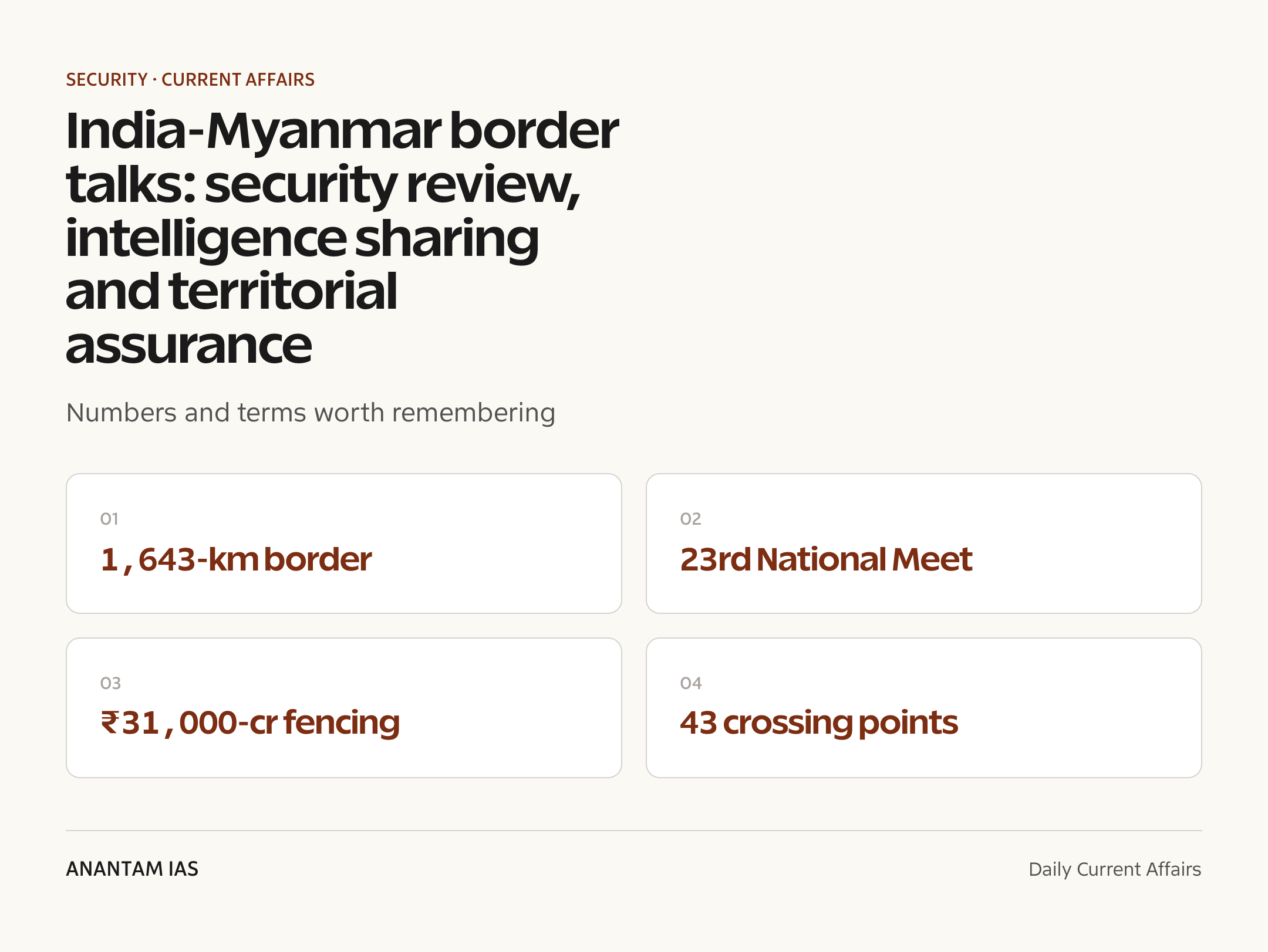
The two sides reviewed the security situation along the 1,643-km India-Myanmar border, agreed to enhance intelligence sharing and operational coordination against transnational crimes, and reaffirmed commitment to completing the Kaladan Multi-Modal Transit Transport Project and the India-Myanmar-Thailand Trilateral Highway.
- The Indian delegation was led by Govind Mohan, Union Home Secretary; the Myanmar side by Major General Min Thu, Deputy Minister of Home Affairs.
- Both sides underscored preventing the misuse of sovereign territory for activities inimical to each other’s security interests — a direct reference to Northeast insurgent camps operating from Myanmar soil.
- Talks covered terrorism, insurgency, narcotics trafficking, arms smuggling, human trafficking, wildlife trafficking, cybercrime and other organised crime.
- The two countries agreed on capacity-building initiatives, regular exchanges and training programmes through existing bilateral mechanisms.
- India underscored Myanmar’s place in its Neighbourhood First, Act East and MAHASAGAR (Mutual and Holistic Advancement for Security and Growth Across Regions) policies.
The development matters in the context of:
- The assurance comes amid Myanmar’s continuing civil war, in which large stretches of the border regions adjoining India are controlled by ethnic armed organisations and resistance forces, not the junta — making any territorial guarantee hard to enforce on the ground.
- The meeting sits at the centre of India’s live policy debates on scrapping the Free Movement Regime (FMR), fencing the 1,643-km border at about ₹31,000 crore, and insulating the Northeast from spillover instability.
- For India, engagement with Naypyidaw balances security imperatives against democratic concerns — Myanmar is India’s only land bridge to ASEAN.
UPSC Relevance
Prelims Relevance
- 23rd National Level Meeting — home-secretary-level India-Myanmar security dialogue; 2026 edition held in New Delhi, July 7–8.
- India-Myanmar border: 1,643 km across Arunachal Pradesh (520 km), Nagaland (215 km), Manipur (398 km) and Mizoram (510 km).
- Assam Rifles guards the India-Myanmar border — administrative control with MHA, operational control with the Indian Army.
- Free Movement Regime (FMR): visa-free movement up to 16 km either side for border residents, formalised in 2018 under Act East; MHA announced its scrapping in February 2024.
- New border-pass system (December 2024): movement limited to 10 km, regulated through 43 designated crossing points manned by Assam Rifles.
- Kaladan Multi-Modal Transit Transport Project: Kolkata–Sittwe Port (sea) → Paletwa (Kaladan river) → Zorinpui, Mizoram (road).
- India-Myanmar-Thailand Trilateral Highway: Moreh (Manipur) to Mae Sot (Thailand) via Myanmar.
- MAHASAGAR — Mutual and Holistic Advancement for Security and Growth Across Regions; India’s expanded maritime-neighbourhood vision building on SAGAR.
- Border fencing: Cabinet Committee on Security gave in-principle approval (September 2024) for fencing and border roads over about 10 years at roughly ₹31,000 crore.
Mains Relevance
GS Paper 3
- Security challenges in border areas: porous hilly terrain, insurgent safe havens, and the fencing-versus-free-movement trade-off on the Myanmar frontier.
- Linkages of organised crime with terrorism: Golden Triangle narcotics, arms smuggling, human trafficking and cyber-scam networks routed through Myanmar.
- Role of intelligence sharing, border-guarding forces (Assam Rifles) and bilateral mechanisms in managing external-internal security linkages.
GS Paper 2
- India and its neighbourhood: calibrated engagement with Myanmar’s military government under Neighbourhood First and Act East.
- Connectivity diplomacy — Kaladan project and the Trilateral Highway as instruments of regional integration and as a counter to China’s corridors in Myanmar.
Essay
- Borders as bridges versus borders as barriers — what the FMR-to-fencing shift says about India’s frontier philosophy.
- National security and humanitarian obligation: managing refugee inflows from a neighbour in civil war.
Background and Context
The 1,643-km frontier: geography before policy
The India-Myanmar border is among India’s most difficult frontiers to police — hilly, forested, thinly demarcated on the ground and historically open.
- It runs 1,643 km through four states — Arunachal Pradesh (520 km), Nagaland (215 km), Manipur (398 km) and Mizoram (510 km).
- The terrain is largely un-fenced, mountainous jungle; villages and ethnic communities (Naga, Kuki-Zo-Chin, Mizo-Chin kinship) straddle the line, so families live on both sides.
- The Assam Rifles, India’s oldest paramilitary force, is the designated border-guarding force here — unlike the BSF on the Pakistan and Bangladesh borders — with administrative control under the MHA and operational control under the Army.
- The border’s openness historically supported legitimate border trade (Moreh–Tamu being the main land gateway) but also insurgent transit, narcotics flows and smuggling.
- See the primer on India’s border management and India-Myanmar relations for the full syllabus picture.
Free Movement Regime: from open border to border passes
The FMR — the border’s defining arrangement — has been rolled back in stages since 2024.
- The Free Movement Regime, formalised in 2018 under the Act East policy, allowed hill tribes residing along the border to travel up to 16 km into the other country without a visa.
- In February 2024, the Union Home Minister announced the government’s decision to scrap the FMR and fence the entire border, citing internal security and the demographic balance of the Northeast.
- In December 2024, a replacement protocol was notified: residents within 10 km of the border can cross using border passes issued at 43 designated crossing points manned by the Assam Rifles.
- State responses diverge sharply: Manipur (post-2023 ethnic violence) pushed for scrapping, while Mizoram and Nagaland oppose fencing, citing kinship ties cut by a colonial-era boundary.
- The FMR debate is now a classic GS3 case study in balancing security hardening against livelihoods, ethnic kinship and treaty-like customary rights.
Fencing and surveillance: the ₹31,000-crore project
Alongside the FMR rollback, India has committed to physically sealing the frontier over a decade.
- The Cabinet Committee on Security gave in-principle approval in September 2024 for fencing the full 1,643 km plus border roads, at an estimated ₹31,000 crore over about ten years.
- Only around 30 km had been fenced by late 2024 — including a roughly 10-km pilot stretch at Moreh, Manipur — with the Border Roads Organisation executing parallel road works.
- Plans include hybrid surveillance — smart fencing, sensors and patrol tracks — adapted to terrain where a conventional linear fence is impractical.
- Critics note fencing costs, ecological damage in biodiversity-rich hills, and the risk of alienating border communities whose cooperation ground-level intelligence depends on.
Insurgency and transnational crime: why the assurance matters
Myanmar’s Sagaing Region and adjoining tracts have long hosted camps of Northeast Indian insurgent groups — the core concern behind Wednesday’s territorial assurance.
- Groups such as NSCN-K, ULFA (Independent) and Manipur valley-based outfits (PLA, UNLF and others) have used Myanmar territory for camps, training and transit.
- India and Myanmar have earlier run coordinated operations — notably Operation Sunrise (2019) — against insurgent camps along the border.
- The border is a conduit for Golden Triangle narcotics (heroin, methamphetamine/yaba), small arms, gold and wildlife contraband; Manipur and Mizoram are key transit corridors.
- The talks’ inclusion of cybercrime reflects the rise of cyber-scam compounds in Myanmar’s lawless border zones, where trafficked Indian nationals have been forced to run online frauds — several rescue operations have been coordinated with Myanmar in 2024–26.
- The agreed intelligence-sharing and operational coordination framework aims to institutionalise real-time inputs rather than episodic, operation-specific cooperation.
The post-coup context: a neighbour in civil war
The February 2021 military coup transformed the border from a managed frontier into the edge of an active civil war.
- Since the February 2021 coup, Myanmar’s junta has lost control of much of Chin State and Sagaing Region — the areas actually abutting India — to ethnic armed organisations and People’s Defence Forces.
- Tens of thousands of refugees, largely Chin, have crossed into Mizoram and Manipur, sheltered by kin communities; the influx feeds India’s demographic and security anxieties.
- Any junta assurance that territory “will not be used against India” is constrained by this reality: Naypyidaw does not control much of the relevant territory.
- India has stuck to calibrated engagement — dealing with the State Administration Council on security and connectivity while providing humanitarian aid — rather than isolation, partly to avoid ceding space to China.
- China’s China-Myanmar Economic Corridor and the Kyaukpyu port project deepen the strategic stakes of India staying engaged.
Connectivity stakes: Kaladan, Trilateral Highway and MAHASAGAR
The meeting re-committed both sides to the two flagship connectivity projects that make Myanmar India’s gateway to Southeast Asia.
- The Kaladan Multi-Modal Transit Transport Project links Kolkata to Sittwe Port (operational since 2023) by sea, Sittwe to Paletwa by the Kaladan river, and Paletwa to Zorinpui in Mizoram by road — giving the Northeast an outlet bypassing the Siliguri Corridor.
- The road leg through conflict-hit Chin State remains the project’s chief bottleneck; completion needs exactly the on-ground security the two sides discussed.
- The India-Myanmar-Thailand Trilateral Highway (Moreh to Mae Sot) is the land spine of Act East; sections in Myanmar await stabilisation and funding.
- India framed the relationship within Neighbourhood First, Act East and MAHASAGAR — signalling that Myanmar bridges India’s continental and maritime strategies.
- Compare with the wider India-ASEAN connectivity projects primer for Prelims-ready specifics.
Way Forward
Harden the border intelligently, not just physically
- Sequence fencing by threat density — insurgency and narcotics corridors first — while pairing it with sensor-based hybrid surveillance in terrain where fences fail.
- Operationalise the promised intelligence-sharing pipeline with dedicated liaison officers, joint databases on insurgent movement, and periodic coordinated patrols or operations.
- Invest in border-area development (Vibrant Villages-style) and formalised trade at Moreh so local communities gain more from a regulated border than from smuggling economies.
Engage all stakeholders in Myanmar and at home
- Maintain quiet channels with ethnic armed organisations controlling the actual border tracts, since junta assurances alone can’t secure them.
- Adopt a clear, humane refugee-management framework with biometric registration, replacing ad-hoc state-level responses in Mizoram and Manipur.
- Fast-track the Kaladan road leg and Trilateral Highway with conflict-sensitive execution, keeping connectivity gains ahead of China’s corridor momentum.
Conclusion
The 23rd National Level Meeting delivers what India most wanted on paper: a renewed Myanmar assurance against anti-India activity from its soil, plus an upgraded intelligence-sharing framework. But the guarantee’s worth depends on a state that controls only part of its own borderlands.
For India, the path runs through both hard and soft instruments — calibrated fencing and surveillance on the 1,643-km frontier, sustained engagement with whoever holds ground across it, and connectivity projects that convert a security liability into the Northeast’s economic gateway. The border question is no longer only about keeping threats out; it’s about managing a shared, unstable neighbourhood without losing the people who live on it.
UPSC Practice Questions
Prelims MCQ 1
With reference to the India-Myanmar border, consider the following statements:
- The India-Myanmar border runs through the four states of Arunachal Pradesh, Nagaland, Manipur and Mizoram.
- The Border Security Force (BSF) is the designated border-guarding force for the India-Myanmar border.
- The Free Movement Regime allowed border residents visa-free movement up to 16 km into the other country.
How many of the above statements are correct?
(a) Only one (b) Only two (c) All three (d) None
Answer: (b) Only two
Explanation:
Statements 1 and 3 are correct. Statement 2 is wrong — the Assam Rifles, not the BSF, guards the 1,643-km India-Myanmar border, under MHA administrative control and Army operational control.
Prelims MCQ 2
The Kaladan Multi-Modal Transit Transport Project connects which of the following pairs of terminal points?
(a) Kolkata Port and Sittwe Port, with onward river-road links to Zorinpui in Mizoram (b) Chennai Port and Yangon Port, with onward rail links to Imphal in Manipur (c) Haldia Port and Kyaukpyu Port, with onward road links to Aizawl in Mizoram (d) Visakhapatnam Port and Dawei Port, with onward highway links to Moreh in Manipur
Answer: (a) Kolkata Port and Sittwe Port, with onward river-road links to Zorinpui in Mizoram
Explanation:
Kaladan links Kolkata to Sittwe Port (Myanmar) by sea, Sittwe to Paletwa via the Kaladan river, and Paletwa to Zorinpui in Mizoram by road — an alternative Northeast outlet bypassing the Siliguri Corridor.
UPSC Mains Questions
- Myanmar’s assurance that its territory will not be used against India’s interests is necessary but not sufficient for Northeast security. Critically examine in the context of the post-2021 situation in Myanmar and India’s border-management response. (250 words)
- The scrapping of the Free Movement Regime and fencing of the India-Myanmar border involve a trade-off between security and the rights of border communities. Discuss, suggesting a balanced framework for managing this frontier. (250 words)
Sources: The Hindu and Indian Express.
Frequently Asked Questions
What was decided at the India-Myanmar meeting?
At the 23rd National Level Meeting in New Delhi (July 7–8, 2026), Myanmar assured India its territory won’t be used against Indian security interests. Both sides agreed to enhance intelligence sharing, operational coordination and capacity building against terrorism, insurgency, narcotics, trafficking and cybercrime, and to push the Kaladan and Trilateral Highway projects.
Who led the two delegations?
India’s delegation was led by Union Home Secretary Govind Mohan, while Myanmar’s was led by Major General Min Thu, Deputy Minister in Myanmar’s Ministry of Home Affairs. The National Level Meeting is the home-ministry-level bilateral security dialogue between the two countries.
How long is the India-Myanmar border?
The border is 1,643 km long and touches four states — Arunachal Pradesh (520 km), Nagaland (215 km), Manipur (398 km) and Mizoram (510 km). It is guarded by the Assam Rifles and is largely unfenced, hilly and forested, which makes policing difficult.
What is the Free Movement Regime (FMR)?
The FMR, formalised in 2018, allowed hill communities living along the border to travel up to 16 km into the other country without a visa. In February 2024 India announced its scrapping; since December 2024, movement is limited to 10 km through border passes issued at 43 designated crossing points.
Why is the border being fenced?
The government cites insurgent movement, narcotics and arms smuggling, and demographic pressures from post-coup refugee inflows. The Cabinet Committee on Security approved fencing the full 1,643 km with border roads at about ₹31,000 crore over roughly ten years, though Mizoram and Nagaland oppose it over ethnic kinship ties.
What is the Kaladan project?
The Kaladan Multi-Modal Transit Transport Project links Kolkata to Sittwe Port in Myanmar by sea, Sittwe to Paletwa by river, and Paletwa to Zorinpui in Mizoram by road. It gives Northeast India an alternative access route to the sea, bypassing the narrow Siliguri Corridor.
Source: https://anantamias.com/current-affairs/india-myanmar-border-security-review-intel-sharing/
National Board for Wildlife: 91st Standing Committee weighs 100+ projects and conservation strategy
Why in News?
Union Minister for Environment, Forest and Climate Change Bhupender Yadav chaired the 91st Meeting of the Standing Committee of the National Board for Wildlife (SC-NBWL) on 9 July 2026 at the Central Academy for State Forest Service, Coimbatore. PIB confirmed the Committee took up more than 100 development proposals that need wildlife clearance and reviewed progress on directions from the 7th NBWL meeting chaired by the Prime Minister.
The SC-NBWL is the statutory forum where nearly every road, transmission line, pipeline or defence work planned inside a national park, wildlife sanctuary or eco-sensitive zone is appraised under the Wild Life (Protection) Act, 1972. So a single meeting like this effectively decides how India resolves the standing tension between infrastructure expansion and habitat protection.
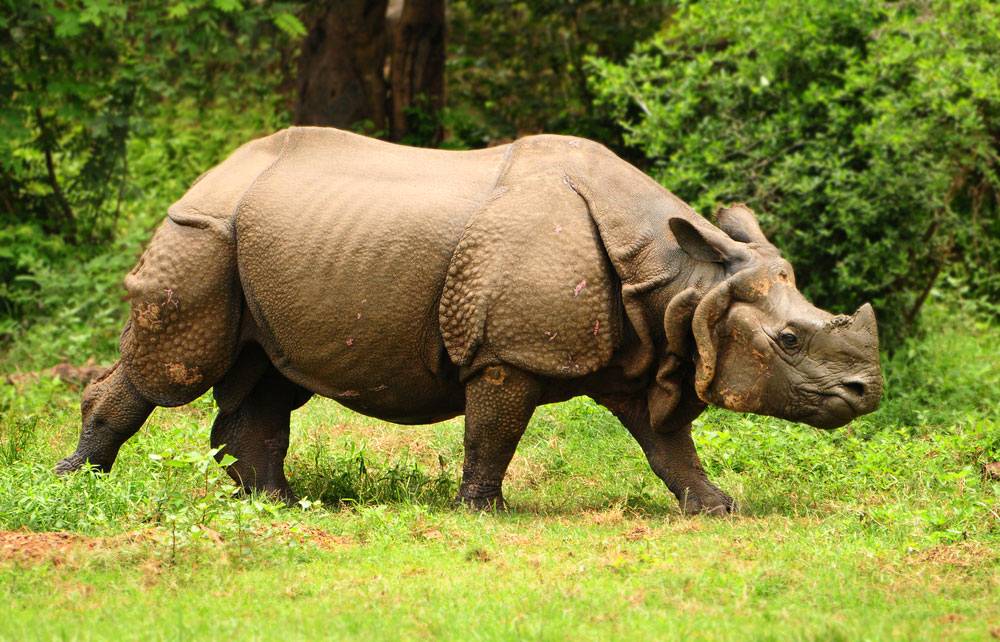
Beyond clearances, the meeting doubled as a conservation-strategy session: it advanced long-term plans for the Greater One-horned Rhinoceros using the Rhino DNA Indexing System (RhoDIS), set the future course for the critically endangered Great Indian Bustard, and brought the Pygmy Hog under the Species Recovery Programme.
- State governments had forwarded 118 proposals relating to infrastructure and defence for appraisal.
- Projects spanned roads, bridges, defence infrastructure, power transmission lines, optical-fibre networks, pipelines, mining and renewable energy in and around wildlife habitats.
- The Committee released scientific publications on the Rhinoceros, Sloth Bear and Great Indian Bustard.
- It advanced strategy for the Greater One-horned Rhinoceros via the Rhino DNA Indexing System (RhoDIS) and included the Pygmy Hog under the Species Recovery Programme.
The development matters in the context of:
- The SC-NBWL is the key statutory gatekeeper balancing development clearances against habitat connectivity under the Wild Life (Protection) Act, 1972.
- Almost every road, transmission line or defence work inside a protected area or its eco-sensitive zone must clear this forum, making it central to India’s development-vs-conservation debate.
UPSC Relevance
Prelims Relevance
- National Board for Wildlife (NBWL) — statutory body under Section 5A of the Wild Life (Protection) Act, 1972.
- The NBWL is chaired by the Prime Minister; the Union Environment Minister is Vice-Chairperson.
- The Standing Committee (SC-NBWL) is constituted under Section 5B and chaired by the Environment Minister.
- NBWL is an advisory body; its clearance is mandatory for projects in protected areas.
- Rhino DNA Indexing System (RhoDIS) — DNA database for the Greater One-horned Rhinoceros.
- Great Indian Bustard — critically endangered, state bird of Rajasthan; Pygmy Hog — smallest wild pig, found in Assam.
- Eco-Sensitive Zones (ESZ) notified around protected areas as shock absorbers.
- Central Academy for State Forest Service, Coimbatore, hosted the 91st meeting.
Mains Relevance
GS Paper 3
- Institutional mechanisms for reconciling infrastructure development with wildlife conservation.
- Species-recovery programmes and science-based conservation (RhoDIS, Species Recovery Programme).
GS Paper 2
- Role of statutory advisory bodies and the Standing Committee in environmental governance and clearances.
Essay
- Development and ecology need not be adversaries — the case for science-led conservation.
Background and Context
What the National Board for Wildlife is
The NBWL is the apex statutory advisory body for wildlife in India.
- Constituted under Section 5A of the Wild Life (Protection) Act, 1972, which replaced the non-statutory Indian Board for Wildlife (set up in 1952) after the Act’s 2002 amendment.
- Chaired by the Prime Minister, with the Union Environment Minister as Vice-Chairperson; it has up to 47 members, including 5 NGOs, 10 eminent ecologists and conservationists, and several officials.
- Its mandate is to promote the conservation and development of wildlife and forests and to advise the government on policy for protection of wild animals, plants and their habitats.
- It has a key structural power: no de-notification or boundary change of a national park or sanctuary, and no diversion of protected-area land, can proceed without a recommendation of the NBWL.
- Its role was reinforced by the Supreme Court, which requires NBWL vetting for projects within protected areas and their notified eco-sensitive zones.
The Standing Committee's gatekeeper role
Day-to-day clearances flow through the Standing Committee, not the full Board.
- The Standing Committee (SC-NBWL) is constituted under Section 5B and chaired by the Union Environment Minister, with official and non-official members.
- Because the full NBWL meets rarely, the SC does the operational work — it appraises project proposals that fall inside national parks, wildlife sanctuaries, tiger reserves and eco-sensitive zones.
- Each proposal is tested on three counts: its ecological impact, its public-welfare or national-development importance, and the adequacy of mitigation measures to protect wildlife and habitat.
- The Committee can approve, reject, defer, or approve-with-conditions, and often attaches safeguards such as compensatory afforestation, corridor protection or wildlife-passage structures.
- It also monitors compliance and reviews progress on directions issued at earlier NBWL and SC meetings — at the 91st meeting it reviewed decisions of the 7th NBWL meeting chaired by the Prime Minister.
Projects considered at the 91st meeting
Over 100 proposals across the country were placed before the Committee.
- State governments had forwarded 118 proposals relating to infrastructure and defence; the SC considered more than 100 requiring clearance under the Wild Life (Protection) Act, 1972.
- Categories spanned roads and bridges, defence infrastructure, drinking-water supply, communication towers, power transmission lines, optical-fibre networks, pipelines, mining, renewable energy, educational institutions and other public works.
- Each proposal was appraised on the basis of its ecological cost, its importance for public welfare and national development, and the adequacy of mitigation to conserve wildlife and habitat.
- Minister Bhupender Yadav stressed that scientific planning, habitat connectivity and effective mitigation should guide decision-making on projects in and around wildlife habitats.
- The Committee reiterated that projects of national importance should proceed with appropriate safeguards that minimise adverse impacts, in line with the Act and other environmental laws.
Species-recovery strategy and RhoDIS
The meeting also set direction for several flagship species.
- It framed a long-term strategy for the Greater One-horned Rhinoceros built on the Rhino DNA Indexing System (RhoDIS) — a DNA database that fingerprints individual rhinos to aid anti-poaching forensics, population monitoring and forensic prosecution.
- India holds the bulk of the world’s Greater One-horned Rhinos, concentrated in Assam’s Kaziranga and other habitats, making a national DNA registry central to their protection.
- It settled a future conservation strategy for the critically endangered Great Indian Bustard (GIB), whose wild population has collapsed to roughly a few hundred, mainly in Rajasthan and Gujarat, threatened by power lines and habitat loss.
- It brought the Pygmy Hog — the world’s smallest wild pig, surviving in the grasslands of Assam — under the Species Recovery Programme.
- The Committee released scientific publications on the Rhinoceros, Sloth Bear and Great Indian Bustard to strengthen the evidence base for conservation.
Protected areas, eco-sensitive zones and the Species Recovery Programme
The durable framework behind the clearances is worth mapping.
- India’s protected-area network has over 100 national parks and 500-plus wildlife sanctuaries, plus 50-plus tiger reserves and conservation and community reserves under the Act.
- Eco-Sensitive Zones (ESZ) are notified around protected areas by the Environment Ministry as shock absorbers, regulating (not banning) activity to buffer the core habitat; the Supreme Court has repeatedly ruled on minimum ESZ widths.
- The Species Recovery Programme is a component of the centrally sponsored scheme Integrated Development of Wildlife Habitats (IDWH), funding focused recovery of critically endangered species.
- Its earlier list covered species such as the Snow Leopard, Hangul, Nilgiri Tahr, Asiatic Lion, Great Indian Bustard, Dugong and Gangetic Dolphin; the Pygmy Hog is the latest addition.
- The Act also underpins dedicated projects like Project Tiger and Project Elephant, and species schedules that grant graded legal protection.
The development-vs-conservation tension
The forum sits at the heart of a recurring policy clash.
- Conservationists argue that very high clearance approval rates risk turning the Committee into a formality rather than a genuine ecological filter.
- Linear infrastructure — roads, railways, transmission lines, canals — fragments habitat and severs wildlife corridors, raising human-wildlife conflict and roadkill.
- Defence and border-area works in eco-sensitive terrain (for example in the Himalayas and the Northeast) sharpen the trade-off between national security and habitat integrity.
- Minister Yadav pitched solution-based policy interventions that combine technological and sociological studies with traditional knowledge in wildlife conservation.
- The intended shift is from case-by-case approvals toward a science-based, connectivity-first model where mitigation and corridors are designed in, not bolted on.
Way Forward
Connectivity-first appraisal
- Make wildlife-corridor mapping and cumulative-impact assessment mandatory before clearing linear projects, so that fragmentation is judged across a landscape, not one project at a time.
- Treat mitigation infrastructure — animal underpasses, overpasses, eco-bridges and canal ramps — as a default design condition rather than an afterthought, with independent monitoring of whether animals actually use them.
Science and community in the loop
- Scale up DNA-based tools like RhoDIS and structured species-recovery plans across more threatened species, building on the Great Indian Bustard and Pygmy Hog decisions.
- Blend traditional ecological knowledge and sociological study with technology, as the Minister urged, and involve local and forest-dependent communities as partners in conservation.
Transparency and accountability
- Publish SC-NBWL agendas, minutes and conditions promptly to answer the criticism of routine, opaque approvals.
- Strengthen compliance auditing of clearance conditions and compensatory measures so that safeguards on paper translate into outcomes on the ground.
Conclusion
The 91st SC-NBWL meeting captured the permanent balancing act of India’s environmental governance — clearing the roads, power lines and defence works a growing economy demands, while defending increasingly shrinking and fragmented wildlife habitats.
By pairing more than 100 project appraisals with concrete species-recovery decisions for the rhino, Great Indian Bustard and Pygmy Hog, the Committee signalled that clearances and conservation are meant to move together, not in opposition.
Its credibility ultimately rests on treating mitigation and habitat connectivity as binding conditions rather than paperwork, and on letting science-based recovery — not project pressure — set the terms on which development enters India’s protected landscapes.
UPSC Practice Questions
Prelims MCQ 1
With reference to the National Board for Wildlife (NBWL), consider the following statements:
- It is a statutory body constituted under the Wild Life (Protection) Act, 1972.
- It is chaired by the Union Minister for Environment, Forest and Climate Change.
- Its Standing Committee appraises projects seeking clearance in protected areas.
How many of the above statements are correct?
(a) Only one (b) Only two (c) All three (d) None
Answer: (b) Only two
Explanation:
Statements 1 and 3 are correct. The full NBWL is chaired by the Prime Minister, not the Environment Minister (who chairs the Standing Committee), so statement 2 is wrong.
Prelims MCQ 2
The ‘Rhino DNA Indexing System (RhoDIS)’ discussed at the 91st SC-NBWL meeting is associated with the conservation of which species?
(a) Great Indian Bustard (b) Pygmy Hog (c) Greater One-horned Rhinoceros (d) Sloth Bear
Answer: (c) Greater One-horned Rhinoceros
Explanation:
RhoDIS is a DNA database underpinning the long-term conservation strategy for the Greater One-horned Rhinoceros.
UPSC Mains Questions
- The Standing Committee of the National Board for Wildlife sits at the intersection of development and conservation. Examine its statutory role and the criticism that it has become a clearance formality. (250 words)
- Discuss how science-based tools and habitat-connectivity planning can reconcile India’s infrastructure needs with the protection of critical wildlife habitats. (250 words)
Sources: PIB, Ministry of Environment, Forest and Climate Change and Ministry of Environment, Forest and Climate Change.
Frequently Asked Questions
What is the National Board for Wildlife?
The NBWL is India’s apex statutory advisory body on wildlife, constituted under Section 5A of the Wild Life (Protection) Act, 1972. It is chaired by the Prime Minister and advises the government on conservation policy and on projects that affect protected areas and wildlife habitats.
Who chairs the Standing Committee of the NBWL?
The Standing Committee (SC-NBWL), constituted under Section 5B of the Wild Life (Protection) Act, 1972, is chaired by the Union Minister for Environment, Forest and Climate Change. It handles the routine appraisal of project proposals that need wildlife clearance.
Why does the SC-NBWL clear development projects?
Projects inside national parks, wildlife sanctuaries or their eco-sensitive zones need clearance so their ecological impact can be weighed against public and national interest. The Committee attaches mitigation conditions to reduce harm to wildlife and their habitats.
What was decided at the 91st meeting?
Held at Coimbatore on 9 July 2026, the meeting considered over 100 development proposals, reviewed 7th NBWL directions, advanced strategy for the Greater One-horned Rhinoceros and Great Indian Bustard, and added the Pygmy Hog to the Species Recovery Programme.
Is NBWL clearance legally binding?
The NBWL is an advisory body, but its recommendation is effectively mandatory: no protected-area boundary can be altered and no project inside such areas can proceed without going through the Board or its Standing Committee under the Wild Life (Protection) Act, 1972.
What is the Species Recovery Programme?
It is a component of the centrally sponsored scheme for wildlife-habitat development that funds focused recovery of critically endangered species. The 91st meeting brought the Pygmy Hog, the world’s smallest wild pig found in Assam, under its ambit.
Source: https://anantamias.com/current-affairs/nbwl-standing-committee-91st-meeting-conservation/
EPFO’s new portal: centralised database and what changes for subscribers
Why in News?
The Employees’ Provident Fund Organisation (EPFO) has rolled out a revamped member portal under the Centralised IT Enabled Services (CITES 2.01) project, completing the migration of its member records — previously spread across 120-plus regional office databases — into a single centralised national database. The project builds on EPFO’s earlier centralisation work documented in its official CITES 2.01 project brief. The Ministry of Labour and Employment announced the rollout on July 8, 2026.
Labour and Employment Minister Mansukh Mandaviya said the annual interest of ₹1.44 lakh crore for FY 2025-26 would be processed on the new portal for about 34 crore EPF accounts. The July 8 announcement targeted July 15, while an EPFO order the next day said computer processing was complete for nearly 34 crore accounts and had moved to field-office verification; the official EPFO portal is the right place to check subsequent notices. Members can also see the amount they are eligible to withdraw under each claim category.
- Full database migration complete: every member record has moved from regional-office silos to one centralised database under CITES 2.01.
- Any-office servicing: a member’s service request can now be processed from any authorised EPFO office in the country, not just the office where PF deductions happened.
- ₹1.44 lakh crore interest for FY 2025-26 (at 8.25%) was processed for about 34 crore accounts; July 15 was the announced target and field-office verification remained part of the workflow.
- Interest till payment date: on final PF settlements, interest is now calculated up to the date of payment authorisation, not just up to the last day of the previous month.
- Auto-settlement of fully KYC-linked, validated advance claims up to ₹5 lakh; automated pre-validation flags deficiencies by SMS and on the portal before processing.
- EPFO has nearly 8 crore contributing members, making this one of the largest social-security database consolidations anywhere.
The development matters in the context of:
- The reform sits at the junction of social security and digital governance — a statutory retirement fund adopting the digital-public-infrastructure playbook of single databases, auto-processing and portability.
- High claim rejection rates have been a persistent grievance against EPFO; visible withdrawal-eligible balances and online query resolution directly target that failure point.
- For India’s migrant formal workforce, de-linking service from the office of employment removes a long-standing friction — records follow the worker, not the city.
- It builds on the October 2025 withdrawal reform that compressed 13 withdrawal categories into 3 and introduced a 25% minimum balance.
UPSC Relevance
Prelims Relevance
- EPFO — statutory body under the Employees’ Provident Funds and Miscellaneous Provisions Act, 1952; administered by the Ministry of Labour and Employment.
- CITES 2.01 — Centralised IT Enabled Services project; migrated 34 crore EPF accounts from 120-plus decentralised regional databases to one centralised database.
- EPFO runs three schemes: EPF Scheme, 1952; Employees’ Pension Scheme (EPS), 1995; Employees’ Deposit Linked Insurance (EDLI) Scheme, 1976.
- Central Board of Trustees (CBT) — tripartite apex body (government, employers, employees) chaired by the Union Labour Minister; declares the annual EPF interest rate.
- EPF interest rate for FY 2025-26: 8.25%; the July 2026 rollout estimated about ₹1.44 lakh crore across roughly 34 crore accounts.
- Universal Account Number (UAN) — portable lifelong PF account number introduced in 2014; the identity spine the centralised database now completes.
- Auto-settlement limit for KYC-validated advance claims: ₹5 lakh.
- October 2025 norms: withdrawal categories cut from 13 to 3 (essential needs, housing, special circumstances) with a 25% minimum balance rule.
- The Code on Social Security, 2020 subsumes the EPF Act, 1952 (yet to be brought fully into force).
Mains Relevance
GS Paper 3
- Social-security architecture for the formal workforce — how digitisation (centralised database, auto-crediting, auto-settlement) changes the delivery of the EPF entitlement.
- Inclusive growth and labour welfare: portability of benefits for migrant workers and the ease-of-living dividend of any-office servicing.
- E-governance as an efficiency lever in public financial institutions — reducing claim rejections, delays and physical visits.
GS Paper 2
- Government policies for vulnerable sections: transparency (visible withdrawal-eligible balances) as a design principle in welfare delivery.
- Statutory bodies and institutional reform — EPFO’s shift from office-tied processing to a national single-database model.
Essay
- Digital rails as the new welfare state: when a database migration matters more than a new scheme.
- Ease of living for the working class — small administrative frictions, large human costs.
Background and Context
EPFO: the institution behind the news
The Employees’ Provident Fund Organisation is India’s largest retirement-savings institution and one of the world’s biggest social-security bodies.
- Created under the Employees’ Provident Funds and Miscellaneous Provisions Act, 1952; functions under the Ministry of Labour and Employment.
- Administers three statutory schemes — the EPF Scheme, 1952 (retirement corpus), the Employees’ Pension Scheme, 1995 (monthly pension) and the EDLI Scheme, 1976 (life insurance cover).
- Governed by the tripartite Central Board of Trustees — representatives of the Centre, states, employers and employees — chaired by the Union Labour Minister.
- Coverage: establishments with 20 or more employees; both employee and employer contribute 12% of basic wages each, with 8.33% of the employer share diverted to EPS (subject to the ₹15,000 wage ceiling).
- Scale today: about 34 crore EPF accounts and nearly 8 crore contributing members.
- The Universal Account Number (UAN), introduced in 2014, gave each member one portable ID — but the records behind it still sat in separate regional-office databases.
What the CITES 2.01 revamp actually changes
The core of the reform is architectural: one national database replacing more than 120 office-level silos.
- The Ministry of Labour and Employment confirmed EPFO has completed migrating its entire database of member records to the new centralised system under the CITES 2.01 project (part of the EPFO 2.01 modernisation).
- Earlier, services were tied to a particular Regional Office — the one where the employer deposited PF. Now a service request can be processed from any authorised EPFO location in the country.
- Practical effect: an employee who worked in Chennai and returned home to West Bengal can resolve PF issues at the nearest EPFO office instead of chasing the Chennai office.
- A unified digital interface now shows membership details, PF balance, claim status, pensionable service records and benefits availed in one place.
- The portal enables automated processes end to end — interest crediting, online claims verification and visibility of withdrawal-eligible amounts by claim category.
Interest crediting: faster and fuller
Two interest-related changes put real money in members’ hands sooner.
- The FY 2025-26 interest of ₹1.44 lakh crore (rate: 8.25%) will be auto-processed on the new portal, verified by field authorities and credited to 34 crore accounts by July 15.
- Earlier the credit routinely slipped to October–November, months after the CBT declared the rate — members saw stale passbook balances for half the year.
- On final PF settlements, interest is now computed up to the date of payment authorisation; the old rule stopped the clock at the last day of the previous month.
- The ministry said this ensures members get the benefit of additional interest for the intervening period — a small per-member gain, but system-wide it ends a quiet loss borne by every exiting subscriber.
Claims: pre-validation, visible limits, fewer rejections
The portal attacks EPFO’s most criticised metric — claim rejections — before a claim is even filed.
- Claims now undergo automated pre-validation; deficiencies or discrepancies are flagged to the member by SMS and on the portal — a first for EPFO.
- EPFO offices can raise queries online during processing and members can respond online, cutting physical visits and back-and-forth by post.
- Members can now see the eligible withdrawal amount under each claim category. Earlier this was invisible, so claims exceeding permissible limits were routinely rejected.
- Fully KYC-linked and validated advance claims up to ₹5 lakh flow through an auto-settlement mechanism with no human touchpoint.
- The stated goal is a higher first-time acceptance rate — high rejection rates have been a headline grievance against EPFO for several years.
The October 2025 withdrawal reform this builds on
The portal operationalises a simplified withdrawal regime announced in October 2025.
- Withdrawal categories were compressed from 13 to 3 — essential needs (illness, education, marriage), housing needs and special circumstances.
- A mandatory 25% minimum balance was introduced; “100% of eligible balance” in practice means up to 75% of total funds, with the full corpus withdrawable after one year of unemployment.
- Illness (self or family): up to 100% of eligible balance after 12 months of membership.
- Education: allowed after 12 months, capped at 10 withdrawals over the membership; marriage: up to 100% of eligible balance, capped at 5 withdrawals.
- Housing: partial withdrawal for purchase, construction, site acquisition, home-loan repayment or renovation — limited to 75% of total funds after 12 months, not more than five times.
Why it matters: social security meets digital public infrastructure
The reform applies the DPI logic — single source of truth, portability, auto-processing — to a 74-year-old statutory fund.
- It is the same design grammar as India Stack and digital public infrastructure: centralise the record, standardise the rail, automate the transaction.
- Portability directly serves labour mobility — the workforce EPFO serves is increasingly inter-state, while its old architecture assumed a worker stayed put.
- It complements the wider social-security agenda — the Code on Social Security, 2020, gig-worker coverage debates and schemes discussed in our note on social security for gig and informal workers.
- EPFO is also the delivery pipe for employment policy — the Employment Linked Incentive (ELI) scheme routes benefits through EPFO enrolment — so cleaner plumbing raises the ceiling for future programmes.
- For the pension debate mapped in our multi-pillar pension landscape note, a credible, low-friction EPF strengthens Pillar 2 (occupational, contributory) of India’s retirement system.
Caveats and challenges
Centralisation solves the access problem but concentrates new risks that the exam answer should acknowledge.
- Data security and privacy: one national database of 34 crore accounts is a high-value target; breach-resilience, access controls and accountability under the DPDP Act, 2023 framework become critical.
- Transition risk: large migrations can corrupt or orphan legacy records; disputed service histories and missing employer contributions still need human adjudication.
- Digital divide: SMS-and-portal workflows assume smartphone access and digital literacy that low-wage members may lack; assisted physical channels must survive the digitisation.
- Coverage gap remains the bigger story: EPFO protects the formal 8 crore contributors, while roughly 90% of India’s workforce stays informal and outside it — technology upgrades don’t by themselves widen the net.
- Grievance redress capacity at field offices must match the new any-office promise, or the bottleneck simply relocates.
Way Forward
Harden the data layer
- Independent security audits, breach-notification protocols and purpose-limited access consistent with the DPDP Act, 2023.
- A published reconciliation window for members to flag migration errors in service records and balances.
Close the delivery loop
- Publish claim-rejection and first-time acceptance dashboards so the portal’s promise is measurable.
- Retain assisted channels — camps, common service centres, helplines in regional languages — for members outside the smartphone economy.
Widen the net
- Use the clean centralised rail to onboard gig and platform workers under the Code on Social Security, 2020.
- Align EPFO systems with ELI-scheme and formalisation incentives so first-time employees enter with a portable, visible account from day one.
Conclusion
The CITES 2.01 rollout is that rare reform where the headline is a database. By collapsing 120-plus office silos into one national record, EPFO has converted a paper-era, geography-bound entitlement into a portable digital one — interest lands by July 15, balances are visible, and any office can serve any member.
The test now is trust at scale: protecting a 34-crore-account database, fixing migration errors quickly, and keeping non-digital members inside the system. If those hold, the new portal becomes the template for the harder task ahead — extending social security beyond the formal 8 crore to the informal many.
UPSC Practice Questions
Prelims MCQ 1
With reference to the Employees’ Provident Fund Organisation (EPFO) and its recent CITES 2.01 portal, consider the following statements:
- EPFO has migrated its member records from decentralised regional-office databases to a single centralised national database.
- Under the revamped system, a member’s service request can be processed only at the regional office where the PF contributions were deposited.
- Interest on final PF settlements is now calculated up to the date of payment authorisation.
How many of the above statements are correct?
(a) Only one (b) Only two (c) All three (d) None
Answer: (b) Only two
Explanation:
Statements 1 and 3 are correct. Statement 2 is wrong — the centralised database ends the tie to a particular regional office; requests can now be processed from any authorised EPFO location in the country.
Prelims MCQ 2
The Employees’ Provident Fund Organisation (EPFO) functions under which Union Ministry, and under which parent legislation was it established?
(a) Ministry of Finance; Employees’ Provident Funds and Miscellaneous Provisions Act, 1952 (b) Ministry of Labour and Employment; Employees’ Provident Funds and Miscellaneous Provisions Act, 1952 (c) Ministry of Labour and Employment; Code on Wages, 2019 (d) Ministry of Corporate Affairs; Employees’ Pension Scheme, 1995
Answer: (b) Ministry of Labour and Employment; Employees' Provident Funds and Miscellaneous Provisions Act, 1952
Explanation:
EPFO is a statutory body under the EPF & MP Act, 1952, administered by the Ministry of Labour and Employment. Its apex tripartite Central Board of Trustees is chaired by the Union Labour Minister.
UPSC Mains Questions
- EPFO’s migration to a centralised database has been described as applying the digital-public-infrastructure playbook to social security. Examine how the CITES 2.01 reforms improve welfare delivery for formal-sector workers, and identify the risks that centralisation introduces. (250 words)
- High claim rejection rates and geography-tied servicing have long undermined trust in India’s provident fund system. Discuss how transparency-by-design features in EPFO’s new portal address these failures, and suggest measures to extend such social-security architecture to informal workers. (250 words)
Sources: Indian Express Explained and Ministry of Labour and Employment.
Frequently Asked Questions
What is EPFO’s CITES 2.01 project?
CITES 2.01 (Centralised IT Enabled Services) is EPFO’s IT modernisation project under which the entire member database — earlier split across 120-plus regional-office systems — has been migrated to one centralised national database, enabling any-office servicing, auto-crediting of interest and automated claim processing on a revamped portal.
When will EPF interest for FY 2025-26 be credited?
By July 15, 2026. The annual interest of about ₹1.44 lakh crore, at the declared rate of 8.25%, is being auto-processed on the new portal, verified by field authorities and credited to roughly 34 crore EPF accounts — earlier the credit often slipped to October–November.
Can I now get EPF services at any EPFO office?
Yes. Because member records sit in one centralised database, a service request can be processed from any authorised EPFO location in India. You are no longer tied to the regional office of your former employer’s city — a major relief for workers who migrate between states.
What is the ₹5 lakh auto-settlement facility?
Advance claims that are fully KYC-linked and validated, up to ₹5 lakh, are settled through an automated mechanism without manual processing. Combined with automated pre-validation and SMS alerts for deficiencies, this is designed to raise first-time acceptance and cut claim rejections.
How were EPF withdrawal rules changed in October 2025?
EPFO compressed 13 withdrawal categories into 3 — essential needs (illness, education, marriage), housing, and special circumstances — and introduced a 25% mandatory minimum balance. Caps apply: 10 lifetime withdrawals for education, 5 for marriage, and housing withdrawals limited to 75% of funds, up to five times.
Which law and ministry govern EPFO?
EPFO is a statutory body under the Employees’ Provident Funds and Miscellaneous Provisions Act, 1952, administered by the Ministry of Labour and Employment. Its tripartite Central Board of Trustees, chaired by the Labour Minister, oversees the EPF (1952), EPS (1995) and EDLI (1976) schemes.
Source: https://anantamias.com/current-affairs/epfo-new-portal-centralised-database-explained/
Samriddh Gram wins WSIS Prize 2026: BharatNet-powered rural service delivery
Why in News?
PIB confirmed on 9 July 2026 that the Department of Telecommunications (DoT) has been declared the Global Winner of the World Summit on the Information Society (WSIS) Prizes 2026 under Action Line C6 – Enabling Environment for its flagship project “Samriddh Gram: Integrated Phygital Service Delivery Model Enabled by BharatNet”. The award was presented at the WSIS Forum 2026 in Geneva.
Samriddh Gram rides on the BharatNet optical-fibre backbone to run village-level Samriddhi Kendras — one-stop hubs that combine broadband connectivity with assisted, in-person (“phygital”) delivery of healthcare, education, banking, agriculture and e-governance services. The win puts India’s digital public infrastructure (DPI) story on a UN-system podium.
- The WSIS Prizes are instituted under the WSIS process led by the International Telecommunication Union (ITU), the UN’s specialised agency for telecommunications.
- Samriddh Gram won in one of 18 award categories; it cleared a multi-stage process — international screening, global online voting (over 2.2 million votes cast across nominated projects), a top-five Champion Project shortlist, and final adjudication by the WSIS Expert Committee.
- Only two projects from India made it to Champion Project status in 2026; Samriddh Gram then emerged as the category’s Global Winner.
- PIB notes that BharatNet has made more than 2.17 lakh Gram Panchayats service-ready and online — the connectivity base the model builds on.
- Union Communications Minister Jyotiraditya Scindia called the award a global recognition of India’s inclusive Digital India vision and its leadership in DPI.
The development matters in the context of:
- The award matters for GS2 because it validates a last-mile service-delivery model: connectivity alone doesn’t deliver welfare — an assisted, village-level interface does.
- It lands amid the global WSIS+20 review era, when countries are re-examining how ICT commitments made at Geneva (2003) and Tunis (2005) translate into development outcomes.
- For India, it strengthens the case for exporting DPI-based governance models — a theme India pushed during its G20 presidency.
UPSC Relevance
Prelims Relevance
- Samriddh Gram — integrated phygital (physical + digital) rural service-delivery initiative of the Department of Telecommunications, built on the BharatNet backbone.
- Samriddhi Kendras — one-stop village-level hubs delivering tele-health, smart classrooms, banking-correspondent and e-governance services with local facilitation.
- WSIS Prizes — ITU-led global awards under the World Summit on the Information Society process; Samriddh Gram won Action Line C6 – Enabling Environment in 2026.
- WSIS Forum — annual multi-stakeholder meet at Geneva; WSIS grew out of two summits — Geneva (2003) and Tunis (2005).
- BharatNet — world’s largest rural broadband project; began as the National Optical Fibre Network (NOFN) in 2011, renamed BharatNet in 2015; over 2.17 lakh Gram Panchayats service-ready.
- Amended BharatNet Programme (2023) — ₹1,39,579 crore outlay to connect all ~2.64 lakh Gram Panchayats on an IP-MPLS ring topology with a 10-year operation mandate.
- Digital Bharat Nidhi — the renamed Universal Service Obligation Fund (USOF) under the Telecommunications Act, 2023; funds BharatNet and rural connectivity.
- Bharat Net Udyami (BNU) model — local entrepreneurs deliver last-mile FTTH (fibre-to-the-home) connections; target of 1.5 crore rural FTTH connections.
- PM-WANI — public Wi-Fi framework (2020) whose hotspots feature in the Samriddh Gram service bundle alongside Health ATMs and PM Jan Aushadhi Kendras.
Mains Relevance
GS Paper 2
- E-governance and citizen-centric service delivery: how a phygital model bridges the assisted-access gap that pure digital portals leave in rural India.
- Government interventions for vulnerable sections: converging health, education, banking and skilling services at one village-level touchpoint.
- International institutions: the ITU/WSIS architecture and how global recognition shapes domestic policy legitimacy.
GS Paper 3
- Infrastructure: BharatNet’s design shift under the Amended BharatNet Programme — from linear to ring topology, and from build-out to utilisation.
- Inclusive growth: broadband as a general-purpose technology for agriculture (IoT soil testing, drone spraying), rural enterprise and e-commerce.
Essay
- Connectivity is necessary but not sufficient: technology delivers development only through the last human mile.
- India’s digital public infrastructure as a public good the Global South can adopt.
Background and Context
What exactly is Samriddh Gram?
Samriddh Gram is DoT’s integrated rural digital-transformation initiative that converts BharatNet connectivity into doorstep services.
- The core unit is the Samriddhi Kendra — a one-stop, village-level hub combining reliable telecom connectivity, digital platforms and assisted physical service delivery.
- “Phygital” is the operative design idea: a trained local facilitator sits between the citizen and the digital service, so the model works even for users with low digital literacy.
- The pilot phase began with a Samriddhi Kendra at Umri village, Guna district (Madhya Pradesh) in early 2026, as reported by DD News and PIB’s nomination release.
- The model treats connectivity as a platform: the same fibre line carries tele-medicine, smart-classroom content, banking and e-governance rather than a single-purpose application.
- Community participation and local facilitation are built into the design — the project’s stated aim is measurable socio-economic outcomes, not just network coverage.
The service bundle at a Samriddhi Kendra
PIB lists a wide convergence basket delivered under one roof.
- Health — tele-consultation, diagnostics through Health ATMs, and low-cost medicines via PM Jan Aushadhi Kendras.
- Education and skilling — smart classrooms and AR/VR-based skill development modules.
- Agriculture — IoT-based soil testing, drone-enabled fertilizer and pesticide spraying, and app-based smart irrigation.
- Finance and governance — Common Services Centre (CSC)/e-governance counters and Banking Correspondent services for financial inclusion.
- Connectivity and commerce — FTTH and PM-WANI public Wi-Fi, e-commerce support for local products, and CCTV-based village surveillance.
- India already runs digital-access channels like e-governance platforms and CSCs; Samriddh Gram’s novelty is convergence — stacking them on one BharatNet-fed hub.
WSIS and the ITU: the institution behind the prize
The award’s weight comes from the UN-system process that grants it.
- The World Summit on the Information Society (WSIS) was a two-phase UN summit — Geneva 2003 and Tunis 2005 — that set global commitments on using ICTs for development.
- The ITU leads the WSIS process; the annual WSIS Forum at Geneva brings together governments, UN agencies, industry, academia and civil society.
- WSIS work is organised into Action Lines — thematic tracks such as ICT infrastructure, capacity building and e-applications; Action Line C6 covers the Enabling Environment (policy and regulatory conditions for inclusive digital development).
- The WSIS Prizes recognise projects that harness ICTs for sustainable development across 18 categories; winners emerge from submission, screening, global online voting, a Champion shortlist and expert adjudication.
- PIB notes the project advances multiple Sustainable Development Goals — health, quality education, financial inclusion, reduced inequalities and innovation.
BharatNet: the backbone underneath
Samriddh Gram is only as strong as the fibre network it stands on.
- BharatNet began as the National Optical Fibre Network (NOFN) in October 2011 and was renamed BharatNet in 2015; it aims to connect every Gram Panchayat with high-speed broadband.
- As per PIB, more than 2.17 lakh Gram Panchayats are now service-ready and online — making BharatNet one of the world’s largest rural broadband builds (see the fuller picture in Broadband in India).
- The Union Cabinet approved the Amended BharatNet Programme (ABP) in August 2023 with an outlay of ₹1,39,579 crore, covering all ~2.64 lakh Gram Panchayats and about 3.8 lakh villages on demand.
- ABP shifts the network to a resilient ring topology under a Design-Build-Operate-Maintain (DBOM) framework with BSNL as the project-management agency, fixing the uptime problems of the old linear design.
- Funding flows from the Digital Bharat Nidhi — the Universal Service Obligation Fund (USOF) as renamed by the Telecommunications Act, 2023.
- Last-mile delivery uses Bharat Net Udyamis (BNUs) — village-level entrepreneurs who sell FTTH connections, with a target of 1.5 crore rural fibre connections.
Why this recognition matters for India's DPI story
The prize is less about a trophy and more about a governance model getting UN-system validation.
- It signals that India’s digital public infrastructure approach — open, population-scale rails plus assisted access — is a replicable template for other developing countries (background: DPI and India Stack).
- It reframes BharatNet’s success metric from kilometres of fibre laid to services actually consumed — the utilisation question that has dogged the project for a decade.
- The “Enabling Environment” category specifically rewards policy and implementation ecosystems, not gadgets — a recognition of institutional design.
- It complements India’s G20-era push to position DPI as a global public good, alongside UPI’s international expansion and the India Stack diplomacy.
The caveats an examiner will expect you to know
A balanced answer acknowledges BharatNet’s persistent execution gaps.
- Utilisation gap — a large share of BharatNet fibre has historically remained under-used (“dark fibre“), with weak uptake of connections at the Gram Panchayat level.
- Maintenance and uptime — fibre cuts and poor upkeep under the earlier linear topology kept many connected GPs effectively offline; the ABP’s ring design responds to exactly this.
- Digital divide within villages — device affordability, digital literacy and gender gaps in phone ownership limit who actually benefits from a Kendra.
- Sustainability of the phygital layer — Samriddhi Kendras need viable revenue models for local facilitators, or they risk the fate of under-used telecentres worldwide.
- Scale-up risk — a pilot that works in a few districts must survive procurement, staffing and state-coordination pressures across 2.6 lakh Gram Panchayats.
Way Forward
Convert connectivity into consumption
- Publish district-wise utilisation dashboards for BharatNet — active FTTH connections, Kendra footfall and service transactions, not just GPs connected.
- Bundle high-demand services (tele-health consultations, exam-form filling, DBT grievance redress) to give villagers a recurring reason to visit Samriddhi Kendras.
Make the phygital layer viable
- Give Bharat Net Udyamis and Kendra facilitators a clear commission-plus-service-fee revenue model, on the lines of the Banking Correspondent economics.
- Converge with existing CSCs and Panchayat Bhavans rather than duplicating physical infrastructure.
Institutionalise and export the model
- Codify Samriddh Gram’s design into a standard operating framework states can adopt, with Digital Bharat Nidhi support tied to service-level outcomes.
- Use the WSIS platform to offer the model as DPI cooperation to Global South partners, as India has done with UPI and DigiLocker stacks.
Conclusion
The WSIS Prize 2026 is a milestone with a message: the world is rewarding India not for laying fibre but for the institutional imagination layered on top of it. Samriddh Gram’s phygital design answers the hardest question in digital governance — how the last, least-connected citizen actually uses the network the state has built.
For aspirants, the topic sits at the junction of GS2 governance (service delivery, e-governance) and GS3 infrastructure (BharatNet, Digital Bharat Nidhi). Remember the pairing: BharatNet is the pipe, Samriddhi Kendras are the tap — and the WSIS jury awarded the tap.
UPSC Practice Questions
Prelims MCQ 1
With reference to the Samriddh Gram initiative, consider the following statements:
- It is an initiative of the Ministry of Rural Development implemented through Common Services Centres.
- It won the WSIS Prize 2026 under Action Line C6 (Enabling Environment) of the ITU-led WSIS process.
- Its village-level delivery hubs are called Samriddhi Kendras and use the BharatNet network.
How many of the above statements are correct?
(a) Only one (b) Only two (c) All three (d) None
Answer: (b) Only two
Explanation:
Statement 1 is incorrect — Samriddh Gram belongs to the Department of Telecommunications (Ministry of Communications), though CSC services feature in its bundle. Statements 2 and 3 are correct: DoT won the ITU-led WSIS Prize 2026 under Action Line C6, and the model delivers services through BharatNet-fed Samriddhi Kendras.
Prelims MCQ 2
The ‘Digital Bharat Nidhi’, recently in news in connection with BharatNet funding, is:
(a) a sovereign wealth fund for investing in Indian technology start-ups (b) the renamed Universal Service Obligation Fund under the Telecommunications Act, 2023 (c) a corpus created under the Digital India programme for state e-governance missions (d) a credit-guarantee fund for village-level entrepreneurs selling broadband connections
Answer: (b) the renamed Universal Service Obligation Fund under the Telecommunications Act, 2023
Explanation:
The Telecommunications Act, 2023 renamed the USOF — the levy-funded pool for rural and remote connectivity — as the Digital Bharat Nidhi. It finances BharatNet, including the ₹1,39,579-crore Amended BharatNet Programme approved in 2023.
UPSC Mains Questions
- “Connectivity becomes development only when it is converted into services.” In the light of the Samriddh Gram initiative winning the WSIS Prize 2026, examine how ‘phygital’ delivery models can close the last-mile gap in rural e-governance. (250 words)
- BharatNet has been criticised for laying fibre faster than India could use it. Discuss the design changes under the Amended BharatNet Programme, 2023 and the role of initiatives like Samriddh Gram in improving utilisation. (250 words)
- India increasingly projects its digital public infrastructure as a global public good. What does international recognition such as the WSIS Prizes add to this effort, and what are its limits? (150 words)
Source: PIB, Ministry of Communications.
Frequently Asked Questions
What is the Samriddh Gram initiative?
Samriddh Gram is a Department of Telecommunications initiative that uses the BharatNet fibre network to run village-level Samriddhi Kendras — one-stop hubs delivering healthcare, education, banking, agriculture and e-governance services through a combined physical-plus-digital (‘phygital’) model with local facilitators.
What award did Samriddh Gram win in 2026?
It was declared Global Winner of the WSIS Prizes 2026 under Action Line C6 (Enabling Environment), awarded at the WSIS Forum 2026 in Geneva under the World Summit on the Information Society process led by the International Telecommunication Union (ITU).
What are Samriddhi Kendras?
Samriddhi Kendras are one-stop village hubs under Samriddh Gram. They combine telecom connectivity with assisted service delivery — tele-consultations and Health ATMs, smart classrooms, banking-correspondent counters, CSC e-governance services, IoT-based agri tools, FTTH and PM-WANI Wi-Fi, and e-commerce support for local products.
What is BharatNet and its current status?
BharatNet, started as the National Optical Fibre Network in 2011, is the world’s largest rural broadband project. Per PIB, over 2.17 lakh Gram Panchayats are service-ready. The Amended BharatNet Programme (2023, ₹1,39,579 crore) targets all 2.64 lakh Gram Panchayats on a resilient ring topology.
What is the Digital Bharat Nidhi?
Digital Bharat Nidhi is the new name for the Universal Service Obligation Fund (USOF) under the Telecommunications Act, 2023. Collected as a levy on telecom operators, it funds connectivity in rural, remote and underserved areas — including BharatNet and last-mile fibre schemes.
Why is the WSIS Prize significant for UPSC?
It is a prelims-ready fact linking several syllabus themes: the ITU and WSIS process (international institutions), BharatNet and Digital Bharat Nidhi (infrastructure), and phygital service delivery (e-governance). It also illustrates India’s digital public infrastructure being validated as a global model.
Source: https://anantamias.com/current-affairs/samriddh-gram-bharatnet-wsis-prize-2026/
Gujarat Data Centre Policy: ₹6 lakh crore investment and 7.5 GW capacity target
Why in News?
The Gujarat government unveiled its first-ever dedicated Data Centre Policy (2026-29) on July 9, 2026. Chief Minister Bhupendra Patel launched the policy in Gandhinagar, pitching the state as India’s preferred destination for hyperscale data centres, cloud computing and AI-driven digital infrastructure, The Hindu reported.
The policy targets investments of ₹6 lakh crore and the creation of 7.5 GW of data centre capacity over the three-year policy period — a striking number against India’s current installed base of roughly 2-3 GW across about 200 data centres.
- Policy period runs 2026-29; launched by CM Bhupendra Patel in Gandhinagar on July 9, 2026.
- Headline targets: ₹6 lakh crore in investment and 7.5 GW of data centre capacity.
- Incentive basket covers capital subsidy, interest subsidy, power-tariff support, SGST reimbursement, stamp-duty and registration exemption, and aid for captive desalination plants.
- At least 51% of electricity consumed by data centres must come from green energy sources.
- The state has already received proposals for about 10 GW of capacity and plans to facilitate around 8 GW, Science and Technology Minister Arjun Modhwadia said.
- Dholera is the policy’s centrepiece — Deputy Chief Minister Harsh Sanghavi said it could become the “world’s largest Data Center City”.
The development matters in the context of:
- India generates nearly 20% of the world’s data but holds only about 3% of global data centre capacity — the demand-supply gap every state policy is chasing.
- The Union Budget 2026 announced a 20-year tax holiday for global data centre infrastructure providers, and data centres above 5 MW already enjoy infrastructure status (2022) — Gujarat’s policy stacks state incentives on top of this central push.
- Uttar Pradesh’s cabinet cleared its own Data Centre Policy 2026 just two days earlier, targeting ₹2 lakh crore — evidence of intensifying competitive federalism in digital infrastructure.
- AI workloads, the DPDP Act 2023 data-governance regime and RBI’s payment-data localisation norms are all pushing compute and storage demand onshore.
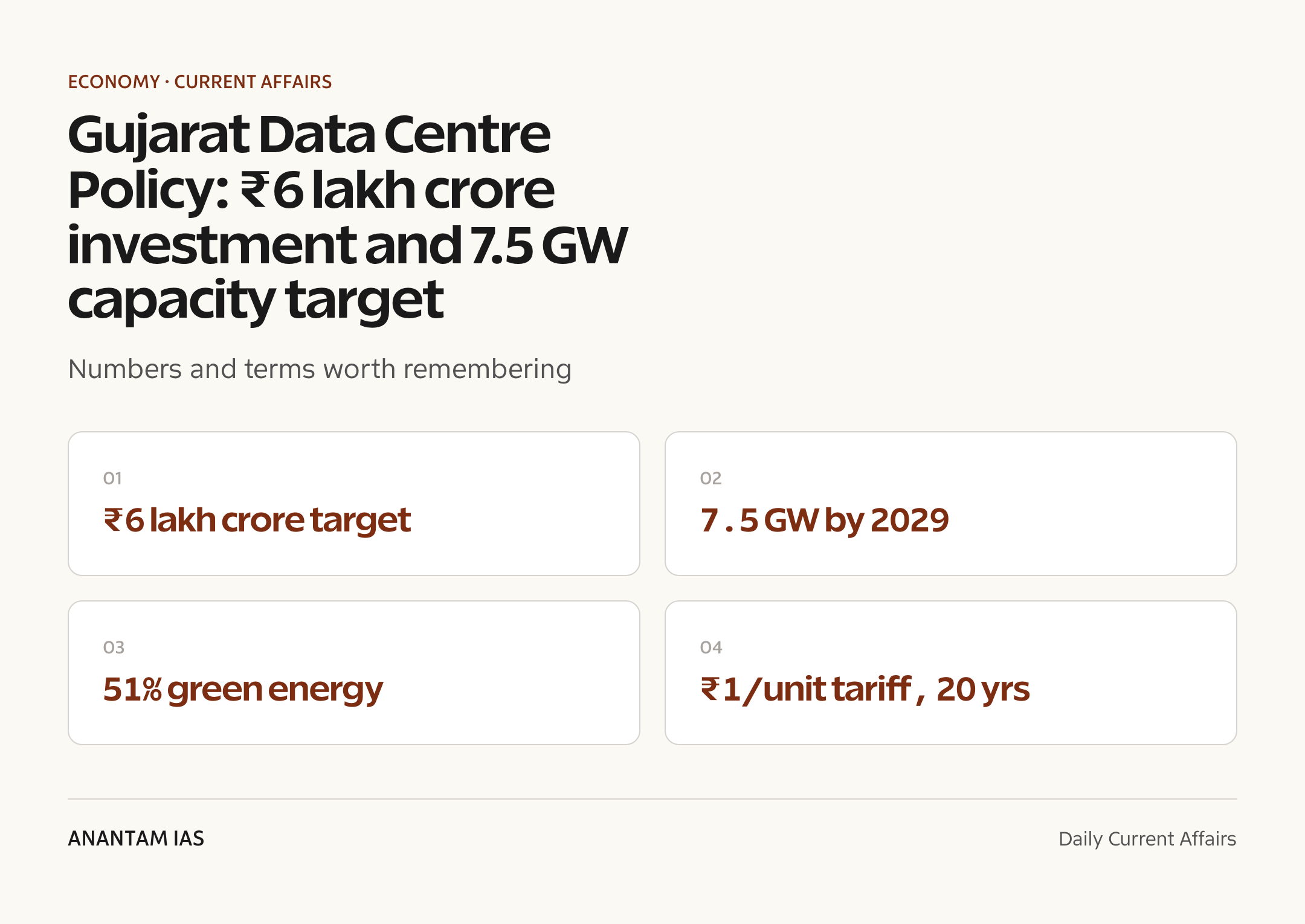
UPSC Relevance
Prelims Relevance
- Gujarat Data Centre Policy (2026-29) — targets ₹6 lakh crore investment, 7.5 GW capacity; launched July 2026.
- Green-energy mandate — minimum 51% of a data centre’s electricity from renewable sources.
- Power incentives — ₹1 per unit tariff subsidy for 20 years; 100% electricity-duty reimbursement for 20 years.
- Capital support — 2.5% capital subsidy on eligible fixed capital investment for projects in the Dholera region; interest subsidy up to 4% for 10 years (annual cap ₹25 crore).
- Water — assistance for captive desalination plants: 20% of capex or ₹2 crore per MLD; no draw-down on water meant for agriculture or industry.
- India’s data-centre base — about 200 data centres with 2-3 GW capacity; the US has ~5,500 and the UK 500+.
- Global picture — ~12,000 data centres worldwide; the US and China together hold nearly 70% of capacity.
- Infrastructure status — accorded to data centres above 5 MW IT load via the Harmonised Master List (2022).
- Cable landing stations — Gujarat will soon have two operational stations, boosting international connectivity for hyperscale operators.
- Dholera SIR — greenfield industrial city on the Delhi-Mumbai Industrial Corridor; upcoming airport and a proposed semi-high-speed rail link to Ahmedabad.
Mains Relevance
GS Paper 3
- Infrastructure — data centres as the physical backbone of the digital economy; role of fiscal incentives (capital/interest/tariff subsidies) in crowding in private investment.
- Energy — reconciling power-hungry AI compute with the 51% green-energy mandate; data centres as anchor demand for renewables.
- Investment climate — state incentive competition (Gujarat vs UP vs Telangana vs Maharashtra vs Tamil Nadu) and the risk of a subsidy race to the bottom.
- Water security — desalination-first sourcing as a template for siting water-intensive industry in water-stressed regions.
GS Paper 2
- Federalism — competitive federalism in industrial policy; Centre’s tax holiday plus state subsidies as layered (cooperative) incentives.
- Governance — data localisation and the DPDP Act 2023 as demand drivers for domestic storage; single-point nodal officers and hand-holding as ease-of-doing-business tools.
Essay
- Data is the new oil, but the refinery needs land, power and water — the material cost of the digital economy.
- Competitive federalism: when states compete for capital, who wins — the investor or the citizen?
Background and Context
What the Gujarat Data Centre Policy 2026-29 offers
The policy bundles fiscal and non-fiscal incentives designed for capital-heavy hyperscale projects.
- Capital subsidy of 2.5% on eligible fixed capital investment for projects in the Dholera region.
- Interest subsidy of up to 4% for 10 years, capped at ₹25 crore a year.
- Power support: ₹1 per unit tariff subsidy for 20 years and 100% reimbursement of electricity duty for 20 years.
- Complete exemption from stamp duty and registration charges, plus reimbursement of SGST on eligible plant, machinery, buildings, infrastructure and operational services for specified periods.
- Desalination assistance: 20% of eligible capital expenditure or ₹2 crore per MLD for captive desalination plants, subject to limits.
- Non-fiscal support: stakeholder consultations, identified land parcels, and senior nodal officers for hand-holding and faster approvals.
The sustainability conditions built into the policy
Gujarat has tied its incentives to green power and non-competing water use — unusual detail for a state industrial policy.
- At least 51% of electricity consumed by data centres must come from green energy sources.
- Water needs must be met through desalination plants rather than drawing on resources meant for agriculture or industry.
- Chief Secretary M.K. Das argued Gujarat’s long coastline and abundant renewable energy make it naturally suited to the sector’s high power and water demands.
- Data centres run 24×7 and cooling alone can consume a large share of their power — pairing them with renewable energy capacity is now standard practice in mature markets.
Why states are racing for data centres: the demand math
The investment case rests on a stark mismatch between the data India produces and the capacity it hosts.
- India generates nearly 20% of the world’s data but accounts for only about 3% of global data centre capacity, Science and Technology Secretary P. Bharati noted at the launch.
- Globally there are around 12,000 data centres; the United States and China together hold nearly 70% of world capacity.
- India has roughly 200 data centres with 2-3 GW capacity, against about 5,500 in the US and more than 500 in the UK.
- Demand drivers: AI training and inference, cloud computing, digital payments, e-commerce, electronics manufacturing and streaming — all data-intensive and growing.
- Regulatory pull adds to market pull: RBI’s 2018 payment-data localisation mandate and the compliance architecture of the DPDP Act 2023 favour storing and processing Indian data within India.
Dholera: the designated data centre city
The policy’s spatial bet is Dholera, the greenfield special investment region south of Ahmedabad.
- Deputy CM Harsh Sanghavi said demand in Dholera already exceeds twice the 7.5 GW envisaged under the policy, and called it a potential “world’s largest Data Center City”.
- The 2.5% capital subsidy is specifically tied to the Dholera region, steering hyperscale projects to the greenfield site.
- Supporting infrastructure: the upcoming Dholera airport and a proposed semi-high-speed rail link between Ahmedabad and Dholera.
- The state is also developing Dholera as a hub for Global Capability Centres (GCCs), pairing compute infrastructure with services employment.
- Connectivity: Gujarat will soon have two operational cable landing stations, with a third project expected — critical for hyperscale and cloud operators moving traffic internationally.
The central policy scaffolding beneath state schemes
Gujarat’s subsidies stack on top of an increasingly generous central regime for digital infrastructure.
- The Union Budget 2026 announced a 20-year tax holiday for global data centre infrastructure providers — CM Patel cited it as an accelerant for state-level investment.
- Data centres with IT load above 5 MW were granted infrastructure status in 2022 via the Harmonised Master List, easing access to long-tenor, cheaper credit.
- A draft National Data Centre Policy circulated by MeitY in 2020 was never notified; the Centre has instead used enabling measures — infrastructure status, the tax holiday, and the Digital India ecosystem.
- The IndiaAI Mission’s public GPU-compute procurement and the growth of AI in India assure baseline demand for domestic compute capacity.
Competitive federalism: how other states compare
Gujarat is a late but aggressive entrant into a field several states already occupy.
- Uttar Pradesh approved its Data Centre Policy 2026 on July 7 — two days before Gujarat — targeting ₹2 lakh crore investment and 50,000 jobs.
- Telangana, Maharashtra and Tamil Nadu are the established hubs Gujarat says it wants to compete with; Mumbai, Chennai and Hyderabad host most current capacity.
- Typical state offers elsewhere: Maharashtra’s electricity-duty exemption up to 15 years, Telangana’s 100% stamp-duty reimbursement and green-power bonuses, Tamil Nadu’s concessional tariffs and single-window clearance.
- Officials called Gujarat’s framework a first-of-its-kind state policy; in practice it’s Gujarat’s first dedicated data centre policy, entering a race where half a dozen states already run incentive schemes.
- The upside of the contest is faster infrastructure roll-out; the risk is a subsidy race where states outbid each other with foregone revenue for footloose capital.
Way Forward
Grid and green-power readiness
- Back the 51% green-energy mandate with firm supply — round-the-clock renewable contracts, storage, and transmission build-out — so compliance doesn’t fall back on fossil power.
- Plan grid capacity ahead of demand: 7.5 GW of data centre load is comparable to the peak demand of a mid-sized state.
Guard against incentive over-reach
- Publish transparent cost-benefit reviews of subsidies against jobs and GSDP outcomes — data centres are capital-intensive but employ relatively few people per rupee invested.
- Coordinate through a notified national framework so state competition complements, rather than cannibalises, the central tax holiday.
Water and local-economy safeguards
- Enforce the desalination-only water rule with metering and audits, given Gujarat’s semi-arid interior.
- Pair compute parks with skilling and GCC linkages so local employment extends beyond construction.
Conclusion
Gujarat’s Data Centre Policy 2026-29 is the clearest sign yet that digital infrastructure has become the new battleground of state industrial policy. The ₹6 lakh crore and 7.5 GW targets are ambitious against India’s current 2-3 GW base, but the proposal pipeline of 10 GW suggests genuine investor appetite in the AI build-out cycle.
For the exam, treat this as a layered story: a global demand-supply gap (20% of data, 3% of capacity), a central scaffolding (infrastructure status, 20-year tax holiday), and state-level competitive federalism with sustainability conditions attached. The green-energy and desalination mandates are the policy’s most examinable design features — and its hardest tests.
UPSC Practice Questions
Prelims MCQ 1
With reference to the Gujarat Data Centre Policy (2026-29), consider the following statements:
- It targets investments of ₹6 lakh crore and the creation of 7.5 GW of data centre capacity.
- It mandates that at least 51% of the electricity consumed by data centres must come from green energy sources.
- It is the first data centre policy announced by any Indian state.
How many of the above statements are correct?
(a) Only one (b) Only two (c) All three (d) None
Answer: (b) Only two
Explanation:
Statements 1 and 2 are correct — the policy targets ₹6 lakh crore and 7.5 GW, with a 51% green-energy mandate and desalination-based water sourcing. Statement 3 is incorrect: it is Gujarat’s first dedicated data centre policy, but states such as Telangana, Maharashtra, Tamil Nadu and Uttar Pradesh already have their own data centre policies.
Prelims MCQ 2
Which of the following best describes the ‘infrastructure status’ granted to data centres in India in 2022?
(a) All data centres were exempted from corporate income tax for 20 years (b) Data centres above 5 MW IT load were included in the Harmonised Master List, easing access to long-tenor institutional credit (c) Data centres were brought under the regulatory control of TRAI (d) State governments were barred from levying electricity duty on data centres
Answer: (b) Data centres above 5 MW IT load were included in the Harmonised Master List, easing access to long-tenor institutional credit
Explanation:
In 2022 the Centre included data centres with IT load above 5 MW in the Harmonised Master List of infrastructure sub-sectors. This improves access to cheaper, longer-tenor financing. The 20-year tax holiday is a separate Union Budget 2026 announcement, not part of infrastructure status.
UPSC Mains Questions
- Data centres are the physical backbone of the digital economy, but they are intensive consumers of land, power and water. In the light of Gujarat’s Data Centre Policy 2026-29, examine how states can attract digital infrastructure investment without compromising energy and water sustainability.
- Competition among Indian states to attract data centre investments reflects both the promise and the perils of competitive federalism. Discuss, with reference to recent state data centre policies and the Centre’s enabling measures for the sector.
Source: The Hindu.
Frequently Asked Questions
What is the Gujarat Data Centre Policy 2026-29?
It is Gujarat’s first dedicated policy for data centres, launched on July 9, 2026 by Chief Minister Bhupendra Patel. It targets ₹6 lakh crore of investment and 7.5 GW of data centre capacity over 2026-29 through capital, interest, power-tariff and SGST incentives plus stamp-duty exemption.
What are the key incentives under the policy?
A 2.5% capital subsidy for Dholera-region projects, interest subsidy up to 4% for 10 years (capped at ₹25 crore a year), ₹1 per unit power-tariff subsidy and 100% electricity-duty reimbursement for 20 years, SGST reimbursement, stamp-duty exemption, and desalination-plant assistance of 20% of capex or ₹2 crore per MLD.
What green conditions does the policy impose?
At least 51% of the electricity consumed by data centres must come from green energy sources, and water requirements must be met through captive desalination plants rather than supplies meant for agriculture or industry.
Why is Dholera central to the policy?
The capital subsidy is tied to the Dholera region, where investor demand already exceeds twice the policy’s 7.5 GW target. With an upcoming airport, a proposed semi-high-speed rail link to Ahmedabad and Global Capability Centre plans, the state projects Dholera as a future data centre city.
How big is India’s data centre gap?
India generates nearly 20% of the world’s data but hosts only about 3% of global data centre capacity — roughly 200 data centres totalling 2-3 GW, against about 5,500 in the United States. The US and China together hold nearly 70% of global capacity.
Is this India’s first state data centre policy?
No. It is Gujarat’s first dedicated data centre policy. States such as Telangana, Maharashtra, Tamil Nadu and Uttar Pradesh already operate data centre policies; UP approved its Data Centre Policy 2026 two days before Gujarat’s launch.
Source: https://anantamias.com/current-affairs/gujarat-data-centre-policy-first-state-framework/
ICMR Centre for High Altitude Medicine at Keylong: Himalayan health research hub
Why in News?
Union Health Minister J.P. Nadda will lay the foundation stone of the ICMR Centre for High Altitude Medicine and Public Health Research at Keylong in Lahaul & Spiti district, Himachal Pradesh, on 11 July 2026, PIB confirmed in a curtain-raiser issued by the Ministry of Health & Family Welfare.
It becomes ICMR’s first dedicated centre for high-altitude medicine, upgrading the council’s existing Keylong field station into a full-fledged multidisciplinary research hub for India’s Himalayan and climate-sensitive regions. ANI reported that the ceremony will draw the Defence Secretary and the Himachal Chief Secretary, underlining the centre’s civil-military spread.
The move matters because India has vast high-altitude populations — tribal residents, pilgrims, tourists and soldiers — yet has lacked a permanent, place-based biomedical institution studying the exact conditions they live and work in. The Keylong centre is meant to close that evidence gap and turn a remote border district into a hub of climate-resilient health science.
- Set up by the Indian Council of Medical Research (ICMR) under the Department of Health Research, Ministry of Health & Family Welfare.
- Sits in a strategically important border region with year-round access to high-altitude and tribal populations.
- Mandate spans high-altitude physiology, mountain medicine, climate-sensitive diseases, maternal-child health and disaster medicine.
- Will integrate telemedicine, drone-enabled healthcare logistics and real-time surveillance for hard-to-reach areas.
- Ceremony includes a Bhumi Pujan, saplings under the Green ICMR Campus Initiative, and a commemorative postal special cover.
The development matters in the context of:
- The Himalayan ecosystem presents distinct public-health stresses — thin air, extreme cold, difficult terrain and rising climate variability — that shape disease and emergency response.
- It advances the Government’s Atmanirbhar Bharat push in health research and its broader goal of climate-resilient, inclusive health systems.
UPSC Relevance
Prelims Relevance
- ICMR — apex biomedical research body, founded 1911 (as IRFA), under the Department of Health Research, Ministry of Health & Family Welfare.
- Keylong — administrative headquarters of Lahaul & Spiti district, Himachal Pradesh, connected to Manali via the Atal Tunnel (Rohtang).
- High-altitude illness — Acute Mountain Sickness (AMS), HAPE (pulmonary edema) and HACE (cerebral edema), driven by hypoxia.
- Acclimatisation — physiological adaptation to low oxygen at high altitude.
- Partner bodies: AFMS (Armed Forces Medical Services) and DRDO.
- Non-communicable diseases (NCDs) vs communicable/infectious diseases in the research mandate.
- Department of Health Research — created 2007; ICMR is its attached body.
- Green ICMR Campus Initiative and native Himalayan saplings.
Mains Relevance
GS Paper 3
- Application of science and technology and indigenous innovation — telemedicine and drone logistics for remote healthcare.
- Disaster management in fragile mountain ecosystems and emergency medical response.
GS Paper 2
- Health-sector governance and equitable access for tribal and border populations.
Essay
- Science at the service of the last mile — health equity in India’s mountains.
Background and Context
ICMR and where this centre sits
The apex biomedical body is extending its footprint into India’s toughest terrain.
- The Indian Council of Medical Research (ICMR) is India’s apex body for formulation, coordination and promotion of biomedical research, tracing its origins to 1911 (as the Indian Research Fund Association).
- It functions under the Department of Health Research (DHR), carved out in 2007 within the Ministry of Health & Family Welfare.
- ICMR runs a national network of ~26 institutes plus regional centres — spanning virology (NIV Pune), nutrition (NIN Hyderabad), vector-borne disease, cancer and reproductive health.
- The Keylong upgrade adds a high-altitude, mountain-focused node the network has so far lacked, complementing existing coastal, urban and plains research bases.
- It is pitched as a multidisciplinary hub for research, innovation and capacity building, not merely a diagnostic outpost.
Why high-altitude medicine matters
Life above roughly 2,500 m stresses the body in ways low-altitude medicine cannot fully address.
- As altitude rises, atmospheric pressure falls and so does the oxygen available to tissues — the state of hypoxia that underlies most mountain illness.
- Acute Mountain Sickness (AMS) — headache, nausea, fatigue on rapid ascent — is the mild, common form.
- HAPE (High-Altitude Pulmonary Edema) floods the lungs with fluid; HACE (High-Altitude Cerebral Edema) swells the brain — both can kill within hours without descent or oxygen.
- The body’s defence is acclimatisation — slower ascent, more red cells and breathing changes over days; the centre will study how residents and visitors adapt.
- Keylong lies above 3,000 m and nearby passes climb far higher, making it an ideal natural laboratory.
- Extreme cold, thin air, difficult terrain and long winter isolation compound every clinical and logistical problem.
The broad research mandate
The scope is deliberately wide to match the region’s layered health burden.
- High-altitude physiology, acclimatisation and mountain medicine.
- Climate-sensitive and emerging diseases whose range and timing shift as the Himalayas warm.
- Both infectious diseases and the rising tide of non-communicable diseases (NCDs).
- Maternal and child health, nutrition and mental health — often neglected in scattered mountain settlements.
- Environmental and occupational health plus disaster medicine for a zone prone to landslides, avalanches and flash floods.
- Its stable resident base enables long-term cohort studies on the environmental determinants of health that transient sites cannot run.
Himalayan health-infrastructure challenge
Geography, not just poverty, is the barrier to care in Lahaul & Spiti.
- Sparse, scattered populations make it uneconomic to place specialists in every valley, leaving a chronic referral gap.
- Heavy snowfall can cut villages off for months; the road window for supplies and evacuation is narrow.
- Peer-reviewed work on Lahaul & Spiti has flagged high-altitude-specific burdens — hypertension, respiratory disease and reproductive-health gaps in tribal cohorts.
- Emergency response — the golden hour — is hardest to honour exactly where terrain is most punishing.
- This is why the centre pairs research with delivery innovation rather than treating them as separate problems.
Technology and last-mile delivery
The centre is built to test, not just study, remote-care solutions.
- Telemedicine and digital health platforms let a district clinic tap distant specialists in real time, bridging the manpower shortfall.
- Drone-enabled healthcare logistics can move blood, vaccines and essential drugs across snow-blocked terrain far faster than road convoys.
- Indian feasibility studies — including drone-delivery trials in extreme Himalayan conditions — have already shown medical payloads can cross ridgelines that stop ambulances.
- Real-time public-health surveillance aims to catch outbreaks and climate-linked disease shifts early.
- It dovetails with national digital-health scaffolding such as the Ayushman Bharat Digital Mission and the government’s broader drones-in-healthcare push.
Institutional collaborations
The centre is designed as an ecosystem, not a standalone lab.
- Armed Forces Medical Services (AFMS) — decades of hard-won field data on soldiers deployed at extreme altitude.
- DRDO — whose high-altitude labs (DIHAR at Leh, DIPAS) already research acclimatisation, nutrition and cold-injury prevention.
- The Himachal Pradesh Government for local delivery, cohort access and integration with state health systems.
- Academic and research institutions in India and abroad for translational research and policy support.
- The mix makes the centre a genuine civil-military-academic platform rather than a single-ministry silo.
Strategic and climate-resilience dimension
Health research here doubles as security-relevant and climate-adaptation capacity.
- Lahaul & Spiti is a border region along the northern frontier, so troop readiness and civilian health overlap directly.
- The Atal Tunnel (opened 2020, bypassing Rohtang Pass) gives Keylong year-round road access, making a permanent institution viable where winter once ruled it out.
- As the Himalayas warm faster than the plains, climate-resilient healthcare — anticipating shifting disease patterns and disaster risk — becomes central, not peripheral.
- The effort supports national priorities in tribal health, disaster preparedness and digital health innovation.
- Officials frame it within the Atmanirbhar Bharat vision of self-reliant biomedical research.
Way Forward
Build durable local capacity
- Train and retain local health workers and researchers so the centre runs year-round, not as a summer-only field camp.
- Establish resident cohort registries and biobanks for continuous, high-quality altitude data across seasons.
- Involve tribal communities as partners in study design so research answers questions they actually face.
Scale what works
- Convert successful telemedicine and drone pilots into a replicable model for Ladakh, Sikkim and the Northeast.
- Feed evidence into national protocols for AMS/HAPE/HACE management, troop deployment and mountain-tourism safety.
- Link surveillance data to disaster-management agencies so health early-warning is built into mountain emergency planning.
Protect the ecosystem it studies
- Guard the fragile Himalayan environment — the campus must model low-impact, climate-resilient construction rather than add stress to the terrain.
- The Green ICMR Campus Initiative and native-sapling plantation should set the template, not be a one-day gesture.
Conclusion
The Keylong centre fills a real gap. India has vast high-altitude populations and armed forces stationed on the world’s toughest frontiers, but little dedicated, place-based biomedical research on the hypoxia, cold and isolation they endure.
By pairing frontier science — high-altitude physiology, disaster medicine, climate-sensitive disease — with delivery tools like telemedicine and drone logistics, the centre treats research and last-mile care as one problem.
If those components deliver, the model can be exported across the entire Himalayan arc, turning a remote border district into a national hub of climate-resilient health science and a template for equity in India’s mountains.
UPSC Practice Questions
Prelims MCQ 1
With reference to the proposed ICMR Centre for High Altitude Medicine and Public Health Research, consider the following statements:
- It is being set up under the Department of Health Research, Ministry of Health & Family Welfare.
- It is located at Keylong in the Lahaul & Spiti district of Himachal Pradesh.
- Its mandate is limited strictly to infectious diseases at high altitude.
How many of the above statements are correct?
(a) Only one (b) Only two (c) All three (d) None
Answer: (b) Only two
Explanation:
Statements 1 and 2 are correct. Statement 3 is wrong — the mandate is broad (physiology, NCDs, maternal-child health, mental health, disaster medicine), not just infectious diseases.
Prelims MCQ 2
‘HAPE’ and ‘HACE’, often discussed in the context of high-altitude health, are best described as:
(a) Two vaccines for cold-region infections (b) Pulmonary and cerebral edema caused by high-altitude hypoxia (c) Names of ICMR field stations in the Himalayas (d) Drone models used for medical delivery
Answer: (b) Pulmonary and cerebral edema caused by high-altitude hypoxia
Explanation:
HAPE is High-Altitude Pulmonary Edema and HACE is High-Altitude Cerebral Edema — severe, potentially fatal conditions driven by hypoxia (low oxygen) at altitude.
UPSC Mains Questions
- Dedicated high-altitude medical research and last-mile technologies like telemedicine and drone logistics can transform healthcare in India’s mountain regions. Discuss with reference to the proposed ICMR centre at Keylong. (150 words)
- Health research in border and tribal regions serves both public-health equity and national security. Examine in the context of India’s Himalayan ecosystem. (150 words)
Sources: PIB, Ministry of Health & Family Welfare and ANI.
Frequently Asked Questions
What is the ICMR Keylong centre?
It is the ICMR Centre for High Altitude Medicine and Public Health Research, being set up at Keylong in Lahaul & Spiti, Himachal Pradesh. It upgrades ICMR’s existing field station into a full multidisciplinary hub for research on high-altitude and climate-sensitive health. The foundation stone is to be laid on 11 July 2026.
Who is establishing the centre and under which ministry?
The Indian Council of Medical Research (ICMR) is setting it up under the Department of Health Research, which sits within the Union Ministry of Health & Family Welfare. It is India’s first dedicated centre focused on high-altitude medicine and public-health research.
Why is Keylong chosen for this centre?
Keylong, in Lahaul & Spiti, offers year-round access to high-altitude and tribal populations in a strategically important border region. The Atal Tunnel provides all-weather road connectivity, making a permanent research institution feasible where winter isolation once ruled it out.
What is high-altitude illness?
It refers to disorders caused by low oxygen (hypoxia) at high altitude, ranging from Acute Mountain Sickness to the life-threatening HAPE (pulmonary edema) and HACE (cerebral edema). The centre will research acclimatisation and treatment to protect residents, soldiers and tourists.
How will the centre use technology?
It will integrate telemedicine, digital health platforms, drone-enabled healthcare logistics for supplies, and real-time public-health surveillance. These tools aim to deliver specialist care and essential medicines to remote, snow-bound Himalayan areas that are hard to reach by road.
Which agencies will collaborate with the centre?
It will build partnerships with the Armed Forces Medical Services (AFMS), the Defence Research and Development Organisation (DRDO), the Himachal Pradesh Government, and academic and research institutions in India and abroad, creating an ecosystem for translational research and policy support.
Source: https://anantamias.com/current-affairs/icmr-high-altitude-medicine-centre-keylong/
NATO summit outcomes: ‘ironclad’ Article 5 pledge and €70 billion Ukraine aid
Why in News?
The 32-member North Atlantic Treaty Organization (NATO) concluded its annual summit in Ankara, Türkiye, on July 8, 2026, with a declaration reaffirming the allies’ “ironclad commitment” to collective defence under Article 5 of the Washington Treaty — “an attack on one is an attack on all”.
The Ankara Summit Declaration pledged €70 billion (about $80 billion) in military equipment, assistance and training for Ukraine in 2026, with at least equivalent levels affirmed for 2027, and announced more than $50 billion in new defence procurements. Russia denounced the outcome, warning of “catastrophic consequences”.
- Summit held on July 7–8, 2026 in Ankara under Secretary-General Mark Rutte, with all 32 heads of state and government attending.
- The declaration reaffirmed Article 5 in explicit language to calm doubts about the US commitment, after President Donald Trump publicly criticised allies over Greenland and their refusal to back his Iran campaign.
- The Hindu reported that behind closed doors Trump reassured leaders — “We want to remain with you” — and pledged to license Ukraine to manufacture Patriot air-defence missiles.
- European allies and Canada, who now finance the vast majority of security assistance to Ukraine, raised core defence investment by over $139 billion in 2025 under the Hague defence commitment (5% of GDP by 2035).
- Russian Foreign Ministry spokesperson Maria Zakharova called the decisions “irresponsible”, accusing NATO of the “militarisation of the European continent”.
The development matters in the context of:
- The summit tests whether the transatlantic alliance, now 77 years old, can hold together as Washington pushes Europe to shoulder its own defence burden.
- For India, the outcome shapes the European security architecture within which it balances ties with the US, Europe and Russia — a live test of strategic autonomy.
- A Europe that arms itself at 5% of GDP changes global defence-industrial supply chains, energy politics and the wider Russia-Ukraine war trajectory that affects Indian trade and diaspora interests.
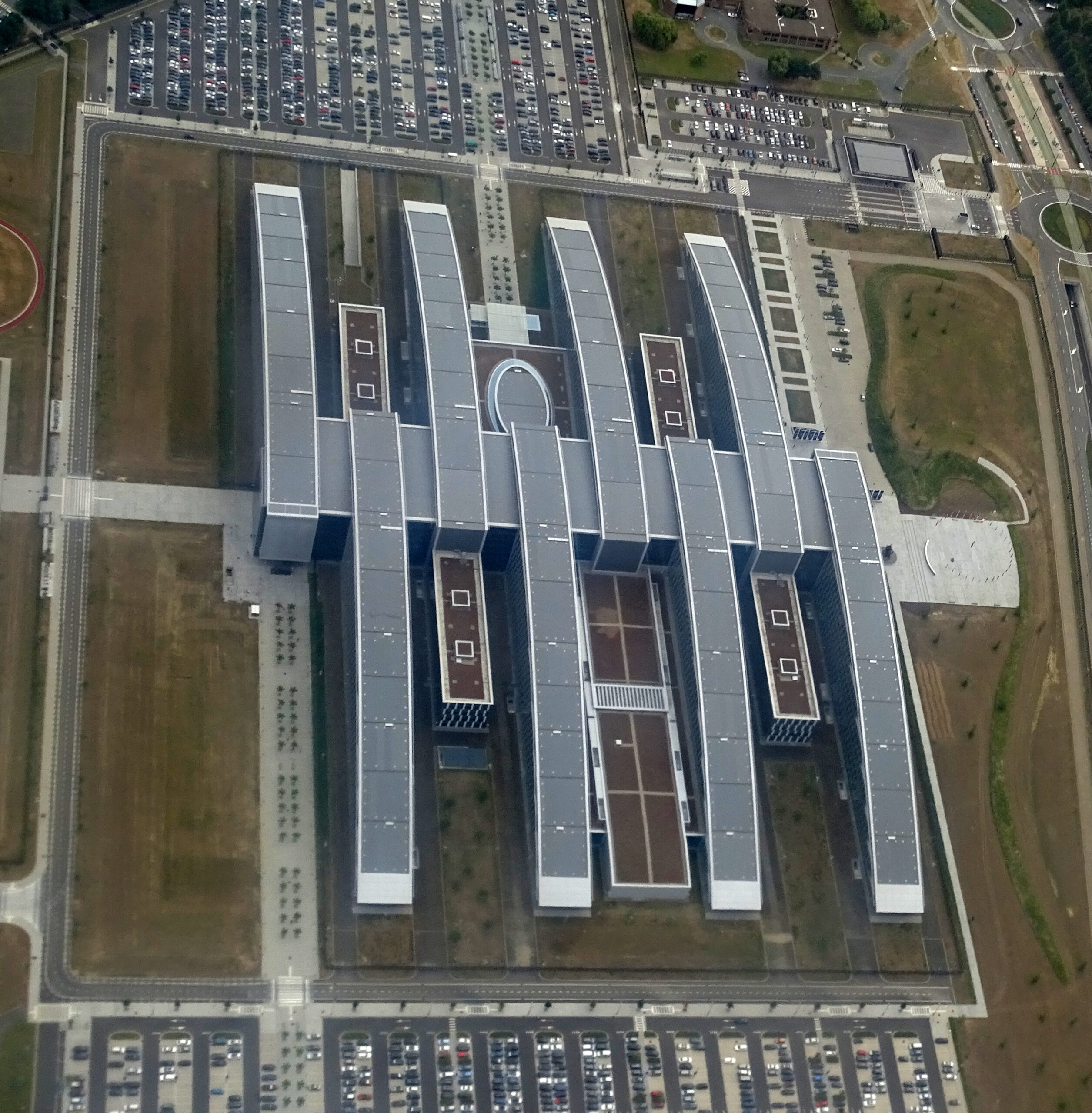
UPSC Relevance
Prelims Relevance
- NATO: founded April 4, 1949 by the Washington Treaty (North Atlantic Treaty); headquarters at Brussels, Belgium; currently 32 members.
- Article 5 — collective defence clause: an armed attack on one member is treated as an attack on all; invoked only once, by the US after the 9/11 attacks (2001).
- Article 4 provides for consultations when any member’s territorial integrity, political independence or security is threatened.
- Newest members: Finland (2023, 31st) and Sweden (2024, 32nd) — both abandoned decades of neutrality after Russia’s 2022 invasion of Ukraine.
- Hague Summit 2025 commitment: defence spending of 5% of GDP by 2035 (3.5% core defence + 1.5% defence-related resilience spending).
- Ankara Summit Declaration 2026: €70 billion Ukraine military aid for 2026; $50 billion+ new procurements; “360-degree” deterrence posture.
- NATO-Ukraine Council — created at the Vilnius Summit 2023; Ukraine is a partner, NOT a member of NATO.
- Secretary-General: Mark Rutte (former Dutch PM, took office October 2024); India is NOT a NATO member or formal partner.
Mains Relevance
GS Paper 2
- Groupings and agreements involving and/or affecting India’s interests — NATO’s burden-shift to Europe and what a militarised Europe means for India’s multi-alignment.
- Effect of the policies of developed countries on India’s interests — US transactional diplomacy (Greenland, trade threats to Spain) and the reliability of alliance guarantees vs India’s strategic autonomy.
- Bilateral and global groupings: contrast NATO’s collective defence (Article 5) with India’s issue-based coalitions (Quad, BRICS, SCO) that carry no mutual-defence obligation.
GS Paper 3
- Security implications: NATO’s push into deep precision strike, integrated air and missile defence, uncrewed systems and an AI-enabled “warfighting cloud” — signals for India’s own defence modernisation.
- Defence economics: the 5% of GDP benchmark vs India’s roughly 2% — trade-offs between guns, growth and welfare.
Essay
- Alliances promise security but can outsource sovereignty — the price of collective defence.
- Strategic autonomy in a world re-dividing into blocs: is non-alignment a luxury or a necessity?
- War in one theatre, insecurity in all: the indivisibility of security in a connected world.
Background and Context
NATO in brief: the world's largest military alliance
Anchor the news to the institution — NATO’s design explains why every word of the Ankara declaration was scrutinised.
- NATO was created on April 4, 1949 by 12 founding states through the Washington Treaty, as a collective-defence bulwark against the Soviet Union; its headquarters is in Brussels, Belgium.
- Article 5 is the alliance’s core: an armed attack against one member in Europe or North America “shall be considered an attack against them all”. It has been invoked only once — after the September 11, 2001 attacks on the US.
- Membership has grown from 12 to 32 states; Finland (2023) and Sweden (2024) joined after Russia’s full-scale invasion of Ukraine — the very expansion Moscow said it fought to prevent.
- The alliance describes itself as protecting about one billion citizens and follows a “360-degree” approach — deterring threats from state actors (chiefly Russia) and terrorism across land, sea, air, cyber and space.
- Decisions are taken by consensus in the North Atlantic Council, which is why a single sceptical leader — as Trump’s conduct showed — can dominate an entire summit.
What the Ankara Summit Declaration says
The July 8 declaration packs four headline commitments into a deliberately short text.
- Article 5 reaffirmed: an “ironclad commitment” to collective defence and the transatlantic bond — wording chosen to end speculation that Washington might dilute its security guarantee.
- Ukraine aid: allies pledged €70 billion in military equipment, assistance and training for Ukraine in 2026, and affirmed “at least equivalent levels” for 2027; the EU’s multi-year Ukraine Support Loan was welcomed.
- Defence industry: more than $50 billion in new procurements announced at Ankara, plus commitments to expand collective manufacturing capacity and cut defence-trade barriers among allies.
- Capability priorities: deep precision strike, integrated air and missile defence, uncrewed systems, an interoperable transatlantic “warfighting cloud” and adoption of powerful AI models.
- On West Asia, the declaration said Iran must never acquire a nuclear weapon and must respect freedom of navigation in the Strait of Hormuz.
The burden shift: Europe pays, America watches
The deeper story of Ankara is a structural rebalancing of who funds European security.
- European allies and Canada now finance the vast majority of security assistance to Ukraine — a reversal from 2022–24, when the US was the largest single donor.
- Under the Hague Summit 2025 commitment, members will raise defence spending to 5% of GDP by 2035 — split as 3.5% on core defence and 1.5% on defence-related resilience and infrastructure.
- Delivering on that pledge, European allies and Canada increased core defence investment by more than $139 billion in 2025 alone, and unveiled tens of billions in fresh arms contracts on the summit’s opening day.
- The Hindu reported Trump’s sideline pledge to give Ukraine a licence to manufacture Patriot missiles — shifting even high-end air-defence production towards the recipient, as Kyiv struggles against Russian ballistic-missile barrages.
- For comparison, India spends roughly 2% of GDP on defence; the NATO benchmark illustrates how sharply threat perception can reorder national budgets.
The Trump factor: friction inside the family
The summit swung between public antagonism and private reassurance within hours.
- Before the session, Trump attacked allies for refusing to back his military campaign against Iran, threatened to cut trade with Spain, and repeated his demand for Greenland, an autonomous territory of NATO member Denmark.
- Behind closed doors, The Hindu reported, he told the 32 leaders “We want to remain with you” and later declared there was “a lot of love in that room, a lot of unity”.
- Estonian PM Kristen Michal read the message as constructive — Europe must “step up, invest more in defence”; Lithuania’s foreign minister cautioned against reading the outbursts as alliance decay.
- Secretary-General Mark Rutte argued the open disputes displayed the alliance’s democratic strength — pointedly contrasting it with decision-making in Moscow.
- The episode underlines a durable exam theme: alliance guarantees are only as stable as the domestic politics of the guarantor.
Russia's response and the escalation question
Moscow framed the summit as proof that NATO is preparing for war with Russia.
- Foreign Ministry spokesperson Maria Zakharova said the decisions could bring “catastrophic consequences”, accusing NATO of “militarisation of the European continent” and preparation for armed conflict with Russia.
- She highlighted “cracks” between the US and its partners — over Greenland and the allies’ refusal to back the US on Iran — arguing the transatlantic rift persists beneath the summit unity.
- On the battlefield, Ukraine has stabilised the front line and is striking deep into Russia; Trump called the strikes “an escalation that can help lead to an end”, claiming both Zelenskyy and Putin want a deal.
- Ukraine remains outside NATO — it engages through the NATO-Ukraine Council (created at Vilnius, 2023) — so aid flows as national and EU commitments, not Article 5 protection.
Why it matters for India
India is not a NATO member, but the alliance’s trajectory directly touches Indian interests.
- Strategic autonomy: India buys arms from Russia, the US, France and Israel while joining no military bloc; a hardening Europe-Russia divide narrows the space for such multi-alignment.
- Defence supply chains: European rearmament at 5% of GDP will crowd global order books for ammunition, air defence and drones — affecting prices and delivery timelines for Indian procurement and openings for Indian defence exports.
- Russia dependence: the longer the war and sanctions persist, the greater the pressure on India’s discounted Russian crude imports and rupee-rouble payment channels.
- Precedent debates: NATO’s Indo-Pacific outreach (partnerships with Japan, South Korea, Australia, New Zealand) raises the recurring question of whether Asian security should be alliance-based; India has consistently preferred issue-based coalitions like the Quad.
- India-NATO contact has been limited to occasional political dialogue (first held in Brussels in 2019) — New Delhi keeps engagement deliberately low-key to preserve ties with Moscow.
Way Forward
For the alliance
- Convert the €70 billion pledge into predictable multi-year disbursal — the declaration itself demands aid that is “equitable, predictable, and sustainable”.
- Pair rearmament with a credible diplomatic track on Ukraine so that deterrence doesn’t foreclose a negotiated settlement.
- Manage intra-alliance disputes — Greenland, trade threats, Iran policy — through NATO’s consultation mechanisms (Article 4) rather than public ultimatums.
For India
- Track the European rearmament market as an opportunity for defence exports (ammunition, components, shipbuilding) under Make in India.
- Deepen diversification of military sourcing and energy supplies so that any Russia-West escalation doesn’t leave critical dependencies exposed.
- Keep advocating dialogue and diplomacy — the consistent Indian line that “this is not an era of war” — while avoiding entanglement in bloc politics.
Conclusion
The Ankara summit delivered what NATO needed most: an unambiguous restatement of Article 5 and hard money — €70 billion for Ukraine, $50 billion in new procurements — to back it. But the theatrics around it showed an alliance whose biggest member now treats commitment as leverage, and whose European members are rearming partly as insurance against their own ally.
For UPSC, the summit is a live case study in collective defence, burden-sharing and the remaking of the European security order — and a foil for India’s own doctrine of strategic autonomy. Revise it alongside the broader Russia-Ukraine timeline in our monthly current affairs compilations and the daily digests at Anantam IAS current affairs.
UPSC Practice Questions
Prelims MCQ 1
With reference to the NATO Ankara Summit (2026), consider the following statements:
- The summit declaration reaffirmed the collective-defence commitment under Article 5 of the Washington Treaty.
- NATO allies pledged €70 billion in military equipment, assistance and training for Ukraine for 2026.
- Ukraine was admitted as the 33rd member of NATO at the summit.
How many of the above statements are correct?
(a) Only one (b) Only two (c) All three (d) None
Answer: (b) Only two
Explanation:
Statements 1 and 2 are correct — the Ankara Summit Declaration reaffirmed the “ironclad commitment” to Article 5 and pledged €70 billion for Ukraine in 2026. Statement 3 is wrong: Ukraine remains a partner engaging through the NATO-Ukraine Council, not a member; NATO still has 32 members.
Prelims MCQ 2
Which of the following countries is the most recent state to join NATO?
(a) Finland (b) Sweden (c) North Macedonia (d) Montenegro
Answer: (b) Sweden
Explanation:
Sweden became NATO’s 32nd and newest member in 2024, a year after Finland (31st, 2023). Both ended long-standing military non-alignment after Russia’s 2022 invasion of Ukraine. North Macedonia joined in 2020 and Montenegro in 2017.
UPSC Mains Questions
- The 2026 NATO summit signals a structural shift of Europe’s defence burden from Washington to European capitals. Examine the implications of this rebalancing for the European security architecture and for India’s policy of strategic autonomy. (250 words)
- “Collective defence alliances provide security guarantees that issue-based coalitions cannot, but at the cost of strategic flexibility.” Discuss in the context of NATO’s response to the Russia-Ukraine war and India’s preference for multi-alignment. (250 words)
- European NATO members have committed to spending 5% of GDP on defence by 2035. Critically analyse what such large-scale rearmament means for global defence-industrial supply chains and for India’s defence procurement and export ambitions. (150 words)
Sources: NATO, Ankara Summit Declaration and The Hindu.
Frequently Asked Questions
What did the NATO Ankara Summit 2026 decide?
The July 8, 2026 declaration reaffirmed the “ironclad” Article 5 collective-defence commitment, pledged €70 billion in military aid to Ukraine for 2026 (with equivalent levels affirmed for 2027), announced over $50 billion in new defence procurements, and recommitted members to the Hague target of 5% of GDP on defence by 2035.
What is Article 5 of the NATO treaty?
Article 5 of the 1949 Washington Treaty is NATO’s collective-defence clause: an armed attack against one member in Europe or North America is treated as an attack against all, allowing each ally to respond, including with armed force. It has been invoked only once — after the 9/11 attacks in 2001.
Is Ukraine a member of NATO?
No. Ukraine is a partner, not a member. It engages the alliance through the NATO-Ukraine Council created at the 2023 Vilnius Summit. Aid to Kyiv flows as national and EU commitments — such as the €70 billion pledged for 2026 — not as an Article 5 guarantee.
How many members does NATO have now?
NATO has 32 members. Finland joined in 2023 as the 31st and Sweden in 2024 as the 32nd, both abandoning decades of military non-alignment after Russia’s full-scale invasion of Ukraine in February 2022. The alliance began with 12 founding states in 1949.
Why did Russia denounce the summit?
Russian Foreign Ministry spokesperson Maria Zakharova said the decisions could have “catastrophic consequences”, accusing NATO of militarising Europe and preparing for armed conflict with Russia. Moscow views continued Ukraine aid and NATO’s eastward expansion as direct threats to its security.
Is India a member or partner of NATO?
Neither. India has no formal relationship with NATO beyond occasional political dialogue, the first held in Brussels in 2019. India follows strategic autonomy — buying arms and building partnerships across blocs (US, Russia, France, Israel) without joining any military alliance or accepting mutual-defence obligations.
Source: https://anantamias.com/current-affairs/nato-summit-2026-ukraine-aid-collective-defence/
US removes Syria from state-sponsors-of-terrorism list: what remains of the blacklist
Why in News?
The United States announced on July 8, 2026 that it will remove Syria from its State Sponsors of Terrorism (SST) list, ending a designation in place since 1979. Secretary of State Marco Rubio notified the US Congress, and the delisting takes effect in 45 days unless lawmakers block it, The Hindu reported.
The move came as President Donald Trump met Syrian President Ahmed al-Sharaa on the sidelines of a NATO summit in Ankara, Turkey. With Syria out, only Iran, North Korea and Cuba remain on the US terror blacklist.
- Rubio said the delisting followed “formal assurances” from Sharaa that Syria will not support acts of international terrorism in future.
- Syria had carried the SST tag since December 1979 — the longest continuous designation ever removed from the list.
- The step completes a sanctions unwind that began after the December 2024 fall of the Assad family, which had ruled Syria for over five decades.
- The US Congress had already repealed the Caesar Act secondary sanctions through the NDAA for FY2026, signed in December 2025.
- Washington went ahead despite reservations from Israel, which has repeatedly struck targets inside Syria, and without a Syria-Israel peace deal.
The development matters in the context of:
- The SST designation is the harshest unilateral US sanctions instrument — it blocks arms sales, dual-use exports, US foreign assistance and exposes the state to terrorism lawsuits in US courts, so its removal is the real gateway for investment into Syria’s reconstruction.
- For India, a stabilising, sanctions-free Syria reopens frozen stakes — the Tishreen power project line of credit and ONGC Videsh oil investments — and tests India’s strategic autonomy in a realigning West Asia.
UPSC Relevance
Prelims Relevance
- State Sponsors of Terrorism (SST) — a US State Department designation for countries judged to have “repeatedly provided support for acts of international terrorism”; it is a unilateral US instrument, not a UN list.
- Post-delisting, the SST list has three members: Iran (1984), North Korea (relisted 2017) and Cuba (relisted 2021).
- Syria was one of the original designees on the first SST list of December 1979.
- Delisting procedure: the President/Secretary of State notifies Congress; removal takes effect after 45 days unless Congress blocks it, with certification that the state has not supported terrorism for the preceding six months plus assurances for the future.
- Caesar Syria Civilian Protection Act, 2019 — US law imposing secondary sanctions on dealings with the Assad government; repealed by Section 6211 of the NDAA FY2026 (December 2025).
- Ahmed al-Sharaa — Syria’s leader after the December 2024 ouster of Bashar al-Assad; earlier led the group Hayat Tahrir al-Sham.
- The UN’s separate framework is the UNSC 1267 sanctions regime (ISIL/Al-Qaida list), which targets entities and individuals, not states.
- India-Syria economic footprint: USD 240 million line of credit for the Tishreen thermal power plant extension and ONGC Videsh stakes in Block-24 and Al Furat Petroleum (suspended since 2012).
- Past SST removals: Iraq (2004), Libya (2006), Sudan (December 2020) after the Abraham Accords-linked deal.
Mains Relevance
GS Paper 2
- Unilateral sanctions as instruments of foreign policy — how the SST designation differs from UN sanctions, and what its use and reversal say about US statecraft.
- West Asia realignment: US-Syria normalisation, the Abraham Accords track, Israel’s reservations and Turkey’s role as venue and backer.
- India’s West Asia policy and strategic autonomy — balancing Israel, Iran, the Gulf and now a post-Assad Syria; scope for reviving development partnership and energy assets.
- Effect of great-power certification politics on international law — a state’s ‘terror sponsor’ status turning on bilateral bargains rather than multilateral process.
GS Paper 3
- Terror financing and state support to non-state actors — why state sponsorship is harder to police than organisational listing under FATF and UNSC regimes.
- Sanctions and the world economy: how secondary sanctions like the Caesar Act chill third-country trade, and what their repeal means for reconstruction finance.
Essay
- Sanctions rarely change regimes; regimes change sanctions — coercion and reconciliation in world politics.
- In diplomacy there are no permanent blacklists, only permanent interests.
Background and Context
What the State Sponsors of Terrorism designation is
The SST tag is the most consequential unilateral sanctions label in US law, resting on three statutes.
- The Secretary of State designates a country under Section 1754(c) of the Export Control Reform Act, 2018, Section 40 of the Arms Export Control Act and Section 620A of the Foreign Assistance Act, 1961 if it has “repeatedly provided support for acts of international terrorism”.
- Four broad penalty baskets follow: a ban on arms exports and sales; strict controls on dual-use exports; prohibition of most US economic assistance; and miscellaneous financial restrictions, including US opposition to World Bank/IMF lending.
- A designated state loses part of its sovereign immunity: under the terrorism exception to the Foreign Sovereign Immunities Act, victims can sue it for damages in US courts.
- The tag also creates legal risk for third parties — businesses dealing with a listed state face exposure inside the US, which is why Trump’s earlier sanctions relief for Syria had only a muted effect while the SST label survived.
- It is a bilateral, political instrument — distinct from the UN’s 1267 ISIL/Al-Qaida sanctions list, which targets individuals and entities through the Security Council.
Why Syria sat on the list for 47 years
Syria was on the very first SST list and stayed there through both Assads.
- Washington listed Syria in December 1979, alongside Libya, Iraq and South Yemen, at the creation of the list.
- Under Hafez al-Assad and later Bashar al-Assad, Damascus hosted Palestinian militant groups and was alleged to be directly involved in incidents such as the 1986 attempted bombing of an El Al airliner in London.
- In recent decades the designation rested mainly on Syria’s alliance with Iran and its supply corridor to Hezbollah, the Lebanese Shia militant movement.
- The Syrian civil war after 2011 added layered sanctions on top of the SST tag, contributed to the rise of the Islamic State and produced one of the world’s largest refugee crises.
How a state exits the blacklist
Delisting is an executive act with a congressional check — and it has a fixed clock.
- The administration must send Congress a report 45 days before rescission, certifying the government concerned has not supported international terrorism in the preceding six months and has given assurances for the future.
- Rubio notified Congress on July 8, 2026; the removal becomes effective automatically unless lawmakers pass a blocking measure — considered unlikely.
- The certification leans on Sharaa’s formal assurances against supporting terrorism, plus his government’s cooperation against the Islamic State.
- Precedents: Iraq (removed 1982, relisted 1990, removed 2004), Libya (2006), South Yemen (1990, on unification) and Sudan (December 2020, tied to its normalisation with Israel).
Who remains: Iran, North Korea, Cuba
The blacklist is now a trio, and each entry carries its own politics.
- Iran — designated in January 1984; the longest-standing current member, cited for backing Hezbollah and regional proxy groups.
- North Korea — first listed in 1988, removed in 2008 during nuclear diplomacy, and relisted in November 2017.
- Cuba — removed in 2015 during the Obama-era thaw, then relisted in January 2021 in the closing days of the first Trump administration, a move The Hindu notes was controversial and pressure-driven.
- The churn shows the list works as a diplomatic lever: states move on and off with the state of bilateral bargaining as much as with verified conduct.
The Sharaa turn and the sanctions unwind
Delisting is the final layer of a rapid, staged dismantling of the Syria sanctions wall.
- The Assad dynasty fell in December 2024; Ahmed al-Sharaa, a former jihadist commander who has recast himself as a unifying civilian leader, took charge and swapped fatigues for a suit.
- Through 2025 Washington eased pressure in steps — general licences, a Caesar Act suspension and an executive order lifting the broad sanctions architecture.
- Congress then repealed the Caesar Act outright via Section 6211 of the NDAA for FY2026, signed in December 2025, while requiring the President to certify every 180 days for four years that Damascus acts against the Islamic State, protects minorities and implements its accord with the Syrian Democratic Forces.
- Trump pressed Syria to make peace with Israel but proceeded with delisting despite no tangible progress — Israel, which continues airstrikes in Syria, remains wary.
- Rubio framed the goal as unlocking trade, investment and reconstruction for a war-shattered economy; Turkey hosting the Trump-Sharaa meeting underlines Ankara’s stake in the new Syria.
What it means for India
India kept its embassy in Damascus through the war, and a legally investable Syria revives real Indian stakes.
- India extended a USD 240 million line of credit in 2009 for the Tishreen thermal power plant extension (2×200 MW); the project stalled during the war and its revival becomes bankable once sanctions risk fades.
- ONGC Videsh holds exploration Block-24 (since 2004) and a 37% stake with China’s CNPC in Al Furat Petroleum — operations suspended since 2012 could be reassessed.
- Syria has consistently backed India’s position on Kashmir, one of the few Arab states to do so publicly; New Delhi opened working-level contact with the Sharaa government, including an MEA Joint Secretary visit in July 2025.
- Reconstruction — estimated in the hundreds of billions of dollars — opens space for Indian pharma, IT, power and rail firms, and for capacity-building through ITEC scholarships that Syria has long used.
- Strategically, US-Syria normalisation reshapes the region India navigates through its West Asia policy — where ties with Iran, the Gulf and Israel must be balanced without picking camps.
Way Forward
For the region and the sanctions regime
- Anchor delisting in verifiable conduct — the NDAA’s 180-day certification cycle on counter-ISIS action, minority protection and the SDF accord should be reported transparently, not waived politically.
- Sequence reconstruction finance through multilateral channels (World Bank, Arab funds) so relief reaches Syrians rather than entrenching a new patronage network.
- Keep the Hezbollah-Iran corridor question separate from economic normalisation: relapse on either should trigger calibrated snap-backs, not another decade-long blanket freeze.
For India
- Re-validate the Tishreen LoC and OVL assets through early technical missions, before competitors lock up reconstruction contracts.
- Upgrade political contact incrementally — ministerial-level engagement tied to the new government’s conduct on minorities and counter-terrorism, consistent with India’s own zero-tolerance line on cross-border terrorism.
- Use humanitarian aid, ITEC training and pharma supply as low-risk entry points while the security situation settles.
Conclusion
Syria’s exit from the US terror blacklist after 47 years is less a verdict on terrorism than a wager on Ahmed al-Sharaa — that engagement, trade and reconstruction will consolidate a stable Syria better than isolation did. The shrunken list of three, each entry shaped by bilateral politics, shows how elastic the ‘state sponsor’ label has always been.
For India, the lesson is practical. A normalised Syria unfreezes decades-old development and energy stakes and adds one more moving piece to a West Asia already reshaped by the Abraham Accords, the Iran question and connectivity corridors. Quiet, interest-driven re-engagement — not haste, not absence — is the play.
UPSC Practice Questions
Prelims MCQ 1
With reference to the United States’ State Sponsors of Terrorism (SST) designation, consider the following statements:
- It is a sanctions list maintained under a resolution of the United Nations Security Council.
- After the removal of Syria in 2026, Iran, North Korea and Cuba remain the only designated states.
- A designation results in a ban on US arms exports and restrictions on US economic assistance to the listed state.
How many of the above statements are correct?
(a) Only one (b) Only two (c) All three (d) None
Answer: (b) Only two
Explanation:
Statement 1 is incorrect — the SST list is a unilateral US State Department designation under US domestic law (Export Control Reform Act, Arms Export Control Act, Foreign Assistance Act), not a UN list. Statements 2 and 3 are correct: post-Syria, only Iran, North Korea and Cuba remain, and designation triggers an arms-export ban, dual-use export controls and aid restrictions.
Prelims MCQ 2
The ‘Caesar Act’, sometimes seen in the news, is best described as:
(a) A UN Security Council resolution authorising humanitarian corridors in Syria (b) A US law that imposed secondary sanctions on entities dealing with the Syrian government, repealed in 2025 (c) An EU regulation freezing the assets of the Assad family (d) A NATO framework for maritime interdiction in the eastern Mediterranean
Answer: (b) A US law that imposed secondary sanctions on entities dealing with the Syrian government, repealed in 2025
Explanation:
The Caesar Syria Civilian Protection Act, 2019 imposed secondary sanctions on third-country dealings with the Assad government. It was repealed by Section 6211 of the US NDAA for FY2026, signed in December 2025, as part of the post-Assad sanctions unwind.
UPSC Mains Questions
- Unilateral sanctions lists reflect the politics of the designating power more than the conduct of the designated state. Critically examine this statement with reference to the United States’ removal of Syria from its State Sponsors of Terrorism list in 2026. (250 words)
- The fall of the Assad government and Syria’s re-entry into the global economy present both opportunities and risks for India’s West Asia policy. Discuss the economic stakes and the diplomatic balancing this demands of New Delhi. (250 words)
- Differentiate between state sponsorship of terrorism and support to terrorism by non-state actors. Why is the former harder to deter through multilateral instruments like the UNSC 1267 regime and FATF? (150 words)
Source: The Hindu.
Frequently Asked Questions
What did the US announce about Syria?
On July 8, 2026, the US said it will remove Syria from its State Sponsors of Terrorism list. Secretary of State Marco Rubio notified Congress, and the delisting takes effect in 45 days unless Congress blocks it — ending a designation in place since 1979.
Which countries remain on the US terror blacklist?
Only three: Iran (designated 1984), North Korea (relisted 2017) and Cuba (relisted 2021). Syria’s exit makes the list the shortest it has been since its creation in 1979, when Syria, Libya, Iraq and South Yemen were the original designees.
What penalties does the SST designation carry?
A ban on US arms sales, strict controls on dual-use exports, prohibition of most US economic assistance, opposition to multilateral lending, and loss of sovereign immunity — victims of terrorism can sue the designated state in US courts. Third parties dealing with it also face legal risk.
Why was Syria delisted now?
The Assad government fell in December 2024, and new leader Ahmed al-Sharaa gave formal assurances that Syria will not support international terrorism. Washington wants to unlock trade, investment and reconstruction to stabilise the Sharaa government, capping a sanctions unwind that included the Caesar Act repeal.
What is the Caesar Act and where does it stand?
The Caesar Syria Civilian Protection Act, 2019 imposed US secondary sanctions on anyone dealing with the Assad government. Congress repealed it through Section 6211 of the NDAA for FY2026 in December 2025, replacing blanket sanctions with 180-day presidential certifications on Syria’s conduct.
How does this affect India?
It revives frozen Indian stakes — the USD 240 million Tishreen power plant line of credit and ONGC Videsh’s oil assets suspended since 2012 — and opens reconstruction opportunities. Syria has also backed India’s position on Kashmir, giving New Delhi reason for calibrated re-engagement.
Source: https://anantamias.com/current-affairs/us-removes-syria-terror-blacklist-sharaa/
Copernicus data: Western Europe logs its hottest June as heatwaves surge
Why in News?
The EU’s Copernicus Climate Change Service (C3S) reported on 9 July 2026 that Western Europe experienced its hottest June on record, with the region’s average temperature reaching 20.74°C — more than 3°C above the 1991–2020 norm — breaking the previous record set only a year earlier, in June 2025. The Hindu reported the findings as a fresh heatwave was already battering the continent this week.
Globally, it was the second-hottest June ever recorded, with world temperatures running 1.39°C above the pre-industrial (1850–1900) average. The world’s oceans also logged their highest June temperatures on record, with a developing El Niño forecast to strengthen in the tropical Pacific.
- Western Europe’s June average hit 20.74°C — the hottest June since records began, per Copernicus C3S.
- An AFP analysis found 410 million people — over two-thirds of Europeans — endured temperatures above 35°C during the June 15–30 heatwave.
- A heat dome — a stagnant high-pressure system acting like a lid on a boiling pot — drove all-time and monthly records in several countries.
- Thousands of deaths were linked to the June heatwave, mostly in France, Spain and Belgium.
- The Mediterranean Sea recorded its own record-breaking marine heatwave, cutting off night-time cooling along the coasts.
- World Weather Attribution called the June event Europe’s most severe heatwave ever recorded and “virtually impossible” without climate change.
The development matters in the context of:
- Europe is the world’s fastest-warming continent — its heat extremes preview what tropical countries like India face at lower warming thresholds.
- The data lands amid the Paris Agreement debate on holding warming to 1.5°C: monthly readings like June’s +1.39°C show how little headroom remains.
- For India, the episode strengthens the case for Heat Action Plans (HAPs), accurate heat-mortality reporting and climate-resilient urban design.
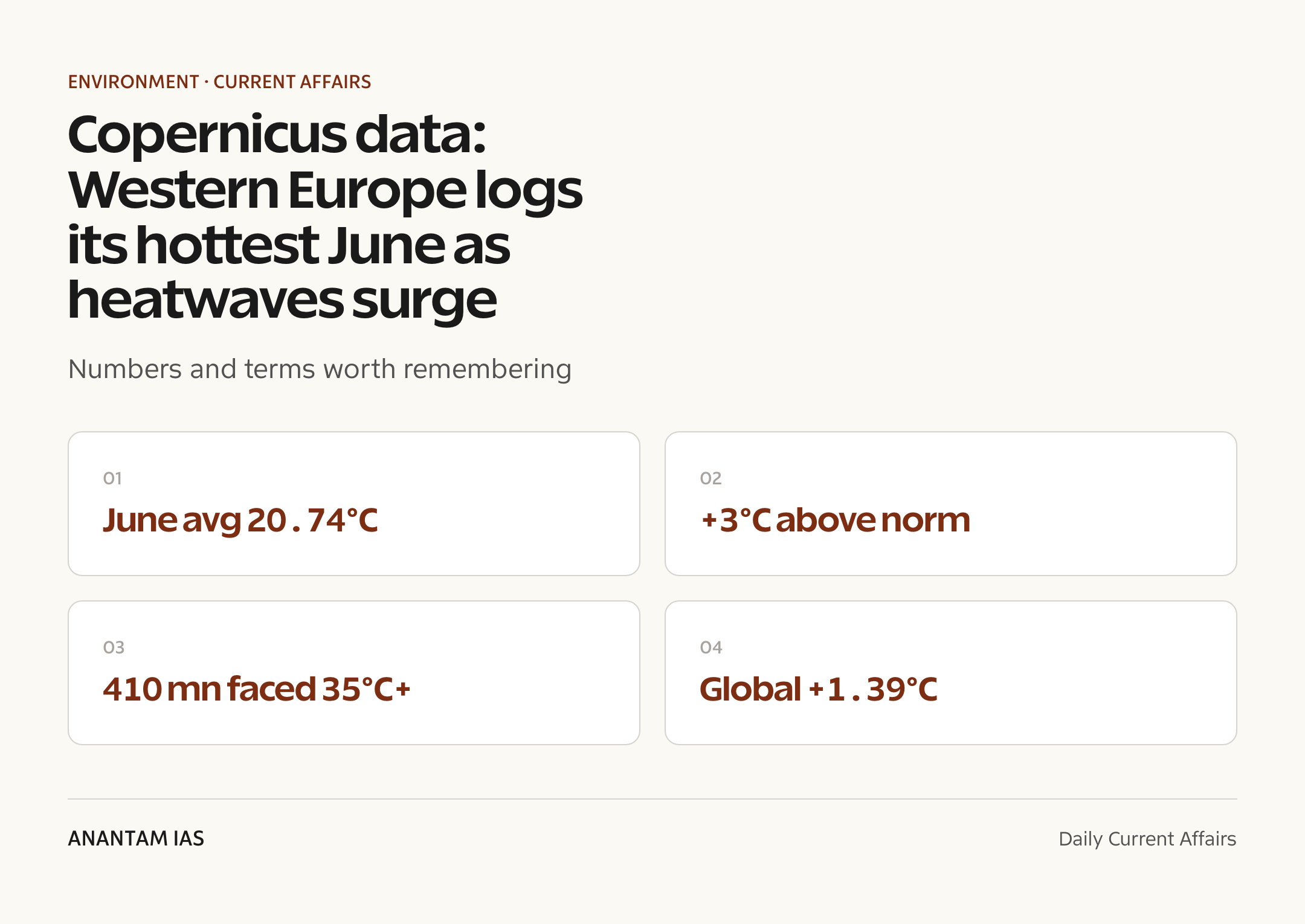
UPSC Relevance
Prelims Relevance
- Copernicus Climate Change Service (C3S) — the climate arm of the EU’s Copernicus Earth-observation programme, implemented by the ECMWF (European Centre for Medium-Range Weather Forecasts).
- ERA5 — the C3S global reanalysis dataset that blends billions of satellite, aircraft, ship and station observations into a consistent climate record.
- Heat dome — a persistent high-pressure ridge that traps hot air, suppresses clouds and rainfall, and bakes the surface for days.
- Marine heatwave — a prolonged period of anomalously high sea-surface temperatures (typically above the 90th percentile for 5+ days).
- Pre-industrial baseline — the 1850–1900 average against which Paris Agreement warming limits (1.5°C / 2°C) are measured.
- World Weather Attribution (WWA) — the scientist network that runs rapid studies quantifying how climate change altered a specific extreme event.
- El Niño — anomalous warming of the central-eastern tropical Pacific that adds a temporary boost on top of the long-term warming trend.
- Tropical nights — nights when the minimum temperature stays at or above 20°C, a key humidity-linked health stressor.
- IMD heatwave criteria — 40°C+ in the plains (30°C+ in hills) with a departure of 4.5–6.4°C from normal; above 6.4°C it is a severe heatwave.
Mains Relevance
GS Paper 3
- Climate change and extreme events: how attribution science converts single disasters into evidence for mitigation and loss-and-damage claims.
- Disaster management: designing Heat Action Plans — early warning, cool shelters, work-hour shifts, mortality surveillance — for Indian cities.
- The compounding chain: heat dome → drought → wildfire (Iberian Peninsula, southern France) as a model of cascading climate risk.
GS Paper 1
- Geography of atmospheric circulation: blocking highs, jet-stream meandering and why mid-latitude Europe warms faster than the global mean.
- Ocean-atmosphere coupling: how marine heatwaves eliminate the sea-breeze relief and amplify coastal heat stress.
GS Paper 2
- Global climate governance: what record months mean for the UNFCCC process, NDC ambition and climate finance for adaptation.
Essay
- Climate change is no longer a forecast; it is the weather report — the ethics of acting on the present, not the future.
- Adaptation and mitigation are not rivals: a civilisation that only builds seawalls will drown behind them.
Background and Context
What Copernicus actually reported
The C3S monthly climate bulletin for June 2026 stacked several records into a single month.
- Western Europe’s June average of 20.74°C was more than 3°C above the 1991–2020 norm — a huge margin for a monthly continental average.
- It broke the previous regional record set in June 2025, meaning back-to-back record Junes in consecutive years.
- For the world and for Europe as a whole, it was the second-hottest June on record; global temperatures ran 1.39°C above the 1850–1900 pre-industrial average.
- The global ocean surface saw its warmest June ever, with a strengthening El Niño expected to add further heat through the year.
- June followed an unusually early spring hot spell in May and preceded another heatwave in early July — a pattern of longer, earlier, repeating heat seasons.
- C3S said the June heatwave “contributed to severe health impacts, including heat-related deaths“, with dry conditions raising drought risk in eastern Europe and feeding wildfires in the Iberian Peninsula and southern France.
Copernicus C3S and ERA5: the world's climate scorekeeper
For prelims, the institution behind the numbers matters as much as the numbers.
- Copernicus is the European Union’s flagship Earth-observation programme; its climate arm, the Copernicus Climate Change Service (C3S), is implemented by the ECMWF.
- C3S publishes monthly climate bulletins built on ERA5, a reanalysis dataset that fuses satellite, ship, aircraft and weather-station observations into a seamless global record from 1940 onwards.
- Because ERA5 updates within days, Copernicus is usually the first authoritative voice on whether a month or year set a record — ahead of NASA, NOAA and the WMO’s consolidated reports.
- Samantha Burgess, strategic climate lead at ECMWF, framed the moment starkly: climate change is shifting “from an abstract statistical future problem… to a concrete present and disruptive feature of daily life”.
- Per Copernicus, 2024 was the first full calendar year to run more than 1.5°C above pre-industrial levels — a warning shot, though the Paris limit refers to a multi-decadal average, not a single year.
Why Western Europe is cooking: heat domes and circulation change
Europe’s geography and shifting atmospheric dynamics make it the fastest-warming continent.
- A heat dome — a quasi-stationary high-pressure ridge — parked over Europe in June, compressing and heating sinking air while blocking rain-bearing systems, “like a lid on a boiling pot”.
- Changes in atmospheric circulation, including a wavier, slower jet stream, are making such blocking patterns more frequent and persistent over Europe.
- Extreme humidity worsened the toll: consecutive tropical nights denied the human body its recovery window, a classic driver of heat mortality among the elderly.
- Europe’s ageing population, dense old housing stock built for a cooler climate, and historically low air-conditioning penetration turn meteorological heat into public-health disasters.
- The result: thousands of excess deaths concentrated in France, Spain and Belgium, echoing the 2003 European heatwave that killed an estimated 70,000 people.
The ocean signal: marine heatwaves
The sea around Europe was as anomalous as the air above it.
- The Mediterranean logged a record-breaking marine heatwave in June, while Europe’s Atlantic coasts were hit by their own hot spells.
- A warm sea removes the sea-breeze and night-time cooling effect — “there’s no coolness coming from the ocean” — so coastal cities stay hot around the clock.
- Marine heatwaves stress fisheries, seagrass meadows and coral, trigger mass mortality of marine species, and load extra moisture into the air, intensifying humid heat onshore.
- For India, the same physics operates in the Indian Ocean — one of the fastest-warming ocean basins — with implications for the monsoon, cyclogenesis in the Arabian Sea, and coastal humid-heat extremes.
Attribution science: putting a number on blame
Event attribution has turned “is this climate change?” from speculation into arithmetic.
- World Weather Attribution (WWA) assessed Europe’s June heatwave as the most severe ever recorded for the region studied, based on three-day average peak temperatures.
- WWA concluded such an event would have been “virtually impossible” without climate change; a comparable June 2003 event would have been about 2°C cooler.
- Attribution studies compare today’s climate with a modelled counterfactual world without human emissions, estimating how much likelier or hotter an event has become.
- This science underpins the loss and damage agenda under the UNFCCC and is increasingly cited in climate litigation against states and corporations.
- For mains answers, attribution is the bridge between a single disaster and the policy claim that mitigation delay has a body count.
Lessons for India: heat as a governance test
Europe’s June is a preview of the heat governance challenge India already lives with every April–June.
- The India Meteorological Department (IMD) declares a heatwave at 40°C+ in the plains with a 4.5–6.4°C departure from normal, and a severe heatwave beyond that — but thresholds alone miss humid heat, which is India’s deadliest variant.
- Ahmedabad’s 2013 Heat Action Plan — South Asia’s first — cut heat mortality through early warnings, cool roofs and hospital protocols; the NDMA now guides Heat Action Plans across 23-plus states, though most remain underfunded and poorly targeted.
- Europe’s mortality numbers highlight India’s own undercounting problem: official heat-death tallies capture only a fraction of excess mortality, as covered in our note on undercounting of India’s heatwave deaths.
- Priorities for India: wet-bulb temperature-based warnings, worker protections (shifted hours, hydration mandates under labour codes), cool-roof and urban-greening programmes, and treating heat as a notified disaster for relief funding.
- Burgess’s adaptation warning applies doubly to India: infrastructure “built for a climate that no longer exists” describes much of the subcontinent’s housing, power grid and water systems.
Way Forward
Mitigation: close the emissions gap
- Accelerate the global transition to net-zero emissions — Burgess’s blunt formula: heatwaves “will only get worse the more fossil fuel we pump into the atmosphere”.
- Strengthen NDC ambition in the next UNFCCC cycle, backed by credible climate finance so developing countries can decarbonise without sacrificing growth.
Adaptation: plan for the climate we have
- Scale up Heat Action Plans with dedicated budgets, legally mandated triggers and city-specific vulnerability maps rather than one-size-fits-all templates.
- Retrofit buildings and cities — cool roofs, shaded streets, urban water bodies — since much of the built stock predates today’s climate.
- Build heat-mortality surveillance into public-health systems so excess deaths are counted, not buried in cardiac and renal statistics.
Science and early warning
- Invest in reanalysis and attribution capacity in the Global South — India’s forecasting under Mission Mausam should extend into rapid event attribution.
- Mainstream marine heatwave monitoring for the Indian Ocean, given its bearing on the monsoon, fisheries and coastal heat stress.
Conclusion
June 2026 is not an outlier; it is a staircase step. Western Europe’s 20.74°C record, the world’s second-hottest June, and the warmest June ocean on record all point the same way — and a strengthening El Niño means the next records are already loading.
For the exam and for policy, the takeaway is identical: attribution science has ended the era of plausible deniability. The choice left is between planned adaptation with rapid mitigation, and unplanned suffering counted in excess-mortality tables.
UPSC Practice Questions
Prelims MCQ 1
With reference to the Copernicus Climate Change Service (C3S), consider the following statements:
- It is implemented by the European Centre for Medium-Range Weather Forecasts (ECMWF) on behalf of the European Union.
- According to C3S, Western Europe’s June 2026 average temperature was more than 3°C above the 1991–2020 norm, its hottest June on record.
- June 2026 was also the hottest June ever recorded globally.
How many of the above statements are correct?
(a) Only one (b) Only two (c) All three (d) None
Answer: (b) Only two
Explanation:
Statements 1 and 2 are correct. C3S is the climate arm of the EU’s Copernicus programme, run by ECMWF, and it reported Western Europe’s hottest June at 20.74°C (3°C+ above the 1991–2020 norm). Statement 3 is wrong — globally, June 2026 was the SECOND-hottest June on record.
Prelims MCQ 2
The term “heat dome”, frequently in the news, best describes which of the following?
(a) A layer of greenhouse gases concentrated over urban areas that traps outgoing radiation (b) A persistent high-pressure system that traps and compresses hot air over a region, suppressing clouds and rainfall (c) The urban heat island effect measured at night over dense city cores (d) A pool of anomalously warm sea-surface water that persists for weeks
Answer: (b) A persistent high-pressure system that traps and compresses hot air over a region, suppressing clouds and rainfall
Explanation:
A heat dome is a quasi-stationary high-pressure ridge under which air sinks, compresses and heats, while clouds and rain are suppressed — ‘like a lid on a boiling pot’. Option (d) describes a marine heatwave.
UPSC Mains Questions
- Europe, the world’s fastest-warming continent, recorded its most severe heatwave in June 2026. Examine the meteorological drivers of such extreme heat events and discuss what lessons Europe’s experience holds for India’s heat governance. (250 words)
- “Attribution science has transformed climate change from a forecast into a finding.” Explain how event attribution works and evaluate its significance for global climate negotiations, loss-and-damage claims and climate litigation. (250 words)
- Marine heatwaves are emerging as silent multipliers of terrestrial heat stress and ecological loss. Discuss their causes and consequences, with special reference to the Indian Ocean and the Indian monsoon. (150 words)
Sources: Copernicus Climate Change Service (C3S) and The Hindu.
Frequently Asked Questions
What did Copernicus report about June 2026?
The Copernicus Climate Change Service reported that Western Europe logged its hottest June on record, averaging 20.74°C — over 3°C above the 1991–2020 norm. Globally it was the second-hottest June, at 1.39°C above the pre-industrial average, and the world’s oceans saw their warmest June ever.
What is the Copernicus Climate Change Service?
C3S is the climate arm of the European Union’s Copernicus Earth-observation programme, implemented by the ECMWF. It publishes monthly climate bulletins based on the ERA5 reanalysis dataset, which merges satellite and ground observations into a consistent global temperature record from 1940 onwards.
What is a heat dome?
A heat dome is a persistent high-pressure system that sits over a region like a lid on a boiling pot. Sinking air compresses and heats, clouds and rain are suppressed, and temperatures build day after day. One such dome drove Europe’s record June 2026 heatwave.
How deadly was Europe’s June 2026 heatwave?
Thousands of deaths were linked to the June heatwave, concentrated in France, Spain and Belgium. About 410 million people — over two-thirds of Europeans — faced temperatures above 35°C during June 15–30, with humid tropical nights denying the body recovery time.
What did World Weather Attribution conclude?
World Weather Attribution, a network of climate scientists, assessed the June 2026 event as Europe’s most severe heatwave ever recorded and said it would have been virtually impossible without human-caused climate change. A comparable event in June 2003 would have been about 2°C cooler.
Why does a European heatwave matter for UPSC?
It packages several syllabus themes in one story: Copernicus and ERA5 for prelims, heat domes and atmospheric circulation for geography, attribution science and UNFCCC politics for GS2–GS3, and direct lessons for India’s Heat Action Plans, IMD heatwave criteria and heat-mortality reporting.
Source: https://anantamias.com/current-affairs/western-europe-hottest-june-copernicus-heatwaves/
Methadone Maintenance Therapy: Punjab’s Harm-Reduction Turn Against Drug Addiction
Why in News?
On June 26, the International Day Against Drug Abuse and Illicit Trafficking, Punjab Health and Family Welfare Minister Dr Balbir Singh inaugurated six Methadone Maintenance Therapy (MMT) clinics in government hospitals — the state’s first dedicated MMT facilities, the Indian Express reported. Methadone has been available in Punjab since a 2012 pilot, but it was always folded into general de-addiction services rather than run through purpose-built clinics.
The launch marks a deliberate widening of Punjab’s treatment toolkit. The backbone of the state’s de-addiction programme remains Buprenorphine-Naloxone (BNX) therapy delivered through more than 450 Outpatient Opioid Assisted Treatment (OOAT) centres. Dedicated MMT clinics now give doctors a supervised, second-line option for patients with severe opioid dependence who don’t respond to BNX — a textbook harm-reduction approach that treats addiction as a chronic health condition, not a moral failing.
- A dedicated MMT clinic was inaugurated in person at Civil Hospital, Ludhiana; five more were digitally launched at District Hospitals Jalandhar and Gurdaspur and Government Medical Colleges at Patiala, Mohali and Faridkot.
- With Kapurthala and Bathinda already dispensing methadone since the pilot phase, eight government hospitals in Punjab are now covered under the MMT programme.
- Over 3 lakh people are registered for treatment at the state’s government OOAT centres, according to the Punjab Health Department — enrolled patients, not the total number of drug users in the state.
- MMT is recommended by the World Health Organisation (WHO) and implemented in India under National AIDS Control Organisation (NACO) guidelines.
- Punjab is simultaneously running its first-ever Drug and Socio-Economic Census — a door-to-door survey of around 65 lakh households that began in May — to estimate drug-abuse prevalence and plan future interventions.
The development matters in the context of:
- The move matters for the NDPS Act debate: India’s drug law has historically leaned on deterrence and criminalisation, while public-health evidence increasingly backs opioid agonist treatment as the most effective response to opioid dependence.
- It’s a live case study in cooperative public health — a state health department scaling a therapy that sits inside central frameworks built by NACO, the Health Ministry and the UN Office on Drugs and Crime (UNODC).
- For GS2 answers, Punjab’s shift illustrates the global policy migration from abstinence-only de-addiction to harm reduction — keeping users alive, healthy and functional while dependence is managed medically.
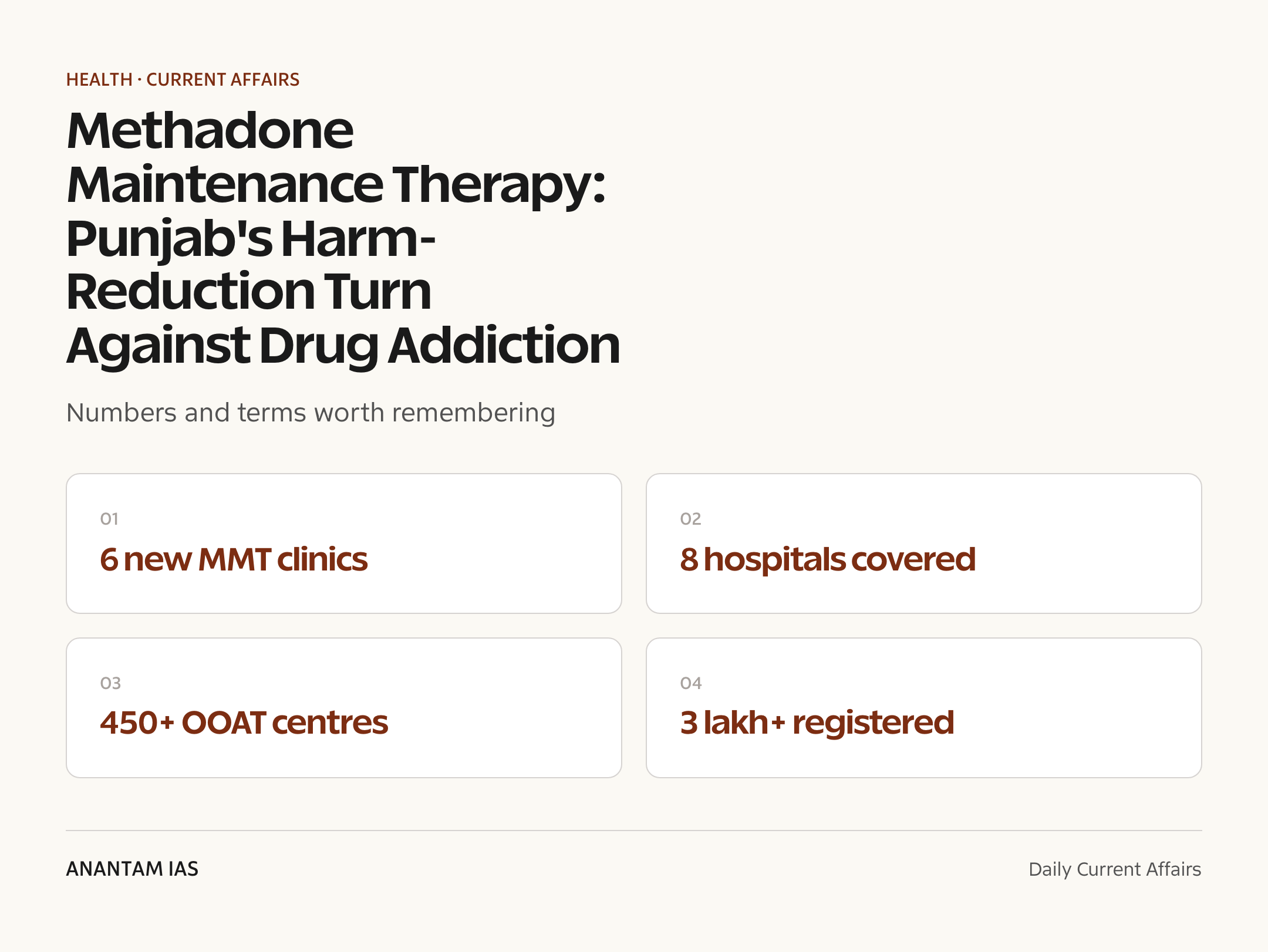
UPSC Relevance
Prelims Relevance
- Methadone — a long-acting opioid agonist; reduces cravings and withdrawal without the intense high of illicit opioids; on the WHO Model List of Essential Medicines.
- Buprenorphine-Naloxone (BNX) — the first-line opioid substitution therapy in India’s OOAT programme; stable patients can get take-home doses of up to 14 days.
- OOAT centres — Outpatient Opioid Assisted Treatment clinics; Punjab runs more than 450 of them.
- Punjab was the first Indian state to introduce MMT — a 2012 pilot at the de-addiction centre of Civil Hospital, Kapurthala, later extended to Bathinda.
- MMT entered India in 2012 through pilots supported by the Ministry of Health and Family Welfare, NACO and UNODC.
- NDPS Act, 1985 — regulates narcotic drugs; the NDPS (Amendment) Act, 2014 created the Essential Narcotic Drugs category (including methadone and morphine) to ease uniform medical access across states.
- Section 71, NDPS Act — empowers the government to establish centres for identification, treatment and rehabilitation of addicts; Section 64A gives addicts who volunteer for treatment immunity from prosecution for small-quantity offences.
- Article 47 (Directive Principles) — directs the State to work for prohibition of intoxicating drinks and drugs injurious to health.
- Nasha Mukt Bharat Abhiyan — the Social Justice Ministry’s flagship de-addiction campaign, launched in 2020 in the most-affected districts.
- International Day Against Drug Abuse and Illicit Trafficking — observed on June 26 every year.
Mains Relevance
GS Paper 2
- Health governance: designing a tiered treatment architecture — first-line BNX at OOAT centres, second-line MMT clinics for severe dependence — as an example of individualised public-health service delivery.
- Policy shift from abstinence-only de-addiction to harm reduction: what it means for the NDPS regime, policing-led responses and the rights of people who use drugs.
- Centre–state interplay: a state health department scaling therapy under NACO guidelines and central drug-control law — vertical programmes vs state innovation.
- Evidence-based welfare: Punjab’s Drug and Socio-Economic Census as a data-for-policy exercise, and the political contestation around survey design.
GS Paper 1
- Drug addiction as a social problem: youth unemployment, agrarian distress, border-state trafficking routes and the social stigma that keeps users away from treatment.
- Role of family and community support systems in recovery — MMT explicitly bundles counselling and psychosocial support with medication.
Essay
- Punishment or treatment? What a society’s response to addiction reveals about its idea of justice.
- Public health succeeds when it meets people where they are — the case for pragmatism over moral perfectionism.
Background and Context
What exactly is Methadone Maintenance Therapy?
MMT is a medically supervised, long-term treatment for people dependent on opioids such as heroin, “chitta” (adulterated heroin), opium and prescription opioid painkillers.
- It uses methadone, a long-acting opioid agonist, to occupy the brain’s opioid receptors — cutting cravings and preventing withdrawal symptoms without producing the intense high of illicit opioid use.
- Medication is only half the design: MMT combines the daily dose with counselling, psychosocial support and regular medical follow-up.
- The goals are concrete: reduce the risk of overdose, relapse and the spread of infections such as HIV and hepatitis among people who inject drugs, and return patients to stable family, social and working lives.
- The therapy is recommended by the WHO — which lists methadone and buprenorphine among essential medicines for opioid dependence — and is run in India under NACO guidelines, since opioid substitution began here as an HIV-prevention strategy. Read the linked primer on NACO and India’s HIV/AIDS programme for that institutional back-story.
- Because methadone is itself a potent opioid, it is dispensed only under strict daily medical supervision at designated clinics — no take-home doses.
From abstinence to harm reduction: the policy shift
Dedicated MMT clinics signal that Punjab is treating opioid dependence as a chronic, relapsing medical condition rather than a failure of willpower.
- Abstinence-only models demand immediate, total cessation — detoxification followed by rehabilitation. Relapse rates are high because untreated cravings and withdrawal push users back to street drugs.
- Harm reduction accepts that some users cannot quit immediately and focuses on cutting the damage — replacing unsafe, illegal, injected opioids with a measured, legal, supervised oral dose.
- International consensus, as doctors quoted by the Indian Express noted, is not that one medication should replace another but that both BNX and methadone should be available so clinicians can individualise treatment.
- The approach dovetails with the constitutional mandate of Article 47 — public health first — and with Section 71 of the NDPS Act, which envisages government-run treatment and rehabilitation centres, not just prosecution.
- Punjab’s wider anti-drug campaign pairs this medical track with enforcement against trafficking — treatment for users, deterrence for suppliers.
MMT vs BNX: how the two therapies compare
Buprenorphine-Naloxone remains the backbone of Punjab’s programme; methadone is the reinforcement for the hardest cases.
- BNX is the first-line treatment for most patients dependent on chitta, opium and similar opioids, delivered through 450+ OOAT centres; it reduces cravings and withdrawal, and stable patients may receive take-home doses up to 14 days.
- Methadone is reserved for selected patients — those with severe opioid dependence or who don’t respond well to BNX, as Dr Rohit Garg of Rajindra Hospital, Patiala, explained to the Indian Express.
- MMT requires a daily clinic visit; patients living within a 4-km radius of a centre are registered, since supervised dosing is non-negotiable.
- Pharmacologically, buprenorphine is a partial agonist with a ceiling effect (safer, harder to overdose on), while methadone is a full agonist — more effective for heavy dependence but demanding tighter control.
- India’s substitution programme initially standardised on buprenorphine because methadone was unavailable and providers grew familiar with BNX; methadone arrived later and still faces stricter licensing, storage and dispensing rules under the NDPS framework, making it harder to scale.
The legal scaffolding: NDPS Act and essential narcotic drugs
Methadone sits at the intersection of medicine and narcotics law, which explains both its promise and its slow rollout.
- The NDPS Act, 1985 controls the production, possession, sale and consumption of narcotic drugs and psychotropic substances — methadone is a controlled opioid under this regime.
- The NDPS (Amendment) Act, 2014 created the category of Essential Narcotic Drugs — including methadone and morphine — replacing a patchwork of state licences with a uniform central framework for legitimate medical use.
- Even after the amendment, methadone dispensing carries heavier compliance — secure storage, records, designated institutions — than BNX, which is why dedicated, hospital-based MMT clinics are the practical delivery model.
- Section 64A of the NDPS Act offers addicts who volunteer for treatment immunity from prosecution for small-quantity offences — the statutory bridge between the criminal-law and public-health tracks.
- The recurring reform question: whether India’s drug law should further decriminalise personal use and consumption, freeing enforcement capacity for traffickers while pushing users toward clinics.
Scale of the challenge: what the data says
Punjab’s registrations and India’s national survey together sketch the size of the opioid problem.
- Over 3 lakh people are registered at Punjab’s government OOAT centres — and officials stress this counts only those enrolled for treatment, not all users.
- Nationally, the Magnitude of Substance Use in India (2019) survey by AIIMS for the Social Justice Ministry estimated roughly 2.26 crore opioid users, with about 77 lakh needing help for opioid-use problems — and Punjab among the worst-affected states.
- Punjab’s first-ever Drug and Socio-Economic Census, covering about 65 lakh households door-to-door since May, aims to estimate prevalence, identify people needing treatment and generate planning data.
- The census has drawn controversy: the Opposition alleges the questionnaire dwells more on the state government’s welfare schemes than on drug abuse itself — a reminder that data exercises carry political stakes.
- Untreated opioid dependence compounds other public-health burdens — overdose deaths, injecting-driven HIV/hepatitis transmission, and the mental-health load discussed in our note on mental health in India.
Institutional architecture: who runs what
Opioid treatment in India is a layered system in which Punjab’s clinics are the newest tier.
- NACO pioneered opioid substitution therapy in India as HIV prevention among people who inject drugs, and its guidelines govern MMT delivery.
- The Ministry of Health and Family Welfare, NACO and UNODC jointly supported the 2012 MMT pilots — Punjab’s Kapurthala pilot made it the first state on board.
- The Ministry of Social Justice and Empowerment runs the demand-reduction track: the Nasha Mukt Bharat Abhiyan (since 2020) and funding for Integrated Rehabilitation Centres for Addicts (IRCAs).
- State health departments operationalise the clinics — Punjab’s OOAT network plus the new eight-hospital MMT footprint (Ludhiana, Jalandhar, Gurdaspur, Patiala, Mohali, Faridkot, Kapurthala, Bathinda).
- The gap the system still struggles with: counsellor shortages, stigma that deters enrolment, and the treatment drop-out that follows when clinics are far away — the very problem the 4-km MMT catchment rule tries to manage. India’s broader mental-health treatment gap shows the same pattern.
Way Forward
Deepen the treatment network
- Expand dedicated MMT clinics beyond eight hospitals so the daily-dosing, 4-km catchment model doesn’t exclude rural patients; consider satellite dispensing under supervision.
- Rationalise NDPS licensing and storage norms for essential narcotic drugs so hospitals can adopt methadone without prohibitive compliance costs.
- Invest in the human layer — trained counsellors, psychiatrists and peer-support workers — since medication without psychosocial support underperforms.
Use data and reduce stigma
- Publish the Drug and Socio-Economic Census methodology and findings transparently so the exercise informs planning rather than political contest.
- Run community campaigns that frame addiction as a treatable health condition, protecting patients from the stigma that keeps them out of clinics.
- Track outcomes — retention in treatment, overdose deaths, relapse rates — and let evidence, not ideology, decide the BNX–methadone mix.
Conclusion
Punjab’s dedicated MMT clinics are a small infrastructure step with a large policy meaning: the state is formally institutionalising harm reduction alongside enforcement. Offering methadone to patients who fail on first-line BNX is what individualised, evidence-based medicine looks like when applied to addiction.
For aspirants, the story ties a current event to durable syllabus anchors — the NDPS Act and its 2014 amendment, Article 47, NACO’s opioid substitution architecture and the abstinence-versus-harm-reduction debate. The test of Punjab’s turn will be measured in retention and recovery rates, not inauguration ribbons.
UPSC Practice Questions
Prelims MCQ 1
With reference to Methadone Maintenance Therapy (MMT) in India, consider the following statements:
- Methadone is a long-acting opioid agonist used to treat dependence on opioids such as heroin and opium.
- Punjab was the first Indian state to introduce methadone maintenance therapy.
- Like buprenorphine-naloxone, methadone can be given as take-home doses of up to 14 days for stable patients.
How many of the above statements are correct?
(a) Only one (b) Only two (c) All three (d) None
Answer: (b) Only two
Explanation:
Statements 1 and 2 are correct — methadone is a long-acting opioid agonist, and Punjab pioneered MMT in India with the 2012 Kapurthala pilot. Statement 3 is wrong: methadone is dispensed only under daily medical supervision at designated clinics; take-home doses apply to BNX, not methadone.
Prelims MCQ 2
The category of ‘Essential Narcotic Drugs’, which eased uniform medical access to substances such as methadone and morphine across India, was created by:
(a) The Drugs and Cosmetics Act, 1940 (b) The NDPS (Amendment) Act, 2014 (c) The Mental Healthcare Act, 2017 (d) The National Health Policy, 2017
Answer: (b) The NDPS (Amendment) Act, 2014
Explanation:
The 2014 amendment to the NDPS Act, 1985 created the Essential Narcotic Drugs category, replacing fragmented state licensing with a uniform central framework so that opioids like morphine, methadone and fentanyl remain accessible for legitimate medical use.
UPSC Mains Questions
- Punjab’s dedicated Methadone Maintenance Therapy clinics mark a shift from abstinence-only de-addiction to harm reduction. Examine the merits and limitations of harm-reduction approaches in India’s drug policy, with reference to the NDPS framework. (250 words)
- Drug addiction is as much a social problem as a medical one. Discuss the socio-economic drivers of the drug crisis in states like Punjab and evaluate the adequacy of the existing institutional response. (250 words)
Source: Indian Express Explained.
Frequently Asked Questions
What is Methadone Maintenance Therapy (MMT)?
MMT is a medically supervised treatment for opioid addiction. Methadone, a long-acting opioid agonist, is given daily under supervision to cut cravings and withdrawal without the high of illicit opioids, combined with counselling and psychosocial support. The WHO recommends it, and NACO guidelines govern its delivery in India.
Why did Punjab open dedicated MMT clinics?
Punjab launched six dedicated MMT clinics on June 26 to give doctors a supervised second-line option for patients with severe opioid dependence who don’t respond to first-line buprenorphine-naloxone therapy. With Kapurthala and Bathinda already dispensing methadone, eight government hospitals now run the programme.
How is MMT different from BNX therapy?
BNX (buprenorphine-naloxone) is the first-line therapy at Punjab’s 450-plus OOAT centres; stable patients can take home up to 14 days of medicine. Methadone is a full opioid agonist reserved for severe or BNX-resistant cases, dispensed only at designated clinics under daily supervision, with patients registered within a 4-km radius.
What are OOAT centres?
Outpatient Opioid Assisted Treatment (OOAT) centres are Punjab government clinics that provide buprenorphine-naloxone therapy, counselling and follow-up for opioid-dependent patients. The state runs more than 450 such centres, and over 3 lakh people are registered for treatment through them.
What is harm reduction in drug policy?
Harm reduction focuses on cutting the damage from drug use — overdose deaths, HIV and hepatitis transmission, crime — rather than demanding immediate total abstinence. Supervised opioid substitution with methadone or buprenorphine replaces unsafe illicit use with a measured legal dose while the patient stabilises.
What is Punjab’s Drug and Socio-Economic Census?
It is Punjab’s first door-to-door survey, begun in May and covering about 65 lakh households, to estimate the prevalence of drug abuse, identify people who need treatment and generate planning data. The Opposition has criticised the questionnaire for focusing heavily on government welfare schemes.
Source: https://anantamias.com/current-affairs/punjab-methadone-maintenance-therapy-drug-policy/
Prambanan temple: Indonesia’s Hindu heritage site and the India connection
Why in News?
Prime Minister Narendra Modi visited the Prambanan Temple complex in Yogyakarta, Indonesia on 8 July 2026 alongside Indonesian President Prabowo Subianto. The Indian Express reported that the visit marked the beginning of India’s effort to help restore the iconic UNESCO World Heritage Site — extending India’s heritage-restoration diplomacy in Southeast Asia to Indonesia’s grandest Hindu monument.
The 9th-century Prambanan Temple Compounds, sitting on the border of Indonesia’s Yogyakarta Special Region and Central Java province on the island of Java, form the largest temple compound dedicated to Shiva in Indonesia. For UPSC, the site bundles three high-yield threads into one topic: the Indianised kingdoms of Southeast Asia, classic Hindu temple architecture abroad, and contemporary cultural diplomacy.
- The PM’s stop at Prambanan came during his visit to Yogyakarta on 8 July 2026; India will assist in the restoration and conservation of the complex.
- The compounds include Prambanan Temple (also called Loro Jonggrang or Candi Prambanan) along with the Sewu, Bubrah and Lumbung temples — the central complex originally had about 240 large and small temples.
- Prambanan was inscribed on the UNESCO World Heritage List in 1991, declared a National Cultural Property of Indonesia in 1998, and is protected under a 2010 national conservation law.
- The move fits India’s record of restoring temples abroad through the Archaeological Survey of India (ASI) — from Angkor Wat in Cambodia to My Son in Vietnam.
- The visit was part of the PM’s three-nation Southeast Asia tour under the Act East Policy — covered in our companion note on the PM’s three-nation visit and Act East Policy.
The development matters in the context of:
- For Prelims, Prambanan is a ready map-and-culture item: a named monument, a precise location (Java), datable dynasties and a UNESCO year — exactly the fact-cluster UPSC likes to test.
- For Mains, it illustrates how civilisational links with Southeast Asia — the so-called Greater India sphere — are being converted into instruments of soft power and bilateral goodwill.
- It also revives the classic GS1 theme of Indian cultural influence abroad: Sanskrit inscriptions, Ramayana traditions and temple-building in the Indonesian archipelago.
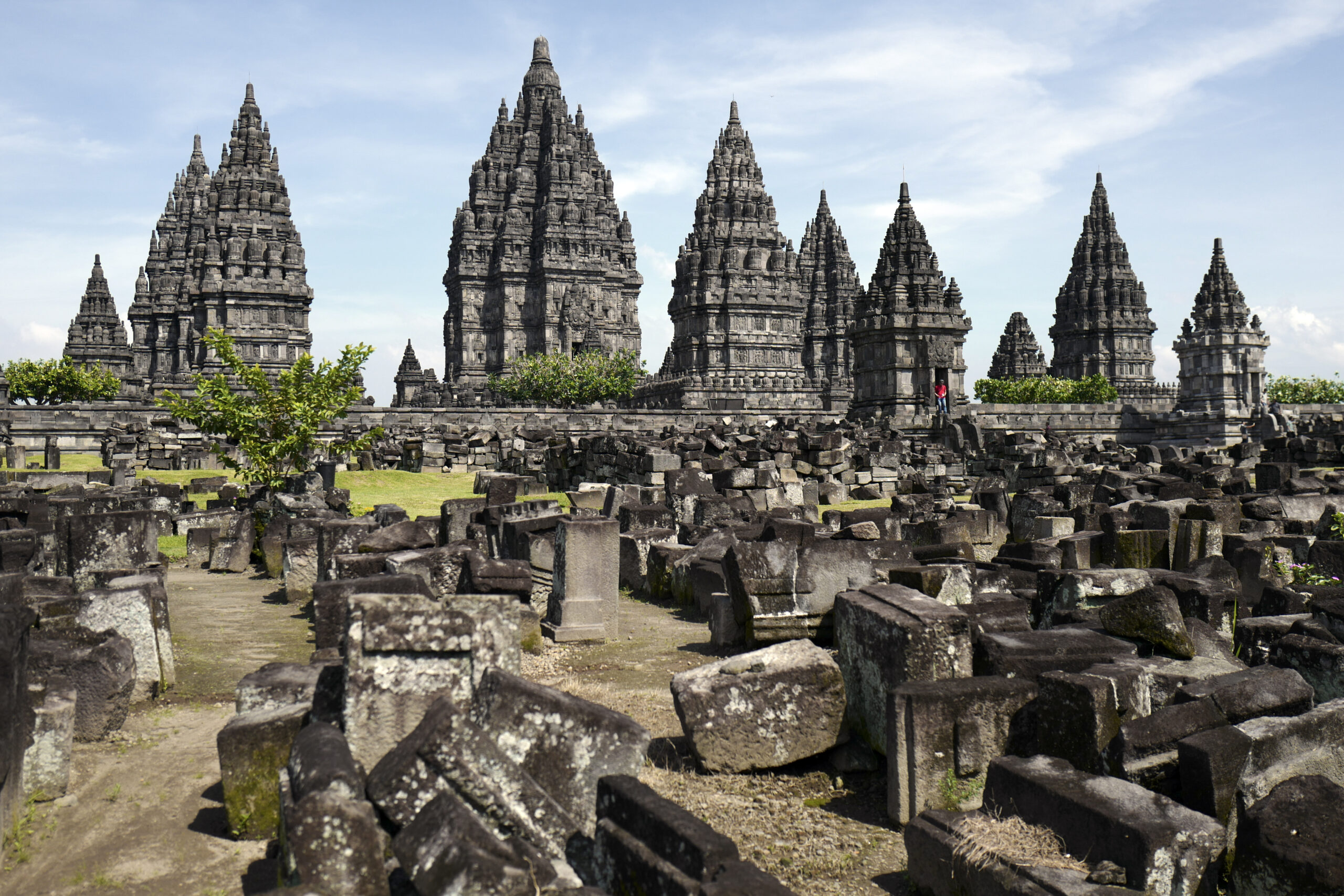
UPSC Relevance
Prelims Relevance
- Location: Prambanan lies on the border of the Yogyakarta Special Region and Central Java, on the island of Java, Indonesia.
- It is the largest Shiva temple compound in Indonesia; the main temple is locally called Loro Jonggrang.
- Commissioned by Rakai Pikatan of the Hindu Sanjaya dynasty (Mataram Kingdom); inscriptions record its consecration in 856 CE.
- Its construction marked the return of the Shaivite Sanjaya line after nearly a century of dominance by the Buddhist Sailendra dynasty — the builders of Borobudur.
- Three main shrines honour the Trimurti — Shiva, Vishnu and Brahma — faced by three shrines for their vahanas; relief panels depict scenes from the Ramayana.
- The northern chamber of the Shiva temple houses Durga as Mahishasuramardini, whom locals call Loro Jonggrang; the western chamber houses Ganesha.
- In Indonesian, candi means an ancient Hindu or Buddhist temple or shrine.
- The Mataram political centre shifted to East Java around 929–930 CE — often linked to an eruption of Mount Merapi — after which Prambanan was abandoned and buried under volcanic debris.
- Early documentation: Dutch East India Company official C A Lons (1733) and Thomas Stamford Raffles, Lieutenant-Governor of Java (1811–16); main-temple reconstruction begun in 1918 was completed in 1953 and inaugurated by President Soekarno.
- UNESCO World Heritage List: 1991 (Prambanan Temple Compounds).
Mains Relevance
GS Paper 1
- Indian cultural influence on Southeast Asia — religion, epics, temple architecture and kingship in the Indianised kingdoms of Java.
- Temple architecture as a source of history: what Prambanan’s Trimurti plan and Ramayana reliefs reveal about 9th-century religion and society.
- Religious syncretism: a Hindu king marrying a Buddhist princess, and Hindu and Buddhist candis built side by side in central Java.
GS Paper 2
- Cultural diplomacy and soft power in India’s Act East Policy — heritage restoration as a low-cost, high-goodwill instrument.
- Institutional dimension: the ASI’s overseas conservation portfolio (Angkor Wat, Ta Prohm, My Son, Bagan) and how it deepens bilateral ties.
Essay
- Civilisational connections as the quiet foundation of modern diplomacy — culture travels farther than armies.
- Heritage is not the past; it is a shared future — monuments as bridges between nations.
Background and Context
Where Prambanan sits and what it contains
Prambanan is not one temple but a cluster of compounds on Java’s volcanic plain.
- The Prambanan Temple Compounds straddle the border of the Yogyakarta Special Region and Central Java province, on the island of Java.
- The listed property comprises Prambanan Temple (Loro Jonggrang / Candi Prambanan) plus the nearby Sewu, Bubrah and Lumbung temples.
- The core Prambanan complex originally consisted of about 240 large and small temples, arranged around the towering central shrines.
- It is the largest temple compound dedicated to Shiva in Indonesia — the Shaivite counterpart to the Buddhist Borobudur, which lies in the same region of central Java.
- The name Prambanan is believed to derive from the village to which the complex once belonged; candi is the Indonesian word for an ancient Hindu or Buddhist shrine.
Sanjaya, Sailendra and the making of a Hindu sanctuary
Prambanan was born of a dynastic contest between a Shaivite and a Buddhist royal house.
- The Sanjaya dynasty ruled the Mataram Kingdom in central Java through the 8th and 9th centuries and is associated with the revival of Shaivite Hinduism on the island.
- Its dominance was challenged by the Sailendra dynasty, a powerful Buddhist house under whom Javanese art, architecture and Buddhist scholarship flourished; hundreds of temples and shrines rose between 700 and 900 CE.
- After the reign of Samaratungga of the Sailendras, Rakai Pikatan of the Sanjaya line is believed to have married Samaratungga’s daughter Pramodhawardhani, ruling between 842 and 856 CE.
- Rakai Pikatan is widely credited with commissioning Prambanan as a grand Hindu sanctuary; researcher Hary Gunarto notes it was intended to mark the return of the Hindu Sanjaya dynasty after nearly a century of Buddhist Sailendra dominance.
- The exact start of construction is uncertain, but inscriptions record the temple’s consecration in 856 CE; for about a century it served as an important pilgrimage centre.
Architecture: a Trimurti complex with a Ramayana gallery
The plan of Prambanan is a textbook statement of Shaivite theology rendered in stone.
- At the heart of the complex stand three temples to the Trimurti — Shiva, Vishnu and Brahma — decorated with relief panels narrating scenes from the Ramayana.
- Opposite them stand three temples dedicated to the gods’ vahanas (mounts) — the animal vehicles who serve them.
- Each of the four projecting sides of the main temple has a stairway leading to a separate chamber, or cella; the eastern stairway opens into the main chamber housing the statue of Shiva.
- The western chamber holds Ganesha; the northern chamber holds the famous Durga as Mahishasuramardini, shown with the demon drawn from the slain buffalo — local people call her Loro Jonggrang, giving the temple its popular name.
- Buddhist artistic influence is visible too: a stupa-like element tops the superstructure, and Buddhist candis of the same era — Sewu, Bubrah, Lumbung, Kalasan, Plaosan and Sari — ring the Hindu complex.
- The marriage of the Hindu ruler and the Buddhist princess, mirrored in this mixed sacred landscape, is often read as a symbol of religious harmony in 9th-century Java.
Abandonment, rediscovery and restoration
Prambanan’s biography runs from volcanic burial to a national icon of independent Indonesia.
- Around 929–930 CE the political centre of the Mataram Kingdom shifted to East Java — a move often linked to an eruption of Mount Merapi, though historians also cite political and economic reasons.
- As central Java emptied, Prambanan fell into disuse and was buried under vegetation and volcanic debris, largely forgotten for centuries.
- A possible early witness was the 15th-century East Javanese court poet Mpu Tanakung, whose description of a ruined temple complex closely matches Prambanan.
- The earliest known European account came from C A Lons, a Dutch East India Company official who toured the ruins in 1733, as scholar Roy E Jordaan records in his 1996 study In Praise of Prambanan.
- Thomas Stamford Raffles, Lieutenant-Governor of Java during the British interregnum (1811–16), took a keen interest in documenting central Java’s ancient monuments, including Prambanan.
- Modern reconstruction of the main temple began in 1918 but — interrupted by the Second World War and Indonesia’s independence struggle — was completed only in 1953, inaugurated by President Soekarno.
- Prambanan entered the UNESCO World Heritage List in 1991, became a National Cultural Property in 1998, and gained further protection under a 2010 national law on conservation.
The India connection: Indianised kingdoms of Southeast Asia
Prambanan is the most visible Javanese chapter of a much older story of Indian cultural transmission.
- From roughly the early centuries CE, Indian traders, priests and scholars carried Sanskrit, Hindu-Buddhist religion, epics and ideas of kingship across the Bay of Bengal, producing the Indianised kingdoms of Southeast Asia.
- Java’s Mataram rulers used Sanskrit-derived inscriptions, Puranic iconography and the Ramayana — the same epic carved on Prambanan’s balustrades and still performed in the celebrated Ramayana ballet staged beside the temple.
- The pattern repeats across the region: Angkor in Cambodia (Khmer), My Son in Vietnam (Champa), Bagan in Myanmar, and Borobudur-Prambanan in Java — all drawing on Indian religious and architectural vocabularies while remaining distinctly local creations.
- Indonesia today is a Muslim-majority nation that treats Prambanan and Borobudur as core national heritage, while Hindu traditions continue on Bali — a living bridge for India-Indonesia cultural ties.
- For GS1, the takeaway is adaptation, not transplantation: Javanese builders absorbed Indian templates and produced original forms — the candi is a Javanese invention with an Indian grammar.
India's restoration diplomacy: the ASI abroad
Helping restore Prambanan extends a proven Indian playbook of heritage diplomacy.
- The Archaeological Survey of India (ASI) has a long record of conserving monuments abroad — most famously at Angkor Wat in Cambodia, where it worked on the main temple from the late 1980s, and later at Ta Prohm.
- The ASI has also restored the Cham temple complex at My Son in Vietnam and the Ananda Temple at Bagan in Myanmar — projects that pair technical conservation with visible goodwill.
- Prambanan brings Indonesia — Southeast Asia’s largest country and a key Indo-Pacific partner — into this circuit, reinforcing the civilisational pillar of the Act East Policy.
- Heritage cooperation is classic soft power: modest budgets, durable symbolism, and direct people-to-people resonance in a country where the Ramayana remains popular culture.
- Read it with the strategic backdrop of the PM’s tour in our note on the three-nation visit and Act East Policy, and explore more topics in Art and Culture.
Way Forward
Institutionalise heritage cooperation
- Convert the Prambanan commitment into a time-bound conservation MoU with clear ASI deliverables, joint documentation and training of Indonesian conservators.
- Build a standing India-ASEAN heritage-conservation programme so projects outlive individual summits, drawing on the Angkor and My Son templates.
Deepen the cultural bridge
- Pair stone conservation with living culture — Ramayana festivals, museum exchanges, digital archives and university partnerships on Southeast Asian studies.
- Develop joint heritage-tourism circuits (Borobudur–Prambanan with Indian Buddhist and temple circuits) to give the diplomacy an economic base.
Conclusion
Prambanan compresses a millennium of shared history into a single skyline: a Shaivite sanctuary raised by the Sanjaya kings in 856 CE, buried by a volcano, recovered by scholars, and now embraced by two modern republics as common inheritance. India’s offer to help restore it is cultural diplomacy at its most natural — the restorer and the restored share the same epic.
For the exam, file Prambanan alongside Borobudur, Angkor and My Son as the monument-map of Indianised Southeast Asia, and alongside the ASI’s overseas projects as the policy face of Indian soft power. One site, two GS papers, and a very likely map question.
UPSC Practice Questions
Prelims MCQ 1
With reference to the Prambanan Temple Compounds, consider the following statements:
- It is the largest temple compound dedicated to Shiva in Indonesia.
- Its construction is credited to the Buddhist Sailendra dynasty.
- It is inscribed on the UNESCO World Heritage List.
How many of the above statements are correct?
(a) Only one (b) Only two (c) All three (d) None
Answer: (b) Only two
Explanation:
Statements 1 and 3 are correct: Prambanan is Indonesia’s largest Shiva temple compound and was UNESCO-listed in 1991. Statement 2 is incorrect — it was commissioned by Rakai Pikatan of the Hindu Sanjaya dynasty (consecrated 856 CE), marking the Sanjaya return after Buddhist Sailendra dominance; the Sailendras are associated with Borobudur.
Prelims MCQ 2
The Sanjaya and Sailendra dynasties, associated with the Prambanan and Borobudur temples respectively, ruled over which of the following regions?
(a) Central Java, Indonesia (b) Sumatra, Indonesia (c) Bali, Indonesia (d) The Malay Peninsula
Answer: (a) Central Java, Indonesia
Explanation:
Both dynasties ruled the Mataram Kingdom region of central Java in the 8th-9th centuries CE. The Shaivite Sanjayas built Prambanan; the Buddhist Sailendras are linked to Borobudur. The political centre shifted to East Java around 929-930 CE, after which Prambanan was abandoned.
UPSC Mains Questions
- The temples of Southeast Asia are Indian in grammar but local in genius. Discuss with reference to Prambanan, Borobudur and Angkor, and examine what such monuments reveal about the process of cultural transmission from India. (250 words)
- Heritage restoration abroad has become a distinctive instrument of India’s cultural diplomacy. Examine its role in the Act East Policy, citing the work of the Archaeological Survey of India in Southeast Asia. (250 words)
Sources: Indian Express Explained and UNESCO World Heritage Centre.
Frequently Asked Questions
Where is the Prambanan temple located?
Prambanan stands on the border of Indonesia’s Yogyakarta Special Region and Central Java province, on the island of Java. The UNESCO-listed compounds include Prambanan (Loro Jonggrang), Sewu, Bubrah and Lumbung temples, originally comprising about 240 large and small shrines.
Who built the Prambanan temple and when?
Rakai Pikatan of the Hindu Sanjaya dynasty, ruler of the Mataram Kingdom, is credited with commissioning Prambanan. Inscriptions record its consecration in 856 CE. Its construction marked the Sanjaya dynasty’s return to power after nearly a century of Buddhist Sailendra dominance in central Java.
Which deities is Prambanan dedicated to?
Prambanan is Indonesia’s largest Shiva temple compound. Its three central shrines honour the Trimurti — Shiva, Vishnu and Brahma — faced by shrines to their vahanas. The Shiva temple also houses Ganesha and Durga as Mahishasuramardini, locally called Loro Jonggrang, and carries Ramayana relief panels.
When did Prambanan become a UNESCO World Heritage Site?
The Prambanan Temple Compounds were inscribed on the UNESCO World Heritage List in 1991. Indonesia designated the site a National Cultural Property in 1998, and a 2010 national law further supports its protection and conservation. Borobudur, nearby in central Java, was also listed in 1991.
Why is Prambanan in the news for India?
Prime Minister Modi visited Prambanan in Yogyakarta on 8 July 2026 with President Prabowo Subianto, beginning India’s effort to help restore the complex. It extends the ASI’s heritage-restoration diplomacy — seen earlier at Angkor Wat, Ta Prohm, My Son and Bagan — to Indonesia.
How was Prambanan rediscovered after its abandonment?
After Mataram’s centre shifted to East Java around 929-930 CE, Prambanan lay buried under volcanic debris. Dutch East India Company official C A Lons reported the ruins in 1733, Stamford Raffles documented them during 1811-16, and reconstruction begun in 1918 was completed in 1953 under President Soekarno.
Source: https://anantamias.com/current-affairs/prambanan-temple-indonesia-heritage-india-link/