Myanmar is India's only neighbour that belongs to both South Asia's strategic arc and the ASEAN grouping. The 1,643 km land border touching Arunachal Pradesh, Nagaland, Manipur and Mizoram turns every domestic shock in Naypyidaw into an Indian policy problem: refugees in Mizoram, arms smuggling through the Golden Triangle, and a civil war that has effectively partitioned the country since the February 2021 military coup. For UPSC GS II, Myanmar is a junction question — it tests your grasp of the Neighbourhood First policy, the Act East Policy, connectivity diplomacy, and great-power competition rolled into one file.
Historical context of ties
India and Myanmar (Burma) were administered as a single colonial unit until 1937. Post-independence ties began warmly — Nehru backed Aung San's democratic project and later welcomed Burmese exiles after the 1962 coup. Relations cooled through the 1970s-80s when New Delhi openly supported the pro-democracy movement led by Aung San Suu Kyi. The 1990s pragmatic turn — driven by insurgency in the Northeast, narcotics flows, and the need to blunt Chinese penetration — produced the Look East Policy (1992), which was upgraded to the Act East Policy (2014). Since then, India has engaged whichever regime held power in Naypyidaw while maintaining a quiet line to democratic forces.
Why Myanmar matters for India
Geostrategic pivot: Myanmar is the only ASEAN nation sharing a land border with India. It sits at the confluence of India's Neighbourhood First and Act East policies, and it anchors the Bay of Bengal Initiative for Multi-Sectoral Technical and Economic Cooperation (BIMSTEC).
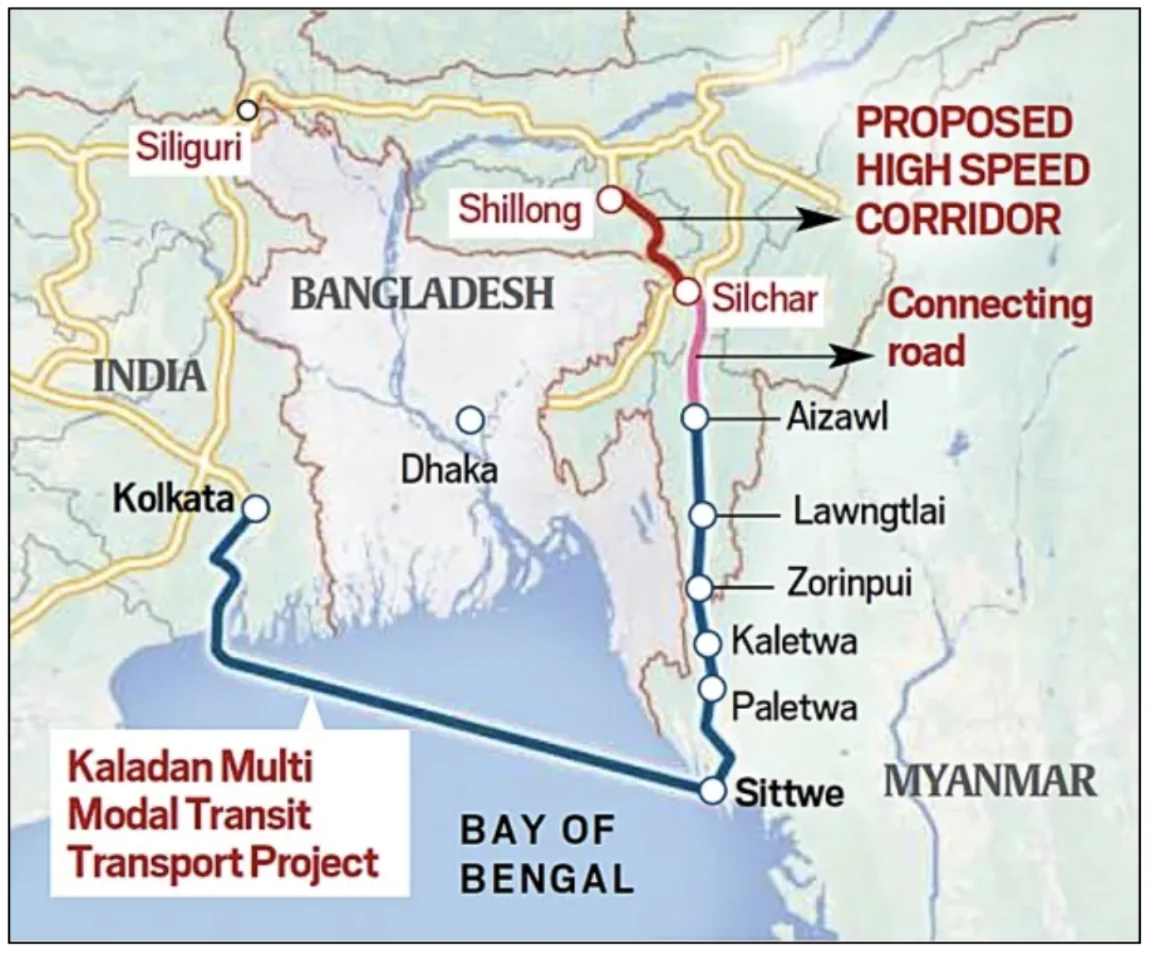
Bypass to the Northeast: The narrow Siliguri Corridor ("Chicken's Neck," only 22 km wide) is India's sole land link to the seven northeastern states. Connectivity projects through Myanmar provide an alternative route and reduce this vulnerability.
Counter-insurgency: North-eastern insurgent groups (NSCN-K, ULFA factions, PLA) have long used Sagaing Region as sanctuary. Operational cooperation with Myanmar's army (Tatmadaw) — including India's 2015 and 2019 cross-border strikes — has been critical.
Narcotics corridor: Shan State, part of the Golden Triangle, is now the world's largest producer of methamphetamine, with flows spilling into Manipur and Mizoram.
China counterweight: Beijing has invested in the Kyaukphyu deep-sea port, oil and gas pipelines to Yunnan, and the China-Myanmar Economic Corridor (CMEC). Losing Myanmar fully to China would give the PLA Navy a second Indian Ocean opening next to the Bay of Bengal.
The border and the Free Movement Regime
The Free Movement Regime (FMR) allowed residents within 16 km on either side of the border to cross without a visa and stay up to 14 days. It recognised that Naga, Kuki, Chin and Mizo communities straddle a border they never drew.
In February 2024, after the Manipur ethnic violence and post-coup refugee flows, India announced the suspension of the FMR and fencing of the entire 1,643 km border. The government cited arms smuggling, drug trafficking, and militant movement. Mizoram and Nagaland state governments publicly opposed the decision, arguing it severs kinship communities. The calibration — how much to fence, which communities to exempt — remains a live political issue.
Areas of cooperation
| Domain | Key initiatives |
|---|---|
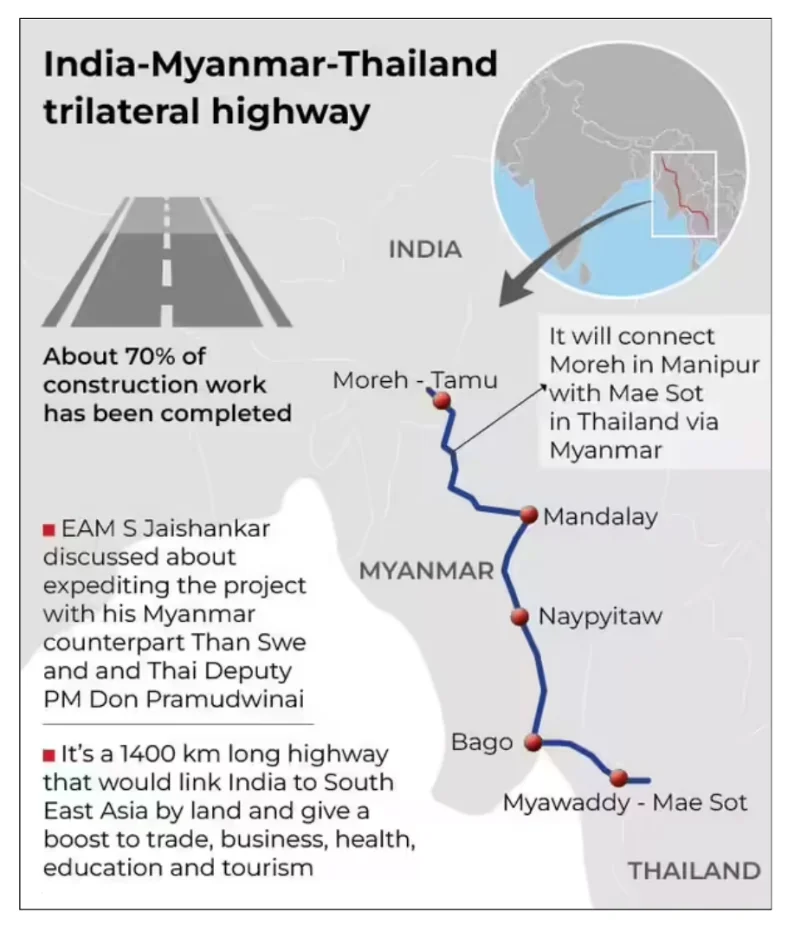
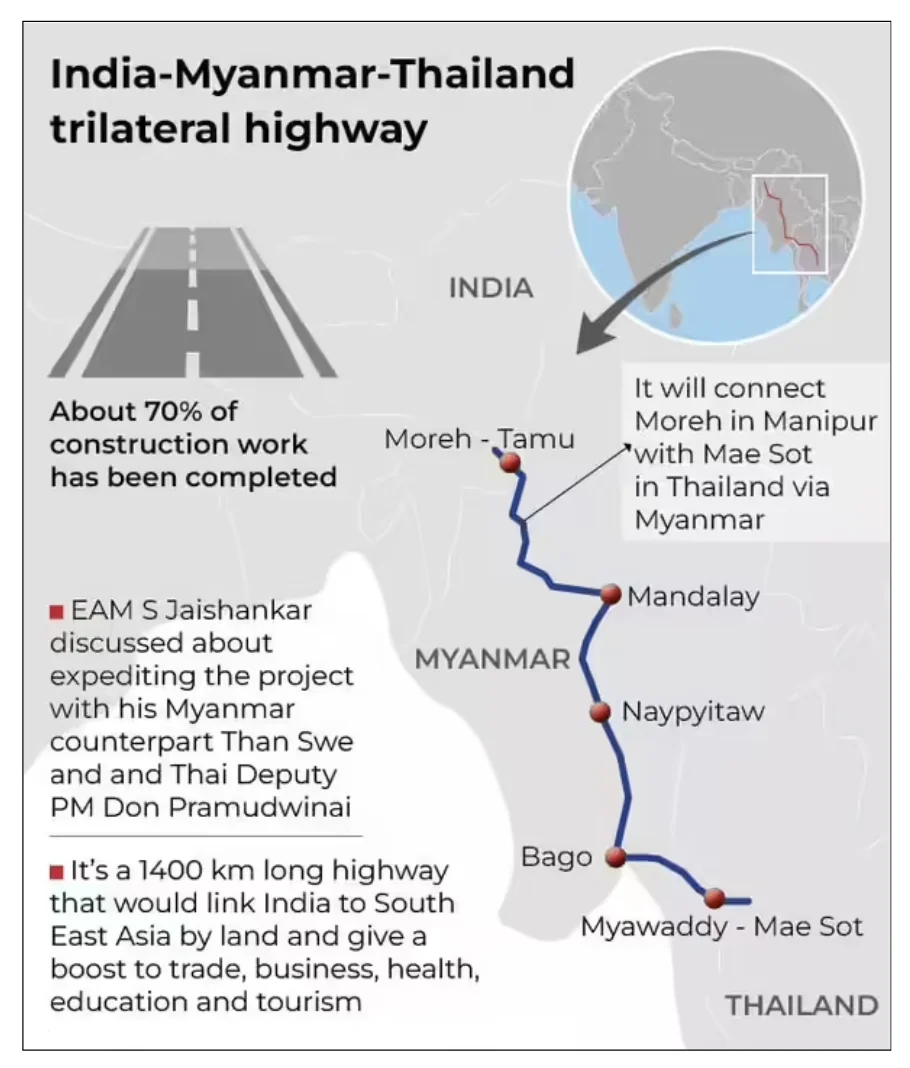
| Connectivity | India-Myanmar-Thailand Trilateral Highway; Kaladan Multi-Modal Transit Transport Project; Sittwe port (operational 2023) |
| Defence | Training, maritime exercise IMNEX; supply of naval and surveillance platforms |
| Energy | ONGC Videsh and GAIL stakes in the Shwe gas project |
| Capacity building | Lines of credit for IT, education, and agriculture; Myanmar Institute of Information Technology |
| Multilateral | BIMSTEC, Mekong-Ganga Cooperation, BCIM (now dormant) |
The Kaladan project is emblematic — it links Kolkata to Sittwe port by sea, then by river up the Kaladan to Paletwa, and onwards by road to Mizoram. Civil war in Chin State has repeatedly stalled the Paletwa-Zorinpui road segment.
The 2021 coup and India's balancing act
On 1 February 2021, the Tatmadaw, led by Senior General Min Aung Hlaing, removed the elected National League for Democracy (NLD) government, citing fraud in the November 2020 polls. Aung San Suu Kyi was jailed.
Since then, the country has fractured:
- The National Unity Government (NUG), formed by ousted legislators, operates underground and from Thailand, raising People's Defence Forces (PDFs).
- Ethnic Armed Organisations (EAOs) — including the Three Brotherhood Alliance (MNDAA, Arakan Army, TNLA) — made major territorial gains in 2023-24.
- The Tatmadaw has lost ground but retains air power and central cities.
- ASEAN's Five Point Consensus (April 2021) has collapsed in practice.
India's response has been principled ambiguity: no formal recognition of the junta, no outright condemnation either; continued back-channel contact with the NUG and select EAOs (Arakan Army, Chin National Army); quiet humanitarian aid; and a firm refusal to follow the Western sanctions track. The rationale is simple — pushing the Tatmadaw fully into China's embrace would be strategically suicidal.
Points of friction
- Refugee flows into Mizoram and Manipur have strained the Centre-state relationship; Mizoram refused the Centre's order to turn refugees back.
- Rohingya crisis: Over a million Rohingya refugees remain in Bangladesh's Cox's Bazar camps. India supported Bangladesh but avoided pressuring the Myanmar junta.
- Project delays: Kaladan's Paletwa stretch is blocked by Arakan Army-junta fighting.
- Drug and weapons trafficking through porous hills.
Latest developments (2024-26)
- FMR suspension (Feb 2024) and announcement of full border fencing.
- Arakan Army captured most of Rakhine State by early 2025, raising the real prospect of Sittwe port operating in AA-held territory — a delicate moment for Kaladan.
- Operation Sindhu Thakur style non-combatant evacuations and tightened port security on the eastern seaboard followed spillover incidents.
- India, as G20 President (2023), kept Myanmar off the summit agenda but used bilateral tracks; 2024's Quad Summit in Wilmington explicitly raised Indo-Pacific stability, with Myanmar the unsaid case study.
- The BRICS expansion (with the UAE, Egypt, Iran and Ethiopia joining in 2024) complicates Myanmar's external options — the junta has sought observer status.
- BIMSTEC Summit (Bangkok, 2025) produced a charter adoption but skirted the Myanmar political question.
- The Red Sea crisis and Houthi attacks rerouted some India-bound shipping via the Andaman Sea, sharpening the strategic value of Sittwe and the Kaladan spine.
- A 2024 MoU on border haats was paused after the FMR suspension; talks continue on revised frameworks.
Way forward for India
- Calibrated engagement with Tatmadaw, NUG and major EAOs — not choosing a side, but keeping influence across actors through multi-stakeholder backchannels.
- De-risk Kaladan by diversifying the inland leg through Mizoram and exploring Bangladesh transit as a backup.
- Refugee protocol with Mizoram and Manipur — humane processing plus security screening, registration and non-refoulement within Indian constitutional norms.
- Soft-power depth: Expand ITEC slots, the Myanmar Institute of Information Technology, and Bodh Gaya-Bagan Buddhist circuit diplomacy.
- Coordinate with Quad and ASEAN on humanitarian corridors without militarising the issue.
- Counter-narcotics cooperation with Thailand and Bangladesh — institutionalise trilateral intelligence and interdiction along the Golden Triangle-Northeast corridor.
- Act East 2.0 Myanmar track: treat infrastructure projects as strategic sinews, not stand-alone deliverables — bundle Trilateral Highway, Kaladan, Moreh ICP, and airport connectivity into one execution unit.
- Institutional memory: invest in Myanmar-focused area studies at Indian universities; India lags on specialist expertise compared with China, Japan, and Singapore.
Public policy framing
The deeper question is how India explains a policy of engagement with an authoritarian junta. Principled ambiguity is intellectually defensible — neither recognising nor repudiating, preserving leverage — but it places a burden on diplomatic communication. Lessons from India's 1990s-2010s Myanmar policy suggest three rules: (a) keep multiple doors open; (b) deliver on small promises before announcing big ones; (c) never let the China factor drive every move. In 2025-26, the test will be whether India can run a humanitarian track in Chin State, keep the Tatmadaw channel open, and secure the Sittwe-Paletwa-Zorinpui stretch — all simultaneously.
UPSC Relevance
Myanmar appears across GS II (India's neighbourhood, effect of developed-country policies, regional groupings) and GS III (border security, internal security of Northeast). Prelims has tested the Kaladan project (2022) and the FMR. Mains prompts rotate between the Act East-Neighbourhood First intersection, the coup's implications, and China in Myanmar. Essay angles: "Geography is the spine of foreign policy," "Good fences make good neighbours — or do they?"
Practice question (Mains): Myanmar sits at the intersection of India's Neighbourhood First and Act East policies. Critically examine how the 2021 military coup has tested this dual framework. (250 words)
Tell Google you want more of this.
Add Anantam IAS as a preferred sourceOne tap, and this site shows up more often in your own Top Stories, AI Overviews and AI Mode. Remove it any time.