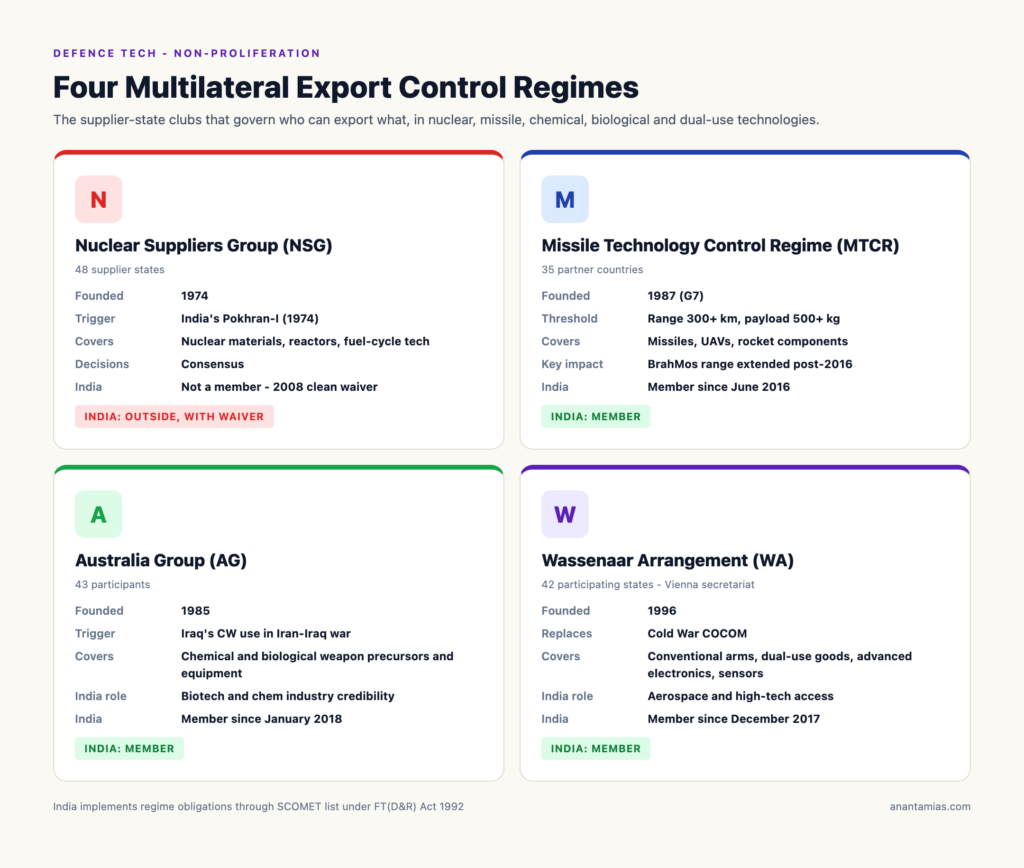
When two countries trade in conventional goods, normal commercial law applies. When they trade in goods that could become weapons of mass destruction or the means to deliver them, a different layer of rules kicks in. That layer is the system of multilateral export control regimes: voluntary clubs of supplier countries that agree to harmonize how they license sensitive exports of nuclear, missile, chemical, biological and dual-use technologies. The point is to prevent diversion to weapons programmes or rogue actors, while still allowing legitimate trade and scientific cooperation.
For India, these regimes are about much more than non-proliferation. They are about access. Membership in the right clubs means India’s defence research organisations can buy advanced sensors and inertial systems, ISRO can import critical rocket components, Indian biotech firms can export to regulated markets, and Indian missile programmes like BrahMos can break out of arbitrary range caps. Non-membership means waiting at the door, often paying premiums, and sometimes being denied outright.
Four regimes matter most: the Nuclear Suppliers Group (NSG), the Missile Technology Control Regime (MTCR), the Wassenaar Arrangement on Conventional Arms and Dual-Use Goods, and the Australia Group on chemical and biological weapon precursors. India is a member of three of these four. The exception is NSG, where China continues to block its entry. India’s 2008 NSG waiver, however, gives it most of the practical benefits of membership without the formal seat.
This guide walks through each regime, India’s current status, the BrahMos and 2008 waiver stories, and the policy implications.
Quick Facts: Export Control Regimes at a Glance
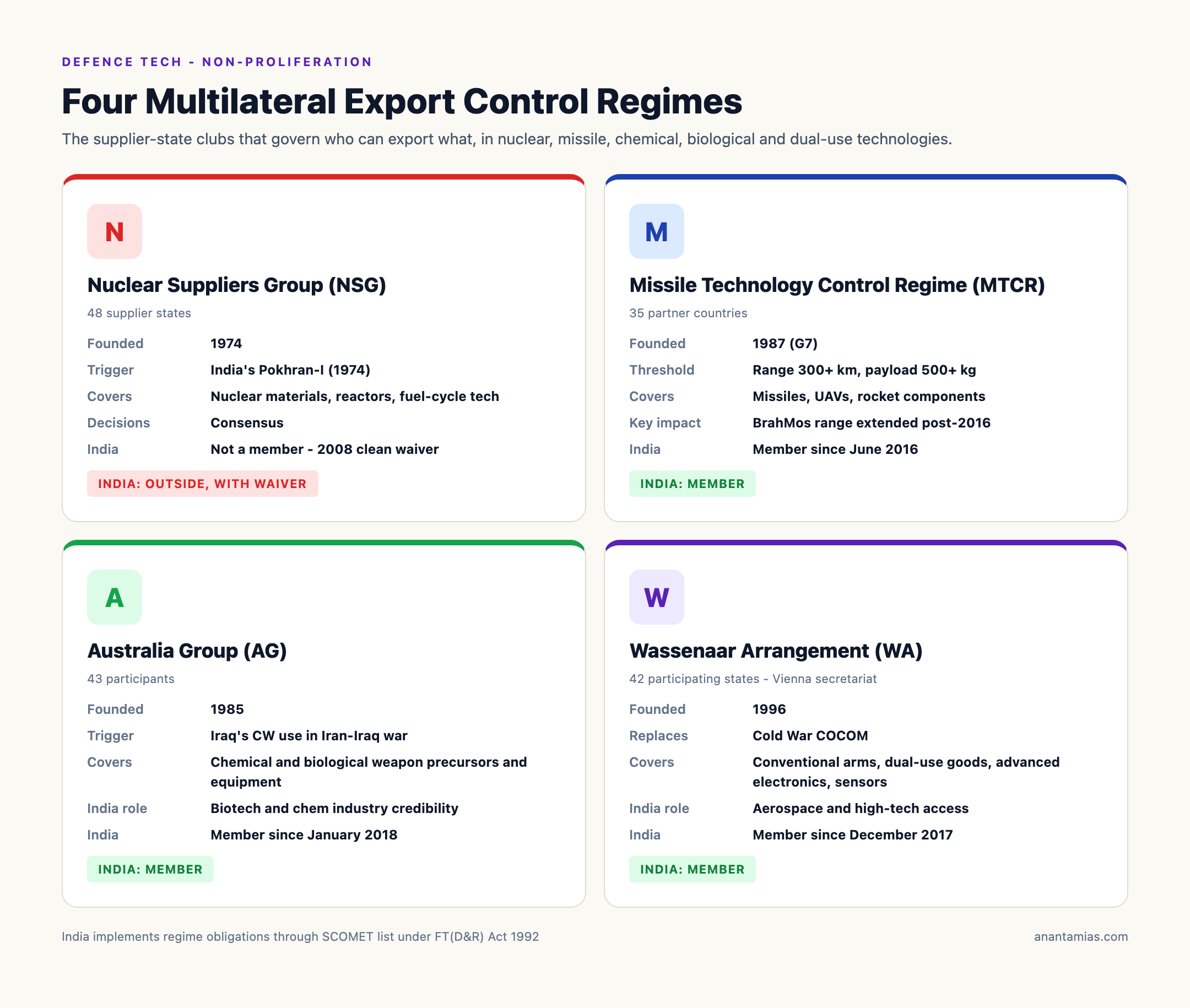
- Four major regimes: Nuclear Suppliers Group (NSG), Missile Technology Control Regime (MTCR), Wassenaar Arrangement (WA), and Australia Group (AG)
- NSG founded: 1974, in response to India’s first nuclear test (Smiling Buddha) in 1974
- MTCR founded: 1987, by the G7 countries to limit missile and UAV proliferation
- Australia Group founded: 1985, after Iraq’s use of chemical weapons in the Iran-Iraq war
- Wassenaar Arrangement founded: 1996, with secretariat in Vienna, replacing the Cold War era COCOM
- India in NSG: Not a member, but holds a 2008 unique waiver
- India in MTCR: Member since June 2016
- India in Wassenaar Arrangement: Member since December 2017
- India in Australia Group: Member since January 2018
- MTCR threshold: Missiles and UAVs with range over 300 km and payload over 500 kg
What Is a Multilateral Export Control Regime?
A multilateral export control regime is a voluntary, informal arrangement among supplier states that share a common interest in preventing the proliferation of specified technologies. The regime sets common control lists, common licensing standards and common information-sharing practices. There is no treaty in most cases, no formal organisation, and no enforcement body. Compliance depends on each member’s domestic export control law and on peer pressure within the club.
The lack of treaty status is sometimes a feature and sometimes a bug. It allows the regimes to update lists quickly, since they do not need to renegotiate a treaty every time a new technology emerges. It also lets them respond to changing geopolitical circumstances. But it means the rules are made by a small group of supplier states without broad participation from importing countries. For India, this asymmetry has been a recurring concern.
The four regimes complement each other. The NSG handles nuclear materials and equipment. The MTCR covers missiles and UAVs that could deliver weapons of mass destruction. The Australia Group focuses on chemical and biological weapons precursors. The Wassenaar Arrangement covers conventional weapons and dual-use goods like advanced electronics, sensors and machine tools. Together they shape the global rules for who can sell what to whom.
Background and Historical Context
The system started with nuclear technology. The 1968 Non-Proliferation Treaty (NPT) classified five countries as nuclear weapons states (China, France, Russia, the United Kingdom and the United States) and required all other signatories to forgo nuclear weapons in exchange for access to peaceful nuclear cooperation. India did not sign. The Indian view, dating to Jawaharlal Nehru, was that the NPT created a discriminatory two-tier system. India’s first nuclear test, Pokhran-I in 1974, code-named Smiling Buddha, used a peaceful nuclear explosion classification but was widely seen as a weapons-relevant test. The shock of this test directly produced the Nuclear Suppliers Group in 1974, a club of supplier states that agreed not to sell nuclear technology to non-NPT countries.
The MTCR followed in 1987, after the G7 became concerned about ballistic missile proliferation in the Middle East and South Asia. The Australia Group was set up in 1985 after Iraq’s chemical weapon use against Iran. The Cold War‘s end in 1991 unravelled the COCOM (Coordinating Committee for Multilateral Export Controls), the western club that had restricted exports to Soviet bloc countries, and the Wassenaar Arrangement replaced it in 1996 with a broader mandate covering conventional arms and dual-use technology.
For India, the 1990s and early 2000s were a period of comprehensive sanctions and technology denial. The 1998 Pokhran-II tests triggered fresh sanctions from the United States, Japan and several European countries. ISRO, DRDO and the Department of Atomic Energy operated under heavy export controls. The turning point came with the 2005 India-United States Civil Nuclear Initiative, which set in motion a sequence of diplomatic moves that culminated in the 2008 NSG clean waiver and, eventually, India’s entry into MTCR, Wassenaar and Australia Group between 2016 and 2018.
The wider strategic context, including India’s defence policy and internal security framework, is closely tied to these export control developments because procurement of advanced systems often depends on supplier-country licensing under these regimes.
The Nuclear Suppliers Group
The Nuclear Suppliers Group is a club of 48 supplier countries that controls the export of nuclear materials, equipment and related dual-use items. Its guidelines are not law in themselves. Each member implements them through national export control regulations. The NSG operates by consensus, which means any one member can block decisions on new members, on adding items to control lists or on granting waivers.
India is not a member. China has consistently blocked Indian membership, citing the principle that NSG membership requires NPT signature. India argues that other non-NPT countries with civilian nuclear programmes have either joined or received waivers, and that India’s track record on non-proliferation, including no transfer of sensitive technology to third parties, justifies admission.
India’s 2008 NSG clean waiver was a unique exception. Pushed by the United States and supported by Russia, France and the United Kingdom, the waiver allowed India to engage in civil nuclear trade with NSG members without joining the regime. The waiver permits India to import uranium from countries like Australia, Canada and Kazakhstan and to negotiate civil nuclear cooperation agreements. It does not give India a vote in NSG decisions. China abstained from the 2008 waiver but has actively blocked subsequent membership efforts, most prominently at the 2016 Seoul plenary.
The waiver has practical effects. Indian nuclear power plants can now access international fuel markets, and the safeguards regime for India’s civil reactors is administered through agreements with the International Atomic Energy Agency. India’s nuclear energy programme is largely a beneficiary of the post-2008 arrangement.
The Missile Technology Control Regime
The Missile Technology Control Regime, established by the G7 in April 1987, is the central international tool for limiting the spread of missile and unmanned aerial vehicle (UAV) technology that could deliver weapons of mass destruction. The MTCR identifies two control categories. Category I covers complete rocket systems and UAVs with a range over 300 kilometers and a payload over 500 kilograms, the threshold defined as MTCR-class. Category II covers components, materials and dual-use technologies for missile and UAV development.
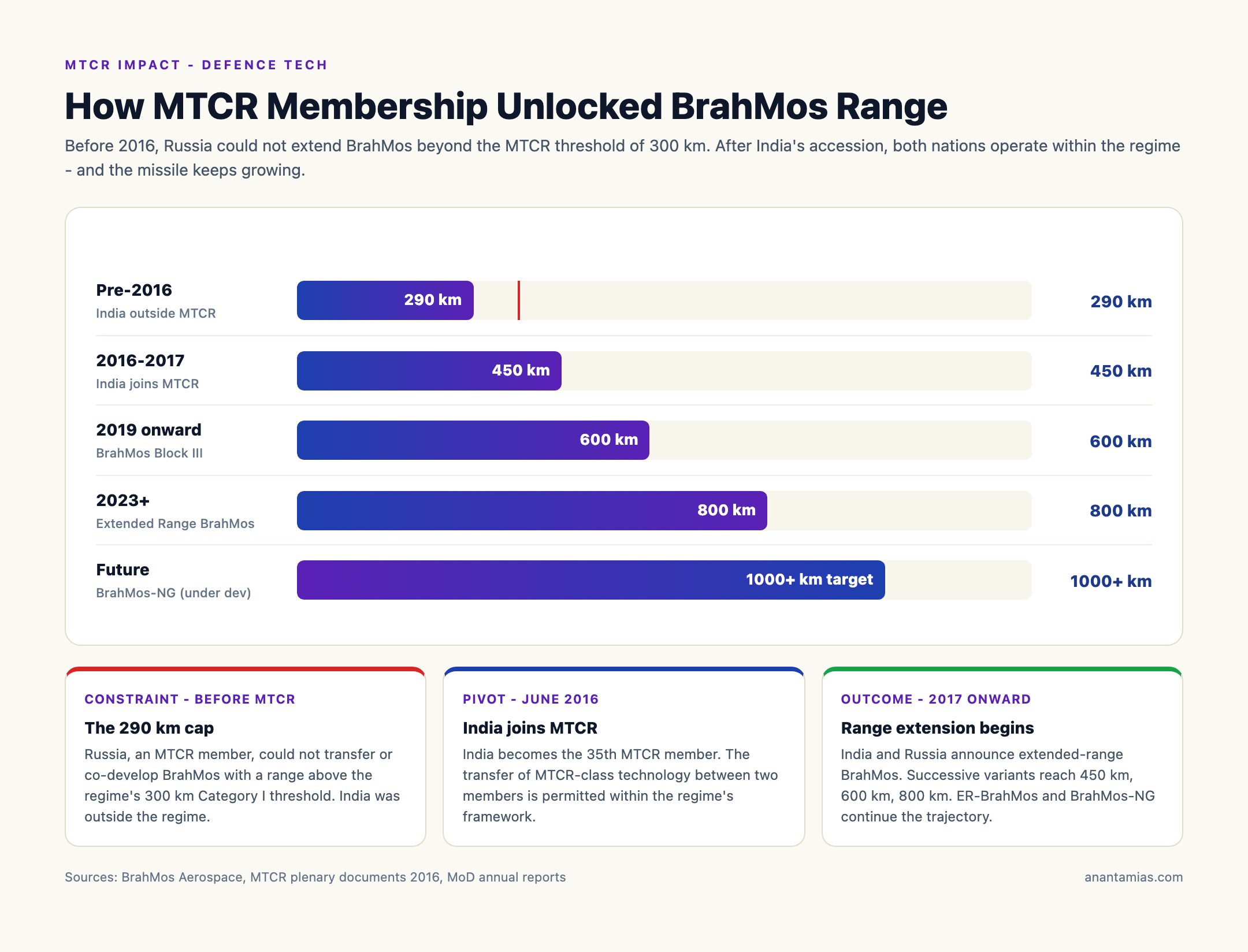
India became a full MTCR member in June 2016. Membership had several immediate benefits. The most visible is the BrahMos supersonic cruise missile, jointly developed with Russia. Before India joined the MTCR, Russia could not transfer or co-develop BrahMos with a range above 290 kilometers, because Russia is an MTCR member and the system would otherwise have crossed the Category I threshold. After Indian accession, both countries are MTCR members, the technology is being shared between members rather than transferred to a non-member, and the range can be extended. Successive variants have demonstrated ranges of 450 kilometers, with longer-range BrahMos-NG and the Extended Range BrahMos under development reaching 800 kilometers and beyond.
The MTCR also opened access to high-end UAVs. The MQ-9B Sea Guardian and Sky Guardian platforms, sold by the United States, are MTCR Category I systems and were not available to non-members on a routine basis. India’s purchase of Sea Guardians, finalised in 2024, became feasible primarily because of MTCR membership. The MTCR also allows India to participate in international UAV cooperation programs and to export Indian missile and rocket technology under regime-compliant licensing.
The Wassenaar Arrangement
The Wassenaar Arrangement on Export Controls for Conventional Arms and Dual-Use Goods and Technologies, signed in 1996 with the secretariat in Vienna, has 42 participating states. Its purpose is to promote transparency and responsibility in transfers of conventional arms and dual-use goods, defined as items that have both civilian and military applications. The control list includes advanced computers, certain types of lasers, sensors, navigation equipment, machine tools and cybersecurity tools.
India joined the Wassenaar Arrangement in December 2017. Membership lets India both buy and sell Wassenaar-controlled items as a recognized responsible state. For Indian industries in aerospace, defence electronics, semiconductors and high-end manufacturing, this is a major credibility upgrade. The same applies in reverse: Indian buyers find it easier to procure controlled items from other Wassenaar members because India is now subject to common rules.
The Wassenaar Arrangement is also where many cybersecurity-related export controls are agreed. The 2013 inclusion of intrusion software and surveillance technology in the Wassenaar lists has been particularly controversial within the technology and human rights communities. India has been a constructive participant in these debates since joining.
The Australia Group
The Australia Group was established in 1985 in response to the use of chemical weapons by Iraq during the Iran-Iraq war. It is named after the country that first proposed the arrangement. Its 43 members harmonize export controls on chemicals, biological agents and related equipment that could be used to make chemical or biological weapons. The control lists include precursors of nerve agents like sarin and VX, dual-use biological agents like Anthrax and equipment such as fermenters and cross-contamination systems used in chemical and biological production.
India joined the Australia Group in January 2018. The benefit for Indian biotech and chemical industries is access to international supply chains and credibility in regulated export markets. Indian firms exporting to the European Union, Japan and the United States benefit from being recognized as Australia Group-compliant suppliers. The Department of Pharmaceuticals and the Ministry of External Affairs jointly administer the implementation through the SCOMET (Special Chemicals, Organisms, Materials, Equipment and Technologies) list under the Foreign Trade (Development and Regulation) Act, 1992.
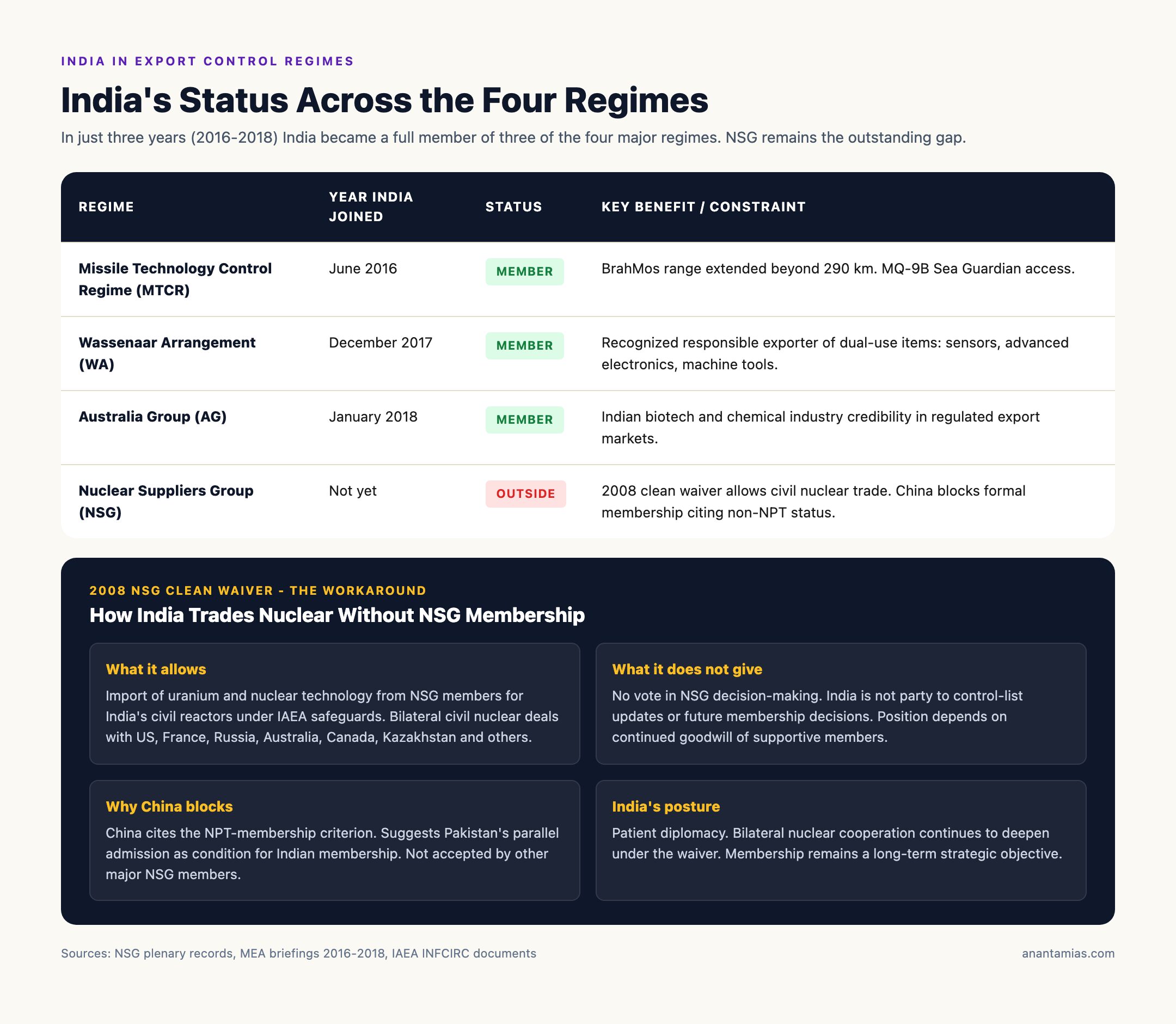
Comparative: India’s Status Across the Four Regimes
| Regime | Founded | Focus area | India’s status | Year joined or significant event |
|---|---|---|---|---|
| NSG (Nuclear Suppliers Group) | 1974 | Nuclear materials, reactors, dual-use nuclear technology | Not a member | 2008 unique clean waiver, blocked from membership by China |
| MTCR (Missile Technology Control Regime) | 1987 | Missiles and UAVs over 300 km range or 500 kg payload | Member | June 2016 |
| Australia Group (AG) | 1985 | Chemical and biological weapon precursors and equipment | Member | January 2018 |
| Wassenaar Arrangement (WA) | 1996 | Conventional arms and dual-use goods and technology | Member | December 2017 |
Why India Is Still Not in the NSG
The principal blocker to Indian NSG membership is China. The Chinese position rests on a procedural argument: NSG decisions are by consensus, and the Group has historically required NPT membership for full participation. China has therefore opposed Indian admission unless either the NPT criterion is changed or Pakistan is admitted alongside India. Most other major NSG members, including the United States, Russia, France, the United Kingdom and Japan, support Indian membership.
India’s argument has three parts. First, the NSG itself was created in response to India’s 1974 test, and excluding India today only freezes a four-decade-old situation. Second, India has a stronger non-proliferation record than several NSG members, including no transfer of sensitive technology to third parties and a robust domestic export control framework. Third, the 2008 clean waiver already recognises India’s exceptional status in nuclear trade, and formal membership is a logical next step.
The practical consequences of non-membership are limited but real. India can trade in nuclear fuel and technology under the 2008 waiver, but it has no formal voice in NSG rule-making, and updates to control lists or membership decisions are made without Indian participation. India’s policy approach has been patient diplomacy at successive plenaries and parallel deepening of bilateral civil nuclear agreements, rather than a confrontational posture.
Challenges and Strategic Implications
The export control system has structural challenges. First, it is supplier-driven and lacks legitimacy among many importing countries that see it as cartel-like. Second, the rapid evolution of technology, particularly in artificial intelligence, additive manufacturing and quantum technology, makes control lists hard to keep current. Third, enforcement is uneven, and several countries have used front companies and third-country routing to evade controls.
For India, the strategic implications are mixed. Membership in MTCR, Wassenaar and the Australia Group is a major upgrade in credibility and access. The remaining gap with NSG is more diplomatic than economic, given the 2008 waiver. India has used the regimes as platforms to push for new control lists in emerging technology, including export controls on cyber tools and additive manufacturing.
A continuing challenge is the consistency of Indian export control enforcement. The SCOMET list and the Foreign Trade Policy provide the legal architecture, but real-time monitoring of Indian exports against multiple regime control lists requires coordination across the Department of Commerce, the Department of Atomic Energy, the Department of Defence Production, ISRO and DRDO. India has invested in enforcement capacity and inspection regimes, but high-profile diversions in any sensitive sector could damage Indian credibility within the regimes.
Prelims Pointers
- The Nuclear Suppliers Group was founded in 1974 in response to India’s Pokhran-I (Smiling Buddha) nuclear test.
- India is not a member of the NSG but received a unique clean waiver in 2008.
- China has been the principal opponent of Indian NSG membership, citing non-NPT status.
- India became a member of the Missile Technology Control Regime in June 2016.
- The MTCR Category I threshold is missiles and UAVs with range over 300 km and payload over 500 kg.
- The BrahMos missile range was extended after India’s MTCR accession because both India and Russia are now members.
- India joined the Wassenaar Arrangement in December 2017.
- The Wassenaar Arrangement covers conventional arms and dual-use goods and technology, with 42 participating states.
- India joined the Australia Group in January 2018.
- The Australia Group was set up in 1985 after Iraq used chemical weapons in the Iran-Iraq war.
- The four regimes are voluntary, informal and operate by consensus rather than by treaty.
- India implements regime obligations through the SCOMET list under the Foreign Trade (Development and Regulation) Act.
Mains Practice Questions
- Discuss the four major multilateral export control regimes and analyze India’s membership status in each. (250 words)
- India’s accession to the MTCR in 2016 was a strategic milestone. Explain the immediate and long-term benefits, with specific reference to the BrahMos programme. (250 words)
- Why has India not yet been admitted to the Nuclear Suppliers Group despite the 2008 waiver? Examine the principal arguments on both sides. (250 words)
- Multilateral export control regimes are voluntary supplier clubs without treaty status. Critically examine their effectiveness and India’s role within them. (150 words)
Way Forward
India’s export control posture has matured rapidly between 2008 and 2018, but the next decade requires a different kind of work. First, NSG membership remains a strategic priority. India should continue patient diplomatic engagement at successive plenaries and use the bilateral civil nuclear partnerships, particularly with the United States, France and Russia, to demonstrate that membership is the natural endpoint of the post-2008 arrangement. Pressure on China to reconsider the consensus block is unlikely to produce quick results, but parallel coalition-building among supportive members continues to matter.
Second, domestic export control implementation needs to keep pace. The SCOMET list should be reviewed annually and aligned with each regime’s updates. Industry awareness, particularly among smaller defence and biotech firms, should be strengthened through outreach by the Directorate General of Foreign Trade and the relevant administrative ministries. End-use monitoring and post-shipment verification capabilities should be modernised to match the standards expected within MTCR, Wassenaar and the Australia Group.
Third, India should help shape regime evolution in emerging technologies. As artificial intelligence, quantum technology, semiconductor manufacturing and synthetic biology mature, control lists will need to evolve. India’s status as both a major exporter and importer of these technologies, combined with its democratic credentials, gives it standing to push for balanced and effective rules. Coordinated input from MEA, MeitY, the Department of Biotechnology and DRDO can make Indian positions more coherent inside the regimes.
Finally, the export control architecture is one piece of a wider strategic technology policy that includes biotechnology, 5G and telecom, semiconductor manufacturing and critical minerals. India’s policy needs to treat these as connected rather than separate fields.
Frequently Asked Questions
What are the four major multilateral export control regimes?
The four major regimes are the Nuclear Suppliers Group (NSG), the Missile Technology Control Regime (MTCR), the Australia Group on chemical and biological weapons precursors, and the Wassenaar Arrangement on conventional arms and dual-use goods. Together they cover the main categories of sensitive exports.
Why is India not a member of the NSG?
China has blocked Indian NSG membership at successive plenaries, citing the absence of Indian signature on the Nuclear Non-Proliferation Treaty. Most other major NSG members support Indian admission, but the Group operates by consensus and a single objection prevents new entries.
What is the 2008 NSG waiver and why does it matter?
In September 2008, the NSG granted India a unique clean waiver that allows civil nuclear trade with India even though India is not a member and not an NPT signatory. The waiver lets India import uranium and nuclear technology from member countries and made the India-US Civil Nuclear Initiative operational.
How did MTCR membership help the BrahMos missile?
Before India joined the MTCR in 2016, Russia could not co-develop or transfer BrahMos with a range above 290 km, because the missile would have crossed the MTCR Category I threshold and Russia is an MTCR member. After Indian membership, both countries are inside the regime, and the BrahMos range has been extended through subsequent variants to 450 km and beyond.
What is the difference between the Wassenaar Arrangement and the Australia Group?
The Wassenaar Arrangement covers conventional arms and dual-use goods and technologies, including advanced electronics, sensors and machine tools. The Australia Group covers precursors and equipment relevant to chemical and biological weapons. They have different control lists, though both rely on member states for implementation.
When did India join MTCR, Wassenaar and Australia Group?
India joined the Missile Technology Control Regime in June 2016, the Wassenaar Arrangement in December 2017, and the Australia Group in January 2018. These three accessions in three consecutive years represent the most significant deepening of Indian engagement with the global non-proliferation architecture.
Are these regimes treaties under international law?
No. All four regimes are voluntary, informal arrangements among supplier states. They operate by consensus, set common control lists and licensing standards, and rely on each member’s national law for implementation. There is no treaty, no enforcement body and no international tribunal.
What is SCOMET and how does it relate to these regimes?
SCOMET stands for Special Chemicals, Organisms, Materials, Equipment and Technologies. It is the Indian export control list maintained under the Foreign Trade (Development and Regulation) Act, 1992. SCOMET aligns Indian controls with the lists of MTCR, Wassenaar, the Australia Group and other obligations. The Directorate General of Foreign Trade administers it.
Does NSG non-membership affect Indian nuclear power generation?
In practice the impact is limited because of the 2008 waiver. India can import uranium from Australia, Canada, Kazakhstan and Russia, and Indian civil reactors are under International Atomic Energy Agency safeguards. The main gap is that India has no vote on NSG rule-making, which can affect the long-term shape of the global nuclear trade architecture.
Which Indian agencies handle export control implementation?
The Department of Commerce through the Directorate General of Foreign Trade administers the SCOMET list. The Department of Atomic Energy handles nuclear-related approvals. The Department of Defence Production, the Ministry of External Affairs, ISRO and DRDO contribute case-by-case assessments. The system is coordinated through inter-ministerial committees on sensitive exports.
Tell Google you want more of this.
Add Anantam IAS as a preferred sourceOne tap, and this site shows up more often in your own Top Stories, AI Overviews and AI Mode. Remove it any time.