Why in News?
The Gujarat government unveiled its first-ever dedicated Data Centre Policy (2026-29) on July 9, 2026. Chief Minister Bhupendra Patel launched the policy in Gandhinagar, pitching the state as India’s preferred destination for hyperscale data centres, cloud computing and AI-driven digital infrastructure, The Hindu reported.
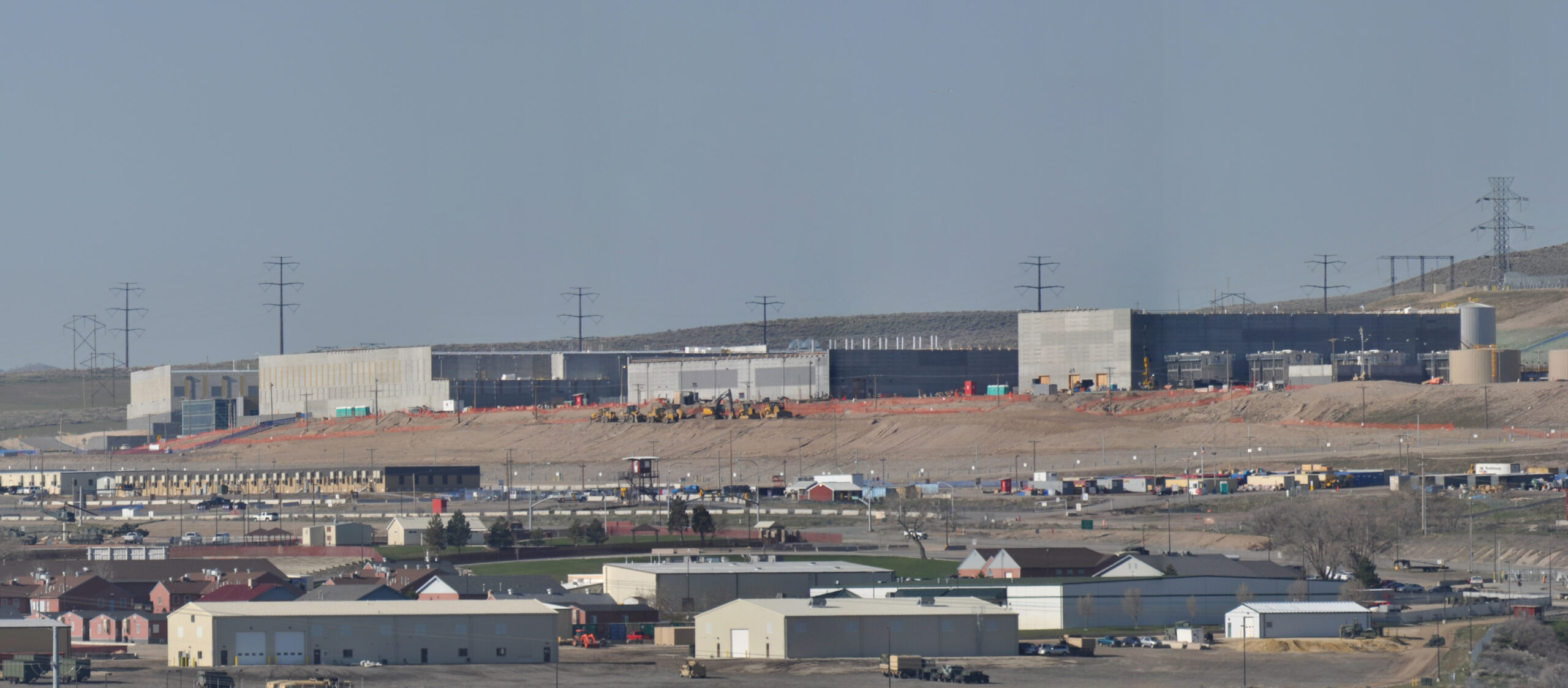
The policy targets investments of ₹6 lakh crore and the creation of 7.5 GW of data centre capacity over the three-year policy period — a striking number against India’s current installed base of roughly 2-3 GW across about 200 data centres.
- Policy period runs 2026-29; launched by CM Bhupendra Patel in Gandhinagar on July 9, 2026.
- Headline targets: ₹6 lakh crore in investment and 7.5 GW of data centre capacity.
- Incentive basket covers capital subsidy, interest subsidy, power-tariff support, SGST reimbursement, stamp-duty and registration exemption, and aid for captive desalination plants.
- At least 51% of electricity consumed by data centres must come from green energy sources.
- The state has already received proposals for about 10 GW of capacity and plans to facilitate around 8 GW, Science and Technology Minister Arjun Modhwadia said.
- Dholera is the policy’s centrepiece — Deputy Chief Minister Harsh Sanghavi said it could become the “world’s largest Data Center City”.
The development matters in the context of:
- India generates nearly 20% of the world’s data but holds only about 3% of global data centre capacity — the demand-supply gap every state policy is chasing.
- The Union Budget 2026 announced a 20-year tax holiday for global data centre infrastructure providers, and data centres above 5 MW already enjoy infrastructure status (2022) — Gujarat’s policy stacks state incentives on top of this central push.
- Uttar Pradesh’s cabinet cleared its own Data Centre Policy 2026 just two days earlier, targeting ₹2 lakh crore — evidence of intensifying competitive federalism in digital infrastructure.
- AI workloads, the DPDP Act 2023 data-governance regime and RBI’s payment-data localisation norms are all pushing compute and storage demand onshore.
UPSC Relevance
Prelims Relevance
- Gujarat Data Centre Policy (2026-29) — targets ₹6 lakh crore investment, 7.5 GW capacity; launched July 2026.
- Green-energy mandate — minimum 51% of a data centre’s electricity from renewable sources.
- Power incentives — ₹1 per unit tariff subsidy for 20 years; 100% electricity-duty reimbursement for 20 years.
- Capital support — 2.5% capital subsidy on eligible fixed capital investment for projects in the Dholera region; interest subsidy up to 4% for 10 years (annual cap ₹25 crore).
- Water — assistance for captive desalination plants: 20% of capex or ₹2 crore per MLD; no draw-down on water meant for agriculture or industry.
- India’s data-centre base — about 200 data centres with 2-3 GW capacity; the US has ~5,500 and the UK 500+.
- Global picture — ~12,000 data centres worldwide; the US and China together hold nearly 70% of capacity.
- Infrastructure status — accorded to data centres above 5 MW IT load via the Harmonised Master List (2022).
- Cable landing stations — Gujarat will soon have two operational stations, boosting international connectivity for hyperscale operators.
- Dholera SIR — greenfield industrial city on the Delhi-Mumbai Industrial Corridor; upcoming airport and a proposed semi-high-speed rail link to Ahmedabad.
Mains Relevance
GS Paper 3
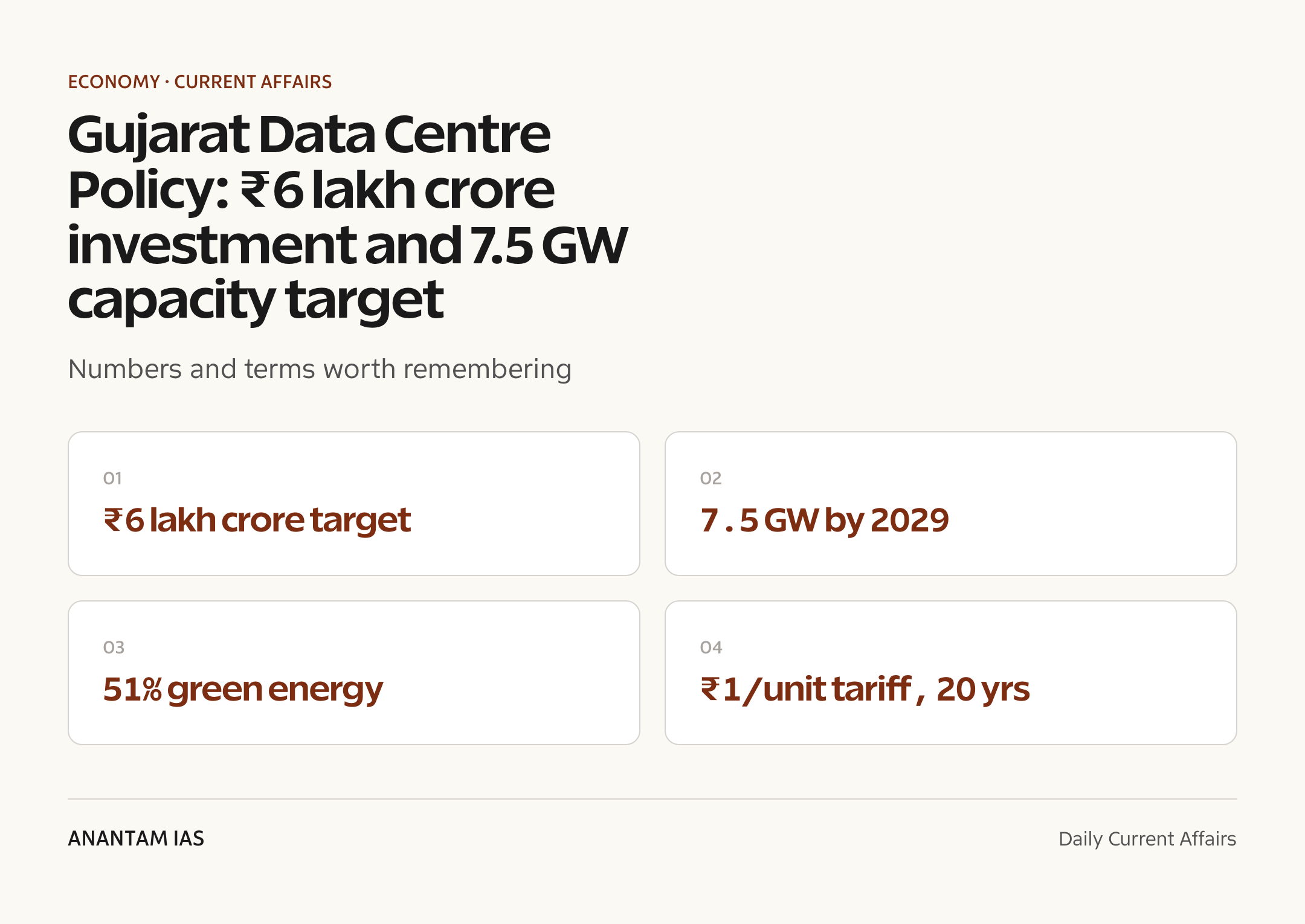
- Infrastructure — data centres as the physical backbone of the digital economy; role of fiscal incentives (capital/interest/tariff subsidies) in crowding in private investment.
- Energy — reconciling power-hungry AI compute with the 51% green-energy mandate; data centres as anchor demand for renewables.
- Investment climate — state incentive competition (Gujarat vs UP vs Telangana vs Maharashtra vs Tamil Nadu) and the risk of a subsidy race to the bottom.
- Water security — desalination-first sourcing as a template for siting water-intensive industry in water-stressed regions.
GS Paper 2
- Federalism — competitive federalism in industrial policy; Centre’s tax holiday plus state subsidies as layered (cooperative) incentives.
- Governance — data localisation and the DPDP Act 2023 as demand drivers for domestic storage; single-point nodal officers and hand-holding as ease-of-doing-business tools.
Essay
- Data is the new oil, but the refinery needs land, power and water — the material cost of the digital economy.
- Competitive federalism: when states compete for capital, who wins — the investor or the citizen?
Background and Context
What the Gujarat Data Centre Policy 2026-29 offers
The policy bundles fiscal and non-fiscal incentives designed for capital-heavy hyperscale projects.
- Capital subsidy of 2.5% on eligible fixed capital investment for projects in the Dholera region.
- Interest subsidy of up to 4% for 10 years, capped at ₹25 crore a year.
- Power support: ₹1 per unit tariff subsidy for 20 years and 100% reimbursement of electricity duty for 20 years.
- Complete exemption from stamp duty and registration charges, plus reimbursement of SGST on eligible plant, machinery, buildings, infrastructure and operational services for specified periods.
- Desalination assistance: 20% of eligible capital expenditure or ₹2 crore per MLD for captive desalination plants, subject to limits.
- Non-fiscal support: stakeholder consultations, identified land parcels, and senior nodal officers for hand-holding and faster approvals.
The sustainability conditions built into the policy
Gujarat has tied its incentives to green power and non-competing water use — unusual detail for a state industrial policy.
- At least 51% of electricity consumed by data centres must come from green energy sources.
- Water needs must be met through desalination plants rather than drawing on resources meant for agriculture or industry.
- Chief Secretary M.K. Das argued Gujarat’s long coastline and abundant renewable energy make it naturally suited to the sector’s high power and water demands.
- Data centres run 24×7 and cooling alone can consume a large share of their power — pairing them with renewable energy capacity is now standard practice in mature markets.
Why states are racing for data centres: the demand math
The investment case rests on a stark mismatch between the data India produces and the capacity it hosts.
- India generates nearly 20% of the world’s data but accounts for only about 3% of global data centre capacity, Science and Technology Secretary P. Bharati noted at the launch.
- Globally there are around 12,000 data centres; the United States and China together hold nearly 70% of world capacity.
- India has roughly 200 data centres with 2-3 GW capacity, against about 5,500 in the US and more than 500 in the UK.
- Demand drivers: AI training and inference, cloud computing, digital payments, e-commerce, electronics manufacturing and streaming — all data-intensive and growing.
- Regulatory pull adds to market pull: RBI’s 2018 payment-data localisation mandate and the compliance architecture of the DPDP Act 2023 favour storing and processing Indian data within India.
Dholera: the designated data centre city
The policy’s spatial bet is Dholera, the greenfield special investment region south of Ahmedabad.
- Deputy CM Harsh Sanghavi said demand in Dholera already exceeds twice the 7.5 GW envisaged under the policy, and called it a potential “world’s largest Data Center City”.
- The 2.5% capital subsidy is specifically tied to the Dholera region, steering hyperscale projects to the greenfield site.
- Supporting infrastructure: the upcoming Dholera airport and a proposed semi-high-speed rail link between Ahmedabad and Dholera.
- The state is also developing Dholera as a hub for Global Capability Centres (GCCs), pairing compute infrastructure with services employment.
- Connectivity: Gujarat will soon have two operational cable landing stations, with a third project expected — critical for hyperscale and cloud operators moving traffic internationally.
The central policy scaffolding beneath state schemes
Gujarat’s subsidies stack on top of an increasingly generous central regime for digital infrastructure.
- The Union Budget 2026 announced a 20-year tax holiday for global data centre infrastructure providers — CM Patel cited it as an accelerant for state-level investment.
- Data centres with IT load above 5 MW were granted infrastructure status in 2022 via the Harmonised Master List, easing access to long-tenor, cheaper credit.
- A draft National Data Centre Policy circulated by MeitY in 2020 was never notified; the Centre has instead used enabling measures — infrastructure status, the tax holiday, and the Digital India ecosystem.
- The IndiaAI Mission’s public GPU-compute procurement and the growth of AI in India assure baseline demand for domestic compute capacity.
Competitive federalism: how other states compare
Gujarat is a late but aggressive entrant into a field several states already occupy.
- Uttar Pradesh approved its Data Centre Policy 2026 on July 7 — two days before Gujarat — targeting ₹2 lakh crore investment and 50,000 jobs.
- Telangana, Maharashtra and Tamil Nadu are the established hubs Gujarat says it wants to compete with; Mumbai, Chennai and Hyderabad host most current capacity.
- Typical state offers elsewhere: Maharashtra’s electricity-duty exemption up to 15 years, Telangana’s 100% stamp-duty reimbursement and green-power bonuses, Tamil Nadu’s concessional tariffs and single-window clearance.
- Officials called Gujarat’s framework a first-of-its-kind state policy; in practice it’s Gujarat’s first dedicated data centre policy, entering a race where half a dozen states already run incentive schemes.
- The upside of the contest is faster infrastructure roll-out; the risk is a subsidy race where states outbid each other with foregone revenue for footloose capital.
Way Forward
Grid and green-power readiness
- Back the 51% green-energy mandate with firm supply — round-the-clock renewable contracts, storage, and transmission build-out — so compliance doesn’t fall back on fossil power.
- Plan grid capacity ahead of demand: 7.5 GW of data centre load is comparable to the peak demand of a mid-sized state.
Guard against incentive over-reach
- Publish transparent cost-benefit reviews of subsidies against jobs and GSDP outcomes — data centres are capital-intensive but employ relatively few people per rupee invested.
- Coordinate through a notified national framework so state competition complements, rather than cannibalises, the central tax holiday.
Water and local-economy safeguards
- Enforce the desalination-only water rule with metering and audits, given Gujarat’s semi-arid interior.
- Pair compute parks with skilling and GCC linkages so local employment extends beyond construction.
Conclusion
Gujarat’s Data Centre Policy 2026-29 is the clearest sign yet that digital infrastructure has become the new battleground of state industrial policy. The ₹6 lakh crore and 7.5 GW targets are ambitious against India’s current 2-3 GW base, but the proposal pipeline of 10 GW suggests genuine investor appetite in the AI build-out cycle.
For the exam, treat this as a layered story: a global demand-supply gap (20% of data, 3% of capacity), a central scaffolding (infrastructure status, 20-year tax holiday), and state-level competitive federalism with sustainability conditions attached. The green-energy and desalination mandates are the policy’s most examinable design features — and its hardest tests.
UPSC Practice Questions
Prelims MCQ 1
With reference to the Gujarat Data Centre Policy (2026-29), consider the following statements:
- It targets investments of ₹6 lakh crore and the creation of 7.5 GW of data centre capacity.
- It mandates that at least 51% of the electricity consumed by data centres must come from green energy sources.
- It is the first data centre policy announced by any Indian state.
How many of the above statements are correct?
(a) Only one (b) Only two (c) All three (d) None
Answer: (b) Only two
Explanation:
Statements 1 and 2 are correct — the policy targets ₹6 lakh crore and 7.5 GW, with a 51% green-energy mandate and desalination-based water sourcing. Statement 3 is incorrect: it is Gujarat’s first dedicated data centre policy, but states such as Telangana, Maharashtra, Tamil Nadu and Uttar Pradesh already have their own data centre policies.
Prelims MCQ 2
Which of the following best describes the ‘infrastructure status’ granted to data centres in India in 2022?
(a) All data centres were exempted from corporate income tax for 20 years (b) Data centres above 5 MW IT load were included in the Harmonised Master List, easing access to long-tenor institutional credit (c) Data centres were brought under the regulatory control of TRAI (d) State governments were barred from levying electricity duty on data centres
Answer: (b) Data centres above 5 MW IT load were included in the Harmonised Master List, easing access to long-tenor institutional credit
Explanation:
In 2022 the Centre included data centres with IT load above 5 MW in the Harmonised Master List of infrastructure sub-sectors. This improves access to cheaper, longer-tenor financing. The 20-year tax holiday is a separate Union Budget 2026 announcement, not part of infrastructure status.
UPSC Mains Questions
- Data centres are the physical backbone of the digital economy, but they are intensive consumers of land, power and water. In the light of Gujarat’s Data Centre Policy 2026-29, examine how states can attract digital infrastructure investment without compromising energy and water sustainability.
- Competition among Indian states to attract data centre investments reflects both the promise and the perils of competitive federalism. Discuss, with reference to recent state data centre policies and the Centre’s enabling measures for the sector.
Source: The Hindu.
Frequently Asked Questions
What is the Gujarat Data Centre Policy 2026-29?
It is Gujarat’s first dedicated policy for data centres, launched on July 9, 2026 by Chief Minister Bhupendra Patel. It targets ₹6 lakh crore of investment and 7.5 GW of data centre capacity over 2026-29 through capital, interest, power-tariff and SGST incentives plus stamp-duty exemption.
What are the key incentives under the policy?
A 2.5% capital subsidy for Dholera-region projects, interest subsidy up to 4% for 10 years (capped at ₹25 crore a year), ₹1 per unit power-tariff subsidy and 100% electricity-duty reimbursement for 20 years, SGST reimbursement, stamp-duty exemption, and desalination-plant assistance of 20% of capex or ₹2 crore per MLD.
What green conditions does the policy impose?
At least 51% of the electricity consumed by data centres must come from green energy sources, and water requirements must be met through captive desalination plants rather than supplies meant for agriculture or industry.
Why is Dholera central to the policy?
The capital subsidy is tied to the Dholera region, where investor demand already exceeds twice the policy’s 7.5 GW target. With an upcoming airport, a proposed semi-high-speed rail link to Ahmedabad and Global Capability Centre plans, the state projects Dholera as a future data centre city.
How big is India’s data centre gap?
India generates nearly 20% of the world’s data but hosts only about 3% of global data centre capacity — roughly 200 data centres totalling 2-3 GW, against about 5,500 in the United States. The US and China together hold nearly 70% of global capacity.
Is this India’s first state data centre policy?
No. It is Gujarat’s first dedicated data centre policy. States such as Telangana, Maharashtra, Tamil Nadu and Uttar Pradesh already operate data centre policies; UP approved its Data Centre Policy 2026 two days before Gujarat’s launch.
Tell Google you want more of this.
Add Anantam IAS as a preferred sourceOne tap, and this site shows up more often in your own Top Stories, AI Overviews and AI Mode. Remove it any time.