

Why in News?
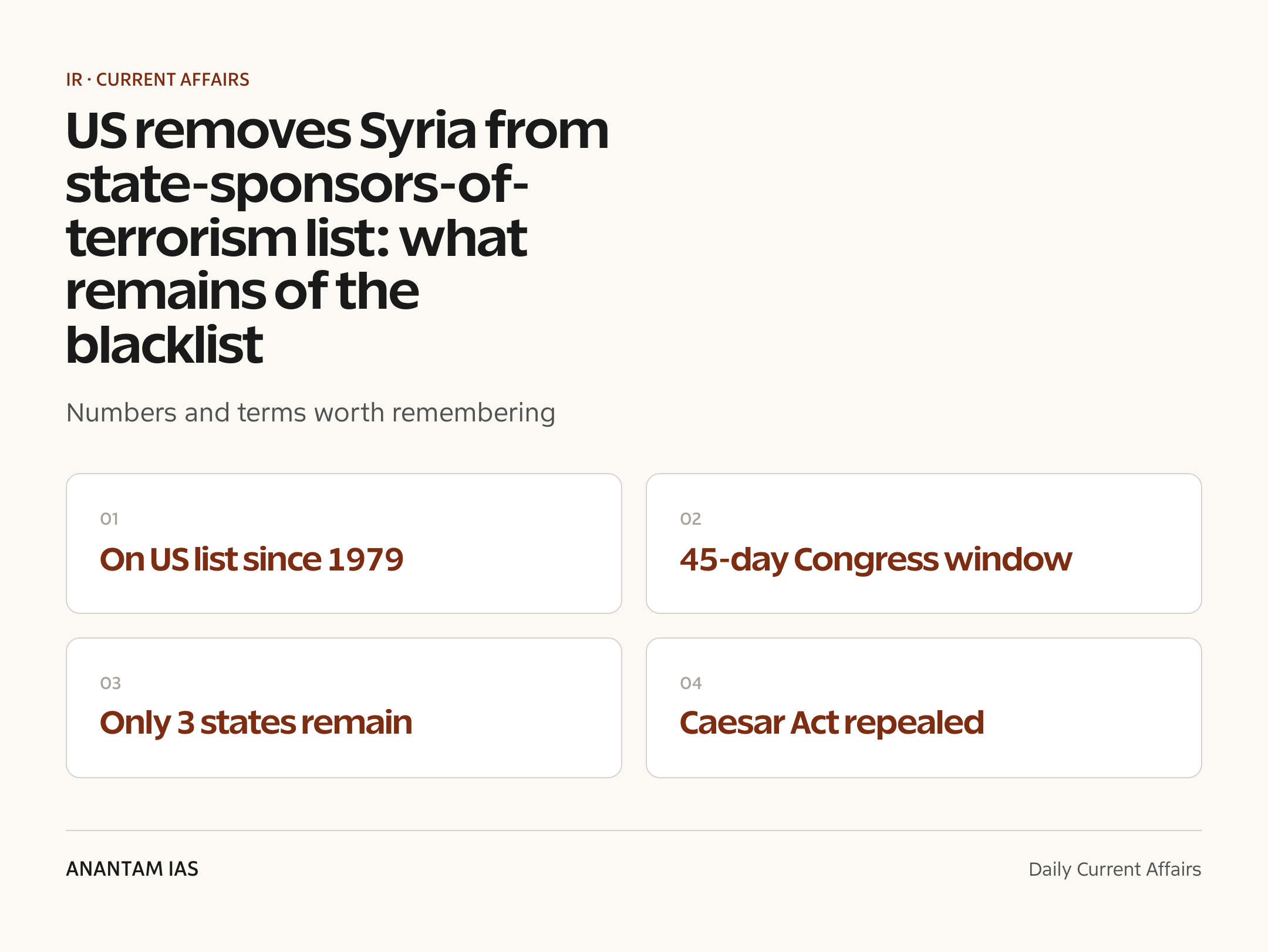
The United States announced on July 8, 2026 that it will remove Syria from its State Sponsors of Terrorism (SST) list, ending a designation in place since 1979. Secretary of State Marco Rubio notified the US Congress, and the delisting takes effect in 45 days unless lawmakers block it, The Hindu reported.
The move came as President Donald Trump met Syrian President Ahmed al-Sharaa on the sidelines of a NATO summit in Ankara, Turkey. With Syria out, only Iran, North Korea and Cuba remain on the US terror blacklist.
- Rubio said the delisting followed “formal assurances” from Sharaa that Syria will not support acts of international terrorism in future.
- Syria had carried the SST tag since December 1979 — the longest continuous designation ever removed from the list.
- The step completes a sanctions unwind that began after the December 2024 fall of the Assad family, which had ruled Syria for over five decades.
- The US Congress had already repealed the Caesar Act secondary sanctions through the NDAA for FY2026, signed in December 2025.
- Washington went ahead despite reservations from Israel, which has repeatedly struck targets inside Syria, and without a Syria-Israel peace deal.
The development matters in the context of:
- The SST designation is the harshest unilateral US sanctions instrument — it blocks arms sales, dual-use exports, US foreign assistance and exposes the state to terrorism lawsuits in US courts, so its removal is the real gateway for investment into Syria’s reconstruction.
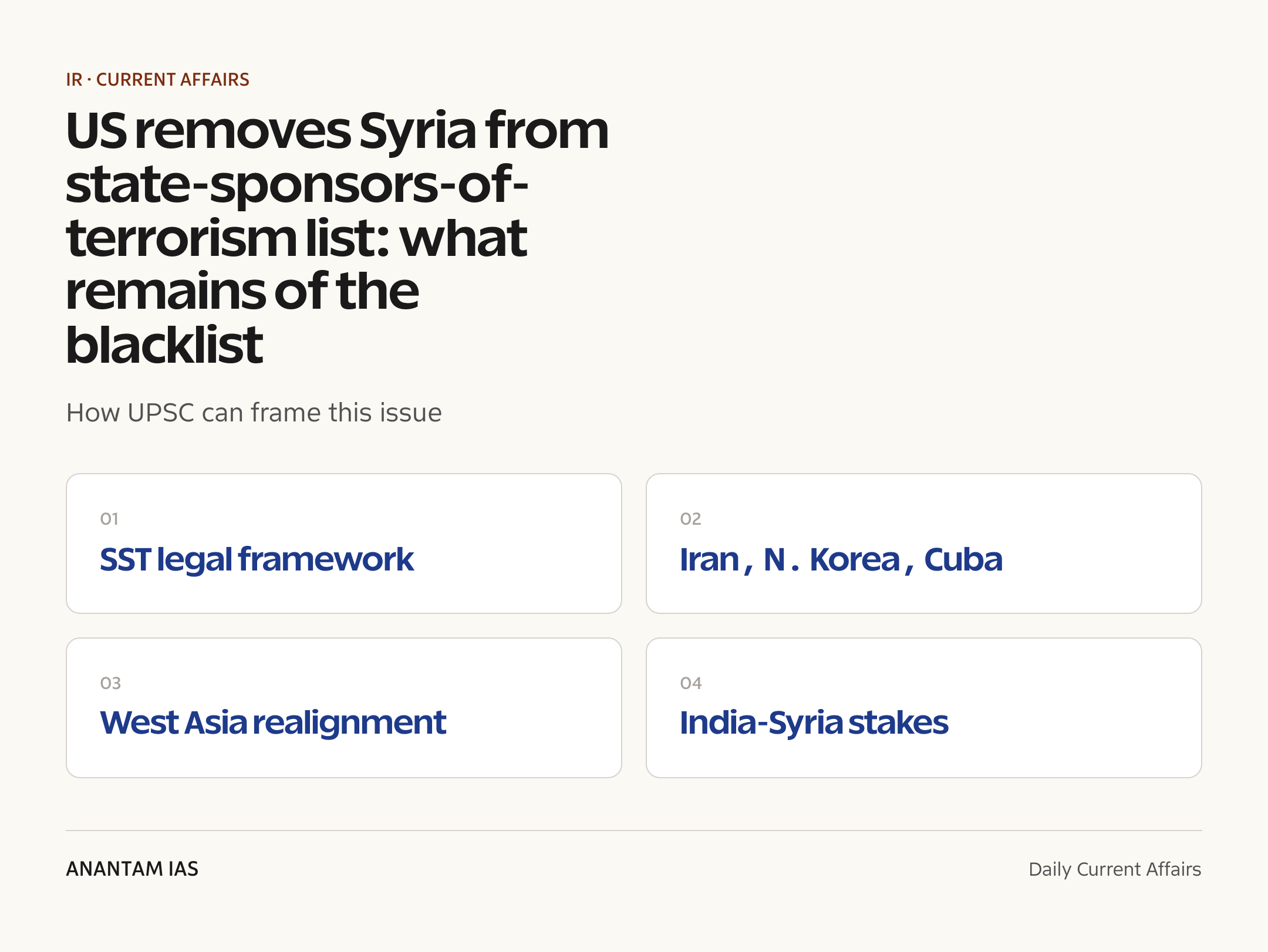
- For India, a stabilising, sanctions-free Syria reopens frozen stakes — the Tishreen power project line of credit and ONGC Videsh oil investments — and tests India’s strategic autonomy in a realigning West Asia.
UPSC Relevance
Prelims Relevance
- State Sponsors of Terrorism (SST) — a US State Department designation for countries judged to have “repeatedly provided support for acts of international terrorism”; it is a unilateral US instrument, not a UN list.
- Post-delisting, the SST list has three members: Iran (1984), North Korea (relisted 2017) and Cuba (relisted 2021).
- Syria was one of the original designees on the first SST list of December 1979.
- Delisting procedure: the President/Secretary of State notifies Congress; removal takes effect after 45 days unless Congress blocks it, with certification that the state has not supported terrorism for the preceding six months plus assurances for the future.
- Caesar Syria Civilian Protection Act, 2019 — US law imposing secondary sanctions on dealings with the Assad government; repealed by Section 6211 of the NDAA FY2026 (December 2025).
- Ahmed al-Sharaa — Syria’s leader after the December 2024 ouster of Bashar al-Assad; earlier led the group Hayat Tahrir al-Sham.
- The UN’s separate framework is the UNSC 1267 sanctions regime (ISIL/Al-Qaida list), which targets entities and individuals, not states.
- India-Syria economic footprint: USD 240 million line of credit for the Tishreen thermal power plant extension and ONGC Videsh stakes in Block-24 and Al Furat Petroleum (suspended since 2012).
- Past SST removals: Iraq (2004), Libya (2006), Sudan (December 2020) after the Abraham Accords-linked deal.
Mains Relevance
GS Paper 2
- Unilateral sanctions as instruments of foreign policy — how the SST designation differs from UN sanctions, and what its use and reversal say about US statecraft.
- West Asia realignment: US-Syria normalisation, the Abraham Accords track, Israel’s reservations and Turkey’s role as venue and backer.
- India’s West Asia policy and strategic autonomy — balancing Israel, Iran, the Gulf and now a post-Assad Syria; scope for reviving development partnership and energy assets.
- Effect of great-power certification politics on international law — a state’s ‘terror sponsor’ status turning on bilateral bargains rather than multilateral process.
GS Paper 3
- Terror financing and state support to non-state actors — why state sponsorship is harder to police than organisational listing under FATF and UNSC regimes.
- Sanctions and the world economy: how secondary sanctions like the Caesar Act chill third-country trade, and what their repeal means for reconstruction finance.
Essay
- Sanctions rarely change regimes; regimes change sanctions — coercion and reconciliation in world politics.
- In diplomacy there are no permanent blacklists, only permanent interests.
Background and Context
What the State Sponsors of Terrorism designation is
The SST tag is the most consequential unilateral sanctions label in US law, resting on three statutes.
- The Secretary of State designates a country under Section 1754(c) of the Export Control Reform Act, 2018, Section 40 of the Arms Export Control Act and Section 620A of the Foreign Assistance Act, 1961 if it has “repeatedly provided support for acts of international terrorism”.
- Four broad penalty baskets follow: a ban on arms exports and sales; strict controls on dual-use exports; prohibition of most US economic assistance; and miscellaneous financial restrictions, including US opposition to World Bank/IMF lending.
- A designated state loses part of its sovereign immunity: under the terrorism exception to the Foreign Sovereign Immunities Act, victims can sue it for damages in US courts.
- The tag also creates legal risk for third parties — businesses dealing with a listed state face exposure inside the US, which is why Trump’s earlier sanctions relief for Syria had only a muted effect while the SST label survived.
- It is a bilateral, political instrument — distinct from the UN’s 1267 ISIL/Al-Qaida sanctions list, which targets individuals and entities through the Security Council.
Why Syria sat on the list for 47 years
Syria was on the very first SST list and stayed there through both Assads.
- Washington listed Syria in December 1979, alongside Libya, Iraq and South Yemen, at the creation of the list.
- Under Hafez al-Assad and later Bashar al-Assad, Damascus hosted Palestinian militant groups and was alleged to be directly involved in incidents such as the 1986 attempted bombing of an El Al airliner in London.
- In recent decades the designation rested mainly on Syria’s alliance with Iran and its supply corridor to Hezbollah, the Lebanese Shia militant movement.
- The Syrian civil war after 2011 added layered sanctions on top of the SST tag, contributed to the rise of the Islamic State and produced one of the world’s largest refugee crises.
How a state exits the blacklist
Delisting is an executive act with a congressional check — and it has a fixed clock.
- The administration must send Congress a report 45 days before rescission, certifying the government concerned has not supported international terrorism in the preceding six months and has given assurances for the future.
- Rubio notified Congress on July 8, 2026; the removal becomes effective automatically unless lawmakers pass a blocking measure — considered unlikely.
- The certification leans on Sharaa’s formal assurances against supporting terrorism, plus his government’s cooperation against the Islamic State.
- Precedents: Iraq (removed 1982, relisted 1990, removed 2004), Libya (2006), South Yemen (1990, on unification) and Sudan (December 2020, tied to its normalisation with Israel).
Who remains: Iran, North Korea, Cuba
The blacklist is now a trio, and each entry carries its own politics.
- Iran — designated in January 1984; the longest-standing current member, cited for backing Hezbollah and regional proxy groups.
- North Korea — first listed in 1988, removed in 2008 during nuclear diplomacy, and relisted in November 2017.
- Cuba — removed in 2015 during the Obama-era thaw, then relisted in January 2021 in the closing days of the first Trump administration, a move The Hindu notes was controversial and pressure-driven.
- The churn shows the list works as a diplomatic lever: states move on and off with the state of bilateral bargaining as much as with verified conduct.
The Sharaa turn and the sanctions unwind
Delisting is the final layer of a rapid, staged dismantling of the Syria sanctions wall.
- The Assad dynasty fell in December 2024; Ahmed al-Sharaa, a former jihadist commander who has recast himself as a unifying civilian leader, took charge and swapped fatigues for a suit.
- Through 2025 Washington eased pressure in steps — general licences, a Caesar Act suspension and an executive order lifting the broad sanctions architecture.
- Congress then repealed the Caesar Act outright via Section 6211 of the NDAA for FY2026, signed in December 2025, while requiring the President to certify every 180 days for four years that Damascus acts against the Islamic State, protects minorities and implements its accord with the Syrian Democratic Forces.
- Trump pressed Syria to make peace with Israel but proceeded with delisting despite no tangible progress — Israel, which continues airstrikes in Syria, remains wary.
- Rubio framed the goal as unlocking trade, investment and reconstruction for a war-shattered economy; Turkey hosting the Trump-Sharaa meeting underlines Ankara’s stake in the new Syria.
What it means for India
India kept its embassy in Damascus through the war, and a legally investable Syria revives real Indian stakes.
- India extended a USD 240 million line of credit in 2009 for the Tishreen thermal power plant extension (2×200 MW); the project stalled during the war and its revival becomes bankable once sanctions risk fades.
- ONGC Videsh holds exploration Block-24 (since 2004) and a 37% stake with China’s CNPC in Al Furat Petroleum — operations suspended since 2012 could be reassessed.
- Syria has consistently backed India’s position on Kashmir, one of the few Arab states to do so publicly; New Delhi opened working-level contact with the Sharaa government, including an MEA Joint Secretary visit in July 2025.
- Reconstruction — estimated in the hundreds of billions of dollars — opens space for Indian pharma, IT, power and rail firms, and for capacity-building through ITEC scholarships that Syria has long used.
- Strategically, US-Syria normalisation reshapes the region India navigates through its West Asia policy — where ties with Iran, the Gulf and Israel must be balanced without picking camps.
Way Forward
For the region and the sanctions regime
- Anchor delisting in verifiable conduct — the NDAA’s 180-day certification cycle on counter-ISIS action, minority protection and the SDF accord should be reported transparently, not waived politically.
- Sequence reconstruction finance through multilateral channels (World Bank, Arab funds) so relief reaches Syrians rather than entrenching a new patronage network.
- Keep the Hezbollah-Iran corridor question separate from economic normalisation: relapse on either should trigger calibrated snap-backs, not another decade-long blanket freeze.
For India
- Re-validate the Tishreen LoC and OVL assets through early technical missions, before competitors lock up reconstruction contracts.
- Upgrade political contact incrementally — ministerial-level engagement tied to the new government’s conduct on minorities and counter-terrorism, consistent with India’s own zero-tolerance line on cross-border terrorism.
- Use humanitarian aid, ITEC training and pharma supply as low-risk entry points while the security situation settles.
Conclusion
Syria’s exit from the US terror blacklist after 47 years is less a verdict on terrorism than a wager on Ahmed al-Sharaa — that engagement, trade and reconstruction will consolidate a stable Syria better than isolation did. The shrunken list of three, each entry shaped by bilateral politics, shows how elastic the ‘state sponsor’ label has always been.
For India, the lesson is practical. A normalised Syria unfreezes decades-old development and energy stakes and adds one more moving piece to a West Asia already reshaped by the Abraham Accords, the Iran question and connectivity corridors. Quiet, interest-driven re-engagement — not haste, not absence — is the play.
UPSC Practice Questions
Prelims MCQ 1
With reference to the United States’ State Sponsors of Terrorism (SST) designation, consider the following statements:
- It is a sanctions list maintained under a resolution of the United Nations Security Council.
- After the removal of Syria in 2026, Iran, North Korea and Cuba remain the only designated states.
- A designation results in a ban on US arms exports and restrictions on US economic assistance to the listed state.
How many of the above statements are correct?
(a) Only one (b) Only two (c) All three (d) None
Answer: (b) Only two
Explanation:
Statement 1 is incorrect — the SST list is a unilateral US State Department designation under US domestic law (Export Control Reform Act, Arms Export Control Act, Foreign Assistance Act), not a UN list. Statements 2 and 3 are correct: post-Syria, only Iran, North Korea and Cuba remain, and designation triggers an arms-export ban, dual-use export controls and aid restrictions.
Prelims MCQ 2
The ‘Caesar Act’, sometimes seen in the news, is best described as:
(a) A UN Security Council resolution authorising humanitarian corridors in Syria (b) A US law that imposed secondary sanctions on entities dealing with the Syrian government, repealed in 2025 (c) An EU regulation freezing the assets of the Assad family (d) A NATO framework for maritime interdiction in the eastern Mediterranean
Answer: (b) A US law that imposed secondary sanctions on entities dealing with the Syrian government, repealed in 2025
Explanation:
The Caesar Syria Civilian Protection Act, 2019 imposed secondary sanctions on third-country dealings with the Assad government. It was repealed by Section 6211 of the US NDAA for FY2026, signed in December 2025, as part of the post-Assad sanctions unwind.
UPSC Mains Questions
- Unilateral sanctions lists reflect the politics of the designating power more than the conduct of the designated state. Critically examine this statement with reference to the United States’ removal of Syria from its State Sponsors of Terrorism list in 2026. (250 words)
- The fall of the Assad government and Syria’s re-entry into the global economy present both opportunities and risks for India’s West Asia policy. Discuss the economic stakes and the diplomatic balancing this demands of New Delhi. (250 words)
- Differentiate between state sponsorship of terrorism and support to terrorism by non-state actors. Why is the former harder to deter through multilateral instruments like the UNSC 1267 regime and FATF? (150 words)
Source: The Hindu.
Frequently Asked Questions
What did the US announce about Syria?
On July 8, 2026, the US said it will remove Syria from its State Sponsors of Terrorism list. Secretary of State Marco Rubio notified Congress, and the delisting takes effect in 45 days unless Congress blocks it — ending a designation in place since 1979.
Which countries remain on the US terror blacklist?
Only three: Iran (designated 1984), North Korea (relisted 2017) and Cuba (relisted 2021). Syria’s exit makes the list the shortest it has been since its creation in 1979, when Syria, Libya, Iraq and South Yemen were the original designees.
What penalties does the SST designation carry?
A ban on US arms sales, strict controls on dual-use exports, prohibition of most US economic assistance, opposition to multilateral lending, and loss of sovereign immunity — victims of terrorism can sue the designated state in US courts. Third parties dealing with it also face legal risk.
Why was Syria delisted now?
The Assad government fell in December 2024, and new leader Ahmed al-Sharaa gave formal assurances that Syria will not support international terrorism. Washington wants to unlock trade, investment and reconstruction to stabilise the Sharaa government, capping a sanctions unwind that included the Caesar Act repeal.
What is the Caesar Act and where does it stand?
The Caesar Syria Civilian Protection Act, 2019 imposed US secondary sanctions on anyone dealing with the Assad government. Congress repealed it through Section 6211 of the NDAA for FY2026 in December 2025, replacing blanket sanctions with 180-day presidential certifications on Syria’s conduct.
How does this affect India?
It revives frozen Indian stakes — the USD 240 million Tishreen power plant line of credit and ONGC Videsh’s oil assets suspended since 2012 — and opens reconstruction opportunities. Syria has also backed India’s position on Kashmir, giving New Delhi reason for calibrated re-engagement.
Tell Google you want more of this.
Add Anantam IAS as a preferred sourceOne tap, and this site shows up more often in your own Top Stories, AI Overviews and AI Mode. Remove it any time.






