

Why in News?
A day before Prime Minister Narendra Modi‘s arrival in Auckland, New Zealand Prime Minister Christopher Luxon announced that 57% of New Zealand’s exports to India would be tariff-free from day one under the India-New Zealand Free Trade Agreement. The Hindu reported the announcement, made in a post on X, where Luxon said New Zealand businesses were “set to boom” with the India trade deal.
Modi lands in Auckland on July 10, 2026 — the last leg of his three-nation tour — in what Luxon called the first visit by an Indian Prime Minister to New Zealand in 40 years. The visit puts the spotlight back on the FTA signed on 27 April 2026, whose hard numbers make the deal’s architecture directly examinable.
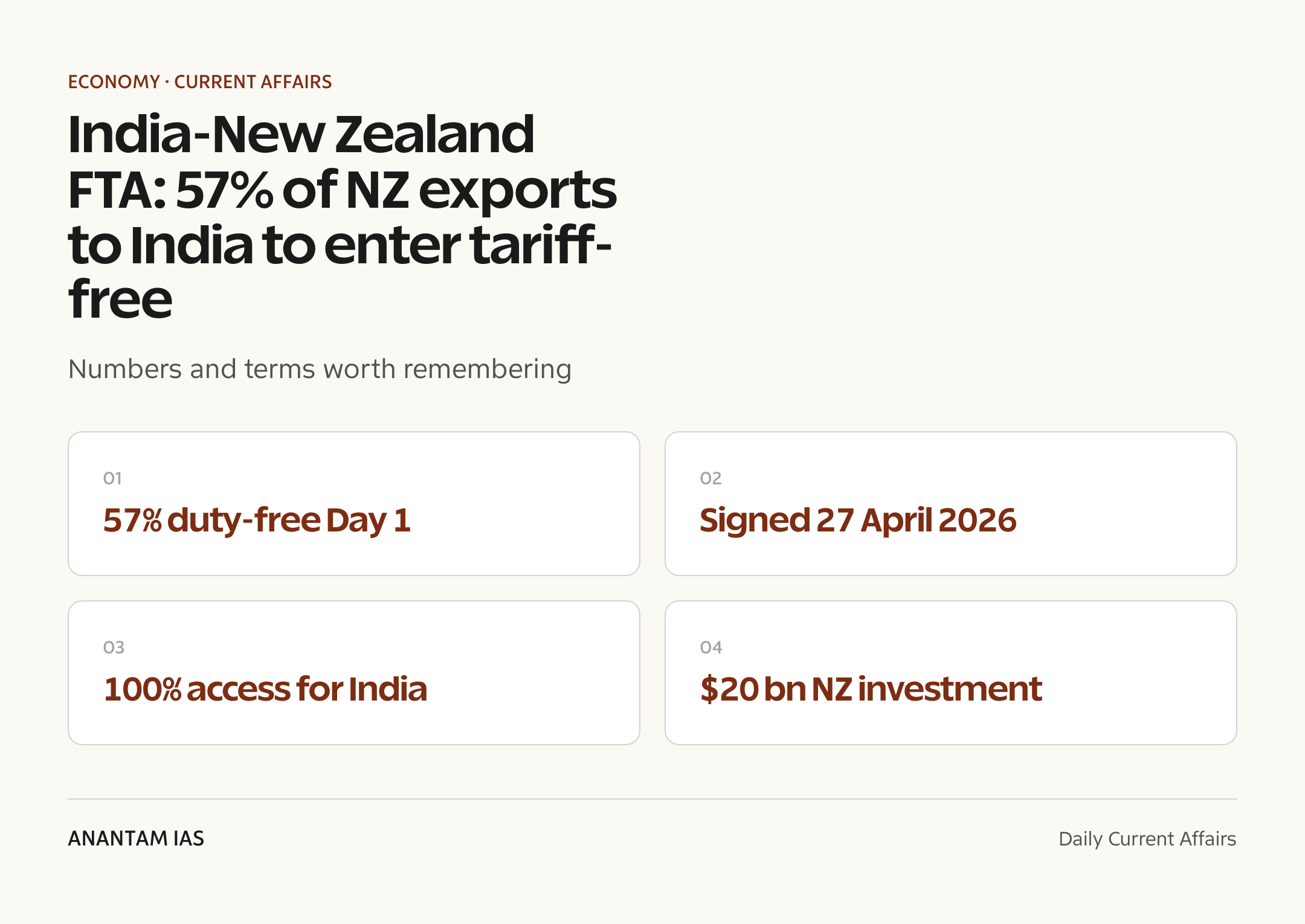
- Luxon’s headline figure: 57% of everything New Zealand exports to India becomes duty-free from day one of the FTA’s entry into force.
- Negotiations launched on 16 March 2025, concluded 22 December 2025 in 5 formal rounds, signature on 27 April 2026 — India’s fastest-concluded FTA, per PIB.
- Tariffs eventually go on 95% of New Zealand’s goods exports to India (by value); New Zealand gives 100% duty-free access to all Indian exports.
- Bilateral merchandise trade was USD 1.3 billion in 2024-25 (up 49%); goods-plus-services trade reached about USD 2.4 billion in 2024.
- Modi framed the tour as strengthening the Act East Policy, the MAHASAGAR vision and a free and open Indo-Pacific.
The development matters in the context of:
- This is India’s first FTA with New Zealand after talks begun in 2010 stalled for a decade — a template case for how India now sequences trade deals with developed economies.
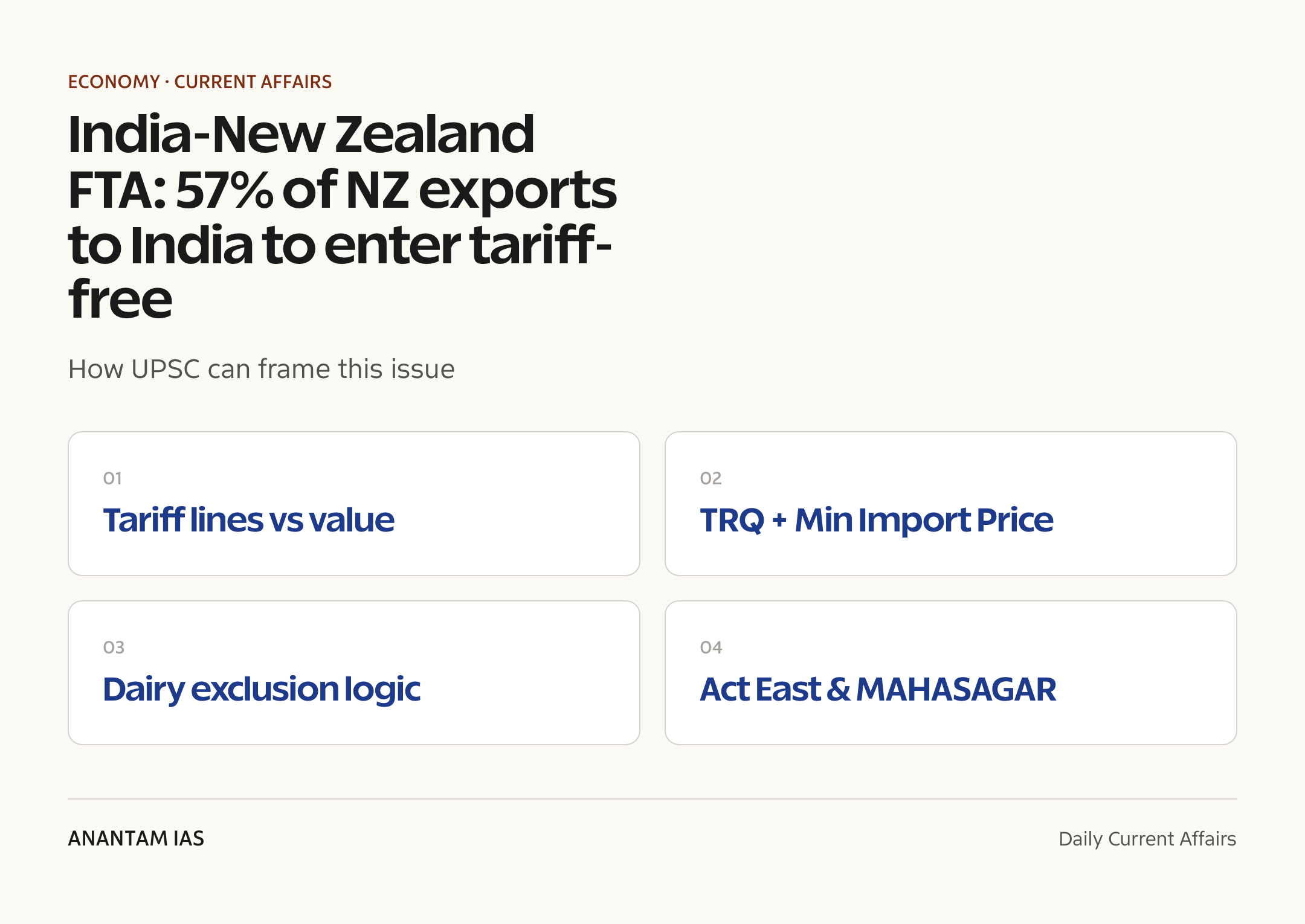
- The 57% day-one figure vs the 95% eventual figure vs India’s 70.03% tariff-line offer is exactly the number-distinction UPSC tests: value coverage, line coverage and phase-in schedules differ.
- The deal shows India’s standard defensive template — dairy excluded, TRQs with minimum import prices for the rest — the same red line held with Australia, the EU and the UK.
- The FTA is the economic arm of India’s Act East and Indo-Pacific outreach covered in the PM’s three-nation tour.

UPSC Relevance
Prelims Relevance
- India-New Zealand FTA — signed 27 April 2026; launched 16 March 2025; 5 formal rounds in ~9 months — India’s fastest FTA.
- 57% of NZ exports to India duty-free from day one; 95% tariff-free after full phase-in; 100% duty-free access for Indian exports to New Zealand.
- India opened 70.03% of tariff lines, excluded 29.97% — exclusions include dairy, sensitive agriculture (onions, chana, corn, almonds), sugar, gems and jewellery, copper and aluminium articles.
- Tariff Rate Quotas with a Minimum Import Price and seasonal windows apply to Mānuka honey, apples, kiwifruit and albumins — only 0.06% of tariff lines.
- USD 20 billion New Zealand investment commitment over 15 years, backed by a Rebalancing Clause for any shortfall.
- Mobility: Temporary Employment Entry (TEE) visa quota of 5,000 skilled Indians (up to 3 years); 1,000 Working Holiday Visas a year; post-study work — STEM Bachelor’s/Master’s up to 3 years, Doctorate 4 years.
- Services: commitments across 118 sectors, MFN treatment in 139 — New Zealand’s best-ever FTA offer — with first-time facilitation of AYUSH services.
- MAHASAGAR = Mutual and Holistic Advancement for Security Across the Regions; New Zealand is India’s second-largest trading partner in Oceania.
- Merchandise trade: USD 873 million (2023-24) → USD 1.3 billion (2024-25); India’s exports USD 711 million — a trade surplus for India.
Mains Relevance
GS Paper 3
- India’s FTA strategy with developed economies — 100% access for labour-intensive exports against calibrated, phased openings at home.
- Protecting sensitive sectors: the dairy exclusion, TRQ-plus-Minimum-Import-Price design, and the Joint Agriculture Productivity Council.
- Trade as an input to manufacturing — duty-free coking coal, wooden logs and metal scrap as cheaper inputs for Indian industry and MSMEs.
GS Paper 2
- India-New Zealand relations and the Indo-Pacific: the FTA as the economic pillar of the Act East Policy and the MAHASAGAR vision.
- Mobility diplomacy — student mobility annexes, post-study work rights and skilled-visa quotas as instruments of external engagement.
Essay
- Trade agreements as statecraft: economics and geopolitics are inseparable in the Indo-Pacific.
- Protecting the farmer while opening the economy — the political economy of India’s dairy red line.
Background and Context
The deal at a glance: what was signed in April 2026
The India-New Zealand FTA covers goods, services, investment, mobility and agricultural cooperation — concluded faster than any Indian trade pact before it.
- Launched on 16 March 2025 by Commerce Minister Piyush Goyal and NZ Trade Minister Todd McClay; concluded 22 December 2025; signed 27 April 2026. Earlier talks, begun in 2010, had run aground largely over dairy.
- For New Zealand: tariffs eventually eliminated on 95% of its goods exports to India — kiwifruit, apples, sheep meat, wool, wood among the winners; 57% of export value duty-free on day one.
- For India: 100% duty-free access across all tariff lines — an unusual clean-sweep offer from a developed partner.
- PIB frames New Zealand as a gateway to the wider Oceania and Pacific Island markets, where it is India’s second-largest trading partner.
- A dedicated chapter covers culture, trade and traditional knowledge, including New Zealand’s indigenous Māori economy — a first in India’s FTAs.
What India opened — and what it kept out
India’s schedule is a graded structure of immediate cuts, phased cuts, partial cuts and hard exclusions — a model of calibrated liberalisation.
- India offered access on 70.03% of tariff lines, kept 29.97% excluded; the opened lines still cover ~95% of New Zealand’s bilateral trade by value.
- 30% of lines: immediate duty elimination — wood, wool, sheep meat, raw hides.
- 35.6%: phased elimination over 3, 5, 7 and 10 years — petroleum oils, malt extract, vegetable oils, selected machinery, dairy-derived peptones.
- 4.37%: tariff reductions (not elimination) — wine, pharmaceutical drugs, polymers, iron and steel articles.
- 0.06%: Tariff Rate Quotas — Mānuka honey, apples, kiwifruit, albumins — each paired with a Minimum Import Price and seasonal windows so imports can’t undercut Indian growers at harvest.
- The exclusion list is India’s sensitivity map: dairy (milk, cream, whey, yoghurt, cheese), most animal products, onions, chana, corn, almonds, sugar, fats and oils, arms, gems and jewellery, copper and aluminium articles.
Dairy: the red line, explained
New Zealand is the world’s largest dairy exporter and India the world’s largest milk producer — which is exactly why core dairy stayed off the table.
- India’s dairy sector supports over 8 crore livelihoods, dominated by smallholders; New Zealand’s industry is industrial-scale and export-oriented — competition would be asymmetric.
- Core dairy — milk, cream, whey, yoghurt, cheese — has no tariff concession at all, the same line India held in the Australia ECTA and holds with the EU and UK.
- The dairy-adjacent openings are peripheral: milk albumins get a 50% tariff cut inside a quota; dairy-based peptones and bulk infant-formula preparations phase down over seven years.
- Design lesson: India separates consumer-facing dairy (excluded) from industrial derivatives (partially opened under quotas) — protecting farmer income while giving processors inputs.
- As a sweetener without market access, an Agricultural Productivity Partnership brings Centres of Excellence and orchard-management support for Indian kiwifruit, apple and honey growers, monitored by a Joint Agriculture Productivity Council.
What India gains: goods, services and people
India’s offensive interests are labour-intensive exports, services and mobility — and the schedule delivers on all three.
- Zero-duty access for textiles and apparel, leather and footwear, gems and jewellery, engineering goods and processed foods — textiles duty-free from day one.
- Duty-free industrial inputs — wooden logs, coking coal, metal scrap — cut production costs for Indian manufacturing.
- New Zealand’s best-ever services offer: 118 sectors committed, MFN in 139 — spanning IT/ITeS, professional services, education, financial services and tourism.
- A first anywhere: New Zealand facilitates trade in Ayurveda, Yoga and other AYUSH services — opening pathways for AYUSH practitioners, yoga instructors, Indian chefs and music teachers.
- A Student Mobility and Post-Study Work annex (New Zealand’s first with any country) guarantees Indian students 20 hours a week of work during study even if domestic policy changes, plus post-study visas of up to 3-4 years.
- A new TEE visa gives 5,000 skilled Indians stays of up to 3 years; a Working Holiday scheme admits 1,000 young Indians a year. Around 3 lakh persons of Indian origin — nearly 5% of NZ’s population — already anchor the relationship.
The USD 20 billion investment promise — and the rebalancing clause
The FTA hard-codes an investment commitment, with an enforcement mechanism India has rarely extracted before.
- New Zealand commits USD 20 billion in India over 15 years, targeted at renewable energy, digital services and modern infrastructure.
- A Rebalancing Clause provides a framework to address any shortfall in investment delivery — converting a political promise into a treaty obligation.
- The corpus exists: New Zealand invests nearly 8% of GDP overseas annually, with total overseas investment of about USD 422.6 billion (March 2025).
- A Mutual Recognition Arrangement for organic products should benefit Indian organic Basmati rice, flax seeds, psyllium husk (isabgol) and black tea.
- Structured MSME cooperation covers export-readiness programmes and linkages with NZ’s SME ecosystem, with focus on women-led and youth-led enterprises.
Where this fits in India's FTA playbook
The New Zealand deal is the latest move in India’s post-2021 pivot from RCEP-scepticism to bilateral deals with developed economies.
- PIB counts 9 FTAs spanning 38 developed countries in recent years — from the UAE CEPA and Australia ECTA (2022) through the EFTA TEPA (2024, with its USD 100 billion investment commitment) to the UK CETA (2025) and now New Zealand.
- The common template: full or near-full access for India’s labour-intensive goods, services-and-mobility chapters, investment commitments — against phased tariff openings and hard agricultural exclusions at home.
- India walked out of RCEP in 2019 largely over import-surge fears, dairy from New Zealand among them; this FTA shows the alternative — bilateral terms where India controls the exclusion list.
- Strategically, the pact is the economic arm of the Act East Policy; Modi’s Auckland leg follows Indonesia and Australia, tracked in our note on the PM’s three-nation visit and the Act East Policy.
- Watch next: ratification and entry into force — the FTA is signed but not yet in force; the numbers UPSC will pick are the signed ones.
Way Forward
Ratify fast, implement carefully
- Complete domestic procedures so entry into force isn’t delayed; early implementation locks in the day-one 57% window while trade momentum is high.
- Notify transparent TRQ administration rules — quota allocation, Minimum Import Price enforcement, seasonal windows — before the first import cycles.
Convert access into exports
- Run exporter-awareness drives so MSMEs in textiles, leather, engineering goods and processed foods actually claim the 100% duty-free access — India’s FTA utilisation rates have historically hovered near 25%.
- Operationalise the services and mobility annexes quickly: qualification recognition decides whether the 5,000 TEE visas get used.
- Track the USD 20 billion commitment through the Rebalancing Clause with published milestones.
Conclusion
Luxon’s 57% announcement is the first hard, day-one number attached to an FTA whose architecture is textbook India: sweeping access abroad, graded openings at home, and an untouchable dairy core. That the deal went from launch to signature in about 13 months shows how deliberately India has rebuilt its trade-negotiation machinery since walking out of RCEP.
For aspirants, the India-New Zealand FTA is now the cleanest single case study of India’s new trade doctrine: tariff-line arithmetic (70.03% opened, 29.97% excluded), TRQ-plus-Minimum-Import-Price safeguards, a treaty-backed investment commitment, and mobility chapters doing the work visas once did. Expect Prelims to test the numbers and Mains to test the design logic.
UPSC Practice Questions
Prelims MCQ 1
With reference to the India-New Zealand Free Trade Agreement signed in April 2026, consider the following statements:
- New Zealand has agreed to provide duty-free access to 100% of Indian exports.
- India has offered tariff concessions on all of its tariff lines to New Zealand.
- Core dairy products such as milk, cheese and yoghurt are kept in India’s exclusion list.
How many of the above statements are correct?
(a) Only one (b) Only two (c) All three (d) None
Answer: (b) Only two
Explanation:
Statements 1 and 3 are correct: New Zealand gives 100% duty-free access to Indian exports, and core dairy sits in India’s exclusion list. Statement 2 is wrong — India opened 70.03% of tariff lines and excluded 29.97%, though the opened lines cover about 95% of New Zealand’s bilateral trade by value.
Prelims MCQ 2
The “Rebalancing Clause” in the India-New Zealand FTA is best described as:
(a) A mechanism to renegotiate tariff schedules if India’s trade deficit widens (b) A framework to address any shortfall in New Zealand’s USD 20 billion investment commitment to India (c) A safeguard duty that India can impose if dairy imports surge (d) A currency-settlement arrangement to reduce dollar dependence in bilateral trade
Answer: (b) A framework to address any shortfall in New Zealand's USD 20 billion investment commitment to India
Explanation:
The FTA locks in a USD 20 billion New Zealand investment commitment over 15 years; the Rebalancing Clause provides a treaty framework to respond if delivery falls short. Dairy is protected by exclusion, not a safeguard duty — core dairy has no concession at all.
UPSC Mains Questions
- The India-New Zealand FTA has been described as a template of ‘calibrated liberalisation’. Examine how the agreement’s tariff architecture and safeguard mechanisms balance India’s export ambitions with the protection of sensitive domestic sectors. (250 words)
- Trade agreements are increasingly instruments of strategy, not just commerce. Discuss with reference to India’s recent FTAs with developed economies and the Indo-Pacific dimension of the India-New Zealand partnership. (250 words)
Sources: PIB, Ministry of Commerce and Industry and The Hindu.
Frequently Asked Questions
What did New Zealand’s PM announce about the FTA?
Ahead of PM Modi’s July 10 Auckland visit, PM Christopher Luxon announced that 57% of New Zealand’s exports to India will be tariff-free from day one of the India-New Zealand FTA, signed on 27 April 2026. Eventually, tariffs go on 95% of New Zealand’s goods exports to India.
What does India get from the India-New Zealand FTA?
New Zealand gives 100% duty-free access to Indian exports, its best-ever services offer (118 sectors), a USD 20 billion investment commitment over 15 years, a 5,000-visa skilled-worker pathway, guaranteed student work rights, and post-study work visas of up to 3-4 years.
Is dairy included in the India-New Zealand FTA?
Core dairy — milk, cream, whey, yoghurt, cheese — is fully excluded from India’s concessions to protect smallholder farmers. Only peripheral items open partially: milk albumins get a 50% tariff cut under quota, and dairy-derived peptones phase down over seven years.
What is a Tariff Rate Quota with Minimum Import Price?
A TRQ allows a fixed quantity of imports at lower duty; beyond it, normal tariffs apply. India pairs TRQs on apples, kiwifruit, Mānuka honey and albumins with a Minimum Import Price and seasonal windows, so cheap imports can’t undercut Indian growers during harvest.
Why is this FTA called India’s fastest?
Negotiations launched on 16 March 2025 and concluded on 22 December 2025 — five formal rounds in about nine months — with signature on 27 April 2026. Earlier India-New Zealand talks, started in 2010, had stalled for a decade, mainly over dairy access.
How big is India-New Zealand trade currently?
Bilateral merchandise trade grew 49% to USD 1.3 billion in 2024-25, with Indian exports at USD 711 million, giving India a trade surplus. Total goods and services trade was about USD 2.4 billion in 2024. New Zealand is India’s second-largest trading partner in Oceania.
Tell Google you want more of this.
Add Anantam IAS as a preferred sourceOne tap, and this site shows up more often in your own Top Stories, AI Overviews and AI Mode. Remove it any time.






