
India observed the 78th Army Day in Jaipur on 15 January 2026. Holding the event outside Delhi continued the recent practice of taking major military commemorations to different regions.
For UPSC, Army Day is a useful hook to revise civil-military memory, military modernisation, jointness, theatre commands, border security and India’s evolving defence posture.
This article explains the 2026 Army Day event through a GS-III security lens rather than as a ceremonial fact.
Quick Facts
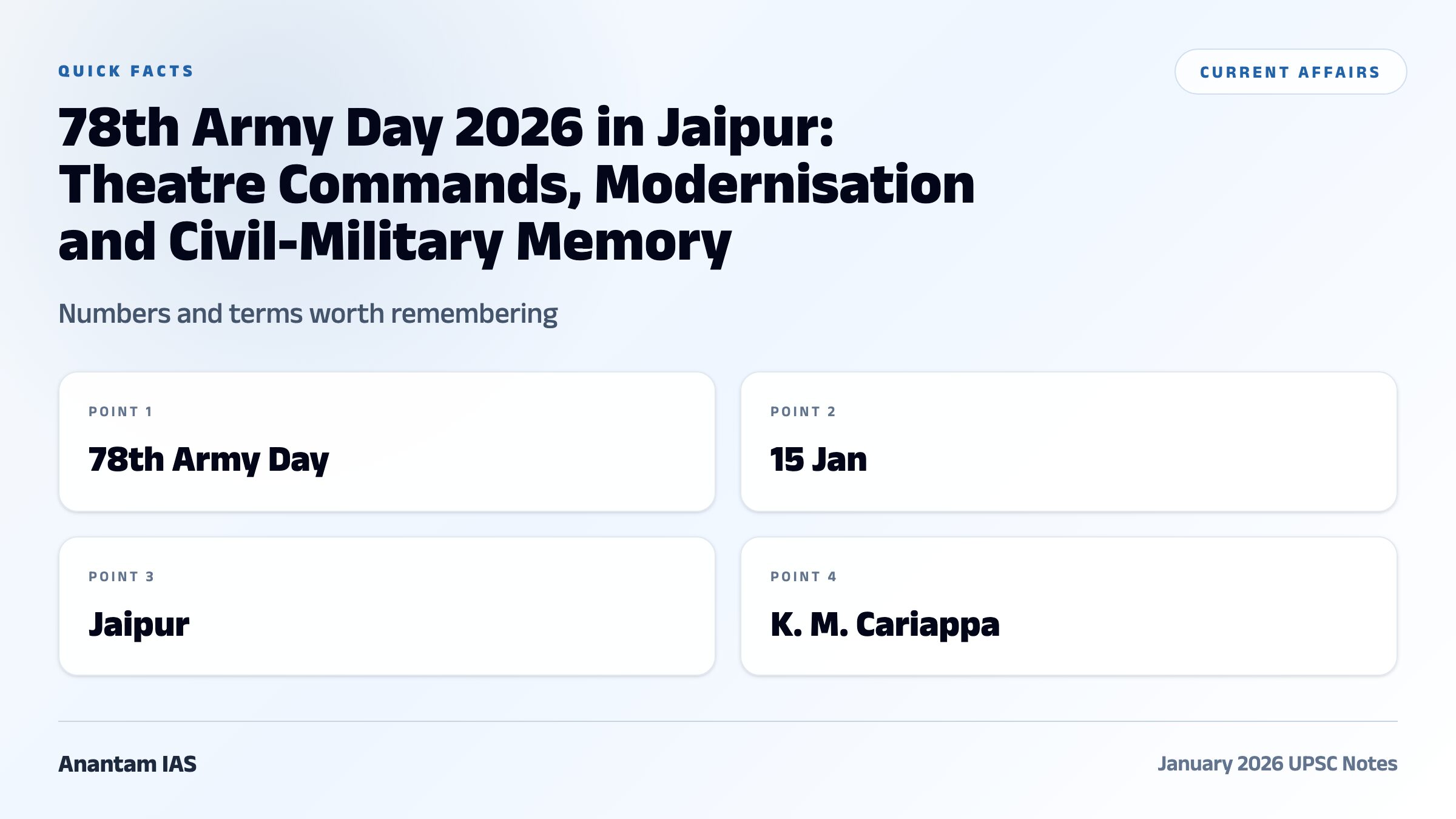
- Army Day is observed on 15 January every year.
- The 2026 event marked the 78th Army Day.
- The main event was held in Jaipur, Rajasthan.
- Army Day commemorates Field Marshal K. M. Cariappa taking over as Commander-in-Chief in 1949.
- The day is linked to military honour, remembrance and operational readiness.
- Official source: PIB Ministry of Defence release dated 15 January 2026.
- Official source: PIB, Ministry of Defence.
What Just Happened
The Indian Army marked Army Day 2026 with ceremonial and public events in Jaipur.
The location is significant because it decentralises national military commemoration and improves public connection with the armed forces outside the capital.
For aspirants, the event should be used to revise modernisation challenges, jointness and the changing nature of warfare.
Background and Historical Context
Army Day marks the Indianisation of command after independence, when K. M. Cariappa became Commander-in-Chief of the Indian Army on 15 January 1949.
The Army’s role has expanded from conventional defence to counter-insurgency, disaster relief, border management, UN peacekeeping and technology-driven warfare.
Current defence debates include theatre commands, Atmanirbhar Bharat in defence, drones, cyber, space, logistics and manpower reforms.
Key Features of Defence
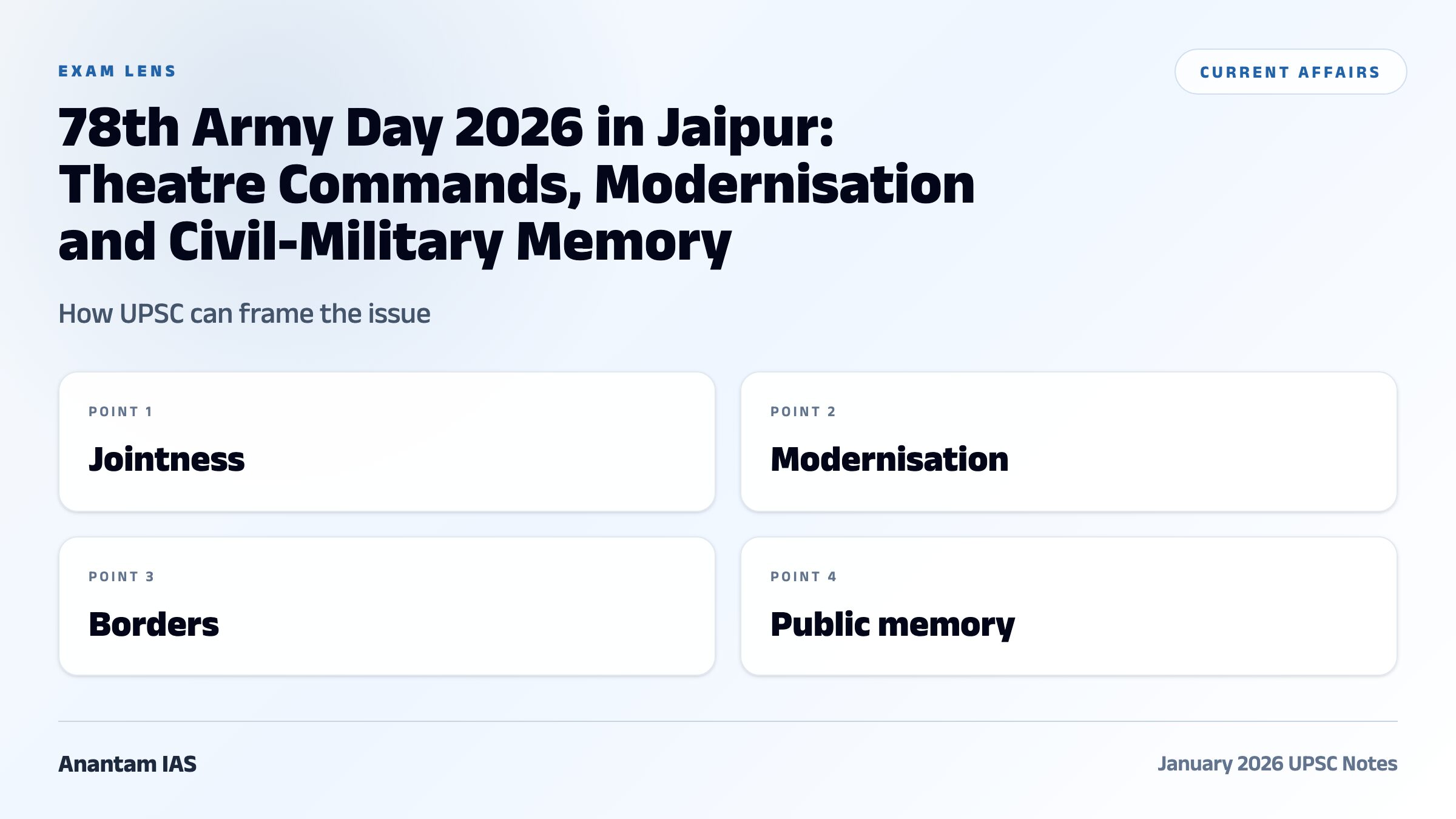
The core policy architecture can be read through these features.
- Commemoration: honours the Army’s service and sacrifice.
- Decentralised venue: Jaipur brings the event closer to citizens outside Delhi.
- Modernisation signal: platforms, drills and messages highlight capability upgrades.
- Jointness debate: Army reform is linked to integrated theatre commands.
- Public outreach: military ceremonies build civil-military familiarity.
- Security context: borders, technology and hybrid warfare shape the agenda.
Why It Matters
This is a high-yield UPSC topic because it joins current news with durable syllabus themes.
- It connects a January 2026 event with durable UPSC syllabus themes.
- It gives usable facts for Prelims and analytical hooks for Mains.
- It helps students move from news recall to policy reasoning.
- It can be linked with static concepts in polity, economy, governance, science, environment or society.
Detailed Analysis: Defence Lens
Army Day is public memory plus policy signal. The parade honours history, but the speeches and displays communicate readiness and reform priorities.
Jointness is the big structural reform. Future conflict will require land, air, maritime, cyber and space coordination rather than service-wise silos.
Technology is changing infantry-heavy assumptions. Drones, precision fires, sensors and electronic warfare now affect battlefield survivability and logistics.
Comparative Perspective
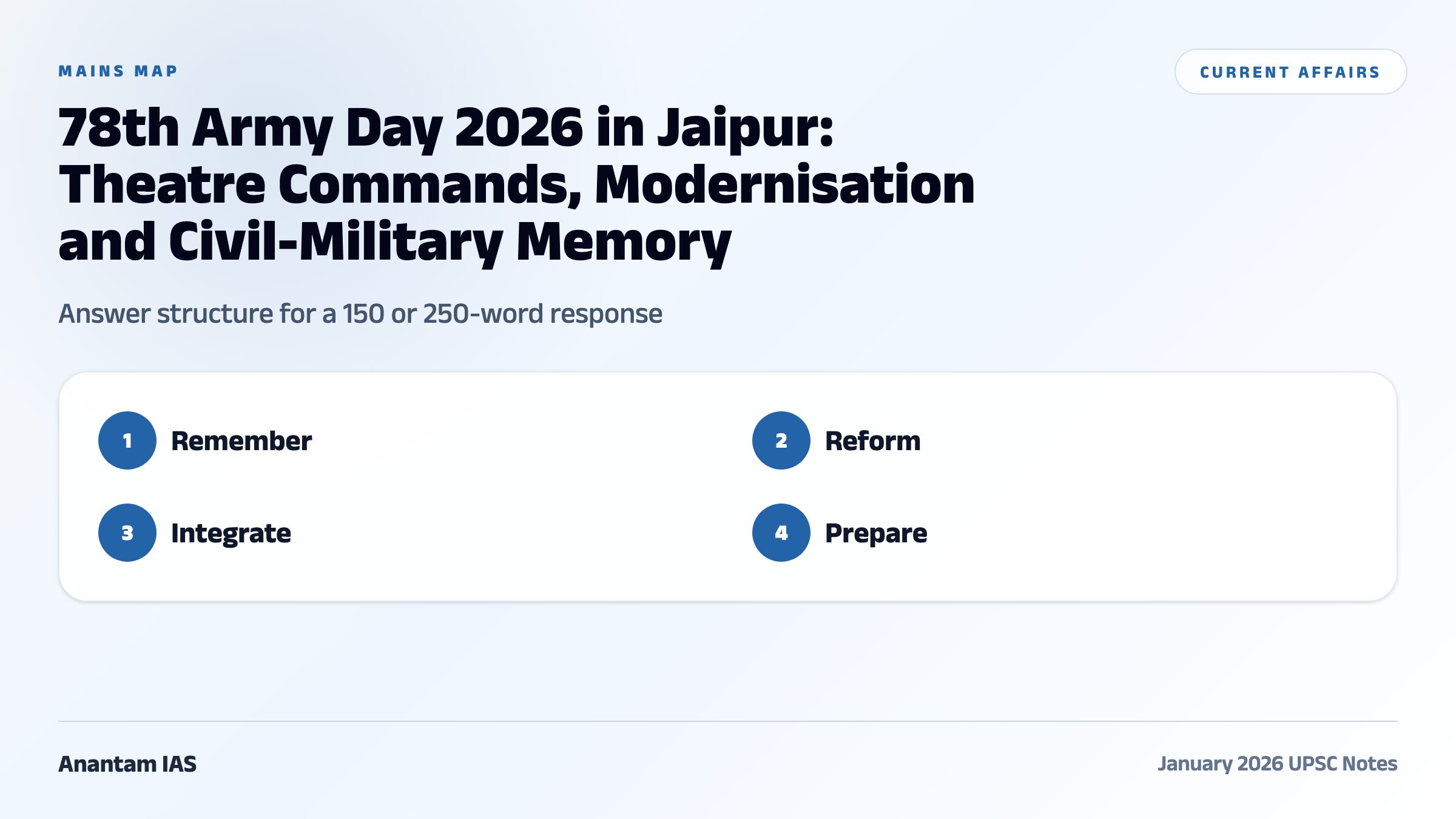
A comparison helps prevent the answer from becoming a one-dimensional news summary.
- Army Day: commemorates Indian Army leadership and service.
- Navy Day: linked to Operation Trident and maritime power.
- Air Force Day: celebrates air power and IAF capability.
- Republic Day parade: presents combined national military and cultural symbolism.
Challenges
The policy or institutional promise runs into recurring constraints.
- Theatre-command reform requires inter-service consensus.
- Defence indigenisation must balance speed, quality and technology absorption.
- Two-front security concerns require logistics resilience.
- Drones and electronic warfare demand rapid adaptation.
- Manpower reforms must preserve morale and operational effectiveness.
Prelims Pointers
- Army Day is observed on 15 January.
- K. M. Cariappa became Commander-in-Chief of the Indian Army on 15 January 1949.
- Field Marshal is a five-star honorary rank in India.
- Theatre commands aim to integrate service capabilities under operational commands.
- CDS stands for Chief of Defence Staff.
- UN peacekeeping is an important Indian Army contribution.
Mains Questions
- Army Day is both a commemoration and a policy signal. Discuss in the context of India’s military modernisation. (GS Paper III, 250 words)
- Why is jointness central to India’s defence reform agenda? (GS Paper III, 150 words)
- Examine how technology is changing land warfare. (GS Paper III, 250 words)
- Civil-military public outreach strengthens national security culture. Analyse. (GS Paper III, 150 words)
Way Forward
India should accelerate joint planning, logistics integration, drone defence, battlefield communications and defence-industrial depth.
Commemorative events should also educate citizens about military history, constitutional control of armed forces and veterans’ welfare.
For UPSC, connect Army Day with reform. That is where the marks are.
The examiner is unlikely to reward a bare fact dump here. The better answer connects the January 2026 event to institutional design, implementation capacity and India’s long-term development priorities.
Frequently Asked Questions
When is Army Day observed?
Army Day is observed on 15 January every year.
Why is 15 January important?
K. M. Cariappa took over as Commander-in-Chief of the Indian Army on 15 January 1949.
Where was Army Day 2026 held?
The main event was held in Jaipur.
Why is Army Day relevant for UPSC?
It links defence history with modernisation, jointness and security policy.
What are theatre commands?
They are integrated operational commands designed to improve joint military planning and execution.
What should students focus on?
Modernisation, jointness, indigenisation, border security and civil-military memory.