
Home › Mains Full Length Test Papers 2026
Free full-length papers
Mains Full Length Test Papers 2026
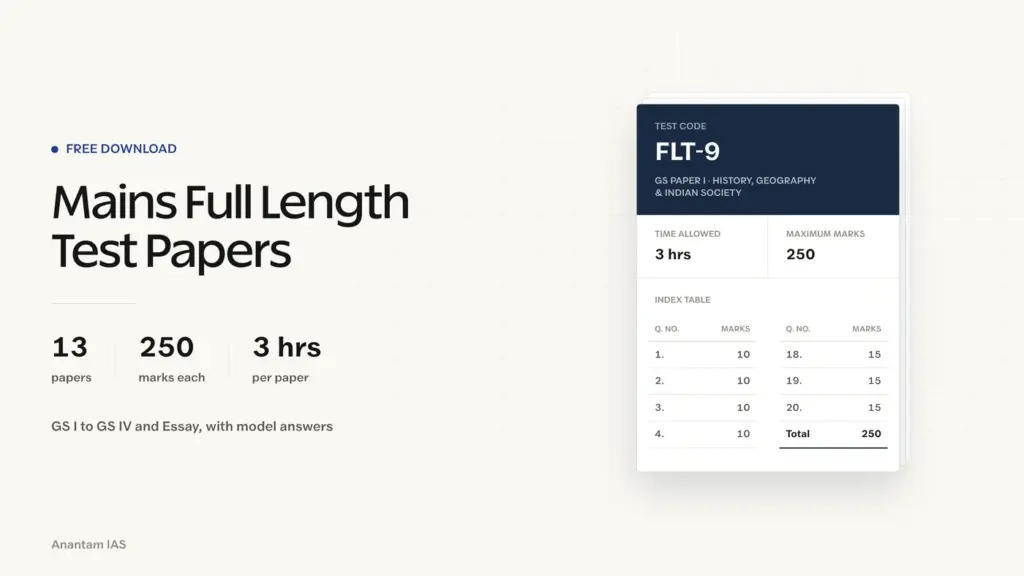
Thirteen UPSC Mains test papers you can sit at home, free. Each one runs at real exam scale: 250 marks, 3 hours, 20 compulsory questions in the same question-cum-answer format UPSC uses. Eight papers ship with model answers. Download the paper, write it under time, then mark your own copy.
A full-length paper tests stamina, not just knowledge
Sectional practice tells you whether you know a topic. A full-length UPSC Mains test paper tells you whether you can still write a structured 150-word answer at the two-hour-forty-minute mark, with a cramping hand and six questions left. Those are different skills, and only one of them is graded in September.
Most aspirants discover the gap too late. They have written hundreds of individual answers and never once written twenty of them back to back against a clock. The result is a familiar Mains post-mortem: strong first ten answers, rushed last five, two questions left blank.
What the 2026 papers cover
- 13 papers from the Anantam IAS Mains QIP 2026-27 test series, spanning GS Paper I through GS Paper IV and Essay.
- 250 marks and 3 hours on every paper, matching the UPSC Mains scheme.
- 20 compulsory questions on each General Studies paper, with marks printed against each question.
- 8 essay topics across two sections on each Essay paper. You write one from each section, about 1000 to 1200 words, 125 marks apiece.
- Model answers for 8 of the 13 papers, written to show structure under exam conditions rather than to be encyclopaedic.
- Question-cum-answer booklet layout, including the UPSC margin rules and the index table you fill in before you start.
Every paper here was set by former Rau's IAS faculty for a paying batch. They are on this page in full, at no cost, because a paper you never sit is worth nothing to anybody.
GS Paper I
Full-length GS Paper I tests: Indian and world history, geography, and Indian society. Each paper runs 20 questions, 250 marks, 3 hours, in the UPSC question-cum-answer format.
- FLT-8Test 8 Indian & World History, Geography & Indian Society 250 marks · 3 hours Question paper Model answers
- FLT-9Test 9 Indian & World History, Geography & Indian Society 250 marks · 3 hours Question paper Model answers
- FLT-11Test 11 Indian & World History, Geography & Indian Society 250 marks · 3 hours Question paper Model answers coming soon
GS Paper II
Full-length GS Paper II tests: constitution, polity, governance, social justice and international relations. Each paper runs 20 questions, 250 marks, 3 hours.
- FLT-1Test 1 Polity & Governance 250 marks · 3 hours Question paper Model answers
- FLT-10Test 10 International Relations, Social Justice & Internal Security 250 marks · 3 hours Question paper Model answers
- FLT-12Test 12 Governance, Constitution, Polity, Social Justice & IR 250 marks · 3 hours Question paper Model answers coming soon
GS Paper III
Full-length GS Paper III tests: economy, environment, disaster management, science and technology, and internal security. Each paper runs 20 questions, 250 marks, 3 hours.
- FLT-6Test 6 Economy, Environment, Disaster Management & Sci-Tech 250 marks · 3 hours Question paper Model answers
- FLT-7Test 7 Economy, Environment, Disaster Management & Sci-Tech 250 marks · 3 hours Question paper Model answers
- FLT-13Test 13 Technology, Economic Development, Biodiversity, Environment & Security 250 marks · 3 hours Question paper Model answers coming soon
GS Paper IV
Full-length GS Paper IV tests on ethics, integrity and aptitude, including the case-study section. Each paper runs 250 marks over 3 hours.
- FLT-3Test 3 Ethics, Integrity & Aptitude 250 marks · 3 hours Question paper Model answers
- FLT-4Test 4 Ethics, Integrity & Aptitude 250 marks · 3 hours Question paper Model answers
Essay
Full-length Essay papers in the UPSC format: eight topics in two sections, write one essay from each in about 1000 to 1200 words, 125 marks each.
- FLT-2Test 2 Essay 250 marks · 3 hours Question paper Model answers coming soon
- FLT-5Test 5 Essay 250 marks · 3 hours Question paper Model answers coming soon
Sit the paper properly or do not sit it at all
A full-length test only produces useful information if you reproduce exam conditions. Attempt it in two sittings, or with your notes open, and the score tells you nothing you can act on.
Before you start
- Print the question paper, or open it on a screen you will not touch again for 3 hours.
- Use loose A4 sheets and the pen you will carry into the exam hall.
- Set one 3-hour timer. Not twenty small ones.
- Put your phone in another room. Notes, books and search stay closed.
- Start at the time your real paper starts, 9:00 am or 2:00 pm, so your body learns the slot.
Then mark your own copy against four criteria
Each paper prints the evaluation rubric the batch is graded on. Use it on yourself before you open the model answers. Scoring your own copy honestly is uncomfortable, which is exactly why it works.
Only then open the model answers
Compare structure before content. The gap that costs marks is almost never a missing fact; it is an introduction that took four lines to say nothing, or a conclusion bolted on because the time ran out. Read the model answer for how it is built, then rewrite your two weakest answers from the same paper without looking.
That rewrite is where the marks come from. The test itself is only the diagnosis.
Full-length tests and daily answer writing solve different problems
Running only one of the two leaves a real hole. Daily practice builds the writing habit; full-length papers prove the habit survives contact with a 3-hour paper.
Daily Answer Writing
A short question set every day with a model answer. Builds fluency, fixes structure, keeps a subject warm. Low cost to start, easy to sustain, and it will never tell you how you behave in hour three.
Full-length test papers
One 250-mark paper, 20 questions, 3 hours. Exposes time allocation, attempt strategy, handwriting decay and the quality drop in the last forty minutes. Costly in energy, so most aspirants avoid them until it is late.
Use both. Write daily on Daily Answer Writing, then sit one full-length paper a fortnight from this page. If you want the questions without the full paper, the Mains practice questions bank is sorted by paper, and the answer-writing guide covers the formats these papers assume you already know.
What these papers will not do for you
Worth saying plainly, because a free PDF page that only lists benefits is selling something.
- Nobody marks your copy. The model answers show you a good answer; they cannot tell you why yours lost 4 marks. Self-evaluation catches structure problems and misses subtle ones.
- Five papers have no model answers yet. FLT-2, 5, 11, 12 and 13 are question papers only for now.
- These are not previous-year UPSC papers. They are set to the UPSC pattern by faculty who have taught it, which is close, not identical. For the real thing, work through UPSC's own past papers as well.
- There is no rank or percentile. You are writing alone, so you get a diagnosis, not a comparison against 2,000 other candidates.
- The Essay papers need a reader. Essay is the one paper where self-marking is close to useless. Get a person to read it, even a non-aspirant, and ask whether the argument held.
If the gap you feel is evaluation rather than practice, that is a different product, and it is copy evaluation, not another PDF.
Questions aspirants ask about these papers
Are these actual UPSC Mains question papers?
How many UPSC Mains test papers can I download here, and what do they cost?
What is the marks and time pattern of each paper?
Why do only eight of the thirteen papers have model answers?
How should I evaluate my own copy without an evaluator?
Should I attempt a full-length test before I finish the syllabus?
Can I write these in Hindi?
What is the difference between these papers and Daily Answer Writing?
Write one this week, not "after the syllabus"
Pick the paper covering your strongest subject and sit it on the next free Sunday. The score will be lower than you expect, and that is the point: you would rather find out in August than in the exam hall. Everything on this page stays free.