Mains 2026 · Answer-writing practice
UPSC Mains 2026 practice questions, with model answer scaffolding.
Original practice questions for Civil Services Mains 2026, written in UPSC style. Every question carries a model answer outline, key points, examples and verified sources — so you can write, score gaps and revise without guessing what an examiner expects.
Pick your paper
All six Mains papers, each as its own practice archive.
Tap a paper to open its question archive. Each archive lists questions with marks, suggested time, difficulty and the syllabus subtopic — and lets you reveal the model answer outline inline.
Essay
Philosophical, social, governance and tech themes — write two 1000-1200 word essays.
GS Paper 1
Indian Heritage and Culture, History, Geography, Indian Society.
GS Paper 2
Polity, Constitution, Governance, Social Justice and International Relations.
GS Paper 3
Economy, Environment, Science and Technology, Internal Security, Disaster Management.
GS Paper 4
Ethics, Integrity and Aptitude — theory plus case studies.
Compulsory English
Reading comprehension, précis, English usage, short essay.
Free PDF downloads
Download any paper as a free practice-question PDF.
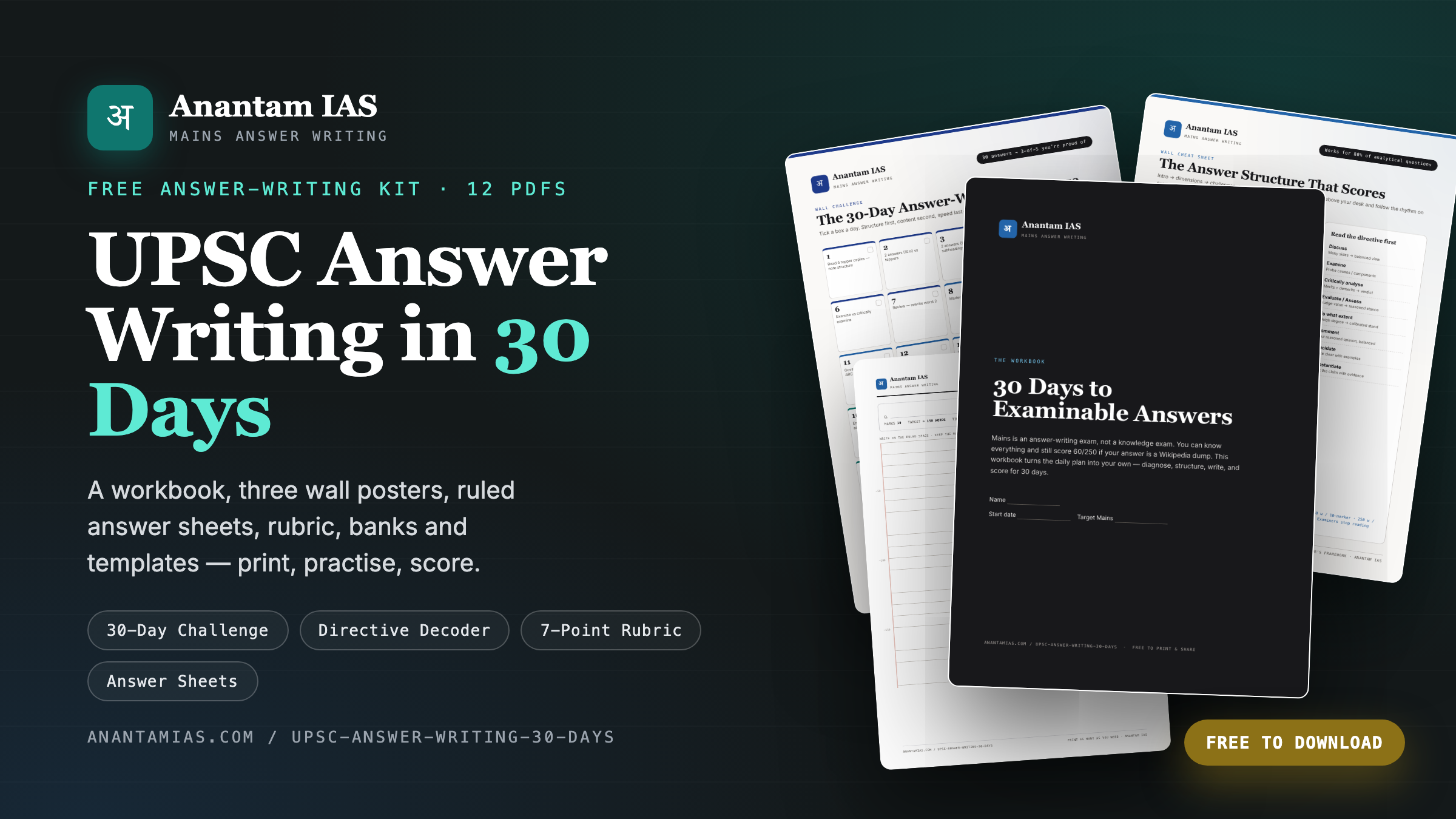
Every paper is also compiled into a free, printable PDF book — the same questions you see in the live archives, each with its model answer outline, key points, examples and sources, grouped by subtopic. Read on any device or print to annotate. No sign-up.
Essay — Practice Questions
60 exam-realistic essay prompts, each with a full outline and a complete model essay — across philosophical, social, governance, economic and environmental themes.
GS Paper 1 — Practice Questions
History, art and culture, geography and Indian society — 80 questions, each with an outline, key facts, examples and sources.
GS Paper 2 — Practice Questions
Polity, Constitution, governance, social justice and international relations — 100 questions with model answers and sources.
GS Paper 3 — Practice Questions
Economy, agriculture, science and tech, security, environment and disaster management — 154 questions, the deepest set in the series.
GS Paper 4 — Practice Questions
Ethics theory plus full case studies — 60 questions with model answers, thinkers and administrative principles.
Compulsory English — Practice Questions
Comprehension, précis, usage and composition — 40 worked questions so the qualifying paper is never a risk.
Preparing GS Paper 4? The GS-IV (Ethics) page also has unit-wise study notes as seven separate PDFs (Units 1–7), alongside the question book above.
How to write a Mains answer
Five moves that turn a 7-mark attempt into an 11-mark answer.
UPSC awards marks for structure and specificity — not effort. The model outlines on this site are built around the same five-step method every Mains topper internalises before they sit the exam.
- Decode the question.Read the question twice. Underline the directive (discuss / examine / critically analyse), the keyword and any time/space scope. Spend ~30 seconds before writing.
- Plan your structure in 60 seconds.Jot a 4–6 point outline in the margin: introduction → 3 body dimensions → conclusion. The plan must fit in 30 words; if it doesn't, the question is unclear and you should re-read.
- Anchor with one specific.Open the body with an article, a judgment, a named scheme, a named report, or a number from the latest data. Specificity in the first body line cues the examiner to score the answer up, not down.
- Build three dimensions.A 10-mark answer needs three distinct points; a 15-mark needs three with sub-dimensions. Use parallel structure — same verb cadence per paragraph — so the examiner can scan.
- Close with a way forward.Conclusion = one balancing sentence + one forward-looking sentence. Avoid clichés. Name an instrument, ministry, deadline or principle that resolves the tension you opened with.
What's inside every question
Four scaffolds. Same shape across all 6 papers.
Every published question carries the same four pieces — so you build a single mental template and reuse it across GS papers, Essay and Compulsory English.
Model answer outline
A 3-part scaffold — introduction → body → conclusion — that you can read in 30 seconds and adapt to your own draft. No verbatim model essays; the outline is the part that's reusable.
Key points to hit
The 6–10 specifics — Articles, judgments, schemes, named instruments — that an examiner expects to see in your answer. If your draft doesn't touch most of these, your structure is off.
Examples to use
Pre-vetted examples and case studies so you spend writing time on argument, not on recall. Named persons, named places, named cases — never "many" or "various".
Sources to read
Linked primary sources (PRS, SCI, PIB, ministry reports, named acts) plus Anantam IAS current-affairs explainers for follow-up reading on each topic.
Subject coverage
What every paper covers, what every answer needs.
The archive mirrors the UPSC 2025 Mains syllabus. Each row below lists the subtopic buckets covered for that paper, the working count today, and the writing convention that consistently scores well.
| Paper | Subtopic buckets | Writing convention | Count |
|---|---|---|---|
| Essay | Philosophical · Society · Governance · Economy & Tech · Environment | Quote, paradox or story openings · 1000-1200 words · 80-90 minutes per essay | 160 |
| GS Paper 1 | Ancient · Medieval · Modern History · Post-Independence · Geography · Indian Society | Cite historians by name · Use sketch maps · Cause–course–consequence structure | 406 |
| GS Paper 2 | Constitution · Polity · Federalism · Governance · Social Justice · International Relations | Quote the Article number first · Pair a judgment with its principle · Three-dimension answers | 426 |
| GS Paper 3 | Economy · Agriculture & Food · Sci-Tech · Environment & Ecology · Internal Security · Disaster Management | Open with a number · Name the mission/scheme · Specific way forward with timeline | 439 |
| GS Paper 4 | Ethics · Attitude · Aptitude · Emotional Intelligence · Moral Thinkers · Case Studies | Pair concept with civil-service example · Decide in case studies · Use thinkers sparingly | 270 |
| Compulsory English | Comprehension · Précis · Short Essay · Grammar & Usage | Précis = 1/3 of original · Self-contained comprehension answers · Six-paragraph structure for essay | 40 |
Featured questions
One question from each paper to start with.
A single, representative question from each of the six papers — a quick way to see the format before you open a full archive.
Contentment is natural wealth; luxury is artificial poverty.
Philosophical · contentment, luxury and true wealth
Evaluate the impact of globalization on Indian youths with reference to social, political, economic and cultural spheres.
Indian Society · globalisation and its effects on Indian youth
Should education be treated primarily as a welfare obligation of the state or as a strategic investment for building a globally competitive, knowledge-driven nation? Critically evaluate.
Governance · education as welfare obligation versus strategic investment
Separatist movements have been one of the major factors contributing to militancy and instability in Jammu & Kashmir (J & K). Bring out actions taken by the Government to bring J&K into national mainstream. Discuss pre and post abrogation status of Articles 370 and 35A. Also bring out positive impacts of abrogation of both articles in mainstreaming the state.
Internal security · separatism in Jammu and Kashmir, Articles 370 and 35A, and mainstreaming
Ethics Case Study: Ravi is a senior police officer with vast experience in riot control and cyber-policing. Since one year, he has been the Superintendent of Police (SP) of a district with a history …
Case study · algorithmic bias, predictive policing and civil liberties
Grammar / usage: Reported and direct speech
Section D · Grammar
Companion resources
Pair this archive with the rest of the Anantam IAS Mains stack.
FAQs
Questions aspirants ask before using this archive
Are these UPSC Mains practice questions previous year questions?
Which Mains papers are covered?
How many questions are on this site?
Can I download these practice questions as a PDF?
How should I use these practice questions?
Do the questions include marks, word limits and timing?
What is the difference between this archive and the Mains QIP 2026 course?
Can I get my answers evaluated?
How often is the question bank updated?
Which question should I attempt first?
Are these questions aligned with the UPSC syllabus?
Ready to write?
Pick a paper. Attempt one question. Check the outline.
That single loop, done 80 times before August, is the difference between a 320 and a 380 in Mains. Start with GS Paper 2 if you've never written a Mains answer before — Polity rewards structure most cleanly.