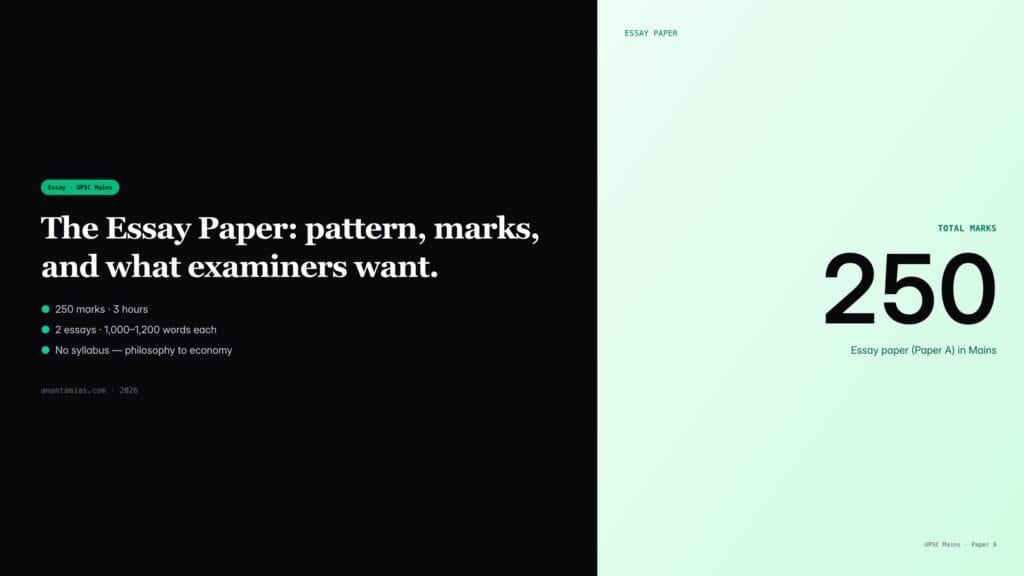
The Essay paper is the UPSC Mains’ most democratic arena: no syllabus to memorise, no facts to forget, only ideas to organise. For 250 marks across 3 hours, it tests whether you can think with clarity and write with discipline. Toppers routinely convert this paper into a rank-booster, while others treat it as a lottery. The difference is preparation that respects the paper’s architecture.
1. Paper Structure at a Glance
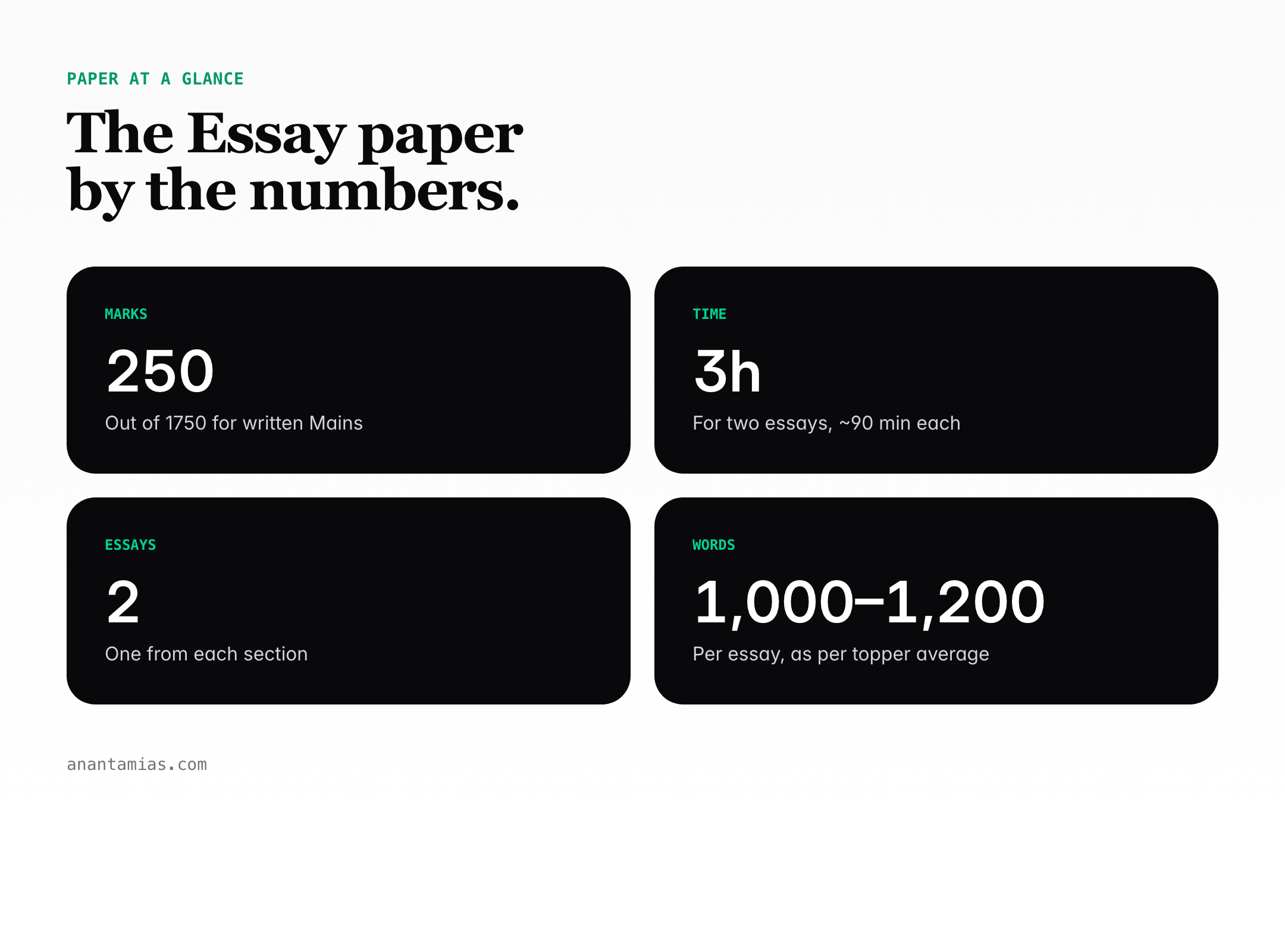
The Essay paper has two sections, each offering four topics. Candidates write one essay from each section, 1000–1200 words, in 90 minutes per essay.
| Attribute | Details |
|---|---|
| Total marks | 250 |
| Duration | 3 hours |
| Sections | 2 (A & B) |
| Topics per section | 4 |
| Essays to attempt | 2 (one from each section) |
| Word limit per essay | 1000–1200 |
| Language | English / Hindi (chosen in DAF) |
2. What the Commission Actually Evaluates
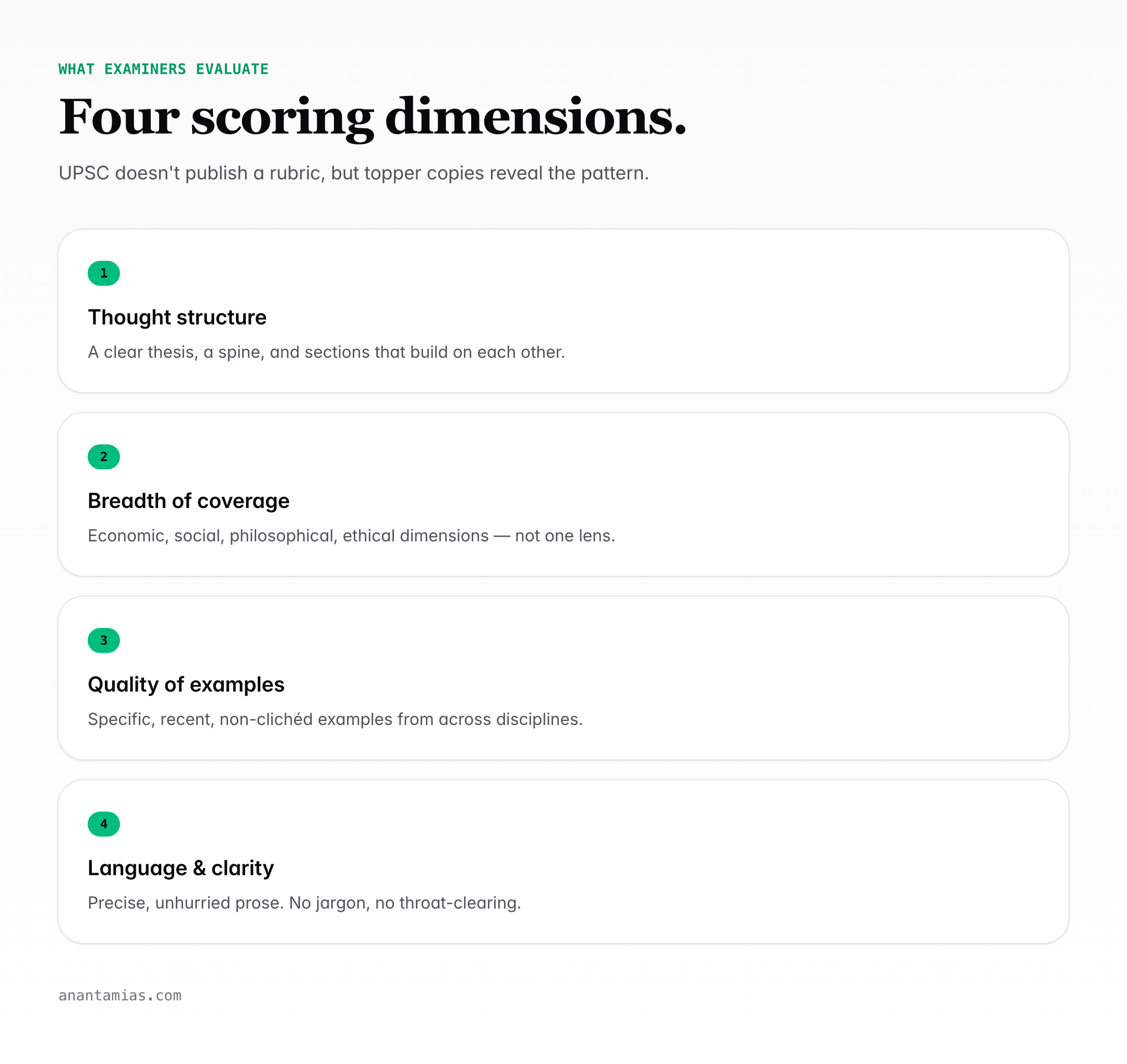
UPSC’s official instruction is deceptively short: ‘Candidates will be expected to keep closely to the subject of the essay, to arrange their ideas in orderly fashion, and to write concisely. Credit will be given for effective and exact expression.’ Each clause is a grading rubric in disguise.
Relevance
Every paragraph must orbit the topic. A brilliant section on climate change inside an essay on ‘Social media and democracy’ bleeds marks.
Arrangement
Examiners read hundreds of scripts. Structure is how you respect their attention. Intro → body with signposted dimensions → conclusion is not cliché; it is courtesy.
Concision
1200 words is a ceiling, not a target. Essays that finish at 1050 words with surgical precision often beat 1200-word scripts that pad.
Exact expression
Clichés, jargon, and Wikipedia-style sentences cost you. Short sentences, active voice, and one metaphor per page lift a script.
3. The Two-Section Split
Since 2014, UPSC has split the paper into Section A and Section B. Topics alternate between the philosophical/abstract and the concrete/policy-based, but never predictably. A single section may carry both ‘Forests are the best case study in democracy’ and ‘Effective government must be preceded by self-government’.
4. Marking Pattern Toppers Report
| Band | Marks | Typical script |
|---|---|---|
| Excellent | 140–160 | Rare, rank-securing; deep philosophy + multi-disciplinary body |
| Very good | 125–140 | Top 1–2% — clear thesis, elegant structure, literary touches |
| Good | 110–125 | Most toppers land here |
| Average | 90–110 | Adequate content, weak structure or stale examples |
| Below average | 70–90 | Descriptive, copy-paste tone, off-topic drift |
5. Syllabus (Or the Absence of One)
There is no notified syllabus. But a pattern-analysis of 2013–2024 PYQs shows eight recurring domains:
- Philosophical abstractions (wisdom, patience, courage, silence)
- Governance and democracy
- Women, gender, and society
- Economy and development
- Science, technology, ethics
- Environment and sustainability
- Education and youth
- International affairs and Indian civilisation
6. Recent PYQ Snapshot
- 2024: ‘Forests precede civilizations and deserts follow them’
- 2023: ‘Thinking is like a game, it does not begin unless there is an opposite team’
- 2022: ‘Forests are the best case studies for economic excellence’
- 2021: ‘The process of self-discovery has now been technologically outsourced’
- 2020: ‘Life is long journey between human being and being humane’
7. Time Allocation
- 10 minutes: brainstorm both sections, pick one topic from each
- 10 minutes: outline with at least 6 dimensions and 2 anchor examples
- 65 minutes: write
- 5 minutes: proof for grammar, title, and conclusion tightness
8. Common Disqualifiers
- Writing two essays from the same section (automatic zero on one)
- Exceeding 1200 words (examiners stop reading)
- Heavy factual errors (e.g., misquoting Article numbers)
- Polemical or communal tone
- Copied UPSC answer-writing style from GS papers
9. How Toppers Prepare
Anudeep Durishetty (AIR 1, 2017) wrote one essay every weekend for six months and got peer review. Tina Dabi built a quote bank across 15 themes. Shubham Kumar outlined 60 PYQs without writing full essays — an underrated practice hack.
10. Final Takeaway
The Essay paper rewards the reader who thinks, not the student who remembers. Treat it like a sixth GS paper and you will score 95. Treat it as an exercise in disciplined thinking and you can touch 140.
Frequently Asked Questions
Is there a prescribed syllabus for the UPSC Essay paper?
No. UPSC does not notify a syllabus. However, eight recurring domains cover nearly all PYQs from 2013 onward.
How many essays must I write?
Two — one from Section A and one from Section B. Writing both from one section leads to one essay being marked zero.
What is the ideal word count?
1000–1200 words. Finishing around 1100 with tight structure scores better than 1200 with padding.
How much time should I spend outlining?
15–20 minutes per essay. A structured outline is worth 20 extra marks.
Can I write the essay in Hindi and other papers in English?
No. The medium chosen in the DAF applies to all written papers.
Tell Google you want more of this.
Add Anantam IAS as a preferred sourceOne tap, and this site shows up more often in your own Top Stories, AI Overviews and AI Mode. Remove it any time.