
A workable UPSC daily timetable does four jobs: it protects your best concentration for the hardest subject, gives current affairs a fixed boundary, makes revision unavoidable, and leaves enough energy to repeat the plan tomorrow. The right target is not a dramatic 14-hour day. It is a schedule you can complete on an ordinary Tuesday.
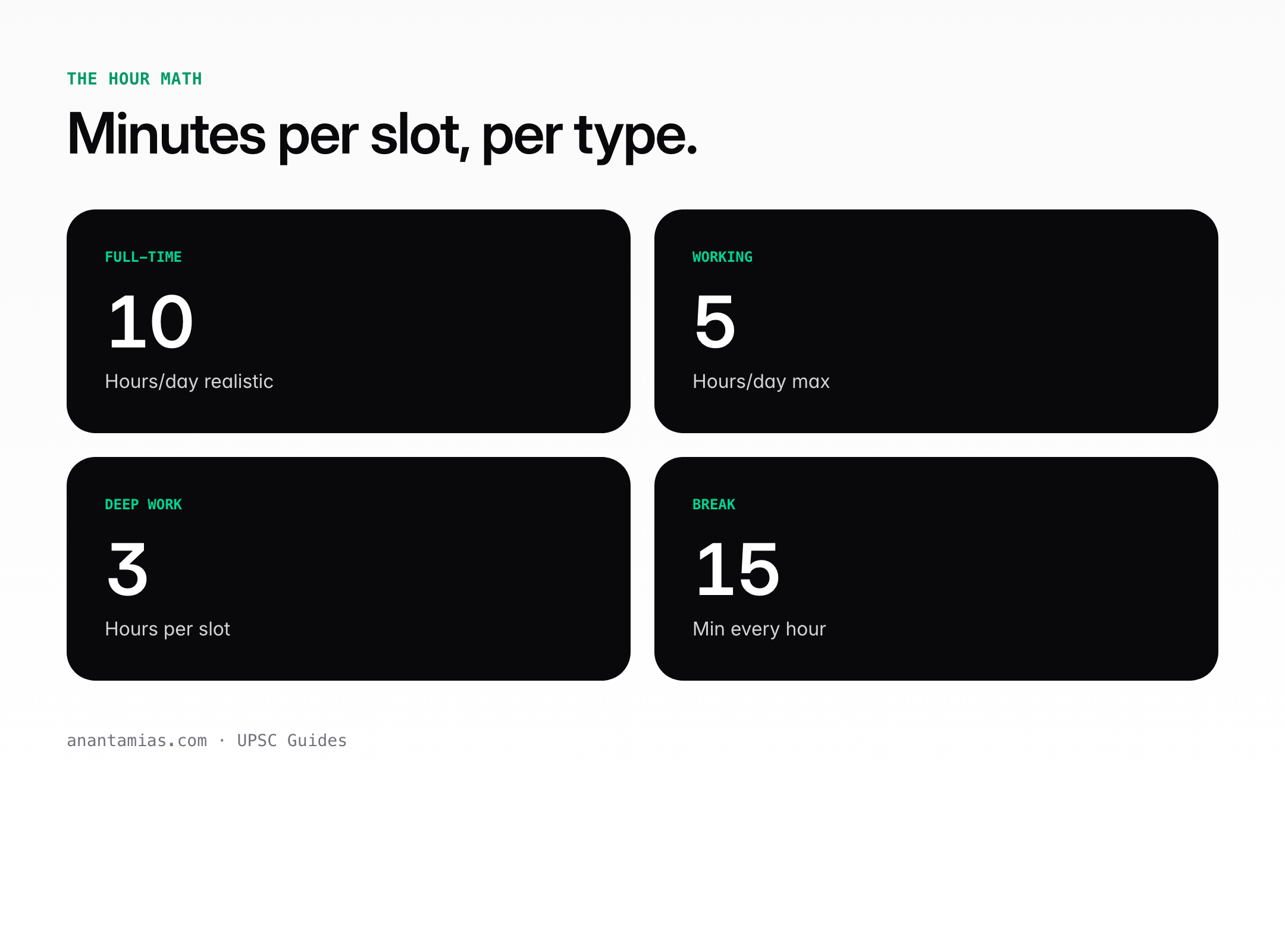
Start with the hours you genuinely control, not the hours you wish you had. A full-time aspirant may have 8–10 focused hours. A working professional may have 4–5 on weekdays. A college student may have 3–4. The structure below works for all three because the blocks change size while the priorities stay the same.
The Short Answer: Build the Day Around Four Blocks
- Core subject: one demanding GS or optional topic when your mind is freshest.
- Current affairs: a capped reading-and-notes block, not an open-ended news scroll.
- Practice: Prelims MCQs, Mains answer writing or both, depending on your exam stage.
- Revision: a same-day review plus a weekly recovery block for unfinished work.
Sleep, meals, exercise, commute and family time sit around these four blocks. Do not pretend they do not exist. A timetable that ignores your actual life is already broken.
Choose Your Study Ratio Before Choosing Clock Times
Two aspirants can study for the same six hours and need completely different days. A beginner needs coverage. Someone ten weeks from Prelims needs testing and error correction. Pick your stage first, then divide the available study time.
| Preparation stage | New study | Practice | Revision | Current affairs |
|---|---|---|---|---|
| Foundation / first reading | 50% | 15% | 20% | 15% |
| Integrated Prelims + Mains | 35% | 25% | 25% | 15% |
| Final 12 weeks before Prelims | 20% | 40% | 30% | 10% |
| Mains answer-writing phase | 25% | 40% | 25% | 10% |
These are starting ratios, not UPSC rules. Track completion for two weeks. If you keep carrying revision forward, reduce new study before cutting sleep.
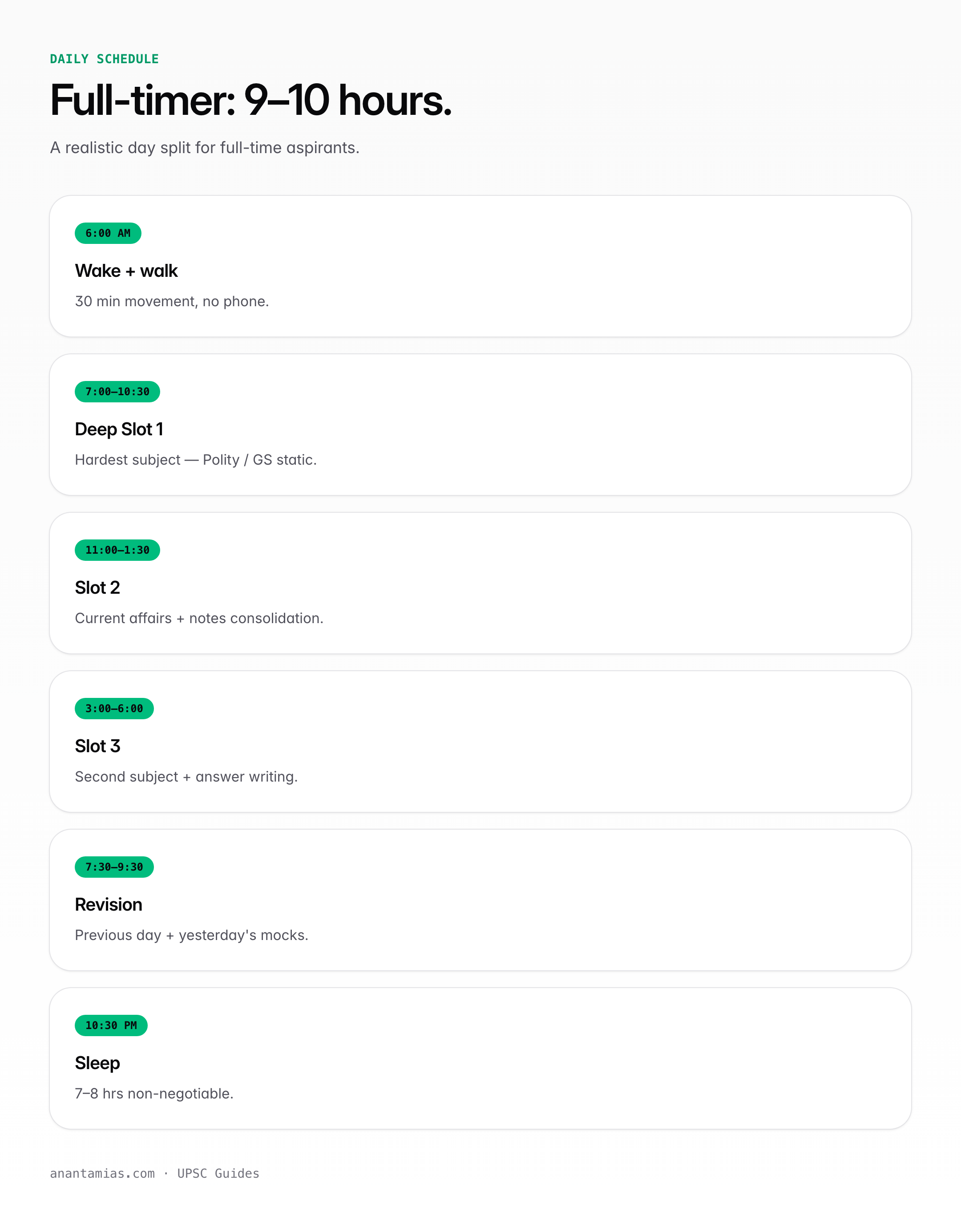
Schedule 1: Full-Time Aspirant (8–10 Focused Hours)
Use the morning for the subject you resist most. Newspaper reading feels productive, which is exactly why it can quietly consume the day. Put a hard stop on it.
| Time | Study block | Output |
|---|---|---|
| 6:00–6:30 | Wake, water, short walk | Ready to start without the phone |
| 6:30–8:30 | Deep study: weakest GS or optional topic | One chapter or one syllabus subtopic |
| 8:30–9:30 | Breakfast and reset | Full break |
| 9:30–11:30 | Second static subject | Notes plus 10 recall questions |
| 11:30–12:15 | Current affairs | Only syllabus-linked notes |
| 12:15–13:00 | Prelims practice | 25–30 MCQs with error log |
| 13:00–14:30 | Lunch and rest | No study |
| 14:30–16:30 | Optional or GS consolidation | One defined topic |
| 16:30–17:15 | Exercise and tea | Proper break |
| 17:15–18:30 | Mains practice | Two answers plus self-review |
| 19:30–20:30 | Revision | Recall today plus one older topic |
| 21:30–21:45 | Plan tomorrow | Three written outcomes |
The output column matters more than the time column. “Study Polity for two hours” lets you sit with a book. “Finish Fundamental Rights and answer ten recall questions” tells you when the block is complete.
Schedule 2: Working Professional (4–5 Hours on Weekdays)
Your morning block carries the preparation. Evenings are vulnerable to late meetings, traffic and plain exhaustion, so do not reserve the hardest topic for 10 PM.
| Time | Activity |
|---|---|
| 5:45–7:45 | Deep study: optional or one static GS subject |
| Commute / lunch break | Current-affairs reading or 20 flashcards; no elaborate note-making |
| 20:30–21:30 | Revision of the morning block plus 15 MCQs |
| 21:30–22:00 | One Mains answer outline or one timed answer |
| Saturday | Two long study blocks and one sectional test |
| Sunday | Test analysis, weekly revision and next-week planning |
Do not force daily answer writing if it repeatedly pushes bedtime back. Write three timed answers across the workweek, then do a longer practice session on Sunday. The habit still compounds.
Schedule 3: College Student (3–4 Hours)
College gives you a longer runway. Use it to build foundations without turning every semester into a mock UPSC year. Your degree work still counts, especially when it overlaps with an optional or GS topic.
| Time | Activity |
|---|---|
| 6:30–8:00 | NCERT, Polity or another foundation subject |
| Between classes | 20–30 minutes of current affairs or spaced revision |
| 17:30–18:15 | Exercise, sport or a complete break |
| 19:00–20:00 | College work |
| 20:00–21:00 | UPSC subject continuation |
| 21:00–21:30 | 10 MCQs or one answer outline |
| Weekend | One three-hour block for revision, PYQs and backlog |
If exams or submissions take over a week, shrink the UPSC plan to one 45-minute maintenance block. Keeping the chain alive is better than planning a heroic restart after the semester ends.
What a Productive Two-Hour Study Block Looks Like
A calendar can reserve two hours, but it cannot make those hours useful. Give each block a starting point, a visible output and a closing check.
- First 10 minutes: recall yesterday’s topic without opening the book. Write what you remember and mark the gaps.
- Next 60–75 minutes: study one defined subtopic. Underline less; pause to explain the idea in your own words.
- Next 20–25 minutes: solve PYQs, MCQs or one short answer using the same topic.
- Final 10 minutes: close the material, list three takeaways and record the next starting point.
The closing note removes friction tomorrow. Instead of reopening a book and wondering where to begin, you start with a written instruction such as “compare Articles 32 and 226, then solve five judiciary PYQs.”
Use shorter cycles if concentration drops sooner. A 50-minute study period followed by a 10-minute break is fine. The principle is to return with a defined task, not to worship one timer method.
Turn the Sample into Your Own Timetable in 20 Minutes
- Mark immovable hours: sleep, job or classes, meals, commute and family duties.
- Find your best two-hour window: assign your weakest major subject to it.
- Add one practice output: MCQs, one answer, two answer outlines or test analysis.
- Cap current affairs: decide both the source and the stop time before you begin.
- Reserve revision: 30–60 minutes daily and one longer weekly block.
- Keep a buffer: leave at least one unassigned block each week for spillover or rest.
Write outcomes, not subjects. “Economy” is not a plan. “Revise inflation, solve 25 PYQs and add errors to the notebook” is.
How the Timetable Changes Across the UPSC Cycle
Foundation phase: protect coverage and recall
At the beginning, keep one primary source per subject and finish the syllabus map before collecting extra material. Most of the day can go to new study, but every block should still end with recall or questions. Waiting until the syllabus is “complete” to revise is how the first subjects disappear from memory.
Prelims phase: tests become study material
As Prelims approaches, reduce fresh sources and increase mixed practice. Schedule the test and its analysis as separate blocks. During analysis, classify mistakes by cause and reopen the minimum material needed to repair them. A wrong answer caused by misreading needs a different fix from one caused by a knowledge gap.
Mains phase: writing moves into the best hours
Do not leave every answer for the last tired half-hour. Put at least some timed writing inside a high-energy block. Alternate between full answers, introductions and conclusions, framework drills, and test review. Reading model answers can support this work, but it cannot replace producing an answer under a clock.
Interview phase: replace volume with deliberate preparation
The personality test needs a different day. Use short blocks for DAF-based questions, current issues, spoken responses and mock feedback. Keep time for reading and reflection. Stuffing more facts into ten-hour days is less useful than learning to form a clear, balanced answer aloud.
Free Planning Tools from the Anantam IAS Shop
A blank timetable rarely fixes the problem by itself. You also need a way to choose weekly outcomes, recover unfinished work and record practice. These resources are free digital downloads; take only the one that fits the gap in your system.

Personalized UPSC Study-Plan Kit
Use this first if your week has no structure. It includes 12 printable PDFs: a planning workbook, wall timetables and worksheets for revision and recovery.

UPSC Answer-Writing Kit
Use this when “answer writing” exists in the timetable but never happens. The 12 PDFs include a 30-day workbook, evaluation tools, templates and ruled sheets.

Half-Yearly Current Affairs PDF
Use this for a weekly revision block, not daily newspaper replacement. The January–June 2026 compilation organises six months of coverage in one free volume.

Indian Polity Rapid Revision Tables
Use this when revision keeps becoming rereading. The free table-led book covers constitutional foundations, Parliament, judiciary, federalism and governance.
A Weekly Rhythm That Prevents Backlog
- Monday to Thursday: new study, short revision and daily practice.
- Friday: lighter new study and consolidation of the week’s notes.
- Saturday: sectional test or a longer answer-writing session.
- Sunday morning: analyse errors and revise weak areas.
- Sunday evening: half-day break, then set three outcomes for the next week.
The error analysis is part of the test. A two-hour mock followed by ten minutes of checking produces a score, not improvement. Record why each wrong answer failed: knowledge gap, misread question, weak elimination or poor time control.
Plan the Week with Outcomes, Not a Giant To-Do List
Choose three weekly outcomes: one coverage outcome, one practice outcome and one revision outcome. For example: finish Parliament, complete 150 Polity MCQs with analysis, and revise Fundamental Rights from memory. Daily blocks then serve those outcomes instead of competing with a list of twenty unrelated tasks.
Set a minimum version for bad days. It may be 45 minutes of revision, ten MCQs and one answer outline. The minimum is not the normal target. It is the floor that keeps one difficult day from becoming an abandoned week.
What to Remove from Your Timetable
- Three current-affairs sources: choose one daily source and one revision compilation.
- Back-to-back lectures all day: add retrieval, questions or notes after each learning block.
- Vague “revision” entries: name the pages, topic or error-log section.
- Zero-buffer weeks: unfinished work then steals sleep or Sunday rest.
- Daily timetable redesign: review the system once a week, not whenever a hard chapter feels uncomfortable.
The Recovery Rule for Missed Days
Do not move every missed task to tomorrow. That creates a timetable with two days of work inside one day. Mark each unfinished item as must do, can wait or drop. Carry forward only the must-do item and place it inside the weekly buffer.
If you miss three days, restart at the next scheduled block. Do not spend the fourth day designing a new color-coded life. The old plan needs a smaller workload, not prettier boxes.
Your Timetable Is Working If You Can Measure Output
At the end of each week, check four numbers: planned blocks completed, MCQs reviewed, answers written and topics revised from memory. Hours studied can support the review, but hours alone hide passive reading.
Keep the first timetable for two weeks before making major changes. Then adjust one variable: block length, subject order or weekly load. When you change everything at once, you cannot tell what fixed the problem.
For the daily work inside the plan, use the Daily Current Affairs, Daily Answer Writing and Prelims MCQs libraries. If you are still deciding what the exam requires, begin with the UPSC syllabus and exam pattern.
Frequently Asked Questions
How many hours should I study daily for UPSC?
A full-time aspirant can plan for 8–10 focused hours, a working professional for 4–5 weekday hours, and a college student for 3–4. Start below your theoretical maximum and track completed outputs for two weeks. Consistency matters more than one unusually long day.
What is the best time to study for UPSC?
Use your most alert two-hour window for the hardest GS or optional subject. For many people that is early morning, but the clock matters less than protecting the same distraction-free window every day.
Should a UPSC timetable include both Prelims and Mains practice?
Yes during integrated preparation. Include a small MCQ block and regular answer writing, then change the ratio as the next exam stage approaches. In the final weeks before Prelims, testing and error correction should take a larger share.
How much time should I give current affairs each day?
Cap daily current affairs at about 45–60 minutes for reading and syllabus-linked notes. Add a separate weekly revision block. Using several newspapers, videos and compilations usually creates duplication rather than better coverage.
What should I do when I fall behind my timetable?
Do not move the entire backlog to the next day. Carry forward only the highest-priority task into a weekly buffer, postpone what can wait and drop low-value work. Restart at the next scheduled block.
Is the Anantam IAS UPSC Study-Plan Kit free?
Yes. The Personalized UPSC Study-Plan Kit is a free digital product with 12 printable PDFs, including a planning workbook, wall timetables and revision and recovery worksheets. Complete the ₹0 checkout to receive the download link.
Should I study seven days a week?
Keep a light review or planning block if you prefer daily continuity, but protect at least half a day each week for rest. A timetable must leave enough energy to repeat it for months.
Tell Google you want more of this.
Add Anantam IAS as a preferred sourceOne tap, and this site shows up more often in your own Top Stories, AI Overviews and AI Mode. Remove it any time.