Disclosure: this guide contains Amazon affiliate links. As an Amazon Associate, Anantam IAS earns from qualifying purchases — at no extra cost to you.
PSIR optional PYQ analysis is the most reliable guide to what UPSC asks, because the papers repeat themes far more often than they repeat questions. Knowing those themes tells you where to spend your preparation time. This is not a question bank. This is a pattern decoder for Paper 1.
Paper 1 has two sections. Section A covers Political Theory, including Indian and Western political thought. Section B covers Indian Government and Politics. Between 2015 and 2025, UPSC set 308 sub-questions across these two sections, 28 in each of the 11 papers. The patterns are striking, and they tell you where to invest your preparation time.
If you are starting your PSIR optional preparation, this analysis should be your foundation document.
Paper 1 Structure: What You Are Actually Facing
Paper 1 carries 250 marks and runs for three hours. It has 8 questions, 4 in each section, and you attempt 5 of them. The split:
- Section A (Political Theory & Concepts): Questions 1 to 4. Question 1 is compulsory.
- Section B (Indian Politics): Questions 5 to 8. Question 5 is compulsory.
After Questions 1 and 5, you pick any three of the remaining six, with at least one from each section. Every question carries 50 marks. The two compulsory questions have five 10-mark parts, each answered in about 150 words. The other six usually split into 20 + 15 + 15 marks.
Key insight: Section B usually gives you more to work with. Indian Politics answers allow for examples, case studies, and current affairs integration. Political Theory answers require abstract reasoning, which is harder to do well under time pressure.
This does not mean you should neglect Section A. It means you should prepare Section A with more precision.
Topic-Wise Weightage: Section A (Political Theory & Concepts)
Here's what the 11 papers from 2015 to 2025 show for Section A, with each sub-question counted under its main theme. The average is the marks set on that theme per paper.
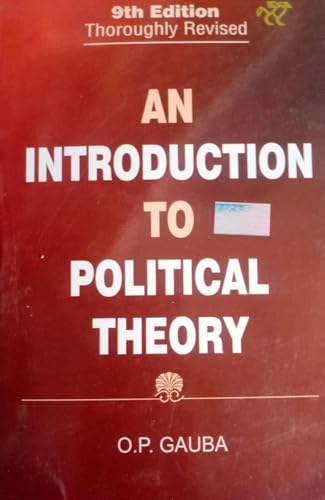
An Introduction to Political Theory — O.P. Gauba
- 694 pages, the Paper 1A concept book almost every PSIR candidate owns
- Concepts in plain prose: state, liberty, equality, justice, rights
- Chapter-end summaries that turn straight into answer frames
| Topic | Papers With a Question (of 11) | Avg. Marks Set Per Paper | Trend |
|---|---|---|---|
| Justice (Rawls, Sen, Nozick) | 10 | 17 | Every paper except 2024 |
| Democracy & Democratization | 11 | 15 | Asked every single year |
| Rights, Liberty & Equality | 11 | 24 | Every year |
| State & Sovereignty | 10 | 13 | Every paper except 2023 |
| Political Ideologies (Marxism, Liberalism, Feminism) | 11 | 26 | Every year; Marxism and feminism both steady |
| Power, Authority & Legitimacy | 8 | 14 | Every paper since 2020 |
| Multiculturalism & Identity | 4 | 5 | Mostly 10-mark short notes (2017, 2022, 2023, 2025) |
| Western Political Thinkers (Plato to Marx) | 11 | 43 | Always present, usually in several parts |
| Indian Political Thought (Kautilya to M.N. Roy) | 11 | 27 | Every year |
| Political Theory: Meaning & Approaches | 11 | 17 | Every year, often a Q1 short note |
Justice: In 10 of 11 Papers Since 2015
John Rawls is one of the most frequently named thinkers in PSIR Paper 1. Between 2015 and 2025, he was named in a Section A question in 9 of the 11 papers, every year except 2019 and 2024. The 2019 paper still asked about communitarian perspectives on justice.
Specific examples:
- 2015: "'Difference Principle' in Rawls' Theory of Justice" (10 marks)
- 2018: "Analyse John Rawls justification of discrimination to achieve the goals of Justice." (15 marks)
- 2020: "Make a comparative assessment of Greek perspective of Justice with the Rawlsian concept of Justice." (20 marks)
- 2023: "Rawls' idea of the 'liberal self' is too individualistic. Explain, in this context, the communitarian critique of Rawls' theory of justice." (15 marks)
Common student mistake: Writing a textbook summary of the veil of ignorance and stopping there. Examiners want you to engage with critics: Nozick's entitlement theory, Sen's capability approach, communitarian critiques from Sandel and Walzer. A Rawls answer without at least two counter-positions reads as a summary, not an argument.
Democracy: Asked Every Year Without Exception
Democracy questions have appeared in every single Paper 1 from 2015 to 2025. The angle changes, but the theme never disappears.
- 2015: "Difference between Participatory and Deliberative Democracy" (10 marks)
- 2017: "Deliberative democracy does not have its salience without participation and participatory democracy does not have its credence without deliberations. Comment." (15 marks)
- 2019: "Deliberative democracy." (10 marks)
- 2021: "'Free and fair deliberation is key to the foundation of democracy.' Explain." (15 marks)
- 2024: "Deliberative democracy seeks to promote democratic decision making about public issues among the citizens. Discuss." (15 marks)
The trend is clear: deliberative democracy keeps coming back (2015, 2017, 2019, 2021 and 2024), and the elite theory of democracy appeared in 2022 and 2025. Prepare the models the syllabus names, representative, participatory and deliberative, along with their critics.
Feminism: A Steady Presence
Feminist political theory shows up roughly every other year: 2016, 2017, 2019, 2021, 2023 (J.S. Mill on the subjection of women) and 2025, and the 2026 paper asked about Mary Wollstonecraft. It isn't surging, but it never stays away for long.
- 2019: "Distinguish between liberal feminism and radical feminism." (15 marks)
- 2021: "Feminist critique of the State" (10 marks)
- 2025: "Explain how the slogan 'the personal is political' addresses the issue of women's oppression and discrimination?" (15 marks)
If you are not reading Carole Pateman, Catharine MacKinnon, Kimberle Crenshaw, and Martha Nussbaum, you are leaving marks on the table.
Topic-Wise Weightage: Section B (Indian Politics)
Section B spreads its questions across the 11 units of the Indian Government and Politics syllabus, and the distribution is uneven.
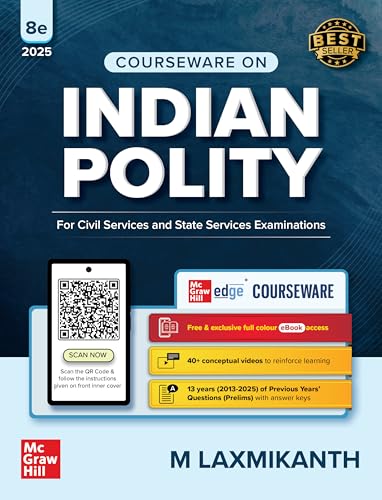
Indian Polity — M. Laxmikanth (8th Edition)
- McGraw Hill courseware edition, 856 pages
- The factual base under every Section B question
- Solved Prelims PYQs from 2013–25 plus 12 years of Mains questions
| Topic | Papers With a Question (of 11) | Avg. Marks Set Per Paper | Trend |
|---|---|---|---|
| Indian Federalism | 7 | 10 | Most years, angle varies |
| Caste & Politics | 7 | 10 | Every other year or so; caste census in 2025 |
| Party System & Coalition Politics | 9 | 13 | Consistent |
| Fundamental Rights & Judiciary | 11 | 23 | Every year (basic structure, judicial activism, Supreme Court) |
| Secularism | 1 | 1 | Only 2015 in this period; back in 2026 |
| Election & Electoral Reforms | 5 | 10 | Up in 2025 (CEC appointment, delimitation) |
| Centre-State Relations | 6 | 10 | Often via the Governor or Inter-State Council |
| Regionalism & Regional Parties | 6 | 7 | Sporadic |
| Panchayati Raj & Local Governance | 11 | 19 | Every year, not declining |
| Communalism & Identity Politics | 6 | 9 | Steady; religion and ethnicity alternate |
| Indian National Movement | 11 | 16 | Every year, often a Q5 short note |
Indian Federalism: The Backbone of Section B
Indian federalism or Centre-State relations came up in 9 of the 11 papers from 2015 to 2025, every year except 2021 and 2024. The questions keep testing the gap between the Constitution's federal design and its centralizing practice, so UPSC expects you to go beyond K.C. Wheare's "quasi-federal" classification.
- 2015: "Cooperative Federalism in India" (10 marks)
- 2018: "Implementation of GST and NEET is a major challenge to Indian federalism." (10 marks)
- 2020: "Does the functioning of the federalism in India tend to make it appear as a unitary state in practice?" (20 marks)
- 2023: "Does the actual working of Indian federalism conform to the centralizing tendencies in Indian polity? Give reasons for your answer." (20 marks)
What examiners reward: Students who use specific examples — Article 356 usage statistics, GST Council voting patterns, Finance Commission recommendations, recent Supreme Court judgments on federalism. Generic answers about "India is quasi-federal" without evidence score poorly.
For a deeper understanding of this topic, refer to our detailed notes on federalism in India.
Caste & Politics: Always Relevant, Never Repetitive
Between 2015 and 2025, UPSC never repeated a caste question. The angles rotate:
- Emergence of backward classes in Indian politics (2016)
- Development versus caste in electoral behavior (2019)
- Caste as a social category becoming a political category (2021)
- Caste politics, regional aspirations and electoral manifestations (2023)
- Caste census and people's aspirations (2025)
Key thinkers to cite: Rajni Kothari ("Politics in India" framework), M.N. Srinivas (dominant caste), Christophe Jaffrelot (India's Silent Revolution), Gopal Guru on Dalit intellectual contributions.
Year-Wise Question Distribution: The Complete Picture
| Year | Political Theory Sub-Questions | Indian Politics Sub-Questions | Sample Themes Asked |
|---|---|---|---|
| 2015 | 14 | 14 | Rawls' difference principle, Plato and the open society (Popper), Cooperative federalism |
| 2016 | 14 | 14 | Feminist theory of the State, Rawls on democratic equality, Backward classes in politics |
| 2017 | 14 | 14 | Eco-feminism, Deliberative democracy, Cooperative to competitive federalism |
| 2018 | 14 | 14 | Rawls on discrimination, Three generations of human rights, GST and NEET as a federal challenge |
| 2019 | 14 | 14 | Deliberative democracy, Gramsci on hegemony, Caste and development in voting |
| 2020 | 14 | 14 | Greek and Rawlsian justice, Post-colonial theory of the State, Federalism in practice |
| 2021 | 14 | 14 | Feminist critique of the State, Rawls and liberalism, Caste as a political category |
| 2022 | 14 | 14 | Ambedkar and Rawls on justice, Elitist theory of democracy, Electoral behavior |
| 2023 | 14 | 14 | Communitarian critique of Rawls, Foucault on power, Centralizing federalism |
| 2024 | 14 | 14 | Deliberative democracy, Plato's theory of Forms, Directive Principles versus Fundamental Rights |
| 2025 | 14 | 14 | Rawls on distributive justice, "The personal is political", Caste census |
Pattern Analysis: What the Data Actually Tells You
Pattern 1: Thinker Rotation in Section A
There's no neat rotation. Some thinkers return almost every year and others come and go. Rawls was named in 9 of the 11 papers. The record for a few others, 2015 to 2025:
- Marx or Marxism: 2015, 2016, 2017, 2019, 2020, 2021, 2024, 2025
- Gramsci: 2015, 2016, 2019
- Plato/Aristotle: 2015, 2017, 2019, 2021, 2024
- Feminist theory: 2016, 2017, 2019, 2021, 2023, 2025
Prediction principle: Don't bet on gaps. A thinker asked last year can be asked again (Marx came up in 2019, 2020 and 2021), and one who's been missing for years can return (Gramsci hasn't been named since 2019). Prepare every thinker on the syllabus list.
Pattern 2: Section B Leans on Recent Developments
Section B regularly ties the syllabus to recent events. The 2018 paper asked about GST and NEET as a challenge to federalism, lateral entry into the civil services, and the environmental movement in Tuticorin. The 2025 paper asked about Jammu and Kashmir after 2019, the caste census, the appointment of Election Commissioners, and delimitation after Census 2027. These aren't pure theory questions.
What this means for preparation: You cannot prepare Paper 1 from textbooks alone. Read EPW (Economic and Political Weekly), follow Supreme Court judgments on fundamental rights, and track parliamentary debates on federal issues.
Pattern 3: Cross-Referencing Thinkers Is the New Normal
UPSC regularly asks you to compare thinkers, not just explain one:
- Kautilya and Machiavelli on statecraft (2015)
- Aristotle's critique of Plato's idealism (2019)
- Greek and Rawlsian conceptions of justice (2020)
- Ambedkar's egalitarian justice and Rawls' justice as fairness (2022)
- Marxist and liberal approaches to the State (2025)
Prepare comparison matrices for major thinker pairs. This is non-negotiable if you're aiming for a high Paper 1 score.
Section A vs Section B: Where Marks Come Easier
Because Questions 1 and 5 are compulsory and you need at least one more question from each section, your answer script always splits like this:
- Section A: 100 or 150 of the 250 marks you answer
- Section B: 150 or 100, the other way round
- The only real choice: which section gets your fifth question
Section B is often the safer home for that fifth question. The reasons:
- Indian Politics allows concrete examples. Examiners can verify your knowledge through specific data points.
- Political Theory penalizes shallow understanding. A mediocre Rawls answer is obvious to any examiner; a mediocre federalism answer can still earn decent marks with good examples.
- Section B overlaps with GS Paper II. Your GS preparation directly feeds into Section B answers.
Strategy for 150+ Marks in Paper 1
The Non-Negotiable 6
These topics have appeared so frequently that skipping any one of them is reckless:
- Justice (Rawls, Sen, Nozick) — prepare 4-5 different angles
- Democracy: representative, participatory, deliberative, elitist
- Indian Federalism — constitutional, fiscal, cooperative, competitive
- Caste & Politics — historical, contemporary, electoral, social mobility
- Rights & Liberty — theoretical AND Indian constitutional context
- Political Ideologies — Marxism, Liberalism, Feminism at minimum
Answer Writing Approach
For Section A (Political Theory):
- Open with a conceptual definition, not a dictionary one
- Cite 2-3 thinkers minimum per answer
- Include one critique for every position you explain
- End with contemporary relevance (1-2 lines connecting to India or the world)
For Section B (Indian Politics):
- Open with a constitutional or institutional reference
- Use specific data: election results, judgment citations, commission reports
- Include at least one scholar's framework (Rajni Kothari, Granville Austin, Zoya Hasan)
- End with a forward-looking assessment
For comprehensive notes that align with this PYQ analysis, see our PSIR optional notes.
Time Management
You have 3 hours for 5 questions of 50 marks each. That's roughly 36 minutes per question. The common trap is overspending on the first question and rushing the last one.
A workable plan: Spend 5 minutes reading and selecting questions. Then give each question about 33 minutes and stick to it ruthlessly. Keep the last 10 minutes for review and adding missed points.
Emerging Trends for 2026 and Beyond
Based on the trajectory of 2019-2025 questions:
- Climate justice and environmental politics: already a Section B regular (environmental movements in 2022 and 2024, environmentalism of the poor in 2023), and the 2026 paper asked about political will on environmental degradation. Expect more.
- Technology and democracy — digital surveillance, AI governance, social media regulation.
- Populism studies: not yet asked by name in Paper 1, but Paper 2 in 2025 asked about the rise of centre-right parties worldwide. Read Cas Mudde, Jan-Werner Muller.
- Decolonization of political theory — non-Western political thought, Gandhian and Ambedkarite frameworks gaining examiner attention.
- Intersectionality: not yet asked by name, but a useful framing for caste, gender and class questions.
UPSC Relevance
PSIR Paper 1 PYQ analysis is not just exam intelligence. It reveals how UPSC thinks about Political Science as a discipline. The mix of descriptive and analytical questions, single-thinker and comparative questions, and theory and application tells you that UPSC wants practitioners of political analysis, not textbook summarizers.
This analysis directly feeds into your answer writing quality. When you know that Rawls was named in 9 of the 11 papers from 2015 to 2025, you prepare 5 different Rawls answers rather than 1. When you know federalism is asked from different angles each year, you build a modular answer framework rather than memorizing one essay.
Students who score well in PSIR optional aren't necessarily smarter. They have better exam intelligence. This PYQ analysis is the starting point for building that intelligence.
Tell Google you want more of this.
Add Anantam IAS as a preferred sourceOne tap, and this site shows up more often in your own Top Stories, AI Overviews and AI Mode. Remove it any time.