
Disclosure: this guide contains Amazon affiliate links. As an Amazon Associate, Anantam IAS earns from qualifying purchases — at no extra cost to you.
The first month of UPSC prep usually goes to buying books, not reading them. You open a topper’s list, see forty titles, panic, and order half of them. Three months later most of those books are still shrink-wrapped, and you’ve read none of them properly. The problem was never the books. It was starting with the wrong ones, in the wrong order.
This is the short, sequenced list a first-year aspirant actually needs. Seven standard books, read in a deliberate order, after you’ve finished the relevant NCERTs. Each one earns its place because it maps directly to how a subject is tested, not because it’s famous. Where a book is overrated for a beginner, this list says so.
How many books you actually need (fewer than you think)
For your first year, you need NCERTs plus roughly seven standard books, and that’s it. Not forty. The seven below cover Polity, Modern History, Economy, Geography, Environment, and Art and Culture, which is the bulk of the General Studies syllabus that’s testable from books. Everything else (current affairs, ethics case studies, optional subject material) sits on top of this base and comes later.
The rule that trips up everyone: a standard book is a second reading, not a first one. You read the NCERTs for a subject first to build the vocabulary, then move to the standard book to add depth. If you skip the NCERT layer, Laxmikanth feels like a wall of unfamiliar terms and you give up. Start with our guide to NCERT books for UPSC if you haven’t built that base yet, then come back here.
Indian Polity by M. Laxmikanth: the one non-negotiable book
If you buy one standard book first, buy this one. Indian Polity by M. Laxmikanth is the single most reliable source for Prelims and GS Paper II, and it’s tested almost verbatim. The book is heavy at around 856 pages, but you don’t read it cover to cover in one go. Start with the chapters on the Preamble, Fundamental Rights, DPSP, the Union and State executive, Parliament, and the judiciary. Those carry the most marks.
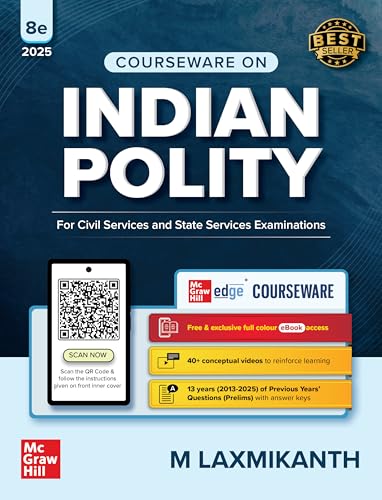
Indian Polity — M. Laxmikanth (8th Edition)
- McGraw Hill courseware edition, 856 pages
- Covers the full Prelims and Mains polity syllabus in one volume
- Solved Prelims PYQs from 2013–25 plus 12 years of Mains questions
What to skip on the first pass: the long appendices, the committee-by-committee detail, and the chapters on minor constitutional bodies. Come to those in your second reading. The honest caveat is that Laxmikanth is dense and exam-shaped, not a story, so read it alongside the relevant NCERT chapters rather than instead of them. Treat it as a reference you’ll revise four or five times, not a novel you finish once.
A Brief History of Modern India by Spectrum: history that’s actually testable
For Modern India, A Brief History of Modern India by Spectrum is the standard, and rightly so. It covers the period from the decline of the Mughals through the freedom struggle to integration after 1947, which is exactly the slice UPSC tests most. The book runs to about 1,000 pages, but the prose is readable and organized chronologically, so you can study it phase by phase.
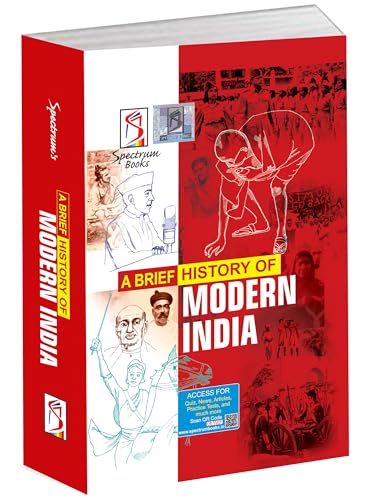
A Brief History of Modern India — Spectrum
- 1,000 pages covering 1707 to the present
- Chronological narrative with chapter summaries
- The most-used modern history book in the exam
Focus your first reading on the chapters covering the Revolt of 1857, the moderate and extremist phases of the Congress, the Gandhian movements, and the partition. The honest stance: don’t pair Spectrum with three other history books out of anxiety. One good Modern India source, revised well, beats four read once. The word “brief” in the title is generous, so give yourself permission to read it slowly across a few weeks.
Indian Economy by Ramesh Singh: start it only after the NCERTs
Economy is the subject where beginners suffer most, and it’s usually because they open Indian Economy by Ramesh Singh before they understand basic terms. This is the standard reference at around 599 pages, and it’s comprehensive, but it assumes you already know what GDP, inflation, fiscal deficit, and the balance of payments mean. Read the Class 11 and 12 Economics NCERTs first, then open this book.
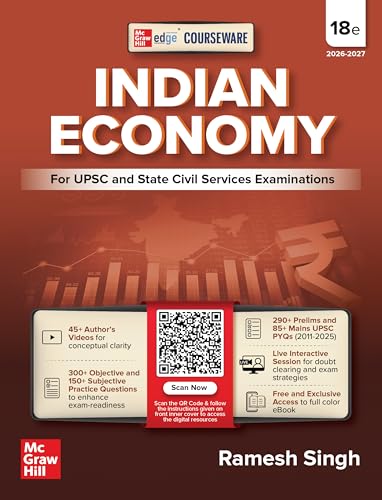
Indian Economy — Ramesh Singh (18th Edition)
- McGraw Hill courseware edition, 624 pages
- Concept-first treatment of growth, banking, fiscal policy and external sector
- Includes Economic Survey and Union Budget coverage
On the first pass, prioritize the chapters on national income, money and banking, inflation, the budget and fiscal policy, and the external sector. Skip the heavily numbered appendices and the historical planning detail until later. The honest caveat: Ramesh Singh is thorough to a fault, and beginners sometimes drown in it. If a chapter feels impossible, that’s a signal to go back to the NCERT, not to push harder. That permission to step back is the whole secret to surviving Economy.
Geography: Certificate Physical and Human Geography by G.C. Leong plus the Oxford Atlas
Geography splits into two buys that work together. Certificate Physical and Human Geography by G.C. Leong is the classic for physical geography, the concepts behind climate, landforms, oceans, and atmospheric processes. It’s compact at around 200 pages and far more affordable than most standard books, which makes it an easy first purchase. Read it alongside the Class 11 Geography NCERT, since the two reinforce each other.
The second buy is a map habit, not just a book. The Oxford Student Atlas for India at about 160 pages is the one to keep open on your desk every single day. Locate every river, mountain range, and city you read about, in any subject, in real time. Beginners treat the atlas as optional and lose easy map-based marks for years. Don’t. The atlas is the cheapest insurance in your whole prep.
Environment by Shankar IAS: the high-yield book most beginners delay too long
Environment and ecology now carry a surprising number of Prelims questions, and Environment by Shankar IAS is the book that covers them efficiently. At roughly 505 pages, it’s a single, self-contained source for ecology, biodiversity, climate change, conventions, and the major environmental laws and bodies. There’s no NCERT that covers this cleanly, which is exactly why this book matters more than its reputation suggests.
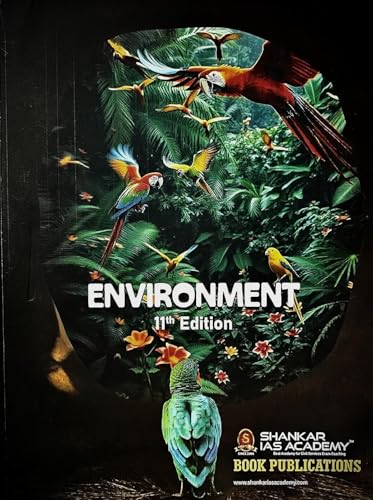
Environment — Shankar IAS Academy (11th Edition)
- 505 pages covering ecology, biodiversity and climate change
- Organised around the environment questions Prelims actually asks
- Updated for current conventions and protected-area listings
Read the chapters on ecosystems, biodiversity, and protected areas first, then the climate-change and international-conventions sections. The honest stance: beginners often push Shankar IAS to “later” because it isn’t a glamorous subject, then scramble before Prelims. Slot it in early. It pairs naturally with current affairs, so you’ll keep reinforcing it through the year. For how this fits the larger Prelims plan, see our list of the best books for UPSC Prelims.
Indian Art and Culture by Nitin Singhania: buy it, but read it last
Indian Art and Culture by Nitin Singhania is the standard for the culture portion of GS Paper I, covering architecture, painting, dance, music, literature, and festivals across roughly 538 pages. It’s a genuinely useful book and worth buying. The stance, though, is about timing: read it last among these seven. Art and Culture is factual and fragmented, so it’s easy to forget if you study it too early and don’t revise it.
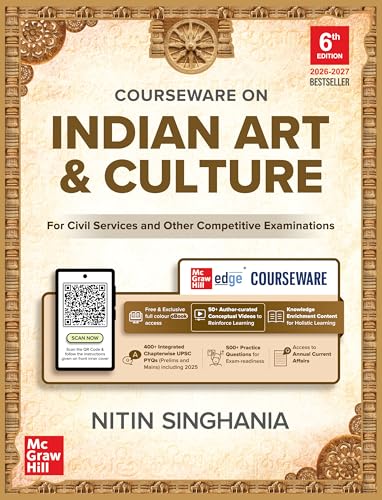
Indian Art and Culture — Nitin Singhania (6th Edition)
- 538 pages, McGraw Hill courseware edition
- Architecture, painting, dance, music and literature in one place
- Illustrated, which matters for a visual subject
When you do read Nitin Singhania, focus first on architecture (temple styles, Indo-Islamic, colonial) and the classical dance and music forms, since those are tested most. Make condensed notes as you go, because raw memorization without a system fades fast. This is the one book on the list where note-making isn’t optional. For the broader Mains picture this book feeds into, our best books for UPSC Mains guide places it in context.
The beginner’s booklist at a glance
| Book | Author / Publisher | Best for / Notes |
|---|---|---|
| Indian Polity | M. Laxmikanth | Polity and governance; the one non-negotiable. Read after Polity NCERTs. |
| A Brief History of Modern India | Spectrum | Modern Indian history; one source, revised well. |
| Indian Economy | Ramesh Singh | Economy; open only after the Class 11-12 Economics NCERTs. |
| Certificate Physical and Human Geography | G.C. Leong | Physical geography concepts; compact and affordable. |
| Oxford Student Atlas for India | Oxford | Daily map habit; keep it open while studying everything. |
| Environment | Shankar IAS | Ecology and environment; high-yield, no NCERT substitute. |
| Indian Art and Culture | Nitin Singhania | Culture for GS Paper I; read last, make notes. |
How to use this list: the reading order that actually works
Don’t buy all seven at once and read them in parallel. That’s how beginners burn out. Move subject by subject: finish the NCERTs for a subject, then read its standard book, then start the next. A reading order that’s worked for years looks like this:
- Polity: NCERTs, then Laxmikanth. Start here because it’s the most rewarding and builds confidence.
- Modern History: NCERTs, then Spectrum, kept chronological.
- Geography: NCERTs and G.C. Leong together, with the Oxford Atlas open daily from day one.
- Economy: Class 11-12 Economics NCERTs first, without exception, then Ramesh Singh.
- Environment: Shankar IAS, read alongside your current affairs.
- Art and Culture: Nitin Singhania last, with condensed notes.
Two habits make this list work. First, revise. A standard book read once and never revisited is wasted money, so plan to revise each title four or five times before Prelims. Second, keep the atlas open the whole time. If you want this booklist set inside a full study routine, our guide on how to prepare for UPSC and the official UPSC syllabus for 2026 show you where each subject fits in the year.
The honest bottom line
Buy seven books, not seventy. NCERTs first, then these standard titles in order, revised until they’re second nature. The aspirants who clear this exam aren’t the ones with the biggest bookshelves. They’re the ones who finished a small, sensible list and revised it relentlessly. Start with Polity this week, keep your atlas open, and let the rest follow. That’s a real first year, not a shopping list.
Frequently Asked Questions
How many books do I really need for UPSC in my first year?
You need the relevant NCERTs plus about seven standard books covering Polity, Modern History, Economy, Geography, Environment, and Art and Culture. Everything beyond that (current affairs, optional subject material, ethics case studies) builds on this base later. A small list revised well beats a large list read once.
Should I read NCERTs before standard books like Laxmikanth?
Yes. NCERTs build the basic vocabulary and concepts for a subject, and standard books assume you already have that foundation. Reading Laxmikanth or Ramesh Singh before the NCERTs is the most common reason beginners feel overwhelmed and give up. Finish the NCERTs for a subject first, then move to its standard book.
Which book should a UPSC beginner start with?
Start with Indian Polity by M. Laxmikanth after finishing the Polity NCERTs. Polity is the most rewarding subject to begin with because it’s tested almost verbatim, builds confidence quickly, and carries heavy weight in both Prelims and GS Paper II.
Is Shankar IAS Environment necessary for beginners?
Yes. Environment and ecology now carry a significant number of Prelims questions, and there’s no NCERT that covers the topic cleanly. Shankar IAS Environment is a single self-contained source for ecology, biodiversity, climate change, and environmental laws. Slot it in early rather than delaying it to the final months.
Do I really need an atlas for UPSC?
Yes, and you should keep it open every day. The Oxford Student Atlas for India is the cheapest item on the list and helps you locate every river, mountain, and place you read about across all subjects. Beginners who skip the atlas habit lose easy map-based marks for years.
When should I read Nitin Singhania’s Indian Art and Culture?
Read it last among the seven standard books. Art and Culture is factual and fragmented, so studying it too early without revision means you forget it. When you do read it, focus first on architecture and classical dance and music, and make condensed notes as you go, since note-making is essential for this subject.
Tell Google you want more of this.
Add Anantam IAS as a preferred sourceOne tap, and this site shows up more often in your own Top Stories, AI Overviews and AI Mode. Remove it any time.