
Opens in a new tab
Join Anantam IAS Channel on Telegram

Daily Digest · Saturday

2 May 2026 Current Affairs for UPSC

2 current affairs published on Saturday, 2 May 2026

2 May 2026 Current Affairs for UPSC — every Why-in-News article AnantamIAS published on Saturday, 2 May 2026, broken down with Why in News?, the exact GS paper it feeds, sub-topic mapping, MCQ-ready facts and a UPSC-style practice question. 2 articles in total, covering Polity, Economy, Environment, S&T, IR, Geography, History, Society and Internal Security — the same Why-in-News + GS-paper-mapping + practice-question format the Compass uses across every daily digest on the site.

Daily current affairs for UPSC is where new material enters your prep stream. Read this 2 May 2026 digest end-to-end in 25–35 minutes, attempt the practice question at the foot of each article (it's MCQ for some, 10/15-marker for others), then bookmark the entries that fall inside your active revision window. Everything stays cross-linked: tap any subject pill to jump to that subject's hub, or use the table of contents above to skip straight to a specific story.

Use this page three ways. Read sequentially for a one-sitting scan of everything that mattered on 2 May 2026. Download the 2 May 2026 PDF below for offline study or print revision. Or use the May 2026 Current Affairs compilation to see this day in the month's full context. For the previous day's reading, see 1 May 2026 Current Affairs; the next day's is 3 May 2026 Current Affairs.

Why we publish daily current affairs separately from the monthly compilation: daily is learning, monthly is revision. Use the daily page to add fresh material to your notes the day it breaks; come back to the May 2026 compilation 60 days before Prelims when the noise has settled and only the lasting takeaway is worth re-reading.

Anticipatory Bail and the Balance between Liberty & Investigation

Open article →Download PDF

Why in News?

Recently, the Supreme Court of India granted anticipatory bail to Congress leader Pawan Khera in a case involving allegations against the wife of Assam Chief Minister Himanta Biswa Sarma. 

The Court observed that:

  • The right to personal liberty (Article 21) is a cherished fundamental right, and any deprivation thereof must be justified on a higher threshold, particularly where the surrounding circumstances may indicate the presence of political overtones.
  • The case appeared prima facie politically motivated, and the arrest was not necessary for investigation. 
UPSC Relevance: GS-2 Polity and Governance: Fundamental Rights

Prelims: Anticipatory Bail, Article 21. 

What is Anticipatory Bail?

  • Anticipatory Bail is a pre-arrest legal remedy that allows a person to seek bail in anticipation of arrest for a non-bailable offence. Becomes operative only upon arrest. 
  • Jurisdiction: Can only be granted by the High Court or the Sessions Court.
  • Governed by Section 482 of the Bharatiya Nyaya Sanhita (BNSS), 2023.
  • Comes with conditions: Courts typically direct the grantee to:
    • make themselves available for interrogation when required
    • not leave the country without prior court permission & surrender their passport
    • not tamper with evidence or influence witnesses
    • cooperate with the investigation
  • Nature of Order: Anticipatory bail is not a blanket protection. It cannot operate for offences committed in the future, and does not permit the accused to commit further offences and claim immunity.

The concept first appeared in the 41st Law Commission Report (1969), which recommended a provision to protect individuals from false or politically motivated implication.

Key Facts: 
Statutory Position: Anticipatory bail can only be granted by the High Court and the Sessions Court under Section 438 of CrPC /  482 of BNSS. Anticipatory bail is a statutory right (not mentioned in the Constitution of India). 

Constitutional Exception: The Supreme Court of India can grant similar relief using Article 136 & Article 142:
Article 136: grant special leave to appeal (SLP) against any judgment, decree, sentence, or order passed by any court or tribunal in India.
Article 142: plenary power to pass any decree or order necessary for doing “complete justice” in any pending matter

Landmark Cases on Anticipatory Bail:

  • Gurbaksh Singh v. State of Punjab (1980): Comprehensive guidelines for Section 438 of CrPC (Section 482 of BNSS) laid down. Held that anticipatory bail can be granted even after an FIR is filed. Power must be exercised with “care and circumspection.” 
  • Sushila Aggarwal v. NCT of Delhi (2020): Settled the question of duration of anticipatory bail. Anticipatory bail need not be time-limited and can continue till the end of the trial unless specific grounds warrant its cancellation. 
  • Arnab Goswami v. State of Maharashtra (2020): SC granted interim bail, highlighting that deprivation of personal liberty for even a single day is too much. Reaffirmed that High Courts must not abdicate their duty under Article 21.
  • Pawan Khera v. State of Assam (2026): The SC granted anticipatory bail, observing that allegations were prima facie politically motivated. Reaffirmed that the right to personal liberty is a cherished fundamental right and its deprivation must be on a higher threshold where political overtones are present. 

The case underscores the judiciary’s role as the guardian of fundamental rights. By scrutinising the political motivation behind an FIR, the SC exercised its power of judicial review over executive action — consistent with the spirit of the Maneka Gandhi case (procedure must be fair and reasonable, not merely formal). 

Hence, a careful balance must be struck between the State’s interest in fair investigation and the individual’s Article 21 rights.

Practice MCQ:

Q. Consider the following statements with reference to Anticipatory bail: 

1. Anticipatory bail can be granted even before an FIR is filed.

2. It provides blanket immunity from arrest for all future offences.

3. It is a statutory provision to protect personal liberty and uphold the right to life.

Which of the statements given above is/are correct?

(a) 1 and 3 only

(b) 2 and 3 only

(c) 1 only

(d) 1, 2 and 3

Answer: (a) 

UPSC PYQ 2021

Q. With reference to India, consider the following statements:

1. When a prisoner makes out a sufficient case, parole cannot be denied to such a prisoner because it becomes a matter of his/her right.

2. State Governments have their own Prisoners’ release on Parole Rules.

Which of the statements given above is/are correct?

(a) 1 only

(b) 2 only

(c) Both 1 and 2

(d) Neither 1 nor 2

Answer: (b) 
70 years of Enforcement Directorate 

Open article →Download PDF

Why in News?

The Enforcement Directorate (ED) marked its 70th founding anniversary on May 1, 2026. The government highlighted ED’s performance in tackling financial crimes. 

  • Since 2005, the ED has attached assets worth about ₹2.36 lakh crore under the Prevention of Money Laundering Act (PMLA).
  • Under PMLA and the Fugitive Economic Offenders Act (FEOA), properties worth over ₹65,800 crores have been confiscated/deprived from the offenders (till March 31, 2026). Out of this, over ₹63,100 crore has been returned to rightful claimants. 
UPSC Relevance: GS-2 Polity and Governance: Law Enforcement Bodies

Prelims: Enforcement Directorate: About & Powers.
Mains: Enforcement Directorate: Powers, contributions & associated challenges. 

What is the Enforcement Directorate?

  • The Enforcement Directorate is a multi-disciplinary law enforcement agency under the Department of Revenue, Ministry of Finance. 
  • It is mandated to investigate economic crimes and violations of foreign exchange laws.
    • Primary mandate is to enforce: (i) Prevention of Money Laundering Act 2002 (PMLA), and (ii) Foreign Exchange Management Act, 1999 (FEMA).
    • Additionally, the implementation of the Fugitive Economic Offenders Act 2018 (FEOA).  
  • Headquarters: New Delhi

Powers of the Enforcement Directorate:

The ED exercises a wide array of coercive and quasi-judicial powers drawn from the three key statutes.

  • Search & Seizure (PMLA): ED officers may search premises and seize documents, records, and assets based on “reason to believe” without prior judicial warrant or a FIR. 
  • Power of Arrest (PMLA): An authorised officer may arrest a person if there is reason to believe that they have committed an offence under PMLA. Arrests are made on internal Enforcement Case Information Reports (ECIRs), unlike regular criminal arrests based on FIRs. However, ED cannot arrest an accused after a Special Court has taken cognisance of a PMLA complaint.
  • Attachment of Property (PMLA): A Director or officer (not below the rank of Deputy Director) may issue a written order provisionally attaching property for up to 180 days, extendable with court approval.
  • Summoning Powers (PMLA): ED may summon any person to give evidence or produce records during an investigation. ED’s summoning powers override territorial limitations under CrPC, i.e., ED can summon individuals to any location, including outside their state of residence.
  • Adjudication & Penalty (FEMA): ED may investigate suspected contraventions of foreign exchange laws and impose monetary penalties on those found guilty. This is a quasi-judicial function distinct from criminal prosecution.
  • Confiscation under FEOA: ED may attach and confiscate properties of fugitive economic offenders (including those held abroad) and vest them with the Central Government.
  • Mutual Legal Assistance: ED facilitates mutual legal assistance treaties (MLATs) with foreign jurisdictions for attachment, confiscation of proceeds of crime, and extradition-related matters.

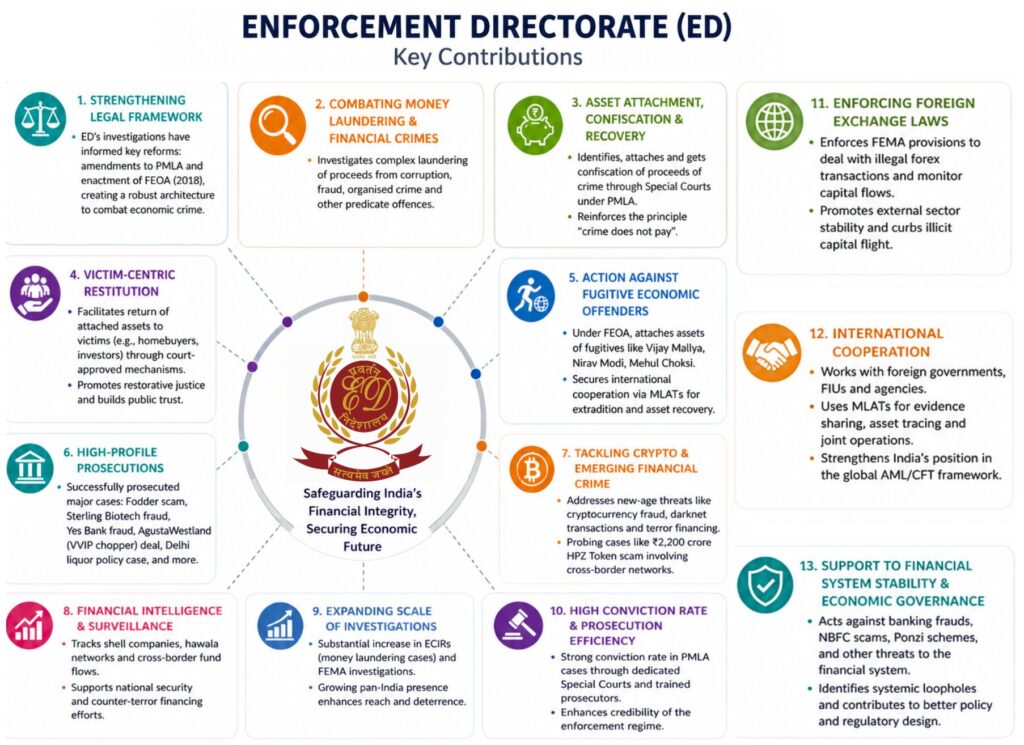
Contributions of the Enforcement Directorate: 

Issues with the functioning of the Enforcement Directorate:

  • Low Trial Completion and Conviction Rate: Between 2014 and 2025, the ED registered ~6,312 money-laundering cases. Of these, only 120 accused persons were convicted by Special PMLA Courts. That translates to a conviction rate of just ~1.9%.
  • Violates Right against Self-Incrimination (Article 20): Under PMLA, statements made to ED officers during interrogation are admissible as evidence. This effectively compels the accused to self-incriminate, and thus violates the constitutional guarantee under Article 20(3), which protects individuals from being a witness against themselves.
  • Absence of FIR & Accountability Deficit: Unlike regular police, the ED registers internal ECIRs (not public FIRs), and the ECIR is not provided to the arrested person at the time of arrest. This deprives the accused of basic procedural safeguards.
  • Tenure Extensions & Institutional Autonomy: The Central Government’s authority to extend the tenure of the ED Director raises questions about the agency’s functional independence. Tenure extensions can create incentives for “regime loyalty” and undermine the ED’s status as an autonomous, apolitical investigative body.
  • Alleged Political Weaponisation: The agency has been criticised for conducting raids during election seasons and targeting opposition state governments. The SC had flagged the ED’s pattern of making allegations without any material evidence to support them.

Way Forward: 

  • Establish functional autonomy for the ED by empowering it to appoint its own cadre and insulating the Director’s tenure from Central Government extension, on the lines of the CBI director’s fixed 2-year tenure model.
  • Provide the accused access to the ECIR at the time of arrest, akin to the FIR system under CrPC, to ensure procedural fairness and compliance with Article 22(1).
  • Fast-track the PMLA Appellate Tribunal to ensure the timely disposal of cases and reduce the “process as punishment” phenomenon.
  • Establish an independent Parliamentary oversight mechanism to review ED’s functioning, including a sunset clause for attachment orders and mandatory review of long-pending ECIRs.
  • Clarify jurisdictional boundaries between Central and State investigative authorities to preserve India’s federal structure, particularly in cases involving state-owned entities and state-registered FIRs.
  • Develop a dedicated regulatory framework for crypto-asset investigations, given the ED’s expanding mandate in digital financial crime, to ensure legal clarity and prevent overreach. 

Practice MCQ:

Q. Consider the following statements with reference to the Enforcement Directorate (ED): 

1. ED can investigate only domestic financial crimes. 

2. ED is empowered to investigate cryptocurrency-related financial crimes.

3. ED can arrest individuals involved in money laundering. 

Which of the statements given above is/are correct?

(a) 1 and 2 only

(b) 2 only

(c) 1 and 3 only 

(d) 2 and 3 only 

Answer: (d)