AI-powered financial inclusion in India has moved from pilot to policy mainstream. Through May 2026, the Reserve Bank’s quarterly Financial Inclusion Index, MoF speeches at the G20 finance track, and a flurry of partnerships between banks and fintechs have made one trend unmistakable. India is no longer trying to extend credit by opening more bank branches or by mandating priority sector quotas alone. It is trying to underwrite previously unbankable customers using machine learning models that read consented digital data trails left by everyday transactions.
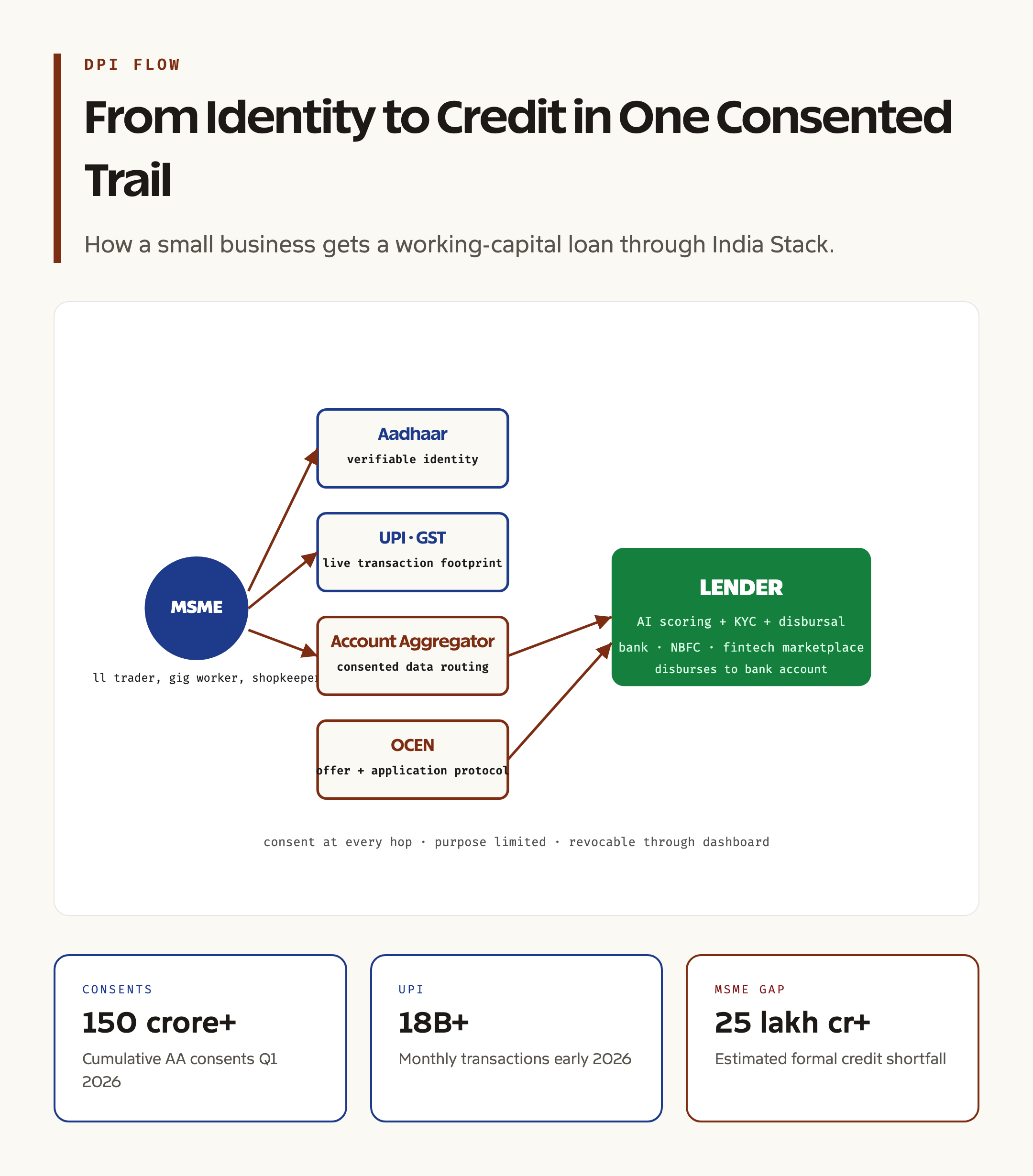
The architecture has three load-bearing pillars. The Account Aggregator framework, live since 2021 and now carrying more than 150 crore data-sharing consents, lets a citizen instruct one financial entity to pull data from another with cryptographic proof. The Open Credit Enablement Network, OCEN, standardizes how lenders, aggregators, and credit marketplaces talk to each other. The Unified Payments Interface generates a real-time transactional footprint that lenders can read with consent. Around these rails, AI models build a credit picture of customers who were invisible to traditional bureau scoring.
For UPSC, AI-powered financial inclusion India sits at the intersection of GS Paper 3 economy themes, GS Paper 2 governance themes around regulatory bodies and digital rights, and the ethics paper through the question of algorithmic fairness. It is also a stock topic in interview boards through the lens of digital public infrastructure and Stack-based governance.
Quick Facts
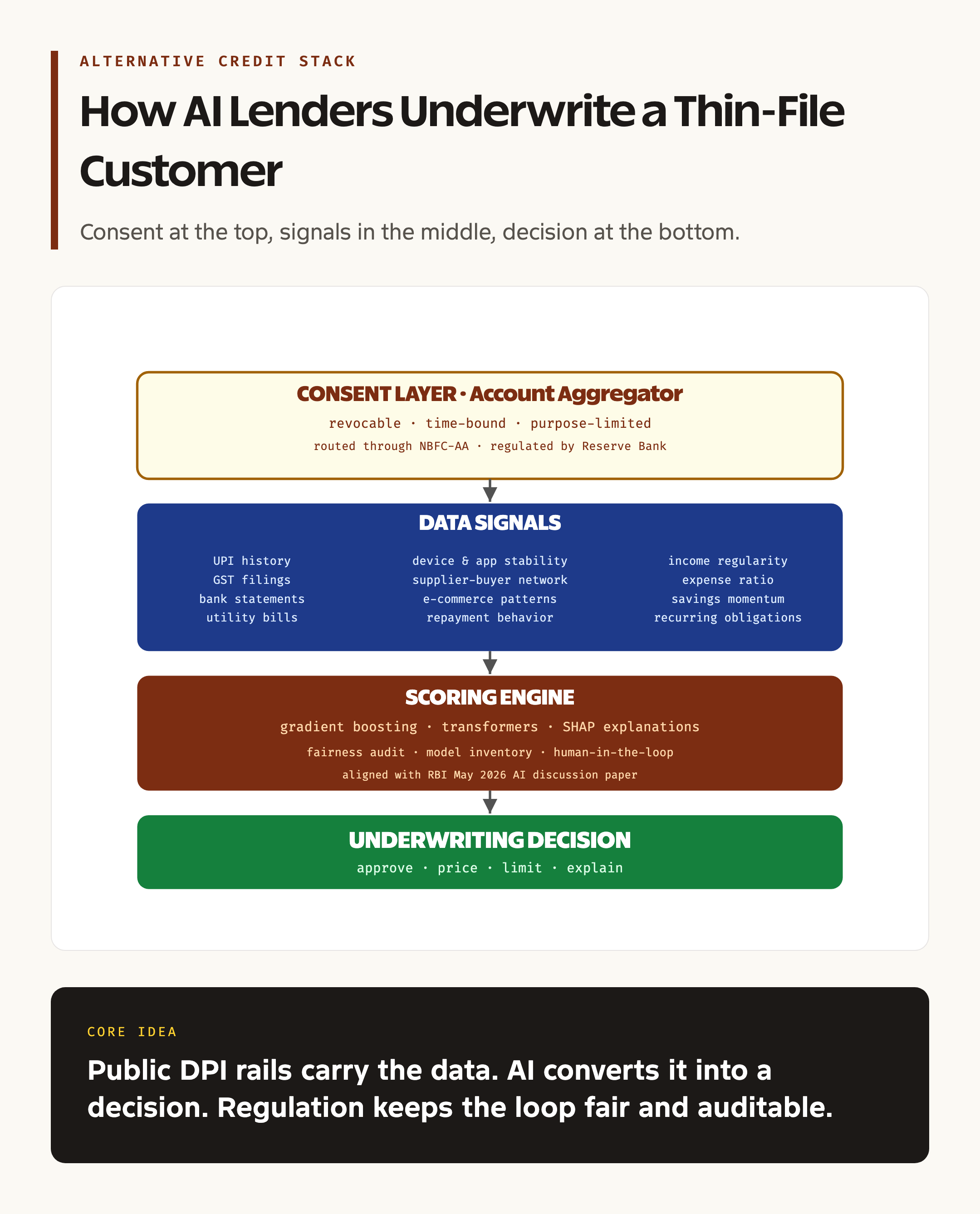
- Account Aggregator framework regulated by the Reserve Bank under the NBFC-AA license, live since September 2021
- More than 150 crore cumulative consents recorded across AA ecosystem as of Q1 2026 (Sahamati industry reports)
- OCEN reference architecture released in 2020, anchored by the iSPIRT volunteer group, with API specifications now adopted by several public sector banks
- UPI processed over 18 billion monthly transactions in early 2026, generating one of the world’s largest real-time payment datasets
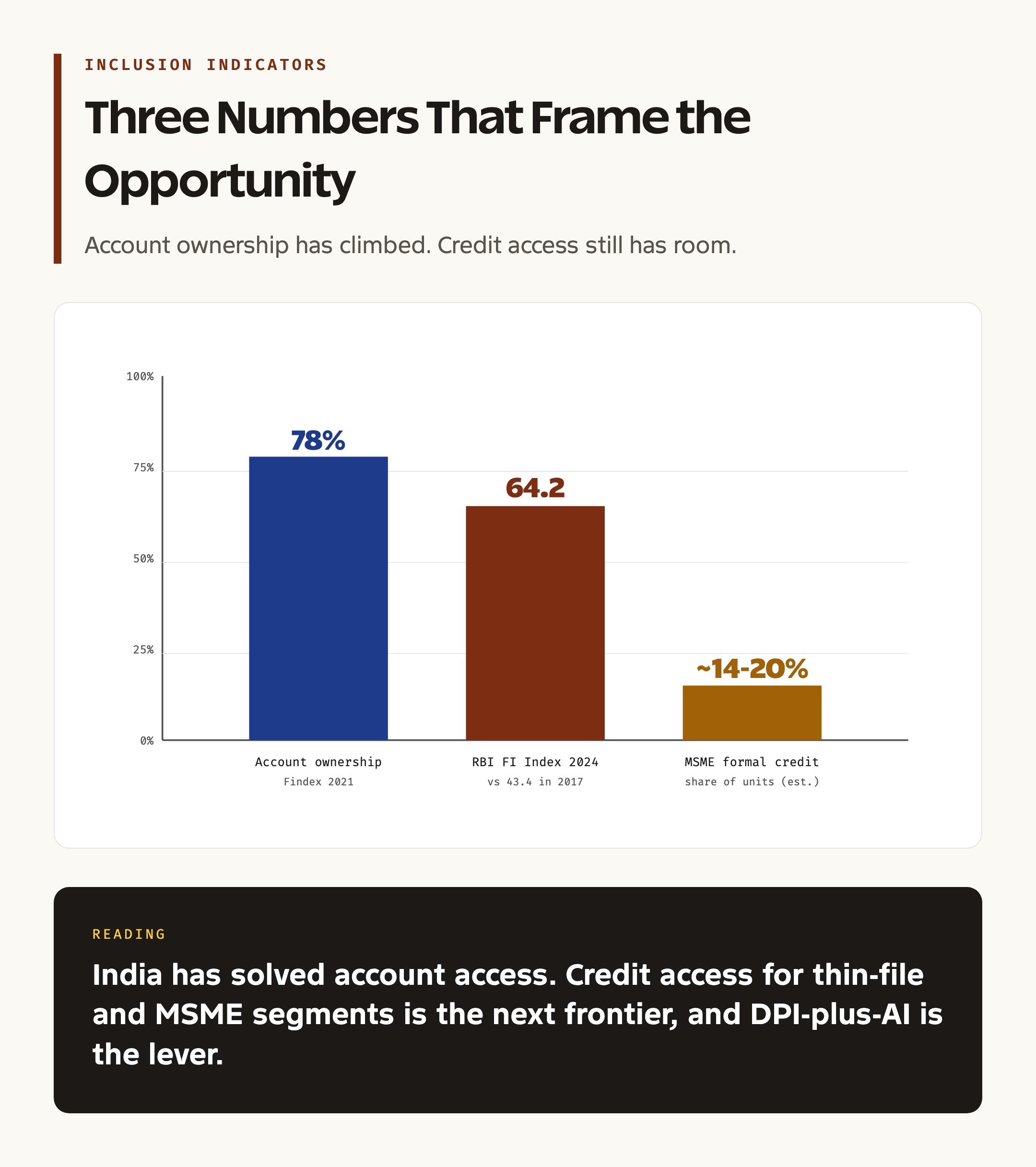
- Reserve Bank Financial Inclusion Index rose from 43.4 in 2017 to 64.2 in 2024, a steady upward trend
- World Bank Findex 2021 placed India’s account ownership rate at roughly 78 percent, up from 35 percent in 2011
- MSME credit gap estimated at over 25 lakh crore rupees by various studies including U.K. Sinha Committee 2019
- NITI Aayog DPI for 2047 roadmap published in 2026 identifies AI-led financial inclusion as a top-three priority
What Just Happened
In the second week of May 2026, three policy and market signals converged. The Reserve Bank released a discussion paper on AI and machine learning in financial services on May 8, opening public consultation until June 30. The paper introduces a tiered risk framework, fairness audit obligations for high-risk models, and a mandatory model inventory for regulated entities. It is the most detailed Indian regulatory document on AI in finance to date.
On May 12, NITI Aayog hosted a closed-door workshop on the DPI for 2047 roadmap, with a dedicated session on AI-led financial inclusion. The workshop produced a draft action agenda focused on extending Account Aggregator coverage to insurance and pensions data, building a national synthetic dataset for credit model training, and standardizing alternative credit scoring vendor accreditation.
On May 14, three large public sector banks announced partnerships with fintech platforms to run AI-powered MSME underwriting pilots using OCEN rails and AA-consented bank statements. The pilots target loan tickets between 50,000 and 25 lakh rupees, traditionally the costliest segment for banks to underwrite manually.
The convergence matters because each piece reinforces the others. AA and OCEN supply the data and routing standards. AI models supply the underwriting capacity. The RBI discussion paper supplies the guardrails. Without any one of these, inclusion stalls. With all three, India can plausibly aim to close most of the formal credit gap within a decade.
Background and Historical Context
India’s financial inclusion story falls into three distinct phases. The first, from bank nationalization in 1969 through the 1990s, used branch expansion and priority sector lending mandates to push banks into rural areas. The second, from 2005 through the early 2010s, used business correspondents, no-frills accounts, and the Pradhan Mantri Jan Dhan Yojana launched in 2014 to push the account ownership rate from roughly 35 percent to over 78 percent. Both phases focused on opening accounts. Neither closed the credit gap.
The third phase, from roughly 2016 onwards, built on JAM, the trinity of Jan Dhan accounts, Aadhaar authentication, and mobile penetration. UPI launched in 2016 and crossed one billion monthly transactions by 2019. Aadhaar provided a verifiable identity layer that drove account opening costs down by an order of magnitude. The Account Aggregator framework, conceptualized by the Reserve Bank’s Inter-Regulatory Group in 2016 and operationalized through 2021, added a consented data-sharing layer.
The architecture sits inside what the country calls India Stack, a layered set of digital public goods including identity (Aadhaar), payments (UPI), data (Account Aggregator), and signature (DigiLocker, eSign). It builds directly on the DPI India Stack approach that has matured over a decade, and feeds into newer agendas tracked in the NITI Aayog DPI 2047 roadmap. This is what makes the Indian model different from purely market-led fintech ecosystems. The public layer is publicly governed, while applications on top are competitive.
AI’s role grew as data volumes did. By 2022, lenders had access to enough transaction history through UPI, GST, and AA to begin building behavioral credit scores that did not rely on bureau histories. The thin-file segment, customers without prior formal credit, started becoming addressable at scale.
Key Provisions of the Architecture
The Account Aggregator framework is a class of regulated NBFC that holds no data itself but routes consents and encrypted data flows between Financial Information Providers (banks, mutual funds, insurers, NPS) and Financial Information Users (lenders, advisors, wealth managers). The framework uses revocable, time-bound, purpose-limited consents that the user controls through a dashboard.
OCEN is a set of API specifications that allow loan service providers, lenders, and account aggregators to interoperate without custom integration. A small business that uses an accounting software can in principle accept a loan offer from any participating lender through that software, with the data flow handled in the background via AA. The model decouples customer relationship from underwriting capital.
AI-powered alternative credit scoring uses combinations of UPI transaction patterns, GST filing data, telecom usage, utility bill history, e-commerce purchase patterns, and AA-sourced bank statements to estimate creditworthiness. Models typically use gradient boosting or deep neural networks, with explainability layers added to comply with regulatory and fairness expectations.
The Reserve Bank’s May 2026 discussion paper proposes classifying AI deployments into low, medium, and high risk tiers based on impact on customer outcomes. High-risk uses, including credit underwriting and pricing, would face mandatory fairness audits, human-in-the-loop requirements for adverse decisions, and a model inventory submitted annually to the regulator.
The Digital Personal Data Protection Act, 2023, governs personal data handling across this stack. AA’s consent architecture predates the DPDP Act but aligns closely with its principles of purpose limitation, data minimization, and explicit consent.
Why It Matters
The MSME credit gap, estimated by various studies including the U K Sinha Expert Committee 2019 at more than 25 lakh crore rupees, is the most consequential gap in India’s financial system. Closing it links directly to broader work on the fintech sector opportunities challenges and strategies and on the financial inclusion India story. Formal credit reaches roughly 14 to 20 percent of MSMEs by most estimates. The rest rely on informal lenders, supplier credit, or self-financing. AI-powered underwriting on AA-consented bank statements and GST data is the first credible technology shot at closing this gap at scale.
For individual borrowers, the gain is access. Salaried workers in the informal economy, gig workers, and small traders, who previously failed bureau-based credit checks because they had no formal credit history, can now be underwritten using their digital footprint. Tickets that were once economically unviable for banks because of underwriting costs become viable when most of the work happens algorithmically.
For lenders, the gain is risk-adjusted return. AI models on rich digital data routinely outperform traditional bureau scores on default prediction, especially in the thin-file and new-to-credit segment. This shifts the economics of small-ticket lending and encourages competition.
For the state, AI-powered financial inclusion is a productivity story. Credit-constrained small businesses are the bottleneck in employment and export performance. Closing the credit gap meaningfully accelerates non-agricultural job creation and formalization.
The risks scale with the opportunities. Algorithmic discrimination, opacity in adverse decisions, and concentration of underwriting power in a handful of large platforms are real concerns. The Reserve Bank’s discussion paper directly addresses these but its effectiveness depends on enforcement and audit capacity.
Detailed Analysis: How the Models Actually Work
Modern alternative credit scoring blends three categories of features. Transactional features capture income regularity, expense patterns, savings behavior, and recurring obligations from bank statements pulled via AA. Behavioral features capture digital engagement, app usage stability, device characteristics, and location stability. Network features look at the borrower’s transaction counterparties, especially in MSME models where supplier-buyer networks matter for assessing business stability.
Models are typically built using gradient boosting or transformer-based architectures, with separate models for thin-file new-to-credit borrowers, MSMEs, and returning borrowers. Training data is sourced from lenders’ own portfolios, with synthetic augmentation where coverage is thin. The largest Indian AI lenders now hold credit performance datasets of several crore observations.
Explainability is a regulatory and business requirement. The Reserve Bank expects adverse credit decisions to be explainable, and customers can challenge denials. Most lenders use SHAP or similar techniques to convert model outputs into customer-readable reasons, though the quality of these explanations varies widely.
Fairness audits, newly proposed in the May 2026 discussion paper, would require lenders to test models for disparate impact across protected groups including gender, religion, and rural-urban location. India’s experience with fairness audits is limited and would need to draw on emerging international standards including those from the European Banking Authority and the United States CFPB.
Comparative Lens: India Versus Other DPI Adopters
Brazil’s Pix payment system, launched in 2020, mirrors UPI’s transaction footprint, and Brazilian regulators have built an Open Finance framework similar to AA. Adoption of AI-based credit scoring is widespread but the data layer is less unified than India’s. Brazil’s lead in credit transformation is comparable but its policy architecture is less integrated.
The European Union’s PSD2 mandate, which since 2018 has required banks to share customer data with authorized third parties, created a consent-based open banking ecosystem. Adoption has been slower than India’s AA, partly because Europe’s pre-existing credit infrastructure was already deep, lowering urgency.
Kenya’s M-Pesa demonstrated how mobile money can drive inclusion, but Kenya lacks the data-sharing and standardized credit-routing layers that India has built. Credit scoring based on M-Pesa data exists but remains proprietary to a few large operators.
China built a credit ecosystem around Alipay and WeChat Pay, with AI scoring as a private-sector phenomenon. The state-led Social Credit System and recent regulatory crackdowns on platform lenders have constrained the space. India’s publicly governed DPI model represents a third path that several developing countries are now studying.
Challenges and Risks
Data quality and coverage remain uneven. AA adoption is concentrated in urban segments and among customers of larger banks. Many cooperative banks, regional rural banks, and small finance institutions have lagged on AA integration. Without their participation, the data picture for rural borrowers stays partial.
Algorithmic bias is a documented risk. Studies of credit AI in the United States and Europe have shown disparate outcomes across racial and socioeconomic groups even when protected attributes are excluded. India’s social fault lines, including caste, region, and gender, could replicate similar biases. Without large-scale fairness audits, these biases stay invisible.
Concentration risk is significant. A handful of AA operators, technology platforms, and lending marketplaces dominate the architecture. If one large player fails or is compromised, ripple effects could be substantial. The Reserve Bank’s systemic risk monitoring of these entities is still maturing.
Consumer protection in algorithmic adverse decisions is weak in practice. Customers denied credit by AI models often receive boilerplate reasons that do not enable meaningful challenge. Grievance redressal under the Reserve Bank Integrated Ombudsman is open but rarely used for algorithmic disputes.
Cybersecurity at the data routing layer is a top concern. AA carries some of the most sensitive financial data in the country. A breach at a major AA could expose millions of customer financial profiles. The Reserve Bank’s prudential standards for AAs are in place but stress-testing is limited.
Prelims Pointers
- The Account Aggregator framework operates under the NBFC-AA license issued by the Reserve Bank, with NBFC-AA registered as a non-banking financial company
- OCEN, the Open Credit Enablement Network, is an open protocol architecture associated with iSPIRT, not a regulated entity itself
- UPI is operated by the National Payments Corporation of India, a not-for-profit entity owned by member banks
- The Reserve Bank Financial Inclusion Index combines parameters of access, usage, and quality with weighted components
- The Digital Personal Data Protection Act, 2023, applies to personal data processing by AA, FIUs, and FIPs
- Sahamati is the industry collective for AA participants, registered as a not-for-profit company
- NITI Aayog released the DPI for 2047 roadmap in 2026 with specific chapters on financial DPI
- The Pradhan Mantri Jan Dhan Yojana launched on August 28, 2014, anchors basic account access
Mains Questions
- “Digital Public Infrastructure has redefined how India approaches financial inclusion.” Examine the architecture of Account Aggregator, OCEN, and UPI, and assess their combined impact on the credit gap. (GS Paper 3, 15 marks)
- AI-driven credit underwriting promises inclusion but raises concerns about fairness, opacity, and concentration. Critically evaluate India’s regulatory readiness to govern algorithmic lending. (GS Paper 3, 15 marks)
- Compare India’s publicly governed DPI model for financial inclusion with private-sector-led fintech ecosystems in Brazil, China, and the European Union. What lessons should India draw? (GS Paper 2, 10 marks)
- Discuss the role of MSME credit access in India’s growth and employment trajectory. How can AI and Account Aggregator change the economics of small-ticket lending? (GS Paper 3, 10 marks)
Way Forward
Extending AA coverage is the immediate priority. All public sector and major private banks are live, but regional rural banks, cooperative banks, and small finance banks remain uneven. The Reserve Bank should mandate full AA integration with a calendar for laggards and provide technical support to smaller institutions.
OCEN adoption needs a similar push. Today, most OCEN-style flows happen through bespoke integrations between banks and fintechs. A standardized OCEN-conformant infrastructure layer, possibly operated as a non-profit utility similar to NPCI, would reduce friction and prevent the protocol from fragmenting.
Fairness audits should move from voluntary to mandatory for high-risk AI deployments. The Reserve Bank’s May 2026 discussion paper points in this direction. Operationalizing it requires audit standards, accredited auditors, and a publicly accessible audit registry.
Consumer protection in algorithmic adverse decisions needs a clear right to explanation, a turnaround timeline for grievance redressal, and a default human review for high-impact denials. The Integrated Ombudsman framework can be extended to cover these obligations.
Synthetic dataset programs for credit AI training, especially covering underrepresented borrowers, would help reduce bias. NITI Aayog’s DPI for 2047 roadmap proposes a national synthetic dataset utility, which deserves rapid implementation with strong privacy guarantees.
Skilling matters and connects to wider conversations on the Jan Dhan Yojana ecosystem. Underwriters, compliance officers, and customer-service teams need AI literacy. Regulatory sandboxes should include explicit training and assessment components, not just product trials.
Frequently Asked Questions
What is AI-powered financial inclusion in India?
It is the use of machine learning models on consented digital data, including bank statements, UPI transactions, and GST filings, to underwrite borrowers who lack a traditional credit bureau history. It combines India’s DPI rails with AI-based scoring to extend formal credit to thin-file customers and MSMEs.
How does the Account Aggregator framework work?
An Account Aggregator is a regulated NBFC that routes encrypted financial data between a data provider, such as a bank, and a data user, such as a lender, only with the customer’s explicit, revocable, and purpose-limited consent. AAs do not store the data themselves.
What is OCEN and why does it matter?
The Open Credit Enablement Network is a set of open API specifications that allows loan service providers, account aggregators, and lenders to interoperate. It standardizes how credit offers, applications, and disbursements flow across the ecosystem, reducing custom integration costs.
Can AI replace credit bureau scores in India?
AI models on AA-sourced and DPI data can complement and in some segments outperform bureau scores, especially for thin-file and new-to-credit customers. Bureaus still play a critical role for repeat borrowers and for cross-lender exposure visibility, so the future is hybrid rather than replacement.
What are the main risks of algorithmic credit decisions?
Risks include disparate impact on protected groups, opacity in adverse decisions, concentration of underwriting power, cybersecurity exposure at routing layers, and customer protection gaps when grievance redressal cannot meaningfully interrogate model outputs.
How does India’s model compare with Brazil and the European Union?
India’s model is publicly governed end-to-end across identity, payments, and data sharing, while Brazil and the European Union rely more on private-sector platforms or bank-led open finance. India’s integration across layers is deeper, though enforcement and audit capacity remain catching up.
What is the role of the Reserve Bank in AI lending?
The Reserve Bank regulates the financial entities deploying AI lending, including banks, NBFCs, and AAs. Its May 2026 discussion paper proposes a risk-tiered framework with fairness audits, model inventories, and human-in-the-loop requirements for high-risk uses.
How does AI lending help MSMEs specifically?
MSME underwriting has historically been expensive because of manual document collection and high default uncertainty. AI on AA-sourced bank statements and GST data reduces per-loan cost and improves default prediction, making small-ticket business loans economically viable for banks.
What happens to a customer’s data once they consent through an AA?
The data flows in encrypted form to the requesting institution for the specific purpose and duration the customer authorized. The AA does not retain the data. The receiving institution must use it only for the stated purpose and delete it after the retention period unless other regulations apply.
Is AI-powered credit accessible in rural India?
Coverage is expanding but uneven. Public sector banks and large private banks are AA-integrated, but cooperative banks and regional rural banks lag. Smartphone penetration, broadband quality, and digital literacy still gate adoption in many rural districts. Closing these gaps is a central goal of the DPI for 2047 roadmap.
Tell Google you want more of this.
Add Anantam IAS as a preferred sourceOne tap, and this site shows up more often in your own Top Stories, AI Overviews and AI Mode. Remove it any time.