Why in News?
The Hindu, carrying a Reuters investigation, reported that researchers linked to Chinese military and security institutions had used outputs from leading United States AI models developed by OpenAI and Anthropic to help train domestic systems for defence-related tasks.
- Reuters said it reviewed more than 80 Chinese academic papers and patents, including material assembled by the Jamestown Foundation, and independently identified additional military-linked case studies.
- The documents reportedly described applications such as intelligence analysis, cyber operations and compact computer-vision systems for unmanned platforms. These are reported research uses and proposals; public documents do not establish that every cited system has entered.
- One reported 2024 study associated with the People’s Liberation Army’s National University of Defense Technology described shrinking an image-processing model for use aboard an unmanned aerial vehicle, where local processing could support video analysis when communications.
- OpenAI and Anthropic have separately said that distillation is a legitimate method when authorised, while large-scale extraction intended to imitate a provider’s capabilities can violate access rules or terms of service.
- The central policy problem is not that model distillation is inherently military or unlawful. It is that a general-purpose efficiency technique can also lower the cost of reproducing selected strategic capabilities outside the original provider’s safeguards.
- Export controls traditionally regulate physical items such as advanced chips and manufacturing equipment. Model outputs are digital, reproducible and accessible through services, resellers or intermediaries, making end-use control harder.
- A distilled model may be smaller, cheaper and capable of operating on local hardware. For military users, local inference can reduce dependence on a remote provider and remain available in contested or disconnected environments.
- Distillation transfers selected behaviour, not the teacher’s complete internal model, training data or reliability. Capability claims must be tested task by task and under realistic operational conditions.
UPSC Relevance
Prelims Relevance
- In knowledge distillation, a teacher model supplies targets or outputs used to train a student model, commonly to obtain a smaller or more efficient system.
- A student may learn from soft targets, such as a teacher’s probability distribution across classes, which can contain more information than a single hard label.
- For generative AI, teacher-produced answers, reasoning traces or preference comparisons can become synthetic training data for a student system.
- Model distillation differs from model-weight theft: the student is trained from observed outputs or permitted internal signals rather than necessarily copying the teacher’s parameter file.
- Model distillation also differs from dataset distillation, which seeks a compact synthetic dataset that can train a model efficiently.
- A smaller model can reduce memory, energy and latency requirements, making edge deployment on drones, vehicles or field devices more practical.
Mains Relevance
GS Paper 3
- Model distillation as an efficiency technique, its role in edge AI and the difference among capability transfer, model copying and ordinary fine-tuning.
- Dual-use risks involving military sensing, cyber operations, intelligence analysis and autonomous platforms.
GS Paper 2
- Need for international rules, confidence-building and cooperation on military AI without blocking legitimate scientific and civilian use.
- Institutional design for procurement review, legal accountability, human control and auditability in high-risk public systems.
Essay
- Technology diffuses not only through machines and blueprints but also through services, outputs and learned behaviour.
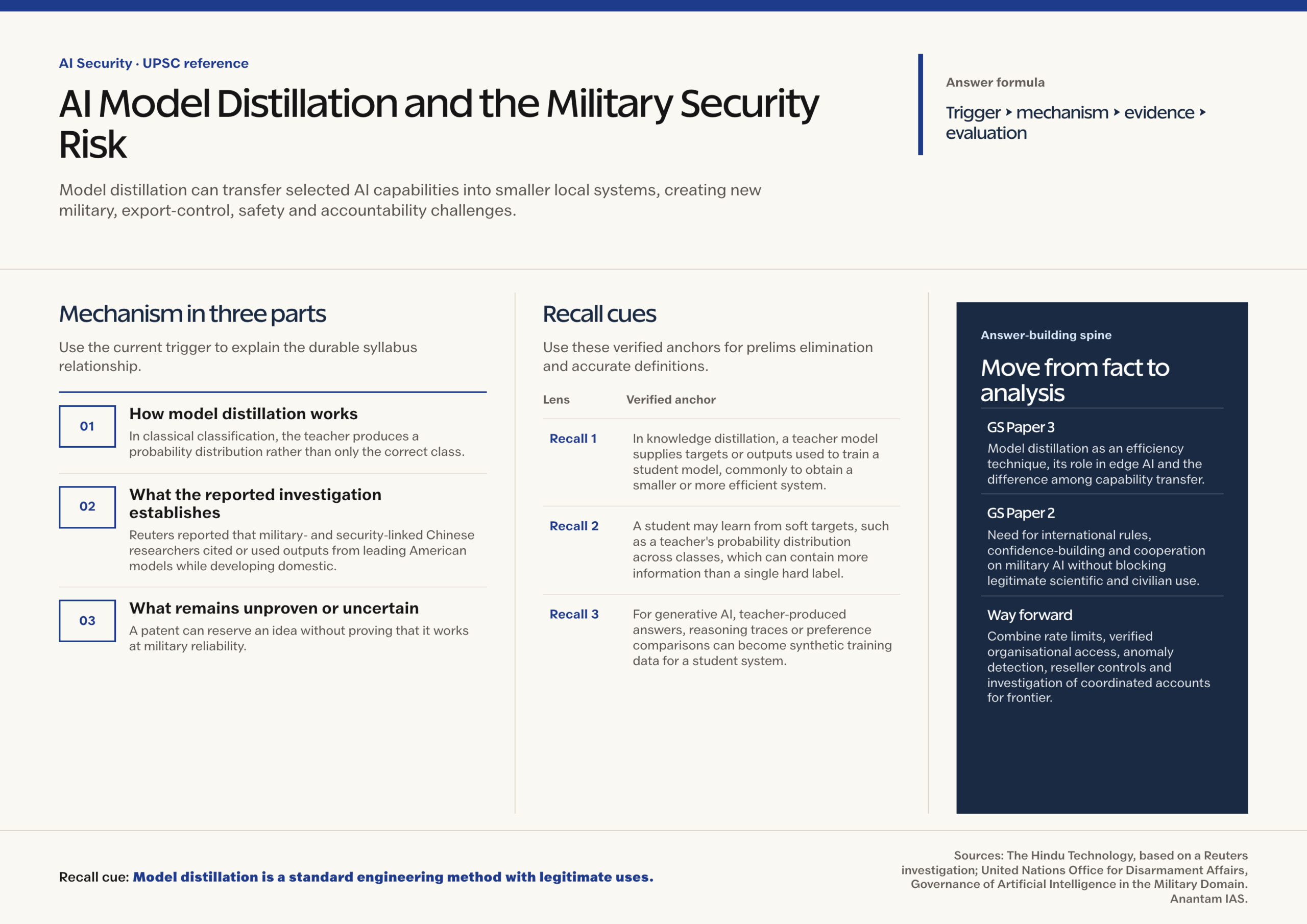
Background and Context
How model distillation works
Distillation is best understood as supervised capability transfer from a teacher to a student, not as pouring an entire model into a smaller container.
- In classical classification, the teacher produces a probability distribution rather than only the correct class. Those relative probabilities reveal which alternatives the teacher considers similar, giving the student a richer learning signal than a hard label.
- In generative systems, developers can query a capable teacher across a carefully designed prompt set, collect its answers and train a student on the resulting synthetic examples. Preference data and iterative feedback may be added.
- When the model owner conducts this process on its own system, it may use internal logits, hidden representations or controlled output sets. An external actor usually has only black-box access and must learn from repeated queries.
- The student is commonly smaller or more specialised. It may trade broad knowledge for lower latency, memory use and inference cost on a defined task such as image recognition, language translation or code analysis.
What the reported investigation establishes
The investigation provides documentary evidence of a research pattern, but each claim must remain tied to what the underlying papers and patents actually show.
- Reuters reported that military- and security-linked Chinese researchers cited or used outputs from leading American models while developing domestic systems. Its review covered more than 80 papers and patents rather than relying on a single demonstration.
- The cited work reportedly spans language-model tasks and compact perception systems. This shows interest in transferring capability into locally controlled systems across more than one technical domain.
- A reported UAV example illustrates the operational attraction of compression: a smaller vision system may analyse sensor data on board, reducing latency and dependence on a communications link.
- The evidence supports the claim that military-linked research is exploring or applying distillation. It should not be stretched into a claim that a named frontier model directly controls weapons or that all reported prototypes are deployed.
What remains unproven or uncertain
Research papers, patents, prototypes and operational systems represent different levels of maturity.
- A patent can reserve an idea without proving that it works at military reliability. A paper can demonstrate performance on a benchmark without establishing resilience to deception, weather, electronic warfare or unfamiliar terrain.
- Public reporting does not reveal the complete query sets, training pipelines, evaluation results or deployment status for every case. It cannot quantify how much capability came from a foreign model rather than domestic data, open models.
- Distillation normally preserves selected performance, not full equivalence. A compact model can lose rare-case competence, calibrated uncertainty and refusal behaviour even while appearing strong on routine tasks.
- Military affiliation and military relevance are important indicators, but they do not by themselves show that a system was authorised for combat use. Analysis must keep capability, intent and deployment separate.
Why smaller local models matter to defence users
Military value often comes from reliable availability at the edge rather than from possessing the largest possible model.
- A local model can operate with lower bandwidth and without sending sensitive imagery, coordinates or intelligence questions to a foreign cloud service. This supports data control and operational security.
- Lower compute and energy requirements make deployment more feasible on unmanned aircraft, ground vehicles, ships, portable cyber systems and command posts with constrained power and hardware.
- Specialisation can improve speed on a narrow task, but it also creates brittleness. A model trained for a known sensor or threat profile may fail when an adversary changes camouflage, language, network behaviour or environmental conditions.
- The strategic effect is capability diffusion: actors that cannot train a frontier system from scratch may still acquire useful slices of its behaviour at lower cost.
Way Forward
Secure model access by risk
- Combine rate limits, verified organisational access, anomaly detection, reseller controls and investigation of coordinated accounts for frontier services.
- Create documented pathways for legitimate compression, research and safety evaluation so that enforcement has a clear boundary.
- Record provenance for prompts, teacher outputs, filters, human review, fine-tuning data and model versions.
- Test accuracy, calibration, robustness, cyber security and safety after every material distillation or update, not only before initial deployment.
Conclusion
- Model distillation is a standard engineering method with legitimate uses.
- The policy response must be equally precise.
UPSC Practice Questions
Prelims MCQ 1
With reference to knowledge distillation in artificial intelligence, consider the following statements:
- It commonly uses outputs from a teacher model as learning targets for a student model.
- It necessarily produces a student with the same parameter values as the teacher.
- It can be used to create a smaller model suited to resource-constrained devices.
How many of the above statements are correct?
(a) Only one (b) Only two (c) All three (d) None
Answer: (b) Only two
Explanation:
Statements 1 and 3 are correct. Distillation trains a student from signals supplied by a teacher and often improves deployment efficiency. It does not require copying the teacher’s parameter values, and the student may use a different size or architecture.
Prelims MCQ 2
Which one of the following best explains why model distillation can complicate controls centred only on advanced AI chips?
(a) It removes all need for computing hardware (b) It automatically reveals a teacher model’s source code (c) It can transfer selected behaviour through digital outputs into a smaller locally trained model (d) It guarantees that the student will pass every safety evaluation
Answer: (c) It can transfer selected behaviour through digital outputs into a smaller locally trained model
Explanation:
Distillation still requires data and compute, and it neither reveals source code automatically nor guarantees safety. Its control challenge is that useful behaviour can be learned from remotely obtained outputs even when access to frontier training hardware is constrained.
UPSC Mains Questions
- Explain model distillation and examine why it creates a regulatory gap between controls on advanced computing hardware and controls on digital AI capability.
- Military applications of distilled AI models illustrate both the value and danger of edge computing. Discuss with reference to reliability, accountability and meaningful human control.
Sources: The Hindu Technology, based on a Reuters investigation and United Nations Office for Disarmament Affairs, Governance of Artificial Intelligence in the Military Domain.
Frequently Asked Questions
What is model distillation?
Model distillation is a training method in which a student model learns from outputs or other signals produced by a teacher model. It is often used to create a smaller, cheaper or more specialised system. The student learns selected behaviour.
Is model distillation the same as stealing a model?
No. Distillation is a legitimate technique when the model owner authorises it or when licences permit the use. It becomes a security or contractual concern when actors use deceptive access, prohibited automated extraction or restricted outputs to imitate capabilities without.
Why is a distilled model useful for military systems?
A compact model can require less memory, power and bandwidth, allowing local processing on drones, vehicles or field devices. That can lower latency and reduce reliance on cloud connectivity. The same compactness does not guarantee robustness, safety or lawful use.
What did the reported Chinese research prove?
Reuters’ review reported a broad pattern of military- and security-linked researchers using or citing outputs from leading American AI systems in domestic defence-related research. It supports concern about capability transfer. It does not prove that every paper or patent became.
Can export controls on chips stop model distillation?
Chip controls can raise the cost of training and running large systems, but they do not by themselves prevent remote queries, synthetic-data collection or student training on less advanced local hardware. Providers and states need complementary controls covering accounts, cloud.
Tell Google you want more of this.
Add Anantam IAS as a preferred sourceOne tap, and this site shows up more often in your own Top Stories, AI Overviews and AI Mode. Remove it any time.