

Why in News?
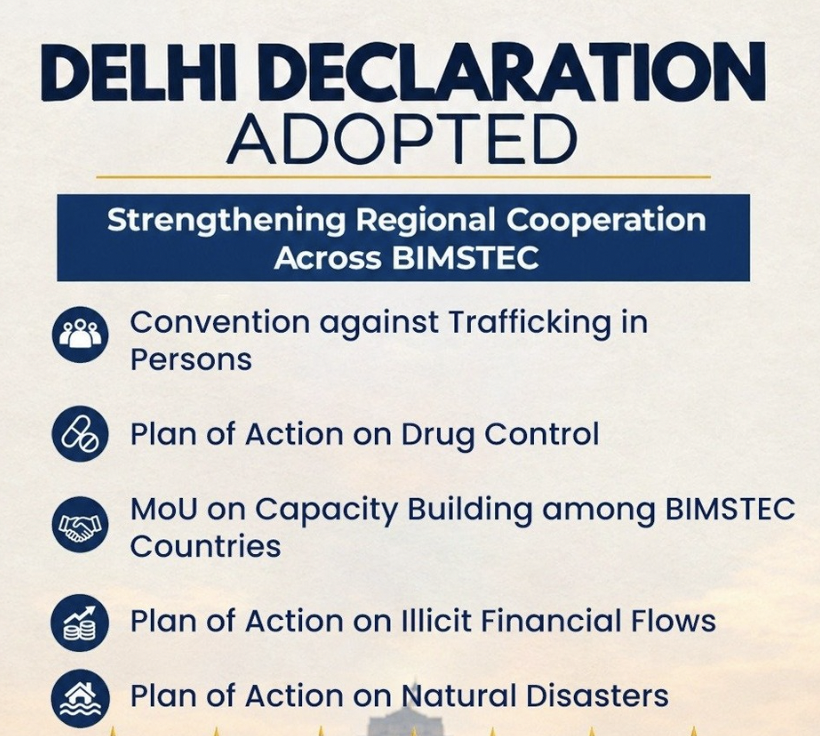
The First BIMSTEC Home Ministers’ Meeting concluded in New Delhi with the adoption of the Delhi Declaration. In the declaration, the BIMSTEC Nations have strongly condemned terrorism and violent extremism in all their forms and manifestations, including cross-border terrorism.
| UPSC Relevance: GS-2 International Relations: International Agreements, Regional groupings, Terrorism Prelims: About BIMSTEC, Delhi Declaration on Terrorism Mains: BIMSTEC: Key Achievements and Significance |
Key Features of the Delhi Declaration:
- Strong condemnation of Terrorism: The declaration condemns terrorism, including cross-border terrorism, and calls for implementation of relevant UN Security Council sanctions, including the 1267 sanctions regime. It also addresses terrorist financing, recruitment, radicalisation and misuse of emerging technologies.
- Shared Regional Security approach: It recognises that terrorism, trafficking, cybercrime and illicit finance cross national boundaries. Cooperation must respect sovereignty, territorial integrity and non-interference, while complementing existing arrangements.
- Protection of trafficking victims in scam centres: It recognises forced criminality, where trafficked persons are compelled to conduct online fraud. It seeks cooperation among origin, transit and destination countries through a victim-centred approach.
- Stronger legal cooperation: It seeks progress on extradition, transfer of sentenced persons and procedures for rescuing and reintegrating trafficking victims.
The Delhi Declaration also called for effective implementation of the finalised Plans of Action in areas of Human Trafficking, Narcotic Drugs and Precursor Chemicals and Anti-Money Laundering, as well as finalisation of the Plan of Action by the Sub-Group on Cooperation in Countering Radicalisation and Terrorism.
| The UN 1267 regime: The current 1267/1989/2253 Committee oversees sanctions against ISIL/Da’esh, Al-Qaida and associated listed individuals and entities. |
About Bay of Bengal Initiative for Multi-Sectoral Technical and Economic Cooperation (BIMSTEC):
The Bay of Bengal Initiative for Multi-Sectoral Technical and Economic Cooperation (BIMSTEC) has emerged as an important bridge between South and Southeast Asia.
Genesis and Evolution:
- Origin & Establishment: 1997 through the Bangkok Declaration as BIST-EC (Bangladesh, India, Sri Lanka, and Thailand Economic Cooperation). Renamed BIMST-EC upon Myanmar’s accession in 1997, and renamed BIMSTEC in 2004 following the entry of Nepal and Bhutan.
- Members: BIMSTEC constitutes a unique link between South and South-East Asia with:
- 5 members from South Asia (Bangladesh, Bhutan, India, Nepal and Sri Lanka)
- 2 from South-East Asia (Myanmar and Thailand).
- BIMSTEC Charter: Adopted at the 5th Summit (Colombo 2022); entered into force in 2024, conferring international legal standing and the capacity to conclude external partnerships.
- 6th Summit (Bangkok, 2025): The summit adopted the organisation’s first long-term vision: Bangkok Vision 2030 under the theme “Prosperous, Resilient and Open BIMSTEC”, endorsed the Agreement on Maritime Transport Cooperation, and established standardised Rules of Procedure.
- Headquarters: Dhaka, Bangladesh
Socio-Demographic and Economic Footprint:
- Population: ~1.8 billion people (~22% of the global population).
- Economic Footprint: Combined GDP of ~$4.5 trillion.
- Geopolitical Role: Serves as a primary littoral bridge between South Asia, Southeast Asia, and the broader Indian Ocean region.
Core Objectives:
- Accelerate regional economic growth, trade integration, and multidimensional connectivity.
- Enhance joint capabilities in counterterrorism, maritime security, and disaster management.
- Promote sustainable resource usage across the Bay of Bengal, focusing on climate resilience and the blue economy.
The BIMSTEC nations also reaffirmed the principle that cooperation within BIMSTEC in the security sector is based on respect for the principle of sovereign equality, territorial integrity, political independence, non-interference in internal affairs, non-aggression, peaceful coexistence, and mutual respect.
Tell Google you want more of this.
Add Anantam IAS as a preferred sourceOne tap, and this site shows up more often in your own Top Stories, AI Overviews and AI Mode. Remove it any time.






