Why in News?
Kerala has reported a rise in cases of infection caused by the Brain-eating amoeba, also known as Naegleria fowleri. According to recent reports, the state recorded over 90 confirmed cases and several deaths between January and April 2026.
| UPSC Relevance: GS-3 Science and Technology: Biology and Biotechnology, Health Prelims: Naegleria fowleri, Primary Amoebic Meningoencephalitis, Amoeba |
What is Naegleria fowleri?
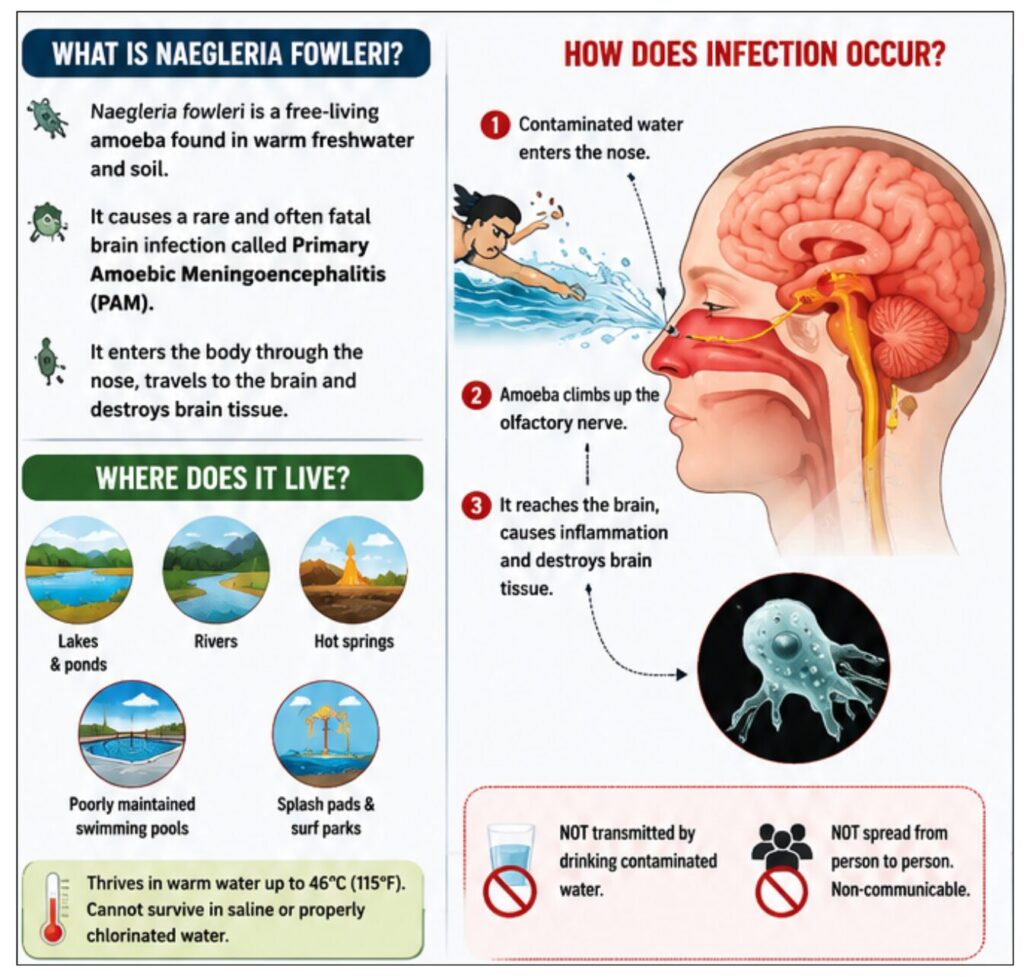
- Naegleria fowleri is a free-living, single-celled amoeba found mainly in warm freshwater bodies and moist soil.
- It causes a rare but highly fatal brain infection known as Primary Amoebic Meningoencephalitis.
- The amoeba is commonly found in:
- Warm freshwater lakes and ponds
- Rivers and hot springs
- Poorly maintained swimming pools
- Splash pads and surf parks with inadequate chlorination
- Contaminated water storage systems
- It thrives particularly in temperatures up to around 46°C.
How does the infection occur?
- The infection occurs when contaminated water enters the nose during swimming or diving, bathing, water sports, or nasal cleansing using contaminated water.
- The amoeba then travels through the olfactory nerve to the brain, where it destroys brain tissue and causes severe inflammation.
- The infection does not occur from drinking contaminated water. PAM is non-communicable and does not spread from person to person.
Primary Amoebic Meningoencephalitis (PAM):
- Initial symptoms resemble meningitis and include severe headache, fever, nausea and vomiting. As the disease progresses, the patient may have a stiff neck and experience confusion, seizures, hallucinations and slip into a state of coma.
- PAM has an extremely high fatality rate, often exceeding 95%. Death usually occurs within 1-18 days after symptoms begin.
- No effective treatment for the disease has been identified yet. At present, it is treated with a combination of drugs.
What is Amoeba?
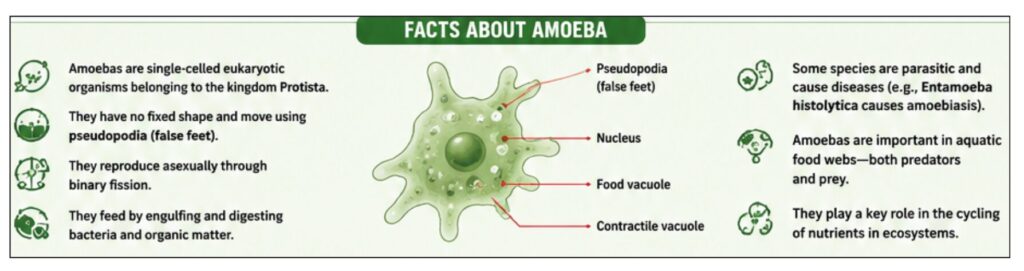
- Amoebas are single-celled eukaryotic organisms. They are found in a variety of aquatic and moist environments.
- Characteristics:
- Possesses no fixed shape
- Move using pseudopodia (false feet)
- Reproduces mainly through binary fission
- Feed by engulfing food particles (phagocytosis)
- Ecological Importance:
- Important components of aquatic food chains
- Help in nutrient recycling
- Act as predators of bacteria and microorganisms
- Disease-causing Amoebae:
- Entamoeba histolytica: Amoebiasis
- Naegleria fowleri: PAM
- Acanthamoeba: Keratitis and Encephalitis
Practice MCQ:
Q. With reference to Primary Amoebic Meningoencephalitis (PAM), consider the following statements:
1. PAM is caused by a free-living amoeba called Naegleria fowleri.
2. Humans can get infected by drinking water contaminated with the amoeba.
3. The amoeba generally enters the human body through the nose.
4. PAM can spread from person to person.
Which of the statements given above are correct?
(a) 1 and 2 only
(b) 1 and 3 only
(c) 2 and 4 only
(d) 1, 3 and 4 only
Answer: (b)
UPSC PYQ 2017
Q. Consider the following statements:
1. In tropical regions, Zika virus disease is transmitted by the same mosquito that transmits dengue.
2. Sexual transmission of Zika virus disease is possible.
Which of the statements given above is/are correct?
(a) 1 only
(b) 2 only
(c) Both 1 and 2
(d) Neither 1 nor 2
Answer: (c)
Tell Google you want more of this.
Add Anantam IAS as a preferred sourceOne tap, and this site shows up more often in your own Top Stories, AI Overviews and AI Mode. Remove it any time.