Why in News?
On 28 August 2026, the Ministry of Defence announced a simplified defence-export SOP and a unified, expanded Open General Export Licence framework.
- Stakeholder consultation is no longer required for non-lethal defence exports to most destinations, while safeguards continue for sensitive countries.
- Consultation has also been removed for exports of all items meant for international tenders and exhibitions.
- Three separate OGEL procedures have been merged into one unified SOP covering platforms, components and intra-company technology transfer.
- The normal OGEL validity has increased from two years to three years, reducing renewal frequency.
- Geographical coverage now extends beyond the earlier 41-country list, excluding negative or sensitive countries and countries under UN Security Council sanctions or arms embargoes.
- The reform separates low-risk, repeat transactions from cases needing closer scrutiny, illustrating risk-based regulation rather than blanket deregulation.
- Faster authorization can help exporters respond to tenders, exhibitions and recurring orders without seeking an identical approval for every eligible consignment.
- The continuing restrictions show that export promotion must remain compatible with national security, end-use concerns and international obligations.
UPSC Relevance
Prelims Relevance
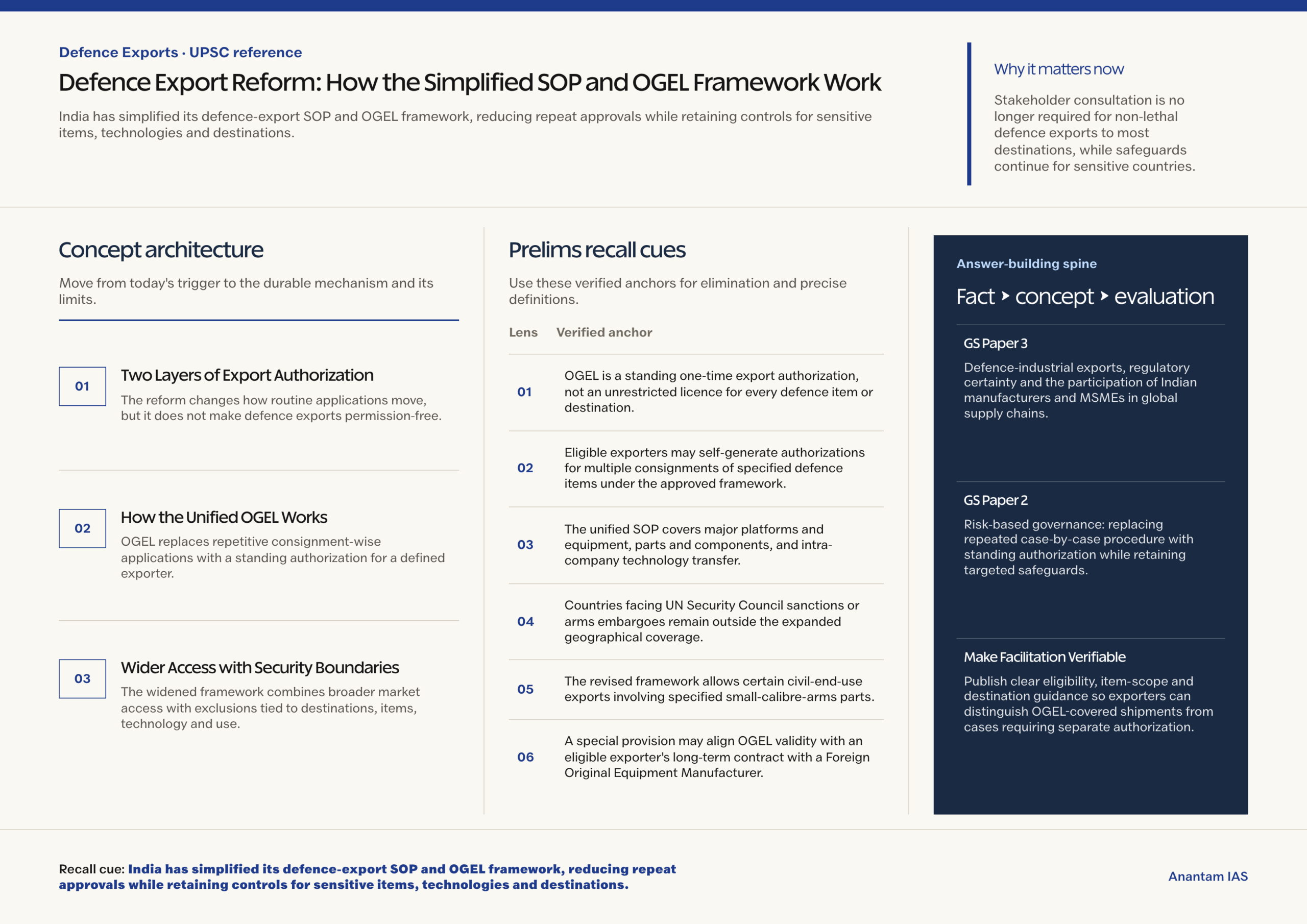
- OGEL is a standing one-time export authorization, not an unrestricted licence for every defence item or destination.
- Eligible exporters may self-generate authorizations for multiple consignments of specified defence items under the approved framework.
- The unified SOP covers major platforms and equipment, parts and components, and intra-company technology transfer.
- Countries facing UN Security Council sanctions or arms embargoes remain outside the expanded geographical coverage.
- The revised framework allows certain civil-end-use exports involving specified small-calibre-arms parts, components and protective equipment.
- A special provision may align OGEL validity with an eligible exporter’s long-term contract with a Foreign Original Equipment Manufacturer, subject to conditions.
Mains Relevance
GS Paper 3
- Defence-industrial exports, regulatory certainty and the participation of Indian manufacturers and MSMEs in global supply chains.
- Balancing faster trade facilitation with controls over sensitive items, technologies, destinations and end use.
GS Paper 2
- Risk-based governance: replacing repeated case-by-case procedure with standing authorization while retaining targeted safeguards.
Essay
- Good regulation does not remove every gate; it places closer scrutiny where the public risk is highest.
Background and Context
Two Layers of Export Authorization
The reform changes how routine applications move, but it does not make defence exports permission-free.
- The Defence Export SOP governs procedural handling, including when authorities seek views from relevant stakeholders before permitting an export and when that consultation may be dispensed with.
- Removing consultation for non-lethal items to most destinations reduces a recurring procedural stage where the proposed item-destination combination carries lower stated sensitivity.
- The exception for sensitive countries preserves differentiated scrutiny; the relaxation is based on destination risk rather than an identical rule for every market.
- For international tenders and exhibitions, consultation is removed across item categories so companies can pursue or display opportunities without that preliminary procedural wait.
- These relaxations concern the consultation step. They should not be read as an official statement that every exporter, item, destination or end use is automatically approved.
How the Unified OGEL Works
OGEL replaces repetitive consignment-wise applications with a standing authorization for a defined exporter, scope and period.
- An eligible exporter receives a one-time standing authorization and can self-generate export authorizations for multiple consignments of specified defence items under the approved licence and prescribed conditions.
- The benefit is procedural continuity: repeat eligible shipments need not begin a separate authorization process each time, provided the exporter, items, destinations and transactions remain within the approved scope.
- A single unified SOP now replaces three procedures for platforms and equipment, parts and components, and intra-company transfers of technology.
- The standard licence lasts three years instead of two, reducing renewal frequency without converting the authorization into a permanent or open-ended permission.
- For eligible long-term arrangements with a Foreign Original Equipment Manufacturer, validity may match the underlying contract, subject to prescribed conditions and approved items.
Wider Access with Security Boundaries
The widened framework combines broader market access with exclusions tied to destinations, items, technology and use.
- Country coverage expands from 41 countries to a wider default, but negative and sensitive nations remain excluded from this facilitative route.
- Countries subject to UN Security Council sanctions or arms embargoes are also excluded, linking domestic facilitation to international security restrictions.
- Item coverage is broader, yet the PIB formulation still refers to eligible or specified items; OGEL is not a general permission for the entire defence catalogue.
- Specified parts and components of small-calibre arms and protective equipment may use the framework for civil end use, illustrating how end use can shape regulatory treatment.
- The design combines speed for repeat, lower-risk transactions with retained controls over sensitive items, technologies and destinations where diversion, unauthorized transfer or misuse demands greater scrutiny.
Way Forward
Make Facilitation Verifiable
- Publish clear eligibility, item-scope and destination guidance so exporters can distinguish OGEL-covered shipments from cases requiring separate authorization.
- Use proportionate end-use documentation and post-export records to preserve traceability without rebuilding the same approval file for every consignment.
- Review negative and sensitive-country controls regularly against security assessments and applicable UN Security Council measures.
- Track processing time, renewal burden and compliance failures to test whether simplification improves legitimate exports without weakening safeguards.
Conclusion
- The reform is best understood as risk-based authorization: a standing route for eligible repeat exports, with targeted scrutiny retained for sensitive destinations, technologies, items and uses.
- In a Mains answer, connect administrative simplification to export competitiveness, then evaluate it against traceability, end-use assurance and India’s international security obligations.
- Do not confuse export licensing with defence indigenisation; one regulates outward transfers, while the other concerns domestic production and import dependence.
UPSC Practice Questions
Prelims MCQ 1
With reference to India’s revised Open General Export Licence framework for defence items, consider the following statements:
- It enables eligible exporters to self-generate authorizations for multiple consignments of specified defence items.
- Its normal validity has been increased from two years to three years.
- It covers countries facing United Nations Security Council arms embargoes.
How many of the above statements are correct?
(a) Only one (b) Only two (c) All three (d) None
Answer: (b) Only two
Explanation:
Statements 1 and 2 are correct. Countries under UN Security Council sanctions or arms embargoes are excluded from the expanded geographical coverage.
Prelims MCQ 2
What is the principal procedural feature of an Open General Export Licence in the revised defence-export framework?
(a) It abolishes controls over all defence exports (b) It permits exports only for international exhibitions (c) It provides a standing authorization for multiple eligible consignments (d) It transfers licensing authority to foreign manufacturers
Answer: (c) It provides a standing authorization for multiple eligible consignments
Explanation:
OGEL is a one-time standing authorization under which eligible exporters can self-generate authorizations for multiple consignments of specified defence items.
UPSC Mains Questions
- Explain how the simplified defence-export SOP and OGEL framework applies risk-based regulation to balance export facilitation with national security safeguards.
- Faster defence-export authorization must be matched by strong destination and end-use controls. Discuss in the context of India’s revised OGEL framework.
Source: PIB, Ministry of Defence.
Frequently Asked Questions
What is an Open General Export Licence in defence exports?
It is a standing one-time authorization allowing eligible exporters to self-generate authorizations for multiple consignments of specified defence items within an approved scope.
Does the revised OGEL permit exports to every country?
No. Its wider coverage excludes negative or sensitive nations and countries facing UN Security Council sanctions or arms embargoes.
What changed in the OGEL procedure?
Three separate procedures were unified, normal validity rose from two to three years, country and item coverage widened, and a long-term FOEM-contract provision was added.
What changed in the Defence Export SOP?
Stakeholder consultation was removed for non-lethal items to most destinations and for all items entering international tenders or exhibitions, while sensitive-country safeguards remain.
Why is the reform relevant for UPSC preparation?
It illustrates risk-based governance: lower repetitive compliance for eligible exports alongside continuing controls over sensitive destinations, items, technologies and end use.
Tell Google you want more of this.
Add Anantam IAS as a preferred sourceOne tap, and this site shows up more often in your own Top Stories, AI Overviews and AI Mode. Remove it any time.